Chindia Alert: You’ll be Living in their World Very Soon
aims to alert you to the threats and opportunities that China and India present. China and India require serious attention; case of ‘hidden dragon and crouching tiger’.
Without this attention, governments, businesses and, indeed, individuals may find themselves at a great disadvantage sooner rather than later.
The POSTs (front webpages) are mainly 'cuttings' from reliable sources, updated continuously.
The PAGEs (see Tabs, above) attempt to make the information more meaningful by putting some structure to the information we have researched and assembled since 2006.
China will not set an economic growth goal for this year as it deals with the fallout from the coronavirus pandemic.
It is the first time Beijing has not had a gross domestic product (GDP) target since 1990 when records began.
The announcement was made by Premier Li Keqiang at the start of the country’s annual parliament meeting.
The world’s second largest economy shrank by 6.8% in the first quarter from a year ago as lockdowns paralysed businesses.
“This is because our country will face some factors that are difficult to predict in its development due to the great uncertainty regarding the Covid-19 pandemic and the world economic and trade environment,” Premier Li said.
The country’s leadership has promised to boost economic support measures amid growing concerns that rising unemployment could threaten social stability.
The move comes as tensions between Beijing and Washington are becoming increasingly strained over the coronavirus pandemic, trade and Hong Kong.
On Thursday, President Donald Trump stepped up his attacks on China, suggesting that the country’s leader, Xi Jinping, is behind a “disinformation and propaganda attack on the United States and Europe.”
It came as Mr Trump and other Republicans have escalated their criticism of Beijing’s handling of the early stages of the outbreak.
Also on Thursday, China announced plans to impose new national security legislation on Hong Kong after last year’s pro-democracy protests.
The announcement was met with a warning from Mr Trump that the US would react “very strongly” against any attempt to gain more control over the former British colony.
Separately, two US senators have proposed legislation to punish Chinese entities involved in enforcing the planned new laws and penalise banks that do business with them.
Earlier this week, the US Senate unanimously passed a proposal to delist Chinese companies from American stock exchanges if they fail to comply with US financial reporting standards.
US-listed Chinese companies have come under increasing scrutiny in recent weeks after Luckin Coffee revealed that an internal investigation found hundreds of millions of dollars of its sales last year were “fabricated”.
BEIJING/SHANGHAI (Reuters) – China’s biggest listed banks posted higher profits in the first quarter despite the wider impact of the coronavirus pandemic on the economy, though margins shrank.
The world’s largest commercial lender Industrial and Commercial Bank of China Ltd (ICBC) (601398.SS)(1398.HK) on Tuesday reported a 3.04% rise in first quarter net profit compared to a year earlier, while Bank of Communications Co Ltd (BoCom) (601328.SS)(3328.HK) reported a 1.8% rise.
Meanwhile at Agricultural Bank of China Ltd (AgBank) (1288.HK)(601288.SS) and China Construction Bank Ltd (CCB) (601939.SS)(0939.HK), first quarter net profit rose 4.79% and 5% respectively from the same period last year.
Following suit, Bank of China Ltd (BOC) (601988.SS) (3988.HK) posted on Wednesday a 3.17% rise in first-quarter net profit.
The growth came despite China’s economy posting the first quarterly contraction since at least 1992 due to the coronavirus pandemic. The government restricted people from travelling and going back to work to contain the spread of the virus, reducing revenue for companies and income for residents.
China’s largest banks are historically more resilient than their smaller kin, as they lend more to state-backed enterprises and have larger capital reserves.
However, despite this firmer base, net interest margins shrank at four of the five lenders, as loan prime rate reform and looser monetary policy weighed, said analysts.
AgBank did not report its net interest margin, the difference between what banks pay on deposits and earn on loans.
SOURED DEBT
ICBC, AgBank and CCB bucked the trend of the wider banking sector by posting steady non-performing loan (NPL) ratios.
The banking sector’s NPL ratio climbed in the first quarter to 2.04%, the banking and insurance regulator said, the highest level since the global financial crisis.
The rise came despite Chinese regulators moving to give banks leeway, allowing them to postpone some loan repayments until the end of June, as credit card and mortgage defaults surged.
About one-third of Chinese bank loans are to sectors including transport and retail that are significantly stressed by the pandemic, according to S&P Global.
“You can see generally from banks’ results that some lenders have reported falling asset quality, the NPL ratios have risen quite a lot,” said Richard Cao, an analyst at Guotai Junan International on Monday.
The largest banks are best placed to absorb such losses with a better ability to get financing and withstand a substantial volume of bad loans, S&P said in a research note in April.
BEIJING (Reuters) – China’s factory activity likely rose for a second straight month in April as more businesses re-opened from strict lockdowns implemented to contain the coronavirus outbreak, which has now paralysed the global economy.
The official manufacturing Purchasing Manager’s Index (PMI), due for release on Thursday, is forecast to fall to 51 in April, from 52 in March, according to the median forecast of 32 economists polled by Reuters. A reading above the 50-point mark indicates an expansion in activity.
While the forecast PMI would show a slight moderation in China’s factory activity growth, it would be a stark contrast to recent PMIs in other economies, which plummeted to previously unimaginable lows.
That global slump, caused by heavy government-ordered lockdowns, as well as the cautious resumption of business in China, suggests any recovery in the world’s second-largest economy is likely to be some way off.
“The recovery so far has been led by a bounce-back in production, however, the growth bottleneck has decisively shifted to the demand side, as global growth has weakened and consumption recovery has lagged amid continued social distancing,” Morgan Stanley said in a note.
“The expected slump in external demand has likely capped further recovery in industrial production.”
The latest official data showed 84% of mid-sized and small business had reopened as of April 15, compared with 71.7% on March 24.
Hobbled by the coronavirus, China’s economy shrank 6.8% in the first quarter from a year earlier, the first contraction since current quarterly records began.
That has left Chinese manufacturers with reduced export orders and a logistics logjam, as many exporters grapple with rising inventory, high costs and falling profits. Some have let workers go as part of the cost-cutting efforts.
A China-based brokerage Zhongtai Securities estimated that the country’s real unemployment rate, measured using international standards, could exceed 20%, equal to more than 70 million job losses and much higher than March’s official reading of 5.9%.
Sheng Laiyun, deputy head at the statistics bureau, said on Sunday migrant workers and college graduates are facing increasing pressures to secure jobs, while official jobless surveys show nearly 20% of employed workers not working in March.
Chinese authorities have rolled out more support to revive the economy. The People’s Bank of China earlier in April cut the amount of cash banks must hold as reserves and reduced the interest rate on lenders’ excess reserves.
Image copyright GETTY IMAGESImage caption The Chinese city of Wuhan recently lifted its strict quarantine measures
The Chinese city of Wuhan, where the coronavirus originated last year, has raised its official Covid-19 death toll by 50%, adding 1,290 fatalities.
Wuhan officials attributed the new figure to updated reporting and deaths outside hospitals. China has insisted there was no cover-up.
It has been accused of downplaying the severity of its virus outbreak.
Wuhan’s 11 million residents spent months in strict lockdown conditions, which have only recently been eased.
The latest official figures bring the death toll in the city in China’s central Hubei province to 3,869, increasing the national total to more than 4,600.
China has confirmed nearly 84,000 coronavirus infections, the seventh-highest globally, according to Johns Hopkins University data.
What’s China’s explanation for the rise in deaths?
In a statement released on Friday, officials in Wuhan said the revised figures were the result of new data received from multiple sources, including records kept by funeral homes and prisons.
Deaths linked to the virus outside hospitals, such as people who died at home, had not previously been recorded.
Media caption Learn how Wuhan dealt with the lockdown
The “statistical verification” followed efforts by authorities to “ensure that information on the city’s Covid-19 epidemic is open, transparent and the data [is] accurate”, the statement said.
It added that health systems were initially overwhelmed and cases were “mistakenly reported” – in some instances counted more than once and in others missed entirely.
A shortage of testing capacity in the early stages meant that many infected patients were not accounted for, it said.
A spokesman for China’s National Health Commission, Mi Feng, said the new death count came from a “comprehensive review” of epidemic data.
In its daily news conference, the foreign ministry said accusations of a cover-up, which have been made most stridently on the world stage by US President Donald Trump, were unsubstantiated. “We’ll never allow any concealment,” a spokesman said.
Why are there concerns over China’s figures?
Friday’s revised figures come amid growing international concern that deaths in China have been under-reported. Questions have also been raised about Beijing’s handling of the epidemic, particularly in its early stages.
In December 2019, Chinese authorities launched an investigation into a mysterious viral pneumonia after cases began circulating in Wuhan.
China reported the cases to the World Health Organization (WHO), the UN’s global health agency, on 31 December.
But WHO experts were only allowed to visit China and investigate the outbreak on 10 February, by which time the country had more than 40,000 cases.
The mayor of Wuhan has previously admitted there was a lack of action between the start of January – when about 100 cases had been confirmed – and 23 January, when city-wide restrictions were enacted.
Around that time, a doctor who tried to warn his colleagues about an outbreak of a Sars-like virus was silenced by the authorities. Dr Li Wenliang later died from Covid-19.
Wuhan’s death toll increase of almost exactly 50% has left some analysts wondering if this is all a bit too neat.
For months questions have been asked about the veracity of China’s official coronavirus statistics.
The inference has been that some Chinese officials may have deliberately under-reported deaths and infections to give the impression that cities and towns were successfully managing the emergency.
If that was the case, Chinese officials were not to know just how bad this crisis would get in other countries, making its own figures now seem implausibly small.
The authorities in Wuhan, where the first cluster of this disease was reported, said there had been no deliberate misrepresentation of data, rather that a stabilisation in the emergency had allowed them time to revisit the reported cases and to add any previously missed.
That the new death toll was released at the same time as a press conference announcing a total collapse in China’s economic growth figures has led some to wonder whether this was a deliberate attempt to bury one or other of these stories.
Then again, it could also be a complete coincidence.
China has been pushing back against US suggestions that the coronavirus came from a laboratory studying infectious diseases in Wuhan, the BBC’s Barbara Plett Usher in Washington DC reports.
US President Donald Trump and some of his officials have been flirting with the outlier theory in the midst of a propaganda war with China over the origin and handling of the pandemic, our correspondent says.
Mr Trump this week halted funding for the World Health Organization (WHO), accusing it of making deadly mistakes and overly trusting China.
“Do you really believe those numbers in this vast country called China, and that they have a certain number of cases and a certain number of deaths; does anybody really believe that?” Mr Trump said at the White House on Wednesday.
On Thursday, UK Foreign Secretary Dominic Raab said: “We’ll have to ask the hard questions about how [coronavirus] came about and how it couldn’t have been stopped earlier.”
But China has also been praised for its handling of the crisis and the unprecedented restrictions that it instituted to slow the spread of the virus.


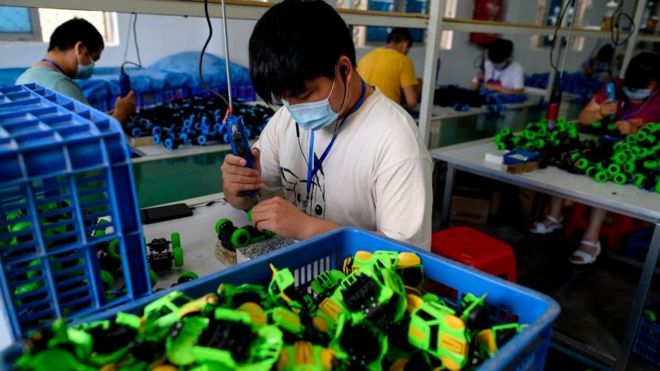 Image copyright GETTY IMAGES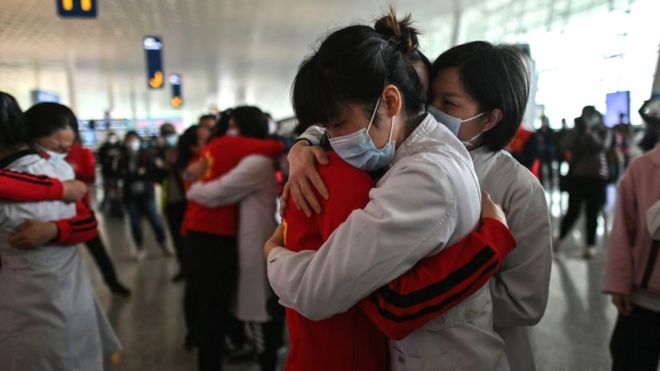





 CHINDIA ALERT: You'll be living in their world, very soon