31/07/2019
- China’s Wang Yi and US’ Mike Pompeo at summit in Thailand to sell their visions of future for Southeast Asia
- Analysts expect pragmatism from Asean as world’s two biggest economic powers play diplomatic game
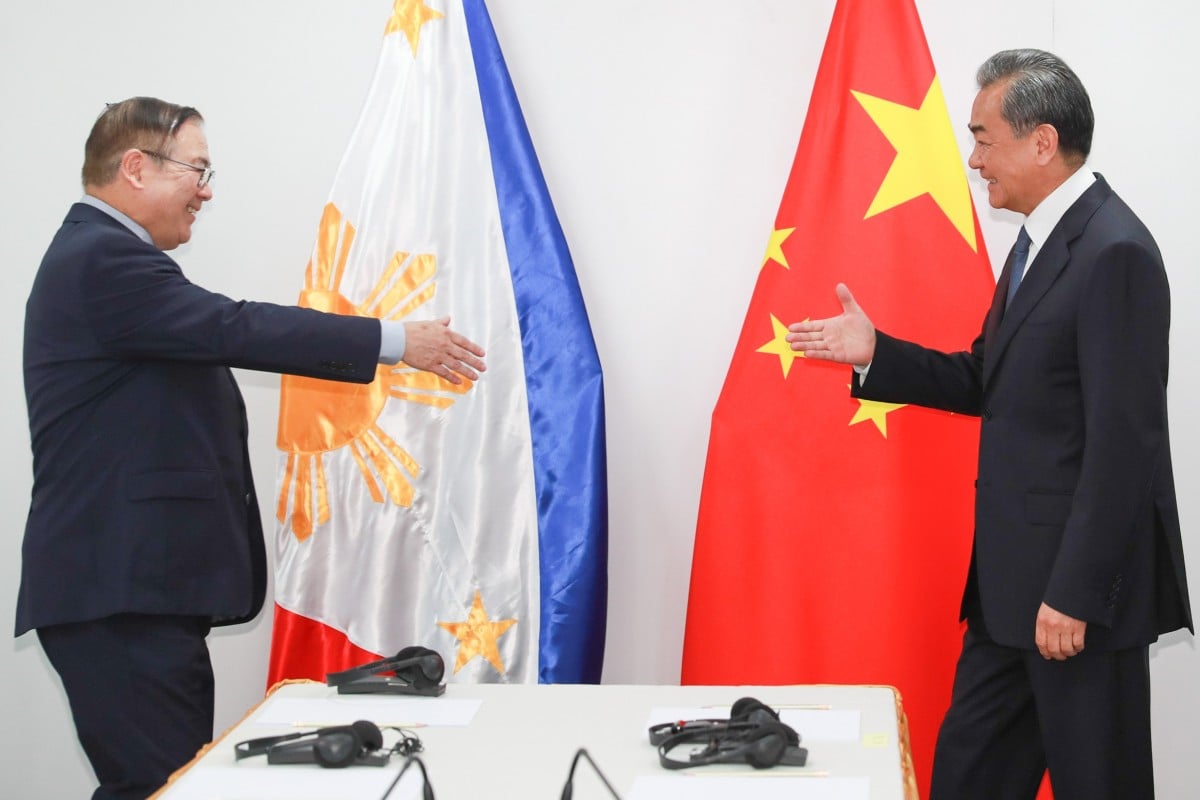
Chinese Foreign Minister Wang Yi (right) greets his Philippine counterpart Teodoro Locsin at the Asean meeting in Bangkok, Thailand. Photo: Xinhua
China and the United States are on a mission to strengthen ties with allies and expand their influence in Southeast Asia this week as their trade war enters a second year.
US Secretary of State Mike Pompeo arrived for a meeting of the Association of Southeast Asian Nations (Asean) in Bangkok on Wednesday to promote the US-led Indo-Pacific strategy, while Chinese Foreign Minister Wang Yi touched down a day earlier to advance Beijing’s Belt and Road Initiative.
The US Department of State said Pompeo’s trip was aimed at deepening Washington’s “long-standing alliances and vibrant bilateral relations with these countries, and [to] reaffirm our commitment to Asean, which is central to our vision for the Indo-Pacific region”.
In Beijing on Wednesday, Chinese foreign ministry spokeswoman Hua Chunying said that while their meeting was yet to be set, Wang and Pompeo were expected to meet and talk “frankly” about bilateral relations.
“I think that it is indeed necessary for China and the United States to maintain communication, as the two countries face many situations,” Hua said. “The issues would be communicated frankly”.
The Indo-Pacific strategy is a military and economic framework to contain China’s expansion into the Pacific and Indian oceans, and give an alternative to Beijing’s flagship belt and road development programme.
En route to Thailand, Pompeo said that after a stalled start to US Indo-Pacific policy during the Barack Obama administration, Washington’s strategy was well on its way to bearing fruit for the US and its allies.
South China Sea tensions, US-China trade war loom over Asean summit
“We have watched these coalitions build out,” he said.
Pompeo dismissed claims that China’s sphere of influence among Asean members was growing, saying such speculation was “not factually accurate”.
“[Asean countries] are looking for partners that are going to help them build out their economies and to take good care of their people,” he said, pledging greater engagement from President Donald Trump’s administration.
Pompeo was expected to sit down on Friday with his South Korean and Japanese counterparts to consolidate their trilateral alliance in the region.
He was also expected to hold talks with Thai Foreign Minister Don Pramudwinai that day.
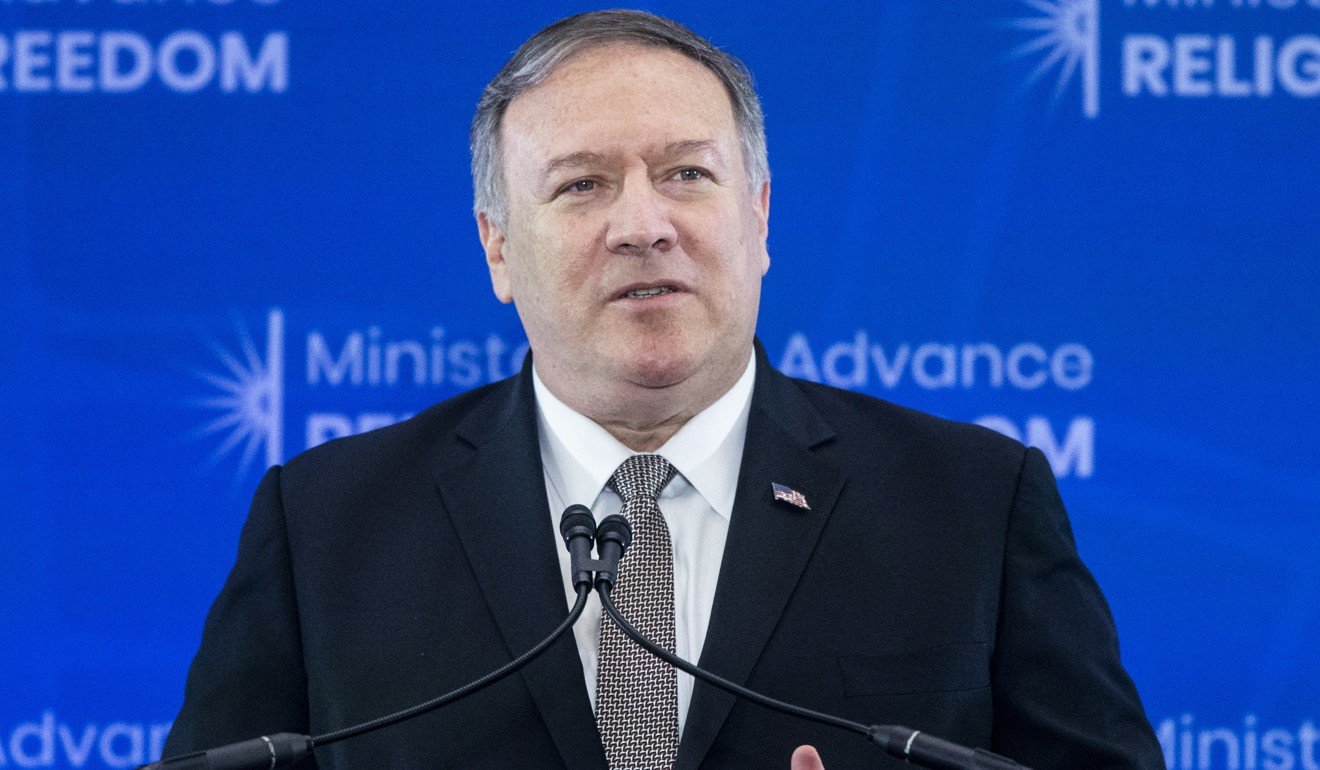
US Secretary of State Mike Pompeo is expected to meet Chinese Foreign Minister Wang Yi at Asean in Thailand. Photo: EPA-EFE
Meanwhile, Wang launched his belt and road pitch to his Cambodian, Philippine and Indonesian counterparts after he arrived in Thailand for the gathering, which ends on Saturday.
The belt and road projects are largely commercial and aimed at strengthening land and sea infrastructure linking Asia, Europe and Africa. But they raised suspicion in the West that they are aimed at eroding the US-led world order.
During his meeting with Philippine Foreign Affairs Secretary Teodoro Locsin, Wang said: “China is willing to have high-level exchanges with the Philippines, to deepen the mutual trust, and promote the Belt and Road Initiative [in the Philippines] … to accelerate the development of regional infrastructure.”
Can China’s trade boost with Asean help get the Regional Comprehensive Economic Partnership over the line?
This year’s Asean forum was taking place as countries were more receptive to Chinese initiatives, in part due to the unpredictability of the US administration, according to Rajeev Ranjan Charturvedy, a visiting fellow at the S. Rajaratnam School of International Studies at Nanyang Technological University in Singapore.
“Policy uncertainties under the Trump administration have already pushed some Asean countries towards China in ways that would have seemed unlikely a few years ago,” Charturvedy said.
Analysts said Trump’s “America first” approach shaped his Asean policy. The president had vowed to apply “punishments” to countries – including Asean member states – for contributing to the US trade deficit.
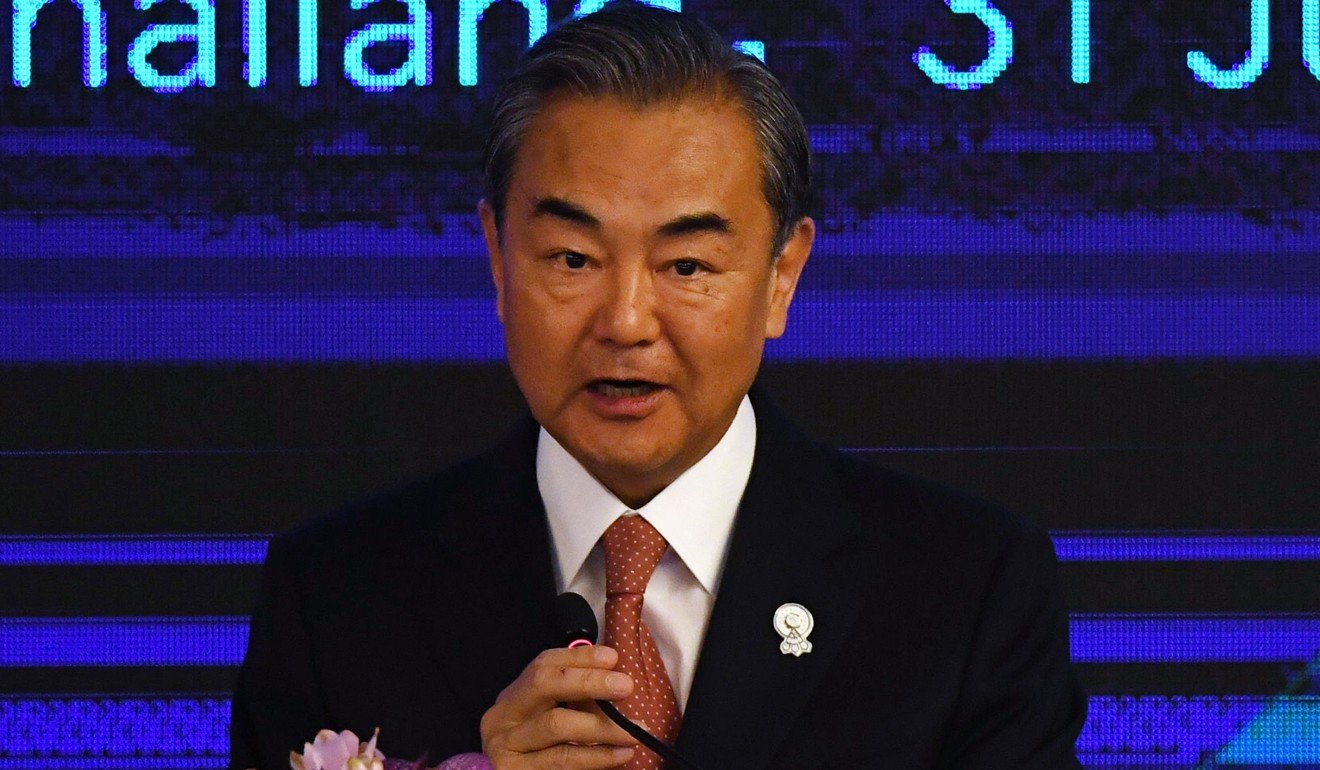
Chinese Foreign Minister Wang Yi is talking to Asean counterparts at a time when they are receptive to China’s proposals, an analyst says. Photo: AFP
Trump was absent at the Asean summit in Singapore last year, leading to concerns that Washington’s commitment to Asia was declining.
Charturvedy said the Asean forum’s focus was about building constructive regionalism, but China’s attitudes to security could pose a challenge.
“[However] Asean countries clearly hope not to be forced to choose between the US and Chinese offers. Rather, they would like more freedom of choice while accommodating for a larger role for China in the region,” he said.
Clarita Carlos, a professor of political science at the University of the Philippines, suggested that Asean members would be pragmatic during the forum.
Robert Lighthizer warns Vietnam over trade deficit with US
They would try to find their own balance between the two major powers – as countries rather than a bloc – to try to maximise each state’s interests and advantages, Carlos said.
“Vietnam has a love-hate relationship with China, especially as a winner in the ongoing US-China trade war,” she said. “Singapore has close relations with China. There are also ups and downs in the relationship with China for Brunei, Malaysia and Indonesia.”
Source: SCMP
Posted in africa, Asia, Association of Southeast Asian Nations (ASEAN), Bangkok, Barack Obama administration, Beijing, belt and road development programme, Belt and Road Initiative (BRI), belt and road projects, Brunei, Cambodian, China alert, China court Asean members, Chinese foreign minister Wang Yi, diplomatic game, Don Pramudwinai, enters second year, Europe, Indo-Pacific strategy, Indonesia, Indonesian, land infrastructure, Malaysia, Mike Pompeo, Philippine, Philippine Foreign Affairs Secretary, pragmatism, President Donald Trump, Regional Comprehensive Economic Partnership, Regional Comprehensive Economic Partnership (RCEP), S. Rajaratnam School of International Studies, sea infrastructure, Singapore, Singapore’s Nanyang Technological University, Southeast Asia, strengthen Indo-Pacific ties, summit, Teodoro Locsin, Thai Foreign Minister, Thailand, trade war, Trump administration, Uncategorized, United States, University of the Philippines, US court Asean members, visions of future, Washington |
Leave a Comment »
10/07/2019
BEIJING (Reuters) – China’s producer prices flatlined in June on lower oil prices and weak global demand, fuelling concerns that a slowdown in manufacturing from a bruising trade war will further drag on growth in the world’s second-biggest economy.
The producer price index (PPI) showed no growth in June from a year earlier, the National Bureau of Statistics (NBS) said on Wednesday. That compared with a 0.6% rise in May and a gain of 0.3% forecast by economists in a Reuters poll.
The June PPI reading was the lowest since August 2016 when the index last fell year-on-year. Factory gate prices slowed from May as well, falling 0.3%.
On the other hand, June consumer price growth in annual terms matched a 15-month high seen in May as supply shortages triggered by the African swine fever outbreak and extreme weather conditions continued to push up pork and fruit prices.
A cooling in producer prices, seen as a gauge of industrial demand that gives momentum to investment and profits in the Chinese economy, may rekindle worries about deflation and prompt the authorities to launch more aggressive stimulus.
“The bigger picture is inflation, apart from food inflation, is actually pretty weak and with the economy continuing to cool, I think the return to factory-gate deflation is very likely,” said Julian Evans-Pritchard, senior China economist at Capital Economics.
Tommy Xie, China economist at OCBC Bank in Singapore, also said he saw the risk of produce prices contracting in annual terms as early as next month.
Upstream sectors were particularly weak, with prices for oil and natural gas extraction down 1.8% from a year earlier, the NBS data showed. Price gains in the coal mining sector also eased.
Although Beijing and Washington reached another truce in their trade war last month, economists expect continuing pressure on the Chinese economy as manufacturers shift more production abroad to avoid U.S. tariffs on China-made goods.
China’s factory activity shrank more than expected in June as tariffs and weaker domestic demand hit new orders for goods.
Beijing is fast-tracking more infrastructure projects but prices for some construction materials remain lacklustre.
Spot prices for steel rebar in June lingered below the levels of a year earlier and may worsen due to seasonal slackening of construction activity amid high temperatures and rainfall in summer.
Premier Li Keqiang pledged earlier this month to implement financing tools including reserve requirement ratio (RRR) cuts to support small and private firms, adding to expectations for further stimulus measures.
At the same time, however, he and other top policymakers have reiterated that China will not resort to large-scale stimulus.
Evans-Pritchard from Capital Economics said the government could adopt more monetary easing and off-budget fiscal support to bolster the economy.
“But I think the days of big drastic stimulus are probably over. The most we can hope for is really it (more government support) helps to dampen the headwinds and prevent the economy from slowing too sharply.”
CPI STILL ELEVATED
The consumer price index (CPI) in June rose 2.7% in annual terms, driven by higher food prices. Fruit prices surged 42.7% from a year earlier while pork prices rose 21.1%.
Analysts polled by Reuters expected consumer prices to rise 2.7%, matching the pace seen in May.
Some economists said consumer inflation may accelerate due to dwindling pig stocks, but others contended price rises will cool.
“CPI may have peaked in June and could come off steadily in the second half,” said Wang Jun, Beijing-based chief economist at Zhongyuan Bank. “There are deflationary risks but the overall pressure is not big, because deflationary risk is only restricted to manufacturing products.”
Core inflation that strips out volatile food and energy prices was at 1.6% in June from a year earlier, the same annual pace as in May.
On a month-on-month basis, CPI fell 0.1% in June after no change in May.
Source: Reuters
Posted in Beijing, Capital Economics, consumer price index (CPI), deflation worries, Fuel, National Bureau of Statistics (NBS), OCBC Bank, Premier Li Keqiang, producer price index (PPI), producer prices, reserve requirement ratio (RRR), Singapore, stall, U.S. tariffs, Uncategorized, Washington, Zhongyuan Bank |
Leave a Comment »
04/07/2019
- China’s talent is turning away from multinationals and towards domestic tech champions in the search for a more fulfilling career
- Change in sentiment comes amid raging US-China tech war and perceptions of ‘bamboo ceiling’ in the West
An increasing number of Chinese jobseekers are looking towards domestic tech firms. Image: SCMP
Molly Liu left her hometown Beijing to pursue a master’s degree in the United States in the 1990s.
After graduation, she fought hard to win an entry-level position at a US-based consultancy and after a period was later sent back to China to help the company’s expansion.
In the land of opportunity, the ambitious US firm showered her with avenues to pursue her career and she ended up working in Hong Kong as well as being one of the first people on the ground for the consultancy in Shanghai, Beijing, Taipei and Singapore.
Times have changed, though. Recently, her only son, Ben Zhang, turned down a hard-to-get job offer from a Boeing subsidiary in the US after gaining a master’s degree in computer science from Carnegie Mellon University in Pittsburgh, Pennsylvania.
Chinese students educated in the US are now looking more at jobs in China. Photo: SCMP
He decided to return to Beijing in 2018 and now works as a product manager at Chinese smartphone maker Xiaomi. He is convinced that the start-up turned tech major can offer him the same sort of opportunities today that the US tech consultancy offered his mother in the 1990s.
This family story about the career choices of two different generations of US-educated Chinese students reflects a wider trend. Once upon a time, US corporations could cherry-pick top Chinese talent from American universities with the promise of large salaries, generous benefits and the chance to work at market-leading organisations.
Today, China’s cutting-edge technology companies – often referred to as China Tech Corporation (CTC) – are the most sought-after employers among many Chinese students, who want more than just a cushy life.
This marks another blow for multinational corporations (MNCs) already struggling to do business in China amid a myriad of restrictions and growing hostility towards them as the US-China trade and tech war gathers pace.
“What I look for in a job is not money. My parents are not counting on me to support them,” says 28-year-old Zhang, whose team in Xiaomi is working on a wide array of connected devices, from televisions to lamps to smart locks. “What I care about most is personal improvement and access to the best resources a company can offer.”
“In Boeing, I could probably work on a new product once every two to three years. But at Xiaomi, every three months, we can roll out a new product,” he added. “You can bring so many things into people’s everyday lives in China, like using your voice to control a TV or an air conditioner – things you can only imagine in the US.”
Zhang is not alone and many Chinese today perceive a “bamboo ceiling” in the US, where they are more often seen as engineers rather than executives.
One Chinese executive who now oversees the technology unit of a listed finance and insurance firm in China said that he used to lead a team of 20 engineers at one of the world’s most valuable tech companies in Silicon Valley.
“My job was to keep optimising the performance of a product [in Silicon Valley],” he said.
“But within three years in China, I was promoted to the chief scientist of our entire company, leading a team of 1,000,” said the man, who asked to remain anonymous as some of his family still reside in the US.
How Trump’s assault on Huawei is forcing the world to contemplate a digital iron curtain
According to an April survey by professional networking site LinkedIn, an increasing number of Chinese jobseekers share Zhang’s outlook. LinkedIn compiled a list of the top 25 most desired employers in China, and about 60 per cent were local Chinese companies, with 13 of them internet firms.
CTC bagged four of the top five spots, with e-commerce giant Alibaba, search giant operator Baidu and Bytedance – which operates short video hit TikTok – taking the lead.
Tesla ranked sixth behind its Chinese challenger Nio. Amazon, the only other foreign company in the top ten, ranked eighth.
Alibaba is the owner of the South China Morning Post.
Li Qiang, executive vice-president of Zhaopin, one of China’s largest online recruiters, described the rising status of CTC among jobseekers as “the dawning of a new era”.
“Nowadays, there is nothing a multinational can offer that a domestic firm cannot, be it a compensation package or the chance to be part of international expansion,” said Beijing-based Li.
“Jobseekers are not particularly looking for domestic firms or multinational firms. They are after good firms and most of the good firms in China these days happen to be domestic tech firms,” said Li.
Li’s comments reflect the wider opportunities within the domestic economy for Chinese jobseekers today, after the rise of many successful private-sector companies and a thriving start-up scene over the past 10 years, meaning it’s not just a one-way street to a state-owned enterprise (SOE) any longer.
A survey by Zhaopin in late 2018 found that 28 per cent of Chinese university students said MNCs were their employer of choice, down from 33.6 per cent in 2017.
Even on pay and benefits, CTC is catching up with multinationals. Zhang said Xiaomi matched the offer from the Boeing unit in the US and many leading tech firms offer benefits such as gym memberships and childcare facilities.
And the rags-to-riches stories of many leading China tech entrepreneurs, some of whom have become billionaires, continue to grab media attention and inspire the younger generation.
To be sure, Chinese students would still rather work for an MNC than an SOE – but the rise of CTC can be seen in company rankings and in the total number of CTC companies in the top employer list, according to Zhaopin.
For a growing number of Chinese students, the doors to America are closing
William Wu, China country manager of global employer brand consultancy Universum, said that the one element Chinese jobseekers pay most attention to these days is whether or not a job can be “a good reference point for a future career”. And a growing number of private Chinese companies now have global brand recognition.
A recent survey by Universum shows that Apple and Siemens were the only two Western names in the top 10 ideal employers for Chinese students in the engineering sector this year, while there were four foreign firms in the top 10 list in 2017.
Huawei Technologies, the Chinese telecoms giant that has been put on a US trade blacklist after the Trump administration said it was a national security risk, ranked top in the Universum list. Xiaomi, the smartphone maker Ben Zhang works for, ranked second while Apple, one of the most valuable tech firms in the US, ranked seventh.
It seems that China’s rising clout in the world is now an attractive factor for jobseekers.
“Every engineer would like to see the technology they’ve worked on have the potential to change the world one day,” said Li Yan, head of multimedia understanding at Chinese short video major Kuaishou. “In the old times Chinese companies were at the bottom of the global value chain, now they are climbing up, providing more opportunities for talent to create world-changing products.”
At Beijing-based Kuaishou, Li’s 100-strong artificial intelligence algorithm team – many of whom joined from Microsoft Asia Research – is working to make machines understand content better than humans by studying the millions of user-generated videos on the company’s platform every day.
CTC companies do have a strong home advantage, with big Western firms having to navigate a myriad of restrictions.
For example, the “Great Firewall” lets Chinese authorities control the content and information reaching the country’s 800 million-plus internet population. Western firms also face other forms of red tape, such as having to form joint ventures with local partners.
Amazon earlier this year announced the close of its China marketplace, giving up the brutal fight with Chinese online shopping giants such as Alibaba to capture domestic e-commerce market share. Oracle China reportedly laid off 900 people in March as it winds down its research and development center in the country.
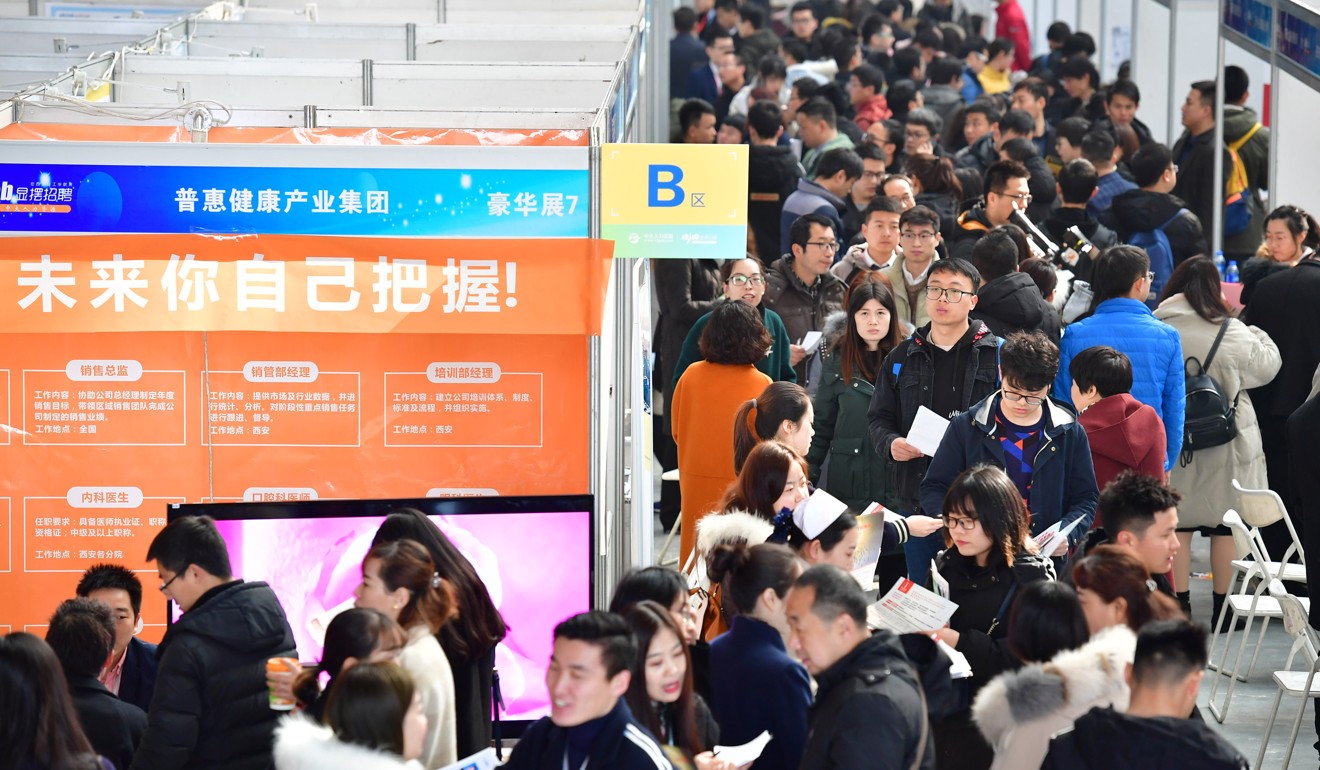
Job applicants visit a provincial job fair at Qujiang International Conference and Exhibition Center in Xian, northwest China’s Shaanxi Province in February. Photo: Xinhua
Oracle has never confirmed the number of lay-offs but said the job cuts formed part of an overall global strategy transformation.
However, there has been little sympathy for those losing their jobs in China, judging by social media posts.
Some people posted that those working for big US tech firms are not “wolf” enough compared with counterparts who work for local tech firms, referring to the long work-hours culture of the domestic tech scene.
A viral story titled “Why there should be no pity for the sacked Oracle China employees” said the company was Beijing’s biggest nursery because of the flexible “work from home” culture and generous compensation package offered to employees.
Oracle said to begin mass lay-offs in China as part of global move to cloud services
“They had every chance to join rising domestic internet firms. But they settled for high salary and low work pressure, which eventually made them frogs in boiling water. Why pity them?” said the article, adding that the earlier people give up on the “glory” of working for MNCs, the quicker they will benefit.
Not all Chinese workers would agree, and there has been a recent backlash against the “996” culture within China’s tech sector, where people routinely work from 9am to 9pm, six days a week.
With geopolitical uncertainty growing day by day, though, many Chinese are asking why leave the family behind for an uncertain fate overseas?
A survey done by consultancy BCG and The Network in 2018 showed that only one in three China residents was willing to move abroad for work, down from 61 per cent in 2014. The country is also the 20th most popular destination worldwide to relocate for a job, compared with 29th in the 2014.
“One of my graduate classmates in the US just gave up a six-digit package at Oracle and joined drone maker DJI in Shenzhen,” said Ben Zhang. “I asked what prompted his return to China. He sent me the viral article and asked, ‘who wants a life that one can see the end of from the very beginning?’”
Source: SCMP
Posted in Alibaba, Apple, ‘bamboo ceiling’, “Great Firewall”, Baidu, Beijing, big brand multinationals, Boeing, Bytedance, Carnegie Mellon University, China Tech Corporation (CTC), China’s top talent, Hong Kong, huawei technologies, Kuaishou, LinkedIn, multinational corporations (MNCs), Nio. Amazon, Oracle China\, Pennsylvania, Pittsburgh, Qujiang International Conference and Exhibition Center, rising domestic tech stars, shaanxi province, Shanghai, Siemens, Silicon Valley, Singapore, south china morning post, state-owned enterprise (SOE), Taipei, Tesla, TikTok, Uncategorized, Universum, wants to work, Xi'an, Xiaomi |
Leave a Comment »
23/06/2019
- Stalled denuclearisation talks also expected to be on the agenda when Chinese president meets Kim Jong-un this week
- Analysts say Korean peninsula has become intense diplomatic battleground between Beijing and Washington
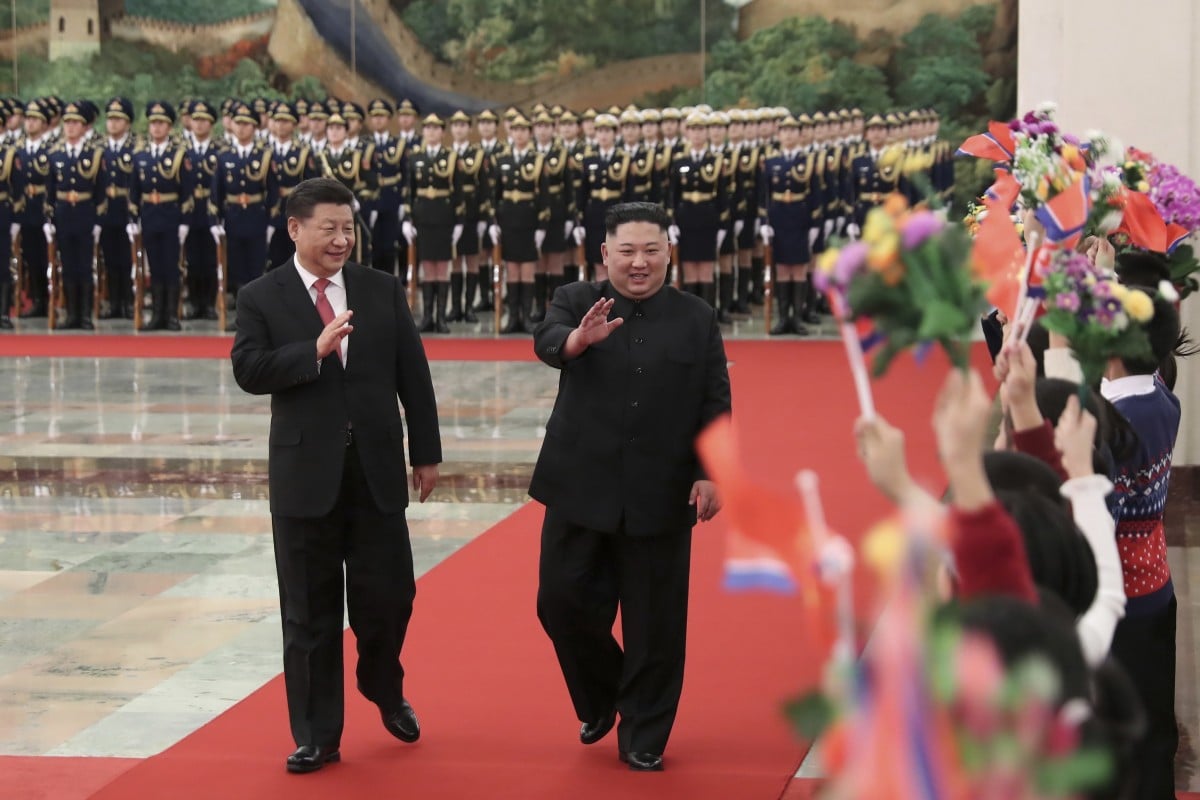
North Korean leader Kim Jong-un (right) attends a welcome ceremony in Beijing with Chinese President Xi Jinping in January. Xi will begin a visit to Pyongyang on Thursday. Photo: AP
Xi Jinping’s upcoming trip to
will be a state visit – a higher status than the last trip to the hermit kingdom by a Chinese president, highlighting the close bilateral ties between Beijing and Pyongyang.
Xi’s two-day trip, which
, is the first by a Chinese president to North Korea in 14 years and comes just a week before he is due to meet US President Donald Trump for talks on the sidelines of the Group of 20 summit in Japan.
“Leaders of the two countries will review the development of the bilateral relationship and carry out an in-depth exchange of opinions on the development of Sino-North Korean relations in the new era, and chart the future course of development,” state news agency Xinhua reported on Tuesday.
Xi’s predecessor, Hu Jintao, went to North Korea in October 2005 on a three-day trip described as an “official goodwill” visit.
Speaking at a regular press briefing in Beijing on Tuesday, foreign ministry spokesman Lu Kang said Xi’s visit aimed to “inject new impetus” into relations in the year the two countries marked the 70th anniversary of establishing diplomatic ties, and to give stalled denuclearisation talks a much needed push.
“Regarding the progress on denuclearisation, as I said, the result of the Hanoi leaders’ meeting in February was indeed a little unexpected. But after that, everyone actually looks forward to the resumption of dialogue in a good direction,” Lu said, referring to the failed talks between Trump and North Korean leader Kim Jong-un in the Vietnamese capital four months ago.
Trump hinted at the possibility of another meeting with Kim after receiving what he called “a beautiful letter” from the North Korean leader last week. On Tuesday, South Korea’s chief nuclear negotiator, Lee Do-hoon, said the US had been in contact with the North.
Life in North Korea the ‘admiration and envy’ of others, state media says
Washington will also send US Special Representative for North Korea Stephen Biegun to South Korea next week, days after Xi’s visit to Pyongyang, to fully align its position on North Korea with its ally.
Meanwhile, Trump confirmed he would meet Xi for talks in Osaka next week, saying in a tweet on Tuesday they had “a very good telephone conversation” and would hold “an extended meeting” at the G20 summit, where they are
over an almost year-long trade war.
Pyongyang has demanded the lifting of sanctions imposed on the regime following its nuclear and missile tests, while Beijing has said the livelihoods of North Koreans should not be affected. But Washington insists full sanctions should remain in place.
The US has also voiced scepticism about Chinese compliance with the sanctions. At a security summit in Singapore earlier this month, US acting Pentagon chief Patrick Shanahan – who on Wednesday stepped down from his role
– presented his Chinese counterpart Wei Fenghe with photographs and satellite images of North Korean ships transferring oil near China’s coast.
Analysts said Xi would seek to use the visit to boost China’s diplomatic leverage on the North Korean nuclear front, strengthening its hand in dealing with the US.
Exports from North Korea to China, which account for the bulk of its trade, plunged 87 per cent last year from 2017, and the country has faced other economic problems at a time when Kim has vowed to deliver on the economy.
A diplomatic source said China was expected to offer a large amount of humanitarian assistance, such as food and fertiliser, to North Korea, which could weaken the impact of sanctions.
China’s goal of denuclearisation on the Korean peninsula is unwavering and will not changeLu Chao, North Korean affairs expert at Liaoning Academy of Social Sciences
Communist Party mouthpiece People’s Daily on Tuesday said via its social media account that Xi would discuss economic and trade cooperation with Kim during the visit.
Quoting Zheng Jiyong, director of the Centre for Korean Studies at Fudan University in Shanghai, the newspaper said Pyongyang had taken steps to reform its economy and introduced China’s industrial manufacturing blueprint.
In September, Beijing proposed building a rail link from the city of Dandong, in China’s northeastern Liaoning province, to Pyongyang and then on to Seoul and Busan in the South, as well as a new road between Dandong and Pyongyang through Sinuiju.
Lu Chao, a North Korean affairs expert at the Liaoning Academy of Social Sciences, said large-scale economic cooperation between China and North Korea was unlikely because of the sanctions, but smaller moves were possible.
Chinese tourists flood North Korea as Beijing remains Pyongyang’s key ally
“For example, China may export daily necessities to North Korea. And if it’s needed, China is very likely to provide [food] assistance to North Korea,” Lu said. “I believe the UN sanctions on North Korea should change, because it has shown a more substantive approach to [achieving] denuclearisation.”
But analysts said Beijing remained firm on the need for Pyongyang to honour its pledges so that denuclearisation could be achieved.
“China’s goal of denuclearisation on the Korean peninsula is unwavering and will not change … China supports [North Korea] and the US continuing to hold talks,” Lu said.
Beijing also had an important part to play in the peace process, according to Boo Seung-chan, an adjunct professor at the Yonsei Institute for North Korean Studies in Seoul.
“China can have a positive role as a mediator to facilitate the peace process on the Korean peninsula,” Boo said.
Source: SCMP
Posted in aims, Asan Institute for Policy Studies, Beijing, Busan, Centre for Korean Studies, chinese tourists, Dandong, denuclearisation, diplomatic battleground, Fudan University, hermit kingdom, Hu Jintao, Kim Jong-un, Korean peninsula, Liaoning Academy of Social Sciences, Liaoning province, new impetus, North Korea, Patrick Shanahan, People’s Daily, President Donald Trump, President Xi Jinping, Pyongyang, Seoul, Shanghai, Singapore, Sino-North Korean relations, South Korea, State visit, ties, Uncategorized, US acting Pentagon chief, US Special Representative for North Korea, Washington, Wei Fenghe, Xinhua, Yonsei Institute for North Korean Studies |
Leave a Comment »
23/06/2019
BANGKOK (Reuters) – Southeast Asian leaders agreed on Sunday to work together on regional economy and security to strengthen their positions amid growing U.S.-China tensions, as they wrapped up this year’s first summit in Bangkok.
The 10-member Association of Southeast Asian Nations (ASEAN) will need its collective economic strength for bargaining power globally, especially amid the trade tensions between the world’s top two economies, Thai Prime Minister Prayuth Chan-ocha told a news conference, as chairman of the 34th ASEAN Summit.
Prayuth urged ASEAN nations to complete negotiations this year for the China-initiated Regional Comprehensive Economic Partnership (RCEP) pact that includes 16 countries.
“This will help ASEAN handle the changes and uncertainty that will happen in the region going forward, particularly the impacts of trade tension between ASEAN’s important trade partners.”
Negotiations began in 2012 on RCEP, which envisions the creation of a free trade zone encompassing 45% of the world’s population and more than a third of its GDP, but does not involve the United States.
First proposed by China, RCEP’s 16 signatories include the 10 ASEAN member states and six Asia-Pacific countries, including major economies China, India, Japan and South Korea. ASEAN has existing free-trade agreements with all six countries.
“If we can do this, we will have the bargaining power and base for negotiation. Because when combined, we are 650 million people, the largest regional bloc in the world,” the Thai prime minister said.
Four ASEAN countries – Thailand, Indonesia, Singapore and Vietnam – will discuss the trade war in next week’s G20 summit, which assembles 20 major economies, in Tokyo, Prayuth said.
ASEAN countries also agreed on a common approach on a U.S.-led Indo-Pacific initiative, at a time when U.S.-China tensions were rising and forcing ASEAN countries to take sides.
Prayuth hailed the bloc’s agreement on the ASEAN Outlook on the Indo-Pacific as a “significant step” for the region.
The endorsed outlook document, seen by Reuters, acknowledges “maritime issues such as unresolved maritime disputes that have the potential for open conflict” as existing and emerging geopolitical challenges.
It outlines maritime cooperation “for peaceful settlement of disputes”. It also aims for connectivity in the Indo-Pacific region.
Source: Reuters
Posted in Bangkok, economic strength, emphasise, Indo-Pacific initiative, Indonesia, Prayuth Chan-ocha, Regional Comprehensive Economic Partnership (RCEP), Reuters, Singapore, Southeast Asian leaders, Thai Prime Minister, Thailand, U.S.-China tensions, Uncategorized, Vietnam |
Leave a Comment »
12/06/2019
- Many of those involved feel profound ‘guilt and shame’ over the lives lost in Beijing 30 years ago, according to two former PLA officers
- Move to tone down language used to describe movement – as ‘political turmoil’ rather than a ‘counter-revolutionary rebellion’ – came from army
The brutal military crackdown on peaceful protesters in Beijing 30 years ago might have saved the Communist Party’s rule, but it has since become a cross to bear for the People’s Liberation Army.
Today, the world’s largest fighting force is still haunted by the
tragedy in 1989, despite efforts to rebuild its image. After the bloodshed, it was the military that suggested the pro-democracy student movement be referred to not as a “counter-revolutionary rebellion” but as a time of “political turmoil”, two former PLA officers told the South China Morning Post.
They said the move to tone down the language around the crackdown reflected the anxiety and shame felt by many rank-and-file officers over a fateful decision that has tainted the military’s reputation and legacy.
Up to that point, the PLA had been widely respected by the Chinese public. Even during the turbulent decade of the Cultural Revolution from 1966, the military was largely uninvolved. Rather, it was instrumental in bringing an end to the chaos and setting China on the path of reform and opening up.
The crackdown in 1989 was unprecedented for the PLA and dealt a crippling blow to its reputation and morale – and the question over the legitimacy of the decision to send in the tanks and open fire on the protesters remains.
“[I believe] the Tiananmen crackdown will be revisited one day – it’s just a matter of time. The ultimate responsibility will fall to those military leaders who directly implemented the decision,” a retired researcher with the PLA’s Academy of Military Science, who requested anonymity, told the Post.
PLA soldiers with automatic weapons eat ice creams as protesters plead with them to leave Tiananmen Square on June 3, 1989. Photo: Reuters
Throughout history and across cultures, following orders has been a fundamental principle of military service. But the absence of a written order on the mission from the commander in chief – late paramount leader Deng Xiaoping – puts its legality in doubt.
It is estimated that hundreds, or perhaps more than 1,000, civilians were killed during the crackdown that began on the night of June 3 and continued until the morning.
“No matter whether it is one or 10,000 people killed, it’s still wrong to shoot at unarmed civilians,” said a retired PLA officer who served in the army’s political department and also declined to be named. “But [the troops] had to do this dirty job because the party’s rule was in danger.”
According to the former military researcher, many commanders involved in the crackdown questioned the decision to use force to quell the protests, particularly since they had only been given a verbal order from above and never saw a written instruction from Deng, who was chairman of the Central Military Commission (CMC).
This was further complicated by the fact that Zhao Ziyang, the party’s general secretary at the time, openly opposed a military crackdown. Without the support and approval of the party’s chief, the operation violated the long-held principle of “the party commanding the gun”.
Even then CMC vice-chairman Yang Shangkun and Xu Qinxian, commander of the 38th Army Corps that had been sent to Beijing, had qualms about carrying out the verbal order, according to the former researcher.
It is not known how many troops were sent in to crush the protests, but the number could be as high as 200,000, according to a book by US-based scholar Wu Renhua.
Soldiers patrol Changan Avenue in Beijing on June 4, 1989. Photo: Jeff Widener/AP
The retired PLA political officer said the instruction to commanders was to “clear out Tiananmen Square by June 4 – and whoever stands in our way is an enemy of the state”.
“Most officers and soldiers were only trained to use heavy weapons like machine guns and tanks. They didn’t even know there were things like rubber bullets, tear gas or other kinds of non-lethal weapons for crowd control,” said the former officer.
“To meet the deadline to clean up the square, some commanders asked their troops to shoot into the air to scare away the crowds – that was the only thing they could think of doing,” he said.
But although they started off firing into the air, ricocheting bullets hit many protesters as they fled and in the chaos and bloodshed, inexperienced troops panicked and started firing into the crowd, according to the former officer.
The army’s clean image was destroyed overnight, and in the minds of many, renmin zidibing – the army of our sons – became the feared and reviled tool of a killing regime.
It also left a psychological scar on the military, which is reflected in the effort to tone down the narrative around the crackdown.
The former researcher said the push to use “political turmoil” instead of the more provocative “counter-revolutionary rebellion” to describe the movement first appeared in a military academy reference book, the Chinese Military Encyclopaedia, in 1997. He said it was proposed by military advisers who believed it could help soften attitudes towards the crackdown.
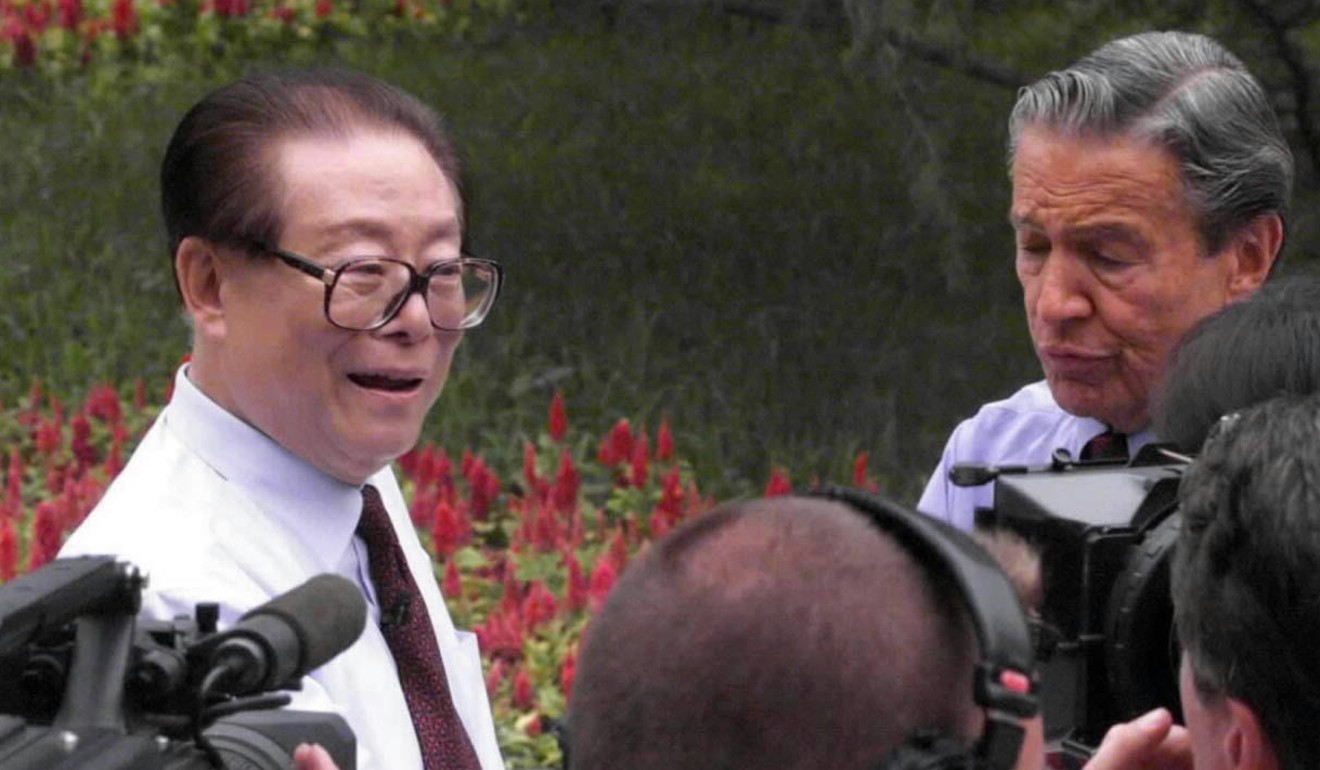
Then president Jiang Zemin with American journalist Mike Wallace during an interview in 2000. Photo: Xinhua
Former president Jiang Zemin spoke of the “political turmoil” in 1989 during an interview with American journalist Mike Wallace in 2000, and the wording has since been widely used by state media.
Meanwhile, the suppression of the protesters also prompted calls for a separation of the army and the party, so the PLA would be a “national” force rather than a political one.
But after
, the idea was squashed by the top leadership in 2007, on the eve of the PLA’s 80th anniversary. It was labelled as a plot by hostile Western forces to topple communist rule in China and is now a taboo subject.
“But despite banning discussion of military nationalisation, the calls from within the PLA to rehabilitate the military and for a review of what happened with the student movement have never stopped,” the former PLA political officer said.
“Many senior military officers believe the students weren’t attempting to overthrow communist rule – they were just asking for a better political system. That’s why calling it a counter-revolutionary rebellion is wrong.”
Curious Beijing residents gather to look at the military hardware in Tiananmen Square on June 7, 1989. Photo: AP
On Sunday, days ahead of the 30th anniversary, Defence Minister General Wei Fenghe
, telling a regional defence forum that putting an end to the “political turbulence” had been the “correct policy”.
“Throughout the 30 years, China under the Communist Party has undergone many changes – do you think the government was wrong with the handling of June Fourth?
There was a conclusion to that incident. The government was decisive in stopping the turbulence,” Wei said at the Shangri-La Dialogue in Singapore.
But according to the former PLA researcher, military top brass involved in the crackdown still felt profound “guilt and shame” over the lives lost.
“None of those people in the PLA would feel a sense of honour for participating in the crackdown,” he said. “Instead they harbour a deep feeling of shame.”
Source: SCMP
Posted in Academy of Military Sciences, army, Beijing, Central Military Commission (CMC), China’s military psyche, Chinese Military Encyclopaedia, Communist Party, counter-revolutionary rebellion, deep scar, Deng Xiaoping, paramount leader, People’s Liberation Army, PLA officers, political turmoil, president jiang zemin, Shangri-La Dialogue, Singapore, south china morning post, Tiananmen crackdown, Uncategorized |
Leave a Comment »
12/06/2019
- Observers will be watching to see if General Wei Fenghe holds talks with his American counterpart
- Forum comes as Beijing and Washington are at odds over issues ranging from security to trade
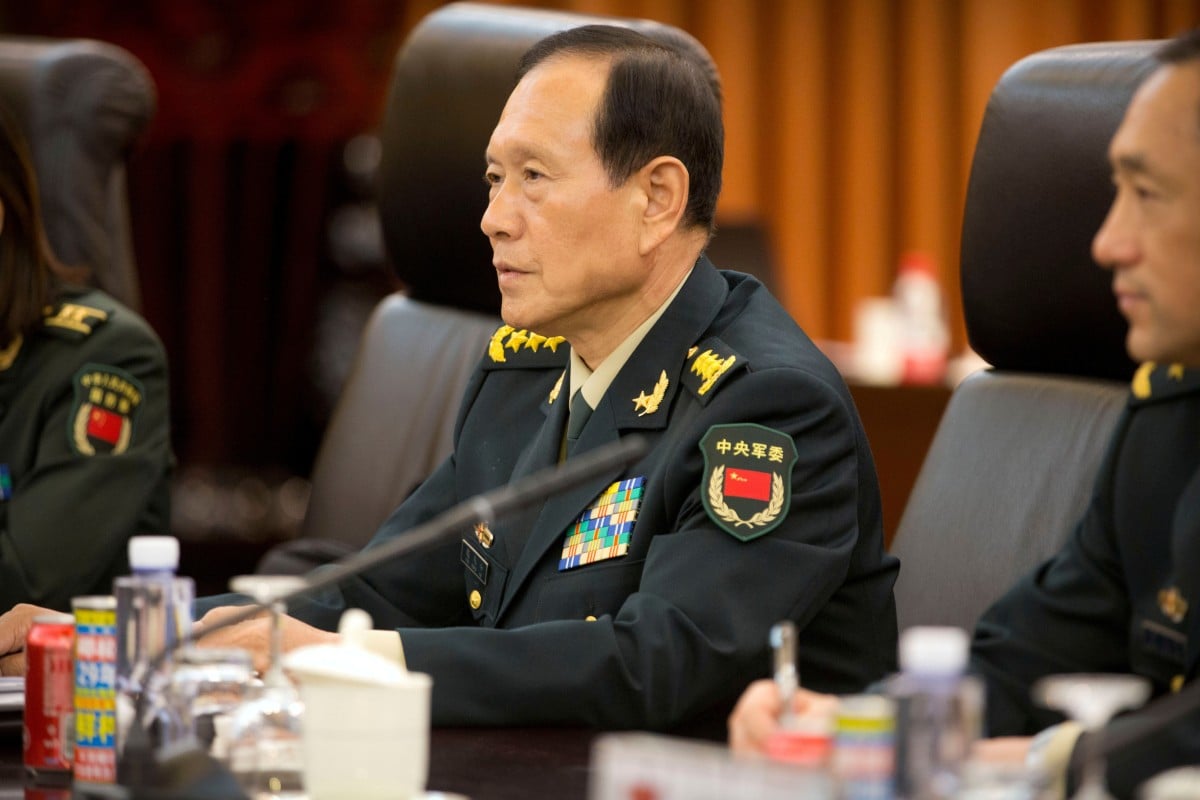
General Wei Fenghe will be the first Chinese defence minister to attend the Shangri-La Dialogue in eight years. Photo: Reuters
China is sending its defence minister to a leading Asian security forum next week, the first time in eight years that a high-ranking Chinese general will represent the country at the conference.
General Wei Fenghe, a State Councillor and China’s defence minister, will speak at the three-day Shangri-La Dialogue in Singapore, a gathering that comes as Beijing and Washington are at odds over issues ranging from security to trade.
“In a highly anticipated speech, General Wei Fenghe will speak on China’s role in the Indo-Pacific at a pivotal time for the region,” the International Institute for Strategic Studies, an organiser of the conference, said on Monday night.
Chinese military sources said that Wei would lead a “relatively big” delegation to the gathering, which starts on May 31 and is co-organised by the Singaporean government.
South China Sea stand-offs ‘a contest of wills’
The last time Beijing sent a high-ranking officer to the event was in 2011 when General Liang Guanglie, then the defence minister, attended.
Acting US secretary of defence Patrick Shanahan will also attend the conference and deliver a speech.
The spoils of trade war: Asia’s winners and losers in US-China clash
Beijing-based military specialist Zhou Chenming said observers would be watching to see whether the two senior defence officials held talks.
“The whole world will keep a close eye on any possible encounters between the Chinese and the Americans … At least now China has shown its sincerity in sending Wei to attend the conference, who is of equal standing as Shanahan, if the latter is willing to hold talks with him in good faith,” Zhou said.
But he said a meeting between Wei and Shanahan would be difficult because of the current distance between Beijing and Washington on major issues.
How Trump’s tweets bested China in the trade war publicity battle
“It’s not realistic to expect they will make a breakthrough because both sides will just sound their own bugles. The … mistrust between China and the US is actually growing every day,” Zhou said.
Just on Sunday, the USS Preble, an Arleigh Burke-class guided missile destroyer, sailed within 12 nautical miles of the Scarborough Shoal, an area in the South China Sea claimed by both China and the Philippines.
The
by strongly urging “the US to stop such provocative actions” and saying it would “take all necessary measures” to protect its “national sovereignty”.
Military analysts said the size of the Chinese delegation at the conference would underscore the importance of the People’s Liberation Army (PLA) attached to the event this year.
One military insider said the delegation would also include Lieutenant General He Lei, former vice-president of the Academy of Military Science, who headed China’s delegation in 2017 and 2018; and Senior Colonel Zhou Bo, director of the defence ministry’s Centre for Security Cooperation. In addition, the PLA would send a number of Chinese academics to speak at various sessions of the forum.
China tries to go one on one with Malaysia to settle South China Sea disputes
Singaporean Prime Minister Lee Hsien Loong will deliver a keynote speech on the opening day of the annual dialogue.
Japan and South Korea are also sending their defence ministers, according to a report by The Korean Times on Tuesday. The report also said South Korean Defence Minister Jeong Kyeong-doo was keen to hold one-on-one meetings with his Chinese and Japanese counterparts on the sidelines of the conference.
Source: SCMP
Posted in Academy of Military Sciences, Beijing, China alert, defence minister, defence ministry’s Centre for Security Cooperation, General Wei Fenghe, guided missile destroyer, Japan, Jeong Kyeong-doo, Lee Hsien Loong, Lieutenant General He Lei, Malaysia, Patrick Shanahan, People's Liberation Army (PLA), Philippines, Scarborough Shoal, Security Conference, Shangri-La Dialogue, Singapore, Singaporean Prime Minister, South China Sea, South Korea, South Korean Defence Minister, State Councillor, tensions, The Korean Times, Uncategorized, US, US secretary of defence, USS Preble, Washington |
Leave a Comment »
10/06/2019
- Beijing has to reconcile the competing needs to appear tough to the Chinese public and conciliatory to an international audience
- China feels US has long had the advantage in shaping global opinion but it now needs to make itself heard
China must appear tough for an increasingly nationalistic audience at home and be conciliatory to an international audience wary of China’s assertive foreign and defence policy. Photo: Xinhua
In just the last week, a Chinese official posed a question that would resonate among his fellow cadres: as China rises, why are we not making more friends and why are our voices not heard?
The question has gained weight as the trade war with the United States has deepened, and Chinese officials have scrambled to win the battle of public opinion at home and abroad.
It also came to the fore at the annual Shangri-La Dialogue security forum in Singapore on the weekend, when Chinese officials were faced with balancing the need to appear tough for an increasingly nationalistic audience at home and being conciliatory to an international audience wary of China’s assertive foreign and defence policy.
Senior Colonel Zhao Xiaozhuo, a senior fellow at the People’s Liberation Army’s Academy of Military Sciences and a public diplomacy veteran for the military, said the expectations clashed in Singapore.
“Currently there are two parallel worlds in the public opinion landscape, one domestic and another international, and the two of them are basically split and in two extremes,” Zhao said.
“[The Shangri-La Dialogue] is a place where the two worlds clash. As the Chinese delegation [at the forum] we need to show our position, but it is becoming more difficult to balance [the expectations of the two sides].
“If you are tough, the domestic audience will be satisfied, but it won’t bode well with the international audience. But if we appear to be soft, we will be the target of overwhelming criticism at home.”
China asks state media to pick battles carefully with long US trade war looming, sources say
Zhao said this was an unprecedented challenge for Chinese cadres, who must also satisfy the expectations of the leadership.
“Our task was about diplomacy and making friends. But [with the tough position] you may not be able to make friends, and might even exacerbate the tension,” he said.
The pressure was immense when Chinese Defence Minister General Wei Fenghe took to the stage on Sunday in a rare appearance at the forum. Concerned about how Wei’s performance would be received at home, Beijing ordered Chinese media to minimise their coverage of acting US defence secretary Patrick Shanahan’s address in case it made China appear weak, according to a source familiar with the arrangements for Chinese media.
In his speech, Wei struck a defiant tone, vowing that the PLA would “fight at all costs” for “reunification” with Taiwan and that China was ready to fight the US to the end on the trade front.
Chinese Defence Minister Wei Fenghe makes a rare appearance at the Shangri-La Dialogue in Singapore. Photo: Reuters
Major General Jin Yinan, from the PLA’s National Defence University, a member of the Chinese delegation to the Singapore summit, said Wei’s speech defied expectations that China would show restraint with the US, and demonstrated China’s confidence on the world stage.
The public response at home was immediate and positive. Tens of thousands of Chinese internet users flooded social media platforms such as the Twitter-like Weibo service to express their approval for Wei’s hard line.
“This is the attitude that the Chinese military should show to the world,” one commenter said.
“I am proud of my country for being so strong and powerful,” another said.
Over the past year, Beijing’s propaganda apparatus has tightly controlled the domestic media narrative on the trade war, barring independent reporting on the tensions. But since the breakdown of trade talks in early May, the authorities have gone one step further by escalating nationalistic rhetoric in newspapers and on television.
How Donald Trump’s tweets outgunned China’s heavy media weapons in the trade war publicity battle
China has also tried to make its case to the world with an official statement. On the same day that Wei addressed the gathering in Singapore, the State Council, China’s cabinet, put China’s side of the dispute in a white paper, saying the US should bear responsibility for the breakdown of the trade talks.
A Chinese delegate at the forum said Beijing felt Washington had long had the advantage in shaping global opinion and there was an urgent need for China to make itself heard.
“We should get more used to voicing our position through Western platforms. The US has been criticising us on many issues. But why should the Americans dominate all the platforms and have the final say over everything?” the delegate said.
Before Wei’s appearance at the dialogue, China had not sent such a high-ranking official for eight years. It had long sought to play down the importance of the forum, seeing it as a platform wielded by the US and its Western allies to attack China.
In 2002, China set up the Beijing Xiangshan Forum to rival the Singapore gathering and amplify its voice on security issues.
But Chinese officials are well aware that Xiangshan does not have the same impact and profile as the Shangri-La Dialogue, according to Collin Koh, a research fellow at the S. Rajaratnam School of International Studies at Nanyang Technological University in Singapore.
“[At the same time, the long absence of high-level Chinese representation to the Shangri-La Dialogue also] raises the question of whether it might be sustainable in the long run for [the dialogue] if they continue to not have such ministerial representation [from China],” Koh said.
Zhao, who is also the director of the Xiangshan forum’s secretariat office, agreed that China lagged the US in promoting the image of the military and in winning public opinion.
“China has not fought a war in 30 years. We have only built some islands in the South China Sea and yet have received so much criticism from the international media. The US has engaged in many wars but they are seldom criticised. This reflects that China is in a disadvantaged position in international discourse,” he said.
Expectations collided at the Shangri-La Dialogue in Singapore this month. Photo: AFP
In a rare conciliatory gesture – and just days before the 30th anniversary of the crackdown on pro-democracy protesters in Tiananmen Square – Wei took questions from a room of international delegates on a range of sensitive issues, including the crackdown and China’s mass internment camps in Xinjiang. While he largely toed the official line in his reply, his presence at the forum and willingness to address the questions raised hopes that China would become a more responsible partner in global affairs despite its continuing disputes with the US.
Andrea Thompson, US undersecretary of state for arms control and international security, said Wei’s attendance at the Singapore gathering was a “positive sign” and she hoped that China would be more open and transparent in addressing issues such as arms control and cybersecurity.
“I appreciate that he is here. I think it’s important to have a dialogue … There will be areas where we will agree, and some areas where we disagree, but you still have to have dialogue,” Thompson said.
Source: SCMP
Posted in Academy of Military Sciences, Andrea Thompson, Beijing, Beijing Xiangshan Forum, China alert, Chinese Defence Minister, General Wei Fenghe, make itself heard, National Defence University, Patrick Shanahan, People’s Liberation Army, S. Rajaratnam School of International Studies, Shangri-La Dialogue, Singapore, Singapore’s Nanyang Technological University, struggles, Uncategorized, US defence secretary, US undersecretary of state for arms control and international security, Washington, win friends, Xiangshan forum, Yinan |
Leave a Comment »
10/06/2019
- With a defence budget second only to the US, China is amassing a navy that can circle the globe and developing state-of-the-art autonomous drones
- The build-up is motivating surrounding countries to bolster their own armed forces, even if some big-ticket military equipment is of dubious necessity
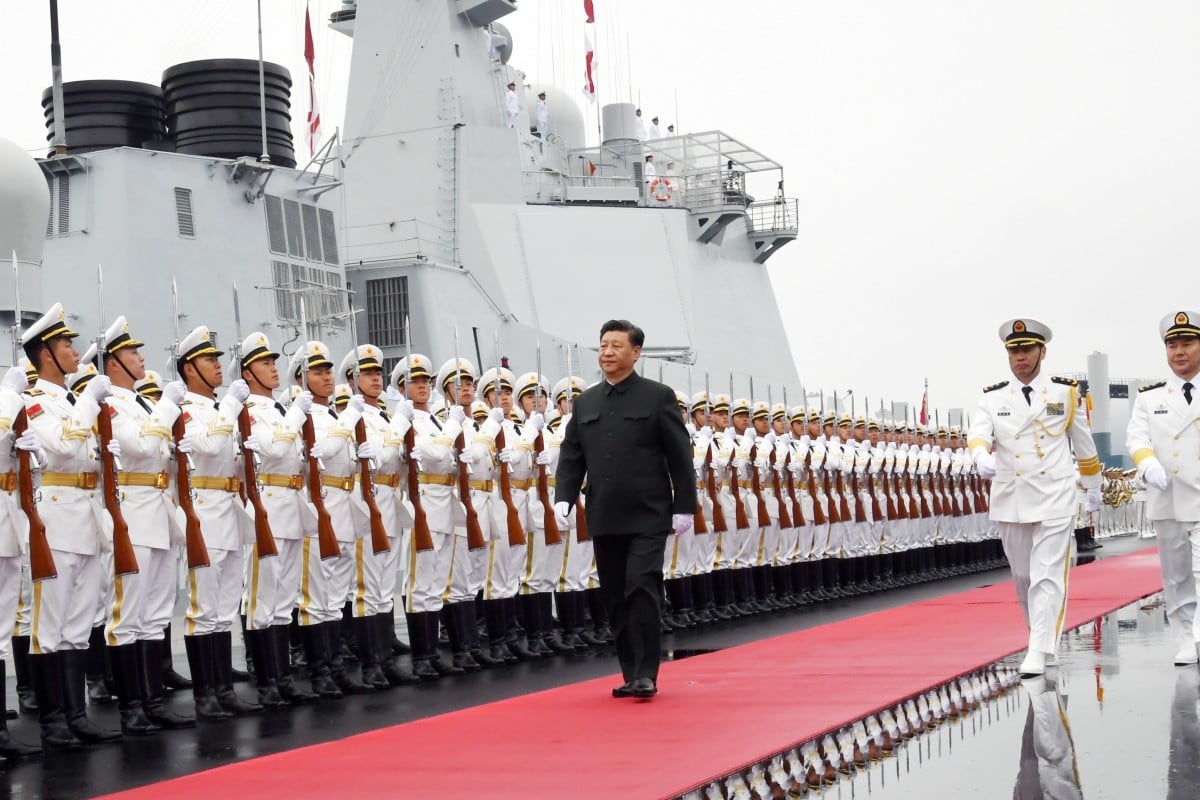
Chinese President Xi Jinping reviews an honour guards before a naval parade in Qingdao. Photo: Xinhua
The Asia-Pacific region is one of the fastest-growing markets for arms dealers, with economic growth, territorial disputes and long-sought military modernisation propelling a 52 per cent increase in defence spending over the last decade to US$392 billion in 2018, according to the Stockholm International Peace Research Institute.
The region accounts for more than one-fifth of the global defence budget and is expected to grow. That was underscored last week by news of
’s bid to strike a
to purchase US tanks and missiles.
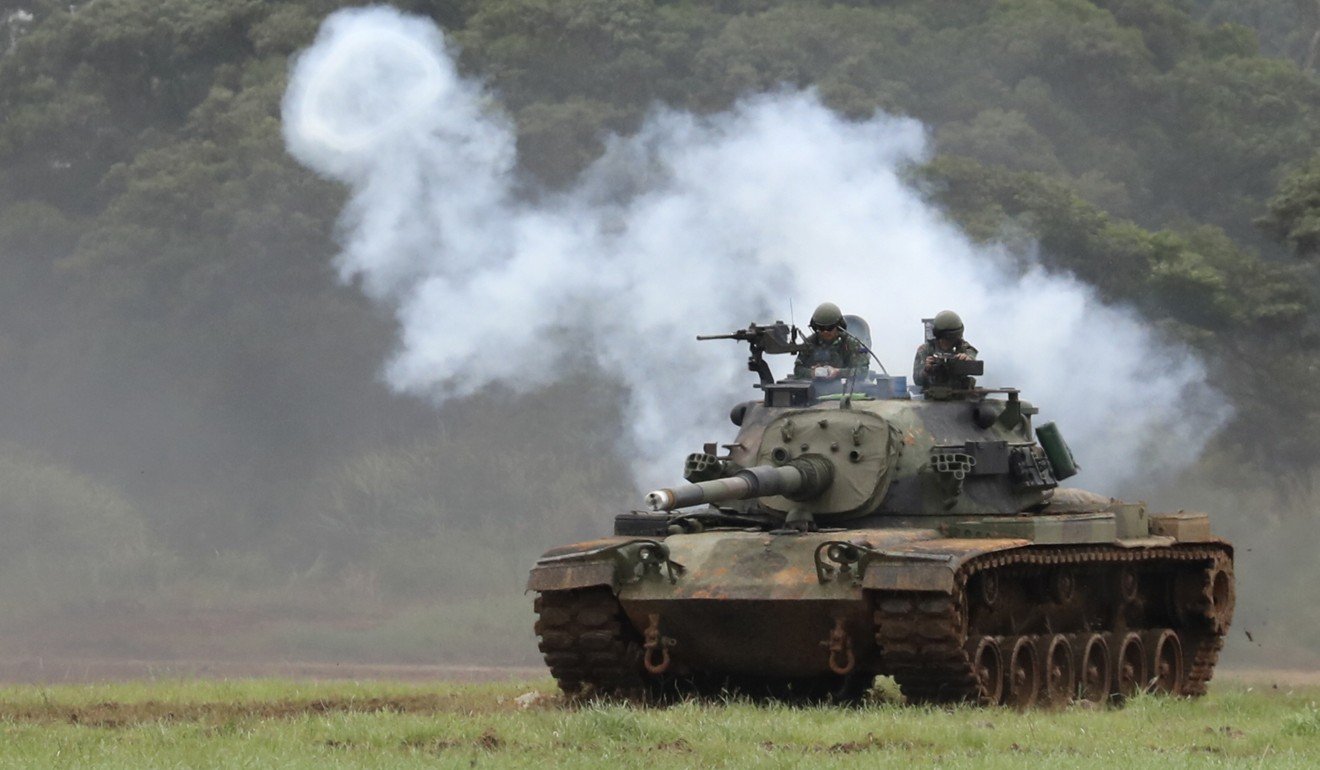
Taiwanese Soldiers on a CM11 battle tank, jointly developed with US arms manufacturer General Dynamics. Photo: EPA
The biggest driver in arms purchases, however, is
– responsible for 64 per cent of military
spending in the region. With a defence budget that is second only to the
, China is amassing a navy that can circle the globe and developing state-of-the-art autonomous drones. The build-up is motivating surrounding countries to bolster their armed forces too – good news for purveyors of submarines, unmanned vehicles and warplanes.
It is no coincidence that the recent
in
, a security conference attended by
chiefs, was sponsored by military contractors including Raytheon,
and
.
Opinion: How the Shangri-La Dialogue turned into a diplomatic coup for China
Kelvin Wong, a Singapore-based analyst for Jane’s, a trade publication that has been covering the defence industry for 121 years, has developed a niche in infiltrating China’s opaque defence industry by attending obscure trade shows that are rarely advertised outside the country.
He said the US is eager to train allies in Asia and sell them arms, while also stepping up its “freedom of navigation” naval operations in contested waters in the
and Taiwan Strait. It has lifted a ban on working with
’s special forces over atrocities committed in
. And it is considering restarting arms sales to the
.
In his speech at the Shangri-La Dialogue, acting US Defence Secretary Patrick Shanahan touted American advancements in technology “critical to deterring and defeating the threats of the future” and said any partner could choose to win access to that technology by joining the US defence network.
Wong said the message was clear: “Buy American.”
Analysts say Chinese soldiers have less training, motivation and lower morale than their Western counterparts. Photo: Reuters
The analyst said there is a growing admission among the Chinese leadership that the
has an Achilles’ heel: its own personnel.
He said one executive at a Chinese defence firm told him: “The individual Chinese soldier, in terms of morale, training, education and motivation, (cannot match) Western counterparts. So the only way to level up is through the use of unmanned platforms and
To that end, China has developed one of the world’s most sophisticated drone programmes, complete with custom-built weapon systems. By comparison, Wong said,
US drones rely on weapons originally developed for helicopters.
Wong got to see one of the Chinese drones in action two years ago after cultivating a relationship with its builder, the state-owned China Aerospace Science & Technology Corporation. He viewed a demonstration of a 28-foot-long CH-4 drone launching missiles at a target with uncanny ease and precision.
“Everyone knew they had this,” Wong said. “But how effective it was, nobody knew. I could personally vouch they got it down pat.”
China unveils its answer to US Reaper drone – how does it compare?
That is what Bernard Loo Fook Weng, a military expert at Singapore’s S. Rajaratnam School of International Studies, told the author Robert Kaplan for his 2014 book, Asia’s Cauldron, about simmering tensions in the South China Sea.
He was describing the competition for big-ticket military equipment of dubious necessity.
is littered with examples of such purchases.
owns an aircraft carrier without any aircraft. Indonesia dedicated about one-sixth of its military budget to the purchase of 11
Su-35 fighter jets. And
splurged on two
submarines it could not figure out how to submerge.
“It’s keeping up with the Joneses,” Wong said. “There’s an element of prestige to having these systems.”
Submarines remain one of the more debatable purchases, Wong said. The vessels aren’t ideal for the South China Sea, with its narrow shipping lanes hemmed in by shallow waters and coral reefs. Yet they provide smaller countries with a powerful deterrence by enabling sneak attacks on large ships.
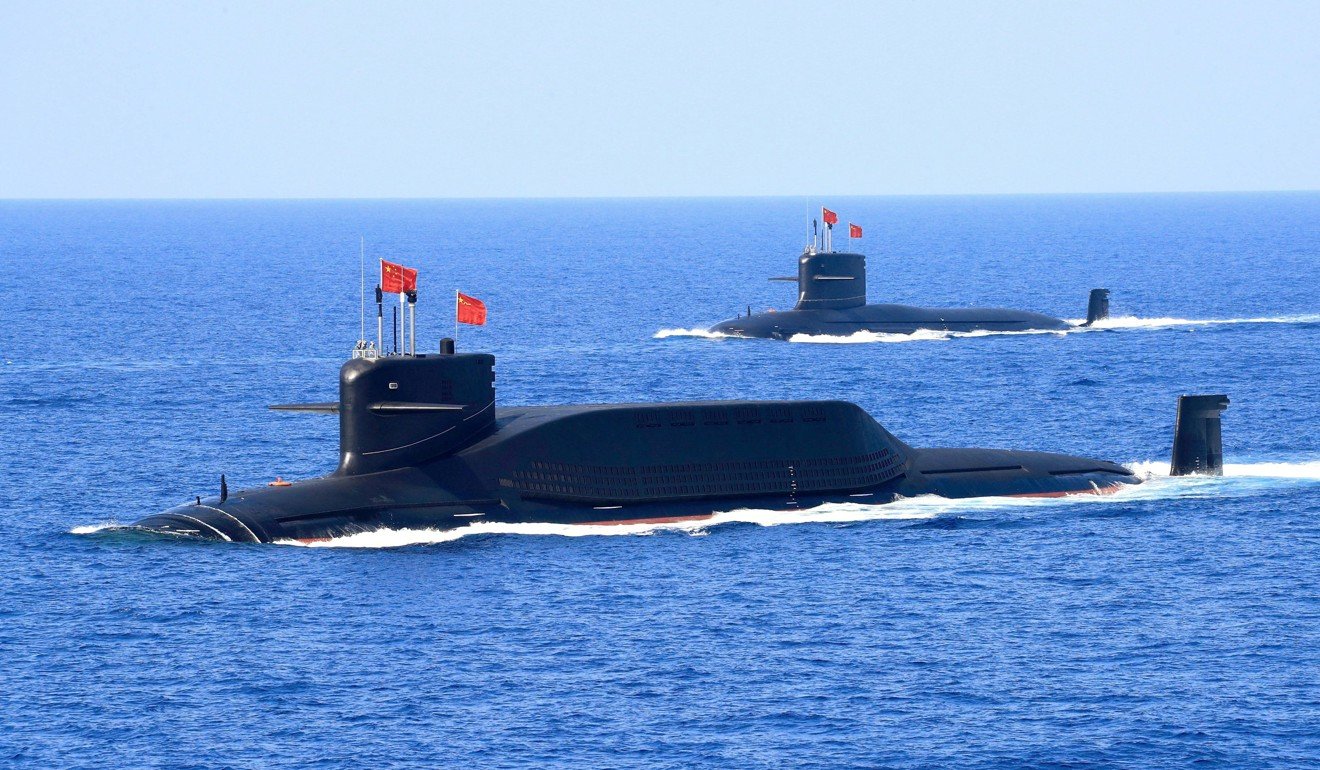
Nuclear-powered PLA Navy ballistic missile submarines in the South China Sea. Photo: Reuters
Asia and
are home to 245 submarines, or 45 per cent of the global fleet, according to the US-based naval market intelligence firm AMI International.
The Philippines remains one of the last coastal nations in the region without a sub – though it is in talks with Russian builders to acquire some.
Singapore recently received the first of four advanced
Type 218 submarines with propulsion systems that negate the need to surface more frequently. If the crew did not need to eat, the submarine could stay under water for prolonged periods. Wong said the craft were specially built for Asian crews.
“The older subs were designed for larger Europeans so the ergonomics were totally off,” he said.
Singapore, China deepen defence ties, plan larger military exercises
Tiny Singapore plays a crucial role securing the vital sea lanes linking the Strait of Malacca with the South China Sea. According to the
the country dedicates 3.3 per cent of its gross domestic product to defence, a rate higher than that of the United States.
State-of-the-art equipment defines the Singapore Armed Forces. Automation is now at the centre of the country’s military strategy, as available manpower is shrinking because of a rapidly ageing population.
Wong said Singapore is investing in autonomous systems and can operate frigates with 100 crew members – 50 fewer than they were originally designed for.
“We always have to punch above our weight,” he said.
Source: SCMP
Posted in artificial intelligence (AI), Asia, Asia-Pacific region, Australia, autonomous drones, BAE Systems, China Aerospace Science & Technology Corporation, East Timor, French, frigates, German, Indonesia, Lockheed Martin, Malaysia, military spending, naval parade, navy, People’s Liberation Army, President Xi Jinping, Qingdao, Raytheon Co, ripple effect, Russian, Shangri-La Dialogue, Singapore, Singapore Armed Forces, South China Sea, Southeast Asia, Stockholm International Peace Research Institute, Strait of Malacca, submarines, Taiwan Strait, Thailand, the Philippines, Uncategorized, unmanned vehicles, US Reaper drone, warplanes, World Bank |
Leave a Comment »
29/05/2019
- Academic on-board the HMAS Canberra says pilots were struck by lasers on a voyage from Vietnam to Singapore, during which they were being tailed by a Chinese warship
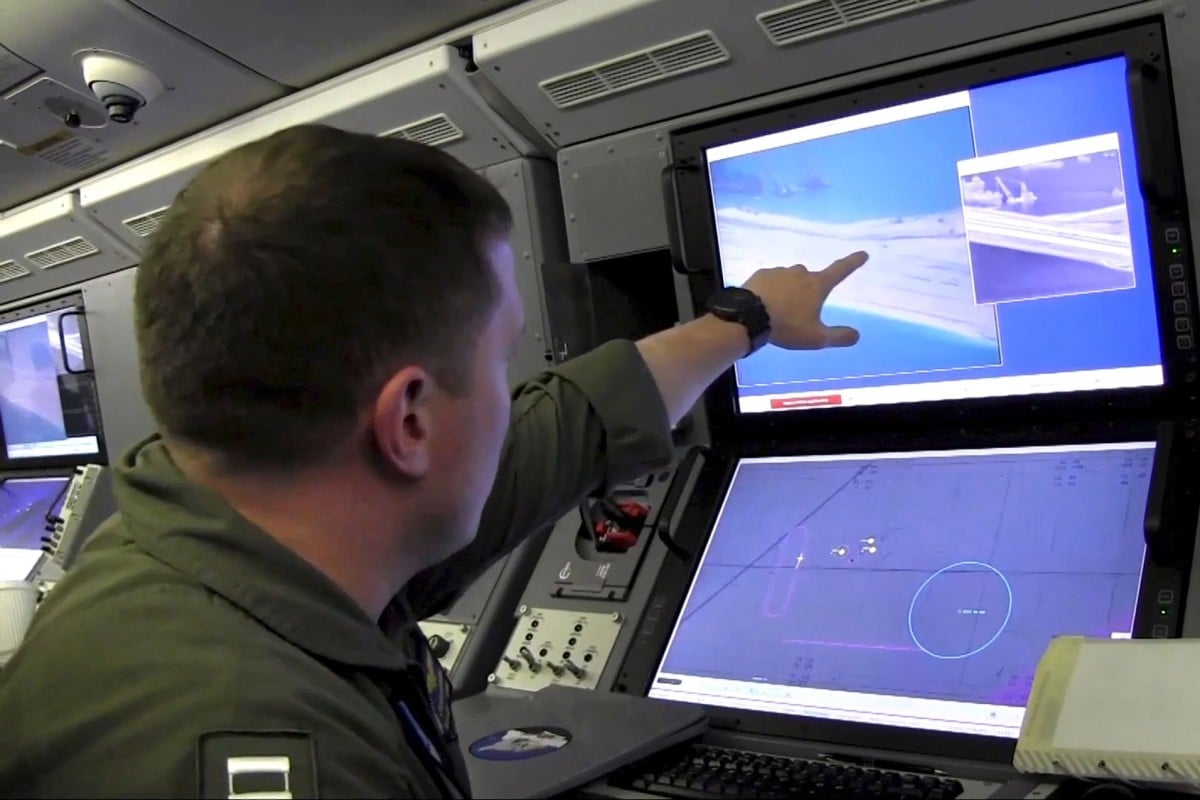
US Navy personnel point at a computer screen showing Chinese activity on the Fiery Cross Reef in the Spratly Islands in the South China Sea. An Australian scholar said
Chinese ships pointed lasers at them during a flight over the disputed sea. Photo: Reuters
Australian navy helicopter pilots were hit by lasers and forced to land during exercises in
, according to one witness on-board the aircraft.
Scholar Euan Graham, who said he was on the Royal
flagship HMAS Canberra during a voyage from Vietnam to Singapore, said the lasers had been pointed from passing fishing vessels while the Canberra was being
.
“Was this startled fishermen reacting to the unexpected? Or was it the sort of coordinated harassment more suggestive of China’s maritime militia? It’s hard to say for sure, but similar incidents have occurred in the western Pacific,” he wrote on the website The Strategist run by the Australian Strategic Policy Institute, an independent, non-partisan think tank based in Canberra.
His account of the incident appeared on Tuesday.
The Mischief Reef in the Spratly Islands in the South China Sea, where China is said to be increasing its military presence. Photo: Reuters
China maintains a robust maritime militia in the South China Sea, composed of fishing vessels equipped to carry out missions just short of combat. China claims the strategic waterway virtually in its entirety and is sensitive to all foreign naval action in the area, especially by
such as Australia.
Similar incidents involving lasers and the Chinese military have been reported as far away as Djibouti, where the US and China have bases. Last year, the US complained to China after lasers were directed at aircraft in the Horn of Africa nation, causing minor injuries to two American pilots.
China denied that its forces targeted the US military aircraft.
Graham said that while bridge-to-bridge communications with the Chinese during the voyage were courteous, the Chinese requested the Australian warships notify them in advance of any corrections to their course.
That was something the Australian navy was “not about to concede while exercising its high-seas freedoms”, Graham wrote.
In South China Sea, Asean has a choice: ‘Asian values’ or rule of law?
He wrote that the constant presence of Chinese vessels shadowing foreign ships appeared to indicate that the Chinese fleet had grown large enough to allow it to have vessels lying in wait for just such orders.
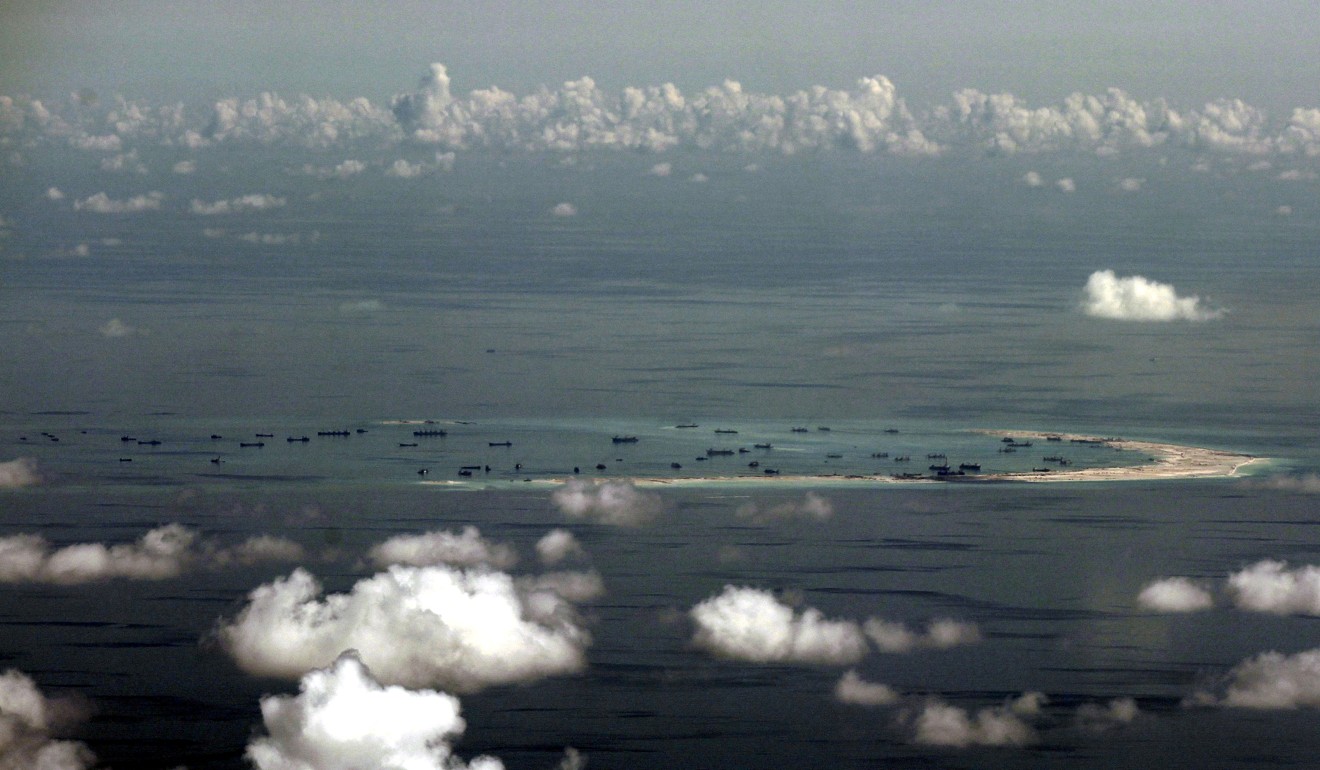
He said their trailing actions also appeared to show that China’s over-the-horizon surveillance capability was also maturing, supported by technology based at points such as Fiery Cross Reef in the contested Spratly island group where China has built military installations and an airstrip atop coral reefs.
Five other governments have claims in the South China Sea that overlap with China’s, and the US and its allies insist on the right to sail and fly anywhere in the area is permitted under international law, despite China’s differing interpretation of such guidelines.
Graham, who is executive director of La Trobe Asia at La Trobe University in Australia, was one of several academics invited to observe Australia’s engagement exercise Indo-Pacific Endeavour 2019.
Source: SCMP
Posted in Australian, Australian Strategic Policy Institute, Australian warships, Beijing’s ‘maritime militia’, bridge-to-bridge communications, Canberra, Chinese fleet, Chinese warship, Fiery Cross Reef, force, HMAS Canberra, Horn of Africa, Indo-Pacific Endeavour, land, lasers, navy helicopter, Scholar, Singapore, South China Sea, Spratly Islands, tailed, Uncategorized, Vietnam |
Leave a Comment »










 CHINDIA ALERT: You'll be living in their world, very soon