Archive for ‘skyrocketed’

01/11/2019

Help pours in for Chinese student who lived on 30 cents a day

Wu Huayan on her hospital bedImage copyright FENG VIDEO
Image caption Wu Huayan ate only rice and chillies in order to save money to help her ill brother

Well-wishers have donated almost a million yuan to a Chinese student who was hospitalised after living on 2 yuan ($0.30, £0.20) a day for five years.

The case of Wu Huayan shocked Chinese people after it hit the headlines earlier this week.

The 24-year old woman became seriously malnourished while struggling to study and support her sick brother.

Ms Wu’s story also sparked anger at authorities for failing to recognise her plight and help her much earlier.

After the story was reported, donations began pouring in for the college student in the city of Guiyang – reportedly totalling some 800,000 yuan ($114,000, £88,000).

What is Wu Huayan’s story?

Earlier, this month, the young woman went into hospital after having difficulty breathing, according to Chinese media.

She was only 135cm (4ft 5ins) tall, weighing barely more than 20kg (43 pounds; three stones).

The doctors found she was suffering from heart and kidney problems due to five years spent eating minimal amounts of food. She said she needed to save money to support her sick brother.

Wu Huayan lost her mother when she was four and her father died when she was in school.

She and her brother were then supported by their grandmother, and later by an uncle and aunt who could only support them with 300 yuan ($42, £32) each month.

Most of that money went on the medical bills of her younger brother, who had mental health problems.

This meant Ms Wu spent only 2 yuan a day on herself, surviving largely off chillies and rice.

The siblings are from Guizhou, one of the poorest provinces in China.

Media caption China’s uphill struggle fighting extreme poverty

What has the reaction been?

The case sparked an outpouring of concern – and anger at authorities.

Many people on social media said they wanted to help with donations, and many voiced concern about her college not helping her.

One user called her situation “worse than that of refugees in Afghanistan”, while another pointed to the extravagant cost of China’s 70th anniversary celebrations, saying the money could have been better spent.

Others expressed their admiration at her efforts to help her brother, while also persevering with her studies in college.

Aside from the donations on crowd funding platforms, her teachers and classmates donated 40,000 yuan ($5,700; £4,400), while local villagers collected 30,000 yuan to help her.

Officials released a statement saying Ms Wu had been receiving the minimum government subsidy – thought to be between 300 and 700 yuan a month – and was now getting an emergency relief fund of 20,000 yuan.

“We will keep following the case of this strong-minded and kind girl,” the Tongren City Civil Affairs Bureau said.

“We will actively co-operate with other relevant departments to solve the problem according to the minimum living standard and temporary assistance responsibility that the civil affairs department bears.”

How bad is poverty in China?

The case of Wu Huayan has echoes of a story from 2018 when a Chinese boy arrived at school with his hair full of frozen ice.

Dubbed “Little Wang”, his story also went viral, leading to international donations from people impressed by his resilience, and shocked at his poverty.

Wang, a left-behind migrant childImage copyright PEOPLE’S DAILY

While China’s economy has skyrocketed over the past decades, poverty has not disappeared, and inequality has grown.

One major reason cited is the huge divide between rural and urban areas.

According to the bureau, the per capita disposable income of a household in the capital Beijing was 57,229 yuan ($8,090; £6,300) in 2017.

As a point of comparison, in rural region of Guizhou where Ms Wu lives, that figure is around 16,703 yuan.

China has moved from being “moderately unequal in 1990 to being one of the world’s most unequal countries,” according to a 2018 report by the International Monetary Fund.

According to the National Bureau of Statistics in 2017, 30.46 million rural people were still living below the national poverty line of $1.90 a day.

China has previously pledged to “eliminate” poverty by 2020.

Source: The BBC
05/10/2019

India’s onion crisis: Why rising prices make politicians cry

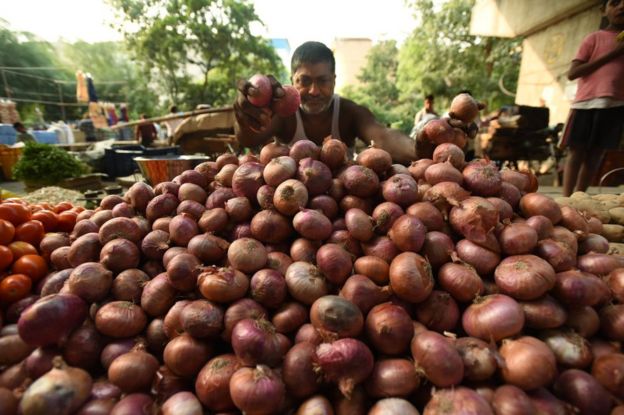
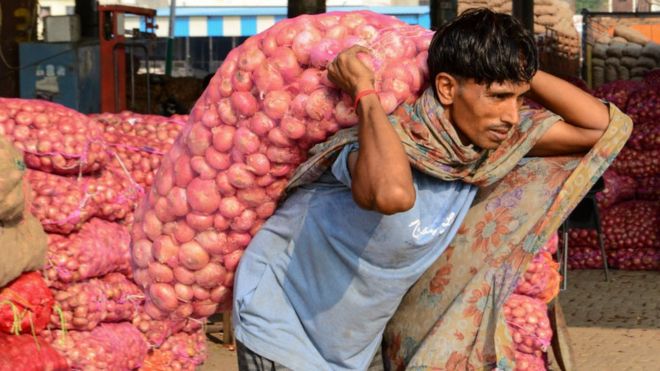
A labourer carries a sack of onions at a wholesale vegetable market on the outskirts of Amritsar on September 19, 2019.Image copyright GETTY IMAGES
Image caption The onion is India’s most “political” vegetable

Onion prices have yet again dominated the headlines in India over the past week. BBC Marathi’s Janhavee Moole explains what makes this sweet and pungent vegetable so political.

The onion – ubiquitous in Indian cooking – is widely seen as the poor man’s vegetable.

But it also has the power to tempt thieves, destroy livelihoods and – with its fluctuating price a measure of inflation – end the careers of some of India’s most powerful politicians.

With that in mind, it’s perhaps unsurprising those politicians might be feeling a little concerned this week.

So, what exactly is happening with India’s onions?

In short: its price has skyrocketed.

Onion prices had been on the rise in India since August, when 25 rupees ($0.35; £0.29) would have got you a kilo. At the start of October, that price was 80 rupees ($1.13; £0.91).

Fearing a backlash, the Bharatiya Janata Party (BJP)-led government banned onion exports, hoping it would bring down the domestic price. And it did.

Vegetable vendors sell onions by the road, at Sector 25 on September 24, 2019 in Noida, India.Image copyright GETTY IMAGES
Image caption Onion prices peaked by the end of September

A kilo was selling for less than 30 rupees on Thursday at Lasalgaon, Asia’s largest onion wholesale market, located in the western state of Maharashtra.

However, not everyone is happy.

While high prices had angered consumers in a sluggish Indian economy, the fall in prices sparked protests by exporters and farmers in Maharashtra, where state elections are due in weeks.

And it is not just at home where hackles have been raised: the export ban has also strained trade relations between India and its neighbour, Bangladesh, which is among the top importers of the vegetable.

But why does the onion matter so much?

The onion is a staple vegetable for the poor, indispensable to many Indian cuisines and recipes, from spicy curries to tangy relishes.

“In Maharashtra, if there are no vegetables or you can’t afford to buy vegetables, people eat ‘kanda bhakari’ [onion with bread],” explains food historian Dr Mohseena Mukadam.

True, onions are not widely used in certain parts of the country, such as the south and the east – and some religious communities don’t eat them at all.

But they are especially popular in the more populous northern states which – notably – send a higher number of MPs to India’s parliament.

“Consumers in northern India wield more power over the federal government. So although consumers in other parts of India don’t complain as much about higher prices, if those in northern India do, the government feels the pressure,” says Milind Murugkar, a policy researcher.

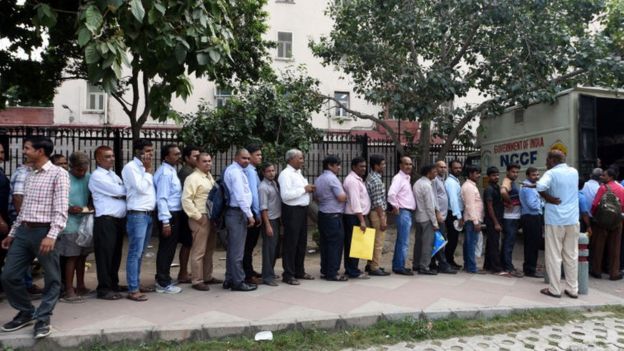
People stand in a queue to buy onions sold at Rs. 22 per kg by the Government of India, outside Krishi Bhawan on September 24, 2019 in New Delhi, India.Image copyright GETTY IMAGES
Image caption Onions are so ubiquitous that the government has been selling them at subsided rates

A drop in prices also affects the income of onion farmers, mainly in Maharashtra, Karnataka in the south and Gujarat in the west.

“Farmers see the onion as a cash crop that grows in the short term, and grows well in dry areas with less water,” says Dipti Raut, a journalist, who has been on the “onion beat” for years.

“It’s like an ATM machine that guarantees income to farmers and sometimes, their household budget depends on the onion produce,” she said.

Onions have even attracted robbers: when prices skyrocketed in 2013, thieves tried to steal a truck loaded with onions, but were caught by the police.

Why do politicians care about the onion?

Put simply, because the price moving too far one way or another is likely to anger a large block of voters, be they everyday households, or the country’s farmers.

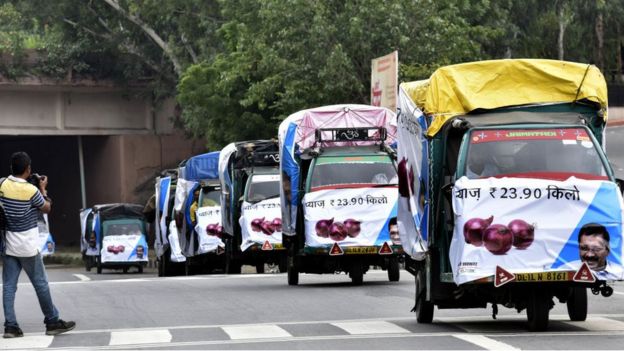
Control rate onion vans seen after flagged off by Chief Minister of Delhi Arvind Kejriwal, at Delhi secretariat, on September 28, 2019 in New Delhi, India.Image copyright GETTY IMAGES
Image caption The Delhi government transported 70 vans full of subsidised onions

Onions are so crucial they have even featured in election campaigns. The Delhi state government bought and sold them at subsidised rates in September when prices were at their peak: chief minister Arvind Kejriwal, it should be noted, is up for re-election next year.

Meanwhile, Indira Gandhi swept to power in 1980 on slogans that used soaring onion prices as a metaphor for the economic failures of the previous government.

But why did onion prices rise this year?

A drop in supply, due to heavy rains and flooding destroying the crop in large parts of India, and damaging some 35% of the onions stocks in storage, according to Nanasaheb Patil, director of the National Agricultural Co-operative Marketing Federation.

He said the flooding had also delayed the next round of produce, which was due in September.

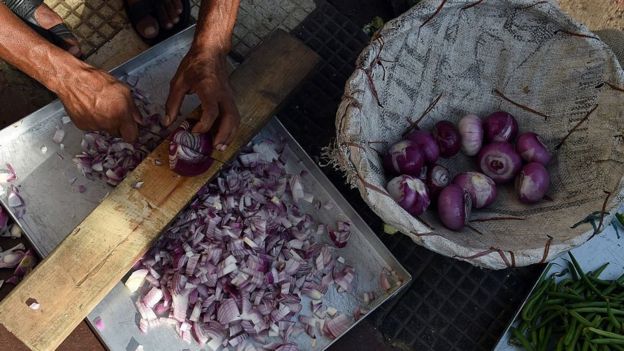
An Indian restaurant worker cuts onions for curries in New Delhi on September 11, 2015.Image copyright GETTY IMAGES

“This has become a fairly regular phenomenon in recent decades,” Mr Murugkar said. “Onion prices swing heavily with a small drop or increase in production.”

In fact, the shortage – and subsequent rise in prices – happens almost every year around this time, according to Ms Raut.

“It’s a vicious cycle and the trader lobby and middlemen benefit from even the slightest price fluctuations,” she added.

What’s the solution?

Ms Raut says more grass-root planning and better storage facilities and food processing services will ease the problem – and making a variety of cash crops and vegetables available across the country would also ease the pressure on onions.

“The government is quick to act when onion prices rise. Why don’t they act as swiftly when prices fall?” asked Vikas Darekar, an onion farmer in Maharashtra. He said the government should buy onions from farmers at a “fair price”.

Mr Murugkar, however, feels that the government should never interfere in “onion matters”.

“If you are interested in raising purchasing power of the people, they should not curtail exports. Do we have such a ban on software exports? It’s really absurd. A government which has won such a huge majority should be able to withstand the pressures from a few consumers.”

Source: The BBC

Law of Unintended Consequences

continuously updated blog about China & India

ChiaHou's Book Reviews

continuously updated blog about China & India

What's wrong with the world; and its economy

continuously updated blog about China & India