Archive for ‘slums’

31/05/2020

India coronavirus: Why is India reopening amid a spike in cases?

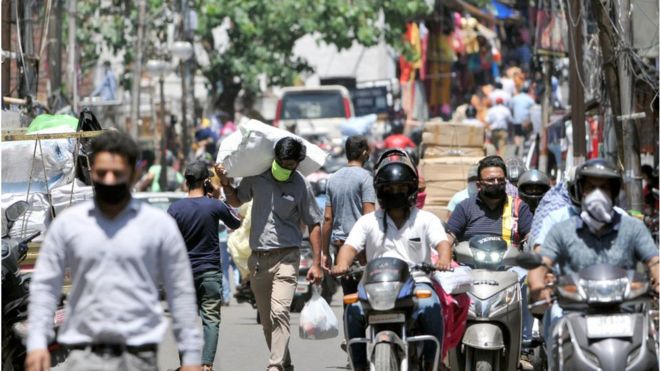
A rush of people and motorists in a marketplace area as shops start opening in the city under specific guidelines, on May 20, 2020 in Jammu, IndiaImage copyright GETTY IMAGES
Image caption Within a week of reopening, India has seen a sharp spike in cases

India is roaring – rather than inching – back to life amid a record spike in Covid-19 infections. The BBC’s Aparna Alluri finds out why.

On Saturday, India’s government announced plans to end a national lockdown that began on 25 March.

This was expected – the roads, and even the skies, have been busy for the last 10 days since restrictions started to ease for the first time in two months. Many businesses and workplaces are already open, construction has re-started, markets are crowded and parks are filling up. Soon, hotels, restaurants, malls, places of worship, schools and colleges will also reopen.

But the pandemic continues to rage. When India went into lockdown, it had reported 519 confirmed cases and 10 deaths. Now, its case tally has crossed 173,000, with 4,971 deaths. It added nearly 8,000 new cases on Saturday alone – the latest in a slew of record single-day spikes.
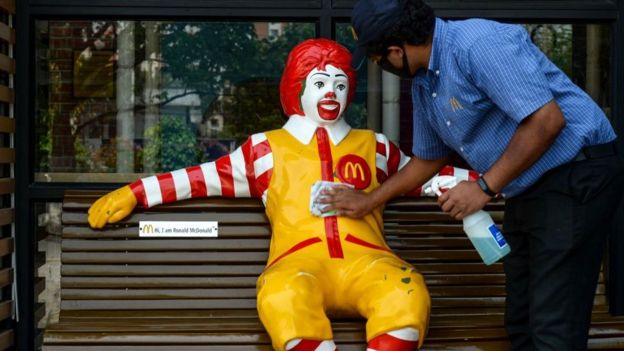
A worker cleans the mascot of fast-food company McDonald's for the reopening of the outlet in Hyderabad on May 20.Image copyright GETTY IMAGES
Image caption Fast food chains like McDonald’s have begun reopening outlets in parts of India.

So, why the rush to reopen?

The lockdown is simply unaffordable

“It’s certainly time to lift the lockdown,” says Gautam Menon, a professor and researcher on models of infectious diseases.

“Beyond a point, it’s hard to sustain a lockdown that has gone on for so long – economically, socially and psychologically.”

From day one, India’s lockdown came at a huge cost, especially since so many of its people live on a daily wage or close to it. It put food supply chains at risk, cost millions their livelihood, and throttled every kind of business – from car manufacturers to high-end fashion to the corner shop selling tobacco. As the economy sputtered and unemployment rose, India’s growth forecast tumbled to a 30-year-low.

Raghuram Rajan, an economist and former central bank governor, said at the end of April that the country needed to open up quickly, and any further lockdowns would be “devastating”.

The opinion is shared by global consultant Mckinsey, whose report from earlier this month said India’s economy must be “managed alongside persistent infection risks”.
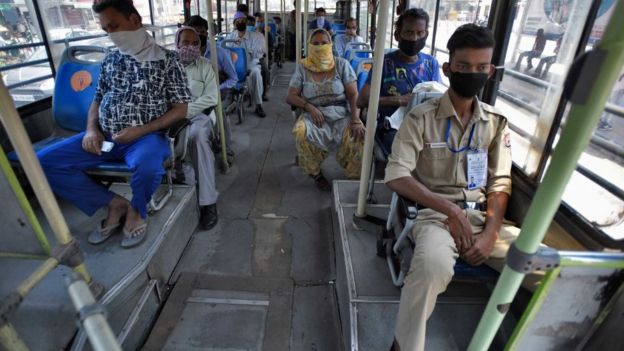
Passengers maintaining social distance as they are on board in a DTC Bus after government eased lockdown restriction, at AIIMS on May 20, 2020 in New Delhi, India.Image copyright GETTY IMAGES
Image caption As restrictions ease, Indians are slowly getting used to the new normal

“The original purpose of the lockdowns was to delay the spike so we can put health services and systems in place, so we are able handle the spike [when it comes],” says Dr N Devadasan, a public health expert. “That objective, to a large extent, has been met.”

In the last two months, India has turned stadia, schools and even train coaches into quarantine centres, added and expanded Covid-19 wards in hospitals, and ramped up testing as well as production of protective gear. While grave challenges remain and shortages persist, the consensus seems to be that the government has bought as much time as possible.

“We have used the lockdown period to prepare ourselves… Now is the time to revive the economy,” Delhi Chief Minister Arvind Kejriwal said last week.

The silver lining

For weeks, India’s relatively low Covid-19 numbers baffled experts everywhere. Despite the dense population, disease burden and underfunded public hospitals, there was no deluge of infections or fatalities. Low testing rates explain the former, but not the latter.

In fact, India made global headlines not for its caseload but for its botched handling of the lockdown – millions of informal workers, largely migrants, were left jobless overnight. Scared and unsure, many tried to return home, often desperate enough to walk, cycle or hitchhike across hundreds of kilometres.

Perhaps the choice – between a virus that didn’t appear to be wreaking havoc yet, and a lockdown that certainly was – seemed obvious to the government.

But that is changing quickly as cases shoot up. “I suspect we will keep finding more and more cases, but they will mostly be asymptomatic or will have mild symptoms,” Dr Devadasan says.

The hope – which is also encouraging the government to reopen – is that most of India’s undetected infections are not severe enough to require hospitalisation. And so far, except in Mumbai city, there has been no dearth of hospital beds.

India’s Covid-19 data is spotty and sparse, but what it does have suggests that it hasn’t been as badly hit by the virus as some other countries.

The government, for instance, has been touting India’s mortality rate as a silver lining – at nearly 3%, it’s among the lowest in the world.

But some are unconvinced by that. Dr Jacob John, a prominent virologist, says India has never had, and still doesn’t have, a robust system for recording deaths – in his view, the government is certainly missing Covid-19 deaths because they have no way of knowing of every fatality.
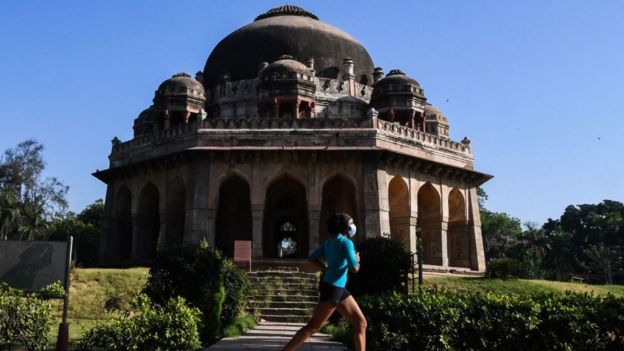
A woman jogs at Lodhi Garden after the local government eased restrictions imposed as a preventive measure against the spread of the COVID-19 coronavirus in New Delhi on May 21, 2020.Image copyright GETTY IMAGES
Image caption Indians are venturing out again but it’s unclear how many of them are asymptomatic.

And, he says, “what we must aim for is flattening the mortality curve, not necessarily the epidemic curve”.

Dr John, like several other experts, also predicts a peak in July or August, and believes the country is reopening so quickly because the “government realised the futility of such leaky lockdowns”.

A shift in strategy

So is the government gearing up for another lockdown when the peak comes?

While Dr Menon believes the lockdown was well-timed, he says it was too focused on cases coming from abroad.

“There was a hope that by controlling that, we could prevent epidemic spread, but how effective was our screening [at airports]?”

Now, he adds, is the time for “localised lockdowns”.
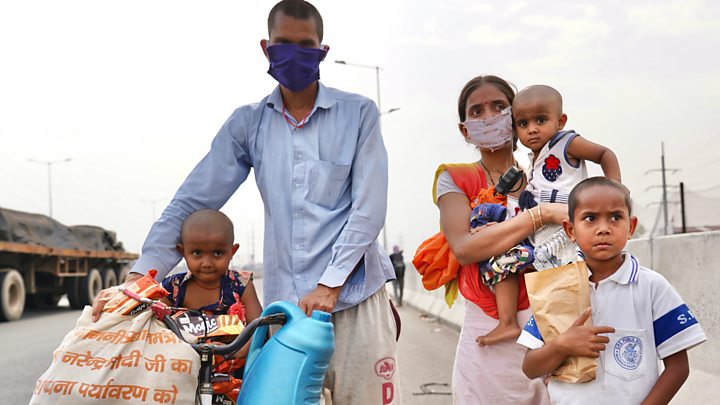
Media caption Coronavirus: Death and despair for migrants on Indian roads

The federal government has left it to states to decide where, how and to what extent to lift the lockdown as the virus’ progression varies wildly across India.

Maharashtra alone accounts for more than a third of India’s active cases. Add Tamil Nadu, Gujarat and Delhi, and that makes up 67% of the national total.

But other states – such as Bihar – are already seeing a sharp uptick as migrant workers return home.

“Initially, most of your cases were in the cities,” Dr Devadasan says. “But we kept the migrant workers in cities and didn’t allow them to go home. Now, we are sending them back. We have facilitated transporting the virus from urban areas to rural areas.”

While the government has said how many infections have been avoided – up to 300,000 – and lives saved – up to 71,000 – by the lockdown, there is no indication of what lies ahead.

There is only advice: The day the government began to ease restrictions, Mr Kejriwal tweeted, urging people to “follow discipline and control the coronavirus disease” as it was their “responsibility”.
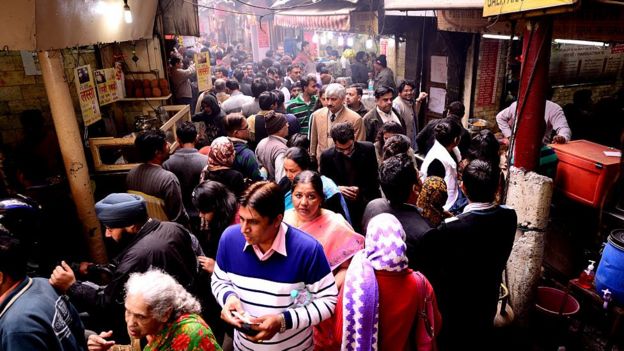
The famous Paranthe wali gali (bylane of fried bread) in Chandni Chowk, on August 20, 2014 in New Delhi, India.Image copyright GETTY IMAGES
Image caption Social distancing will prove to be India’s biggest post-lockdown challenge

Because the alternative – of curfews and constant policing – is unsustainable.

“My worry is more the circumstances of people – it’s not as though they have an option to practise social distancing,” Dr Menon says.

And they don’t – not in joint family homes or one-room hovels packed together in slums, not in crowded markets or busy streets where jostling is second nature, or in temples, mosques, weddings or religious processions where more is always merrier.

The overwhelming message is that the virus is here to stay, and we have to learn to live with it – and the only way to do that, it appears, is to let people live with it.

Source: The BBC
01/04/2020

TikTok, a Chinese soft-power time bomb in US living rooms?

  • The coronavirus has fuelled explosive growth of the app, which now has 800 million users, few of whom will know it is owned by China’s ByteDance
  • While videos of dancing teens may seem benign, there are growing fears in America it could be a Trojan Horse for mass surveillance by Beijing
TikTok is seen by some as the latest front in the US-China tech war. Photo: Shutterstock
Your average, not-so-hip adult would have probably drawn a blank at the mention of

TikTok

not long ago – unless they have a child addicted to the wildly popular app, on which users make and share short, amusing videos.

It has grown explosively since its 2016 launch, with 800 million monthly active users now – 300 million of them outside China in places such as India (120 million) and the 
United States

(37 million). And many have no idea it is owned by a Chinese company, ByteDance.

The first Chinese app to mount a real global challenge to Facebook and Instagram, it is seen as one of the shiniest new weapons in the US-China technology war. And a boost, perhaps, to Chinese soft power.
TikTok, the missing link between Hong Kong and Indian protesters?
9 Feb 2020
It experienced a growth spurt in 2019 that analysts predicted would slow a little this year. That, however, was before the coronavirus, which seems to be giving the app a bump, especially beyond its core teenage fan base.
As pandemic fears rise and millions are stuck indoors, major Hollywood celebrities such as Jennifer Lopez, 50, have taken to posting their own all-singing, all-dancing videos, which then go viral on other media platforms.
Even the World Health Organisation has jumped on the bandwagon, joining the app in late February to share public health advice.
The TikTok logo on a smartphone. Photo: Getty Images
But to some, the growth of TikTok is far from benign.

Privacy advocates and several US congressmen want to rein in the app over concerns it may censor and monitor content for the Chinese government, and be used for misinformation and election interference. This despite the fact that TikTok keeps its servers outside China and swears it will not hand over user data.

Are these fears justified – or fuelled by political and anticompetitive motives?

Thinkers such as Yuval Noah Harari warn that the coronavirus pandemic could be a watershed in the history of mass surveillance.
But Eric Harwit, a professor of Asian studies at the University of Hawaii, does not buy such arguments against TikTok, especially given that 60 per cent of its US users are aged 16 to 24.

“ByteDance has done a pretty good job of having a firewall between TikTok and the Chinese version of it, Douyin.

TikTok, iPhone: all you need to escape Mumbai’s slums – for 15 seconds

1 Nov 2019

“Also, many users in the US are teens and they’re not a particularly useful source of national security information.

“So I’d say the concerns are motivated more by a general fear of any kind of Chinese telecommunication application rather than actual attempts to siphon off valuable US intelligence information.

“And Facebook and other American companies have similar products,” Harwit points out. “US government officials will always want to protect American commercial interests.”

Sarah Cook, a China analyst for Freedom House – the US government-funded think tank – disagrees.

“We have concerns about how Facebook and Twitter deal with information affecting electoral politics, and that’s magnified if you’re talking about a Chinese company that now has a user base that rivals theirs.”

Chinese officials, she argues, have shown a willingness to censor and manipulate information well beyond their country’s borders – for instance, regarding the scale of the initial outbreak in Wuhan, an obfuscation that may have exacerbated its impact abroad.

“For those who think Chinese government censorship is only Chinese people’s problem, this pandemic shows how much that’s not the case.

“And even if it’s not happening right now with TikTok, the concern is that Chinese companies are beholden to their government, whether they want to be or not.

“I’m not saying block TikTok entirely,” she says. “It’s a question of looking at it in a democratic system and deciding on reasonable oversight and safeguards to protect users and information flows when that time comes.”

When it comes to expanding China’s cultural influence, though, neither Cook nor Harwit believes the app is especially effective.

Most people are oblivious to its Chinese origins, which the user experience does not reflect in any way. So there is no goodwill-generating soft power of the sort wielded by, say, 

South Korea

through the K-pop industry.

If anything, TikTok often promotes the increasingly homogenous, Western-leaning culture seen on many globally popular social media apps.
So says Morten Bay, a lecturer in digital and social media at the University of Southern California’s Annenberg School for Communication and Journalism.
“A semi-Western culture, with small variations of local culture, is becoming the norm on social media. And Chinese soft power is difficult to assert because there’s no value difference.”
And even if Chinese tech companies keep taking bigger bites of the Western market, he is sceptical of China’s “ability to leverage that for soft power in a geopolitical sense”.

“Because there is a very big apparatus pushing against China in that regard. As soon as TikTok started gaining traction in the US, people came out against it, trying to make everyone aware of the privacy and geopolitical issues.

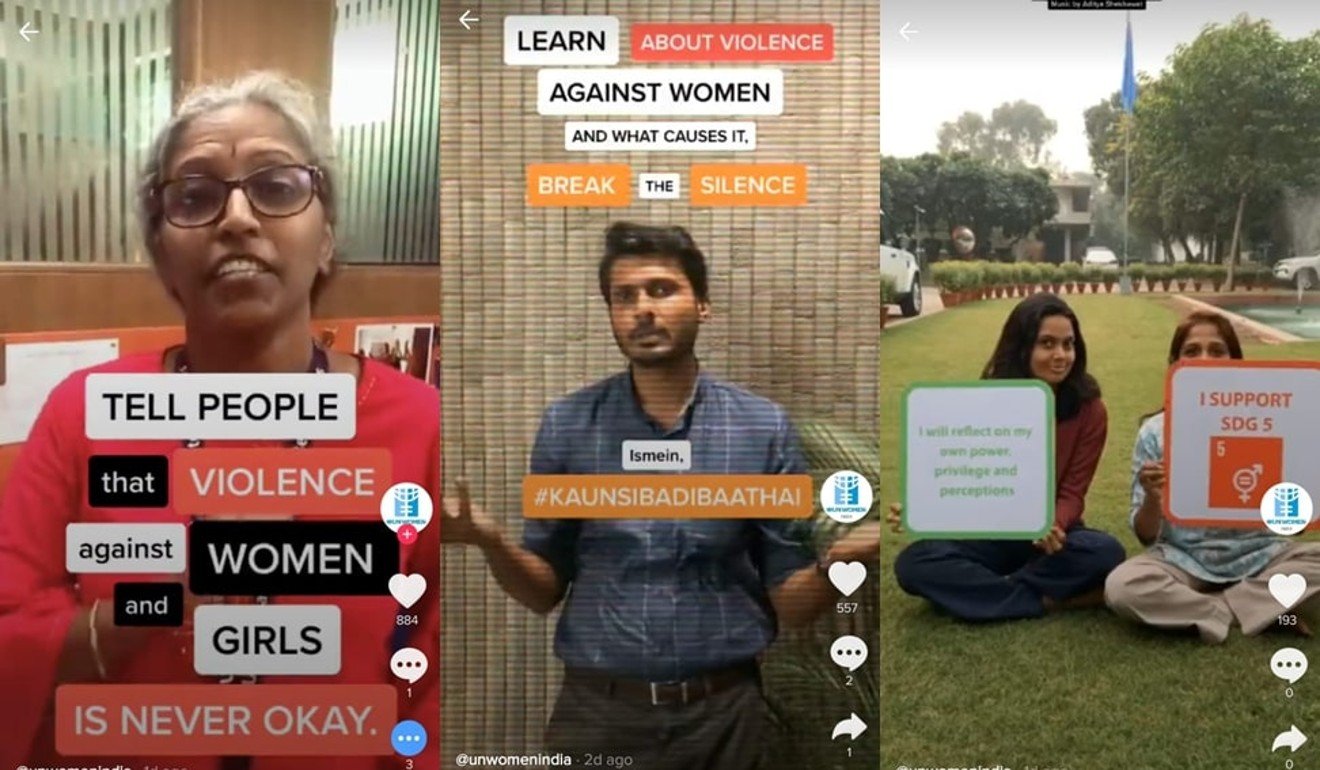
The #KaunsiBadiBaatHai campaign on TikTok aims to raise awareness about women's safety issues in India. Image: TikTok
The #KaunsiBadiBaatHai campaign on TikTok aims to raise awareness about women’s safety issues in India. Image: TikTok
“So China faces a lot of resistance,” Bay concludes. “And I’m not sure a social media platform on its own can do much about that.”
Still, if you had to back a horse in this race, TikTok would be it, says Zhang Mengmeng.

When she and her colleagues from global industry analysis firm Counterpoint Research visited the company, they were impressed by its research and development capabilities.

“Because they’re a very young company, their pace for incubating new projects is a lot faster, especially compared to successful but older internet companies in China which have been around for 15 to 20 years.

Indian invasion of Chinese social media apps sparks fear and loathing in New Delhi

28 Apr 2019

“They have lots of little start-up projects within the company and their organisational structure is very flat – it doesn’t matter what your age is, if you have a good idea, you get promoted very quickly.”

TikTok’s rise is also emblematic of a broader role reversal in the US-China tech war, she believes.

“Before, the US was more advanced in terms of internet development and China seemed to just copy its new ideas. Now, this is reversing. There are so many people in China using the internet that start-ups there can test ideas very easily.

“So now it seems like a lot of US companies are trying to see what ideas are coming out of China.” 

Source: SCMP

13/02/2020

Another wall goes up for Trump, this time in India

AHMEDABAD, India (Reuters) – U.S. President Donald Trump will be shielded from the sight of slums by a newly built wall when he visits the city of Ahmedabad during a visit to India this month.

A senior government said the wall was being built for security reasons, not to conceal the slum district.

But the contractor building it told Reuters the government “did not want the slum to be seen” when Trump passes by on the ride in from Ahmedabad’s airport.

“I’ve been ordered to build a wall as soon as possible, over 150 masons are working round-the-clock to finish the project,” the contractor said, speaking on condition of anonymity.

The government official conceded that the wall was part of a “beautification and cleanliness” drive.

Whatever the reason, the 400-meter-long and seven-feet-high wall will prevent the U.S. leader from getting a glimpse of a slum district that houses an estimated 800 families.

Trump, who has made his pledge to build a wall along the United States’ border with Mexico a feature of his presidency, will visit India on Feb. 24-25 to reaffirm strategic ties that have been buffeted by trade disputes.

He is expected to attend an event dubbed “Kem Chho Trump” (“How are you, Trump”) at a stadium in Ahmedabad along the lines of the “Howdy Modi” extravaganza he hosted for Indian Prime Minister Narendra Modi in Houston last September.

Speaking at the White House on Tuesday, Trump quoted Modi as saying “millions and millions of people” would attend the rally.

The event provides Trump, who was impeached in December, with the opportunity to woo the support of hundreds of thousands of Indian-American voters ahead of the U.S. presidential election in November.

But some slum dwellers whose homes will be cordoned off by the wall in Ahmedabad – the largest city in Modi’s home state of Gujarat – said the government was wasting tax-payer money to hide the poor.

“Poverty and slums are the reality of our life, but Modi’s government wants to hide the poor,” said Parvatbhai Mafabhai, a day worker who has lived there with his family for more than three decades.

Source: Reuters

Law of Unintended Consequences

continuously updated blog about China & India

ChiaHou's Book Reviews

continuously updated blog about China & India

What's wrong with the world; and its economy

continuously updated blog about China & India