Chindia Alert: You’ll be Living in their World Very Soon
aims to alert you to the threats and opportunities that China and India present. China and India require serious attention; case of ‘hidden dragon and crouching tiger’.
Without this attention, governments, businesses and, indeed, individuals may find themselves at a great disadvantage sooner rather than later.
The POSTs (front webpages) are mainly 'cuttings' from reliable sources, updated continuously.
The PAGEs (see Tabs, above) attempt to make the information more meaningful by putting some structure to the information we have researched and assembled since 2006.
SHANGHAI (Reuters) – China ordered on Saturday that anyone in Wuhan working in certain service-related jobs must take a coronavirus test if they want to leave the city.
The order comes after the central city, where the coronavirus emerged late last year, lifted a 70-day lockdown that all but ended the epidemic there.
People in Wuhan work in nursing, education, security and other sectors with high exposure to the public must take a nucleic acid test before leaving, the National Health Commission said in an order.
The government of Hubei province, of which Wuhan is capital, will pay for the tests, the commission said.
Since the city relaxed its lockdown restrictions people who arrived in there before Chinese New Year, when the virus was peaking in China, are allowed to go back to their homes.
People working in other sectors aiming to leave Wuhan are encouraged to take voluntary tests before going.
Within seven days of arrival at their destinations, people who can present test results showing they do not carry the virus, as well as a clean bill of health on a health app, can go back to work.
Everyone else will have to spend 14 days in quarantine before returning to work.
Authorities have worked with the China’s tech giants to devise a colour-based health code system, retrieved via mobile app, that uses geolocation data and self-reported information to indicate one’s health status.
Wuhan will speed up its efforts to investigate asymptomatic coronavirus cases and confirm the presence of antibodies in people, which might suggest immunity, the commission said.
Wuhan, which accounts for 60% of infections in China and 84% of the death toll as of Saturday, has been testing inhabitants aggressively throughout the virus’ breakout and many companies had already been asking workers from the city to undergo tests before resuming work.
Wuhan revised up its death toll from the coronavirus by 1,290 on Friday, taking the city’s toll to 3,869, because of incorrect reporting, delays and omissions, especially in the chaotic early stages of the outbreak, authorities said.
China national death toll is 4,632 from 82,719 cases.
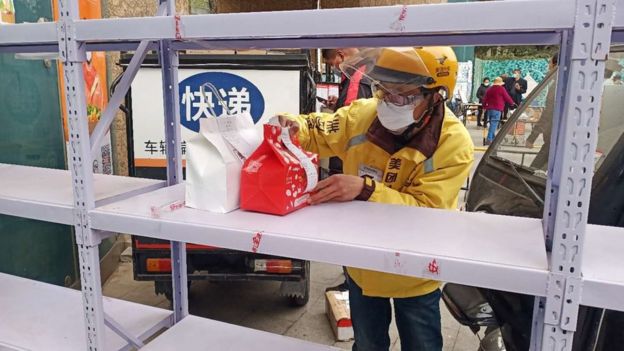
“Doctors and nurses are people who saved me from cancer and gave me strength in the darkest time. I need to return the favour,” says Li Yan, a food delivery rider based in Beijing.
Mr Li was diagnosed with lymph cancer in 2003, when he was just 17 years old. He recovered from the disease and has been full of gratitude ever since for the medical workers who nursed him back to health. With China in a national lockdown, food delivery firms found themselves in hot demand providing meals for residents stuck at home to prevent the spread of the coronavirus.
As a delivery rider for Meituan, one of China’s biggest food delivery firms, Mr Li saw an opportunity to repay the medical professionals he admires by providing them with food and drinks as they worked tirelessly on patients across the city. “Given my past experience, I felt I needed to do something for them in return during the virus outbreak,” he adds.
Beijing is a city of 21 million residents, and Mr Li covers its Tongzhou district, where there are a handful of hospitals with fever clinics, one of which is a designated hospital for Covid-19 treatment. “Many might have concerns delivering for the hospital, but I’ve chosen to deliver for them more often. I just think of the local residents and medical workers who need us. I can’t leave them being hungry. It’s not for money.”
Before the outbreak in China, he delivered more than 50 orders on an average day. But during the first ten days after the coronavirus outbreak in late January, the number of orders dropped to less than 20, as some restaurants were closed. The outbreak also coincided with the Chinese New Year period which is normally a low season.
“By mid-February when the situation was brought more under control, and people’s concerns and fears gradually began to ease, orders started to be restored. I can deliver over 40 orders a day now.”
Image copyright LI YAN
During this time, Meituan brought in a contactless delivery option which allowed food to be dropped off at designated points to avoid contact between customers and riders. “When I called customers to explain, some initially didn’t understand and wanted to cancel the order. But gradually people grew more understanding and began to welcome the contactless approach.”
Empty streets
China was in lockdown for more than two months, although restrictions are now beginning to be lifted. It will still take time before a sense of normalcy returns.
“I remember when the coronavirus first broke out, it was hazy for a few days in Beijing. Streets were empty and stores were closed. An ambulance or a delivery rider occasionally drove by. It felt like I was living in a different world.”
Mr Li says restaurants have started to re-open and people have begun coming back to work in the office since mid-February. Orders are still lower than normal but are improving.
“I miss the hustling Beijing which used to filled with traffic, the days when I could smell car exhaust when I stop at crossroads, the times when I had to walk all the way up to the 6th floor to deliver food, and even times when I was late for a delivery.”
Image copyright LI YAN
When the virus first broke out, face masks and alcohol disinfectant were the most ordered items along with supermarket groceries. “Grains, rice, cooking oil, vegetables, fruits, and solid, packaged food that lasts long. Orders often came in big sizes and transaction prices at around 200 yuan [£23; $28] to 300 yuan on one order.”
Being a food delivery rider, Mr Li feels he can not only give back to the medical community but to the city’s vulnerable too.
“I once received an order that came with a note saying the customer is a 82-year-old who lives alone and couldn’t get downstairs to pick up the food so the rider needs to enter the residential community and deliver food to the door. I had to spend some time communicating with security and finally was allowed in. The door was open when I arrived, and I put the bowl of wontons [a type of dumpling] on the table.”
Tips have increased from happy customers during the pandemic as a result. “Many more send me thank-you notes in the Meituan app and tell me to take care.”
Image copyright LI YAN
Keeping clean
Mr Li has a new routine now which involves lots of disinfecting and temperature checks. “I get my temperature checked dozens of times everyday now, before entering shopping malls, at restaurants, and returning home to the residential compound I live in. I also bring with me disinfectant sprays, a towel in my scooter and use disposable gloves when delivering to areas with reported confirmed cases.”
While he’s providing a vital service, is Mr Li worried about the risk of infection? “I did have worries when the virus spread and was at its worst time here but I feel like I’ve already been there, given what I went through in the fight against cancer.
“I’ve learnt to take things easy, look at the bright side of things and always seek strength in a dark time. As long as I take sufficient precautions, masks, gloves, disinfectants and everything, and follow advice from disease control experts, I think the possibility of getting the virus is pretty low.”
And with a seven-month pregnant wife at home, Mr Li is looking forward to happier times.
PARIS (Reuters) – Airbus (AIR.PA) has prolonged a planned closure of its final assembly plant in Tianjin, China, as a result of the coronavirus emergency, the planemaker said on Wednesday, adding it was monitoring for any signs of impact on deliveries.
It appears to be the first significant impact on aerospace production since the coronavirus outbreak, whose death toll has risen to nearly 500.
Airbus has said it is planning to raise output from the plant to six A320-family aircraft a month, just over 10% of Airbus narrowbody production, in early 2020 from a previous rate of four.
“The Tianjin final assembly line facility is currently closed,” Airbus said in a statement.
“Airbus is constantly evaluating the situation and monitoring any potential knock-on effects to production and deliveries and will try to mitigate via alternative plans where necessary.”
Industry sources said the Tianjin plant had been closed along with many businesses over the Chinese New Year but was due to reopen at the end of January.
The reopening has been suspended due to the virus outbreak hitting the logistics involved in keeping the line open.
Tianjin is one of two Airbus aircraft final assembly lines outside Europe, alongside a sister plant in Mobile, Alabama.
BEIJING, China (Reuters) – China ramped up measures to contain a virus that has killed 26 people and infected more than 800, suspending public transport in 10 cities, shutting temples over the Lunar New Year and even closing the Forbidden City and part of the Great Wall.
The week-long holiday to welcome the Year of the Rat began on Friday, raising fears the infection rate could accelerate as hundreds of millions of people travel to their homes and abroad in what is usually a festive time of year.
The World Health Organisation (WHO) has declared the new coronavirus an emergency for China but stopped short of declaring the epidemic of international concern.
While most of the cases and all of the deaths have been in China, the virus has been detected in Thailand, Vietnam, Singapore, Japan, South Korea, Taiwan and the United States. It was likely Britain also had cases, a health official said.
RELATED COVERAGE
‘What choice do I have?’ Lock-down strands millions in China’s Wuhan
WHO expects coronavirus cases to rise in China
The newly identified coronavirus has created alarm because it is too early to know just how dangerous it is and how easily it spreads between people.
Symptoms include fever, difficulty breathing and coughing.
Most of the fatalities have been elderly, many with pre-existing conditions, the WHO said.
Cases are likely to continue to rise in China but it is too soon to evaluate the severity of the virus, a WHO spokesman said on Friday.
As of Thursday, there were 830 confirmed cases and 26 people had died there, China’s National Health Commission said.
In Wuhan, where the outbreak began last month, pharmacies were running out of supplies and hospitals were flooded with nervous resident seeking medical checks.
“There’s so much news, so much data, every 10 minutes there’s an update, it’s frightening, especially for people like us in a severely hit area,” Lily Jin, 30, a resident of the city, told Reuters by phone.
While restrictions have already been put in place in cities across the country to curb the outbreak, China will take stricter and more targeted measures, state television reported citing a state council, or cabinet, meeting on Friday, but gave no further details.
“The spread of the virus has not been cut off … Local authorities should take more responsibility and have a stronger sense of urgency,” state broadcaster CCTV said.
Most cases have been in Wuhan, where the virus is believed to have originated in a market that traded illegally in wildlife. Preliminary research suggested it crossed to humans from snakes.
The city of 11 million people, and neighboring Huanggang, a city of about 7 million, were in virtual lockdown.
Nearly all flights at Wuhan’s airport had been canceled, and airports worldwide have stepped up the screening of passengers from China.
Checkpoints blocked the main roads leading out of town, and police checked incoming vehicles for wild animals.
Wuhan was rushing to build a 1,000-bed hospital for the infected by Monday, the official Changjiang Daily reported.
About 10 people got off a high-speed train that pulled into Wuhan on Friday afternoon but nobody got on before it resumed its journey. Although it stopped there, Wuhan had been removed from the train’s schedule.
“What choice do I have? It’s Chinese New Year. We have to see our family,” said a man getting off the train who gave his family name Hu.
CHINA EMERGENCY
The WHO said on Thursday it was a “bit too early” to designate the outbreak a public health emergency of international concern, which would require countries to step up their response.
Some experts believe the virus is not as dangerous as the one that caused the 2002-03 outbreak of Severe Acute Respiratory Syndrome, which also began in China and killed nearly 800 people, or the one that caused Middle East Respiratory Syndrome, which has killed more than 700 people since 2012.
There is no known vaccine or particular treatment.
“There is some work being done and there are some trials now for MERS (vaccines). And we may look at some point whether those treatments and vaccines would have some effect on this novel coronavirus,” WHO spokesman Tarik Jasarevic said on Friday.
Gilead Sciences Inc said it was assessing whether its experimental Ebola treatment could be used. Meanwhile, three research teams were starting work on vaccines, the Coalition for Epidemic Preparedness Innovations said.
In the meantime, Chinese authorities have imposed restrictions on movement and gatherings to try to stem the spread. It has advised people to avoid crowds and 10 cities in the central province of Hubei, where Wuhan is located, have suspended some transport, the Hubei Daily reported.
Some sections of the Great Wall near Beijing will be closed from Saturday, state media said.
Some temples have also closed, including Beijing’s Lama Temple where people make offerings for the new year, have also been closed as has the Forbidden City, the capital’s most famous tourist attraction.
Shanghai Disneyland will close from Saturday. The theme park has a 100,000 daily capacity and sold out during last year’s Lunar New Year holiday.
The virus is expected to dent China’s growth after months of economic worries over trade tensions with the United States, unnerving foreign companies doing business there.
Shares in luxury goods firms have suffered from the anticipated drop in demand from China, and on Friday French spirits group Remy Cointreau said it was “clearly concerned” about the potential impact.
Chinese President Xi Jinping, also general secretary of the Communist Party of China Central Committee and chairman of the Central Military Commission, beats a wooden drum of the Wa ethnic group three times to bless the coming year in Sanjia Village in the city of Tengchong, southwest China’s Yunnan Province, Jan. 19, 2020. Xi has extended Chinese New Year greetings to all Chinese people during a three-day inspection tour to Yunnan Province which concluded Tuesday. (Xinhua/Ju Peng)
KUNMING, Jan. 21 (Xinhua) — Chinese President Xi Jinping has extended Chinese New Year greetings to all Chinese people.
He wished Chinese people of all ethnic groups a better life and the country greater prosperity in the new year.
Xi, also general secretary of the Communist Party of China (CPC) Central Committee and chairman of the Central Military Commission, made the remarks during a three-day inspection tour of southwest China’s Yunnan Province which concluded Tuesday.
During a visit to Sanjia Village in the city of Tengchong on Sunday afternoon, Xi learned about poverty alleviation efforts and called for efforts to speed up the development of ethnic minorities and areas with large ethnic minority populations.
After joining local villagers in making rice cakes, a traditional local festival food, Xi noted that shaking off poverty is the new starting point, calling for vigorously promoting rural vitalization after China completes the building of a moderately prosperous society in all respects.
According to local custom, Xi beat a wooden drum of the Wa ethnic group three times to bless the coming year.
Later that day, Xi went to the old town of Heshun, a gateway on the ancient Southern Silk Road, where he visited a village-level library built over 90 years ago.
Visiting the memorial hall of Ai Siqi, a renowned philosopher, Xi said the country needs a large number of talented individuals who can explain the adaptation of Marxism to the Chinese context well and who can use easy-to-understand language to spread the Party’s new theories to more ordinary households.
Visiting an ecological wetland of Dianchi Lake in Kunming on Monday, Xi stressed resisting the old way of developing the economy at the cost of the environment.
Dianchi Lake, once among the most polluted lakes in China, has seen its ecology greatly improved after years of conservation efforts.
Inspecting market supply for Chinese New Year at the Kunming International Convention and Exhibition Center, Xi demanded a sufficient supply of safe and reliable goods during the festival.
There, Xi extended Chinese New Year greetings to local residents, the Chinese people of all ethnic groups, compatriots in Hong Kong, Macao and Taiwan, and overseas Chinese nationals.
Xi then went to the former site of the National Southwest Associated University in Kunming. He stressed the close link between education and the fate and future of the country and noted that the goal of China’s education system is to nurture a new generation of capable young people who are well-prepared to join the socialist cause.
After hearing the work reports of the CPC Yunnan Provincial Committee and the provincial government on Tuesday morning, Xi encouraged Yunnan to break new ground in promoting ethnic unity and progress, pushing forward ecological conservation, and pursuing greater cooperation with South Asia and Southeast Asia.
Xi urged efforts to promote high-quality development, accelerate building a modernized economy, consolidate the achievements in poverty alleviation, boost the healthy and sustainable development of tourism, while continuing to fight air, water and soil pollution.
He also required further opening-up to neighboring countries, speeding up the building of connectivity networks and strengthening cultural and people-to-people exchanges.
Xi demanded efforts to strengthen governance capacity in border areas and areas with large ethnic minority populations, implement the plans to boost the development of ethnic minority areas and ethnic groups with small populations, step up the fight against cross-border crime, gangs and their “protective umbrellas,” and maintain the stability of border areas.
On the anti-poverty fight, Xi ordered focusing on areas with extreme poverty, preventing people from falling back into poverty due to illness, injury or the lack of follow-up policies, and further aligning developmental poverty relief with protective poverty relief.
On Party building, Xi said the “staying true to the Party’s founding mission” campaign should be regarded as a lifelong task for strengthening Party building among all Party members and a source of inspiration in the new era.
Chinese President Xi Jinping, also general secretary of the Communist Party of China Central Committee and chairman of the Central Military Commission, visits a village of the Wa ethnic group to extend his Chinese New Year’s greetings to the villagers in Qingshui Township of the city of Tengchong, southwest China’s Yunnan Province, Jan. 19, 2020. Xi visited Yunnan Province Sunday on an inspection tour ahead of Chinese New Year. (Xinhua/Ju Peng)
KUNMING, Jan. 19 (Xinhua) — Xi Jinping, general secretary of the Communist Party of China Central Committee, visited southwest China’s Yunnan Province Sunday on an inspection tour ahead of Chinese New Year.
Xi went to a village of the Wa ethnic group in Qingshui Township of the city of Tengchong Sunday afternoon to learn about poverty alleviation efforts and extend his Chinese New Year’s greetings to the villagers.
He also visited the old town of Heshun, a gateway on the ancient Southern Silk Road that linked China’s Sichuan and Yunnan with Myanmar and India, to learn about exchanges, historical and cultural inheritance, as well as ecological and environmental protection along the trade route.
LONDON, Feb. 12 (Xinhua) — China and UK should keep the long-term interests and larger picture in mind, look at each other’s development as opportunities, respect each other’s sovereignty, security and right to development, handle our differences properly and enhance strategic mutual trust, Chinese Ambassador to Britain Liu Xiaoming has said.
The Chinese diplomat made the remarks while attending the Chinese New Year Dinner by the Cities of London and Westminster Conservative Association on Monday night.
“If we compare China-UK relations to a building, it could not stand tall without a solid foundation. This foundation is the mutual confidence between our two countries,” he said.
Recalling that the world economy is under downward pressure, with surging protectionism and unilateralism making things doubly difficult. Against this situation, Liu said it is all the more important that China and the UK advocate free trade, oppose protectionism and promote open cooperation.
“We hope that the UK would continue to provide a fair, transparent and non-discriminatory business environment for Chinese companies. We hope you will make successful Chinese companies such as Huawei feel welcome here in Britain, and convince them that the UK is a trustworthy place to put their money,” said the Chinese ambassador.
Liu said both China and the UK are known for their profound cultural heritage and important contribution to the progress of human civilization.
“I hope that in the new year our two countries will continue to enhance cultural and people-to-people exchanges, and deepen mutual understanding and strengthen friendship.”
The ambassador also hoped that people from all walks of life in both China and UK will join hands to cement the foundation for a solid and magnificent edifice of bilateral relations.
British Prime Minister Theresa May sent a congratulatory message to the event, saying that it is an important moment to recognize the contribution of the Chinese community in London and across the whole of the United Kingdom.
“The Chinese community’s expanding business expertise, scientific inquiry and cultural heritage and traditions are of immense value to our country – not least here in London, where the vibrancy of Chinatown stands as a strong beacon for the Chinese community and a reminder of all that they have contributed to our society,” she said.
TAIYUAN, Feb. 9 (Xinhua) — More than 100 overseas students have been invited to an ancient town in north China’s Shanxi Province to join celebrations for Chinese New Year (Spring Festival), which falls on Feb. 5.
“An opening Pingyao welcomes you” is the celebration of the ancient town of Pingyao, running from Jan. 28 to Feb. 20. More than 100 students across the world participated in the opening ceremony on Jan. 28.
The students took part in celebrations, watching traditional performances, such as opera, acrobatics and magic shows, joining in the Spring Festival Gala, lantern shows, cultural exhibitions, and learning about the local customs.
Farhad Farzad, an Afghan student studying Chinese in a university in the city of Taiyuan, Shanxi’s capital, said it was the first time for him to celebrate Spring Festival. He wrote “happy new year” in Chinese with a writing brush.
Chisom Nwosu, from Nigeria, said that the festival atmosphere in Pingyao was jubilant and the performances were great. It was her chance to gain a better understanding of traditional Chinese folk culture.
Pingyao became a UNESCO world cultural heritage in 1997. It is famous for its well-preserved ancient city walls.
In the 1980s, there were rarely foreign visitors in Pingyao. However, the figure soared to 115,000 last year. The ancient town has received more than 1.5 million foreign tourists since 1997.
NEW YORK, Feb. 7 (Xinhua) — While Chinese New Year celebrations are in full swing in China, cultural activities held across North America to mark the most important festival of China are no less enthralling, spreading the joy to the other side of the Pacific.
Dragon and lion dances, Chinese cuisines, Peking opera performances, light shows… a flurry of events in the United States and Canada have deepened people’s understanding of the meaning and charm of the festival. And sometimes, they may even find themselves a bit richer when they are bestowed with red packets of “lucky money,” part of the festival tradition.
A FEAST FOR EYES AND PALATES
Chinese Lunar New Year, or Spring Festival, fell on Feb. 5 this year. In China, celebrations begin about a week in advance and end with the Lantern Festival on the 15th day of the new year. It is an occasion for family members to reunite, bid farewell to the past year and celebrate the advent of a new spring, with its promise of renewal and hope.
The value placed in family and the universal wish for a new start partly explain why the traditional Chinese festival can so easily transcend borders and be embraced elsewhere. For kids who are not worldly enough to grasp the significance behind it, colorful events such as dragon dances and delicious Chinese food prove to be reason enough to enjoy the festival.
In New York, the landmark Empire State Building was glowing red, blue and yellow on Monday and Tuesday for the Chinese New Year. It is for the 19th consecutive year that the 443-meter skyscraper above midtown Manhattan shone in honor of the Chinese New Year.
The light show event will allow “native New Yorkers to experience a bit of beauty of the Chinese traditional cultural festival,” said Chinese Consul General in New York Huang Ping.
In Times Square, an array of calligraphers from both China and the United States on Tuesday gave away their handwritings of “Fu,” a Chinese character meaning fortune and luck, and red scarfs printed with the same character to hundreds of visitors at the “Crossroad of the World.” Receivers of the gifts, upon learning the meaning of Fu character, were filled with joy and expressed their best wishes to the Chinese people around the world.
During an NBA game at Madison Square Garden on Wednesday, spectators enjoyed dragon and lion dances during halftime. They also received giveaways including red packets as well as pig dolls as the New York Knicks team celebrated the Chinese lunar Year of the Pig. A spectator won 600 U.S. dollars during a game called ‘Name the Pig.’
In Chicago, more than 70 guests crowded a Chinese restaurant on Monday to enjoy traditional Chinese cuisine and the legendary “face-changing” performance. Performers of “face-changing” instantly switched masks by raising a hand, swinging a sleeve or tossing the head, to the thunderous applause and cheers from the audience.
“It is amazing and exciting. I have never seen it before,” Rhonda McDonald, who came from the U.S. city of Houston to attend the celebration, told Xinhua, “I love Chinese food and Chinese culture. Every year, my kids and I celebrate the Chinese New Year.”
In San Francisco, Mayor London Breed, dressed in red that represents happiness and good luck in Chinese culture, on Tuesday launched official celebrations of Chinese New Year in the city’s Chinatown.
Among the crowd, a 15-year-old high school student named Logan said he was happy to be a part of the exciting celebrations, and he came for the event every year.
“Each new year is different, and I can always feel something new from the thrilling festivities,” Logan said.
Breed said that there will be a market fair this week in Chinatown, where one can find flowers and goodies, such as red packets for kids and oranges which in Chinese are a popular symbol for “good luck.” She will also attend San Francisco’s grand Chinese New Year Parade scheduled for Feb. 23, a Chinatown tradition that dates back to the 1860s.
The parade will feature beautiful floats, outfits, costumes, firecrackers, newly crowned Miss Chinatown U.S.A, as well as the dance performance of an 88-meter-long golden dragon operated by 180 men and women from a local martial arts group.
The Niagara Falls on Canada side was lit up in red to celebrate the Chinese New Year in Ontario, Canada on Tuesday. On the night of Jan. 28, the CN Tower in Toronto was lit up in red to celebrate the Chinese New Year, the fifth consecutive year to do so.
A FESTIVAL FOR CLOSER TIES
By celebrating the Chinese New Year together, people from both sides of the Pacific have deepened their understanding of each other’s cultures and made the ties closer, officials have said.
“There is no better way than to celebrate the Chinese New Year through cultural exchanges,” said David Whitaker, CEO of Choose Chicago, the official tourism organization for the city, on Tuesday as the city kick off Chinese New Year celebrations.
“The more we learn about China, the better we understand each other,” Whitaker told Xinhua.
During a show titled “Charming Beijing-Tianjin-Hebei” featuring Chinese artists performing folk music, Tai Chi, Peking opera, acrobatic and martial arts, on Jan. 25, Vice Mayor of Beverly Hills John Mirisch said his city enjoys a great relationship with China.
“We welcome the Chinese, and think sharing some of their interesting cultural experiences with American audiences right here in Beverly Hills makes us understand and appreciate each other more.”
The Empire State Building’s lighting of Lunar New Year serves as a symbol of friendship between the peoples of the United States and China, said Huang, the consul general.
After putting a Chinese couplet on the door of the governor’s office at the Missouri State Capitol in Jefferson City, Missouri Governor Mike Parson and First Lady Teresa Parson held a Chinese Lunar New Year reception at their mansion on Monday evening.
“I truly appreciate how the Asian American community has come from across the state to Jefferson City to celebrate the Lunar New Year in the Missouri State Capitol. We’re excited to have this opportunity to share the diversity and cultural traditions of all Missouri,” Parson said. “Rest assured that we will continue to lead the state with a noble vision and an open heart.”
Lion dance is performed during the 2019 Spring Festival parade in downtown Antwerp, Belgium, on Feb. 2, 2019. (Xinhua/Zheng Huansong)
BEIJING, Feb. 5 (Xinhua) — For centuries, the Lunar New Year has been the most important festival in China and a large part of Asia. People leave behind the worries and troubles of the past year and move on to a new spring full of hope and life.
Today, the festival has become a worldwide holiday as China plays a bigger role in world affairs and people all around the world share the wish to leave uncertainties behind and usher in a peaceful and prosperous year ahead. As the Chinese New Year falls on Tuesday, major cities across the globe are vying to hold the greatest celebration of this traditional festival outside China.
YEAR OF PIG
Tuesday marks the first day of the Year of the Pig in the Chinese Zodiac. The Chinese Zodiac is based on a twelve-year cycle, and each year in that cycle is under a certain animal sign. It is believed people are born with the positive traits of their zodiacs. For example, babies born in this Year of the Pig are expected to be kind and fortunate.
Peppa, the sweet little piglet from a British animated TV series, has become a media sensation in this Year of the Pig. A nationwide cinema release, “Peppa Celebrates Chinese New Year,” co-produced by Alibaba Pictures, debuted in China on Tuesday. Its promotional video named “What’s Peppa” went viral and clocked some 1.5 billion hits on Chinese social media platforms such as Weibo and Wechat.
“Peppa is the perfect ambassador for the Year of the Pig celebrations as it is the most iconic pig on screen,” said Oliver Dumont, president, Family & Brands, of the leading Canadian entertainment conglomerate Entertainment One (eOne), which owns Peppa Pig and is a co-producer of the movie.
Other than the Chinese film, a two-part episode special of Peppa Pig has been created specifically for the Chinese New Year. “This is a great opportunity to promote and share the Chinese language and culture all around the world,” Dumont said.
In the movie and TV episode, Peppa learns what the Chinese New Year is about and experiences many of its traditions with her family, teaching dozens of millions of fans about Chinese culture.
The Chinese New Year, also known as the Spring Festival, is the most important festival in China. Celebrations begin about a week in advance and end with the Lantern Festival on the 15th day of the new year. Receiving red packets of “lucky money,” having big family meals and welcoming the God of Wealth with deafening firecrackers are among the many highlights of the festivities.
WORLDWIDE PARTY
For other parts of the world, the Chinese New Year has become a great occasion to enjoy exotic food, culture and to party. Organizers in cities around the world are racking their brains vying to stage the most brilliant celebration outside China.
–In London
The Science Museum of Britain celebrated the Chinese New Year by hosting exhibitions on science development in China. While enjoying Chinese delicacies and new year traditions, visitors experienced ancient Chinese inventions through augmented reality glasses, learned about Chinese fossils and watched presentations on the recent development of Chinese space technology.
Aleksandar Zivanovic, an engineer and regular visitor of the museum, found the European Space Agency’s introduction of the Chinese space program most fascinating. “It’s a nice way to celebrate the Chinese New Year, and a good way to find out about Chinese culture and what’s going on in Chinese science,” he said.
Celebrations in London will last a month with a series of activities culminating in the Trafalgar Square parade on Feb. 10, which organizers say to be the biggest Chinese New Year celebration outside Asia.
–In Sydney
Sydney’s signature Harbor Bridge is glowing red and pink to provide a breathtaking setting for the Chinese New Year celebrations.
A spectacular 5-meter-tall matrix-style steel pig lantern glows by the landmark Sydney Opera House. Another 11 giant lanterns representing the remaining zodiac animals, including an elaborate eight-meter stack of monkeys, an electric sheep and a six-meter-tall inflatable ox, light up the Sydney Harbor.
Sydney has been celebrating the lunar new year for 22 years. This year’s events will include the lunar lanterns exhibition, Chinatown celebrations, community performances, dragon boat races and lion dances across the city. “It’s a celebration for our Asian community, but it’s a wonderful educational experience for the rest of us,” Mayor of Sydney Clover Moore said.
–In New York
The Empire State Building, landmark of Manhattan, New York, is glowing red, blue and yellow Monday for the Chinese New Year.
A window display featuring pigs in a traditional Chinese style has also been installed in the building’s lobby windows on Fifth Avenue. Visitors can appreciate pigs as portrayed in various art forms, including clay sculptures, paper cuts, sugar-figure blowing and lanterns.
It is for the 19th consecutive year that the Empire State Building, standing 443 meters above midtown Manhattan, shines in honor of the Chinese New Year.
New York is also known around the world for the splendid firecracker shows that light up the Hudson River and parts of the city during Chinese New Year celebrations.
New York and some other U.S. states have made the lunar new year a public holiday. This is particularly unusual given that the Chinese New Year does not have a set date on the Gregorian calendar. Instead, it falls on a day between Jan. 21 and Feb. 20 each year.
In addition to being widely celebrated across the globe, the lunar new year is also a public holiday and important national festival in many countries such as Vietnam, Indonesia and South Korea.
The Chinese New Year has become an international event as its traditions and values touch the hearts of people all around the world. As Chinese President Xi Jinping has said, the vision, concepts and values of China’s traditional culture are also valuable for addressing the issues that humanity faces.
BEST WISHES FROM WORLD LEADERS
The Chinese New Year also offers an opportunity for foreign leaders to extend best wishes to the Chinese people, seeking closer ties with China, attracting Chinese tourists and consolidating support from Chinese communities.
For example, in a congratulatory video speech, Japanese Prime Minister Shinzo Abe spoke Chinese to wish the Chinese people a happy new year. He pledged to relax visa policies for Chinese students studying in Japan and called for more people-to-people exchanges between the two countries. Abe also expressed the wish that bilateral ties further improve in the new year.
New Zealand Prime Minister Jacinda Ardern posted her lunar new year’s wishes on social media. She took the opportunity to thank the Chinese community in New Zealand for its hard work and contributions. Ardern expressed the hope to strengthen ties with China, boosting cooperation in trade, education and tourism.
Pakistani President Arif Alvi, President of Argentina Mauricio Macri, President of Afghanistan Ashraf Ghani, Austrian President Alexander Van der Bellen and other world leaders also sent videos or messages to wish the Chinese people a happy lunar new year.




 CHINDIA ALERT: You'll be living in their world, very soon