Chindia Alert: You’ll be Living in their World Very Soon
aims to alert you to the threats and opportunities that China and India present. China and India require serious attention; case of ‘hidden dragon and crouching tiger’.
Without this attention, governments, businesses and, indeed, individuals may find themselves at a great disadvantage sooner rather than later.
The POSTs (front webpages) are mainly 'cuttings' from reliable sources, updated continuously.
The PAGEs (see Tabs, above) attempt to make the information more meaningful by putting some structure to the information we have researched and assembled since 2006.
BEIJING, May 28 (Xinhua) — Chinese lawmakers Thursday voted to adopt the country’s long-expected Civil Code at the third session of the 13th National People’s Congress, the top legislature.
The Civil Code will take effect on Jan. 1, 2021.
In addition to general provisions and supplementary provisions, the Civil Code, the world’s latest modern-day civil law, has six parts on real rights, contracts, personality rights, marriage and family, succession, and tort liabilities.
The personal rights, property rights and other lawful rights and interests of the parties to civil legal relations shall be protected by law and shall not be infringed upon by any organization or individual, reads the Civil Code in its opening chapter.
Lawmakers say the codification is not about formulating a new civil law but rather systematically incorporating existing civil laws and regulations, modifying and improving them to adapt to new situations while maintaining their consistency.
A major innovation of China’s Civil Code, jurists say, is embodied in the personality rights part. While some countries have related law provisions, few have a specific law book in civil code dedicated to protecting personality rights.
The personality rights part covers stipulations on a civil subject’s rights to his or her life, body, health, name, portrait, reputation and privacy, among others.
The personality rights part shows that China has reached a new height in protecting the dignity of people, said Chen Jingying, a national lawmaker and vice president of East China University of Political Science and Law.
The Civil Code is a milestone in developing the socialist legal system with Chinese characteristics, and will greatly boost the modernization of China’s system and capacity for governance, said Wang Yi, dean of the law school at Renmin University of China.
Every morning and night for the past four years, businessman Zhong Congrong has been on the streets of Chongqing to stop people dropping their litter
Admired as a welfare champion, the 54-year-old says he has been beaten and insulted for his cause
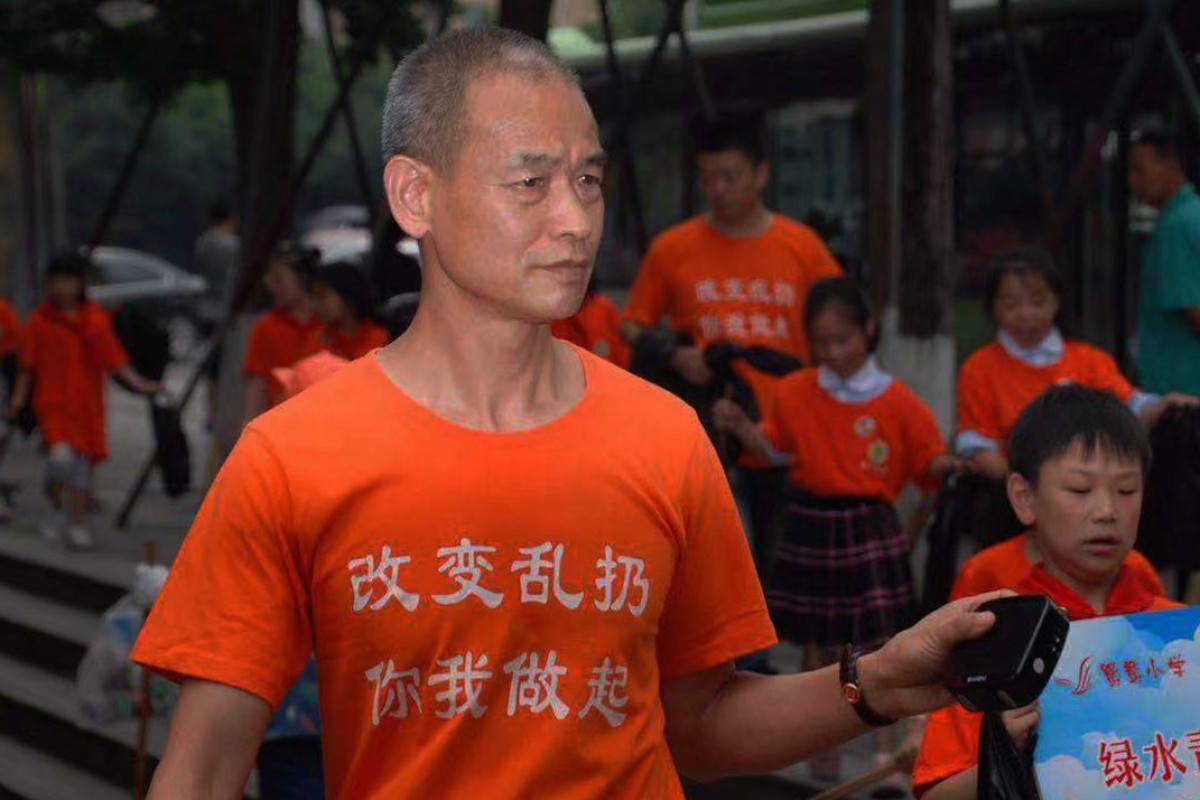
Zhong Congrong is a familiar figure on the streets of his hometown. Photo: Handout
Zhong Congrong owns three businesses in southwestern China which together are worth more than 100 million yuan (US$14.3 million), but he prefers to risk being labelled as an environment “nut” who wants to clean up Chongqing.
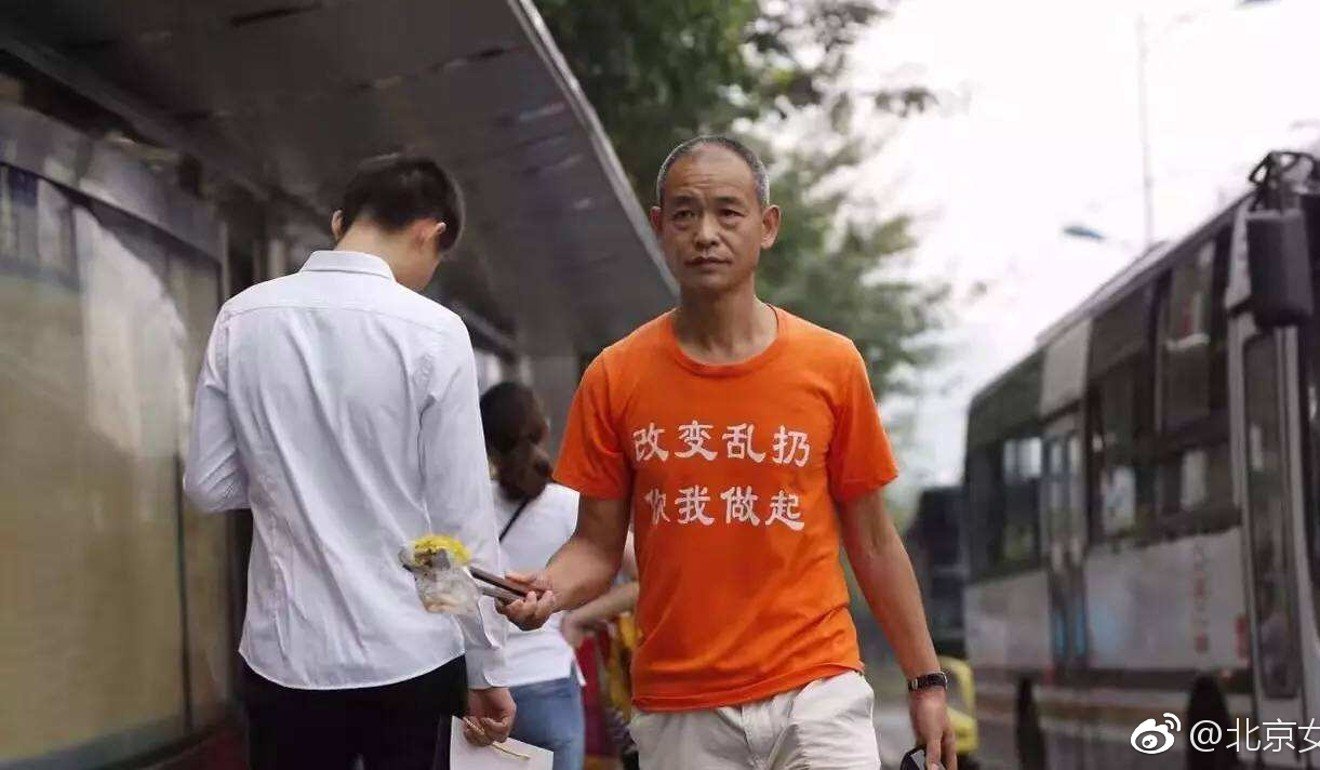
Every morning after breakfast and each evening after supper, the entrepreneur pulls on an orange T-shirt, gets into his Mercedes-Benz SUV and heads downtown. For one or two hours, he walks the streets, picking scraps of rubbish off the road and talking to passers-by about littering.
“It is my mission to change people’s bad habits and to raise their awareness of protecting the environment,” said Zhong, who has been on this mission for four years. It has brought the 54-year-old civic rewards, earned him a bruising or two from people who do not want to listen to his message and it nearly cost him his marriage.
Throughout it all, he has remained a persistent voice for the environment in the city of more than 30 million people and, as some of them have learned, he refuses to give up.
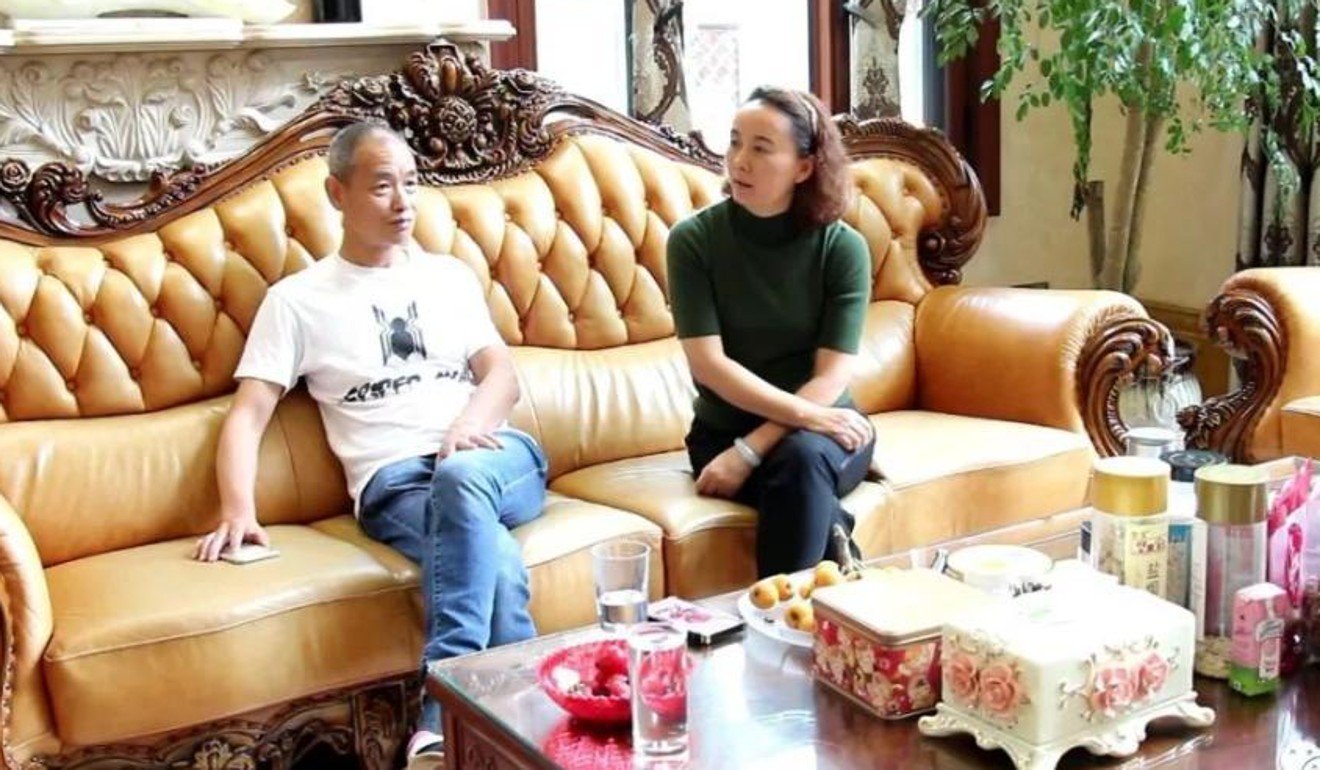
Yang Zuhui (right) has come to admire Zhong Congrong’s dedication to his litter picking mission, but she fears for her husband’s safety. Photo: Weibo
On mainland China, cities have banned littering and some hit offenders with fines as high as 200 yuan. However, the rules are rarely obeyed and feebly enforced, and while there are plenty of dustbins in public places, litter is still a nuisance.
Zhong said his mission started in 2015 after he met a woman in her 70s in Sanya, the southern coastal city on the South China Sea island of Hainan. He was struck by how dedicated she and her husband were when they went litter picking each day.
“They are retired professors from a prestigious university in Beijing,” Zhong said. “I chatted a lot with her and I asked her, ‘What’s the point of collecting rubbish every day? You clean up the beach today, but tomorrow new rubbish appears’.”
The way to solve the problem was to teach people to not litter, she told him, but she said she “dared not” try to do that. Zhong said that encounter gave him his purpose and he would dare to change attitudes.
Shanghai recycling scheme slips up on 9,000 tonnes of waste
Back home, Zhong watched and learned – concluding that customers of restaurants and fast food businesses tended to be the people who dropped rubbish most.
“Perhaps it’s because when people dine in restaurants, they throw their rubbish wherever they like. Going outside, they keep on doing it,” he said.
“People in shopping malls are generally more civilised.”
Zhong says his mission began in 2015 during a holiday on the island of Hainan. Photo: Dickson Lee
While on patrol, Zhong makes himself easy to see in an orange T-shirt that bears his clean-up message. His tools include a metal pincer for picking up tissue paper, plastic bags, drinks bottles, nappies and other everyday detritus and putting it into bins.
He also carries a voice recorder that sends out an appeal to restaurant customers: “To protect our environment and not to affect our kids’ healthy growing up, dear friends, please don’t throw rubbish.”
Can China sort its household waste recycling problem by 2020?
Zhong said that at first he felt afraid and self-conscious when he stood in front of a crowd of diners with his green gospel. But time and practise taught him he had almost nothing to fear, he said.
One of the bigger challenges is getting through to the many people who do not listen to him and refuse to dispose of their rubbish the right way.
“It’s normal that our society has various kinds of people and I need to face this reality,” Zhong said. “I was prepared in my mind that I would be called ‘nut’ since this is such an arduous but fruitless cause.”
He tackles the problem with his usual persistence, so argument and persuasion is all part of the job. When Zhong insists the rule breakers take their rubbish and bin it, some ignore him and others walk away – but he is ready with an answer.
“I tell them, ‘If you don’t pick it up, I guarantee that you will lose face today. I will let passers-by see and hear what a humiliating thing you have done. Everybody will then condemn you and you will be embarrassed’,” he said.
When people tell him what they do is none of his business, Zhong replies that what he is doing is in the public interest.
Sometimes there is a heavier price. Zhong said he once watched several men in their 20s throw rubbish onto the road from their car. He set off after them in his SUV. He waylaid them and asked them to clean up after themselves – the men refused, swore at him and beat him up. Their day ended in a police station.
Zhong said he hoped his work would bring “positive energy” to the employees of his vehicle components and packaging materials companies, but his mission was not about business prestige.
However, last year, he was named as one of the top 10 public welfare figures of Chongqing by the municipal government, while his family was honoured as a Chinese good family by the semi-governmental All-China Women’s Federation, a women’s rights organisation established in 1949.
Street cleaner who found US$22,000 in rubbish refuses to accept a reward
There were trials for Zhong closer to home – his wife, Yang Zuhui, did not support his mission at first and threatened to divorce him.
“It’s OK that you picked up trash on the street and you were just another cleaner there,” she told him in an interview with Hunan Television in 2017. “But what worried me was that you tried to persuade others – physical violence [against him] was inevitable.”
She also said: “My husband is not very tall and, on many occasions, he was at a disadvantage and got beaten up. I am worried about his personal safety.”
Zhong impressed his daughter’s schoolfriends with an inspiring speech. Photo: Weibo
But two years ago, their 10-year-old daughter helped change Yang’s attitude towards her husband’s mission after a school outing.
After lunch that day, Zhong gave the adults and children who had left rubbish behind one of his lectures.
His daughter, who was embarrassed by Zhong’s speech, came to appreciate him when classmates told her: “Your father is awesome. He is like a hero who protects the Earth.”
Yang was won over because she knew her husband was a determined man and once he decided on a course of action would not change his mind.
Their son – who is in his 20s and has returned to Chongqing after studying in France – always stands by his father, Zhong said.
“My son told me that environmental voluntary work normal abroad and it is respected,” he said.
Going out to collect rubbish has become part of Zhong’s life, he said.
“In the evening, if I stay at home, my wife and daughter will ask me ‘Why don’t you go to pick up rubbish?’”
He said it was important to go litter picking every day because the more he did it the more people he could influence.
“By breaking the littering habit, Chinese people can stand tall when they travel abroad,” Zhong said.
Image copyright HAMPSTEAD THEATREImage caption “Speaking out cost me my job, my marriage and my happiness at the time,” Dr Wang said
A whistleblower who exposed HIV and hepatitis epidemics in central China in the 1990s, potentially saving tens of thousands of lives, has died aged 59.
Dr Shuping Wang lost her job, was attacked, and had her clinic vandalised after she spoke out.
She died in Utah in the US, where she moved after the scandal.
A play inspired by her life is currently running in London, with the playwright calling her a “public health hero”.
Dr Wang never returned to China after leaving, saying it did not feel safe.
Why did Dr Wang speak out?
In 1991 in the Chinese province of Henan, Dr Wang was assigned to work at a plasma collection station. At the time, many locals sold their blood to local government-run blood banks.
It wasn’t long before she realised the station posed a huge public health risk.
Poor collection practices, including cross-contamination in blood-drawing, meant many donors were being infected with hepatitis C from other donors.
Undeterred, she reported the issue to the Ministry of Health. As a result, the ministry later announced that all donors would need to undergo hepatitis C screening – reducing the risk of the disease being spread.
But because of her whistleblowing, Dr Wang said, she was forced out of a job.
Her seniors said her actions had “impeded the business”. She was transferred, and assigned to work in a health bureau. But in 1995, she uncovered another scandal.
Image copyright HAMPSTEAD THEATRE
Dr Wang discovered a donor who had tested HIV positive – but had still sold blood in four different areas.
She immediately alerted her seniors to test for HIV in all the blood stations in Henan province. Again, she was told this would be too costly.
She decided to take things into her own hands, buying test kits and randomly collecting over 400 samples from donors.
She found the HIV positive rate to be 13%.
She took her results to officials in the capital, Beijing. But back home, she was targeted. A man she described as a “retired leader of the health bureau” came to her testing centre and smashed her equipment.
When she tried to block him, he hit her with his baton.
‘I’m not a man. I’m a woman’
In 1996, all the blood and plasma collection sites across the country were shut down for “rectification”. When they re-opened, HIV testing was added.
“I felt very gratified, because my work helped to protect the poor,” she said. But others were not happy.
At a health conference later that year, a high-ranking official complained about that “man in a district clinical testing centre [who] dared to report the HIV epidemic directly to the central government”.
“I stood up and said I’m not a man. I’m a woman and I reported this.”
Later that year, she was told by health officials that she ought to stop work. “I lost my job, they asked me to stay home and work for my husband,” Dr Wang said.
Her husband, who worked at the Ministry of Health, was ostracised by his colleagues. Their marriage eventually broke down.
Image copyright HAMPSTEAD THEATREImage caption A scene from The King of Hell’s Palace
In 2001, Dr Wang moved to the US for work, where she took the English name “Sunshine”.
Henan, the province that Dr Wang had worked in, was one of the worst hit.
The government later announced that a special clinic had been set up to care for those suffering from Aids-related illnesses.
Several years later, Dr Wang re-married and moved with her husband Gary Christensen to Salt Lake City, where she began working at the University of Utah as a medical researcher.
But her past followed her. In 2019, she said, Chinese state security officers made threatening visits to relatives and former colleagues in Henan, in an attempt to cancel the production of a play inspired by her life.
She refused, and the play titled “The King of Hell’s Palace” premiered at London’s Hampstead Theatre in September.
Dr Wang died on 21 September while hiking in Salt Lake City with friends and her husband. It’s thought she may have had a heart attack.
Image caption Dr Wang with playwright Frances Ya-Chu
“Speaking out cost me my job, my marriage and my happiness at the time, but it also helped save the lives of thousands and thousands of people,” she had told the Hampstead Theatre website in an interview just one month before her death.
“She was a most determined, relentless optimistic and most loving woman,” wrote her friend David Cowhig after news of her death.
“She chose the English name Sunshine for a reason. Perhaps her exuberance and love for the outrageous – made possible [the] perseverance she had.”
Image copyright KOREA FUTURE INITIATIVEImage caption The trade of North Korean women in China is said to be worth $100m a year for criminal organisations
Thousands of North Korean women and girls are being forced to work in the sex trade in China, according to a new report by a London-based rights group.
They are often abducted and sold as prostitutes, or compelled to marry Chinese men, says the Korea Future Initiative.
The trade is worth $100m (£79m) a year for criminal organisations, it says.
The women are often trapped because China repatriates North Koreans, who then face torture at home, it says.
“Victims are prostituted for as little as 30 Chinese yuan ($4.30; £3.40), sold as wives for just 1,000 yuan, and trafficked into cybersex dens for exploitation by a global online audience,” the report’s author Yoon Hee-soon said.
They are coerced, sold, or abducted in China or trafficked directly from North Korea. Many are sold more than once and are forced into at least one form of sexual slavery within a year of leaving their homeland, it adds.
Many are enslaved in brothels in districts in north-east China with large migrant worker populations.
The girls – some as young as nine – and women working in the cybersex industry are forced to perform sex acts and are sexually assaulted in front of webcams. Many of the subscribers are thought to be South Korean.
Women forced into marriage were mostly sold in rural areas for 1,000 to 50,000 yuan, and were raped and abused by their husbands.
Media caption North Korean defectors who had to escape twice
The group collected its information from victims in China and exiled survivors in South Korea.
One woman, named as Ms Pyon from Chongjin City, North Korea, is quoted as saying in the report:
“I was sold [to a brothel] with six other North Korean women at a hotel. We were not given much food and were treated badly…After eight months, half of us were sold again. The broker did bad things to me.”
“When I arrived [at the new brothel] I had bruises on my body. [The broker] was beaten then stabbed in the legs by some members of the gang.”
Another, Ms Kim, said: “There are many South Koreans [in Dalian, China]…We put advertising cards under their doors [in hotels]…The cards are in the Korean-language and advertise what we offer…We are mostly taken to bars [by the pimp].
“South Korean companies want [North Korean prostitutes] for their businessmen…Prostitution was my first experience of meeting a South Korean person.”
WHEN Da Lin moved in with his girlfriend two years ago, his mother tried to stop them: she feared that their living together unmarried would sully his girlfriend’s reputation and, by association, his too. She will be happy only after they finally marry next year (his family is buying the apartment, hers the car).
That generational clash is replicated in thousands of families across China: cohabitation without marriage was long anathema and officially illegal until 2001. Today it is commonplace.China’s social mores are changing astonishingly quickly. Before 1980 around 1% of couples lived together outside wedlock, but of those who wed between 2010 and 2012, more than 40% had done so, according to data from the 2010 and 2012 China Family Panel Studies, a vast household survey (see chart). Some reckon even that is an underestimate. A recent study by the China Association of Marriage and Family, an official body, found that nearly 60% of those born after 1985 moved in with their partner before tying the knot, which would put the cohabitation rate for young people on a par with that of America.
The number of unmarried couples living together is growing for many of the same reasons it has elsewhere: rising individualism, greater empowerment of women, the deferral of marriage and a decline in traditional taboos on pre-marital sex. Greater wealth helps—more couples can afford to live apart from their parents. Yet Chinese cohabitation has distinctive characteristics. In rich countries, living together is most common among poorer couples, but in China youngsters are more likely to move in together if they are highly educated and live in wealthy cities such as Beijing and Shanghai. Shacking up is seen as a sign of “innovative behaviour”, say Yu Xie of Princeton University and Yu Jia of the Chinese Academy of Social Sciences.
Elsewhere rising cohabitation represents the fraying of marriage: many couples never bother to wed. In China, however, cohabitation is almost always a prelude to marriage—as for Da Lin and his girlfriend—rather than an alternative to it. Marriage is still near-universal, although the skewed sex ratio resulting from China’s one-child policy and a cultural preference for boys has resulted in a surplus of poor rural men who will remain unhappily single. Some highly educated women in cities forgo marriage too.In some Western countries those who live together for an extended period enjoy some of the same legal rights and obligations as married couples. In China cohabitation carries no legal weight. And it is very hard for a child born out of wedlock to acquire a hukou, or residency permit, which provides access to health care, education or other public services.In the 1980s virginity was considered a woman’s chief asset and few couples dared to date openly, let alone live together. Now China is in the midst of a sexual revolution—some 70% of people have sex before marriage, according to a study conducted in 2012. Many young Chinese, however, still have conservative ideas about how their elders should behave: although cohabitation is also on the rise among the elderly, many of them avoid remarrying because their adult children oppose it.
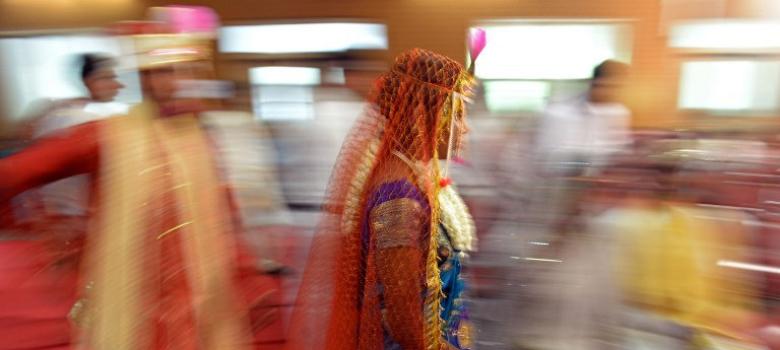
Caste and language are losing significance in urban India, at least as far as marriage is concerned, according to a survey of more than 400 single adults in Delhi, Mumbai and Bangalore. But other social traditions are not being forgotten: adults between the ages of 20 and 35 say the most important thing is that their partner respects elders and treats their spouse’s family just as they do their own.
More than half of the participants in the survey conducted by Floh, a forum for singles to meet and interact online and offline, said they would take the decision of whom to marry jointly with their parents. Only 22% believed that they could marry someone their parents did not entirely approve of. The respondents all came from similar socio-economic background, with at least an undergraduate degree and earning more than Rs 40,000 per month.
Floh founder Siddharth Mangharam believes that the survey shows that India treads its own path when it comes to social interactions. “We are not following some Western ideology, just 20 or 30 years behind,” he said.
Young urban Indians – and parents, who were also interviewed – seem to have unshakable faith in the idea that humans fall in love at first sight. When asked, 71% of single adults and 62% of parents said they were convinced the phenomenon existed. Most respondents’ main reason for being single was that they had not found the “right one”.
The Economist: “CHINA’s communists attacked many bourgeois institutions after taking power in 1949. But marriage was not one of them. On the contrary, they enacted a marriage law in 1950, four years before they introduced a constitution. The pressure to marry remains heavy in today’s China, where almost 80% of adults have tied the knot at some point, compared with only 68% in America. But today, in contrast to the 1950s, marriage is bound up with another bourgeois institution: property.
In China mortgages often precede marriages. According to popular belief, if a man and his family cannot buy property he will struggle to find a bride. In choosing a husband, three-quarters of women consider his ability to provide a home, according to a recent survey of young people in China’s coastal cities by Horizon China, a Beijing-based market-research firm. Even if a woman herself dismisses this criterion, her family and friends, not to mention the country’s estate agents, will not let her forget it.
“Naked marriages”, as property-less ones are known, are endorsed by increasing numbers of young people. But as they get older, their attitudes may regress faster than society’s progress. One 28-year-old Beijing woman married her husband after falling in love with him at college. But “if you introduced a man to me now, and he couldn’t afford a home, I wouldn’t marry him,” she says. “I need to be more realistic. I’m not a 20-year-old girl.”
Some economists argue that competition for brides in China’s marriage “market” helps explain the punishingly high prices in its property market. Houses are least affordable in those parts of China where men most outnumber women, argue Shang-jin Wei of Columbia University, Xiaobo Zhang of the International Food Policy Research Institute and Yin Liu of Tsinghua University (see chart).












 “Naked marriages”, as property-less ones are known, are endorsed by increasing numbers of young people. But as they get older, their attitudes may regress faster than society’s progress. One 28-year-old Beijing woman married her husband after falling in love with him at college. But “if you introduced a man to me now, and he couldn’t afford a home, I wouldn’t marry him,” she says. “I need to be more realistic. I’m not a 20-year-old girl.”
 CHINDIA ALERT: You'll be living in their world, very soon