Chindia Alert: You’ll be Living in their World Very Soon
aims to alert you to the threats and opportunities that China and India present. China and India require serious attention; case of ‘hidden dragon and crouching tiger’.
Without this attention, governments, businesses and, indeed, individuals may find themselves at a great disadvantage sooner rather than later.
The POSTs (front webpages) are mainly 'cuttings' from reliable sources, updated continuously.
The PAGEs (see Tabs, above) attempt to make the information more meaningful by putting some structure to the information we have researched and assembled since 2006.
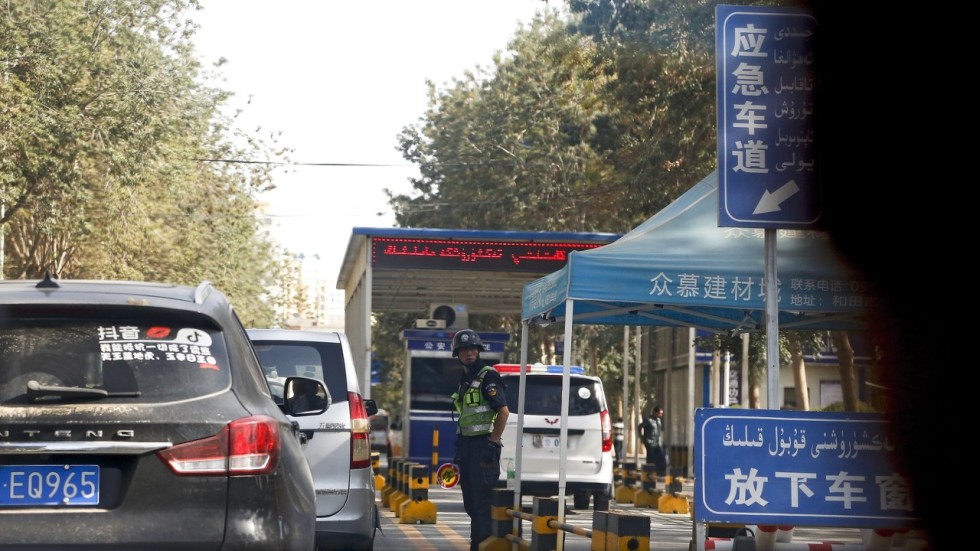
China has denied a German human rights delegation access to the far western region of Xinjiang to investigate mass detention centres for Uygurs, according to the German foreign ministry.
German Human Rights Commissioner Bärbel Kofler said on Tuesday that the request was made as part of preparations for the annual German-Chinese Human Rights Dialogue in Lhasa on Thursday and Friday.
“I am shocked by reports of the treatment of the Turkic Uygur minority, more than one million of whom are estimated to be imprisoned in internment camps in Xinjiang,” Kofler said, adding that she would continue to ask for permission to travel to Xinjiang.
She said she would also raise Germany’s concerns about religious freedom, civil society, and other human rights issues in China during the meeting in Tibet.
Germany has been a vocal critic of China’s human rights record, including the interment camps in Xinjiang
China says the camps are vocational training centres and part of its anti-terrorism efforts, but critics say Uygurs are forced into centres in violation of human rights.
Former inmates and monitoring groups say people in the camps are subjected to prison-like conditions and forced to renounce their religion and cultural background.
On a trip to China last month, German Foreign Minister Heiko Maas urged Beijing to be more transparent about conditions in the camps.
Germany, along with the United States and France, called on China to close the camps during a United Nations review of China’s human rights record in Geneva last month.
Last week, Uygur woman Mihrigul Tursun told the United States Congress that she was tortured multiple times while detained in one of the centres, where a number of detainees died.
A climb like this has never been done and I was thrilled to do this, Tuhin Satarkar said.
NEW DELHI: Bouldering sensation Tuhin Satarkar pushed his limits as he scaled three routes in the treacherous Sahayadri mountain range in 12 days, from November 16 to 28, to become the first Indian to ever achieve the feat, it was announced today.
In this project the Pune-based climber set out to climb three peaks in the Sahayadri mountains on a 12-day camping trip.
It was a true test of endurance, speed and invention as he studied the rock faces, set the route, successfully executed the climbs, and moved on to the next destination all within the 12 days he set out to complete the project.
The climb took him to Dhodap, Jivdhan and Naneghat, three famous peaks which are known to have been ascended by Chatrapati Shivaji Maharaj and his Marathi Malvas.
“The Sahayadri range has one of the most daunting mountains in Maharashtra. Being a Maharashtrian, I was excited to get an opportunity to pay tribute to Chatrapati Shivaji Maharaj and his band of Marathi Malvas,” the Red Bull athlete said.
“I would like to thank Red Bull for their continued support. It has been an exciting test for me- three climbs, across three forts and one ancient route in 12 days is definitely a challenge. A climb like this has never been done and I was thrilled to do this,” he added.
COMMENT
The Red Bull athlete Tuhin is the finest of India’s current generation of climbers. Inspired by his parents, who were both climbers, Tuhin took to the vertical sport at the age of eight and has been pushing boundaries ever since.
Image copyrightWSUPImage captionDhaka, Bangladesh: Community leader Nasima shows off her village’s new community toilet
Hi-tech loos that use little or no water and can recycle waste products safely and sustainably promise to give billions of people around the world access to much-needed sanitation. So why do so many still lack this basic amenity?
About 2.3 billion people still lack basic toilets, according to the World Health Organization (WHO). And 4.5 billion don’t have safely managed sanitation, with waste disposed in a way that won’t contaminate drinking water.
Each year contaminated water kills half a million children under five through diarrhoeal diseases, the WHO says.
So many inventors, entrepreneurs and research institutions around the world have been working on hi-tech loos that can function without the need for expensive mains sewerage systems.
Image captionMillions of people live next to unsanitary open sewers with potentially fatal consequences
One approach is taking chloride from urine, turning it into chlorine with electricity, and using that as a disinfectant, says Dr Brian Hawkins, a research scientist in nanomaterials at Duke University, North Carolina.
Activated charcoal can remove organic material and nano-membranes replace the need for septic tanks, he says.
A solar-powered toilet using this approach, developed at Duke and nearby universities, is being tested at a cotton mill in Coimbatore, India and a township in South Africa.
Currently, it can handle about 15 users a day.
New membrane technology means toilets can “get clean water out of human waste, which is pretty cool”, says Dr Alison Parker, a lecturer at Cranfield University in Bedford.
But power is needed to push waste through the membranes. So the challenge is making a self-contained loo that doesn’t need external electricity.
Image captionCranfield University’s clever loo can produce clean water from human waste
Her lab’s Nano Membrane Toilet works by “relying on the energy we can get from human waste, burning faeces, and the person lifting the lid and closing it again – so that’s not a huge amount of energy to work with,” she says.
But reverse electrodialysis, from putting faeces components on one side of the membrane and urine on the other, “gives us a little extra energy”, she says, and is “just enough to give it the boost to do what we need”.
Heating urine before it goes through the membrane to be closer to the vapour state makes it more efficient, too, says Dr Parker.
She says her lab’s waterless flush toilet is “basically ready and could be commercialised straight away”.
A challenge now is making them feasible for rural areas – the membranes need cleaning every three months, which is more easily achieved in cities.
Reducing costs
While there is lots of innovation going on, the key challenge is making sanitation affordable, says Jack Sim, World Toilet Day founder.
He remembers growing up in Singapore in the 1950s and 60s and having to use his village’s communal outhouse. It was a “very traumatic” experience, he says, involving buckets and lots of green flies.
Moving to public housing with a flushable loo was “like a miracle”, he recalls.
Image captionWorld Toilet Day founder Jack Sim (r) meets Indian Prime Minister Narendra Modi
He believes people on low incomes need to be convinced to “sacrifice something else and build a toilet first”.
But many promising products are now stuck in the “valley of death”, says Duke University’s Dr Hawkins.
This is the space between developing a successful prototype and “getting to a locked-down product you can scale up, mass produce, and find a market share”.
The aim is to get the operating expenses of clean toilets down to five cents (3.8p) per person per day, he says.
And Neil Jeffery, chief executive of Water & Sanitation for the Urban Poor, a non-profit organisation focusing on African and Indian cities, points out that it’s “not just about the toilets – it’s about how you collect waste safely, transport it, treat it, and how it’s then used”.
Most African cities only have 10-15% of households connected to mains sewerage, he says, with many urban settlements sharing pit latrines instead.
When these fill up, a lorry needs to take their contents to a treatment plant.
Image captionCrane Engineering’s waste treatment trucks will be trialled in 2019
But this can be a costly two- or three-hour drive, says Mark Hassman, project manager for the Mobile Septage Treatment System at Crane Engineering in Wisconsin.
He says the amount of waste that trucks actually bring to treatment plants is “less than 5% [of the total] in some cities”.
Instead, they dump it in ditches, mix it with rubbish and burn it, or “plop it in a ditch, and if it’s rainy season, it goes downstream”.
Mr Hassman has been leading a team designing trucks that can process 70-80% of the waste on site. So instead of emptying two pits, “they can now maybe do eight in one drive, and that hopefully reduces the cost and enables people to afford clean pit emptying,” he says.
He says the trucks are “fairly close” to producing potable water.
The trucks will have trial runs in Africa in 2019, and his company is “looking to get these units out there” commercially in 2020.
The crucial requirement is to create a market that enables companies to make a profit from loos that are also affordable for poorer households, he says.
Image captionSpecial treatment trucks can turn human waste into clean water
Lack of sanitation also has an economic impact.
The Bill & Melinda Gates Foundation, which has been running its Reinvent the Toilet Challenge since 2011, says “more than $200bn (£155bn) is lost due to healthcare costs and decreased income and productivity” as a result of poor sanitation.
This is one of the reasons why Indian Prime Minister Narendra Modi has committed $20bn to build 111 million latrines by 2019 – “the biggest toilet building project in the history of mankind”, says Mr Sim.
The goal of sanitation for all may still be “some years” away. “But I can see this problem being solved in the next decade,” he says.
Not a day too soon for the billions still suffering.
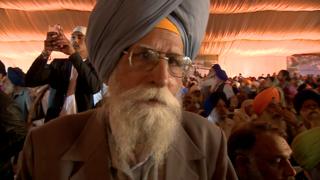
Image captionGurcharan Singh welcomes the opportunity to unite Indians and Pakistanis
Seventy-five-year-old Gurcharan Singh was just a child during Partition in 1947, when his family left their home in the city of Sialkot, in modern day Pakistan, to head to India.
Now on a visit to the Sikh temple in the Pakistani village of Kartarpur, he was delighted that the two countries had agreed to construct a corridor allowing visa-free access to pilgrims from India.
“Since Pakistan was created our community has wanted this,” he told the BBC. “Two families, Indians and Pakistanis, are meeting again.”
The Gurdwara Darbar Sahib Kartarpur is one of the holiest places in Sikhism. It’s believed to have been built on the site where Guru Nanak, the founder of the religion, died in the 16th Century.
Image captionThe Gurdwara Darbar Sahib Kartarpur, close to the Pakistan-Indian border, is one of the holiest sites in Sikhism
The temple is located around 4km (2.5 miles) from the border with India, but tensions between the neighbouring countries have meant Sikh pilgrims have often found it difficult to visit. Some have had to be content with viewing it through binoculars from India.
The “Kartarpur corridor” will however lead from the Indian border straight to the gurdwara, with the sides fenced off.
The move has been welcomed enthusiastically by the Sikh community, and also represents a rare instance of co-operation between the two countries, which have fought three wars against each other since independence.
Image captionThe ceremony was attended by Sikh children
Relations between India and Pakistan remain strained, but at a ceremony formally starting construction work on the pathway on the Pakistani side of the border, the country’s Prime Minister Imran Khan said: “We will only progress when we free ourselves from the chains of the past”.
A number of Indian politicians were amongst those attending.
Pakistani Foreign Minister Shah Mahmood Qureshi told the BBC the Kartarpur project would help improve the countries’ relationship.
“The more people meet, the more they realise how much in common we have, and what we are missing by not resolving our outstanding issues.” he said.
Formal talks between India and Pakistan have stalled since an attack in 2016, which Indian authorities blamed on Pakistani-backed militants. Pakistan denied the claim.
Prime Minister Khan directly addressed the commonly held view that Pakistan’s powerful military and intelligence services don’t want peace with India, whilst civilian governments generally do.
“My political party, the rest of our political parties, our army, all our institutions are all on one page. We want to move forward,” he said.
Image captionPakistani PM Imran Khan spoke of his hope that the two neighbours can one day be friends
However India’s Foreign Minister, Sushma Swaraj, said the initiative did not mean “bilateral dialogue will start”, adding: “Terror and talks cannot go together. The moment Pakistan stops terrorist activities in India, bilateral dialogue can start.”
Pakistan denies supporting militants targeting Indian forces in Kashmir and in return accuses India of supporting separatist movements within Pakistan.
Following his election victory this summer, Mr Khan announced that for every “one step” India takes on improving relations, Pakistan would take “two”. However, a planned meeting between the countries’ foreign ministers on the sidelines of the United Nations General Assembly in September was cancelled by Indian officials, amidst anger over stamps issued by Pakistan commemorating what they termed Indian atrocities in Kashmir.
Analyst Michael Kugelman, from the Wilson Centre, told the BBC the Kartarpur border crossing was a “significant” development but it would be wrong to suggest that the next step was a peace process.
“It’s a confidence building measure but at the end of the day India and Pakistan are still at loggerheads”.
Image captionSikhs will be celebrating a landmark birthday of their founder next year
Many observers have also predicted that substantial progress on dialogue between the neighbours would have to wait at least until after elections are held in India, next April or May.
Mr Kugelman said: “It’s politically risky for the Indian government, particularly for a Hindu nationalist government like the current one, to extend an olive branch to Pakistan during the height of campaign season.”
The Kartarpur corridor is due to become operational next year, in time for celebrations of the 550th anniversary of the birth of Guru Nanak.
Theresa May has announced new education links with China as she arrives for a three-day visit to boost trade and investment after Brexit.
The initiative includes the extension of a Maths teacher exchange programme and a campaign to promote English language learning in China.
The UK prime minister has claimed her visit “will intensify the golden era in UK-China relations”.
But she has stressed China must adhere to free and fair trade practices.
In an article for the Financial Times ahead of her arrival, she acknowledged that London and Beijing did not see “eye-to-eye” on a number of issues – and she promised to raise concerns from UK industry about the over-production of steel and the protection of intellectual property against piracy.
‘Two great nations’
Other issues likely to be discussed include North Korea and climate change. It is not clear whether they will include human rights in Hong Kong.
Mrs May, who will hold talks with Chinese President Xi Jinping, is travelling at the head of a 50-strong business delegation, including BP and Jaguar Land Rover, as well as small firms and universities including Manchester and Liverpool.
Her first stop, Wuhan, in central China, is home to the largest number of students of any city in the world.
The education deal includes:
Extension of a maths teacher exchange programme for a further two years to 2020, enabling around 200 English teachers to visit China
Joint training of pre-school staff in the UK and China
Better information-sharing on vocational education
The launch of an “English is GREAT” campaign to promote English language learning in China
Education deals worth more than £550m, which it is claimed will create 800 jobs in the UK
Mrs May said new agreements signed on her trip would “enable more children and more young people than ever to share their ideas about our two great nations”, helping to ensure that “our golden era of co-operation will endure for generations to come”.
During the three-day trip, Mrs May is expected to focus on extending existing commercial partnerships rather than scoping out new post-Brexit deals.
She said she expected China to play a “huge role” in the economic development of the world, adding: “I want that future to work for Britain, which is why, during my visit, I’ll be deepening co-operation with China on key global and economic issues that are critical to our businesses, to our people, and to what the UK stands for.”
She acknowledged that her agenda “will not be delivered in one visit: it must be our shared objective over the coming years”.
Hong Kong concerns
But she added: “I’m confident that, as China continues to open up, co-operation and engagement will ensure its growing role on the global stage delivers not just for China, but for the UK and the wider world.”
In a statement ahead of the visit, a Chinese Ministry of Foreign Affairs spokesman said Beijing saw Mrs May’s trip as “an opportunity to achieve new development of the China-UK global comprehensive strategic partnership”.
But asked whether the UK had achieved its aim of becoming China’s closest partner in the West, he replied: “Co-operation can always be bettered. As to whether China and Britain have become the closest partners, we may need to wait and see how Prime Minister May’s visit this time plays out.”
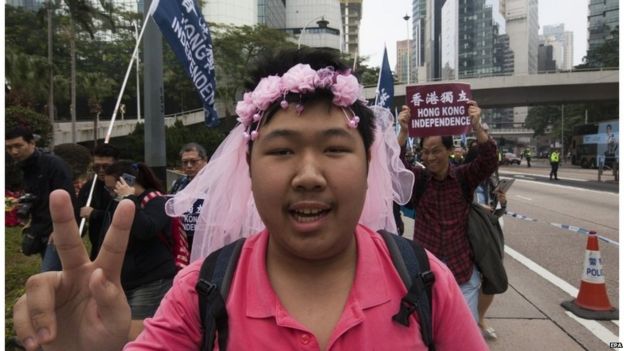
Image copyrightEPAImage captionCritics accuse China of abandoning its “one country, two systems” pledge on Hong Kong
In recent years, both countries have hailed a “golden era” in UK-Sino relations.
China has signalled its desire to invest in high-profile UK infrastructure projects, including the building of a new nuclear reactor at Hinkley Point – although its involvement has raised some national security concerns.
British trade with China has increased by 60% since 2010 and UK ministers are expected to use the trip to stress that the UK will remain an “excellent place to do business” after it leaves the EU next year.
The UK has said it will prioritise negotiating free trade agreements with major trading partners such as the United States, Australia and Canada after it leaves the EU in March 2019.
Earlier this year, the UK said it would not rule out becoming a member of the Trans Pacific Partnership free-trade zone, whose members include Japan, South Korea and Vietnam and which is considered by many as a counter-weight to Chinese influence in the region.
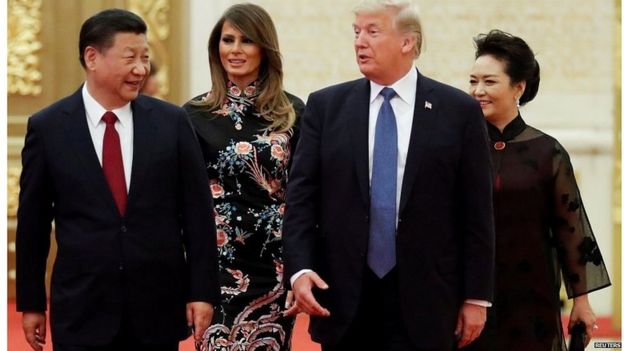
Image copyrightREUTERSImage captionUS President Donald Trump and French counterpart Emmanuel Macron have both visited China recently
Lord Patten, the last British governor of Hong Kong, has urged Mrs May to use the visit to privately raise what he says has been the steady erosion of freedoms and rights in the former British colony in recent years.
Hong Kong is supposed to have distinct legal autonomy under the terms of its handover to China in 1997.
In a letter to the PM, Lord Patten and ex-Lib Dem leader Lord Ashdown said its residents needed assurances that the UK’s growing commercial relationship with China would not “come at the cost of our obligations to them”.
WHEN Richard Liu asked for help in tracing his family history, thousands of people offered suggestions. Little wonder: Mr Liu, the founder of JD.com, a popular online mall, is worth about $10bn. There are more than 65m people in China who share his surname—some would love to connect their family branches to his bountiful tree. But constructing an accurate lineage could be tough, not only because of the huge number of Lius. In a country that in recent decades has seen the biggest movement of people in history away from their ancestral homes, genealogical records are patchy.
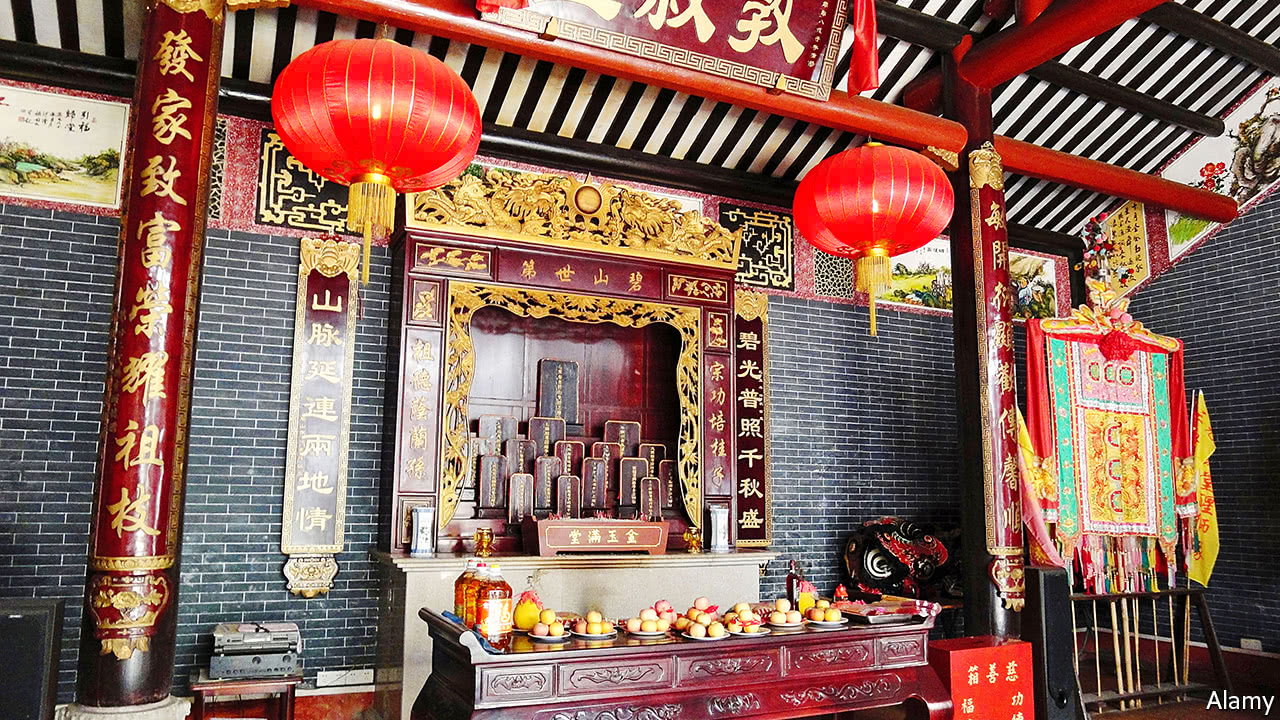
Veneration of ancestors is part of Chinese culture. Traditionally this required the scrupulous updating of genealogies by family elders. These were recorded in books known as zupu that listed members of each generation—though typically only the men. Zupu were often kept in ancestral shrines (such as the one pictured, dedicated to a clan surnamed Li in the southern city of Guangzhou). But war and migration in the past two centuries have complicated matters. Under Mao, the Communist Party tried to stamp out ancestor worship. Many zupu were destroyed. Mr Liu was born in Jiangsu, an eastern province, and can trace his heritage back to a branch of the Liu family in the central province of Hunan. There the trail goes cold because the relevant zupu is missing, say local media.
In the West, people trying to trace their lineage often consult websites that provide data from sources such as census records and church registers. Such sites enable users to link their trees with others. But in China there is little in the way of official historical records that contain genealogical data and are open to commercial databases. Local gazettes often provided information about members of prominent families, but were silent about the masses.
Yet not all is lost. Over the past couple of decades, clan associations have re-established themselves and worked to compile records again. Zupu that were hidden in Mao’s day, or taken abroad, have helped to fill in gaps. Some family elders have “put their collective memory down on paper”, says Huihan Lie, founder of My China Roots, a genealogy service. The paucity of surnames in China—almost 85% of people share just 100 family names—is not necessarily an obstacle. Given names can also provide clues. They are usually made up of two characters, with the first one sometimes chosen from a generational sequence of names ordained by the recipient’s clan. Mr Liu knows the sequence for eight generations in his family.
Websites are helping to make the search easier. My China Roots recently received private funding to build an online zupu database, starting with records from southern provinces where they are often more complete. Eventually the plan is to include Hunan, where Mr Liu’s search is focused. With luck, searching for ancestors will someday be as easy as online shopping.
“IT WAS 2012…I was number 37,” says Ashwini, referring to the badge that was pinned on her shirt pocket.
Her task was to go onto the stage and introduce herself to around 70 eligible bachelors and their parents. Families then conferred and, provided caste and religious background proved no obstacle, would approach the event’s moderator asking to meet number 37. At midday girls would wait for prospects to swing by, again with parents on either side. A brief exchange might establish the potential bride’s cooking skills or her intention to work after marriage. If the two sides hit it off, they would exchange copies of their horoscopes. Nearly 50 men lined up to meet Ashwini that day, speed-dating style. No one made the cut. She later married a colleague.
Such gatherings form an important part of the wedding industry, worth around $50bn a year, in a country where arranged marriages continue to be the norm. India has 440m millennials—roughly, the generation born between 1980 and 1996—and a further 390m youngsters have been born since 2000, so there are plenty of anguished parents for marriage facilitators to pitch to. KPMG, a consultancy, estimates that out of 107m single men and women, 63m are “active seekers”. For now, only a tenth surf the internet to find a spouse. But the number who do is about to explode, argue executives in the marriage-portal business (India has 2,600 such sites). “After Facebook [took off], people are more open about their lives than ever before, which has had a great knock-on effect,” says Gourav Rakshit of Shaadi.com, one of India’s oldest matrimonial sites.
Take Matrimony.com, the country’s biggest online matchmaker, which raised $78m in its initial public offering on September 13th. Its shares began trading this week. It runs 300-odd websites in 15 languages, catering to different castes and religions. It has sites for divorcees, the disabled, the affluent (“Elite Matrimony”) and for those with unfavourable astrological charts, which make it difficult to find a match. All online firms run a “freemium” model: upload your profile at no charge and let an algorithm match horoscope details with potential partners filtered by age, caste, education, income and sometimes (alas) complexion. Or you can pay for features like instant chat or a colourful border around your profile to ensure the algorithm returns you as a top search result.
Such a long list of options means that finding a match on the web can be time-consuming and tedious. “It’s like looking for a needle in a haystack,” says one suitor. Predictably, many also complain that online profiles often do not reflect reality. Outright fakes remain a scourge. This month a man was arrested in Delhi for extorting over 5m rupees ($77,700) from 15 women by luring them on matrimonial websites. And no amount of artificial intelligence can yet identify what will make two youngsters click.
Spouseup, a south Indian startup, is undaunted. It trawls social media to determine a candidate’s personality and recommends matches by calculating a “compatibility score”. Nine-tenths of its 50,000 users are non-resident Indians who usually fly to India for a month or so, scout for partners, settle on one, get hitched and fly back together. For these time-starved travellers, the machine-led scouring “provides an insight that would come from five coffee dates,” says Karthik Iyer, the firm’s founder. Banihal, which is based in Silicon Valley, relies on a long psychometric questionnaire of around 100 questions to match like-minded partners.
Real-world complements to online efforts can help secure a match. Some services, such as IITIIMShaadi.com, aimed at people graduating from prestigious universities, also act as conventional wedding-brokers, by meeting prospects on their clients’ behalf. The job is no different from that of a headhunter, says Taksh Gupta, its founder. He charges anywhere between 50,000 and 200,000 rupees for the service. His most recent catch, after a search lasting over two years, was a husband for a 45-year-old woman from a prestigious university who would settle for no less than an Ivy League groom. Matrimony.com, too, has over 400 “relationship managers” and 140 physical outlets.
“The opportunity is huge”, enthuses Murugavel Janakiraman, boss of Matrimony.com. Around four-fifths of new customers now come via smartphones, lured by instant alerts about new potential matches and services that match up people in the same town. But the spread of smartphones also brings competition. Casual-dating apps are spreading fast. Tinder, on which decisions about eligibility rarely benefit from parental advice, now counts India as Asia’s largest, fastest-growing market.
India Real Time started in 2010 as the first attempt by a global newspaper to offer a news product for Indian readers through the internet. Seven years and crores of clicks later, The Wall Street Journal is winding down the successful blog.
We will continue to offer the content Indian readers want through the more popular paths of distribution: WSJ subscriptions, apps and social media.
All those years monitoring the India Real Time reader has given us unprecedented insight into what educated India watchers are actually reading and we will continue to apply that knowledge to how we choose and craft stories.
We also discovered the types of stories they weren’t reading. One surprising example was the English-speaking elite just weren’t that mesmerized by cricket or Bollywood. Our readers were either getting that news elsewhere or maybe they just weren’t as film and cricket crazy as people in India are supposed to be.
Here are five other lessons we learned about India’s news junkies: Visa Power
President Donald Trump signed an executive order to revamp the H-1B visa guest worker program, in Kenosha, Wisconsin, April 18, 2017. PHOTO: SCOTT OLSON/GETTY IMAGES
H-1B may be bureaucratic jargon that means little to most Americans but it is click bait for others. Our readers couldn’t get enough news about how Washington is tinkering with the high-skilled worker visas. Stories like “H-1B Visas: How Donald Trump Could Change America’s Skilled Worker Visa,” and “So What Does Obama’s Immigration Reform Mean for India’s High-Skilled Worker?” were by far the most read, attracting millions of readers.
Modi Magic
Indian Prime Minister Narendra Modi in Ahmadabad, India, June 30, 2017. PHOTO: AJIT SOLANKI/ASSOCIATED PRESS
India’s prime minster appeals to tech-savvy Indians at home and abroad and our readers wanted to know everything he was up to whether it was his pop-star performance at Madison Square Garden or the vanity suit he wore when he met President Barack Obama.
Battle of the Billions
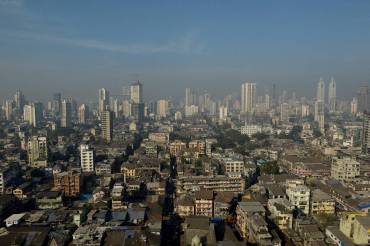
The Bhendi Bazaar area of Mumbai, Dec. 2, 2016. PHOTO: INDRANIL MUKHERJEE/AGENCE FRANCE-PRESSE/GETTY IMAGES
A theme that resonated with our readers was how India was doing relative to China. As India’s economy has grown it has become increasingly aware it is living in the shadow and slipstream of its giant neighbor. When our readers saw headlines like “The Difference Between Indian and Chinese Migrants,” “India Ranked Less Corrupt Than China for the first time in 18 years,” and “India Passes China to Become Fastest-Growing Economy,” they tapped on their smartphones to read more.
Tech Triumphs
The Polar Satellite Launch Vehicle rocket lifted off carrying India’s Mars spacecraft from the east coast island of Sriharikota, India, Nov. 5, 2013. PHOTO: ARUN SANKAR/ASSOCIATED PRESS
Our readers couldn’t get enough of technology trends and inventions. From stories about how India pulled off its Mars mission and how outsourcers are coping with the cloud to blogs on an Indian-designed smartshoe and a roti-making machine, IRT was rewarded when it covered India’s contribution to the tech world.
Please Explain
An Indian Oil Corp. employee counted Indian rupee banknotes in the village of Mangrauli, Uttar Pradesh, India, July 19, 2016. PHOTO: PRASHANTH VISHWANATHAN/BLOOMBERG NEWS
Years of traffic to the blog showed us readers want reporters to sometimes step back and explain the history and context of a story as well as how it will affect their lives. “How Can Indians Living Abroad Exchange Their Old Rupee Notes?” and “Who is Anna Hazare?” are great examples of stories that went viral because they explained the basics. The blog also had a lot of popular quirky explainers including “A Short History of the Kiss in India,” and “India Shining: We Unravel the Secret Behind Delhi’s Dazzling Sweater Vests.”The list of hits could go on and on—in fact it will but not on a separate blog page—there were great graphics like the rape map and the global comparison of wages. There were stories that made waves like a multi-part long form series on the history of Ayodhya as well as a quick hit that exposed how some Indian snacks from Haldiram’s and others were getting blocked from entry into the U.S.The Wall Street Journal is taking all the experience and insight gained through India Real Time and will continue to deliver its unique take on what is happening in India and what matters to Indians. It will continue to use the largest team of international newspaper journalists in South Asia to deliver the stories that matter through its websites, apps and social media pages.
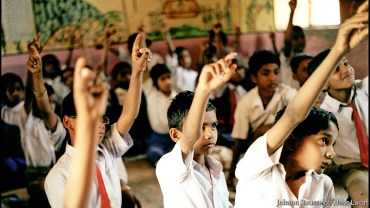
IN 1931 Mahatma Gandhi ridiculed the idea that India might have universal primary education “inside of a century”.
He was too pessimistic. Since 1980 the share of Indian teenagers who have had no schooling has fallen from about half to less than one in ten. That is a big, if belated, success for the country with more school-age children, 260m, than any other.
Yet India has failed these children. Many learn precious little at school. India may be famous for its elite doctors and engineers, but half of its nine-year-olds cannot do a sum as simple as eight plus nine. Half of ten-year-old Indians cannot read a paragraph meant for seven-year-olds. At 15, pupils in Tamil Nadu and Himachal Pradesh are five years behind their (better-off) peers in Shanghai. The average 15-year-old from these states would be in the bottom 2% of an American class. With few old people and a falling birth rate, India has a youth bulge: 13% of its inhabitants are teenagers, compared with 8% in China and 7% in Europe. But if its schools remain lousy, that demographic dividend will be wasted.
India has long had a lopsided education system. In colonial times the British set up universities to train civil servants, while neglecting schools. India’s first elected leaders expanded this system, pouring money into top-notch colleges to supply engineers to state-owned industries. By contrast, Asian tigers such as South Korea and Taiwan focused on schools. Of late, India has done more to help those left behind. Spending on schools rose by about 80% in 2011-15. The literacy rate has risen from 52% in 1991 to 74% in 2011. Free school lunches—one of the world’s largest nutrition schemes—help millions of pupils who might otherwise be too hungry to learn.
Pointless pampered pedagogues
However, the quality of schools remains a scandal. Many teachers are simply not up to the job. Since 2011, when the government introduced a test for aspiring teachers, as many as 99% of applicants have failed each year. Curriculums are over-ambitious relics of an era when only a select few went to school. Since pupils automatically move up each year, teachers do not bother to ensure that they understand their lessons. Overmighty teachers’ unions—which, in effect, are guaranteed seats in some state legislatures—make matters worse. Teachers’ salaries, already high, have more than doubled over the past two rounds of pay negotiations. Some teachers, having paid bribes to be hired in the first place, treat the job as a sinecure. Shockingly, a quarter play truant each day.
Frustrated by the government system, and keen for their children to learn English, parents have turned to low-cost private schools, many of which are bilingual. In five years their enrolment has increased by 17m, as against a fall of 13m in public schools. These private schools can be as good as or better than public schools despite having much smaller budgets. In Uttar Pradesh the flight to private schools almost emptied some public ones. But when it was suggested that teachers without pupils move to schools that needed them, they staged violent protests and the state backed down.
India spends about 2.7% of GDP on schools, a lower share than many countries. Narendra Modi, the prime minister, once vowed to bump up education spending to 6%. However, extra money will be wasted without reform in three areas. The first is making sure that children are taught at the right level. Curriculums should be simpler. Pupils cannot be left to pass through grades without mastering material. Remedial “learning camps”, such as the ones run by charities like Pratham, can help. So can technology: for example, EkStep, a philanthropic venture, gives children free digital access to teaching materials.
The second task is to make the system more meritocratic and accountable. Teachers should be recruited for their talents, not their connections. They should be trained better and rewarded on the basis of what children actually learn. (They should also be sackable if they fail to show up.) The government should use more rigorous measures to find out which of a hotch-potch of bureaucratic and charitable efforts make a difference. And policymakers should do more to help good private providers—the third area of reform. Vouchers and public-private partnerships could help the best operators of low-cost private schools expand.Mr Modi’s government has made encouraging noises about toughening accountability and improving curriculums.But, wary of the unions, it remains too cautious. Granted, authority over education is split between the centre and the states, so Mr Modi is not omnipotent. But he could do a lot more. His promise to create a “new India” will be hollow if his country is stuck with schools from the 19th century.
At least 22 people have been killed after a bus they were travelling in collided with a truck in the northern Indian state of Uttar Pradesh.
The crash happened early on Monday in the city of Bareilly, 251km (155 miles) from the state capital, Lucknow.
A senior police official said all 22 victims had been charred badly and could not be immediately identified.
The passenger bus had caught fire following the collision. Police are searching for the driver of the truck.
India road crashes kill 146,133 people in 2015
The AFP news agency quoted police as saying the doors of the bus jammed after the collision, trapping passengers inside.
A few people managed to escape by breaking open the windows of the vehicle.
The chief spokesman of the Uttar Pradesh police, Rahul Srivastav, said the bus was carrying 41 passengers, and that those who were injured had been rushed to hospital.
The condition of many of them is said to be serious, and officials warn that the toll is likely to rise.
India has the world’s highest number of road deaths, with an accident taking place every four minutes.
Most crashes are blamed on reckless driving, poorly maintained roads and ageing vehicles.


 China has denied a German human rights delegation access to the far western region of Xinjiang to investigate mass detention centres for Uygurs, according to the German foreign ministry.







 CHINDIA ALERT: You'll be living in their world, very soon

