Archive for ‘Social & cultural’

03/10/2016

Amitabh Bachchan: ‘If she gets paid more than me, that’s fine’ – BBC News

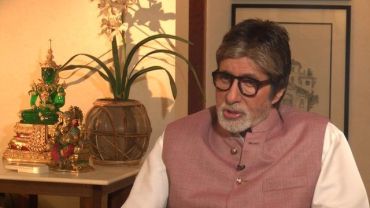
One of India’s biggest stars, Amitabh Bachchan, says he’s glad people are talking about the gender pay gap.

He recently starred in a film called Pink about feminism and attitudes towards women in India which has caused quite a stir in the country.

He spoke to the BBC’s Yogita Limaye.

Source: Amitabh Bachchan: ‘If she gets paid more than me, that’s fine’ – BBC News

03/10/2016

How has India changed a year after Dadri beef lynching? – BBC News

It has been a year since a Muslim man in northern India was lynched over rumours that his family had slaughtered a cow and eaten beef.

Hindus consider cows to be sacred, and for many, eating beef is taboo. The slaughter of cows is also banned in many Indian states.But Mohammad Akhlaq’s death sparked widespread outrage and contributed to changing the social and political discourse of the country. The BBC’s Ayeshea Perera looks at some of the most significant things that happened in India following his death.

The ‘intolerance’ furore

Image copyright AFP: The government began to be haunted by allegations of intolerance

Perhaps the largest fallout of Mohammad Akhlaq’s death in Uttar Pradesh state was the accusation of “intolerance” that began to haunt Prime Minister Narendra Modi’s ruling Hindu nationalist BJP.

Critics of the BJP have often accused it of being Hindu majoritarian in its outlook and of being hostile to ethnic and religious minorities, particularly Muslims. And this incident only strengthened those voices.

The fact that Mr Modi did not immediately condemn the incident, choosing to remain silent even as state party leaders jumped to the defence of the accused, caused even more anger.

It prompted an unprecedented movement by writers and poets who had been celebrated by the government – they started returning their prestigious Sahitya Akademi awards to protest at intolerance in India. More than 40 writers from all across the country returned their awards and were soon joined by a group of film makers who said they would not be “guilty of flattening diversity” in the country.

Leading writer Nayantara Sehgal, a niece of India’s first prime minister Jawaharlal Nehru, wrote that “… India’s culture of diversity and debate is now under vicious assault… The prime minister remains silent about this reign of terror. We must assume he dare not alienate evil-doers who support his ideology.

“But “intolerance” was not limited to returning awards – it found its way into popular discourse as well. Bollywood superstar Amir Khan also created a furore when he expressed concern over the “growing intolerance” in India. He was later joined by fellow star Shah Rukh Khan who said he “respected” people returning awards to protest against intolerance.

Later, the arrest of a student leader from India’s prestigious Jawarhalal Nehru University on sedition charges over a rally condemning the hanging of a man convicted of attacking the Indian parliament also sparked cries of “intolerance” on a massive scale.

The BJP loses Bihar

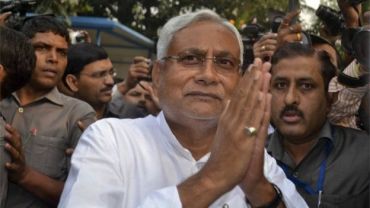
Image copyright AP: Nitish Kumar led an alliance which defeated PM Narendra Modi’s BJP in the Bihar polls

A second outcome that can be linked back to the Dadri killing is that the BJP went on to lose state elections in the neighbouring northern state of Bihar – a poll it was widely expected to win.Incumbent chief minister Nitish Kumar, who was on his second term, had already suffered a crushing defeat to Mr Modi’s party in the 2014 parliamentary elections, and another “Modi wave” was expected to sweep the state elections as well.

But in a masterstroke, Mr Kumar and his allies positioned themselves as a “secular” alliance, in direct opposition to the “communal” BJP.

The fact that Mr Modi and BJP party chief Amit Shah raised the sensitive issue of cow slaughter and consumption of beef during election rallies in the state also did not seem to help.

When Mr Kumar’s party won, it was called a “historic verdict” and hailed as proof that running a poll campaign along religious and ethnic lines would not bring results.

The rise of cow protection vigilante groups

Image copyright MANSI THAPLIYAL: These self styled cow protectors created headlines after they lay in wait for and then badly beat up a number of truck drivers transporting cattle for slaughter

The death of Mr Akhlaq seemed to put new focus on “cow protection” groups who took it upon themselves to ensure that cattle would not be slaughtered or consumed.

Mostly members of militant Hindu groups like the Bajrang Dal, Vishwa Hindu Parishad (World Hindu Council) and Shiv Sena, these self-styled cow protectors created headlines after they lay in wait for and then beat up a number of truck drivers transporting cattle for slaughter.

In another attack, two Muslim woman were beaten up after they were accused of carrying beef. And most significantly, in an incident which led to massive caste unrest, four low-caste Dalit men trying to skin a dead cow were thrashed by vigilantes in the western state of Gujarat.A video of the incident went viral and led to huge protests and an uproar in parliament.

After again being accused of silence, Mr Modi used a radio address almost a full month later to criticise vigilante attacks, saying such people made him “angry”, and any attacks must be investigated.

Eating as an act of defiance

Beef fry is an essential part of the diet in south India’s Kerala stateThe right to eat beef became another huge talking point in

Source: How has India changed a year after Dadri beef lynching? – BBC News

30/09/2016

Glass loos with a view open in China – BBC News

Whatever will the Chinese think of next?

China’s recent obsession with glass tourist attractions has gone round the U-bend with the opening of some see-through treetop public toilets.

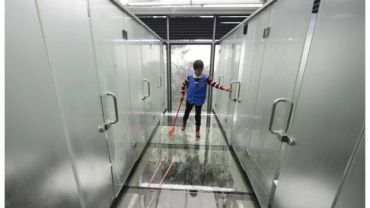
The loos, near Shiyan Lake in southern Hunan province, have fabulous views of both the forest below and other people using the facilities.

Cubicle walls, even those between the men’s and women’s sections, are only separated by lightly frosted glass.

But state media said few visitors dared use the loos on their opening day.

Image copyrightBARCROFT IMAGESImage caption

Shy users of the urinals may take comfort from the privacy barriers between them, though not in the fact they are made of glass

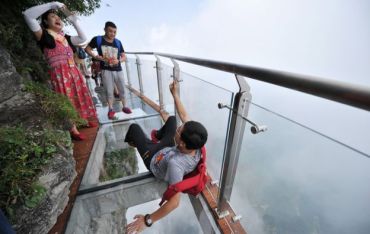
Despite a boom in the construction of glass bridges and walkways in scenic locations in China in recent years – in some cases so popular they had to be closed – these are thought to be the first entirely glass public bathrooms in the country.

However, it not the first time those busting to go have been exposed a little more than they might like by the enthusiasm for glass.

There were reports recently of some male toilets in a university dorm in Hunan which included one very public cubicle.

Image copyrightBARCROFTImage captionUnusually, a head for heights is a requirement for a job as a cleaner there

Image copyrightBARCROFTImage caption Awkward: cubicle walls are only lightly-frosted, even between the men’s and women’s sections

News of the wide-view WCs at Shiyan Lake sparked a range of reactions online.Responding to a Facebook post about it by state television channel CCTV, Ejike Nnadi summed up the feelings of many: “Hell no.”

Others were more taken by the idea. “You’ll be surprised by what you can tolerate when you really, really need to go,” said one post.

Another nodded towards another modern use for restrooms: “I’d be in there ’til my battery hit zero if there was signal in there!”

Image copyrightBARCROFTImage captionThe well-lit lavs are built on a steep hillside

Tina Chen took a dimmer view of all such projects though. “(It) is not about being shy, just again someone had extra money to waste.”

Image copyrightGETTY IMAGESImage caption Unusual glass structures have provided popular photo ops for tourists across China

Awkward or not, it is hoped that these bathrooms for the brave will encourage tourists to visit the countryside around Changsha city and admire the spectacular autumn colours of its forests.

Source: Glass loos with a view open in China – BBC News

29/09/2016

Chinese Tourists Encouraged to Behave Ahead of Mass Vacation – China Real Time Report – WSJ

Urinating on the streets of Hong Kong? Hurling hot water at flight attendants? Stealing wood from Lovers’ Beach in Thailand?

These are the kind of mainland-Chinese tourist antics that the motherland is looking to stub out ahead of the week-long national holiday known as Golden Week, when throngs of citizens travel both domestically and abroad.

To help them do so, the China National Tourism Administration and one of China’s dominant online travel firms, Ctrip.com International, are teaming up to find model tourists to promote travel behavior worthy of emulation—and national recognition.

“Civility of Chinese tourists is an important indicator of a country’s soft power and one of the major ways to export a country’s influence,” the tourism administration’s Vice Chairman Wang Xiaofeng said at an event announcing the campaign.

The two organizations, along with state-run newspaper China Daily, are asking the Chinese public to provide examples of what they think is model traveler decorum. Ctrip will give gifts to exemplary participants, such as free travel products and company souvenirs, said Ctrip senior director of investment relations Zhou Shiwei.

“The campaign is about changing the perception of Chinese travelers,” he said. “We definitely want Chinese travelers to be well-received abroad.

”Examples include pictures of Chinese soccer fans who picked up trash in Seoul, even after the Chinese men’s team lost to South Korea earlier this month, or photos of Chinese tourists patiently waiting in line.Ctrip says the campaign is aiming to publish a compilation of guidelines and pictures suggested by Chinese netizens during Golden Week. Chinese tourists can upload pictures via Chinese social-media network Weibo, and to the China Daily website. It is unclear how the photos will be verified.More than 600 million Chinese are expected to travel abroad in the next five years, as China’s middle class grows and visa restrictions ease in some countries welcoming Chinese spending. Last year, about 120 million Chinese traveled overseas—10% more than in 2014, according to the national tourism administration.

Domestically, tourism generated about $620 billion last year, with more than four billion trips taken.

The campaign, entitled “Good Chinese Tourists,” is an addition to other recent efforts the government has put forth to curb travel misbehavior. Last year, it unveiled new measures that allow authorities to track the bad habits of wayward tourists for up to two years.

The tourism administration also recently published a guidebook on civilized tourism, in which it urges tourists to refrain from spitting and littering—common practices back home—and to take photographs only where permitted. “Do not chase, beat or feed animals,” it adds. “Do not be greedy with complimentary items.

”For traveling abroad, the guide includes recommendations that cutting in line is “shameful wherever you are” and suggests that tourists “not leave footprints on toilet seats.”

Source: Chinese Tourists Encouraged to Behave Ahead of Mass Vacation – China Real Time Report – WSJ

25/09/2016

Culture: Chinese, Indian and Japanese

I’ve just finished watching a short six-part series featuring Joanna Lumley on her trip from near the northern-most tip to the southern-most island of Japan – http://www.itv.com/hub/joanna-lumleys-japan/2a4327a0001. If, like me, you have not been to Japan but are curious about that mysterious far eastern country, then this show is well worth investing six hours of your time.

But the reason I’m raising it here on my blog is that to me it shows in stark contrast the three cultures today: Chinese, Indian and Japanese.

The series illustrate, without a shadow of doubt, that the Japanese have somehow managed to retain most of its old traditions and culture while adopting much of (the best of ) Western culture.The two co-exist happily and without any visible friction.  For example, young girls in traditional kimono are shown visiting the famous cherry blossom festival, alongside Japanese in plain western clothing. Or modern, educated Japanese taking time off to do a multi-temple pilgrimage (see Lumley photo). 

The Chinese, in my opinion, have (certainly in urban areas) disbanded most of their traditional and culture – apart from a few national festivals – and adopted western customs and culture wholesale. Apart from a few speialist travelogue TV series on rural China (http://watchdocumentary.org/watch/wild-china-episode-01-heart-of-the-dragon-video_3a9158d41.html), any TV show on China reveals mainly western modernity.

And finally, my take on Indian culture is that it has not moved far from what has been prevalent over the centuries, apart from a thin veneer of western culture and customs such as car ownership (see India on Wheels – http://www.bbc.co.uk/programmes/b013q5y0) and western clothing or education for the upper class in the English language.

I would really like to hear from you, my blog readers, on this subject, hopefully based on personal experience rather than based on a TV programme!


23/09/2016

Shacking up | The Economist

WHEN Da Lin moved in with his girlfriend two years ago, his mother tried to stop them: she feared that their living together unmarried would sully his girlfriend’s reputation and, by association, his too. She will be happy only after they finally marry next year (his family is buying the apartment, hers the car).

That generational clash is replicated in thousands of families across China: cohabitation without marriage was long anathema and officially illegal until 2001. Today it is commonplace.China’s social mores are changing astonishingly quickly. Before 1980 around 1% of couples lived together outside wedlock, but of those who wed between 2010 and 2012, more than 40% had done so, according to data from the 2010 and 2012 China Family Panel Studies, a vast household survey (see chart). Some reckon even that is an underestimate. A recent study by the China Association of Marriage and Family, an official body, found that nearly 60% of those born after 1985 moved in with their partner before tying the knot, which would put the cohabitation rate for young people on a par with that of America.

The number of unmarried couples living together is growing for many of the same reasons it has elsewhere: rising individualism, greater empowerment of women, the deferral of marriage and a decline in traditional taboos on pre-marital sex. Greater wealth helps—more couples can afford to live apart from their parents. Yet Chinese cohabitation has distinctive characteristics. In rich countries, living together is most common among poorer couples, but in China youngsters are more likely to move in together if they are highly educated and live in wealthy cities such as Beijing and Shanghai. Shacking up is seen as a sign of “innovative behaviour”, say Yu Xie of Princeton University and Yu Jia of the Chinese Academy of Social Sciences.

Elsewhere rising cohabitation represents the fraying of marriage: many couples never bother to wed. In China, however, cohabitation is almost always a prelude to marriage—as for Da Lin and his girlfriend—rather than an alternative to it. Marriage is still near-universal, although the skewed sex ratio resulting from China’s one-child policy and a cultural preference for boys has resulted in a surplus of poor rural men who will remain unhappily single. Some highly educated women in cities forgo marriage too.In some Western countries those who live together for an extended period enjoy some of the same legal rights and obligations as married couples. In China cohabitation carries no legal weight. And it is very hard for a child born out of wedlock to acquire a hukou, or residency permit, which provides access to health care, education or other public services.In the 1980s virginity was considered a woman’s chief asset and few couples dared to date openly, let alone live together. Now China is in the midst of a sexual revolution—some 70% of people have sex before marriage, according to a study conducted in 2012. Many young Chinese, however, still have conservative ideas about how their elders should behave: although cohabitation is also on the rise among the elderly, many of them avoid remarrying because their adult children oppose it.

Source: Shacking up | The Economist

17/09/2016

India’s Craze for Ayurveda Is Producing Billionaires – India Real Time – WSJ

A yoga teacher clad in white robes and often seen meditating on the banks of the Ganges is the latest to join the billionaires club in India.

But Acharya Balkrishna is no ordinary yoga teacher. He controls Patanjali Ayurved Ltd., the consumer-products company founded by his guru, Baba Ramdev, and whose Ayurvedic soaps, shampoos and food supplements are increasingly becoming staples in middle-class Indian homes. Indians’ craze for the company’s Ayurvedic formulations has seen Mr. Acharya’s net worth skyrocket to $3.8 billion, according to Hurun’s India Rich List for 2016. That puts him at number 25 in Hurun’s list of richest Indians, ahead of industrialists like Ratan Tata, Adi Godrej and Anand Mahindra.

Such is the demand for Patanjali, which sells creams, cleaners and hair conditioners rooted in Ayurveda, India’s traditional system of medicine, that the world’s biggest consumer-products makers are tweaking their products to compete. India’s traditional system of medicine encourages therapies like yoga and believes everything from the common cold to diabetes can be fixed by certain herbs, foods and oils.

Colgate Palmolive last month launched a toothpaste flavored with basil, clove and lemon. L’Oréal SA in June launched a new range of shampoos infused with eucalyptus, green tea and henna, an Indian herb Patanjali also packs in its shampoo. Unilever PLC recently purchased an Ayurvedic hair-care company.

Mr. Balkrishna is a reclusive figure next to Mr. Ramdev, one of India’s best-known yoga teachers who founded Patanjali in 2006 and has since transformed it into a multi-million dollar consumer goods empire. Mr. Balkrishna controls the business because Mr. Ramdev has sworn off most trappings of wealth.

Messrs. Ramdev and Balkrishna are regularly seen practicing yoga on the banks of the Ganges in Haridwar, the Hindu holy city where Patanjali is based and where they run an ashram.

Ayurveda has produced other billionaires, too. The Burman family which runs Dabur India, another consumer-goods maker that draws inspiration from traditional Indian medicine, is 13th on Hurun’s India rich list.

Mukesh Ambani, the chairman of Reliance Industries, is the richest Indian with a net worth of $24 billion. Dilip Shanghvi, who heads generics-drug maker Sun Pharmaceutical Industries, is second with $18 billion in his kitty.

Source: India’s Craze for Ayurveda Is Producing Billionaires – India Real Time – WSJ

08/09/2016

A 16-year-old British girl earns £48,000 helping Chinese people name their babies – BBC Newsbeat

Beau Jessup, a British A-level student from Gloucestershire, came up with the idea after a family visit to China.

They were out for a meal with friends when she was asked to give an English name to a newborn baby.

In China it is considered important to have an English name for future study or business with the UK.

‘Special Name’ requires the user to pick five of the 12 personality traits which they most hope their baby will grow into

In China they name their child based on the elements and Beau wanted a similarity between how they pick their Chinese name and how they pick their English name.

And she does this by assigning personality traits to each English name.

They also select the gender of the baby and pay the equivalent of 60p.

The three chosen names are then shared with family and friends on We-Chat, China’s WhatsApp equivalent, to help make the final decision.

Each suggestion is printed on a certificate with its meaning and an example of a famous person with that name.

Beau says that when she was first asked to name her father’s friend’s baby, she was surprised.

“I’m not really qualified or relevant enough in that baby’s life to be the person to give it a name.

“But after hearing of some of the “embarrassing” names, Beau decided she needed to act.

There was someone called Rolex

“There are quite a few examples where people have gotten the names wrong.”

Beau explains that the Chinese are fascinated by western culture but their access to it is restricted by the government in China.There isn’t open access to the internet so they can’t use standard baby naming websites that people may use in the UK.

“Being exposed to luxury items and things like Harry Potter, Disney films and Lord of the Rings means they use those for reference.

“I once heard of someone called Gandalf and another called Cinderella.”

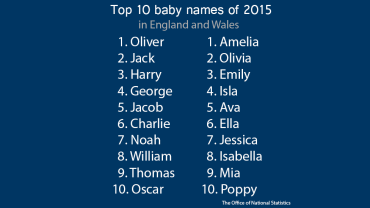
Amelia and Oliver were the most popular baby names in England and Wales in 2015

That’s according to the Office for National Statistics which released the complete set of data last week.

But Beau doesn’t know which names are the most popular on her website, and she’s “happy about that”.

“It is called ‘special name’ and it’s based on individual preference and what they personally want their child to be.”

Beau says it’s quite strange to know she’s named more than 200,000 babies

“It’s nice to be a part of such a happy experience and be a part of those young stages in a baby’s life.”The site’s success has been a pleasant surprise.

“I wanted to do it just to see if an idea could turn into more than just simply an idea.”

And I never expected it to become more than just a small project because I never really considered myself very academic.

“It is obviously a nice surprise, but it is definitely a surprise.”

Source: A 16-year-old British girl earns £48,000 helping Chinese people name their babies – BBC Newsbeat

02/09/2016

Crime Capital: Why Delhi Is by Far India’s Most Dangerous City – India Real Time – WSJ

Delhi is India’s biggest megacity, home of the country’s central government and, according to new police data, way ahead of the competition in the quest to claim the title as the country’s capital of crime.

The National Crime Records Bureau released its statistics for 2015 on Tuesday and Delhi left everyone else in the dust.Around 25% of the nearly 670,000 crimes recorded in India’s 53 largest cities were committed in Delhi last year, even though the megacity only accounts for around 10% of their combined populations.

The financial capital Mumbai was a distant second, recording only about 6% of the crimes. Tech hub Bangalore claimed about 5% of the crimes and Chennai looked to be the safest of the top five major metros, accounting for only 2% of the crimes.

This is not because Delhi–home of more than 16 million souls–has the largest population. Even on a per capita basis, the capital shined when it came to crime.

Last year it brought home the gold in theft and insulting the modesty of women, beating all the other cities with populations of more than 1 million,  according to the bureau’s data. In rape, only Jodhpur was worse. In the murder category, it was the bloodiest of the five major metros and well above average.

Delhi police attribute the high rate of crime in the city to their hard work. More and more cases are being registered every year as the force cracks down, said Taj Hassan, spokesman for the Delhi police.

“Delhi, being the national capital, witnesses a lot of law and order problems because people from all states live here,” he said. “The law and order situation is under control.”

More than previous years and in other cities, people are now being “encouraged to come forward and report” every incident of crime. “Not even a single complaint goes unnoticed,” he said.

There was, however, one area of hope.Surprisingly Delhi-ites were relatively law-abiding last year when it came to injuries caused by rash driving and road rage. Maybe the city’s notorious traffic is keeping cars from going fast enough to cause injury.

Maybe the city’s police force is too busy tracking down violent criminals to deal with bad drivers.

Source: Crime Capital: Why Delhi Is by Far India’s Most Dangerous City – India Real Time – WSJ

26/08/2016

A horror confronted | The Economist

HUANG YANLAI was 74 when he first raped 11-year-old Xiao Yu.
He threatened her with a bamboo-harvesting knife while she was out gathering snails in the fields for her grandmother in Nan village, Guangxi province, in China’s south-west. Over the following two years, Xiao Yu (a nickname meaning Light Rain) was raped more than 50 times, her hands tied and a cloth stuffed in her mouth. She was a left-behind child, entrusted to relatives while her parents worked in distant cities. Her father returned home once a year. Told that his daughter was in trouble, he asked her what was wrong but she was too frightened to tell him. So he beat her up.

Her abusers bribed her to keep quiet, giving her about 10 yuan (about $1.50) each time they raped her, threatening that “if this gets out, it will be you who loses face, not us.” They were right. When Xiao Yu finally confided to her grandmother and went to the police, the villagers called her a prostitute and drove her out of town.

Xiao Yu’s story came to national attention after it was reported by state media. At the end of May it formed part of a study released by the Girls’ Protection Foundation, a charity in Beijing founded to increase awareness of child sexual abuse, a crime officials preferred not to discuss openly until recently. The study said there had been 968 cases of sexual abuse of children reported in the media between 2013 and 2015, involving 1,790 victims. Wang Dawei of the People’s Public Security University said that, for every case that was reported, at least seven were not. That would imply China had 12,000 victims of child sexual abuse during that period. “I have never seen this many child sexual-assault cases, ever,” ran one online reaction. “Why is it such things were hardly heard of five years ago,” asked another, “and now seem all over the media?”

China is no exception; it is no longer taboo to discuss the problem. In 2015 Fang Xiangming of China Agricultural University, in a report for the World Health Organisation (WHO), estimated, using local studies, that 9.5% of Chinese girls and 8% of boys had suffered some form of sexual abuse by adults, ranging from unwanted contact to rape. For boys the rate is as high as the global norm, for girls it is slightly less so. Because of the country’s size, however, the absolute numbers are staggering. Perhaps 25m people under 18 are victims of abuse.Chinese pride themselves on the protectiveness of their families. That children suffer even an average level of abuse is a surprise to many. But, as everywhere, children hide their experience. In 2014 Lijia Zhang, a journalist, wrote a first-hand account in the New York Times of sexual abuse at her school in the city of Nanjing in the 1970s. She said it never occurred to her and other victims to report the teacher. “We didn’t even know the term sexual abuse.” Even in Hong Kong, where sex is more openly discussed, a study of university students found that 60% of male victims and 68% of female ones surveyed since 2002 had not told anyone about their abuse. These rates of non-disclosure are considerably higher than in the West. Mr Fang, the author of the study for the WHO, says that if Chinese girls were more open, then the true rate of female sexual abuse might turn out to be as high as elsewhere, just as it is for boys.

In any country, child sexual abuse is hard to measure. China has never conducted a nationwide survey, though it is talking about holding one in the next couple of years. There are many provincial or citywide studies. But as in other countries, researchers use different measures and standards. And there are no studies of abuse over time, so it is hard to detect trends. Even so, there are reasons to believe that children are at growing risk.

First, China has huge numbers of “left-behind” children, like Xiao Yu. According to the All-China Women’s Federation, an official body, and UNICEF, the UN agency for children, 61m people below the age of 17 have been left in rural areas while one or both parents migrate for work. Over 30m boys and girls, some as young as four, live in state boarding schools in villages, far from parents and often away from grandparents or guardians. (A growing number of rural children whose parents are still at home have to board, because of the closure of many small schools in the countryside as village populations shrink.) Another 36m children have migrated with their families to cities, but their parents are often too busy to look after them properly.

Time for new thinking

About 10m left-behind children see their parents only once a year and otherwise rely on the occasional phone call. “Every time my mother called, she would tell me to study hard and listen to my teachers,” said one victim of sexual assault by a mathematics teacher at a school in You county, in the central province of Hunan. “I could not bring myself to tell her over the phone what was happening.”

How much abuse is inflicted on left-behind children is not known. Researchers complain that schools with large numbers of them often refuse to allow sexual-abuse surveys. But given their vulnerability, left-behind children are likely to be victims of such abuse more frequently—possibly much more so—than average.

Another risk factor is a mixture of ignorance, shame and legal uncertainty that makes it very difficult for children to defend themselves. Fei Yunxia works for the Girls’ Protection Foundation, the NGO that released the recent study of abuse cases. She travels to schools, giving sex-education classes. “No one tells these students about their bodies or how to protect themselves from harm,” she told Xinhua, a government news agency. Sex education in China is rare and never touches on abuse. The NGO says that 40% of 4,700 secondary-school pupils polled in 2015, when asked what was meant by their “private parts”, said they did not know. When cases are reported to the authorities, little is done, either because of legal loopholes, or because officials refuse to recognise the problem, or because they cover up for colleagues.

It does not help that China’s statute of limitations is only two years. Wang Yi of Renmin University says this is too short for cases involving child sexual abuse: victims often remain silent for years. There is no national register of sex offenders, though Cixi, a city in Zhejiang province, aroused controversy in June when it said it would publish “personal information” about major sex criminals after their release to let the public monitor them (some commentators worried about an invasion of privacy).

The lack of well-developed sex-crime laws means victims are often failed by the justice system. In Liaoning province eight school girls aged between 12 and 17 were kidnapped, stripped, beaten, and forced to watch and wait their turn while men who had paid $270 per visit raped them repeatedly in hotel rooms. The men were charged with having “sex with under-aged prostitutes”, a charge that shamed the victims into silence. The law that allowed child-rape victims to be classified as prostitutes was scrapped in 2015. But a women’s legal-counselling centre in Beijing, which had led a campaign against it, was itself closed earlier this year as part of a crackdown on civil society launched by China’s president, Xi Jinping. No wonder that, as a lawyer in the You county case put it, “silence is the preferred solution.”

A shift in moral assumptions about sex presents another challenge. China is in the middle of a sexual revolution. Sex before marriage is more common. The age of first sexual experience is dropping. Most researchers into child abuse think there may be a link between such changes and sexual violence against children, if only because the revolution in mores seems to go hand in hand with changes to the traditional child-rearing system that, through intense surveillance, may limit abuse.

Ye Haiyan, challenging abuse

When a country confronts the problem of child abuse it typically goes through three stages, argues David Finkelhor of the University of New Hampshire. First the public and media become alert to the problem. This is happening. With the help of social media, and thanks to a greater willingness to speak out on social matters, campaigners have begun to organise. Ye Haiyan (pictured), known online as “Hooligan Sparrow”, helped arouse public awareness with her protests in 2013 against the rape of six girls aged between 11 and 14 by their school principal. In the next stage the government becomes concerned and starts to tighten laws. Then the police, social workers and public prosecutors begin to deal with problems on the ground. China is moving into this third stage.

Make them safer

Since early this decade, prosecutors and police have been spelling out how cases of abuse should be handled, from the collection of evidence to support for victims and procedures for separating a child from his or her parents. At the end of 2015 China adopted its first domestic-violence law. It says that preventing this is the “joint responsibility of the state, society and every family”. All this, says Ron Pouwels, UNICEF’s head of child protection in China, means that “China gets it and is determined to do something about it.”

But much more work is needed. For example, there are very few social workers. The government has set a target of 250,000 properly qualified ones by the end of 2020. But only 30,000 take up such jobs each year. Crucially, Mr Xi needs to reverse his campaign against civil society and his efforts to stifle media debate. Further improving public awareness of the problem will need the help of NGOs and a freer press (free, for example, to point out that abusers are often people in authority—Ms Ye, the activist, was harassed by officials for trying to do so). Over the past 30 years, China has enhanced the life prospects of millions of children by providing them with better education and health care. Now it is time to protect them from sexual violence, too.

Source: A horror confronted | The Economist

Law of Unintended Consequences

continuously updated blog about China & India

ChiaHou's Book Reviews

continuously updated blog about China & India

What's wrong with the world; and its economy

continuously updated blog about China & India