Archive for ‘Social & cultural’

04/08/2014

With court ban on illegal mosque loudspeakers, some Mumbai Muslims oppose street prayers too

The performance of religious practices in public spaces has occasionally caused friction in Indian cities. On July 30, the Bombay High Court addressed one particularly vexing source of strain when it asked the city police to take down all illegal loudspeakers attached to mosques in Mumbai and Navi Mumbai.
The court’s directive came in response to a public interest litigation filed by a Navi Mumbai resident against the unauthorised loudspeakers during prayer time at mosques. The court specified that all illegal loudspeakers, whether installed at mosques or at Ganesh or Navratri pandals, should be removed “irrespective of religion, caste or community”.

Even though the loudspeaker issue has been repeatedly politicised in Maharashtra (in 2010, the Shiv Sena had demanded a blanket ban on all mosque loudspeakers after the party was booked for violating noise norms at its Dussehra rally), several Muslim activists came out in support of the court directive.

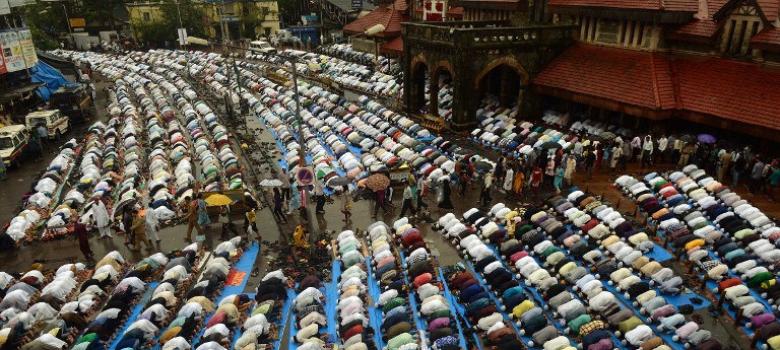
But the call to prayer being announced on loudspeakers is not the only Muslim practice that some members of other communities complain about. In densely-populated cities like Mumbai, when large numbers of devotees gather to pray their Friday namaz, the congregation often spills out of the mosques and into the streets outside, hindering traffic and pedestrian movements for up to 30 minutes.

For many Muslim activists, this phenomenon is as much of an inconvenience to the public as the loudspeakers. But they believe the government has a greater role to play in helping to solve the problem.

“Nobody really likes to pray namaz outside on the streets, because it inconveniences so many people,” said Ghulam Arif, president of the Qartaba Wisdom Club, a Mumbai-based non-profit organisation that works on social issues. The only reason the practice continues, he said, is because the community is too large to fit into the existing mosques.

“The government could give Muslims the permission to organise Friday prayers in open grounds and maidans near mosques,” said Arif.

The community has been recommending a specific solution to the problem for nearly two decades: allowing mosques to expand by granting them additional floor space index. Increasing FSI  – the ratio of plot size to the height of a building that can be erected on it  –  would mean a greater number of floors to accommodate more worshippers.

via Scroll.in – News. Politics. Culture..

04/08/2014

For a country obsessed with fair skin, why are so many Indians buying self-tanners?

Market research firm Euromonitor has just released a study on the grooming habits of the world. It has one rather surprising finding – Indians are slathering on massive dollops of tanning lotions. Indians are apparently second only to Chinese in consuming what the researcher calls self-tanning products.

It doesn’t add up.

Indians are the highest consumers of whitening creams, the same survey shows, and that is unsurprising. The country’s problematic preference for fair skin is well known. Fairness cream ads featuring big Bollywood stars are ubiquitous. In 2010, AC Nielsen estimated the size of the market for skin whitening products at $432 million.

But there is not a single well-known brand of skin-tanning lotions in the country.

via Scroll.in – News. Politics. Culture..

02/08/2014

With End of China’s One-Child Policy, There Hasn’t Been a Baby Boom – Businessweek

Last November, China announced the loosening of its restrictive one-child population policy: Couples would soon be permitted to have two children so long as one parent was an only child. Government planners predicted that roughly half of China’s 11 million eligible couples would chose to have a second child within five years, and investors predicted a boom in sales of diapers, baby formula, and educational toys in China.

Why China's Second-Baby Boom Might Not Happen

The policy change has been rolled out in 29 of China’s 33 provinces and regions, yet by the end of May only 271,000 applications for permission to have a second child had been submitted. Many came from older mothers concerned not to lose their chance. At an agency in Beijing’s Tuanjiehu neighborhood that connects parents with maternity nannies, staff said that the majority of requests pertaining to second children came from women in their late 30s.

Six months into the new policy is still too early to judge the ultimate impact. But experts now express more modest expectations. “Every metric thus far indicates the loosening isn’t leading to a baby boom,” says Mei Fong, author of a forthcoming book on China’s population policies. With rising costs of urban living, Chinese couples are deliberately limiting family size for reasons similar to those depressing fertility in Taiwan, Japan, Korea, Singapore, and Western countries.

via With End of China’s One-Child Policy, There Hasn’t Been a Baby Boom – Businessweek.

01/08/2014

BBC News – ‘Suspects shot’ in Xinjiang imam killing

Police have shot dead two suspects in the killing of the imam of China’s largest mosque and captured another, state media say.

Jume Tahir speaks during an interview at Id Kah Mosque in Kashgar in this still image taken from video dated 3 August 2011

Jume Tahir was the imam in Kashgar, in China’s restive Xinjiang region.

He was found dead after morning prayers at the Id Kah mosque on Wednesday.

Police said the suspects, located shortly afterwards, “resisted arrest with knives and axes”. They were “influenced by religious extremism“, Xinhua news agency said.

Xinjiang, in China’s far west, is home to the Muslim Uighur minority.

Tensions have rumbled for years between Uighurs and Beijing over large-scale Han Chinese migration and tight Chinese control.

In recent months, however, there has been a marked increase in Xinjiang-linked violence, including a market attack in the regional capital Urumqi that left more than 30 people dead.

Beijing blames these attacks on extremists inspired by overseas terror groups. Uighur activists say heavy-handed restrictions on religious and cultural freedoms are fuelling local resentment.

via BBC News – ‘Suspects shot’ in Xinjiang imam killing.

01/08/2014

China’s Girl Births Ratio Improves as Country Gets More Educated – Businessweek

Priscilla Yang is standing outside Tuanjiehu Beijing Maternity Hospital, her husband dutifully holding aloft a purple umbrella to shield her from the blazing July sun. The 27-year-old is eight months pregnant and feeling relieved: Her latest rounds of prenatal tests came back normal.

Yang doesn’t know, but wonders about, the gender of her child. A college-educated public-relations executive, Yang says she hasn’t tried to wheedle illicit information from the maternity hospital staff. Boy or girl, “both are OK,” she says. “What I care most about is that the baby is healthy.”

Yang’s indifference about gender is becoming more common, though the struggle has been long. It has been illegal in China since 2001 for doctors to reveal the sex of the fetus to expectant parents. When ultrasound technology became widely available in the late 1980s, the number of sex-selective abortions shot up. Traditional Chinese culture prized sons, who performed heavy labor on farms and were expected to inherit land and stay home to care for elderly parents. Daughters left their parents’ household to join their husband’s after marriage. The one-child policy, announced in 1980 and enacted nationally within a few years, only intensified the desire for sons. Even after the 2001 law, many Chinese parents managed to bribe poorly paid doctors to see ultrasound results—then chose to abort female fetuses.

via China’s Girl Births Ratio Improves as Country Gets More Educated – Businessweek.

29/07/2014

Police shoot dead dozens of attackers during mob violence in Xinjiang | South China Morning Post

Police in Xinjiang shot dead dozens of knife-wielding attackers on Monday morning after they staged assaults on two towns in the westerly Xinjiang region, the official Xinhua news agency said on Tuesday, citing local police.

china_xinjiang_explosion_tok101_43157649.jpg

Describing the incident as a “premeditated terror attack,” the official Xinhua news agency said a gang armed with knives attacked a police station and government offices in Elixku, a township in Kashgar prefecture, and then some of them moved on to nearby Huangdi Township, attacking civilians and smashing vehicles as they passed.

Dozens of civilians were killed or injured in the attack before police responded by shooting dead dozens of attackers, official media reported.

Citing local police, Xinhua said dozens of civilians of both Uygur and Han ethnicities were killed or injured, while police officers at the scene shot dead dozens of members of the mob.

Over 30 cars were vandalised, some of which were set on fire, the report said.

Earlier this month, the regional capital Urumqi marked the fifth anniversary of the 2009 riot that left 197 people dead and about 17,000 others injured, mostly Han Chinese.

The turbulent region has since seen a series of violent incidents that have left many people dead or injured, including last May’s bombing of a market in Urumqi that left dozens dead and prompted a clampdown by authorities.

In the immediate wake of that bombing, which came just weeks after a blast at an Urumqi rail station left three dead, China launched one-year “anti-terror” campaign in Xinjiang in which hundreds of suspects have been arrested and large amounts of explosives and explosive devices have been seized, according to local media.

On June 17, authorities executed 13 people and sentencing three others to death for their role in terror attacks and related crimes in Xinjiang, including an attack on government facilities and police stations in the oasis city of Turpan on June 26 last year that left 24 police officers and civilians dead.

China’s heavy-handed approach has drawn concerns that many of the region’s Uygurs, including vocal critics and people linked to the separatist East Turkestan Islamic Movement, have been arrested and indefinitely detained without trial, while others have disappeared without trace.

Uygurs in Xinjiang and those in self-exile abroad have long complained that discrimination and restrictions on religion, such as a ban on taking children to mosques, are fuelling anger at the Han Chinese majority.

via Police shoot dead dozens of attackers during mob violence in Xinjiang | South China Morning Post.

29/07/2014

In Delhi, an unintended consequence of free parking: violent deaths

Rajender Bhatia was sitting in his ground floor apartment in central Delhi on Sunday morning when his neighbour turned up. Kartik, who lived on the second floor of the same building, had come to pick a bone with Bhatia about the parking situation around their building. The argument quickly escalated and, according to the police, a couple of other men also joined the fracas that turned into a proper scuffle.

Then suddenly the 55-year-old Bhatia collapsed, prompting the others to run away and his family to take him to the hospital. The doctors there declared Bhatia dead on arrival and a case was registered against Kartik and the other men, who have since been arrested and booked with culpable homicide not amounting to murder.

Bhatia, unfortunately, is not the first to have died in an argument over parking in Delhi: there have been seven other violent incidents related to it this year alone. And, considering the state of parking in the capital, it’s unlikely Bhatia’s case will be the last.

Police records suggest that 15 people have died in the capital over parking-related issues in the past five years, with many more incidents of violent clashes. Other than the capital’s generally high stress levels, which have given it the reputation of being particularly prone to violence and spats, the huge number of cars being added to the roads combined with limited space is mainly what is behind this unique category of crimes. It isn’t uncommon to see car tires being slashed or a parked car being keyed by angry residents who see it as a way to complain about parking.

via Scroll.in – News. Politics. Culture..
29/07/2014

Why India’s family planning program is unhappy with parents

It’s not just politicians resisting sex education, but parents as well, according to Mahinder Watsa, former president of the Family Planning Association of India, which turned 65 last week.

Watsa, perhaps better known today for his newspaper column dispensing often wry advice on sex, was also the first to push for the inclusion of sex education in the FPAI’s programmes in the late 1970s.

“You need to have special classes for parents,” he said. “Parents should be the ones who should be involved deeply, but they pass the job on to teachers.” But teachers, he said, do not take an active part in sex education for fear of being criticised by both parents and politicians.

This fear might partly stem from the pronouncements of political leaders. In the latest instance, last month, health minister Harsh Vardhan, a qualified doctor, advocated the Gandhian route to birth control through abstinence and yoga and said that sex education in its current form should not be taught in schools. He later clarified that he was only against graphical representation of what he termed “vulgarity”.

But his remarks have yet again underlined the political class’s confused and often misguided approach to sex education.

In contrast, over the years, the focus of the FPAI, which was founded in 1949, has expanded from issues of fertility and controlling the number of children a healthy family should have to the rights of young people in accessing information and knowledge about their sexuality.

via Scroll.in – News. Politics. Culture..

28/07/2014

Beijing gets tough on party officials who go private | The Times

China’s intensifying anti-corruption campaign has turned its guns on the people who link government and business, forcing nearly 230 senior Communist party officials to quit the company directorships they hold on the side.

China’s president Xi Jinping

The draconian orders, which have also affected tens of thousands of more junior officials moonlighting for corporate China, are said to have unleashed a mass “exodus” of independent directors from listed Chinese companies in recent months.

The government has promised there will be more to come. China’s state news agency warned that the authorities were planning another “detailed directive” that analysts believe would attempt to tighten further the restrictions on the roles officials can play in the private sector.

The rules are expected to crack down on the activities of retired officials: as the rules stand, they are able to take on company directorships if those positions do not relate to their former specialities as civil servants.

Sources believe that the new directives will broaden the terms of the ban in a way that could affect foreign companies in the mining, energy, banking and pharmaceutical sectors.

The same burst of anti-corruption propaganda also invited the public to “blow the whistle on violations”.

The crackdown began last autumn with a ban on senior government and party officials from working for outside companies. Although a few resignations followed that ban, the real purge did not begin until scores of listed companies were subjected to an inspection a few months later.

That inspection, according to Chinese state media, identified 229 officials at the ministerial or provincial level who were working for outside companies and 40,700 junior officials with a source of company income outside their civil servant salaries.

About 300 Chinese companies listed on the Shanghai and Shenzhen stock exchanges have apparently been affected by the shakedown, losing the officials they specifically hired to build relationships with Beijing and bring the companies closer to the government.

The central role of those relationships within Chinese business has been laid bare over the past two years as details have emerged of the fabulous wealth amassed by the families of senior officials.

Also exposed has been the extent to which western companies operating in China have been convinced that their success can only be guaranteed by hiring either former officials or people with exceptionally strong personal links to the central and provincial governments.

via Beijing gets tough on party officials who go private | The Times.

28/07/2014

Improving health care: Congratulations! Inoculations! | The Economist

FANS of the China model frequently say that, for all the disadvantages of a one-party state, there are also benefits. Enforcing basic health care is one—and by no means a small one. Last year China’s mortality rate for children under five years old was just one-fifth the rate it was in 1991, down from 61 deaths per 1,000 live births to 12. The maternal mortality rate has also dropped substantially—by 71%—since 1991. In 1992, one in ten Chinese children under five contracted hepatitis B. Today fewer than one in 100 of them carry the disease.

China’s advances have not gone unnoticed. Last month a group of four international bodies, including the World Health Organisation (WHO) and the World Bank, said China was one of ten countries to have made exceptional progress in reducing infant and maternal mortality (see chart). Not all of the ten—which included Egypt, Peru, Bangladesh and Vietnam—are one-party states.

China’s improvement lies in two basic, connected areas: better care at birth and countrywide immunisation. Since 2000 the government has offered subsidies to mothers who give birth in hospitals, thereby reducing health dangers from complications—especially the risk of neonatal tetanus. The scheme also brought hard-to-reach people and groups into contact with the health-care system.

From 2001 to 2007, the share of births that took place in hospitals rose by 46%, making it easier to give a hepatitis B vaccine immediately. China now has one of the highest usage rates of the birth dose of the vaccine in the world: 96% of Chinese babies receive it on their first day of life. In 2012 the WHO commended China for a “remarkable” public-health achievement. That year it declared China free of maternal and neonatal tetanus.

Margaret Chan, the WHO’s director-general, this month said that China’s regulatory system for vaccines had passed the WHO’s evaluation with outstanding results. Dr Chan says she has “full confidence” in the safety of vaccines made in China. Last year the WHO approved one for the first time for use by UNICEF. (That has not dispelled suspicions within China itself, however, about the safety of Chinese vaccines.) China and the WHO claim that about 95% of children are vaccinated for measles, rubella and polio. In 2008 the government added eight new vaccines, including hepatitis A and meningitis, to its national programme. All are administered to children free of charge. Just as important has been the mobilisation of a network of health-care workers, at provincial, county and township levels.

via Improving health care: Congratulations! Inoculations! | The Economist.

Law of Unintended Consequences

continuously updated blog about China & India

ChiaHou's Book Reviews

continuously updated blog about China & India

What's wrong with the world; and its economy

continuously updated blog about China & India