Archive for ‘Social & cultural’

19/05/2012

* Rich in kindness

China Daily: “Billionaire behind major philanthropic projects says there’s always more to do.
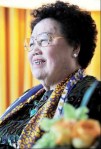
Entrepreneur and philanthropist Chan Laiwa, also known as Chen Lihua, is no stranger to lists of the world’s richest people, from Forbes to Hurun. But the self-made billionaire finds there is “so much” beyond wealth. “While wealth does come through our hard work and efforts, it is not the ultimate goal and is not above everything,” Chan, 71, says in her Manhattan hotel room the day before she was honored at an April gala as one of Time magazine’s 100 Most Influential People for 2012.

Such sentiments might seem standard from any rich person concerned with public image, but Chan in person – sincere, humble and thoughtful – makes people around her feel at ease. She impresses most with her passion for art, particularly of sandalwood, a medium she has loved since she was a girl. Born into a family of Manchu, the ethnic group that led Chinas last imperial dynasty, the Qing 1644-1911, Chan spent most of her childhood in the Summer Palace in Beijing. She is a descendant of a noble Manchu family of the Yellow Banner Clan, some members of which were ministers of state under the Qing emperor.

Chan’s childhood home was furnished with red sandalwood, a material used in the emperors’ palace in bygone times. “As I grew older, I felt the need to preserve this important part of Chinese culture,” recalls Chan, who opened a furniture factory in the 1980s and began making old-style pieces modeled after those from Beijing’s Palace Museum, more widely known as the Forbidden City.

In 1999, Chan fulfilled a childhood dream by investing in a $16 million red sandalwood museum in the capital. The thousands of treasures displayed there include a scale model of a corner tower in the Forbidden City, a reproduction of the memorial gateway carved with 320 dragons from Longquan Temple in Shanxi province, and a number of intricate furniture pieces and sculptures.

She made her fortune in the 1990s through a series of real estate ventures involving her Fu Wah International Group, the Hong Kong company fashioned out of Chan’s furniture store. The businesswoman later moved to Beijing for more opportunities. Chan was recently voted among Time magazines 100 Most Influential People in the World for 2012.

via Rich in kindness|People|chinadaily.com.cn.

09/05/2012

* China: The world’s cleverest country?

BBC News: “China’s results in international education tests – which have never been published – are “remarkable”, says Andreas Schleicher, responsible for the highly-influential Pisa tests.

These tests, held every three years by the Organisation for Economic Co-operation and Development, measure pupils skills in reading, numeracy and science. Pisa tests – the Programme for International Student Assessment – have become the leading international benchmark. The findings indicate that China has an education system that is overtaking many Western countries. While there has been intense interest in Chinas economic and political development, this provides the most significant insight into how it is teaching the next generation. …

“Even in rural areas and in disadvantaged environments, you see a remarkable performance. “In particular, he said the test results showed the “resilience” of pupils to succeed despite tough backgrounds – and the “high levels of equity” between rich and poor pupils. …

In an attempt to get a representative picture, tests were taken in nine provinces, including poor, middle-income and wealthier regions. The Chinese government has so far not allowed the OECD to publish the actual data.But Mr Schleicher says the results reveal a picture of a society investing individually and collectively in education. On a recent trip to a poor province in China, he says he saw that schools were often the most impressive buildings. He says in the West, it is more likely to be a shopping centre. “You get an image of a society that is investing in its future, rather than in current consumption.

“There were also major cultural differences when teenagers were asked about why people succeeded at school.

“North Americans tell you typically its all luck. Im born talented in mathematics, or Im born less talented so Ill study something else.

“In Europe, its all about social heritage: My father was a plumber so Im going to be a plumber.

“In China, more than nine out of 10 children tell you: It depends on the effort I invest and I can succeed if I study hard.”They take on responsibility. They can overcome obstacles and say Im the owner of my own success, rather than blaming it on the system.”

via BBC News – China: The worlds cleverest country?.

To anyone who knows something about Chinese history, the results are not surprising at all.  If, for over 1,500 years anyone – peasant, labourer, artisan, or scholar – who passed the right exams can become a magistrate, civil servant or governor; then passing exams and studying for them becomes ingrained, part of the tacit cultural norm. And despite two major revolutions, one to overthrow imperialism and the other to lift the masses, exams still play a key role in success. It is no surprise that eight of the nine top CCP leaders are engineers by training.

Related articles:

08/05/2012

* China issues policies to raise wellbeing of working women

Xinhua: “A new regulation, made public Monday, provides employed Chinese women with better welfare policies, including extended maternity leave and higher workplace protection.

A pregnant woman

A pregnant woman (Photo credit: Wikipedia)

According to the regulation adopted by the State Council in April, maternity leave has been extended from 90 days to 98 days, which is in line with the 14-week minimum standard set by the International Labour Organization. The regulation more clearly specifies leave granted to women who have miscarriages. According to it, a female employee will get 15 days of leave if their miscarriage occurs within the first four months of pregnancy and 42 days of leave if it happens later. Under the regulation, female employees should be paid either by the maternity insurance programs they have joined or by employers during their maternity leave.

The regulation also expands the categories of jobs that pregnant women and breastfeeding mothers are banned from working for, while removing restrictions on what jobs married women at the childbearing age should take.It also imposes clear penalties on the offenders, ranging from 1,000 to 300,000 yuan 159 to 47,619 U.S. dollars. And it stipulates that those employers who seriously violate the rules should be suspended from operation.

According to the government, China is estimated to currently have 102 million women in full-time employment.”

via China issues policies to raise wellbeing of working women – Xinhua | English.news.cn.

03/05/2012

* China’s Bright Food buys Weetabix

Reuters: “China’s Bright Food will take control of breakfast cereal maker Weetabix, beloved by generations of British children, in the biggest foreign acquisition by a Chinese food group.

State-owned Bright Food has agreed to buy a 60 percent stake in a deal which puts a value of 1.2 billion pounds $1.94 billion, including debt, on the private-equity owned company that coined the slogan “Have you had your Weetabix today?”

The Shanghai-based group has been on the acquisition trail, seeking to raise its profile and cater for its rapidly growing home market. Weetabix is its second foreign purchase in a year and its first in Europe after other deals fell through. Eighty-year-old Weetabix is Britain’s second biggest maker of breakfast cereals and cereal bars after Kellogg. Its brands include Alpen muesli and Ready Break as well as Weetabix, which lays claim to being Britain’s No. 1 breakfast cereal for under-5s and is made from wheat grown within 50 miles 80 km of its base in southern England.

“As China’s leading food group, we are pleased to become the controlling shareholder of Weetabix,” Bright Food chairman Wang Zhongnan said in a statement on Thursday. “Weetabix has an excellent product portfolio, including leading British cereal brand Weetabix and other category-leading brands. “Private equity owners Lion Capital and Weetabix management will keep a 40 percent stake. The quintessentially British breakfast cereal group was founded in 1932 by the secretive George family and soon producing its iconic bricks of wheat. It was bought by a private equity firm in 2004.

Bright Food now sees a big opportunity for Weetabix in China, where breakfast is a very important meal and there is a trend towards healthy eating.The group, which makes “White Rabbit” candy, bought majority stakes in Australias Manassen Foods and New Zealands Synlait Milk over the past two years.”

via UPDATE 2-Chinas Bright Food buys Weetabix | Reuters.

Related post: https://chindia-alert.org/2012/02/13/pattern-of-chinese-overseas-investments/

26/04/2012

* Understanding social media in China

McKinsey Quarterly: “The world’s largest social-media market is vastly different from its counterpart in the West. Yet the ingredients of a winning strategy are familiar.

No Facebook. No Twitter. No YouTube. Listing the companies that don’t have access to China’s exploding social-media space underscores just how different it is from those of many Western markets. Understanding that space is vitally important for anyone trying to engage Chinese consumers: social media is a larger phenomenon in the world’s second-biggest economy than it is in other countries, including the United States. And it’s not indecipherable. Chinese consumers follow the same decision-making journey as their peers in other countries, and the basic rules for engaging with them effectively are reassuringly familiar.

In addition to having the world’s biggest Internet user base—513 million people, more than double the 245 million users in the United States. China also has the world’s most active environment for social media. More than 300 million people use it, from blogs to social-networking sites to microblogs and other online communities. That’s roughly equivalent to the combined population of France, Germany, Italy, Spain, and the United Kingdom. In addition, China’s online users spend more than 40 percent of their time online on social media, a figure that continues to rise rapidly.

This appetite for all things social has spawned a dizzying array of companies, many with tools more advanced than those in the West: for example, Chinese users were able to embed multimedia content in social media more than 18 months before Twitter users could do so in the United States. Social media began in China in 1994 with online forums and communities and migrated to instant messaging in 1999. User review sites such as Dianping emerged around 2003.  Blogging took off in 2004, followed a year later by social-networking sites with chatting capabilities such as Renren. Sina Weibo launched in 2009, offering microblogging with multimedia. Location-based player Jiepang appeared in 2010, offering services similar to foursquare’s. This explosive growth shows few signs of abating, a trend that’s at least partially attributable to the fact that it’s harder for the government to censor social media than other information channels. That’s one critical way the Chinese market is unique.

As you shape your own social-media strategy, it’s important to fully understand some other nuances of the country’s consumers, content, and platforms.”

via Understanding social media in China – McKinsey Quarterly – Marketing & Sales – Digital Marketing.

25/04/2012

* Four men move a mountain for their offspring

Snowy mountains (probably 'white-horse mountai...

Snowy mountains Yunnan, China (Photo credit: Wikipedia)

China Daily: “For years the people of Zhongzhai village, Wenshan, Yunnan province, have been blocked from the outside world by a mountain. But after six years, four men have finally carved a five kilometer stretch out of the remote mountainous area.

The four families endured years of hardship, one man even partly losing the function of his hand, spending all their saving on clearing the hilly road and building an enormous debt of 80,000 yuan $11,895 despite each family only earning 500 yuan a year. But the group – who have been dubbed the “Modern Yu Gong” say it has all be worth it, “As long as our children get a way to go to school,” said one.

Yu Gong was an old man in Chinese fable who was determined to dig away two big mountains in front of his family home, which caused his family great inconvenience. His famous words read: “I will soon be dead, but I have children, and when my children are dead, there are still my grandchildren. My family will grow and grow and the mountain will get smaller and smaller. With such determination, surely it is possible to move the mountains!”

via Four men move a mountain for their offspring[1]|chinadaily.com.cn.

It so happens that Yu Gong Yi Shan – Foolish Old Man Moves Mountains was one of Chairman Mao’s favourite fables. Fortunately, his successor Deng Xiaoping and his successors followed through with this endeavour – http://www.imdb.com/title/tt1312185/plotsummary

17/04/2012

* Irish horses to race in China as Magnier wins €38m stud deal

Independent.ie: “HUNDREDS of Irish horses are set to race regularly in China after bloodstock giant Coolmore announced a ground-breaking deal. The agreement is part of a plan that will see Ireland help set up a horse racing industry in Tianjin, China’s fourth largest city.

Horse racing in Sligo, Ireland

Horse racing in Sligo, Ireland (Photo credit: Wikipedia)

Top Irish stud farm Coolmore – owned by racing tycoon John Magnier and based in Fethard, Co Tipperary – will help China set up a similar operation. The planned equine centre will be the first of its kind in the country.

It is due to open for business next year. The contract is worth more than €38.5m to Ireland over three years.

via Irish horses to race in China as Magnier wins €38m stud deal – Irish, Business – Independent.ie.

A sure sign that China is liberalising. As far as we know gambling is illegal in China. Though, behind closed doors …  

But now we are going to see real horse racing in China. Or will the races be run without any betting?!

16/04/2012

* Violence breaks out at Indian beef-eating festival

BBC: “A beef-eating festival at a university in the Indian city of Hyderabad has led to clashes between rival sets of students, police say.

They say that Hindus who regard cows as sacred fought with low caste Dalit groups who organised the event. About 1,500 people were fed beef biriyani as part of the festival late on Sunday evening. Dalit groups want beef on the campus hostel menu.  Right wing Hindu groups say eating beef is not Hindu practice.

Last year’s event at Osmania University also ended in violence. The BBC’s Omer Farooq in the city says that says there has been tension for a few days now on the campus. Our correspondent says that has been the case ever since organisers announced that the festival – held over the weekend – would go ahead. Right wing Hindu groups soon afterwards declared their intention to stop it.”

via BBC News – Violence breaks out at Indian beef-eating festival.

05/04/2012

# Deciphering Chinese names

Chiang Kaishek with Muslim General Ma Fushou a...

There are around 100 common Chinese surnames and, apart from possibly Ma (), there is no religious or regional clustering. The colloquial for ‘the public’ is lao bai xing, which literally means “old hundred surnames”. The surname Ma, more often than not, is used by Muslim Chinese; and is thought to be derived from the Prophet Mohammed.

Traditionally, for many centuries, most Chinese families followed the standard practice of using three mono-syllabic words for their names, such as Sun Yatsen, father of modern China.
Maybe surprisingly, Dr Sun is revered in both the Peoples’ Republic and Taiwan. Both have huge memorials to him. The photo courtesy –
http://hcyip.wordpress.com/tag/nanjing-massacre/ – is of the mainland memorial.

The first, Sun (), is the family or clan name. After all what is most important, your antecedents, of course rather than you yourself – back to the collective mindset of Chinese.

The second, Yat, is the ‘generation name’. It is given by the parents to each of the siblings. So, all of Yatsen’s brothers and sisters would have Yat plus another word as their name. And, indeed, all his paternal first cousins. In some families, the boys and girls may have variants of this name.

If the family is conforming to old traditions, then the middle name (the generation name) is taken from a poem specially composed for the family, with each generation taking a successive word from the poem. Typically, the poem will be about something noble and aspirational, such as: “World peace, national unity; Social harmony, family prosperity”. So, the first generation’s middle name will be world, the next peace and so forth. Of course, in most families, long before they reach the eighth generation, some successor would have thought to create his own couplet to be more modern and so the cycle restarts.

The third, sen, is the personal name and can be any word in the Chinese vocabulary. Having said that, some words are regarded as more masculine and others more feminine.

Just to confuse everyone, some families use the second name as the personal name and third as the generation name. So, for example, Sun Yatsen’s wife Madam Sun was named Soong Chingling and her two sisters were Soong Ailing and Soong Meiling. Although Sun and Soong sound similar, Soong is a differnt name altogether () incidentally, Meiling was Chiang Kaishek‘s wife, Madame Chiang.

Despite being a feudal society until recent times, women kept their names after marriage. So the wife of the disgraced leader Bo


Xilai is Gu Kailai; rarely – but confusingly – called Bogu Kailai.
In places like Singapore and Hong Kong sometimes married women, esp business women, would keep their maiden name along with the husband’s surname, making it four names. Sort of like the British ‘double-

barrelled‘ surnames such as the actress Helene Bonham Carter.

Most Chinese who live in Hong Kong, Singapore, Taiwan and other enclaves of Chinese emigrees tend to keep to the traditional way of naming.

Her Excellency Wu Yi, Vice Premier of the Peop...

But since the revolution in 1949 and especially since the Cultural Revolution in the 70s, many mainland Chinese have stopped using the generation name and use just one name after the surname such as Madame Wu Yi, retired senior leader who led China into the WTO and who managed the SARS crisis of early 2000s.

This causes huge problems for the authorities as, it is not uncommon, at roll call in school, several kids would raise their hands– for example – to Wang Ta (= Wang senior). The authorities are encouraging parents to revert to a middle name when naming their children.

30/03/2012

* Senior leader underlines infrastructure building in Xinjiang

Maps of Xinjiang Uygur Autonomous Region of Ch...

Maps of Xinjiang Uygur Autonomous Region of China Español: Región autónoma de Xinjiang (Photo credit: Wikipedia)

Xinhua: “Senior Chinese leader Zhou Yongkang on Thursday demanded infrastructure be improved in the western Xinjiang Uygur autonomous region through projects supported by central government.

Zhou, a member of the Standing Committee of the Political Bureau of the Communist Party of China CPC Central Committee, urged authorities to give more support to the construction of major projects in the region, including irrigation systems, reservoirs, railways, electricity and natural gas schemes. Antiquated public facilities had created a major bottleneck constraining the regions development, Zhou said at a meeting attended by representatives from the National Development and Reform Commission, the central bank, and ministries of finance, railways, and water resources. These departments and a group of large state-owned enterprises and commercial banks have been tasked to assist the projects.

Three Uyghur girls at a Sunday market in the o...

Zhou called for more financial support and administrative coordination to push forward these projects, which he said will help enhance the regions capability of self-initiated development, ensure sound economic and social development, and create more jobs. The projects should benefit Xinjiang by improving people’s livelihoods, promoting ethnic solidarity and maintaining social stability, according to Zhou. He also demanded efforts to avoid illegal land use, prevent excessive exploitation of resources and protect the environment in Xinjiang.”

via Senior leader underlines infrastructure building in Xinjiang – Xinhua | English.news.cn.

Law of Unintended Consequences

continuously updated blog about China & India

ChiaHou's Book Reviews

continuously updated blog about China & India

What's wrong with the world; and its economy

continuously updated blog about China & India