Archive for ‘Muslim’

15/02/2019

Pulwama attack: India will ‘completely isolate’ Pakistan

India has said it will ensure the “complete isolation” of Pakistan after a suicide bomber killed 46 soldiers in Indian-administered Kashmir.

Federal Minister Arun Jaitley said India would take “all possible diplomatic steps” to cut Pakistan off from the international community.

India accuses Pakistan of failing to act against the militant group which said it carried out the attack.

This is the deadliest attack to hit the disputed region in decades.

Both India and Pakistan claim all of Muslim-majority Kashmir but only control parts of it.

An insurgency has been ongoing in Indian-administered Kashmir since the late 1980s and there has been an uptick in violence in recent years.

How will India ‘punish’ Pakistan?

India says that Jaish-e-Mohammad, the group behind the attack, has long had sanctuary in Pakistan and accuses its neighbour of failing to crack down on it.

It has called for global sanctions against the group and has said it wants its leader, Masood Azhar, to be listed as a terrorist by the UN security council.

Although India has tried to do this several times in the past, its attempts were repeatedly blocked by China, an ally of Pakistan.

Mr Jaitley set out India’s determination to hold Pakistan to account when speaking to reporters after attending a security meeting early on Friday.

He also confirmed that India would revoke Most Favoured Nation status from Pakistan, a special trading privilege granted in 1996.

Pakistan said it was gravely concerned by the bombing but rejected allegations that it was in any way responsible.

But after Prime Minister Narendra Modi said in a speech that those behind the attack would pay a “heavy price”, many analysts expect more action from Delhi.

After a 2016 attack on an Indian army base that killed 19 soldiers, Delhi said it carried out a campaign of “surgical strikes” in Pakistan-administered Kashmir, across the de facto border. But a BBC investigation found little evidence militants had been hit.

However analysts say that even if the Indian government wants to go further this time, at the moment its options appear limited due to heavy snow across the region.
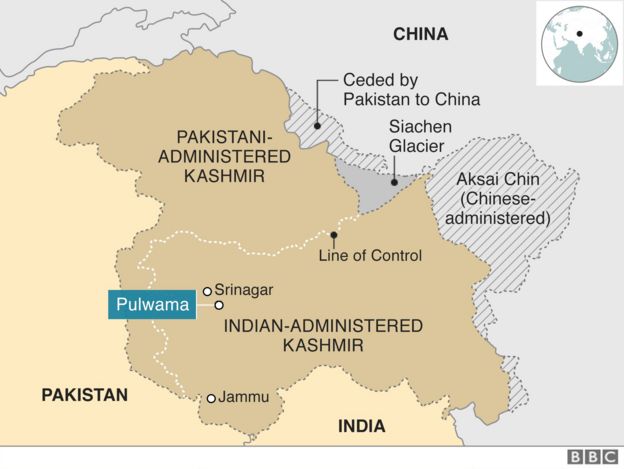
map

How did the attack unfold?

The bomber used a vehicle packed with explosives to ram into a convoy of 78 buses carrying Indian security forces on the heavily guarded Srinagar-Jammu highway about 20km (12 miles) from the capital, Srinagar.

“A car overtook the convoy and rammed into a bus,” a senior police official told BBC Urdu.

It stands as the deadliest militant attack on Indian forces in Kashmir since the insurgency began in 1989.

The bomber is reported to be Adil Dar, a high school dropout who left home in March 2018. He is believed to be between the ages of 19 and 21.

Soon after the attack Jaish-e-Mohammad released a video, which was then aired on the India Today TV channel. In it, a young man identified as Adil Dar spoke about what he described as atrocities against Kashmiri Muslims. He said he joined the banned group in 2018 and was eventually “assigned” the task of carrying out the attack in Pulwama.

He also said that by the time the video was released he would be in jannat (heaven).

Dar is one of many young Kashmiri men who have been radicalised in recent years. On Thursday, main opposition leader Rahul Gandhi said that the number of Kashmiri men joining militancy had risen from 88 in 2016 to 191 in 2018.

India has been accused of using brutal tactics to put down protests in Kashmir – with thousands of people sustaining eye injuries from pellet guns used by security forces.

What’s the reaction?

“We will give a befitting reply, our neighbour will not be allowed to de-stabilise us,” said Prime Minister Modi.

Mr Gandhi and two former Indian chief ministers of Jammu and Kashmir all condemned the attack and expressed their condolences.

The attack has also been widely condemned around the world, including by the US and the UN Secretary General.

The White House called on Pakistan to “end immediately the support and safe haven provided to all terrorist groups operating on its soil”.

Pakistan said it strongly rejected any attempts “to link the attack to Pakistan without investigations”.

What’s the background?

There have been at least 10 suicide attacks since 1989 but this is only the second suicide attack to use a car.

Prior to Thursday’s bombing, the deadliest attack on Indian security forces in Kashmir this century came in 2002, when militants killed at least 31 people at an army base in Kaluchak near Jammu, most of them civilians and relatives of soldiers.

At least 19 Indian soldiers were killed when militants stormed a base in Uri in 2016. Delhi blamed that attack on the Pakistani state, which denied any involvement.
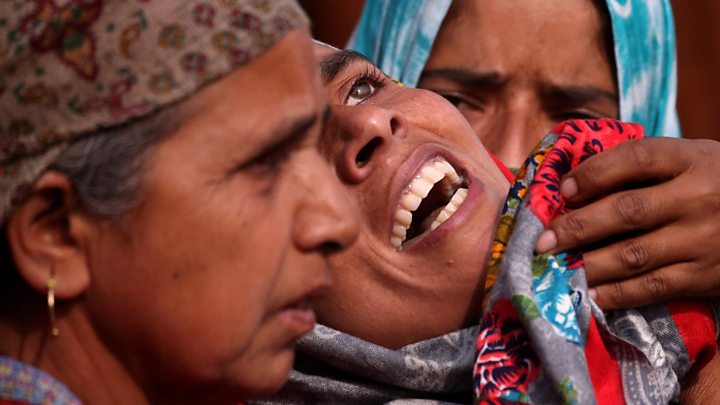
The latest attack also follows a spike in violence in Kashmir that came about after Indian forces killed a popular militant, 22-year-old Burhan Wani, in 2016.

More than 500 people were killed in 2018 – including civilians, security forces and militants – the highest such toll in a decade.

India and Pakistan have fought three wars and a limited conflict since independence from Britain in 1947 – all but one were over Kashmir.

Who are Jaish-e-Mohammad?

Started by cleric Masood Azhar in 2000, the group has been blamed for attacks on Indian soil in the past, including one in 2001 on the parliament in Delhi which took India and Pakistan to the brink of war.

Most recently, the group was blamed for attacking an Indian air force base in 2016 near the border in Punjab state. Seven Indian security personnel and six militants were killed.

It has been designated a “terrorist” organisation by India, the UK, US and UN and has been banned in Pakistan since 2002.

However Masood Azhar remains at large and is reportedly based in the Bahawalpur area in Pakistan’s Punjab province.

India has demanded his extradition from Pakistan but Islamabad has refused, citing a lack of proof.

Source: The BBC

09/02/2019

India court hands 7 Muslim men life sentences for killings that sparked 2013 riots

NEW DELHI (Reuters) – An Indian court on Friday sentenced seven Muslim men to life in prison for the murder of two Hindu men in 2013 in the northern state of Uttar Pradesh, an incident that had sparked religious riots killing about 65 people and displacing thousands.

The riots began in the district of Muzaffarnagar, 130 km (81 miles) northeast of New Delhi, and spread to other areas in the country’s most populous state months before the 2014 election won by Prime Minister Narendra Modi’s Hindu nationalist party.

A court in Muzaffarnagar sentenced the men after they were found guilty of killing the two Hindus in the village of Kawal on Aug. 27, 2013, prosecutor Rajeev Sharma told Reuters.

Reuters could not immediately contact the families of the convicted men.

Nearly all the victims here of the riots were Muslims, including about 12,000 people who were made temporarily homeless due to the unrest that polarised western Uttar Pradesh on religious lines.

Source: Reuters

08/05/2017

The bullies of Urumqi: The extraordinary ways in which China humiliates Muslims | The Economist

CHINESE officials describe the far western province of Xinjiang as a “core area” in the vast swathe of territory covered by the country’s grandiose “Belt and Road Initiative” to boost economic ties with Central Asia and regions beyond.

They hope that wealth generated by the scheme will help to make Xinjiang more stable—for years it has been plagued by separatist violence which China says is being fed by global jihadism. But the authorities are not waiting. In recent months they have intensified their efforts to stifle the Islamic identity of Xinjiang’s ethnic Uighurs, fearful that any public display of their religious belief could morph into militancy.Xinjiang’s 10m Uighurs (nearly half of its population) have long been used to heavy-handed curbs: a ban on unauthorised pilgrimages to Mecca, orders to students not to fast during Ramadan, tough restrictions on Islamic garb (women with face-covering veils are sometimes not allowed on buses), no entry to many mosques for people under 18, and so on.

But since he took over last August as Xinjiang’s Communist Party chief, Chen Quanguo has launched even harsher measures—pleased, apparently, by his crushing of dissent in Tibet where he previously served as leader. As in Tibet, many Xinjiang residents have been told to hand their passports to police and seek permission to travel abroad. In one part of Xinjiang all vehicles have been ordered to install satellite tracking-devices. There have been several shows of what officials call “thunderous power”, involving thousands of paramilitary troops parading through streets.

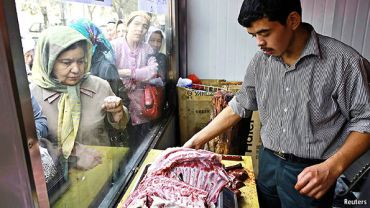
Last month, new rules came into effect that banned “abnormal” beards (such as the one worn by the man pictured in front of the main mosque in Kashgar in south-western Xinjiang). They also called on transport workers to report women wearing face veils or full-body coverings to the police, and prohibited “naming of children to exaggerate religious fervour”. A leaked list of banned names includes Muhammad, Mecca and Saddam. Parents may not be able to obtain vital household-registration papers for children with unapproved names, meaning they could be denied free schooling and health care.

Residents have also been asked to spy on each other. In Urumqi, the region’s capital, locals can report security threats via a new mobile app. People living in Altay in northern Xinjiang have been promised rewards of up to 5m yuan ($720,000) for tip-offs that help capture militants—over 200 times the local income per person.

Across Xinjiang residents have been asked to inform the authorities of any religious activities, including weddings and circumcisions. The government is also testing its own people’s loyalty. In March an official in Hotan in southern Xinjiang was demoted for “timidity” in “fighting against religious extremism” because he chose not to smoke in front of a group of mullahs.

Mr Chen is widely rumoured to be a contender for a seat in the ruling Politburo in a reshuffle due late this year. Displays of toughness may help to ingratiate him with China’s president, Xi Jinping, who has called for “a great wall of iron” to safeguard Xinjiang. Spending on security in Xinjiang was nearly 20% higher in 2016 than the year before. Adverts for security-related jobs there increased more than threefold last year, reckon James Leibold of La Trobe University and Adrian Zenz of the European School of Culture and Theology at Korntal, Germany.

Uighurs have been blamed for several recent attacks in Xinjiang. In one of them in February, in the southern prefecture of Hotan, three knife-wielding men killed five people and injured several others before being shot dead by police (local reports suggested the violence occurred after a Uighur family was punished for holding a prayer session at home). Officials may be congratulating themselves on the success of their tactics; reported large-scale attacks by Uighurs inside and outside Xinjiang have abated in the past 18 months. Yet as in Tibet, intrusive surveillance and curbs on cultural expression have fuelled people’s desperation. “A community is like a fruit,” says a Uighur driver from Kashgar. “Squash it too hard and it will burst.”

Source: The bullies of Urumqi: The extraordinary ways in which China humiliates Muslims | The Economist

Tags:
02/11/2016

China’s Alibaba in ‘flying pig’ controversy – BBC News

A Chinese Muslim‘s call for e-commerce giant Alibaba to rename one of its services because it uses the word “pig” has sparked a backlash in China.

It all began when Alibaba changed the name of its popular travel booking app from Alitrip to one that means “Flying Pig” in Chinese. Its English name is Fliggy.

Over the weekend, Uighur businessman Adil Memettur criticised this decision on popular microblogging network Sina Weibo, where he has hundreds of thousands of followers.

He noted that the app is popular among minorities because it lets people whose names have unusual spellings make bookings.

“But now that Alitrip has changed its name to Flying Pig, I can only uninstall it, and maybe all my Muslim friends too, because the word “pig” is taboo to Muslims all over the world. Alibaba is an international corporation, could it take Muslim taboos into consideration?” he said.

Image copyrightSINA WEIBO / ADIL MEMETTUR. Mr Memettur is an Uighur Chinese who runs a cake business

His post quickly sparked condemnation and ridicule from other Chinese online, with some asking if this meant China had to expunge all references to pigs in popular culture and literature.

“We each have our own way of life; we do not force you to live according to our rules, but you cannot force us to change the law,” said Weibo user Fireflyinred.

Mr Memettur quickly took down the post and on Sunday night he posted an apology.

Alibaba told the BBC that they decided to rebrand the app to appeal to a younger demographic. “We embrace diversity and respect all creeds and religions. The name change is meant to reflect the demographic’s aspirations to pursue dreams, sit back and enjoy life,” said the spokesman.

The visceral pushback stems from the fact that the pig occupies an important place in Chinese culture.

Pork is not only a staple of Chinese cuisine – the government keeps a national reserve of pork in case of market shortages – but the pig is also celebrated in folklore and the Chinese zodiac.

Online, the reaction to Mr Memettur has been intense, often descending into derogatory comments and insulting jokes about Muslims and Uighur culture.

It has also highlighted how gaps in understanding between Muslim minorities and the Han Chinese majority can arise.

Image copyrightAFP/GETTY IMAGES – The Uighurs are one of China’s biggest Muslim minorities

Because of their relatively small numbers, concentrated mostly in the West, Muslims still do not figure largely in Chinese public discourse.

China’s 21 million Muslims, comprising minority ethnic groups such as the Huis and Uighurs, make up only 1.6% of the population, with the rest from the Han ethnic majority and they have mostly co-existed peacefully.

The western province of Xinjiang, home to many Chinese Uighurs, has seen unrest with residents saying they have been economically and culturally displaced by a growing influx of Han migrants. Violence there has been attributed by the authorities to Islamist militants and separatists – rights groups point to increasingly tight control by Beijing.

Image copyrightGETTY IMAGES- Xinjiang cities like Kashgar are home to Muslim minorities such as the Uighurs

In this instance some online, like blogger Han Dongyan, have called for respect and calm.”Don’t extend this to all Muslims… (Mr Memettur) has made a mistake and he can be criticised, but don’t respond to an extreme with another extreme and tar them all with the same brush, this is wrong too!” he wrote in one popular post.

Source: China’s Alibaba in ‘flying pig’ controversy – BBC News

31/10/2016

An uncertain community | The Economist

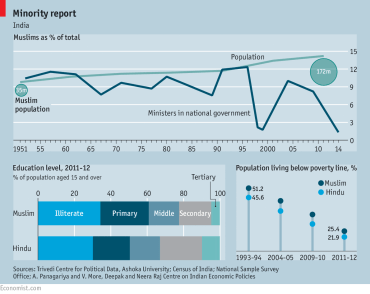
FOR a community of 172m, almost 15% of the population, Muslims at first glance appear oddly absent from the pages of India’s newspapers. In fact, they crop up a lot, but not by name.

Instead, reporters coyly refer to “a certain community”. The clumsy circumlocution is a way of avoiding any hint of stoking sectarian unrest. The aim is understandable in a country that was born amid ferocious communal clashes and which has suffered all too many reprises. But the dainty phrase also hints at something else. Since India’s independence in 1947, the estrangement of Muslims has slowly grown.

India’s Muslims have not, it is true, been officially persecuted, hounded into exile or systematically targeted by terrorists, as have minorities in other parts of the subcontinent, such as the Ahmadi sect in Pakistan. But although violence against them has been only sporadic, they have struggled in other ways. In 2006 a hefty report detailed Muslims’ growing disadvantages. It found that very few army officers were Muslim; their share in the higher ranks of the police was “minuscule”. Muslims were in general poorer, more prone to sex discrimination and less literate than the general population (see chart). At postgraduate level in elite universities, Muslims were a scant 2% of students.

A decade later, with most of the committee’s recommendations quietly shelved, those numbers are unlikely to have improved. Indeed, since the landslide election win by the Hindu-nationalist Bharatiya Janata Party (BJP) in 2014, some gaps have widened. There are fewer Muslim ministers now in the national government—just two out of 75—than at any time since independence, even though the Muslim share of the population has grown.

India remains a secular country, yet some laws proposed by the BJP bear a disturbingly sectarian tint. One bill would allow immigrants from nearby countries who happen to be Hindu, Sikh, Christian or Buddhist to apply for citizenship, while specifically barring Muslims. Another would retroactively block any legal challenge to past seizures of property from people deemed Pakistani “enemies”, even if their descendants have nothing to do with Pakistan and are Indian citizens. Courts have repeatedly ruled in favour of such claimants—all of them Muslim—but their families could now be stripped of any rights in perpetuity.

Far more than such legislative slights, what frightens ordinary Muslims is the government’s silence in the face of starker assaults. A year ago many were shocked when a mob in a village near Delhi, the capital, beat to death a Muslim father of three on mere suspicion that he had eaten beef. Earlier this month, after one of his alleged killers died of disease while in police custody, a BJP minister attended the suspect’s funeral, at which the casket was draped, like a hero’s, with the Indian flag.

Earlier this month, too, newspapers reported a disturbing discrepancy between the fates of two men arrested for allegedly spreading religiously insulting material via social media. One of the men, a member of a right-wing Hindu group in the BJP-run state of Madhya Pradesh, was quickly released from custody after the customary beating. The arresting officers have been charged with assault; their superiors up to the district level transferred. In the other case, in the state of Jharkhand, a Muslim villager was arrested for posting pictures implying he had slaughtered a cow. Police claimed he died of encephalitis following his arrest. A court-ordered autopsy revealed he had been beaten to death. To date, no police officers have been charged.

The BJP’s handling of a popular uprising in India’s only Muslim-majority state, Jammu and Kashmir, has also raised Muslim concern. Four months into the unrest, in which dozens of civilians have been killed and hundreds injured, with continuous curfews and strikes keeping schools and shops closed, the government still refuses to talk to any but the most supine local politicians. “You don’t understand,” snaps a cabinet minister, “It’s a violent movement to build an Islamic theocracy. No democracy can tolerate that.”

Omair Ahmad, a writer on Muslim affairs, scoffs at this. The problem, he says, is that Indian governments insist on treating Kashmir as a “Muslim issue” when the real question is one of democratic representation. Yet most Indian Muslims tend to toe the official line, either from a desire to appear loyal or because they genuinely feel only a faint bond with Kashmir.

The fact is that India’s Muslims are divided, not only between dominant Sunnis and a large Shia minority but also between starkly different social classes and regions: a Muslim in Bengal is likely to share no language and few traditions with a co-religionist far to the south in steamy Kerala. The divisions may soon get deeper. Both India’s supreme court and the national law commission, a state body charged with legal reform, are deliberating whether laws governing such things as divorce and inheritance should remain different for different religious groups, or should be harmonised in a uniform national code, as the constitution urges. Spotting another “Muslim issue”, past governments have let conservative clerics control family law. As a result India, unlike most Muslim-majority countries, still allows men to divorce simply by pronouncing the word three times.

The BJP, however, is calling for sweeping reform, with Narendra Modi, the prime minister, painting the issue as a straightforward question of women’s rights. Much as many Muslims heartily agree that change is long overdue, suspicions linger that the BJP’s aim is less to generate reform than to spark inevitable protests by Muslim conservatives, so uniting Hindus in opposition to Muslim “backwardness”.

This question may play out in elections this winter in Uttar Pradesh, India’s most populous state, nearly 40m of whose 200m people are Muslim. The state has witnessed repeated communal clashes since the destruction by Hindu activists, in 1992, of a medieval mosque said to have been built over an ancient temple marking the birthplace of Rama, a Hindu deity. Many expect the BJP to play the “Muslim card” in an effort to rally Hindu votes.

There is hope: a similar ploy flopped last year in the neighbouring state of Bihar. Whatever the outcome, India’s Muslims feel increasingly like spectators in their own land. “They called it a secular state, which is why many who had a choice at partition wanted to stay here,” says Saeed Naqvi, a journalist whose recent book, “Being the Other”, chronicles the growing alienation of India’s Muslims. “But what really happened was that we seamlessly glided from British Raj to Hindu Raj.”

Source: An uncertain community | The Economist

07/10/2016

Keeping pure and true | The Economist

CHINA’S cities abound with restaurants and food stalls catering to Muslims as well as to the many other Chinese who relish the distinctive cuisines for which the country’s Muslims are renowned.

So popular are kebabs cooked by Muslim Uighurs on the streets of Beijing that the city banned outdoor grills in 2014 in order to reduce smoke, which officials said was exacerbating the capital’s notorious smog (the air today is hardly less noxious).

Often such food is claimed to be qing zhen, meaning “pure and true”, or halal, prepared according to traditional Islamic regulations. But who can tell? Last year angry Muslims besieged a halal bakery in Xining, the capital of Qinghai province, after pork sausages were found in the shop’s delivery van. There have been several scandals in recent years involving rat meat or pork being sold as lamb. These have spread Muslim mistrust of domestically produced halal products.

In response, some local governments have introduced regulations requiring food purporting to be halal to be just that (though not going into detail of what halal means, such as the slaughter of animals with a knife by a Muslim). Earlier this year, however, the national legislature suspended its work on a bill that would apply such stipulations countrywide.

There is much demand for one. Local rules are often poorly enforced. Advocates of a national law say a lack of unified standards is hampering exports to Muslim countries. According to Wang Guoliang of the Islamic Association of China, the country’s halal food industry makes up a negligible 0.1% of the global market.

The government began drafting a national halal law in 2002. But Muslim communities in China have varying definitions of the term. Work on the bill was slow. Each year, during the legislature’s annual session in March, Muslim delegates called for faster progress. But there were opponents, too. Some scholars argued that the government should not regulate on matters relating to religious faith. Others said that by giving in to the Muslims’ demands, China would encourage them to press for more concessions and ultimately form their own enclaves run by sharia.

Such views may have given pause to China’s leaders. In April, at a high-level meeting on religious affairs, President Xi Jinping said religion should be prevented from interfering with the law. That month Wang Zhengwei, a Muslim official who had been pushing for halal legislation, was removed from his post as the head of the State Ethnic Affairs Commission.

Also in April, the Communist Party chief of Ningxia urged officials to “sharpen [their] vigilance” against the use of halal labels on products such as toilet paper, toothpaste and cosmetics. And the government of Qinghai province ordered the inspection of Muslim-only toilets and hospital rooms, as well as shops catering to Muslims, to make sure that halal symbols were being used only on food. Xinjiang, the far-western region that is home to the Uighurs, recently introduced an anti-terrorism law threatening punishment of those who “overextend” halal rules. Officials clearly worry that those who do so might be the same sort of people who embrace jihad.

Ismael An, a Muslim writer, says this is overreacting. “Supporters of the halal law are not the so-called extremists, because real extremists don’t make demands through legislation,” he says. On the internet, however, a small but vocal group of Islamophobes has been calling for a boycott of halal-certified products. They say the price of such goods factors in payments to Islamic groups that grant the certificates—they do not want to give the religion even indirect support. Ironically, it is the non-Muslim love of Muslim food that will ensure the campaign will not succeed.

Source: Keeping pure and true | The Economist

07/10/2016

China’s other Muslims | The Economist

THE faithful are returning from the haj. Waiting for prayers outside the Great Mosque in Tongxin, a remote town in the western province of Ningxia, Li Yuchuan calls his pilgrimage a liberation: “Our prayers are just homework for it.” His 84-year-old friend (pictured, right) leaps up and twists himself with lithe agility into the shape of a pretzel. “We Muslims pray five times a day,” he says. “We are flexible and tough.” China’s Muslims need to be.

China has a richly deserved reputation for religious intolerance. Buddhists in Tibet, Muslims in the far western region of Xinjiang and Christians in Zhejiang province on the coast have all been harassed or arrested and their places of worship vandalised. In Xinjiang the government seems to equate Islam with terrorism. Women there have been ordered not to wear veils on their faces. Muslims in official positions have been forced to break the Ramadan fast. But there is a remarkable exception to this grim picture of repression: the Hui.

China has two big Muslim groups, the Uighur of Xinjiang and the more obscure Hui. Though drops in the ocean of China’s population, they each have about 10m people, the size of Tunisia. But while the Uighur suffer, the Hui are thriving.

The number of mosques in Ningxia (cradle of the Hui, as one of their number puts it) has more than doubled since 1958, from 1,900 to 4,000, says Ma Ping, a retired professor at Northern Nationalities University. New ones are being built across the province. The Hui are economically successful. They are rarely victims of Islamophobia. Few Muslim minorities anywhere in the world can say as much.

The Hui’s religious practices reflect the waves of Islam that have washed over China. According to Ma Tong, a Hui scholar, just over half of them follow the Hanafi school of Sunni Islam, which was brought to China centuries ago. At the Najiahu mosque south of Yinchuan, Ningxia’s capital, banners adorn the entrance saying “ancient and authentic religion” and “cleave to the original path”. A fifth of the Hui follow the more austere code of Wahhabism brought to China in the 19th century (there are also a handful of more extreme Salafist converts resulting from recent contacts through the haj). And a fifth follow one of three Sufi schools of Islam, an esoteric and mystical branch derided as apostate by hardline Salafists. The Hui’s religious diversity makes it easier for the party to tolerate them. Divide and rule.

But the real secret of the Hui’s success lies in the ways they differ from the Uighur. The Uighur, of Turkic origin, are ethnically distinct. They speak their own language, related to Turkish and Uzbek. They have a homeland: the vast majority live in Xinjiang. A wall of discrimination separates them from the Han Chinese. If they have jobs in state-owned enterprises, they are usually menial.

In contrast, the Hui are counted as an ethnic minority only because it says so on their hukou (household-registration) documents and because centuries ago their ancestors came as missionaries and merchants from Persia, the Mongol courts or South-East Asia. Having intermarried with the Han for generations, they look and speak Chinese. They are scattered throughout China (see map); only one-fifth live in Ningxia.

Unlike the Uighur and Tibetans, they have taken the path of assimilation.

At the new Qiao Nan mosque in Tongxin, the congregation is celebrating the life of an important local figure in the mosque’s history. The ceremony begins with a sermon by the ahong (imam). Then come prayers chanted in Arabic. At the house of the local worthy’s grandson, the worshippers read from the Koran, then visit the tomb. But the afternoon ends very differently, with a reading from an 18-metre-long scroll written by the grandson, Ma Jinlong. This consists of excerpts from eighth-century classical Chinese poetry, illustrated with his own delicate water-colours. Mr Ma is both a stalwart of the mosque and a Chinese gentleman-scholar.

A close connection with Chinese society is characteristic of the Hui. Some of the most famous historical figures were Hui, though few Chinese are aware of it. They include Zheng He, China’s equivalent of Columbus, who commanded voyages of discovery around 1400. Recently, the party chief in Jiangsu province as well as the head of the Ethnic Affairs Commission, a government body, were Hui.

Relations with the Han have not always been good. The so-called Dungan revolt by the Hui in the 1860s and 1870s was a bloodbath. But since the death of Mao in 1976, the two sides have reached an accommodation. Dru Gladney, of Pomona College in California, says a hallmark of the Hui is their skill at negotiating around the grey areas of China’s political system.

Thanks to this, they have been successful economically. They dominate halal food production. They are emerging as the favoured middlemen between state enterprises and firms in Central Asia and the Gulf. China’s largest school of Arabic is a private college, set up and partly financed by Hui, on the outskirts of Yinchuan. Most students are training to be corporate interpreters.

One sign of how far the government tolerates the Hui is that they are even able to practice Islamic (sharia) law to a limited extent. Sharia is not recognised by the Chinese legal code. Yet at the Najiahu mosque, the ahong and the local county court share the same mediation office. Every week or so, the ahong adjudicates in family disputes usingsharia. Only if he fails do civil officials step in.

Surprisingly, the Hui have not lost their religion or identity despite centuries of assimilation. Mr Ma, the retired professor, says Hui people often form close-knit communities and pursue similar occupations; restaurants and taxis in many cities are run by Hui. But their religion is “still the most important binding factor”, he says. The Hui maintain a delicate balance. They can practise their religion undisturbed thanks to assimilation. But it is their religion that makes them distinct.

This is a fine line, and it means the Hui are vulnerable to China’s shifting religious attitudes. They have so far mostly escaped Islamophobia. But bigotry is becoming more common on social media. “The greens” (a significant colour in Islam) has become an online term of abuse. So far the government has tolerated the Hui’s culture. But in Ningxia in July, Xi Jinping, the president, told his audience to “resolutely guard against illegal infiltration”—even though there is little sign of any. His government has become more repressive towards many religious groups. The Hui could be next.

But the lessons offered by the Hui’s experience are largely positive. Islam, the Hui show, are not the threat that party leaders sometimes imply it is. They show that you can be both Chinese and Muslim. At Yinchuan airport, a returning pilgrim is waiting for his luggage. He wears a white robe with “Chinese pilgrimage to Mecca” stitched in green Arabic letters below a Chinese flag embroidered in red, the symbol of an atheist party-state. “It was the experience of a lifetime,” he says of the haj—and disappears into a sea of white hats worn by hundreds of cheering fellow Muslims who fill the arrivals hall to welcome him home.

Source: China’s other Muslims | The Economist

Law of Unintended Consequences

continuously updated blog about China & India

ChiaHou's Book Reviews

continuously updated blog about China & India

What's wrong with the world; and its economy

continuously updated blog about China & India