Archive for ‘religion’

15/02/2019

Pulwama attack: India will ‘completely isolate’ Pakistan

India has said it will ensure the “complete isolation” of Pakistan after a suicide bomber killed 46 soldiers in Indian-administered Kashmir.

Federal Minister Arun Jaitley said India would take “all possible diplomatic steps” to cut Pakistan off from the international community.

India accuses Pakistan of failing to act against the militant group which said it carried out the attack.

This is the deadliest attack to hit the disputed region in decades.

Both India and Pakistan claim all of Muslim-majority Kashmir but only control parts of it.

An insurgency has been ongoing in Indian-administered Kashmir since the late 1980s and there has been an uptick in violence in recent years.

How will India ‘punish’ Pakistan?

India says that Jaish-e-Mohammad, the group behind the attack, has long had sanctuary in Pakistan and accuses its neighbour of failing to crack down on it.

It has called for global sanctions against the group and has said it wants its leader, Masood Azhar, to be listed as a terrorist by the UN security council.

Although India has tried to do this several times in the past, its attempts were repeatedly blocked by China, an ally of Pakistan.

Mr Jaitley set out India’s determination to hold Pakistan to account when speaking to reporters after attending a security meeting early on Friday.

He also confirmed that India would revoke Most Favoured Nation status from Pakistan, a special trading privilege granted in 1996.

Pakistan said it was gravely concerned by the bombing but rejected allegations that it was in any way responsible.

But after Prime Minister Narendra Modi said in a speech that those behind the attack would pay a “heavy price”, many analysts expect more action from Delhi.

After a 2016 attack on an Indian army base that killed 19 soldiers, Delhi said it carried out a campaign of “surgical strikes” in Pakistan-administered Kashmir, across the de facto border. But a BBC investigation found little evidence militants had been hit.

However analysts say that even if the Indian government wants to go further this time, at the moment its options appear limited due to heavy snow across the region.
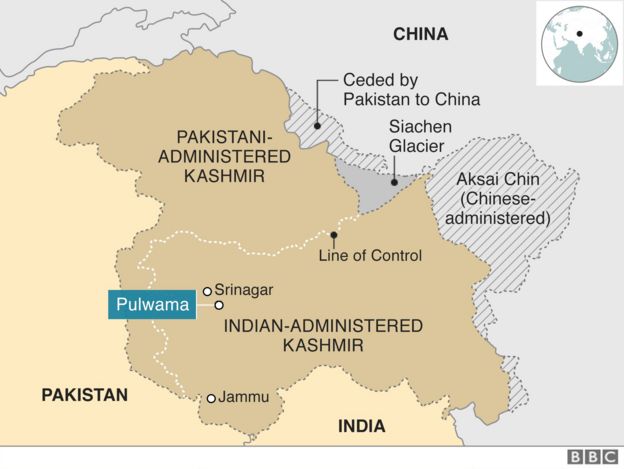
map

How did the attack unfold?

The bomber used a vehicle packed with explosives to ram into a convoy of 78 buses carrying Indian security forces on the heavily guarded Srinagar-Jammu highway about 20km (12 miles) from the capital, Srinagar.

“A car overtook the convoy and rammed into a bus,” a senior police official told BBC Urdu.

It stands as the deadliest militant attack on Indian forces in Kashmir since the insurgency began in 1989.

The bomber is reported to be Adil Dar, a high school dropout who left home in March 2018. He is believed to be between the ages of 19 and 21.

Soon after the attack Jaish-e-Mohammad released a video, which was then aired on the India Today TV channel. In it, a young man identified as Adil Dar spoke about what he described as atrocities against Kashmiri Muslims. He said he joined the banned group in 2018 and was eventually “assigned” the task of carrying out the attack in Pulwama.

He also said that by the time the video was released he would be in jannat (heaven).

Dar is one of many young Kashmiri men who have been radicalised in recent years. On Thursday, main opposition leader Rahul Gandhi said that the number of Kashmiri men joining militancy had risen from 88 in 2016 to 191 in 2018.

India has been accused of using brutal tactics to put down protests in Kashmir – with thousands of people sustaining eye injuries from pellet guns used by security forces.

What’s the reaction?

“We will give a befitting reply, our neighbour will not be allowed to de-stabilise us,” said Prime Minister Modi.

Mr Gandhi and two former Indian chief ministers of Jammu and Kashmir all condemned the attack and expressed their condolences.

The attack has also been widely condemned around the world, including by the US and the UN Secretary General.

The White House called on Pakistan to “end immediately the support and safe haven provided to all terrorist groups operating on its soil”.

Pakistan said it strongly rejected any attempts “to link the attack to Pakistan without investigations”.

What’s the background?

There have been at least 10 suicide attacks since 1989 but this is only the second suicide attack to use a car.

Prior to Thursday’s bombing, the deadliest attack on Indian security forces in Kashmir this century came in 2002, when militants killed at least 31 people at an army base in Kaluchak near Jammu, most of them civilians and relatives of soldiers.

At least 19 Indian soldiers were killed when militants stormed a base in Uri in 2016. Delhi blamed that attack on the Pakistani state, which denied any involvement.
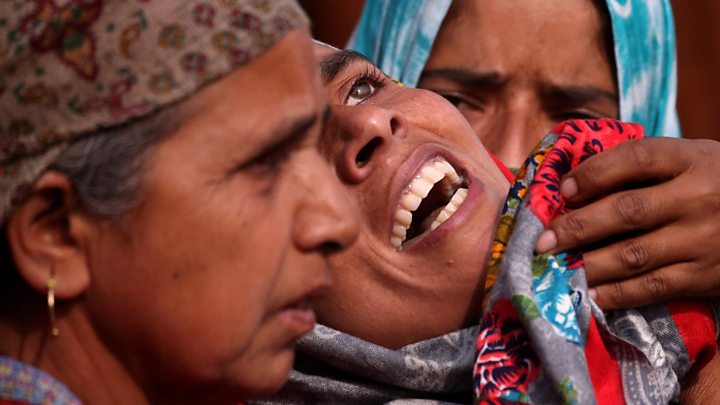
The latest attack also follows a spike in violence in Kashmir that came about after Indian forces killed a popular militant, 22-year-old Burhan Wani, in 2016.

More than 500 people were killed in 2018 – including civilians, security forces and militants – the highest such toll in a decade.

India and Pakistan have fought three wars and a limited conflict since independence from Britain in 1947 – all but one were over Kashmir.

Who are Jaish-e-Mohammad?

Started by cleric Masood Azhar in 2000, the group has been blamed for attacks on Indian soil in the past, including one in 2001 on the parliament in Delhi which took India and Pakistan to the brink of war.

Most recently, the group was blamed for attacking an Indian air force base in 2016 near the border in Punjab state. Seven Indian security personnel and six militants were killed.

It has been designated a “terrorist” organisation by India, the UK, US and UN and has been banned in Pakistan since 2002.

However Masood Azhar remains at large and is reportedly based in the Bahawalpur area in Pakistan’s Punjab province.

India has demanded his extradition from Pakistan but Islamabad has refused, citing a lack of proof.

Source: The BBC
09/02/2019

India court hands 7 Muslim men life sentences for killings that sparked 2013 riots

NEW DELHI (Reuters) – An Indian court on Friday sentenced seven Muslim men to life in prison for the murder of two Hindu men in 2013 in the northern state of Uttar Pradesh, an incident that had sparked religious riots killing about 65 people and displacing thousands.

The riots began in the district of Muzaffarnagar, 130 km (81 miles) northeast of New Delhi, and spread to other areas in the country’s most populous state months before the 2014 election won by Prime Minister Narendra Modi’s Hindu nationalist party.

A court in Muzaffarnagar sentenced the men after they were found guilty of killing the two Hindus in the village of Kawal on Aug. 27, 2013, prosecutor Rajeev Sharma told Reuters.

Reuters could not immediately contact the families of the convicted men.

Nearly all the victims here of the riots were Muslims, including about 12,000 people who were made temporarily homeless due to the unrest that polarised western Uttar Pradesh on religious lines.

Source: Reuters

06/02/2019

Hindu right-winger arrested for re-enacting Gandhi assassination

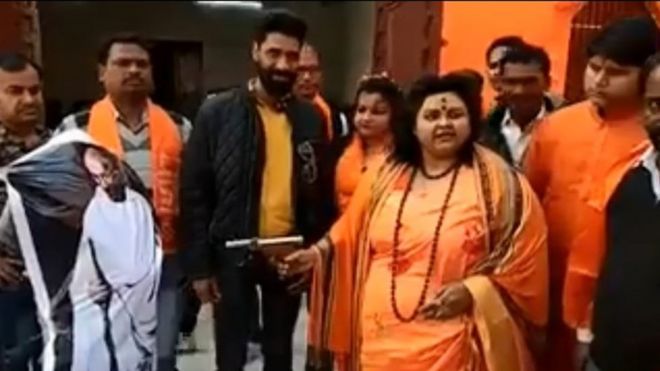
Pooja Pandey, leader of the Hindu Mahasabha, shooting at an effigy of Gandhi with an air pistolImage copyrightSCREENGRAB
Image captionPooja Pandey, leader of the Hindu Mahasabha, shooting an effigy of Gandhi with an air pistol

A leader of a fringe Hindu right-wing group in India has been arrested after a video of her shooting an effigy of Mahatma Gandhi went viral.

The Hindu Mahasabha had organised an event to “celebrate” the 71st anniversary of Gandhi’s assassination.

In the video, Pooja Pandey shoots the effigy with an air pistol after garlanding a picture of Nathuram Godse, who shot the independence leader.

Gandhi has long been seen as too moderate by some right-wing Hindus.

Police had been seeking Ms Pandey’s arrest since the video, believed to have been released by her group, emerged last week.

Two police teams were deployed to track her and her husband, who also features prominently in the footage.

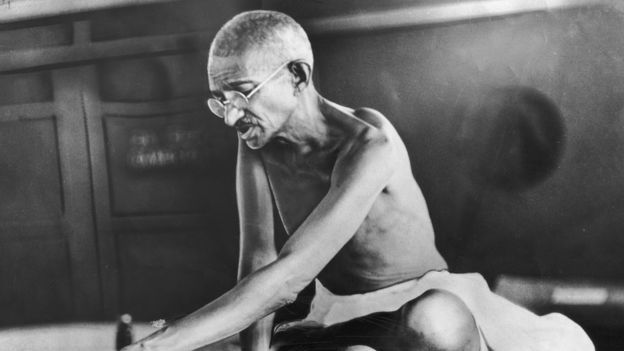
Circa 1935: Indian spiritual and political leader Mahatma Gandhi (1869 - 1948)Image copyrightGETTY IMAGES
Image captionNathuram Godse shot Mahatma Gandhi on 30 January 1948

They had already made several other arrests in connection with the video which was shot on 30 January – the day Gandhi was killed.

“We arrested nine people within a week and are searching for two more suspects in the case,” police officer Neeraj Jadaun told the BBC.

Godse, who shot Gandhi in the chest three times at point-blank range on 30 January 1948, was an activist with nationalist right-wing groups, including the Hindu Mahasabha.

Hindu hardliners in India accuse Gandhi of having betrayed Hindus by being too pro-Muslim, and even for the division of India and the bloodshed that marked Partition, which saw India and Pakistan created after independence from Britain in 1947.

This is not the first time the controversial fringe group has tried to glorify Godse and celebrate Gandhi’s assassination.

In 2015, the group announced plans to install statues of Godse across six districts in the southern state of Karnataka, sparking protests across the state.

Source: The BBC

25/01/2019

Exclusive: Hindu group RSS urges India’s Modi to resist U.S. push to ease e-commerce curbs

NEW DELHI (Reuters) – A Hindu nationalist group close to Prime Minister Narendra Modi’s party has urged him to resist pressure from the United States and not defer new regulations for the e-commerce sector, according to a letter seen by Reuters.

The economic wing of the group, Rashtriya Swayamsevak Sangh (RSS), which is the fountainhead of the ruling party, has written to Modi saying that changing the policy implementation date, under pressure from Washington, will hurt 130 million small Indian entrepreneurs.

“There is no need to buckle under these pressures. India must continue to chart the way best for itself and the entrepreneurs,” the Swadeshi Jagran Manch said in its letter, which was reviewed by Reuters.

The new rules, to be implemented from Feb. 1, will deal a blow to Walmart Inc and Amazon.com’s ambitions in the country. They mandate that e-commerce companies will not be allowed to sell products from firms in which they have an equity interest.

Reuters reported on Thursday the United States government had told Indian officials the new rules will hinder the investment plans of the two companies.

The rules, which will force the companies to change their business structures and raise operational costs, have sparked an extensive lobbying effort from both Amazon and Walmart, which last year invested $16 billion in Indian e-commerce company Flipkart.

Both Amazon and Walmart have sought an extension of the Feb. 1 deadline, but government sources have said that was unlikely to happen as Modi needs millions of traders by his side in an upcoming national election due by May.

On Friday, the Confederation of All India Traders, which has supported tougher scrutiny of large e-commerce players, said “the entire trading community will vote against the government if they extend the deadline”.

The e-commerce spat is the latest in a number of disputes over trade and investment relations between India and the United States.

Walmart spokesman Greg Hitt told Reuters this week the company had “engaged the (United States) administration on this issue”.

The RSS has long advocated self-reliance and opposed the opening up of the Indian economy to foreign players.

Small Indian retailers have alleged that e-commerce companies use their control over inventory from their affiliates to create an unfair marketplace that allows them to sell some products at lower prices, which hurts the businesses of brick-and-mortar retailers. Such arrangements would be barred under the new policy.

In front-page advertisements in newspapers last week, Walmart-owned Flipkart highlighted how the platform had helped transform local struggling businesses selling badminton racquets and sarees, a traditional dress.

Source: Reuters

17/12/2018

Narendra Modi: Is hardline Hindu politics failing India’s PM?

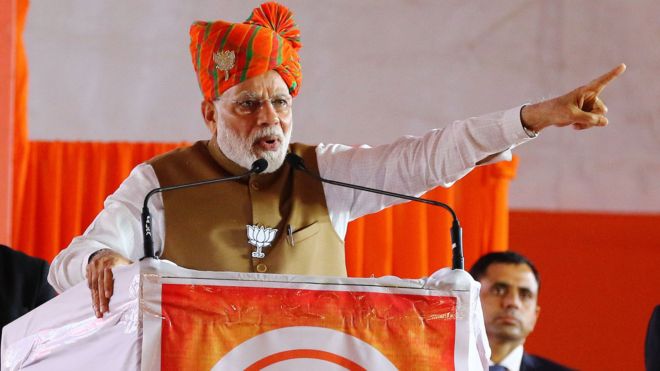
Prime Minister Narendra Modi addressing the election campaign rally ahead the state assembly polls , in Jaipur , Rajasthan, India , Dec 04,2018.Image copyrightGETTY IMAGES

Last week’s electoral losses in five states for India’s ruling party has led to speculation that its agenda of promoting hardline Hindu politics has backfired. The BBC’s Priyanka Pathak reports.

Prime Minister Narendra Modi’s Bharatiya Janata Party (BJP) lost to the main opposition Congress party in the Hindi-speaking heartland states of Madhya Pradesh, Rajasthan and Chhattisgarh, all of which they previously governed. Local parties swept up the other two states – Telangana and Mizoram – putting the BJP in a tough place ahead of general elections next year.

It appears that after winning no less than 13 state elections since coming to power in 2014, the BJP’s seemingly invincible electoral juggernaut is losing steam.

There is a great deal of introspection within and outside the party. And the main question is: has the BJP’s recent pursuit of a hardline Hindu agenda – known locally as Hindutva – backfired? Will a departure from an inclusive, development agenda to a polarising, communal one cost the BJP general election too?

These are legitimate questions because the party deployed the chief minister of the northern state of Uttar Pradesh, Yogi Adityanath, as its star campaigner in the five states that went to polls.

Mr Adityanath is widely considered a controversial figure because of his well-publicised anti-Muslim comments.

He addressed 74 election rallies while Mr Modi, who is usually his party’s star campaigner, addressed just 31.

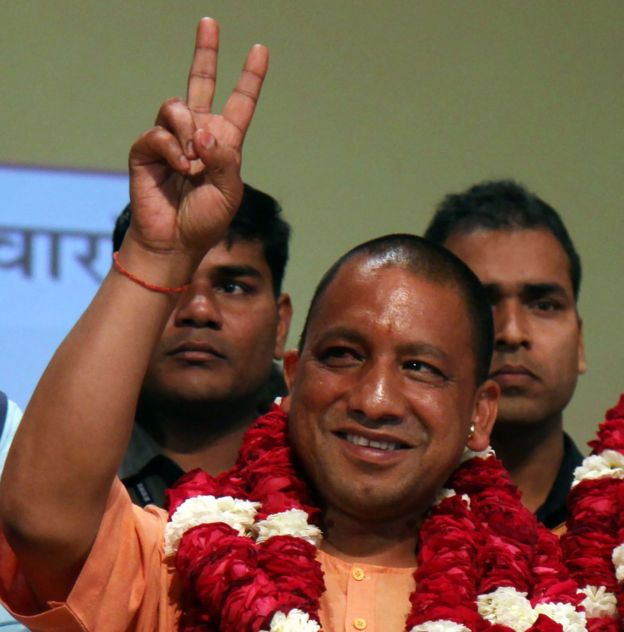
Adityanath victoryImage copyrightAFP
Image captionYogi Adityanath is seen as a “poster child” for a hardline Hindu agenda

Mr Adityanath also spent the past few months courting the Sangh Parivar – a “family” of Hindu nationalist organisations including the Rashtriya Swayamsevak Sangh (RSS), a hardline Hindu organisation with umbilical ties to the BJP.

The Sangh Parivar also includes the Vishwa Hindu Parishad (VHP), which has been at the forefront of a movement demanding the construction of a Hindu temple on the site of a 16th Century mosque that was torn down by Hindu mobs in 1992, provoking widespread riots that left thousands dead.

Hindus believe Ayodhya, situated in Mr Adityanath’s Uttar Pradesh state, is the birthplace of their revered deity Lord Ram, and say an older temple existed at the site before the mosque was constructed.

Mr Adityanath has announced the construction of a giant statue of Ram in the state, and changed the name of the historical city of Allahabad to the more “Hindu” sounding Prayagraj ahead of the forthcoming Ardh Kumbh Mela, one of the world’s largest religious gatherings.

But if Mr Adityanath was hoping to prove to the VHP leadership that he is a more willing pursuer of the Hindutva agenda and, therefore, a potential alternative to Mr Modi, the recent electoral defeats do not advance his case.

Many observers believe that the BJP’s defeats are because the party deviated from the development agenda that swept them to power in 2014. The pursuit of Hindutva has backfired, they say.

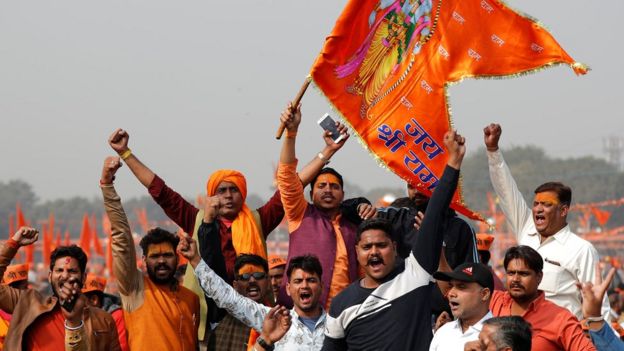
Supporters of the Vishva Hindu Parishad (VHP), a Hindu nationalist organisation, shout religious slogansImage copyrightREUTERS
Image captionHindus believe the disputed religious site of Ayodhya is the birthplace of one of their most revered deities

But some in the Sangh Parivar disagree, insisting that it is actually the opposite that is true. “Just the way people feel disenchanted with the economic policies of the government, the people have also lost faith in this government’s commitment to build the Ram temple. If the VHP and RSS have to come to the street to warn the government about it, what does it tell you? What does it tell the electorate?” one of them said.

Last week, tens of thousands of Hindus gathered in the capital, Delhi, to demand the expedited construction of the temple and criticised the government for failing to do so.

They chanted a striking slogan directly targeting Mr Modi’s stated development-first agenda: “Pehle Ram ko aasan do, phir humko sushasan do (First give Ram a throne, then give us good governance)”.

But it must be noted that while Mr Modi has never openly supported these hardline elements, his silence on issues such as an increasing number of attacks on Muslims over various issues like eating beef – cows are considered sacred in Hinduism and their slaughter is banned in many Indian states – is interpreted as a tacit approval for muscular Hindu politics.

But he now faces pressure to do more.

His government already leads a lacklustre economy. And this renewed pressure to recommit to Hindutva, despite its apparent failure as an electoral agenda, puts Mr Modi’s government in a difficult place.

There is also the fact that the RSS played a vital role in the BJP’s 2014 election victory by mobilising and galvanising voters. They are also credited for Mr Modi’s rise from state chief minister to a national figure. Apart from spearheading a sophisticated online and digital campaign in his favour, cadres also held 600 district-level meetings across the country to make Mr Modi a familiar name among the rural population.

Clearly, they cannot be ignored or offended.

So even as the liberals suggest that Hindutva has backfired and demand that the government refocus on the economy, there are voices within the BJP which are demanding a more strident return to the party’s “core” agenda – including the construction of the Ram temple and renewed focus on efforts to protect cows – to reassure their base that the BJP has not abandoned them.

The less-than-satisfactory economic performance will also make the Hindutva agenda more important, they say.

09/12/2018

As election nears, religious tensions surge in an Indian village

NAYABANS, India (Reuters) – Nayabans isn’t remarkable as northern Indian villages go. Sugar cane grows in surrounding fields, women carry animal feed in bullock carts through narrow lanes, people chatter outside a store, and cows loiter.

But this week, the village in Uttar Pradesh state became a symbol of the deepening communal divide in India as some Hindu men from the area complained they had seen a group of Muslims slaughtering cows in a mango orchard a couple of miles away.

That infuriated Hindus, who regard the cow as a sacred animal. Anger against Muslims turned into outrage that police had not stopped an illegal practise, and a Hindu mob blocked a highway, threw stones, burned vehicles and eventually two people were shot and killed – including a police officer.

The events throw a spotlight on the religious strains in places like Nayabans since Prime Minister Narendra Modi’s Hindu nationalist Bharatiya Janata Party (BJP) came to power at the national level in 2014 and in Uttar Pradesh in 2017. Tensions are ratcheting up ahead of the next general election, due to be held by May.

The BJP said it was “bizarre” to assume the party would benefit from any religious disharmony, dismissing suggestions that its supporters were largely responsible for the tensions.

“In a large country like India nobody can ensure that nothing will go wrong, but it’s our responsibility to maintain law and order and we understand that,” party spokesman Gopal Krishna Agarwal said. “But people are trying to politicize these issues.”

SPONSORED

Nayabans, just about three hour’s drive from Delhi, has about 400 Muslims out of a population of 4,000, the rest are Hindu. Relations between the communities began deteriorating around the Muslim holy month of Ramadan last year when Hindus in the village demanded that loudspeakers used to call for prayer at a makeshift mosque be removed, local Muslims said.

“For 40 years mikes were used in the mosque, calls for prayer were made five times a day, but no one objected,” said Waseem Khan, a 28-year-old Muslim community leader in Nayabans.

“We resisted initially but then we thought it’s better to live in peace then create a dispute over a mike,” he said. “We don’t want to give them a chance to fan communal tensions.”

Reuters spoke with more than a dozen Muslims from the village but except for Khan, no one else wanted to be named for fear of angering the Hindu population.

Several among a group of Muslim women and girls standing outside the mosque said they have been living in fear since the BJP came to power in the state in 2017.

They said that Hindu groups now hold provocative processions through the village during every Hindu festival, loudspeakers blaring, something that used to happen rarely before. They said they felt “terrorised” by Hindu activists.

“While passing through our areas during their religious rallies, they chant ‘Pakistan murdabad’ (down with Pakistan) as if we have some connection to Pakistan just because we are Muslims,” Khan said.

HINDU PRIEST CHIEF MINISTER

The subcontinent was divided into Muslim Pakistan and Hindu-majority India at the time of independence from British colonial rule in 1947.

During the violence on Monday, many Muslims in Nayabans locked themselves in their homes fearing attacks. Some who had attended a three-day Muslim religious congregation some miles away stayed outside the area that night to avoid making themselves targets for the mob.

Muslim villagers say they are particularly fearful of the top elected official in Uttar Pradesh, Chief Minister Yogi Adityanath, who is a Hindu priest and senior BJP figure. Hindu hardliners started asserting themselves more in the village after he was elected, they say.

Uttar Pradesh sends 80 lawmakers to the lower house of parliament, the largest of any state in the country.

Considered the county’s political crucible, it has also been the scene for spiralling Hindu-Muslim tensions.

Slideshow (8 Images)

Adityanath said the lead up to the rioting in Nayabans was a “big conspiracy”, but did not elaborate.

In the only statement from his office on the incident, Adityanath ordered police to arrest those directly or indirectly involved in the slaughter of cows and made no mention of the death of the police inspector. He announced 1 million rupees ($14,110) as compensation for the family of the other dead man, a local who is among those accused by police for the violence.

Both men were Hindus and died of bullet wounds, although police said it was not yet clear who shot whom.

Police say they have arrested up to five people for the cow slaughter but have not given their religion. Locals say all the arrested people are Muslims. Four Hindu men have been arrested for the violence leading to the deaths.

“All invidious elements who may have conspired to vitiate the situation will be exposed through a fair and transparent investigation,” Anand Kumar, the second highest police official in Uttar Pradesh, told Reuters.

Asked if there was any bias against Muslims, Uttar Pradesh government spokesman Sidharth Nath Singh – who is also the state’s health minister – told Reuters: “We believe in equality and our motto is sabka saath, sabka vikas”, using a Hindi phrase often used by Modi that means “collective effort, inclusive growth”.

RELATIVE HARMONY

The two communities in Nayabans have lived in relative harmony for years, residents from both groups said.

But now Hindus in the village, who mostly say they support Yogi, accuse the Muslims of trying to turn themselves into the victims when they weren’t.

“Can’t believe they are raising our processions with journalists!” said Daulat, a Hindu daily wage labourer who goes by one name. “They are making it a Hindu-Muslim issue, we are not. Their people have been accused of killing cows, so they are playing the victim.”

At a middle school, metres from the police outpost near where the two men got killed, two women teachers, sitting on a veranda soaking in the winter sun, said its 66 students stopped coming for classes in the first few days after the violence.

“We worship cows and their slaughter can’t be accepted,” said one of the teachers, Uma Rani. “Two Hindus died here but nothing happened to the cow killers.”

Both teachers were Hindus.

Political analysts say relations between the two communities are likely to stay tense ahead of the national vote, particularly in polarised states such as Uttar Pradesh.

The BJP made a near-clean sweep in Uttar Pradesh in 2014, helping Modi win the country’s biggest parliamentary mandate in three decades, but pollsters predict a tighter contest next year because of a lack of jobs and low farm prices.

“Facing economic headwinds and lacklustre job growth, Modi will rally his conservative base by selectively resorting to Hindu nationalism,” global security consultancy Stratfor said last month.

Muslims say they increasingly feel like second-class citizens in their own country.

“The BJP will definitely benefit from such incidents,” said Tahir Saifi, a Muslim community leader a few miles from the area of violence who supports a regional opposition party in Uttar Pradesh. “They want all Hindus to unite, and when religion comes into the picture, other issues like development take a back seat.”

05/12/2018

Two killed in violence over cow slaughter in north India

NEW DELHI (Reuters) – A senior police officer and another man were killed on Monday in violent protests over reports of a slaughtered cow, an animal sacred in Hindu culture, in India’s Uttar Pradesh state.

A crowd angered over what they believed was the slaughter of the cow threw stones and torched vehicles outside a police station. The officer died from gunshot wounds, district magistrate Anuj Jha told Reuters.

Earlier, police had said the officer was stoned to death and the other man died from gunshot wounds.

“Villagers complained after they found a dead cow, and took to the streets to protest. They blocked a road with a tractor and pelted stones,” he said.

So-called cow vigilantes from India’s Hindu majority have attacked and killed a number of Muslims involved in transporting cattle to slaughterhouses in recent years. However, the exact circumstances of Monday’s protests were not clear.

Reporting by Sudarshan Varadhan, Himani Singh and Amit Ganguly; Edited by Mark Heinrich

02/12/2018

Kartarpur corridor: A road to peace between India and Pakistan?

  • 29 November 2018
Gurcharan Singh
Image captionGurcharan Singh welcomes the opportunity to unite Indians and Pakistanis

Seventy-five-year-old Gurcharan Singh was just a child during Partition in 1947, when his family left their home in the city of Sialkot, in modern day Pakistan, to head to India.

Now on a visit to the Sikh temple in the Pakistani village of Kartarpur, he was delighted that the two countries had agreed to construct a corridor allowing visa-free access to pilgrims from India.

“Since Pakistan was created our community has wanted this,” he told the BBC. “Two families,­ Indians and Pakistanis,­ are meeting again.”

The Gurdwara Darbar Sahib Kartarpur is one of the holiest places in Sikhism. It’s believed to have been built on the site where Guru Nanak, the founder of the religion, died in the 16th Century.

Image captionThe Gurdwara Darbar Sahib Kartarpur, close to the Pakistan-Indian border, is one of the holiest sites in Sikhism

The temple is located around 4km (2.5 miles) from the border with India, but tensions between the neighbouring countries have meant Sikh pilgrims have often found it difficult to visit. Some have had to be content with viewing it through binoculars from India.

The “Kartarpur corridor” will however lead from the Indian border straight to the gurdwara, with the sides fenced off.

The move has been welcomed enthusiastically by the Sikh community, and also represents a rare instance of co-operation between the two countries, which have fought three wars against each other since independence.

Image captionThe ceremony was attended by Sikh children

Relations between India and Pakistan remain strained, but at a ceremony formally starting construction work on the pathway on the Pakistani side of the border, the country’s Prime Minister Imran Khan said: “We will only progress when we free ourselves from the chains of the past”.

A number of Indian politicians were amongst those attending.

Pakistani Foreign Minister Shah Mahmood Qureshi told the BBC the Kartarpur project would help improve the countries’ relationship.

“The more people meet, the more they realise how much in common we have, and what we are missing by not resolving our outstanding issues.” he said.

Formal talks between India and Pakistan have stalled since an attack in 2016, which Indian authorities blamed on Pakistani-backed militants. Pakistan denied the claim.

Prime Minister Khan directly addressed the commonly held view that Pakistan’s powerful military and intelligence services don’t want peace with India, whilst civilian governments generally do.

“My political party, the rest of our political parties, our army, all our institutions are all on one page. We want to move forward,” he said.

Image captionPakistani PM Imran Khan spoke of his hope that the two neighbours can one day be friends

However India’s Foreign Minister, Sushma Swaraj, said the initiative did not mean “bilateral dialogue will start”, adding: “Terror and talks cannot go together. The moment Pakistan stops terrorist activities in India, bilateral dialogue can start.”

Pakistan denies supporting militants targeting Indian forces in Kashmir and in return accuses India of supporting separatist movements within Pakistan.

Following his election victory this summer, Mr Khan announced that for every “one step” India takes on improving relations, Pakistan would take “two”. However, a planned meeting between the countries’ foreign ministers on the sidelines of the United Nations General Assembly in September was cancelled by Indian officials, amidst anger over stamps issued by Pakistan commemorating what they termed Indian atrocities in Kashmir.

Analyst Michael Kugelman, from the Wilson Centre, told the BBC the Kartarpur border crossing was a “significant” development but it would be wrong to suggest that the next step was a peace process.

“It’s a confidence building measure but at the end of the day India and Pakistan are still at loggerheads”.

Image captionSikhs will be celebrating a landmark birthday of their founder next year

Many observers have also predicted that substantial progress on dialogue between the neighbours would have to wait at least until after elections are held in India, next April or May.

Mr Kugelman said: “It’s politically risky for the Indian government, particularly for a Hindu nationalist government like the current one, to extend an olive branch to Pakistan during the height of campaign season.”

The Kartarpur corridor is due to become operational next year, in time for celebrations of the 550th anniversary of the birth of Guru Nanak.

08/05/2017

The bullies of Urumqi: The extraordinary ways in which China humiliates Muslims | The Economist

CHINESE officials describe the far western province of Xinjiang as a “core area” in the vast swathe of territory covered by the country’s grandiose “Belt and Road Initiative” to boost economic ties with Central Asia and regions beyond.

They hope that wealth generated by the scheme will help to make Xinjiang more stable—for years it has been plagued by separatist violence which China says is being fed by global jihadism. But the authorities are not waiting. In recent months they have intensified their efforts to stifle the Islamic identity of Xinjiang’s ethnic Uighurs, fearful that any public display of their religious belief could morph into militancy.Xinjiang’s 10m Uighurs (nearly half of its population) have long been used to heavy-handed curbs: a ban on unauthorised pilgrimages to Mecca, orders to students not to fast during Ramadan, tough restrictions on Islamic garb (women with face-covering veils are sometimes not allowed on buses), no entry to many mosques for people under 18, and so on.

But since he took over last August as Xinjiang’s Communist Party chief, Chen Quanguo has launched even harsher measures—pleased, apparently, by his crushing of dissent in Tibet where he previously served as leader. As in Tibet, many Xinjiang residents have been told to hand their passports to police and seek permission to travel abroad. In one part of Xinjiang all vehicles have been ordered to install satellite tracking-devices. There have been several shows of what officials call “thunderous power”, involving thousands of paramilitary troops parading through streets.

Last month, new rules came into effect that banned “abnormal” beards (such as the one worn by the man pictured in front of the main mosque in Kashgar in south-western Xinjiang). They also called on transport workers to report women wearing face veils or full-body coverings to the police, and prohibited “naming of children to exaggerate religious fervour”. A leaked list of banned names includes Muhammad, Mecca and Saddam. Parents may not be able to obtain vital household-registration papers for children with unapproved names, meaning they could be denied free schooling and health care.

Residents have also been asked to spy on each other. In Urumqi, the region’s capital, locals can report security threats via a new mobile app. People living in Altay in northern Xinjiang have been promised rewards of up to 5m yuan ($720,000) for tip-offs that help capture militants—over 200 times the local income per person.

Across Xinjiang residents have been asked to inform the authorities of any religious activities, including weddings and circumcisions. The government is also testing its own people’s loyalty. In March an official in Hotan in southern Xinjiang was demoted for “timidity” in “fighting against religious extremism” because he chose not to smoke in front of a group of mullahs.

Mr Chen is widely rumoured to be a contender for a seat in the ruling Politburo in a reshuffle due late this year. Displays of toughness may help to ingratiate him with China’s president, Xi Jinping, who has called for “a great wall of iron” to safeguard Xinjiang. Spending on security in Xinjiang was nearly 20% higher in 2016 than the year before. Adverts for security-related jobs there increased more than threefold last year, reckon James Leibold of La Trobe University and Adrian Zenz of the European School of Culture and Theology at Korntal, Germany.

Uighurs have been blamed for several recent attacks in Xinjiang. In one of them in February, in the southern prefecture of Hotan, three knife-wielding men killed five people and injured several others before being shot dead by police (local reports suggested the violence occurred after a Uighur family was punished for holding a prayer session at home). Officials may be congratulating themselves on the success of their tactics; reported large-scale attacks by Uighurs inside and outside Xinjiang have abated in the past 18 months. Yet as in Tibet, intrusive surveillance and curbs on cultural expression have fuelled people’s desperation. “A community is like a fruit,” says a Uighur driver from Kashgar. “Squash it too hard and it will burst.”

Source: The bullies of Urumqi: The extraordinary ways in which China humiliates Muslims | The Economist

Tags:
07/04/2017

Gujarat: India state approves life term for killing cows – BBC News

The western Indian state of Gujarat has passed a law making the slaughter of cows punishable with life imprisonment.

Under an amendment to the state’s Animal Preservation Act, those found guilty of transporting beef will also be jailed for 10 years.

The cow is considered sacred by India’s Hindu majority, and killing cows is illegal in many states.

But the new amendment means Gujarat now has the toughest laws on the issue in the country.

Offenders will face heavy fines, as well as time behind bars. The penalty for either act has been doubled from 50,000 rupees ($771; £618) to 100,000 rupees.

Why India man was lynched over beef rumours

Why the humble cow is India’s most polarising animal

India meat traders strike over closures

Gujarat Minister of State Pradipsinh Jadeja told reporters that the cow was a symbol of Indian culture and the amendments to the act had been made “in consultation with the people”.

Chief Minister Vijay Rupani has also spoken repeatedly of “harsh” punishment for those who kill cows.

The new laws will come into effect from Saturday.

Source: Gujarat: India state approves life term for killing cows – BBC News

Law of Unintended Consequences

continuously updated blog about China & India

ChiaHou's Book Reviews

continuously updated blog about China & India

What's wrong with the world; and its economy

continuously updated blog about China & India