Archive for ‘Religious clash’

12/01/2015

Han cadres required to learn Tibetan language – Xinhua | English.news.cn

Mastery of the Tibetan language will become a requirement for non-native cadres in China’s Tibet Autonomous Region.

All seven prefecture-level cities in Tibet have started organizing Tibetan language training for non-native cadres, according to the regional bureau of compilation and translation on Monday.

Qoizha, deputy director of the bureau, said they have handed out 40,000 books on basic Tibetan language for daily conversation.

President Xi Jinping stressed at a conference on ethnic work in September 2014 that in ethnic regions, ethnic minority cadres should learn Mandarin, and Han cadres should also learn ethnic languages. The language skill should become a “requirement” for cadres.

“One cannot serve the local people well if one cannot speak the local language,” Xi said.

Tibet has adopted a bilingual policy since the regional legislature passed a law in 1987 stipulating both Tibetan language and Mandarin as official languages in the region.

Qoizha said over 90 percent of Tibet’s population of 3 million is of Tibetan ethnicity. Breaking the language hurdle can help non-native cadres better interact with local communities.

In the past 20 years, close to 6,000 cadres and technical professionals from various Chinese provinces and municipalities have been sent to help develop the southwestern autonomous region of Tibet. Cadres usually stay in the region for three years.

via Han cadres required to learn Tibetan language – Xinhua | English.news.cn.

12/01/2015

Police in China shoot dead six in restive Xinjiang | Reuters

A group of “mobsters” on Monday tried to set off an explosive device in a business district in China‘s troubled western region of Xinjiang, prompting police to shoot six of them dead, the local government said.

Hundreds of people have been killed in resource-rich Xinjiang, strategically located on the borders of central Asia, in violence in the past two years between the Muslim Uighur people who call the region home and ethnic majority Han Chinese.

The government has also blamed attacks elsewhere in China, including Beijing, on Islamist militants from Xinjiang.

Monday’s violence came two months after 15 people were killed when a group threw explosives into a crowded street of vendors selling food in Xinjiang.

Police in Shule county, south of the old Silk Road city of Kashgar, had acted on a tip-off about “a suspicious person carrying an explosive device”, the Xinjiang government said on its official news website.

An axe-wielding individual tried to attack police officers and set off an explosive device, prompting the officers to shoot him, the government said.

via Police in China shoot dead six in restive Xinjiang | Reuters.

31/12/2014

Religion in India bubbles over into politics – Businessweek

In small-town northern India, Muslims are offered food and money to convert to Hinduism. If that doesn’t suffice, they say they’re threatened. Across the country, the Christmas holiday is canceled for hundreds of government servants who spend the day publicly extolling the policies of Prime Minister Narendra Modi. Powerful Hindu nationalist leaders — some with close ties to Modi’s government — say they intend to ensure India becomes a completely Hindu nation.

But Modi himself? He has remained silent as nationalist demands have bubbled over into day-to-day politics, and amid growing fears among minority religious groups of creeping efforts to shunt them aside.

“We told him we feel insecure and fearful,” said the Rev. Dominic Emmanuel, a Roman Catholic priest who was in a delegation of religious leaders who met a few days ago with Modi. “We told him, ‘If there were just two words from your side, prime minister, we would feel so much better.'”

via Religion in India bubbles over into politics – Businessweek.

03/11/2014

Religious Tension Escalates in North India Ahead of Muharram – India Real Time – WSJ

As Muslims across India prepare to observe the holy day of Ashura in the Islamic month of Muharram on Tuesday, religious tension between Hindus and Muslims is on the rise in some parts of northern India.

Shiite Muslims, who traditionally hold processions on the 10th day of Muharram to mourn the death of Prophet Muhammad’s grandson, have been forbidden from passing through certain Hindu neighborhoods in New Delhi.

According to Zafarul Islam Khan, head of the All India Muslim Majlis-e-Mushawarat, an umbrella organization of Muslim groups based in Delhi, in the Bawana neighborhood of northwest Delhi, a “maha panchayat,” an unelected village council, on Sunday decided that Muslim processions should be banned in public spaces, particularly those with majority Hindu populations.

Heads of nearby villages dominated by the Hindu Jat caste also attended this meeting to affirm their opposition to the public processions, Mr. Khan says members of the Muslim community told him. Members of the village council could not be reached for comment.

Muslims have, in turn, agreed to restrict their processions to a Muslim-dominated residential colony instead of the main market of Bawana, according to a report in the Times of India.

During the Ashura march — also referred to as Muharram — many Muslims weep and inflict wounds on themselves in an expression of grief for the martyrdom of Hussein, Prophet Muhammad’s grandson.

“The Muslims themselves have decided not to take their processions to Hindu areas,” said Mr. Khan, adding, “this is happening for the first time.”

After communal violence broke out in New Delhi following celebrations for the Hindu festivals of Dussehra and Diwali last month, the atmosphere in neighborhoods with mixed Hindu and Muslim populations is still tense, according to a Times of India report.

In the eastern neighborhood of Trilokpuri in the capital, tension over the construction of a platform for Hindu gatherings close to a mosque led to low intensity violence for several days, culminating in three days of riots that ended Oct. 26.

There is an ongoing conflict over public space, said Mr. Khan, which leads to small incidents of communal tension across the country.

“In my childhood, everyone took part in the [Muharram] processions,” he said, adding that increasing polarization between Hindus and Muslims have turned festivals into a point of communal tension.

Processions for Muharram often begin a few days before the 10th day, which falls on Tuesday this year. On Sunday, authorities imposed curfew-like restrictions in most parts of Srinagar, the Muslim-majority summer capital of the northern state of Jammu and Kashmir, to prevent religious processions of Shiite Muslims on the eighth day of Muharram, according to a report in Xinhua, China’s state-run news agency.

via Religious Tension Escalates in North India Ahead of Muharram – India Real Time – WSJ.

04/08/2014

With court ban on illegal mosque loudspeakers, some Mumbai Muslims oppose street prayers too

The performance of religious practices in public spaces has occasionally caused friction in Indian cities. On July 30, the Bombay High Court addressed one particularly vexing source of strain when it asked the city police to take down all illegal loudspeakers attached to mosques in Mumbai and Navi Mumbai.

The court’s directive came in response to a public interest litigation filed by a Navi Mumbai resident against the unauthorised loudspeakers during prayer time at mosques. The court specified that all illegal loudspeakers, whether installed at mosques or at Ganesh or Navratri pandals, should be removed “irrespective of religion, caste or community”.

Even though the loudspeaker issue has been repeatedly politicised in Maharashtra (in 2010, the Shiv Sena had demanded a blanket ban on all mosque loudspeakers after the party was booked for violating noise norms at its Dussehra rally), several Muslim activists came out in support of the court directive.

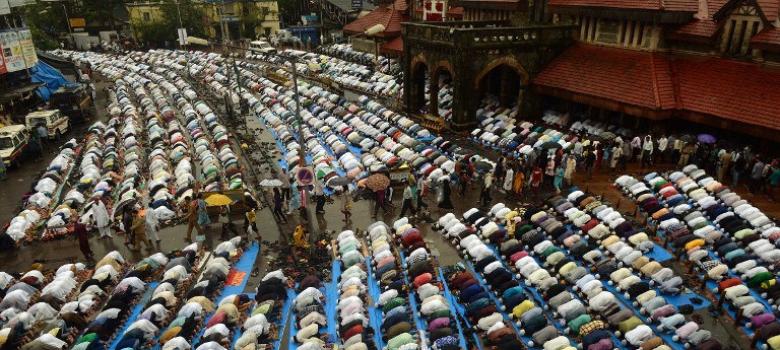
But the call to prayer being announced on loudspeakers is not the only Muslim practice that some members of other communities complain about. In densely-populated cities like Mumbai, when large numbers of devotees gather to pray their Friday namaz, the congregation often spills out of the mosques and into the streets outside, hindering traffic and pedestrian movements for up to 30 minutes.

For many Muslim activists, this phenomenon is as much of an inconvenience to the public as the loudspeakers. But they believe the government has a greater role to play in helping to solve the problem.

“Nobody really likes to pray namaz outside on the streets, because it inconveniences so many people,” said Ghulam Arif, president of the Qartaba Wisdom Club, a Mumbai-based non-profit organisation that works on social issues. The only reason the practice continues, he said, is because the community is too large to fit into the existing mosques.

“The government could give Muslims the permission to organise Friday prayers in open grounds and maidans near mosques,” said Arif.

The community has been recommending a specific solution to the problem for nearly two decades: allowing mosques to expand by granting them additional floor space index. Increasing FSI  – the ratio of plot size to the height of a building that can be erected on it  –  would mean a greater number of floors to accommodate more worshippers.

via Scroll.in – News. Politics. Culture..

01/08/2014

BBC News – ‘Suspects shot’ in Xinjiang imam killing

Police have shot dead two suspects in the killing of the imam of China’s largest mosque and captured another, state media say.

Jume Tahir speaks during an interview at Id Kah Mosque in Kashgar in this still image taken from video dated 3 August 2011

Jume Tahir was the imam in Kashgar, in China’s restive Xinjiang region.

He was found dead after morning prayers at the Id Kah mosque on Wednesday.

Police said the suspects, located shortly afterwards, “resisted arrest with knives and axes”. They were “influenced by religious extremism“, Xinhua news agency said.

Xinjiang, in China’s far west, is home to the Muslim Uighur minority.

Tensions have rumbled for years between Uighurs and Beijing over large-scale Han Chinese migration and tight Chinese control.

In recent months, however, there has been a marked increase in Xinjiang-linked violence, including a market attack in the regional capital Urumqi that left more than 30 people dead.

Beijing blames these attacks on extremists inspired by overseas terror groups. Uighur activists say heavy-handed restrictions on religious and cultural freedoms are fuelling local resentment.

via BBC News – ‘Suspects shot’ in Xinjiang imam killing.

29/07/2014

Police shoot dead dozens of attackers during mob violence in Xinjiang | South China Morning Post

Police in Xinjiang shot dead dozens of knife-wielding attackers on Monday morning after they staged assaults on two towns in the westerly Xinjiang region, the official Xinhua news agency said on Tuesday, citing local police.

china_xinjiang_explosion_tok101_43157649.jpg

Describing the incident as a “premeditated terror attack,” the official Xinhua news agency said a gang armed with knives attacked a police station and government offices in Elixku, a township in Kashgar prefecture, and then some of them moved on to nearby Huangdi Township, attacking civilians and smashing vehicles as they passed.

Dozens of civilians were killed or injured in the attack before police responded by shooting dead dozens of attackers, official media reported.

Citing local police, Xinhua said dozens of civilians of both Uygur and Han ethnicities were killed or injured, while police officers at the scene shot dead dozens of members of the mob.

Over 30 cars were vandalised, some of which were set on fire, the report said.

Earlier this month, the regional capital Urumqi marked the fifth anniversary of the 2009 riot that left 197 people dead and about 17,000 others injured, mostly Han Chinese.

The turbulent region has since seen a series of violent incidents that have left many people dead or injured, including last May’s bombing of a market in Urumqi that left dozens dead and prompted a clampdown by authorities.

In the immediate wake of that bombing, which came just weeks after a blast at an Urumqi rail station left three dead, China launched one-year “anti-terror” campaign in Xinjiang in which hundreds of suspects have been arrested and large amounts of explosives and explosive devices have been seized, according to local media.

On June 17, authorities executed 13 people and sentencing three others to death for their role in terror attacks and related crimes in Xinjiang, including an attack on government facilities and police stations in the oasis city of Turpan on June 26 last year that left 24 police officers and civilians dead.

China’s heavy-handed approach has drawn concerns that many of the region’s Uygurs, including vocal critics and people linked to the separatist East Turkestan Islamic Movement, have been arrested and indefinitely detained without trial, while others have disappeared without trace.

Uygurs in Xinjiang and those in self-exile abroad have long complained that discrimination and restrictions on religion, such as a ban on taking children to mosques, are fuelling anger at the Han Chinese majority.

via Police shoot dead dozens of attackers during mob violence in Xinjiang | South China Morning Post.

15/07/2014

One injured as explosion hits Xining airport car park in Qinghai | South China Morning Post

An explosion rocked the car park of Xining’s main airport today, state media reported. One person was injured by shrapnel, according to the authorities.

xining_blast-net.jpg

Police and bomb experts rushed to the scene within minutes of the blast and cordoned off the area around the busy Caojiapu (variably spelled as Caojiabao) airport.

One cleaner was hit when the object detonated in the lot just outside the terminal, the China West Airport Group said in a press statement at 4pm.

According to Chinanews.com, the staff was hit by a piece of glass and was sent to hospital.

Airport operations were not affected, the airport authority said. Cars in the parking lot were moved to other areas to clear the scene.

The Qinghai public security bureau and armed police are now conducting further investigation.

The explosives were concealed in a rubbish bin at the corner of the car park, according to the China Youth Daily.

A person surnamed Bao working for the public security bureau of Haidong prefecture near Xining told the South China Morning Post that the bureau’s command centre were not informed of the blast as yet, but that they would be sending staff to the scene.

“Airport police, anti-terror police, SWAT and paramilitary [officers] have cordoned off the site and are doing further investigation,” Bao said.

The Caojiapu airport is the busiest airport in the Tibet Plateau region. According to the airport’s figures, it handles four million trips a day.

Earlier in June, the airport held an emergency rescue drill – the largest held in the past 10 years – involving firefighters, medical emergency response teams as well as runway and airport maintenance teams.

Clearing explosives was part of the drill.

via One injured as explosion hits Xining airport car park in Qinghai | South China Morning Post.

23/06/2014

Shenzhen to pump one billion yuan into building new Xinjiang university | South China Morning Post

Shenzhen will pump one billion yuan (HK$1.26 billion) into a new university to be built in Xinjiang’s southern Kashgar city, on top of the region’s own one billion yuan of investment.

uygur-uni.jpg

Shenzhen was contributing to the university in support of education in the Xinjiang Uygur autonomous region, the Xinjiang Daily reported on Monday.

“Building Kashi University will provide strong human resources to the industrial restructuring in southern Xinjiang and improve the local livelihood,” said Kenjiang Tulahong, a member of the region’s National People’s Congress Standing Committee.

Plans to build the university were announced by the State Council after a Xinjiang working group meeting in May. It was an important strategic approach, the newspaper said.

Xinjiang, in the northwest and home to the Uygur ethnic minority who are mostly Muslims, has been the focus of a security crackdown after recent violent attacks in the region and elsewhere on the mainland that the central government has blamed on terrorists and separatists who want to establish an independent state called East Turkestan.

President Xi Jinping, who chaired the second Central Work Conference on Xinjiang on May 19, stressed the importance of ethnic unity, education and economic development. Officials at the conference pledged to promote bilingual education and interaction between ethnic groups in the region.

On Monday, Xinjiang party chief Zhang Chunxian, speaking at the region’s party committee meeting, vowed to safeguard social stability and the Central Committee’s authority and political discipline on major issues opposing separatism.

The same day, Korla Evening News reported that police in Korla city, western Xinjiang, had busted an underground group that was teaching the Koran to children. Two men were arrested on suspicion of abusing two children and forcing them to study the Koran, on top of running illegal religious activities. The two pupils were then sent to local kindergartens and assigned guardians, the newspaper reported.

Kashi University, when completed, would give Uygur students more opportunities for higher levels of academic training in future, Kashgar officials said.

“Kashi University will have comprehensive departments and disciplined teachers to train a wider range of talents,” Kashgar Normal College dean Aierken Wumaier said.

The university plans to provide curriculums in the liberal arts, science, art, engineering, management, economics and medicine, among others, he said. The institute aimed to recruit 13,000 students by 2015, he added.

via Shenzhen to pump one billion yuan into building new Xinjiang university | South China Morning Post.

23/05/2014

Terrorist attack kills dozens in China’s tense Xinjiang region – CNN.com

A series of explosions tore through an open-air market in the capital of the volatile western Chinese region of Xinjiang on Thursday, killing dozens of people and wounding many more, state media reported.

Watch this video

China‘s Ministry of Public Security said the attack in the heavily policed city of Urumqi was “a serious violent terrorist incident” and vowed to crack down on its perpetrators. President Xi Jinping called for the terrorists behind it to be “severely” punished.

Two SUVs slammed into shoppers gathered at the market in Urumqi at 7:50 a.m. Thursday, and explosives were flung out of the vehicles, China’s official news agency Xinhua said.

The vehicles then exploded, according to Xinhua, which said at least 31 people were killed and more than 90 wounded.

Some of the photos circulating on social media suggested a hellish scene, with bodies strewn on the ground amid burning wreckage. Others showed flames and smoke billowing out of the end of a tree-lined street guarded by police officers.

via Terrorist attack kills dozens in China’s tense Xinjiang region – CNN.com.

Enhanced by Zemanta
Law of Unintended Consequences

continuously updated blog about China & India

ChiaHou's Book Reviews

continuously updated blog about China & India

What's wrong with the world; and its economy

continuously updated blog about China & India