Archive for ‘The Chinese Dream’

06/12/2019

“One country, two systems” principle proves feasible, achievable, popular in Macao SAR: liaison office director in Macao

MACAO, Dec. 6 (Xinhua) — The “one country, two systems” principle has proved to be feasible, achievable and popular in the Macao Special Administrative Region (SAR) since Macao returned to the motherland in 1999, said Fu Ziying, director of the Liaison Office of the Central People’s Government in the Macao SAR.

Fu told Xinhua in a recent interview that the Macao SAR government, along with all walks of life, has comprehensively and precisely understood and implemented the “one country, two systems” principle and strictly abided by China’s Constitution and the Basic Law of the Macao SAR since Macao’s return to the motherland.

The Macao SAR government has ensured the steady and practical implementation of the “one country, two systems” principle by devoting to developing economy, improving people’s wellbeing, upholding inclusiveness and mutual support and promoting the unity of the compatriots in Macao under the banner of loving both the motherland and the region, thus opening a new horizon in practicing the “one country, two systems” with Macao characteristics.

Fu eulogized Macao’s success in implementing the “one country, two systems” principle in three aspects.

Firstly, for the past 20 years, the authority of China’s Constitution and the Basic Law has been firmly safeguarded in Macao and the executive-led system has been running smoothly.

The Macao SAR government and all walks of life have always firmly safeguarded the authority of China’s Constitution and the Basic Law by holistically combining upholding the principle of “one country” with respecting the differences of the “two systems,” and maintaining the power of the central government with ensuring the high degree of autonomy of the Macao SAR, ushering in a new era of good political situation in Macao.

The national sovereignty, security and interests are well safeguarded and the capability and level of law-based governance has been significantly promoted in Macao, Fu said.

Secondly, Macao has witnessed rapid economic development and continued improvement of people’s livelihood, with people feeling more satisfied and happier, Fu said.

Macao, by making good use of the advantages of the “one country, two systems” principle, has achieved a leaping development in economy, Fu said.

Over the past 20 years, Macao has witnessed the fastest development in its history, with outstanding performance in various macroeconomic sectors, Fu said.

With the full efforts from the SAR government in building long-term efficient mechanisms in social security, housing, education, health, human resources and disaster prevention and reduction, the social welfare and people’s livelihood have been greatly improved since Macao’s return to the motherland, said Fu,

Thirdly, Macao’s success could be seen in its harmony and inclusiveness in society, where both loving the motherland and the region has become the mainstream value, according to Fu.

He said education on the country’s Constitution and the Basic Law is deep-rooted in the society, as the “one country, two systems,” “Macao people governing Macao” and the high degree of autonomy are well-accepted by residents in Macao.

Fu said Macao has attached great importance to cultivating patriotism among the youth, with patriotic education legalized in Macao in 2006.

The development of the socialism with Chinese characteristics had entered a new era, so is the cause of the “one country, two systems,” said Fu.

Under the leadership of Chinese President Xi Jinping, the practice of “one country, two systems” is included in the Chinese Dream.

In the future, Macao should further exploit the advantages of “one country, two systems” principle, seize the opportunities brought about by the Belt and Road Initiative and the construction of the Guangdong-Hong Kong-Macao Greater Bay Area.

“We will always comprehensively and precisely understand and implement the principle of ‘one country, two systems’,” said Fu.

Fu called on Macao to participate in the country’s reform and opening-up cause more actively so as to help boost the country’s people-to-people exchanges with other countries.

He highlighted the importance of the construction of the Greater Bay Area, hoping that Macao would, by participating in the development, further expand its industries and promote people’s livelihood so as to maintain the economic and social stability.

“Remain true to the original aspiration of the principle of ‘one country, two systems,’ Macao, the land of lotus, will for ever glisten,” Fu added.

Source: Xinhua

20/10/2019

Xi meets delegates to PLA logistic support force Party congress, senior officers in Hubei

CHINA-HUBEI-WUHAN-XI JINPING-MEETING (CN)

Chinese President Xi Jinping, also general secretary of the Communist Party of China (CPC) Central Committee and chairman of the Central Military Commission, meets with delegates to the first Party congress of the People’s Liberation Army (PLA) Joint Logistic Support Force in Wuhan, capital of central China’s Hubei Province, Oct. 18, 2019. (Xinhua/Li Gang)

WUHAN, Oct. 19 (Xinhua) — Chinese President Xi Jinping on Friday met with delegates to the first Party congress of the People’s Liberation Army (PLA) Joint Logistic Support Force and senior officers stationed in central China’s Hubei Province, respectively.

Xi, also general secretary of the Communist Party of China (CPC) Central Committee and chairman of the Central Military Commission, extended congratulations on the convening of the congress and sincere greetings to all the delegates and service personnel in the joint logistic support force.

The congress opened Wednesday in Wuhan, during which the delegates discussed the development of the joint logistic support force since its establishment and the plan for the next five years.

When meeting with senior officers stationed in Hubei, Xi extended sincere greetings to all officers and soldiers of the armed forces stationed in the province.

Xi encouraged them to faithfully perform their duties, forge ahead with determination, push for new progress in all work, and contribute to the realization of the Chinese dream of national rejuvenation and the dream of a strong military.

Source: Xinhua

01/10/2019

Military advances and Xi Jinping’s supreme status among the themes as Beijing celebrates National Day

  • 70th anniversary of the founding of the People’s Republic of China marked by its biggest ever military parade and huge civilian parade
  • Xi says no force can stop China ‘marching forward’ and vows to protect the long-term stability of Hong Kong
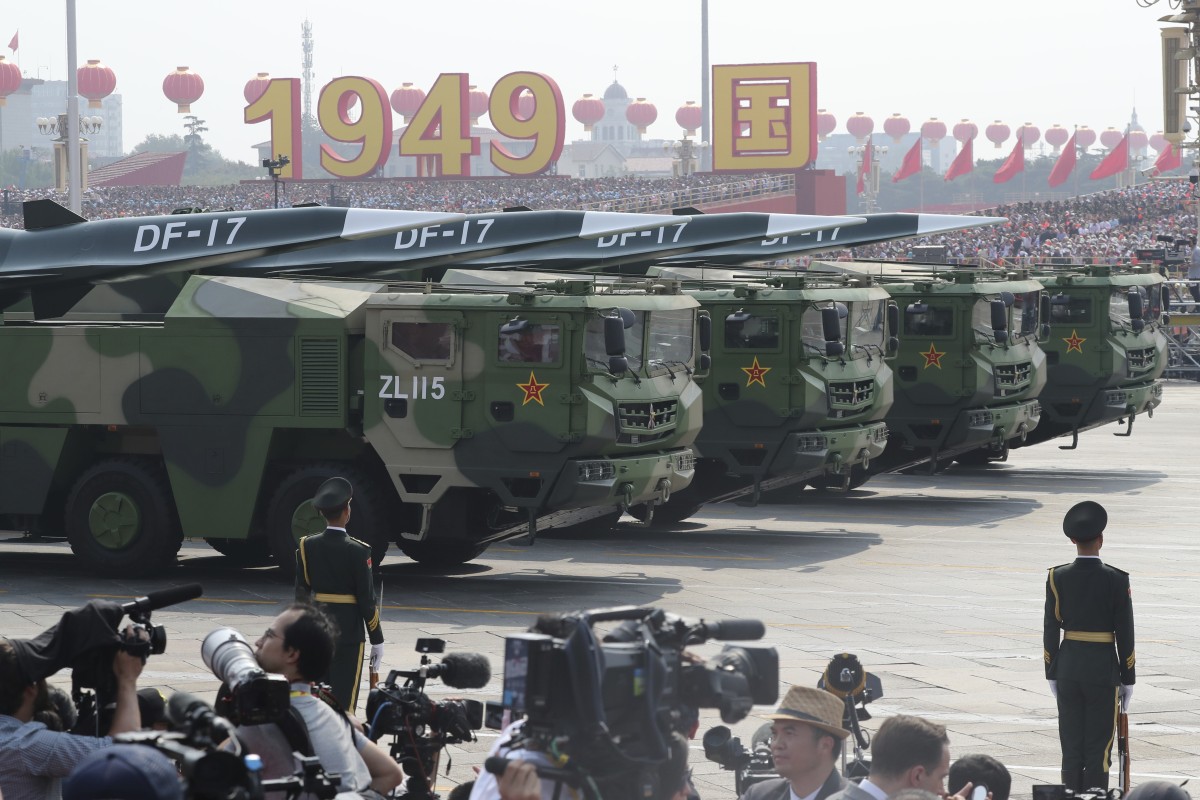
Military vehicles carry DF-17 missiles capable of reaching the US mainland during the parade to mark 70 years of the People’s Republic. Photo: AP
China staged a massive military parade in Beijing on Tuesday to mark the 70th anniversary of the founding of the People’s Republic, with much of the smog-shrouded capital city under a security lockdown.
President Xi Jinping inspected over 15,000 troops, more than 160 aircraft and 580 weapon systems in a show of the country’s growing military might and his drive to modernise the People’s Liberation Army.
He also delivered a bullish eight-minute speech hailing the accomplishments of seven decades of Communist rule and pledging to achieve his vision of a “Chinese dream” of national rejuvenation and global prominence.

Here are some of the key takeaways from a day of celebration in Beijing:

A show of unity

Xi presided over the ceremony in Tiananmen Square flanked by his predecessors Jiang Zemin and Hu Jintao, along with other retired and present party elders.

The rare appearance of Jiang and Hu – on the rostrum of the Gate of Heavenly Peace, where the country’s founding father Mao Zedong declared Communist rule on October 1, 1949 – was clearly aimed at projecting unity and solidarity in the face of daunting domestic and international challenges.

China’s National Day parade, as it happened
Hu had been absent from the funeral of former premier Li Peng in late July, although the ailing Jiang attended.

Former vice-president Zeng Qinghong and Song Ping, the oldest party elder in attendance, also appeared on the rostrum.

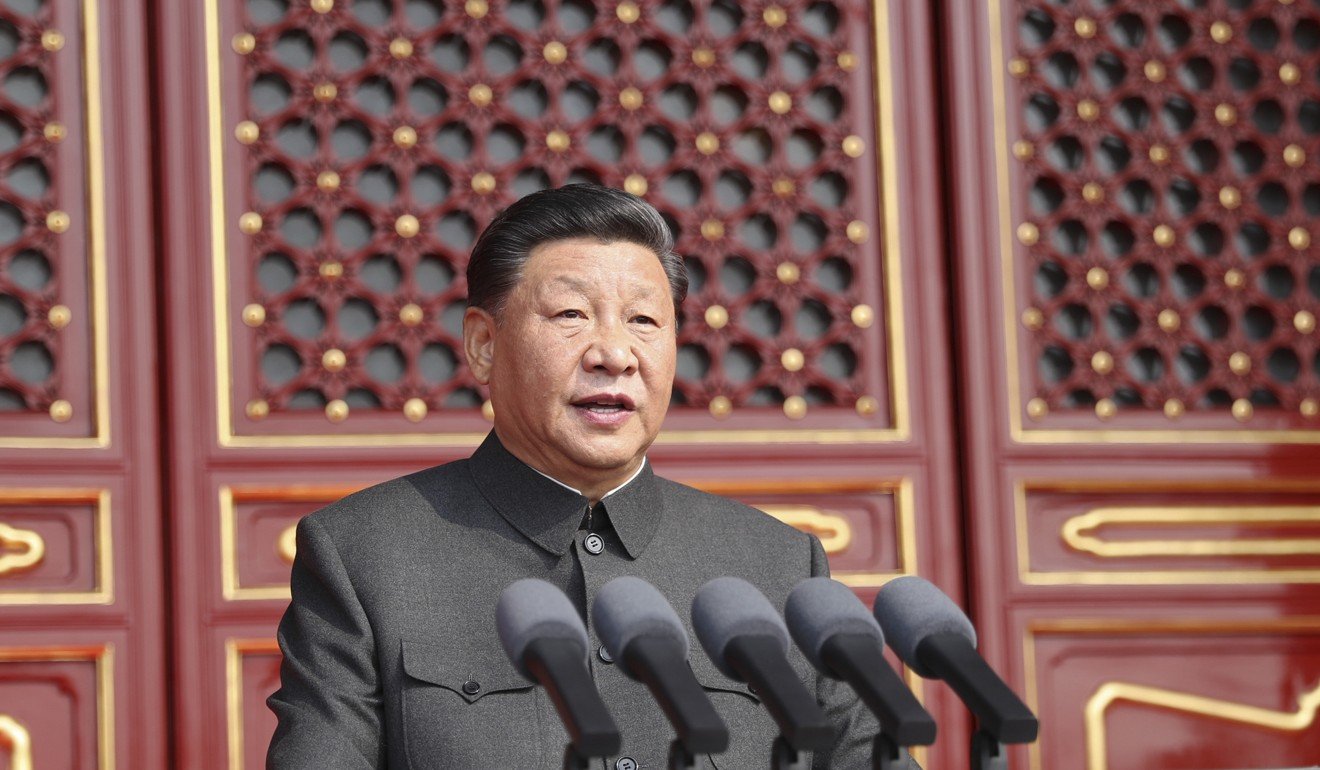
President Xi Jinping speaks in Tiananmen Square during Tuesday’s celebrations. Photo: Xinhua

But notably, while former premier Wen Jiabao was present, his predecessor Zhu Rongji was not.

‘No force can shake China’

Dressed in a Mao suit, Xi’s nationally televised speech invoked China’s “century of humiliation” and praised the achievements of its people, saying there was no force that could stop it forging ahead.

“No force can shake the status of our great motherland, and no force can stop the Chinese people and the Chinese nation from marching forward,” he said.

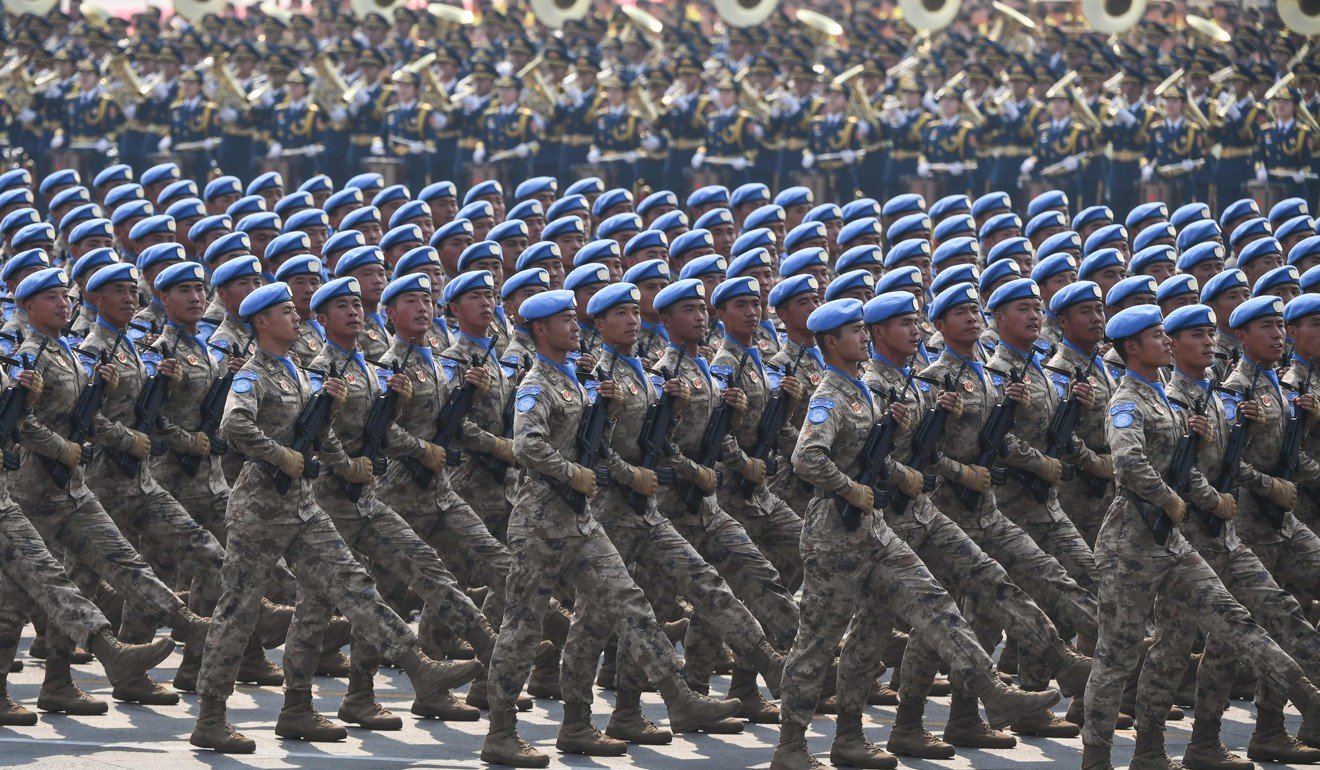
Chinese troops take part in the Republic’s largest ever military parade. Photo: AFP
“The People’s Liberation Army [PLA] will serve its purpose in safeguarding the sovereignty, security and development interests of the country, and world peace,” he said, at a time when Beijing has expanded its military footprint globally, including with its first overseas military base in Djibouti.
Xi called on the Communist Party and the country to unite and continue to fight for the realisation of what he called the “Chinese dream” – the nation’s rejuvenation.
One country, two systems
Amid escalating unrest in Hong Kong, which has plunged the city into a deepening crisis and threatened to overshadow the National Day celebrations, Xi vowed that the central government would uphold “one country, two systems”.
He said the central government would protect the long-term stability of Hong Kong and Macau, and stressed the goal of “peaceful reunification” with the self-ruling Taiwan, repeating a message frequently used by his predecessors, including Deng Xiaoping, Jiang and Hu.

The theme of one country, two systems later appeared in a National Day parade for the first time, with placards forming the words: “Hong Kong’s tomorrow will be better.”

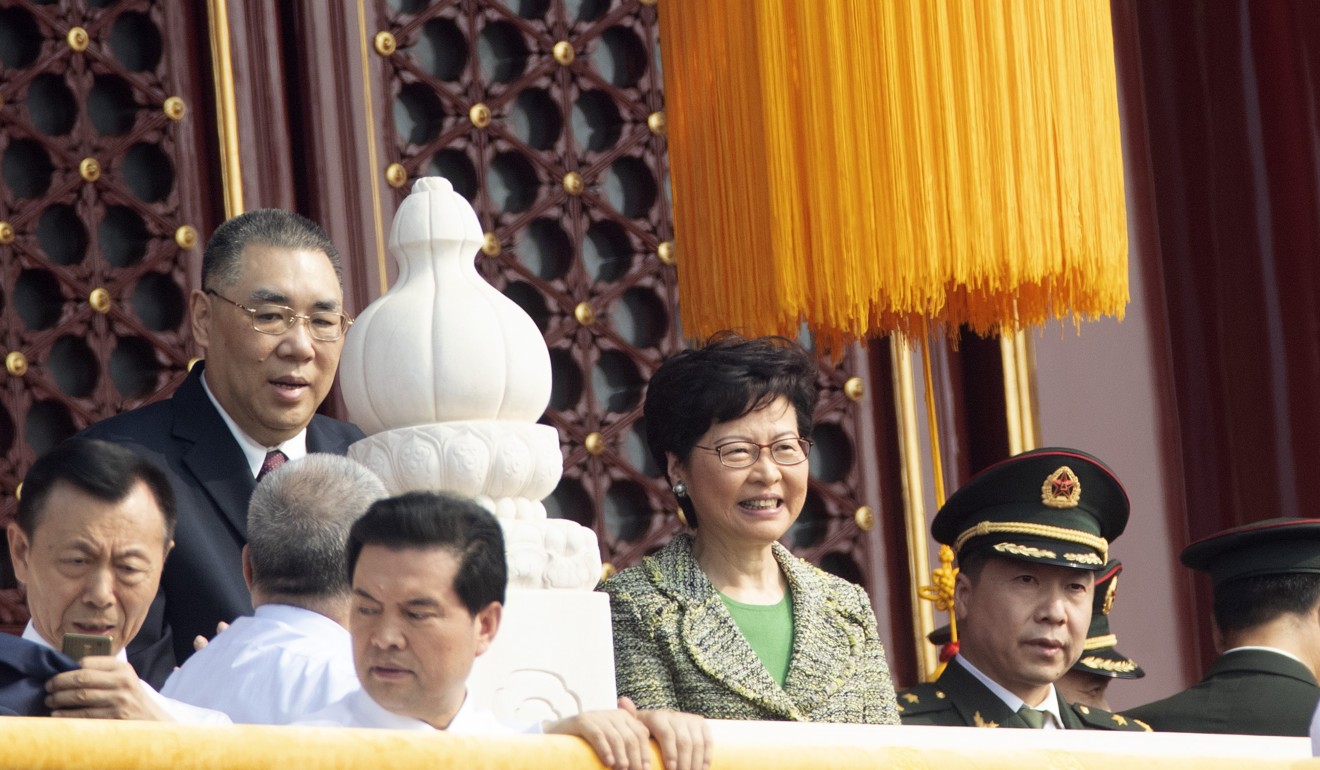
Hong Kong Chief Executive Cheng Yuet-ngor attended the ceremony, as did 10 Hong Kong police officers involved in suppressing anti-government protests in the city.
Showing off new weapons
China’s advancement in military weaponry was on full display, with almost half of the items featured being shown to the public for the first time.
Hong Kong leader Carrie Lam was among the guests in Beijing on Tuesday. Photo: AP

The morning’s celebrations included an 80-minute military parade – the biggest since the founding of the People’s Republic – in an apparent effort to showcase the prowess of the PLA, the world’s biggest military with 2 million personnel.

Among the weapons shown were DF series missiles, including the DF-17, a nuclear-capable glider that has the capacity to strike the US mainland, and the DF-41, which has a range of up to 15,000km, making it the world’s longest-range military missile.

Signalling Xi’s status

A 100,000-strong civilian parade featuring huge portraits of Xi and predecessors including Mao, Deng, Jiang and Hu wrapped up the morning celebration.

The procession was divided into three parts, representing three eras of the People’s Republic: the Mao era, Deng’s reform and opening up, and Xi’s era, which seeks global prominence on a par with that of the United States.

Xi appeared keen to project his supreme status in the party, reinforced since he abolished the constitutional term limit a year ago, allowing him potentially to remain leader for life.

He waved at his own portrait, unveiled alongside a sign reading “Carry out Xi Jinping Thought on Socialism with Chinese Characteristics for a New Era”.

Source: SCMP

01/11/2013

Zhang Xin: the billionaire queen of China’s new skyline | The Times

At nine she was homeless; as a teenager, she worked in sweatshops. So how did Zhang Xin become one of China’s richest women, asks Leo Lewis.

Zhang Xin in front of the Galaxy Soho construction site, 2011

Inside the penthouse premises of the exclusive Beijing American Club, China’s most powerful woman aims a quiet smile at a circle of armchairs; she targets each occupant with a flash of eye contact and brings the exquisitely elite gathering to attention. Silence falls.

Property developer Zhang Xin, queen of the Beijing skyline, is the chief executive of Soho China, one of the country’s most influential property companies. She is immaculately but not ostentatiously dressed in a scarlet blouse, chairing a discussion that touches delicately on the future of China, of the Communist Party and of China’s engagement with the outside world. Sharing her sofa, and the main speaker for the evening, is Peter Mandelson; his book The Third Man: Life at the Heart of New Labour, newly translated into Chinese, is already popular within the higher echelons of Party leadership. Around them sits a unique assembly of Chinese business leaders, diplomats, journalists and high financiers. It is an evening that reflects Zhang’s status as one of the world’s greatest female success stories.

Over the past decade, Zhang, 48, has become a role model for women, for the ambitious poor and for ordinary Chinese in general. The 6.7 million people who follow her on Weibo (China’s equivalent of Twitter) are doing so for a reason: the Chinese Government may try to co-opt the concept of a “Chinese Dream” for political ends, but Zhang is its living embodiment – a woman who has risen from her beginnings as a teenage sweatshop worker to become one of the wealthiest women on the planet, overseeing an empire worth $3.6 billion (£2.2 billion).

Zhang’s parents were educated Chinese Burmese who moved back to China in the Fifties when Chairman Mao’s dream still appeared unsullied. But during the lunacy of the Cultural Revolution, their university degrees counted against them: a young Zhang and her mother were separated from her father and brother and forced – as part of the country’s “re-education” programme – to swap their urban lifestyle for the grinding poverty of the Chinese countryside.

When she was 9, Zhang was able to return to Beijing with her mother, but the city offered scant relief from debilitating poverty. The two were briefly homeless, obliged to sleep on the desks of the small office where Zhang’s mother worked translating the grandstanding speeches of Communist leaders. Life did not improve much. A few years later, with China’s great economic boom still years away, the pair escaped to Hong Kong. Aged 14, Zhang toiled in the territory’s cramped, punishing garment factories. Driven by the need for hard cash, she would switch employers for the sake of a single dollar’s increase in pay.

“The motivation for working in the factories was to get out of the factories,” she says. The girls alongside her appeared content with their lives. She could never contemplate that. Convinced even then that education had the power to change everything, Zhang would scurry from each 12-hour shift straight to evening classes. She dreamt all the time, she says, simply of keeping pace with the education that “normal” teenage schoolgirls would be receiving back in China.

Slowly, her savings grew to the point where she could afford a plane ticket from Hong Kong to London. Armed with nothing but a raw immigrant’s ambition, she arrived in the UK and began another lowest-rung scrabble for cash. This time, there were English classes at the end of each work day. The strategy paid off: using grants and scholarships, she secured a place at the University of Sussex. Afterwards, she completed a master’s degree in development economics at Cambridge.

Earlier this year, Zhang returned to Sussex as an honorary Doctor of Laws and delivered a speech to graduating students. “It is the place that cultivated me, inspired me and encouraged me to follow my deepest instincts and to become the person that I am today,” she told them. “For this I am truly grateful.”

“If I look back at my life and ask myself what was the most important transformational element, I would say education,” she says. “The point it all changed was when I decided to go to England to become a student.

“When I first got there, I thought there has to be a model answer for these essays we write every week, because that is how the Chinese write. I would submit the essay and my tutor would call us in, and he wasn’t interested at all in whether this answer was right or wrong. Only later, I understood this is a way of cultivating your intellectual curiosity… That is still largely missing in Chinese education.”

via Zhang Xin: the billionaire queen of China’s new skyline | The Times.

17/09/2013

China’s Bosses Size Up a Changing Labor Force

This post about the workforce and another posted today about houses-for-pensions show how fast China is catching up with the developed nations; not always for the good of its citizens.

BusinessWeek: “John Liu is the 31-year-old founder and owner of Harderson International, a small factory in southern China that applies paint and decals to ceramics and glass. His showroom includes samples of tinted perfume bottles made for Ralph Lauren and Kate Spade.

Chinese workers on a television set assembly line in Shenyang, Liaoning Province in 2012

A 2006 graduate of Wuhan University in central China, Liu is not much older than the 20-somethings and late teenagers who come to work on the assembly line. But generational cohorts in China are extremely compressed, and Liu sees a vast gap in expectations between himself and those a decade younger. “When I finished school, I felt I needed to find a good stable job quickly and earn money,” he says. “But living conditions in China have improved quickly. Young people now don’t have to work so hard to earn a living, and many have parents who will support them. … A lot of those born in the 1990s can’t stand this kind of repetitive work, so they choose to stay home or do very simple cashier work, even though it pays less.” The upshot is that, for a small factory, it’s “getting harder to find workers.”

Last year the total size of China’s working-age population began to decline, according to figures from China’s National Bureau of Statistics. As the Economist ominously noted, China’s moment of “peak toil” has passed. Yet it’s not only demographics that are changing. Today’s Internet-savvy young workers have different ideas and higher expectations than their predecessors, and not only regarding pay. In response to an evolving workforce, factory managers at a handful of small and midsize plants in China’s Pearl River Delta say they must now offer better conditions to attract and retain workers—or else look for opportunities to automate.”

via China’s Bosses Size Up a Changing Labor Force – Businessweek.

See also: https://chindia-alert.org/2013/01/20/chinas-workforce-peak-demographics/

03/05/2013

* Xi Jinping’s vision: Chasing the Chinese dream

The Economist: “THESE have been heady days for Chen Sisi, star of a song-and-dance group run by China’s nuclear-missile corps. For weeks her ballad “Chinese dream” has been topping the folk-song charts. She has performed it on state television against video backdrops of bullet trains, jets taking off from China’s newly launched aircraft-carrier and bucolic scenery. More than 1.1m fans follow her microblog, where she tweets about the Chinese dream.

Ms Chen is playing her part in a barrage of dream-themed propaganda unleashed by the Communist Party. Schools have been organising Chinese-dream speaking competitions. Some have put up “dream walls” on which students can stick notes describing their visions of the future. Party officials have selected model dreamers to tour workplaces and inspire others with their achievements. Academics are being encouraged to offer “Chinese dream” research proposals. Newspapers refer to it more and more (see chart in full article). In December state media and government researchers, purportedly on the basis of studies of its usage, declared “dream” the Chinese character of the year for 2012.

It was, however, one very specific usage just before that December publication which set the country dreaming. On November 29th, two weeks after his appointment as the party’s general secretary and military commander-in-chief, Xi Jinping visited the grandiose National Museum next to Tiananmen Square. Flanked by six dour-looking, dark-clad colleagues from the Politburo’s standing committee, Mr Xi told a gaggle of press and museum workers that the “greatest Chinese dream” was the “great revival of the Chinese nation”.”

via Xi Jinping’s vision: Chasing the Chinese dream | The Economist.

Law of Unintended Consequences

continuously updated blog about China & India

ChiaHou's Book Reviews

continuously updated blog about China & India

What's wrong with the world; and its economy

continuously updated blog about China & India