Chindia Alert: You’ll be Living in their World Very Soon
aims to alert you to the threats and opportunities that China and India present. China and India require serious attention; case of ‘hidden dragon and crouching tiger’.
Without this attention, governments, businesses and, indeed, individuals may find themselves at a great disadvantage sooner rather than later.
The POSTs (front webpages) are mainly 'cuttings' from reliable sources, updated continuously.
The PAGEs (see Tabs, above) attempt to make the information more meaningful by putting some structure to the information we have researched and assembled since 2006.
Image copyright PRESS INFORMATION BUREAUImage caption The area has become a hotspot in part because of a road India has built
The armies of the world’s two most populous nations are locked in a tense face-off high in the Himalayas, which has the potential to escalate as they seek to further their strategic goals.
Officials quoted by the Indian media say thousands of Chinese troops have forced their way into the Galwan valley in Ladakh, in the disputed Kashmir region.
Indian leaders and military strategists have clearly been left stunned.
The reports say that in early May, Chinese forces put up tents, dug trenches and moved heavy equipment several kilometres inside what had been regarded by India as its territory. The move came after India built a road several hundred kilometres long connecting to a high-altitude forward air base which it reactivated in 2008.
The message from China appears clear to observers in Delhi – this is not a routine incursion.
“The situation is serious. The Chinese have come into territory which they themselves accepted as part of India. It has completely changed the status quo,” says Ajai Shukla, an Indian military expert who served as a colonel in the army.
China takes a different view, saying it’s India which has changed facts on the ground.
Reports in the Indian media said soldiers from the two sides clashed on at least two occasions in Ladakh. Stand-offs are reported in at least three locations: the Galwan valley; Hot Springs; and Pangong lake to the south.
India and China share a border more than 3,440km (2,100 miles) long and have overlapping territorial claims. Their border patrols often bump into each other, resulting in occasional scuffles but both sides insist no bullet has been fired in four decades.
Their armies – two of the world’s largest – come face to face at many points. The poorly demarcated Line of Actual Control (LAC) separates the two sides. Rivers, lakes and snowcaps mean the line separating soldiers can shift and they often come close to confrontation.
The current military tension is not limited to Ladakh. Soldiers from the two sides are also eyeball-to-eyeball in Naku La, on the border between China and the north-eastern Indian state of Sikkim. Earlier this month they reportedly came to blows.
And there’s a row over a new map put out by Nepal, too, which accuses India of encroaching on its territory by building a road connecting with China.
Why are tensions rising now?
There are several reasons – but competing strategic goals lie at the root, and both sides blame each other.
“The traditionally peaceful Galwan River has now become a hotspot because it is where the LAC is closest to the new road India has built along the Shyok River to Daulet Beg Oldi (DBO) – the most remote and vulnerable area along the LAC in Ladakh,” Mr Shukla says.
India’s decision to ramp up infrastructure seems to have infuriated Beijing.
Image copyright AFPImage caption There have been protests in Nepal against Indi’s new road link
“According to the Chinese military, India is the one which has forced its way into the Galwan valley. So, India is changing the status quo along the LAC – that has angered the Chinese,” says Dr Long Xingchun, president of the Chengdu Institute of World Affairs (CIWA), a think tank.
Michael Kugelman, deputy director of the Asia programme at the Wilson Center, another think tank, says this face-off is not routine. He adds China’s “massive deployment of soldiers is a show of strength”.
The road could boost Delhi’s capability to move men and material rapidly in case of a conflict.
Differences have been growing in the past year over other areas of policy too.
The new federally-administered Ladakh included Aksai Chin, an area India claims but China controls.
Senior leaders of India’s Hindu-nationalist BJP government have also been talking about recapturing Pakistan-administered Kashmir. A strategic road, the Karakoram highway, passes through this area that connects China with its long-term ally Pakistan. Beijing has invested about $60bn (£48bn) in Pakistan’s infrastructure – the so-called China Pakistan Economic corridor (CPEC) – as part of its Belt and Road Initiative and the highway is key to transporting goods to and from the southern Pakistani port of Gwadar. The port gives China a foothold in the Arabian Sea.
In addition, China was unhappy when India initially banned all exports of medical and protective equipment to shore up its stocks soon after the coronavirus pandemic started earlier this year.
How dangerous could this get?
“We routinely see both armies crossing the LAC – it’s fairly common and such incidents are resolved at the local military level. But this time, the build-up is the largest we have ever seen,” says former Indian diplomat P Stobdan, an expert in Ladakh and India-China affairs.
“The stand-off is happening at some strategic areas that are important for India. If Pangong lake is taken, Ladakh can’t be defended. If the Chinese military is allowed to settle in the strategic valley of Shyok, then the Nubra valley and even Siachen can be reached.”
In what seems to be an intelligence failure, India seems to have been caught off guard again. According to Indian media accounts, the country’s soldiers were outnumbered and surrounded when China swiftly diverted men and machines from a military exercise to the border region.
This triggered alarm in Delhi – and India has limited room for manoeuvre. It can either seek to persuade Beijing to withdraw its troops through dialogue or try to remove them by force. Neither is an easy option.
“China is the world’s second-largest military power. Technologically it’s superior to India. Infrastructure on the other side is very advanced. Financially, China can divert its resources to achieve its military goals, whereas the Indian economy has been struggling in recent years, and the coronavirus crisis has worsened the situation,” says Ajai Shukla.
What next?
History holds difficult lessons for India. It suffered a humiliating defeat during the 1962 border conflict with China. India says China occupies 38,000km of its territory. Several rounds of talks in the last three decades have failed to resolve the boundary issues.
China already controls the Aksai Chin area further east of Ladakh and this region, claimed by India, is strategically important for Beijing as it connect its Xinjiang province with western Tibet.
Image copyright GETTY IMAGESImage caption India and China have a long history of border disputes
In 2017 India and China were engaged in a similar stand-off lasting more than two months in Doklam plateau, a tri-junction between India, China and Bhutan.
This time, too, talks are seen as the only way forward – both countries have so much to lose in a military conflict.
“China has no intention to escalate tensions and I think India also doesn’t want a conflict. But the situation depends on both sides. The Indian government should not be guided by the nationalistic media comments,” says Dr Long Xingchun of the CIWA in Chengdu. “Both countries have the ability to solve the dispute through high-level talks.”
Chinese media have given hardly any coverage to the border issue, which is being interpreted as a possible signal that a route to talks will be sought.
Pratyush Rao, associate director for South Asia at Control Risks consultancy, says both sides have “a clear interest in prioritising their economic recovery” and avoiding military escalation.
“It is important to recognise that both sides have a creditable record of maintaining relative peace and stability along their disputed border.”
But trade with partner countries might not be as badly affected as with countries elsewhere in the world, observers say
China’s trade with belt and road countries rose by 3.2 per cent in the January-March period, but second-quarter results will depend on how well they manage to contain the pathogen, academic says
China’s investment in foreign infrastructure as part of its Belt and Road Initiative has been curtailed because of the coronavirus pandemic. Photo: Xinhua
The coronavirus pandemic is set to cause a slump in Chinese investment in its signature
and a dip in trade with partner countries that could take a year to overcome, analysts say.
But the impact of the health crisis on China’s economic relations with nations involved in the ambitious infrastructure development programme might not be as great as on those that are not.
China’s total foreign trade in the first quarter of 2020 fell by 6.4 per cent year on year, according to official figures from Beijing.
Trade with the United States, Europe and Japan all dropped in the period, by 18.3, 10.4 and 8.1 per cent, respectively, the commerce ministry said.
By comparison, China’s trade with belt and road countries increased by 3.2 per cent in the first quarter, although the growth figure was lower than the 10.8 per cent reported for the whole of 2019.
China’s trade with 56 belt and road countries – located across Africa, Asia, Europe and South America – accounts for about 30 per cent of its total annual volume, according to the commerce ministry.
Despite the first-quarter growth, Tong Jiadong, a professor of international trade at Nankai University in Tianjin, said he expected China’s trade with belt and road countries to fall by between 2 and 5 per cent this year.
His predictions are less gloomy than the 13 to 32 per cent contraction in global trade forecast for this year by the World Trade Organisation.
“A drop in [China’s total] first-quarter trade was inevitable but it slowly started to recover as it resumed production, especially with Southeast Asian, Eastern European and Arab countries,” Tong said.
“The second quarter will really depend on how the epidemic is contained in belt and road countries.”
Nick Marro, Hong Kong-based head of global trade at the Economist Intelligence Unit, said he expected China’s total overseas direct investment to fall by about 30 per cent this year, which would be bad news for the belt and road plan.
“This will derive from a combination of growing domestic stress in China, enhanced regulatory scrutiny over Chinese investment in major international markets, and weakened global economic prospects that will naturally depress investment demand,” he said.
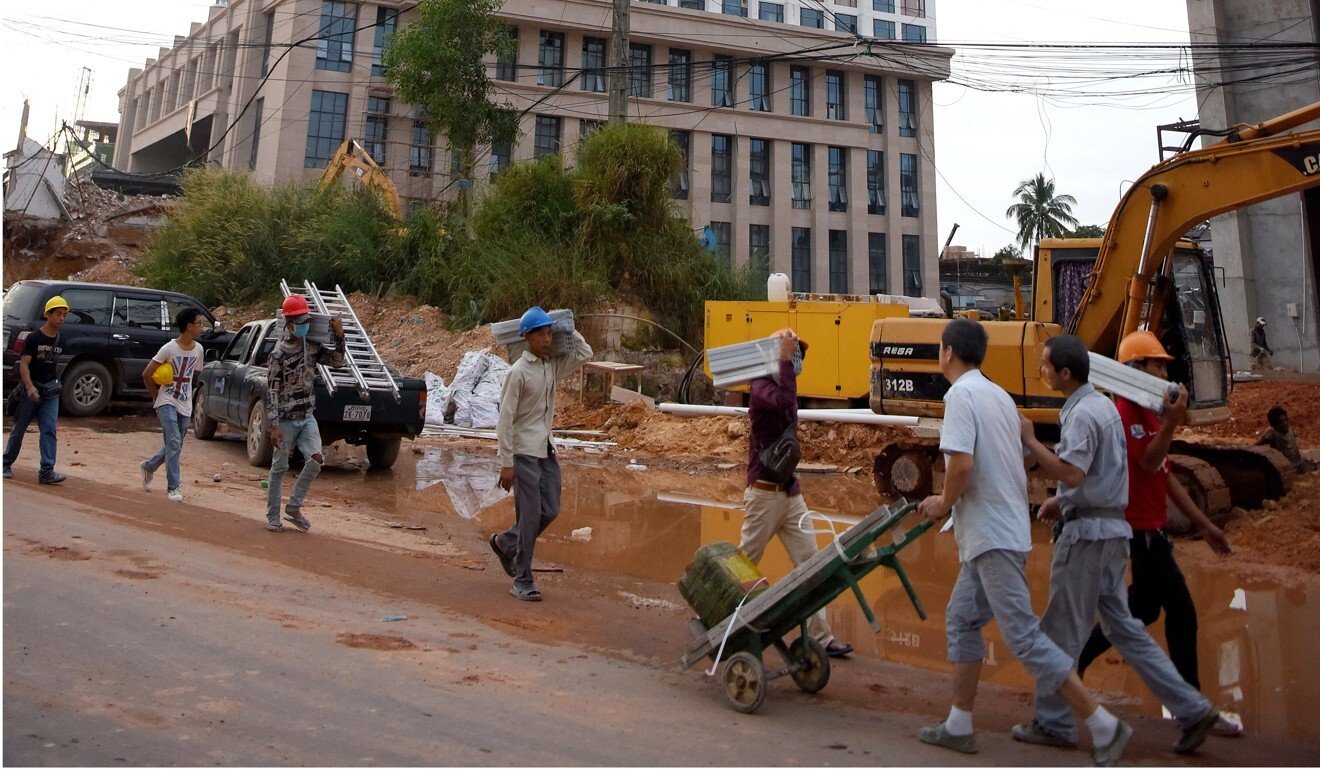
The development of the Chinese built and operated special economic zone in the Cambodian town of Sihanoukville is reported to have slowed, while infrastructure projects in Bangladesh, including the Payra coal-fired power plant, have been put on hold.
The development of the Chinese built and operated special economic zone in the Cambodian town of Sihanoukville is reported to have slowed. Photo: AFP
Marro said the reduction of capital and labour from China might complicate other projects for key belt and road partner, like Pakistan, which is home to infrastructure projects worth tens of billions of US dollars, and funded and built in large part by China.
“Pakistan looks concerning, particularly in terms of how we’ve assessed its sovereign and currency risk,” Marro said.
“Public debt is high compared to other emerging markets, while the coronavirus will push the budget deficit to expand to 10 per cent of GDP [gross domestic product] this year.”
Last week, Pakistan asked China for a 10-year extension to the repayment period on US$30 billion worth of loans used to fund the development of infrastructure projects, according to a report by local newspaper Dawn.
China’s overseas investment has been falling steadily from its peak in 2016, mostly as a result of Beijing’s curbs on capital outflows.
Last year, the direct investment by Chinese companies and organisations other than banks in belt and road countries fell 3.8 per cent from 2018 to US$15 billion, with most of the money going to South and Southeast Asian countries, including Singapore, Vietnam, Indonesia and Pakistan.
Tong said the pandemic had made Chinese investors nervous about putting their money in countries where disease control measures were becoming increasingly stringent, but added that the pause in activity would give all parties time to regroup.
“Investment in the second quarter will decline and allow time for the questions to be answered,” he said.
“Past experience along the belt and road has taught many lessons to both China and its partners, and forced them to think calmly about their own interests. The epidemic provides both parties with a good time for this.”
Dr Frans-Paul van der Putten, a senior research fellow at Clingendael Institute in the Netherlands, said China’s post-pandemic strategy for the belt and road in Europe
might include a shift away from investing in high-profile infrastructure projects like ports and airports.
Investors might instead cooperate with transport and logistics providers rather than invest directly, he said.
“Even though in the coming years the amount of money China loans and invests abroad may be lower than in the peak years around 2015-16, I expect it to maintain the belt and road plan as its overall strategic framework for its foreign economic relations,” he said.
Test in Xiong’an, the new city being built south of Beijing, will focus on everyday goods and services for the first time
American food outlets to be included in the digital currency tests, conducting small transactions with local firms
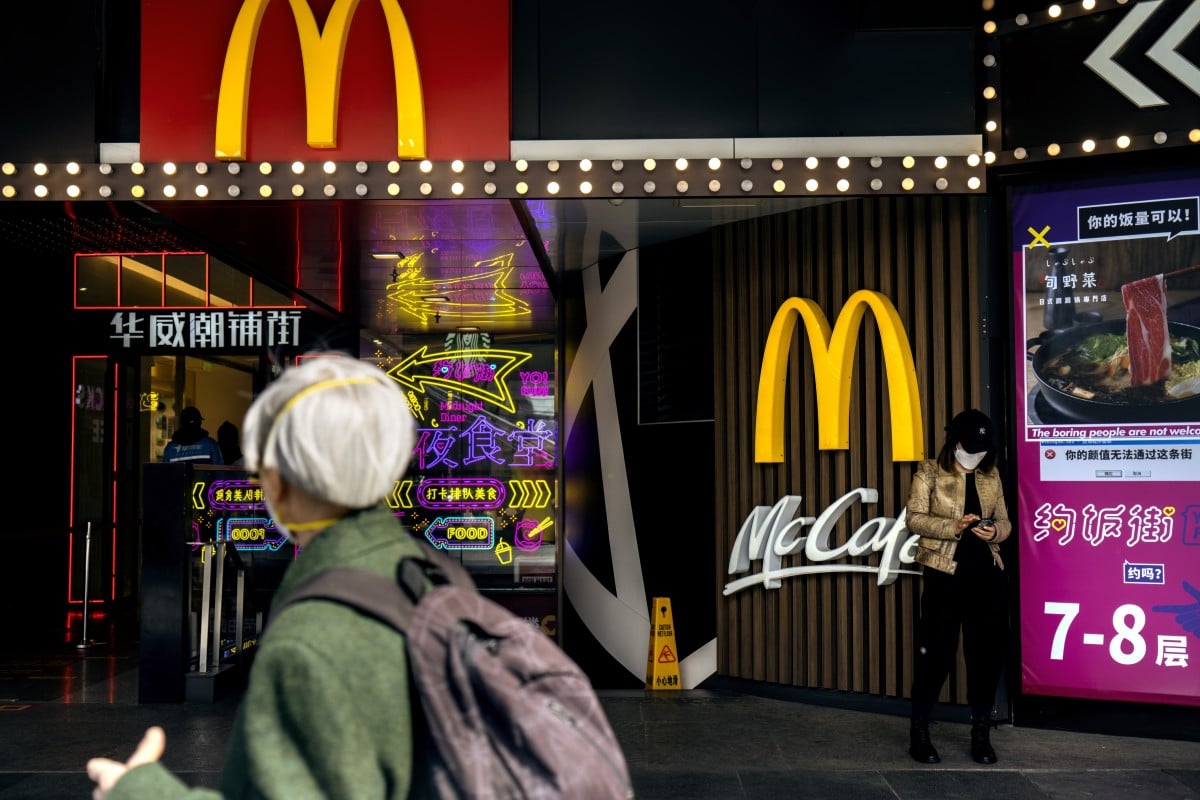
American chains Starbucks, McDonald’s and Subway were named on the People’s Bank of China’s list of firms that will test the digital currency in small transactions with 19 local businesses. Photo: Bloomberg
China’s central bank has accelerated the testing of its new sovereign digital currency and, for the first time, will include some foreign consumer brands in the programme.
American chains Starbucks, McDonald’s and Subway were named on the People’s Bank of China (PBOC)’s list of firms that will test the digital currency in small transactions with 19 local businesses.
The global names will be joined by local hotels, convenience stores, a stuffed bun shop, a bakery, a bookstore and a gym, according to details revealed at a promotional event in the Xiong’an New Area, a city being built south of Beijing, news portal Sina.com reported.
The inclusion of businesses providing everyday goods and services marks an expansion of the PBOC’s testing. It follows a previous disclosure that last week in Suzhou the digital currency was used to pay half public sector workers’ travel subsidies for May.
Is China a currency manipulator?
Wednesday’s promotional event was organised by the local branch of the National Development and Reform Commission, the powerful planning agency, and attended by representatives of the Big Four state-owned banks and two of the country’s internet giants – Alibaba and Tencent.
China has not released a timetable for launching the digital yuan, but last week’s reports on new testing have fanned speculation that it could be imminent.
The tests were reportedly accelerated after Facebook launched its Libra project in June last year, an attempt to create a global digital currency pegged to a basket of currencies and backed by global commercial giants.
The Libra Association, the consortium managing the project, announced changes last week in an attempt to win regulatory approval and pave the way for an official launch sometime later this year. The consortium said it would create multiple digital units tied to existing currencies such as the US dollar or the euro, rather than a single token based on a basket of currencies.
China’s official digital currency, known as Digital Currency Electronic Payment (DCEP), came into the public spotlight last week when a screenshot of a test version of an app developed by the Agricultural Bank of China circulated online.
The digital currency app has several basic functions, similarly to other Chinese online payment platforms such as Alipay and WeChat Pay – the country’s two most popular online payment tools – allowing users to make and receive payments, and transfer money.
“It’s certain that the DCEP is now in its final testing stage and should be officially launched,” BlockVC, an investment firm, said in a research note.
The PBOC’s digital currency research institute confirmed last Friday that testing was being conducted in four cities: Shenzhen, Suzhou, Xiong’an and Chengdu. In addition, venues for the 2022 Winter Olympics in Beijing and Zhangjiakou will join the testing programme in the future.
What is the Hong Kong Dollar Peg?
The institute, which was inaugurated in 2017, said that the test versions and applications of the currency had not been finalised.
The project testing is based on two principles: the central bank issues the virtual money to commercial banks who then pass it on to consumers, and that is aimed at replacing cash in all transactions.
China is the first major economy to publicly announce plans for a sovereign digital currency, aiming to better control the rapid rise of digital payments worldwide.
The PBOC has, however, cracked down on the trading of other digital currencies and banned banks from accepting cryptocurrencies, which it views as a risk to financial stability.
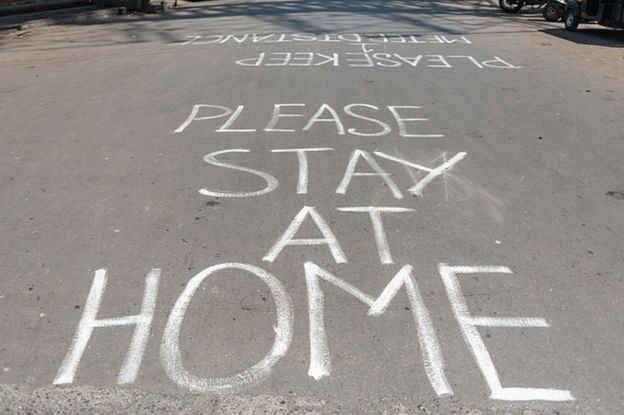
Image copyright GETTY IMAGESImage caption More than a billion people have been staying at home during the lockdown
Will India extend its rigorous 21-day lockdown to slow the spread of coronavirus beyond its end date next week? By all accounts, yes.
On 24 March, India shut its $2.9 trillion economy, closing its businesses and issuing strict stay-at-home orders to more than a billion people. Air, road and rail transport systems were suspended.
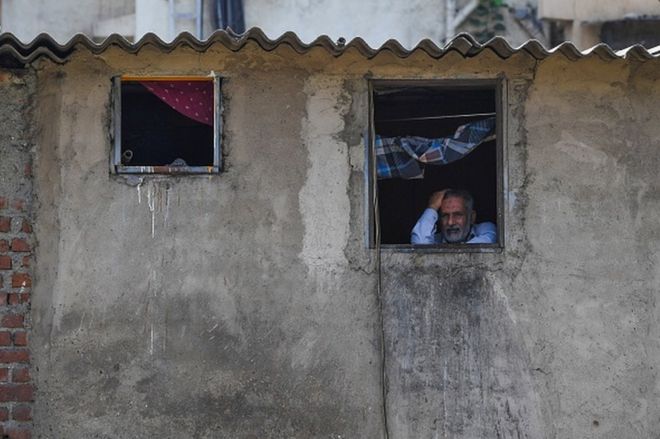
Now, more than two months after the first case of Covid-19 was detected in the country, more than 5,000 people have tested positive and some 150 people have died. As testing has ramped up, the true picture is emerging. The virus is beginning to spread through dense communities and new clusters of infection are being reported every day. Lifting the lockdown could easily risk triggering a fresh wave of infections.
A harsh lockdown is certain to slow down the disease. Virologists I spoke to believe India is still at an early stage of the infection. The country still doesn’t have enough data on the transmissibility of the virus or even how many people could have been infected and recovered to develop adequate herd immunity. (It is slowly beginning finger prick blood tests to look at the presence of protective antibodies.)
More than 250 of India’s 700-odd districts have reported the infection. Reports say at least seven states have a third of all infections, and want the lockdown extended. Six states have reported clusters of rapidly growing infections – from the capital Delhi in the north to Maharashtra in the west and Tamil Nadu in the south.
Economic fallout
Not surprisingly, the lockdown is already hurting the economy. Many of the early hotspots are economic growth engines and contribute heavily in revenues to the exchequer. Mumbai, India’s financial capital and Maharashtra’s main city, accounts for more than a third of overall tax collection. The densely populated city has reported more than 500 cases and 45 deaths, and numbers are steadily rising. Authorities say the infection is now spreading through the community. Mumbai has made wearing face masks mandatory.
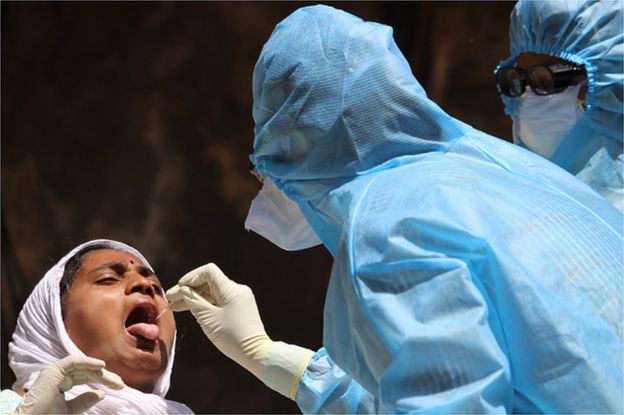
Image copyright GETTY IMAGESImage caption India has ramped up testing during the lockdown
Many of these hotspot clusters are also thriving manufacturing bases. The spread of infection means that they will be under lockdown for a longer period of time.
The services industry, which generates almost half of India’s GDP, is also likely to remain shut for some more time. Construction, which employs a bulk of migrant workers, will remain similarly suspended. The unemployment rate may have already climbed to more than 20% after the lockdown, according to a report by the Center for Monitoring Indian Economy.
For the moment, economists say, the government will have to prioritise farming over everything else to ensure the livelihoods of millions and secure the country’s future food supplies.
Half of India’s labour force work on farms. The lockdown happened at a time when a bumper winter crop had to be harvested and sold, and the rain-fed summer crop had to be sowed. The immediate challenge is to harvest and market the first crop, and secure the second.
Moving trucks to pick up produce and take them to markets, with adequate social distancing and hand washing will be something the government will have to move on quickly.
“The immediate challenge is to ensure that rural India is not hit,” says Rathin Ray, an economist. “Realistically, a complete lockdown cannot be continuously maintained beyond early May. We don’t have a choice but to reopen gradually after that.”
Image copyright GETTY IMAGESImage caption India has been under a lockdown from 24 March
There is little doubt about that. For his part, SK Sarin, who heads a government advisory panel on combating the disease, says the lockdown can be only eased in a “graded manner in areas that are not hotspots” and that the hotspots remained cordoned off.
Like other affected countries, India will have to prepare itself for what Gabriel Leung, an infectious disease epidemiologist and dean of medicine at the University of Hong Kong, describes as several rounds of “suppress and lift” cycles.
During these periods “restrictions are applied and relaxed, applied again and relaxed again, in ways that can keep the pandemic under control but at an acceptable economic and social cost.”
Also, Dr Leung observes, “how best to do that will vary by country, depending on its means, tolerance for disruption and its people’s collective will. In all cases, however, the challenge essentially is a three-way tug of war between combating the disease, protecting the economy and keeping society at an even keel”.
It is now clear that shutdowns need to continue until transmission has slowed down markedly, and testing and health infrastructure has been scaled up to manage the outbreak.
Experts from the southern state of Kerala, a striking outlier that is containing the infection thanks to a transparent government and a robust public health system, say it isn’t time to lift the lockdown yet and have recommended a three-phase relaxation.
For most countries, easing the lockdown is a tricky policy choice. It sparks fears of triggering a fresh wave of infection and presents the inevitable trade-off between lives and livelihoods. French Prime Minister Edouard Phillipe, says relaxing the lockdown in his country is going to be “fearsomely complex”. In a crisis like this, according to his Dutch counterpart Mark Rutte, leaders have to “make 100% of the decisions with 50% of the knowledge, and bear the consequences.”
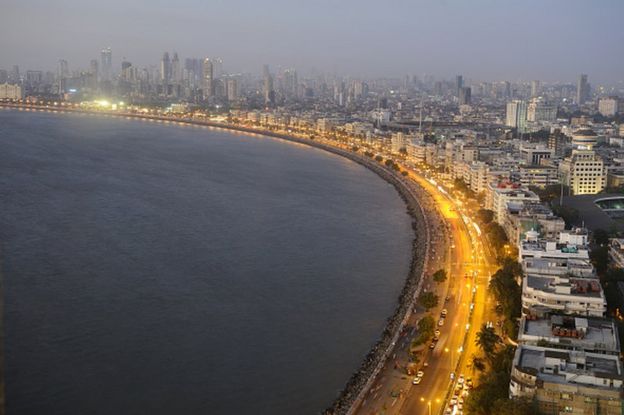
Image copyright GETTY IMAGESImage caption India’s financial capital, Mumbai, is emerging as a hotspot
It is going to be tougher for India with its vast size, densely packed population and enfeebled public health system. Also, no country in the world possibly has so much inter-state migration of casual workers, who are the backbone of the services and construction industries.
How will India manage to return these workers to their work places – factories, farms, building sites, shops – without a substantial easing of public transport at a time when crowded trains and buses can be a vector of transmission and easily neutralise the gains of the lockdown? Even allowing restricted mobility – allowing social distancing, temperature checks and passenger hygiene – would put considerable pressure on the public transport system.
The policy choices are fiendishly tough, and the answers are far from easy. India bungled the lockdown by not anticipating the exodus of millions of migrant workers from cities. The weeks ahead will tell whether the fleeing men, women and children carried the infection to their villages. The country simply cannot afford to make similar mistakes again while trying to relax the lockdown. Nitin Pai of The Takshashila Institution, a think tank, believes states should be left to decide on easing restrictions, and decisions “should be based on threat [of infection], which should be determined by extensive testing”.
This week Prime Minister Narendra Modi said that the “situation in the country is akin to a social emergency”. His government now needs make sure that the looming threat to the nation’s health and economic progress is tackled skilfully.
Photo taken on April 20, 2017 shows Chengdu railway container center station in the Qingbaijiang railway port of China (Sichuan) pilot free trade zone in Chengdu, southwest China’s Sichuan Province. China has released an overall plan about the country’s new western sea-land transportation channel to deepen the sea-land two-way opening-up and the development of western China, according to the National Development and Reform Commission. The plan covers the period from 2019 to 2025 with an outlook extended to 2035. (Xinhua/Xue Yubin)
BEIJING, Aug. 15 (Xinhua) — China has released an overall plan about the country’s new western sea-land transportation channel to deepen the sea-land two-way opening-up and the development of western China, according to the National Development and Reform Commission.
The plan covers the period from 2019 to 2025 with an outlook extended to 2035.
The new western sea-land transportation channel is located in the hinterlands of the western regions, connecting the Silk Road Economic Belt from the north, the 21st Century Maritime Silk Road from the south and the Yangtze River economic belt.
According to the plan, the new western sea-land transportation channel is strategically positioned to support the country’s western regions in participating in international economic cooperation and promote the deep integration of transportation, logistics and the economy.
The founder of Huawei has said there is “no way the US can crush” the company, in an exclusive interview with the BBC.
Ren Zhengfei described the arrest of his daughter Meng Wanzhou, the company’s chief financial officer, as politically motivated.
The US is pursuing criminal charges against Huawei and Ms Meng, including money laundering, bank fraud and stealing trade secrets.
Huawei denies any wrongdoing.
Mr Ren spoke to the BBC’s Karishma Vaswani in his first international broadcast interview since Ms Meng was arrested – and dismissed the pressure from the US.
“There’s no way the US can crush us,” he said. “The world cannot leave us because we are more advanced. Even if they persuade more countries not to use us temporarily, we can always scale things down a bit.”
However, he acknowledged that the potential loss of custom could have a significant impact.
Last week, US Secretary of State Mike Pompeo warned the country’s allies against using Huawei technology, saying it would make it more difficult for Washington to “partner alongside them”.
Australia, New Zealand, and the US have already banned or blocked Huawei from supplying equipment for their future 5G mobile broadband networks, while Canada is reviewing whether the company’s products present a serious security threat.
Mr Ren warned that “the world cannot leave us because we are more advanced”.
“If the lights go out in the West, the East will still shine. And if the North goes dark, there is still the South. America doesn’t represent the world. America only represents a portion of the world.”
Many of the UK’s mobile companies, including Vodafone, EE and Three, are working with Huawei to develop their 5G networks.
They are awaiting a government review, due in March or April, that will decide whether they can use Huawei technology.
Commenting on the possibility of a UK ban, Mr Ren said Huawei “won’t withdraw our investment because of this. We will continue to invest in the UK.
“We still trust in the UK, and we hope that the UK will trust us even more.
“We will invest even more in the UK. Because if the US doesn’t trust us, then we will shift our investment from the US to the UK on an even bigger scale.”
Image copyrightGETTY IMAGESImage captionHuawei has denied that it poses any risk to the UK or any other country
What does Mr Ren think about his daughter’s arrest?
Mr Ren’s daughter Meng Wanzhou, Huawei’s chief financial officer, was arrested on 1 December in Vancouver at the request of the US, and is expected to be the subject of a formal extradition request.
The first covers claims Huawei hid business links to Iran – which is subject to US trade sanctions. The second includes the charge of attempted theft of trade secrets.
Mr Ren was clear in his opposition to the US accusations.
“Firstly, I object to what the US has done. This kind of politically motivated act is not acceptable.
“The US likes to sanction others, whenever there’s an issue, they’ll use such combative methods.
“We object to this. But now that we’ve gone down this path, we’ll let the courts settle it.”
Image copyrightREUTERSImage captionMeng Wanzhou was arrested in Vancouver last December
What did Mr Ren say about Chinese government spying?
Huawei, which is China’s largest private company, has been under scrutiny for its links to the Chinese government – with the US and others expressing concern its technology could be used by China’s security services to spy.
Under Chinese law, firms are compelled to “support, co-operate with and collaborate in national intelligence work”.
But Mr Ren said that allowing spying was a risk he wouldn’t take.
“The Chinese government has already clearly said that it won’t install any backdoors. And we won’t install backdoors either.
“We’re not going to risk the disgust of our country and of our customers all over the world, because of something like this.
“Our company will never undertake any spying activities. If we have any such actions, then I’ll shut the company down.”
Is Huawei part of the Chinese state?
Analysis – Karishma Vaswani, BBC Asia business correspondent – Shenzhen
For a man known as reclusive and secretive, Ren Zhengfei seemed confident in the conviction that the business he’s built for the last 30 years can withstand the scrutiny from Western governments.
Mr Ren is right: the US makes up only a fraction of his overall business.
But where I saw his mood change was when I asked him about his links to the Chinese military and the government.
He refused to be drawn into a conversation, saying only that these were not facts, simply allegations.
Still, some signs of close links between Mr Ren and the government were revealed during the course of our interview.
He also confirmed that there is a Communist Party committee in Huawei, but he said this is what all companies – foreign or domestic – operating in China must have in order to abide by the law.


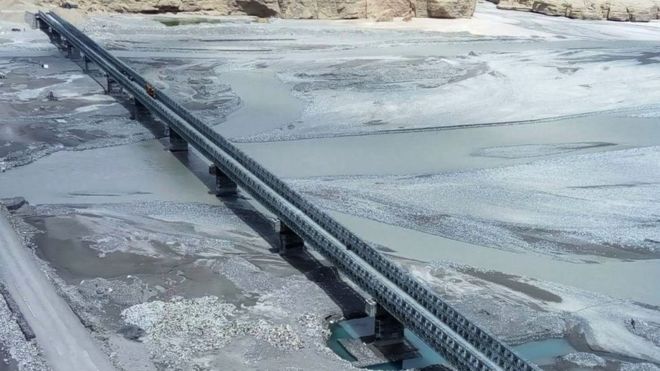 Image copyright PRESS INFORMATION BUREAU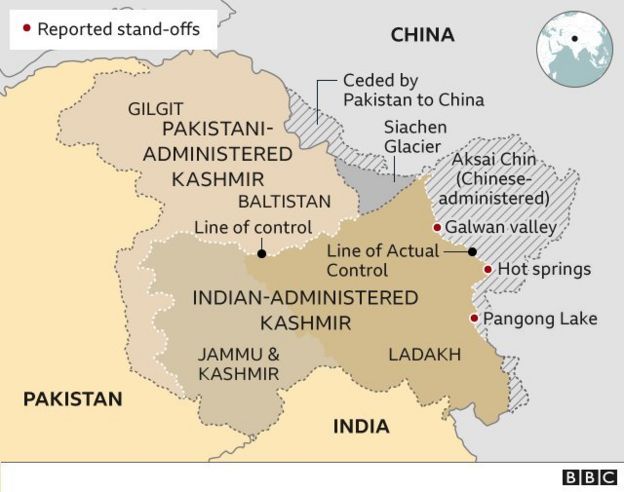
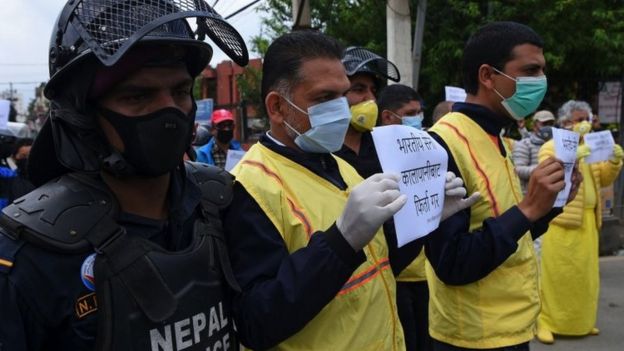 Image copyright AFP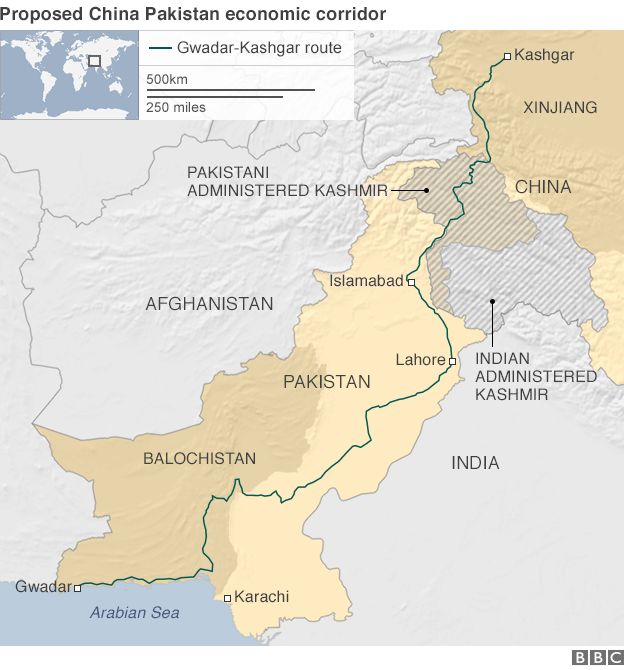
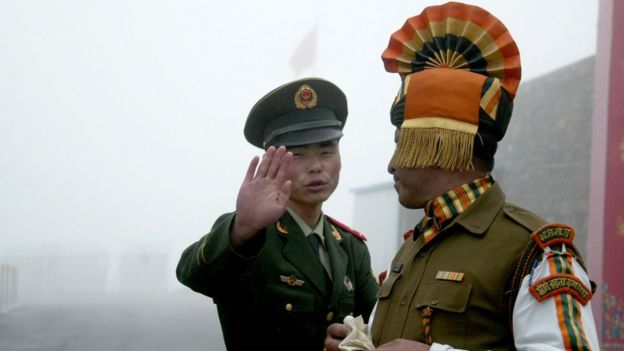 Image copyright GETTY IMAGES




 CHINDIA ALERT: You'll be living in their world, very soon