17/03/2020
- AutoNavi’s latest data shows increase in offline traffic and searches of major business districts
- Traffic data could signal that consumer activity in China has entered a recovery
AutoNavi’s mobile app users can search the names of malls and shops to see real-time traffic data. Photo: AP
Data from AutoNavi, the maps app operated by Alibaba Group Holding, shows that traffic in major shopping districts in China picked up by an average of 30 per cent over the past month, as consumer activity gradually returns to normal now that the coronavirus infection rate appears to have peaked in the country.
The early sign of increased consumer activity in China contrasts with the panic and economic uncertainty now engulfing Europe and the US, as the widening pandemic forces governments around the world to take lessons from China on how to tackle the spread of the disease with curfews and social distancing measures.
AutoNavi’s latest big data report, released on Monday, shows that traffic in and around shopping districts in several major cities in the country rose 30 per cent over the weekend of March 14-15 compared with the weekend of February 15-16, when the coronavirus in China was at its height and many areas in the country were under lockdown.
China’s Meituan Dianping to join maps service battle
15 Aug 2019
“Consumer confidence is starting to rebound as the coronavirus comes under control,” said Guo Ning, vice-president of AutoNavi. “We are seeing more and more people stepping out, with offline consumption slowly recovering.”
Alibaba is the owner of the South China Morning Post.
China’s nearly two-month lockdown has dealt a hammer blow to the economy, with retail sales – a key metric of consumption – down by 20.5 per cent across the combined two months of January and February, marking the first decline on record. The virus has however proved a boon for China’s e-commerce sector, as shoppers stuck at home buy even more online.
The new data appears to show that the country’s offline economy could now see a slow recovery. This does not mean that retail businesses can slack off on preventive measures – hand sanitiser, extra cleaning and temperature monitoring are likely to remain fixtures of everyday life in shopping malls.
AutoNavi’s mobile app users can search the names of malls and shops to see real-time traffic data – often used to avoid visiting malls at peak periods. AutoNavi said the average 30 per cent increase in traffic refers to the combined volume of people using the app to navigate the shopping destinations.
Alibaba’s AutoNavi crosses 100 million daily users
AutoNavi has more than 400 million monthly active users, according to company data. It was the first domestic travel platform to exceed 100 million daily active users.
Digital maps have become a key tool in China’s attempts to control the coronavirus pandemic, with competitor map apps from Baidu and Tencent also launching features to track population flows and provide information on clinics able to test for and treat the disease.
Covid-19, as the novel coronavirus is known, has now killed over 3,200 people in China and infected just over 80,000, of which around 68,000 have recovered. There are now around 87,000 confirmed cases outside China, according to the latest figures from health authorities.
Source: SCMP
Posted in Alibaba Group Holding, around, AutoNavi, Big data, China, coronavirus, Coronavirus pandemic, COVID-19, Data, Digital maps, e-commerce sector, economy, Fears, hammer blow, lockdown, maps, Meituan Dianping, novel coronavirus, recede, recovery, shopping areas, shows, south china morning post, traffic, Uncategorized |
Leave a Comment »
13/03/2020
- Government records suggest first person infected with new disease may have been a Hubei resident aged 55, but ‘patient zero’ has yet to be confirmed
- Documents seen by the Post could help scientists track the spread of the disease and perhaps determine its source
The first known case of Covid-19 in China dates back to November, but the hunt for “patient zero” goes on. Photo: EPA-EFE
The first case of someone in China suffering from
Covid-19, the disease caused by the novel
coronavirus, can be traced back to November 17, according to government data seen by the
South China Morning Post.
Chinese authorities have so far identified at least 266 people who were infected last year, all of whom came under medical surveillance at some point.
Some of the cases were likely backdated after health authorities had tested specimens taken from suspected patients.
Interviews with whistle-blowers from the medical community suggest Chinese doctors only realised they were dealing with a new disease in late December.
Scientists have been trying to map the pattern of the early transmission of Covid-19 since an epidemic was reported in the central China city of Wuhan in January, two months before the outbreak became a global health crisis.
Understanding how the disease spread and determining how undetected and undocumented cases contributed to its transmission will greatly improve their understanding of the size of that threat.
According to the government data seen by the Post, a 55 year-old from Hubei province could have been the first person to have contracted Covid-19 on November 17.
From that date onwards, one to five new cases were reported each day. By December 15, the total number of infections stood at 27 – the first double-digit daily rise was reported on December 17 – and by December 20, the total number of confirmed cases had reached 60.
On December 27, Zhang Jixian, a doctor from Hubei Provincial Hospital of Integrated Chinese and Western Medicine, told China’s health authorities that the disease was caused by a new coronavirus. By that date, more than 180 people had been infected, though doctors might not have been aware of all of them at the time.
With pandemic declared, the race is on to develop a coronavirus vaccine
By the final day of 2019, the number of confirmed cases had risen to 266, On the first day of 2020 it stood at 381.
While the government records have not been released to the public, they provide valuable clues about how the disease spread in its early days and the speed of its transmission, as well as how many confirmed cases Beijing has recorded.
Scientists are now keen to identify the so-called patient zero, which could help them to trace the source of the coronavirus, which is generally thought to have jumped to humans from a wild animal, possibly a bat.
Of the first nine cases to be reported in November – four men and five women – none has been confirmed as being “patient zero”. They were all aged between 39 and 79, but it is unknown how many were residents of Wuhan, the capital of Hubei and the epicentre of the outbreak.
It is possible that there were reported cases dating back even earlier than those seen by the Post.
According to the
World Health Organisation’s website, the first confirmed Covid-19 case in China was on December 8, but the global body does not track the disease itself but relies on nations to provide such information.
A report published in medical journal The Lancet by Chinese doctors from Jinyintan Hospital in Wuhan, which treated some of the earliest patients, put the date of the first known infection at December 1.
Dr Ai Fen, the first known whistle-blower, told People magazine in an interview that was later censored, that tests showed that a patient at Wuhan Central Hospital was diagnosed on December 16 as having contracted an unknown coronavirus.
With pandemic declared, the race is on to develop a coronavirus vaccine
Accounts by other doctors seem to suggest the medical community in Wuhan became aware of the disease in late December.
Previous reports said that although doctors in the city collected samples from suspected cases in late December, they could not confirm their findings because they were bogged down by bureaucracy, such as having to get approval from the Chinese Centre for Disease Control and Prevention, which could take days. They were also ordered not to disclose any information about the new disease to the public.
As late as January 11, Wuhan’s health authorities were still claiming there were just 41 confirmed cases.
Source: SCMP
Posted in back, Beijing, China’s, Chinese Centre for Disease Control and Prevention, confirmed, coronavirus, coronavirus vaccine, Covid-19 case, first, Hubei, Hubei Provincial Hospital of Integrated Chinese and Western Medicine, Jinyintan Hospital, novel coronavirus, November 17, pandemic, patient zero, resident, south china morning post, traced, Uncategorized, website, World Health Organisation’s, Wuhan, Wuhan Central Hospital, Wuhan’s health authorities |
Leave a Comment »
02/03/2020
- The enterprise collaboration industry in China is forecast to achieve a compound annual growth rate of 12.4 per cent over five years to reach US$7 billion by 2024
Tencent has been accused of using its market dominance with WeChat to stifle competition. Photo: Reuters
Tencent’s super app WeChat, with a user base of 1.2 billion people, has blocked links from a ByteDance remote work tool as Chinese tech giants fight for dominance in the burgeoning enterprise collaboration market.
The latest move adds another ByteDance app to WeChat’s blacklist, which already includes Douyin, the Chinese version of TikTok, and its sister platform Xigua Video, amid ongoing accusations that Tencent uses its market dominance to stifle competition.
Feishu, the Chinese version of ByteDance’s productivity tool Lark, said Saturday that users could not open any of its links on WeChat, nor could they share name cards to invite colleagues.
Feishu said WeChat did not provide advance notice of the ban, adding that the move has “significantly affected work efficiency and user experience” at a time when many companies in China have moved their office operations online to limit the spread of coronavirus infections.
Instead, Lark users need to copy the link and open it in a browser instead of opening it directly via WeChat.
Tencent launches new social apps as flagships WeChat and QQ show their age
A WeChat representative declined to comment other than to cite the company’s regulations on external links. The rules, introduced in October 2019, said the platform will punish websites or apps that send links to “mislead or entice users to download or redirect to an external app”. Punishment includes blocking their domain name from opening in WeChat.
Xie Xin, a ByteDance vice president overseeing Feishu, said the app does not support sign-ups using a WeChat account nor does it enable the sharing of documents or messages on the Tencent app.
In addition to blocking the ByteDance app, WeChat also suspended two tech-focused media websites, 36Kr and ITHome, from publishing posts on the platform after they reported the Lark case over the weekend. The relevant articles have also been removed from WeChat.
The WeChat representative said it did not force media to delete their articles. Rather, the media in question have violated WeChat’s rules on multiple occasions.
The enterprise collaboration industry in China, which has received a huge boost from the health crisis, is forecast to achieve a compound annual growth rate of 12.4 per cent over five years to reach nearly 49 billion yuan (US$7 billion) by 2024, according to the Qianzhan Industry Research Institute.
Feishu is a small but fast-emerging player in the sector, jumping 40 places from late January to become the 15th most downloaded business iOS app on Monday. However, it still lags far behind Alibaba’s DingTalk and Tencent’s WeChat Work and Tencent Meeting, which ranked as the top three among business iOS apps in China as of Monday, according to App Annie.
Alibaba is the parent company of the South China Morning Post.Tencent has also blocked apps from other Chinese tech giants. Links from Taobao, Alibaba’s online marketplace, and Haokan, a short video app from Baidu, cannot be accessed on WeChat. In contrast, Tencent allows the sharing of links from JD.com and PDD pages, online marketplaces in which it owns a financial stake.
“Having more than 1 billion users, [WeChat] has a monopolistic position in the market,” said Wang Sixin, a professor at the Communication University of China who specialises in media policy and rules. “Under these circumstances, Tencent has to have legitimate reasons to block other apps, otherwise it’s taking advantage of its dominance to force out smaller rivals.”
In April 2019, a Chinese lawyer sued Tencent under the country’s anti-monopoly law, charging that the company’s actions infringed on his rights as a user. In December, the intellectual property court in Beijing heard the case, with Tencent representatives arguing that WeChat did not prevent users from sharing links and using the app on other platforms, Southern Metropolis Daily reported. The court has not yet reached a verdict.
Besides enterprise collaboration, Tencent and ByteDance are coming up against each other in other markets. Last week Tencent began testing a
short video function for WeChat, a sector dominated by TikTok and Douyin, while ByteDance plans to
this year to challenge Tencent’s dominance in gaming
Source: SCMP
Posted in Alibaba's, amid, APP, Baidu, blocks, China’s, Communication University of China, coronavirus, Douyin, Feishu, Haokan, heats up, Lark, lockdown, QQ, south china morning post, Southern Metropolis Daily, Taobao, telecommuting war, TENCENT, Tencent’s, TikTok, Uncategorized, WeChat, work-from-home, Xigua Video |
Leave a Comment »
28/02/2020
- Around 200 Shincheonji Church of Jesus members continued to meet in the Chinese city amid rumours of virus, but ‘no one took [claims] seriously’ at first
- Around half the Covid-19 cases in South Korea have been linked to members of the religious group
The Shincheonji church in Daegu has been linked to a cluster of infections. Photo: Yonhap via AP
Members of the Christian sect linked to a cluster of coronavirus cases in South Korea held meetings in Wuhan until December, only stopping when they realised that their community had been hit by Covid-19, the previously unknown disease caused by the virus.
The South China Morning Post has learned that the Shincheonji Church of Jesus in Wuhan, the Chinese city at the centre of the epidemic, has around 200 members, most of whom are currently under quarantine outside the city.
“Rumours about a virus began to circulate in November but no one took them seriously,” said one member, a 28-year-old kindergarten teacher.
“I was in Wuhan in December when our church suspended all gatherings as soon as we learned about [the coronavirus],” said the woman, who declined to be named because of the sensitivity of the matter.
She said the group was continuing to share sermons and teachings online, but most members had returned home at the start of the Lunar New Year holiday in late January.
The 250,000-member Shincheonji Church of Jesus is regarded by mainstream Christian groups as a secretive and unorthodox sect. Its founder, Lee Man-hee, has claimed that he is the second coming of Jesus Christ.
Around half the Covid-19 infections in South Korea have been linked to a branch of the church in Daegu.
Coronavirus spreads through Europe from Italy to Austria, Croatia, Tenerife
According to the Korea Centres for Disease Control and Prevention, there were 977 confirmed cases as of Tuesday – the second highest number outside China – and 11 deaths.
Of the 84 new cases reported on Tuesday, over half were recorded in Daegu city.
Coronavirus: Churches on high alert as South Korea confirms huge rise in infections
A member of the church from Daegu reportedly visited China in January, and health officials in South Korea are investigating whether a cluster of infections in Cheongdo city is linked to a three-day funeral ceremony held at a local hospital.
Chinese sources said that the Shincheonji church has about 20,000 members in China – most of whom live in major cities such as Beijing, Shanghai, Dalian, Changchun and Shenyang.
One Christian pastor in Hubei province, who declined to be named, said that Shincheonji church members were hard-working and some continued to proselytise even during the outbreak.
Chinese cities quarantine travellers from South Korea amid spike in coronavirus cases
The Wuhan kindergarten teacher said she was confident that the recent mass outbreaks in South Korea were not linked to Shincheonji church members from the city.
“I don’t think the virus came from us because none of our brothers and sisters in Wuhan have been infected. I don’t know about members in other places but at least we are clean. None of us have reported sick,” she said.
“There are so many Chinese travelling to South Korea, it’s quite unfair to pin [the disease] on us.”
Coronavirus: China reports 508 new Covid-19 cases, with only nine outside outbreak epicentre
She sidestepped questions on whether church members had travelled from Wuhan to South Korea after the outbreak.
The teacher said that in 2018 the Wuhan group’s “holy temple” in Hankou district had been raided by police “who branded us a cult”, but members continued to worship in small groups.
“We are aware of all the negative reporting out there after the outbreak in South Korea, but we do not want to defend ourselves in public because that will create trouble with the government,” she said. “We just want to get through the crisis first.”
Airfares from South Korea to China shoot up amid Covid-19 fears
Bill Zhang, a 33-year-old Shanghai resident and a former missionary with Shincheonji, said the group’s secretive nature made it hard for the authorities to effectively crackdown on its activities.
He said the Shanghai branch held its main meetings on Wednesdays and Saturdays, attracting 300 to 400 people at a time.
“The Shincheonji church in Shanghai has been raided many times and police spoke to church leaders regularly.
“But the church members simply continued their meetings in smaller groups of eight-to-10 people and regrouped when the surveillance was relaxed.”
Zhang continued: “Shincheonji holds that it is the only real church that upholds the biblical truth and all other churches – mainstream or cults – are evil.”
Source: SCMP
Posted in Austria, Beijing, Centres for Disease Control and Prevention, Changchun, church, coronavirus, COVID-19, Croatia, Daegu, Dalian, December, Europe, Hankou, held meetings, hubei province, Italy, Korea, linked, Lunar New Year holiday, outbreak, quarantine, secretive, Shanghai, Shenyang, Shincheonji Church of Jesus, south china morning post, South Korea, South Korean, Tenerife, travellers, Uncategorized, Wuhan |
Leave a Comment »
25/01/2020
- Evacuation plan outlined in email as diplomats look for ways to protect foreign nationals
- Paris earlier reports three cases on its soil – the first to be identified in Europe
The French consulate in Wuhan is planning to evacuate French nationals from the city to escape the deadly coronavirus. Photo: AFP
Foreign diplomats in Wuhan are scrambling to assess the situation in the
coronavirus
-plagued city, with French officials planning to evacuate French nationals trapped by the Chinese government’s lockdown.
The plan would allow French people who want to leave Wuhan, the capital of Hubei province, to travel by bus to Changsha in neighbouring Hunan province, according to an email seen by the South China Morning Post.
“The consulate general, in collaboration with local authorities, plans to set up a bus service to allow French nationals … and their Chinese and foreign spouses and children to travel from Wuhan to Changsha,” it said.
The email, sent by the French consulate, also asked anyone who received it to pass the notice on to other French nationals. It was not clear which bodies received the email and the date of the planned evacuation was not specified.
The consulate could not be reached for comment on Saturday.
France, the United States, Britain and South Korea all have consulates in Wuhan, according to China’s foreign ministry.
The South Korean consulate said in a post on its website that it would suspend all visa applications “indefinitely until further notice”.
A diplomatic source said several foreign embassies in China were considering plans to evacuate their nationals from Wuhan.
First coronavirus case ‘had no links to seafood market’
It is not known how many foreigners remain in the city, which has a population of about 11 million and has been under a government-imposed lockdown since Thursday morning.
French Foreign Minister Jean-Yves Le Drian said in a statement on Friday that Paris was monitoring the crisis and “can increase the power [to respond] if necessary”.
There have so far been three confirmed cases of the new coronavirus in France, in Paris and Bordeaux.
French Foreign Minister Jean-Yves Le Drian said on Friday that Paris was monitoring the crisis in China. Photo: AFP
The US said earlier that most of its consulate staff and their families had been pulled out of Wuhan.
An emailed inquiry to the British consulate in the city received only an automated reply, saying: “Wuhan is now in crisis mode. We may not be able to answer your emails for some time.”
The consulate would be closed for the Lunar New Year holiday until January 31, it said.
Meanwhile, British citizen Kharn Lambert told the BBC on Thursday how he had been “trapped” in Wuhan.
The PE teacher said he was afraid to leave his house for fear of catching the deadly virus.
“If you saw the street behind me at night time where I normally live … if I show you out there now, it’s dead,” he said.
More than 1,280 confirmed cases have been reported across China, of which more than 700 were in Hubei, according to local government figures released on Saturday.
The death toll in Hubei stands at 39, with two other fatalities reported in the provinces of Hebei and Heilongjiang.
Tens of millions of people in Hubei are effectively on lockdown since a travel ban was imposed on most of the province.
Flights, trains, buses and ferries connecting Wuhan to other cities in Hubei have been suspended. Rail authorities in Wuhan, which is a hub for several major high-speed lines, said operations at 61 stations and more than 400 train services had been suspended until further notice.
Source: SCMP
Posted in Bordeaux, Britain, British citizen, bused out, buses, Changsha, China’s Foreign Ministry, consulate, coronavirus, diplomats, escape, Europe, Evacuation plan, ferries, flights, foreign nationals, Foreigners, French citizens, French Foreign Minister, Hebei, Hebei province, Heilongjiang province, high-speed lines, hub, Hubei, hubei province, Hunan Province, Jean-Yves Le Drian, Lunar New Year holiday, Paris, Population, Rail authorities, south china morning post, South Korea, The BBC, trains, Uncategorized, United States, Wuhan |
Leave a Comment »
19/12/2019
- Families appeal to city authorities and toy company for help to recover fees already paid for classes
- Four outlets shut their doors in aftermath of contract dispute
Families in Shanghai are appealing to authorities for help to recover money paid for lessons at closed Lego Education Learning Centres. Photo: Weibo
Hundreds of Shanghai parents are appealing to Danish toy company Lego for help after four of its authorised learning centres suddenly closed their doors, leaving families tens of thousands of yuan out of pocket.
Shanghai Jixiao Information Science and Technology, which ran three Lego Education Learning Centres in the city, said in an online statement on Monday that it was left with no choice but to close the centres after Lego Education in China ended its agreement with its Chinese partner, Beijing-based Semia.
The closure of the centres – the Ruihong, Jinqiao and Haiwaitan branches – came just weeks after the Lego centre in Nanxiang shut down.
Semia was authorised by Lego Education to operate learning branches across mainland China and authorisation third parties to do as well, according to Shanghai-based Jfdaily.com.
Rachel Wang, a mother of a six-year-old boy, said that in various online forums about 650 families had reported losing a combined 5.2 million yuan (US$742,000) in prepaid classes at the three stores. Another 130 families whose children were enrolled at the Nanxiang store were seeking 900,000 yuan in refunds, she said.
Wang said the parents had appealed to the Shanghai municipal government to pressure Lego to look at the case.
“We are planning to sue the learning centre, and in the meantime we hope Lego Group can pay attention to this case and help us. Many of the parents chose these centres as we saw on Lego’s website they were listed as among the company’s authorised stores,” she said.
“We are angry and very disappointed with Lego.
“It made a lot of money in China because we trusted it.”
Lego and Tencent will develop games and videos for kids in China
Tao Lina said everything appeared fine when he took his five-year-old daughter to the Haiwaitan centre on Sunday.
“But the next day, we were told that the store had closed. I was so surprised,” Tao said.
“We had never heard of Semia and we were not aware of its existence. We all thought that the learning centres was franchised directly by Lego.”
He said he had paid for 144 classes at the centre and his daughter had attended about 60 of them, each costing 160 yuan. Tao said he hoped his daughter could continue attending the classes – which use Lego products to teach children about subjects such as robotics – but had not been able to contact the centre’s managers.
Shanghai Jixiao said the termination of the Semia-Lego Education agreement had scared off parents, cutting cash flow and forcing it to close the centres.
In its online statement, the company said its troubles started in September, when it received a lawyer’s letter from both Semia and Lego Education.
“It required us to promise not to use the [Lego Education] logo after December 31, 2019 and to stop teaching Lego courses after August of next year,” Shanghai Jixiao said.
On October 11, Lego Education said on WeChat that it had terminated its cooperation with Semia. Most of the 137 Lego learning centres in China would be allowed to use the Lego brand until December 31 and continue teaching Lego courses until July 31 next year.
But after the announcement, many parents sought refunds, causing a cash-flow crisis for the Shanghai company.
Shanghai Jixiao also said that the lawyer’s letter sent in September required all learning centres to sign an agreement absolving Semia of all responsibility.
If it signed the agreement, it would have three months to change the brand and products, which Shanghai Jixiao said was impossible. If it did not sign it, it would have to stop using the Lego brand at once.
Shutting the centres down was the only option after their various efforts, including joint appeals with other mainland learning stores to Lego, visiting Lego headquarters in Denmark and calling Lego’s executives, were unsuccessful, the Shanghai company said.
Chinese teens put to the information age test in global Pisa education study
5 Dec 2019
It offered two mobile phone numbers for parents to contact them but the phones were powered off on Wednesday and Thursday.
Lego did not respond to a request for comment from the South China Morning Post.
But on Wednesday, Lego said it ended the contract with Semia to improve the company’s learning centres, adding that it had no business relations with the closed stores, Thepaper.cn reported.
A manager at Semia’s franchising department identified only as Wei was quoted by Jfdaily.com as saying that the authorisation contract for the three stores owned by Shanghai Jixiao actually ended between October 2018 and February this year.
“They were waiting for us to renew the authorisation contract with Lego, but we failed to reach an agreement with Lego. So these learning centres lost their authorisation,” she was quoted as saying.
Wei said all the authorised stores operated independently.
“Legally speaking, their problems should be solved by themselves,” she said, adding that she could not contact Shanghai Jixiao’s owner either.
There are 19 Lego Education branches across Shanghai, according to Lego Education’s WeChat account.
Market regulation authorities in Pudong and Huangpu districts had started to look at the case, Jfdaily.com reported.
Source: SCMP
Posted in after, Beijing-based, brick wall, closed, closures, Danish, Denmark, Haiwaitan centre, hit, Huangpu District, Jfdaily.com, learning centre, Lego, Lego Education Learning Centres, Lessons, money, Nanxiang, paid for, parents, Pudong, recover, refund, Semia, Semia-Lego Education agreement, Shanghai, Shanghai Jixiao Information Science and Technology, south china morning post, TENCENT, toy company, Uncategorized |
Leave a Comment »
17/12/2019
- This is the third instalment in a four-part series examining the brewing US-China tech war over the development and deployment of artificial intelligence tech
- The US is home to five of the world’s top 10 universities in the AI field, which includes computer vision and machine learning, while China has three
For those Chinese with long-term plans to stay in the US, a major obstacle lies in getting work visas, especially in the current trade war environment. Illustration: Perry Tse
After working in the United States for more than a decade, Zheng Yefeng felt he had hit a glass ceiling. He also saw that the gap in artificial intelligence between China and the US was narrowing.
Last year Zheng, who worked as a researcher at Siemens Healthcare in New Jersey, made a decision that addressed both problems. He accepted an offer to head up the medical research and development team at Tencent’s YouTu artificial intelligence lab in Shenzhen, known as China’s Silicon Valley.
“There was almost no room for promotion if I stayed in the US,” he said, expressing a common dilemma faced by experienced Chinese tech workers in America.
With the US-China trade war leading to tighter scrutiny of Chinese nationals working in the US tech industry, people like Zheng are moving back to China to work in the burgeoning AI sector, especially after Beijing designated AI a national priority. The technology’s varied applications have attracted billions of dollars of venture capital investment, created highly valued start-ups like SenseTime and ByteDance, and sparked a talent war among companies.
That has created an odd symbiotic relationship between the two countries vying for AI supremacy. The US, with its superior higher education system, is the training ground for Chinese AI scientists like Zheng, who obtained a PhD from the University of Maryland after earning bachelor’s and master’s degrees at China’s premier Tsinghua University.
“Many professors in China have great academic ability, but in terms of the number [of top professors], the US is ahead,” said Luo Guojie, who himself accepted an offer from Peking University to become an assistant professor after studying computer science in the US.
Among international students majoring in computer science and maths in US universities, Chinese nationals were the third largest group behind Indians and Nepalese in the 2018-2019 academic year, representing 19.9 per cent, according to the Institute of International Education.
[To build] the best universities is not easy. The university is a free speech space, whereas in China, this is not the case Gunther Marten, a senior official with the European Union delegation to China
The South China Morning Post spoke with several Chinese AI engineers who decided to stay and work in the US after their studies. They only agreed to give their surnames because of the sensitivity of the issues being discussed.
A 25-year-old Beijinger surnamed Lin graduated from one of China’s best engineering schools in the capital before heading to a US university for a master’s degree in computer science in 2017. Like some of his peers, he found the teaching methods in China to be outdated.
“It’s hard to imagine that a final exam of a coding course still asked you to hand write code, instead of running and testing it on a computer,” said Lin, who now works as a software engineer for Google in Silicon Valley.
“Although we still had to take writing tests [in the US], we had many practical opportunities in the lab and could do our own projects,” he added.
A Facebook software engineer surnamed Zhuang had a similar experience at his university in Shanghai.
“Many engineering students [in China] still get old-school textbooks and insufficient laboratory training,” he said. “Engineering practices for AI have been through a fast iteration over the past few decades, which means many Chinese students are not exposed to the most updated knowledge in the field, at least not in the classroom.”
Zhuang also noted out that many classes in China are taught in Chinese, meaning engineering graduates are not fluent in English, the preferred language of the global AI research community.
The US is home to five of the world’s top 10 universities in the AI field, which includes computer vision and machine learning, while China has three. Carnegie Mellon University (CMU) in Pennsylvania ranks No 1 while China’s Tsinghua University is No 2, according to CSrankings, which bases the list on papers published since 2009.
US tech chief: China is threatening US’ lead in global AI race
With its top institutions and an open culture that encourages freedom of speech, including unfettered internet access, the US has become a magnet for the brightest AI students the world over.
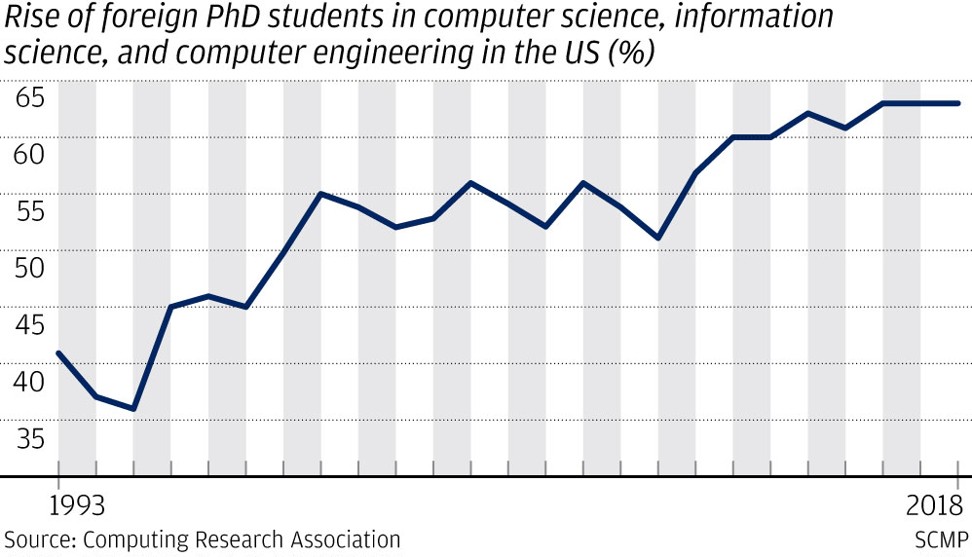
In 2018, 62.8 per cent of PhD degrees and 65.4 per cent of master’s degrees in computer science, information science and computer engineering programmes in the US were granted to “non-resident aliens”, according to a survey by the Computing Research Association.
“[To build] the best universities is not easy,” Gunther Marten, a senior official with the European Union delegation to China, said on the sidelines of the World Internet Conference in Wuzhen in October. “The university is a free speech space, whereas in China, this is not the case.”
When these US-educated AI scientists finish studying, most take advantage of a rule allowing them to stay in the country for three years to gain work experience.
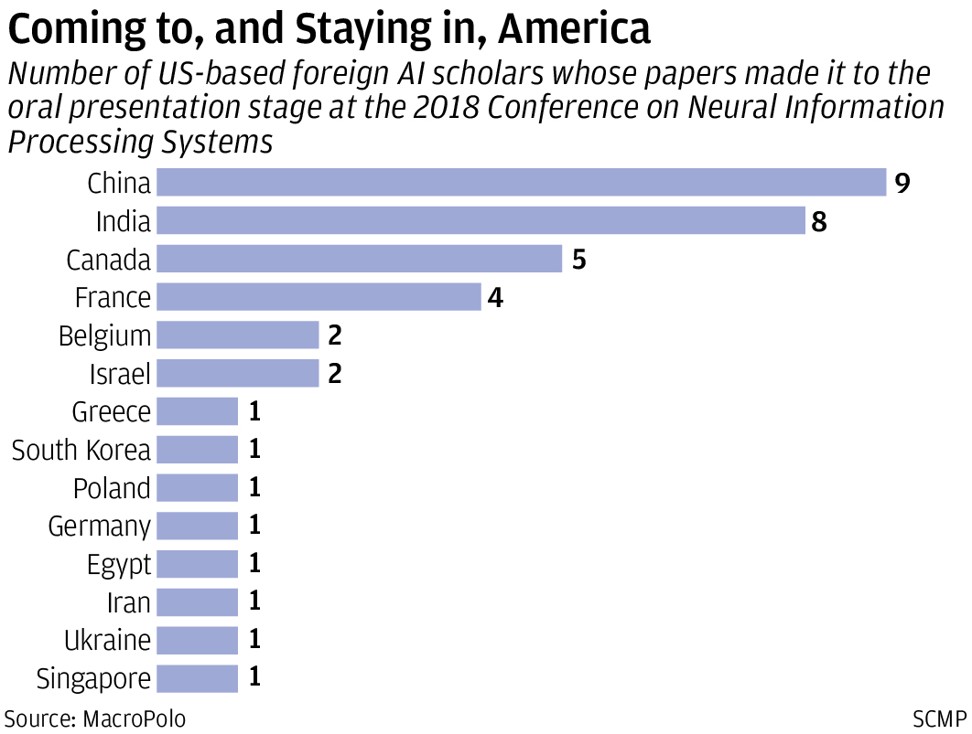
Of the foreign nationals taking part in last year’s Conference on Neural Information Processing Systems (NIPS), a major machine learning event for AI professionals, 87 per cent of those whose papers made it to the oral presentation stage went to work for American universities or research institutes after earning their PhD, according to MacroPolo, a think tank under the Paulson Institute.
“China has many great universities and companies, especially in certain subfields of AI such as computer vision, but many people remain hesitant to move to China due to the political environment, quality of life concerns and workplace issues,” said Remco Zwetsloot, a research fellow at Georgetown University’s Center for Security and Emerging Technology (CSET).
China’s PhD students miserable, yet hopeful: survey
Some of the US-trained Chinese AI engineers told the Post they were scared off by China’s “996” working culture: 9am to 9pm, six days a week. Tech firms in China typically expect their employees to work long hours to prove their dedication.
Lin, the Beijinger who now works for Google, used to be an intern at one of China’s largest internet giants. “I worked from the time I woke up until going to bed,” he said, “At Google, I’ve been confused because many people here only work till 5pm but Google is still a global leader.” Lin said he would be happy to return to China if the 996 work culture eases.
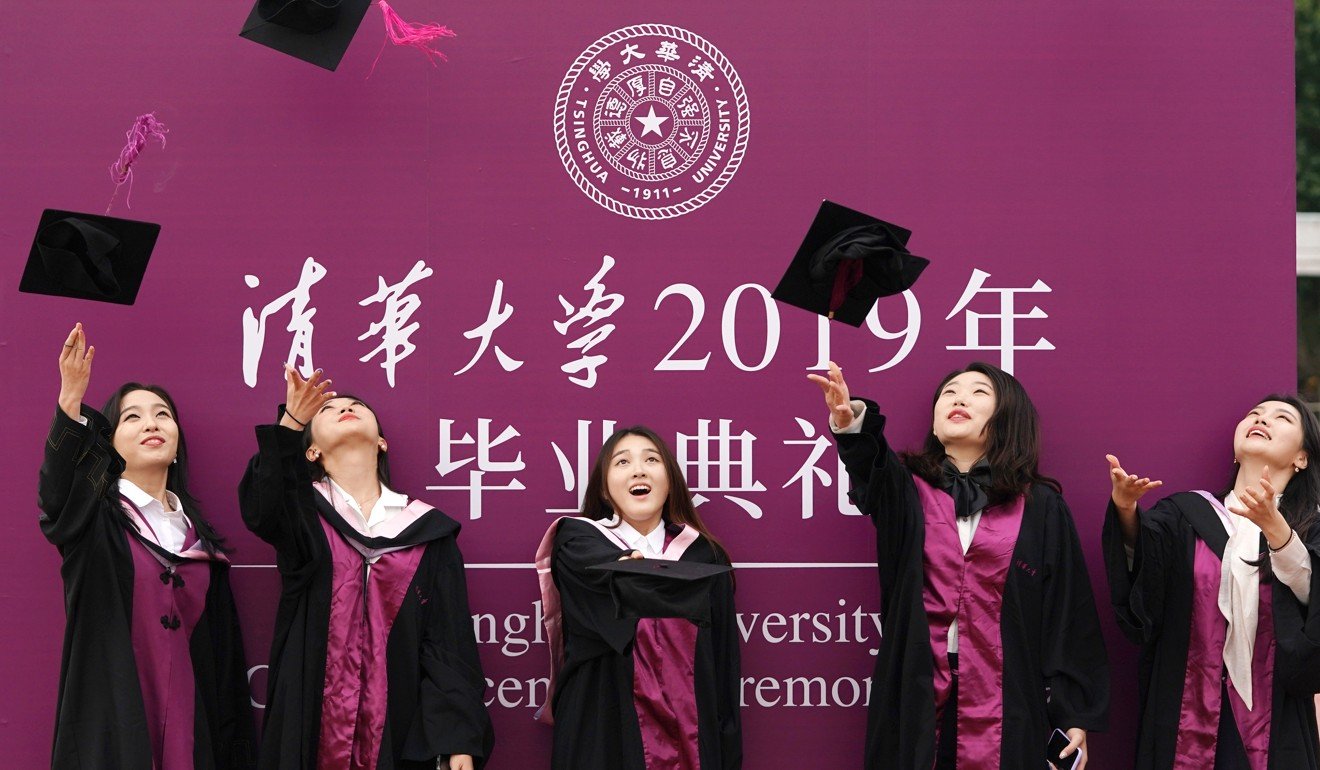
Graduates throw their caps in the air as they pose for a group photo during the 2019 commencement ceremony of Tsinghua University in Beijing. Tsinghua ranks as China’s top university for AI. Photo: Xinhua
Chen, a female postgraduate student at Carnegie Mellon, who recently accepted a job offer from Google, once interned at Beijing-based AI unicorn SenseTime, where she worked from 10am to between 8pm and 10pm most days.
A SenseTime spokesperson said the company has adopted flexible working hours for its employees.
Besides a better work-life balance, Chinese graduates look for jobs in Silicon Valley because of the higher pay.
“If you include pre-tax income, many of us get offers that pay more than 1 million yuan (US$142,000) a year but in China the salaries offered to the best batch of fresh undergraduates are about 200,000 to 300,000 yuan (US$28,000 to US$43,000),” Chen said.
Still, for those Chinese with long-term plans to stay in the US, a major obstacle lies in getting work visas, especially in the current trade war environment. Most AI-related workers are on H-1B visas that allow US companies to employ non-US nationals with expertise in specialised fields such as IT, finance and engineering.
However, the number of non-immigrant H-1B visas granted has started to fall since 2016, when it peaked at 180,000, according to the US Department of State, and US tech companies have complained that a policy shift by the Trump administration has made the approval process longer and more complicated.
In 2017, President Donald Trump requested an overhaul of the H-1B visa programme, saying he did not want it to enable US tech companies to hire cheaper foreign workers at the expense of American jobs. He also wants to give priority to highly skilled people and restrict those wanting to move to the US because of family connections.
Science graduates from overseas countries can stay in the US with their student visas for up to three years while competing for the hard to get work visas, which are granted based on undisclosed mechanisms. Overseas students already working in the US can apply for so-called green cards, which offer permanent residency.
After working for a major US tech company for almost three years on a student visa, one Chinese software engineer, who spoke to the Post on condition of anonymity, said she was relocated to the US firm’s Beijing office last year after failing to obtain a H-1B work visa.
“While there might be individual cases, it seems like the current tensions have not – at least as of a few months ago – led to noticeable changes in the overall number of Chinese students staying in the US after graduating,” said CSET’s Zwetsloot.
Some Chinese AI scientists use Twitter to announce their decision to stay. Chen Tianqi, who just obtained a PhD at the University of Washington in Seattle, and Jun-Yan Zhu, a CMU and UC Berkeley alumnus currently working at Adobe, each tweeted that they would join Carnegie Mellon as assistant professors next year.
To achieve the goal of turning China into “the world’s primary AI innovation centre” by 2030, according to a 2017 blueprint issued the State Council, the central government has stepped up efforts to attract US-educated talent.
The Thousand Talents Plan has seen more than 6,000 overseas Chinese students and academics return since its was established in 2008, but because of escalating tensions with the US, Beijing has played down the initiative.
Longer term, Beijing’s willingness to invest significant sums into the AI sector could see more Chinese return for the better employment opportunities. Between 2013 and the first quarter of 2018, China attracted 60 per cent of global investment in AI, according to a Tsinghua University report.
China’s spending on AI may be far lower than people think
Chinese authorities are investing heavily in the sector, with the city of Shanghai setting up a 10 billion yuan (US$142 million) AI fund in August and Beijing city government announcing in April it would provide a 340 million yuan (US$48 million) grant to the Beijing Academy of Artificial Intelligence.
“More and more senior people like me have come back, and some start their own businesses,” said Zheng, the Siemens Healthcare researcher who joined Tencent. “It’s easier for Chinese to seek venture capital in China than in other countries.”
Source: SCMP
Posted in Adobe, AI, Artificial intelligence, artificial intelligence (AI), artificial intelligence lab, Beijing Academy of Artificial Intelligence, Beijing’s, Beijinger, Carnegie Mellon, Carnegie Mellon University (CMU), China’s Silicon Valley, Chinese, computer vision, Computing Research Association, Conference on Neural Information Processing Systems (NIPS), countries, dominance, European Union, Facebook, Georgetown University’s Center for Security and Emerging Technology (CSET), Google, H-1B visa programme, Home, hopes, machine learning, MacroPolo, New Jersey, overseas, Paulson Institute, Pennsylvania, return, Science graduates, Seattle, SenseTime, Shanghai, Shenzhen, Siemens Healthcare, Silicon Valley, south china morning post, TENCENT, Tencent’s YouTu, Thousand Talents Plan, Tsinghua University, Twitter, UC Berkeley, Uncategorized, University of Maryland, University of Washington, US Department of State, US-China trade war, US-educated |
Leave a Comment »
29/10/2019
- Chinese President Xi Jinping and US President Donald Trump set to meet on the sidelines of the Apec summit in Chile next month, a source says
- The two state leaders are expected to sign an interim trade deal ‘if everything goes smoothly’
Chinese President Xi Jinping and US President Donald Trump have met twice already over the course of the 16-month trade war. Photo: AP
Chinese President Xi Jinping and US President Donald Trump are tentatively expected to meet on November 17 with the aim of signing an interim trade deal, a source briefed on the arrangements told the South China Morning Post.
The two leaders are expected to come face-to-face immediately after the Asia-Pacific Economic Cooperation (Apec) summit in Santiago, Chile, with a trade truce signed “if everything goes smoothly”, said the person, who declined to be identified.
Trade envoys from Beijing and Washington are still finalising the text for the two leaders to sign, but both sides have expressed optimism that Trump’s so-called phase one trade deal can be completed in time for the meeting.
Trump said on Monday that negotiations on the interim deal were running “ahead of schedule”.
“We are looking probably to be ahead of schedule to sign a very big portion of the China deal, and we’ll call it phase one but it’s a very big portion,” Trump said. “That would take care of the farmers. It would take care of some of the other things. It will also take care of a lot of the banking needs.
“So we’re about, I would say, a little bit ahead of schedule, maybe a lot ahead of schedule,” the president said, adding the deal would “probably” be signed.
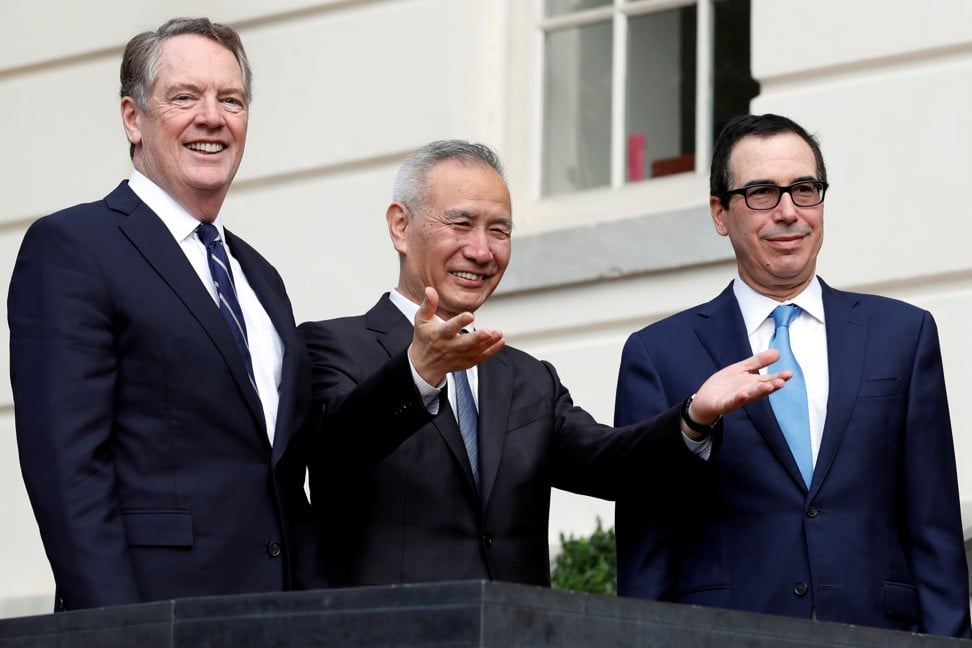
Top trade negotiators for the two countries – US Treasury Secretary Steven Mnuchin, US trade representative Robert Lighthizer and Chinese Vice-Premier Liu He – spoke by telephone last Friday. The Office of the US Trade Representative released a statement after the call saying that the two sides “made headway on specific issues” and “are close to finalising some sections of the agreement”.
China’s official Xinhua News Agency said on Saturday negotiators have “agreed to properly resolve core concerns of each other” and had “basically completed technical discussions about parts of the text”. In particular, China would lift the current ban on US poultry imports and recognise the American public health certification system for meat product imports, Xinhua said.
The top trade envoys are expected to hold another conference call in the near future.
China’s Vice-Premier Liu He between US trade representative Robert Lighthizer (left) and US Treasury Secretary Steve Mnuchin during trade negotiations in Washington this month. Photo: Reuters
Taoran Notes, an account on Chinese social media platform WeChat run by the official Economic Daily newspaper, wrote over the weekend that Beijing and Washington had moved a step closer to agreement on a “temporary deal”.
“According to past experiences and practises, the negotiation will enter the stage of translation and legal review after the technical completion of the text,” the account said.
Geng Shuang, a Chinese foreign ministry spokesman, said that technical negotiations about part of the deal were finished but deputy-level talks were ongoing. “China hopes both sides can find a trade solution based upon mutual respect and benefits,” Geng said at a regular press conference on Tuesday.
If it goes ahead as planned, the summit between Trump and Xi in Chile next month would be the third time the two leaders have sat down to talk about ending the nearly 16-month-long trade war.
Last December, the two leaders met on the sidelines of the G20 Leaders’ Summit in the Argentinian capital Buenos Aires and agreed to a three-month tariff truce to allow time for the countries’ trade envoys to work out a comprehensive deal. But the talks collapsed in early May with the US blaming China for reneging on promises it made in negotiations, while China blamed the US for attempting to infringe on its economic sovereignty.
The pair met again in late June in the Japanese city of Osaka, where they agreed to restart trade negotiations.
A minor ceasefire was reached in October when Beijing promised to buy US$40 billion to US$50 billion worth of American agricultural products in exchange for Washington postponing indefinitely a tariff increase on US$250 billion of Chinese goods to 30 per cent from 25 per cent on October 15.
Analysts expect fresh 15 per cent duties on about US$160 billion of Chinese imports – including popular products like smartphones and consumer electronics – that are due to go into effect mid-December will also be postponed if a deal is signed, though this has not been officially confirmed.
The interim deal is also expected to contain a provision on intellectual property protection, a key US demand. China has taken steps to improve IP protection, including setting up a system to punish and compensate instances of infringement, and improve settlement disputes. But how well these measures will be implemented remains in question.
China and the US would also agree to avoid allowing currency devaluations to gain trade advantages, codifying a commitment both countries made as part of a G20 agreement several years ago. A currency agreement – similar to provisions in the yet-to-be-ratified US-Mexico-Canada Agreement – could pave the way for the US to remove its designation of China as a “currency manipulator”.
The deal may include a new dispute resolution mechanism to ensure both sides live up to commitments. The system, which will give both sides equal standing, would replace a contentious US-proposed enforcement mechanism that was a key reason for trade talks breaking down in May after China felt the demands too intrusive and one-sided. It is unclear how effective the proposal would be, but the US has insisted since talks began that a similar mechanism be implemented to ensure China did not backslide on promises as it had in the past.
In addition to large purchases of farm products, the interim agreement may contain commitments by China to buy US-built aircraft and energy products, particularly liquefied natural gas.
China will also agree to lift foreign ownership limits on Chinese financial firms under the deal, changes which are already underway.
However, the interim deal will not address broader US complaints about China’s economic model, particularly allegations that foreign firms are treated unfairly and heavy government subsidies favour some domestic industries. Nor will it contain any break for telecommunications equipment maker Huawei and other Chinese tech companies that were blacklisted by the US on national security concerns.
Posted in American agricultural products, Apec summit, Argentinian capital, Asia-Pacific Economic Cooperation (Apec) summit, banking needs, Beijing, Buenos Aires, Chile, China alert, Chinese economic model, Chinese Vice-Premier Liu He, consumer electronics, currency devaluations, Economic Daily, energy products, farmers, G20 Leaders’ Summit, government subsidies, Huawei, intellectual property protection, interim, Japanese city, Liquefied natural gas, meeting, Osaka, poultry imports, President Donald Trump, President Xi Jinping, Robert Lighthizer, Santiago, sign, smartphones, south china morning post, Steven Mnuchin, Taoran Notes, telecommunications equipment maker, Trade envoys, trade war deal, U.S. Treasury Secretary Steven Mnuchin, Uncategorized, US, US Trade Representative, US Treasury Secretary, US-built aircraft, US-Mexico-Canada Agreement, Washington, WeChat, Xinhua News Agency |
Leave a Comment »
17/10/2019
- Fly-past will begin with helicopters and feature the country’s new generation warplanes
- A People’s Liberation Army Air Force officer will lead the squadron in a KJ-2000 and become the first serving commander to fly in a National Day parade
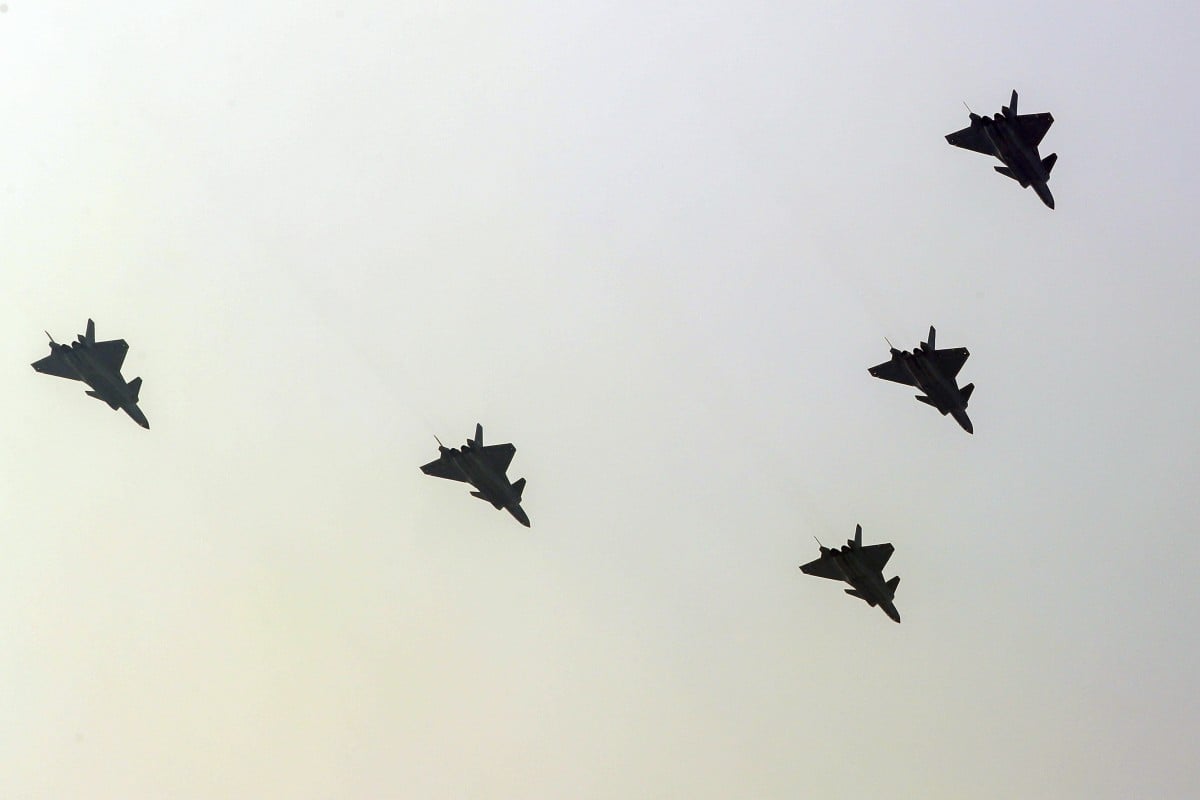
J-20 stealth fighter jets will be featured in Tuesday’s National Day parade in Beijing. Photo: AP
China will assemble the biggest squadron of its most advanced military aircraft for the National Day parade in the capital next week.
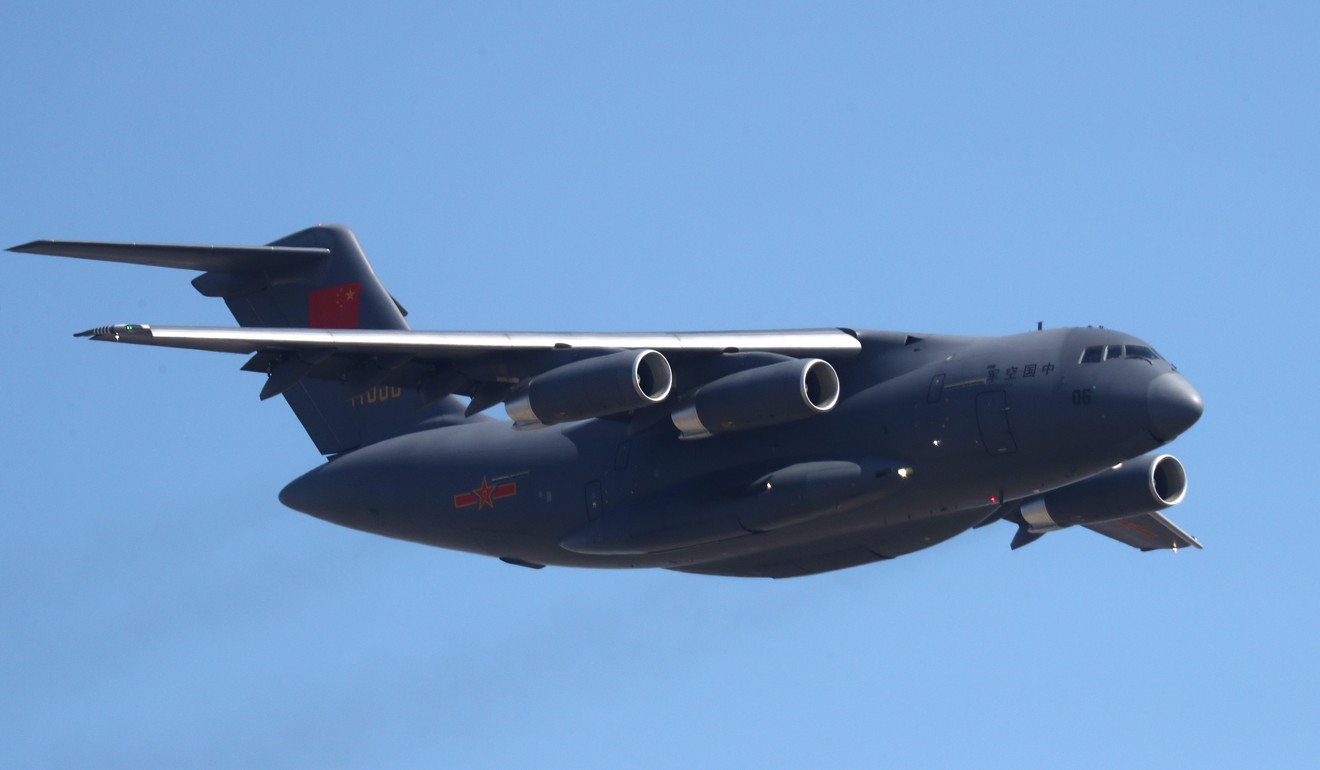
Three types of the new generation “20” series warplanes – five J-20 stealth fighter jets, three Y-20 transport planes and six Z-20 helicopters – will join airborne squadrons in the parade, according to a fly-past schedule obtained by the South China Morning Post.
“This year will be the biggest parade to have so many ‘20’ series advanced aircraft flying together,” a military insider said, referring to aircraft developed since 2000.
The J-20 is the country’s first stealth fighter; the Y-20 is China’s first heavy airlifter; and the Z-20 is a medium-lift utility helicopter comparable to the American Black Hawk.
The appearance of all three types of warplanes indicates that each one has entered production.
The H-20 subsonic stealth bomber, China’s answer to the US Air Force’s B-21 Raider, is also part of the “20” series will not make an appearance because it might need at least five more years of development.
The military insider involved in preparations for the parade, said People’s Liberation Army Air Force Commander Ding Laihang would lead the squadron in a KJ-2000 early warning aircraft.
Chinese fighter jets seen in skies over Beijing as preparations for National Day parade step up
“Ding will fly the KJ-2000 over Tiananmen Square for inspection by President Xi Jinping,” the source said, adding that Ding would be the first serving commander to fly in a National Day parade.
“The arrangement is similar to 2015 when [then] Russian Air Force commander Viktor Bondarev flew a Tu-160 strategic bomber over Moscow’s Red Square to mark the 70th anniversary of the end of the second world war.”
The KJ-2000 is the most advanced active early warning aircraft in the PLA Air Force, but it is based on the Russian Ilyushin aircraft.
The Y-20 transport aircraft will be among the new generation of planes taking part in the parade. Photo: Dickson Lee
According to the schedule, 167 aircraft will take part in the fly-past, starting with a helicopter carrying a national flag.
Eight Z-10 attack and 12 Z-19 reconnaissance helicopters will follow in formation, creating the number 70 in the sky to mark the 70th anniversary of the founding of the People’s Republic.
A source close to the navy said Z-8 multi-role and Z-19 reconnaissance helicopters be among the aircraft deployed to the Type 075 amphibious helicopter dock launched on Wednesday.
China says National Day military parade ‘won’t disappoint’ in scale or advanced weapons
A total of 44 fighter jets representing five key battle warplanes – the J-20, the J-16 fighter-bomber, the J-15 carrier-based fighter jet, the J-11 and the J-10 – will participate in the event.
But the J-8 fighter jet was not on the schedule, confirming that the first interceptor built in China has been formally retired.
Various H-6 series bombers will also make an appearance, including the H-6K and H-6N strategic bombers, as well as HU-6 refuelling plane based on the H-6 platform.
H-6K long-range bombers have been sent to the Taiwan Strait as part of “encirclement” patrols close to the self-ruled island in recent years.
Meanwhile the modified H-6N strategic bomber is designed to be armed with the Changjian-10 land-attack subsonic cruise missile, which has an operational range of more than 1,500km (932 miles).
Macau-based military observer Antony Wong Dong said that by adding more functions, the H-6 series of bombers was showing the world China had modified its combat capacity.
Wong also said the appearance of three types of training planes – the JL-8, JL-9 and JL-10 – was notable.
“It indicates that the Chinese air force had build up a systematic and comprehensive training system to train more pilots,” he said.
Source: SCMP
Posted in 70th anniversary, 70th anniversary of the founding of the People's Republic of China (PRC), advanced, American Black Hawk, B-21 Raider, Beijing, biggest squadron, Changjian-10, China’s, early warning aircraft, Fly-past, fly-past schedule, H-20 subsonic stealth bomber, H-6N strategic bomber, helicopters, Ilyushin aircraft, J-20 stealth fighter jets, KJ-2000, Mass show, Military aircraft, Moscow, National Day, National Day parade, People’s Liberation Army Air Force, PLA Air Force, President Xi Jinping, Red Square, Russian, Russian Air Force, second world war, south china morning post, strategic bombers, Tiananmen Square, Tu-160, Uncategorized, US Air Force, Y-20 transport planes, Z-20 helicopters |
Leave a Comment »
30/09/2019
- Train trips, Xinjiang and chartered flights among the growing holiday trends, travel agents say
Destinations such as Dubrovnik, Croatia, are becoming more popular among mainland Chinese tourists, according to one of China’ s biggest travel services. Photo: AFP
Chartered flights and niche destinations such as Croatia and Malta are growing in popularity as Hong Kong falls out of favour for mainland Chinese holidaymakers over the National Day “golden week” break.
Japan has overtaken Thailand as the most searched overseas destination on the website of travel agency Ctrip, followed by Malaysia, the United States, Singapore, Australia, Macau, France, Italy and Russia.
Within the mainland places such as Beijing and Shanghai continued to be among the most popular searches but Urumqi, capital of Xinjiang Uygur autonomous region, is a fast-growing term, especially among people in Shanghai and Guangzhou.
“It could be that tourists want to see autumn leaves,” a Ctrip spokesman told the South China Morning Post.
October 1 marks the start of a week-long break on the mainland when millions of Chinese take the chance to travel. This year, an estimated 800 million people are expected to go on trips in China or overseas, about 10 per cent more than last year.
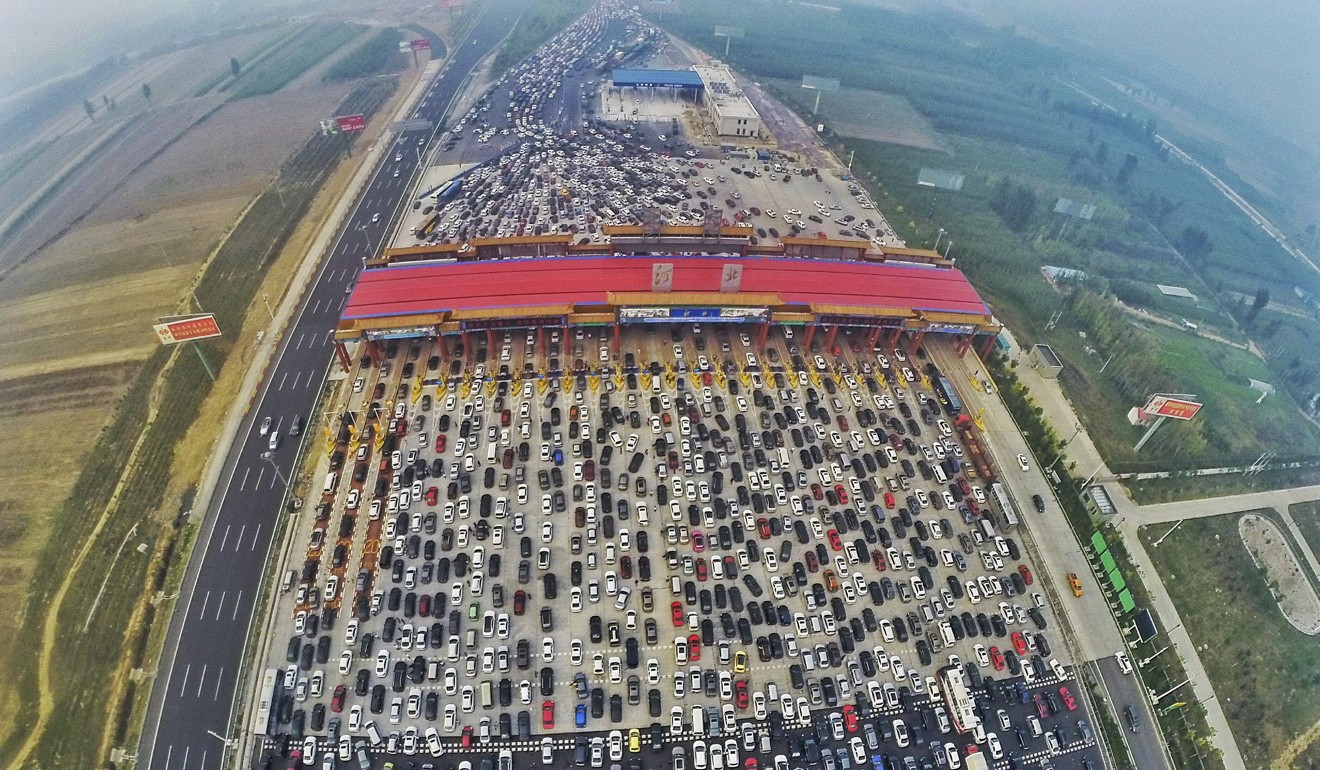
The country’s motorways are expected to be jammed from about 2pm on Monday, reaching a peak at around midnight, and again from 10am Tuesday, according to web mapping service Tencent Map.
China’s highways can expect heavy traffic as travellers head out for the holiday. Photo: Reuters
Ctrip said people heading overseas were increasingly seeking out new destinations, with bookings to places such as the Czech Republic, Austria, Croatia, Malta and Cambodia growing by 45 per cent this year.
“As Chinese people travel outside the country more and their experience of travel grows, many are more willing to go to smaller eastern European countries, such as the Czech Republic,” the spokesman said.
“Popular movies also have a strong influence. Many young people are willing to travel to see where films are shot, such as Croatia, one of the locations for Game of Thrones.”
Other noticeable trends this year include more people travelling with pets, by train and on chartered flights. The site said it sold 60 per cent more European train tickets and 10 times the number of train tickets for Japan for this golden week compared to last year.
The most popular routes in Asia were Tokyo to Kyoto in Japan, and Seoul to Busan in South Korea.
Hong Kong protests leave ‘golden week’ tourist boom in tatters as visitor arrivals during Chinese holiday period are set to be slashed by a third
Thousands of users also chose chartered flights, a service Ctrip introduced in September.
Ji Yu, head of chartered flights for Ctrip said most people thought chartered flights or helicopters were something only millionaires could afford, but in the internet age, they had become cheaper and more accessible.
“In the internet era, consumer needs vary from person to person, especially in terms of travel. There are products on the market to satisfy each customer’s personal needs.”
Among the more popular chartered routes were from Beijing or Shanghai to Tokyo, Bangkok, the Maldives and London.
More people are also going away for longer. Digital travel services giant Qunar said that 80 per cent of the travellers booking flights or hotels through its services were heading off for more than five days. And of those 41 per cent were travelling for more than a week.
Meanwhile, trips to Hong Kong have fallen substantially, with just 15 group tours expected to enter the city each day, down from 110 last year, according to the Travel Industry Council of Hong Kong.
Efforts to promote Hong Kong attractions have also increased in Shenzhen in recent weeks, with advertising videos scenic spots, popular restaurants and malls in Hong Kong playing on cross-border buses. Passengers can also get discounts to some stores and services with their tickets.
Source: SCMP
Posted in Australia, Austria, autumn leaves, Ürümqi, Bangkok, Beijing, booking flights, break, Busan, Cambodia, capital, chartered flights, Chinese travellers, consumer needs, cross-border buses, Ctrip, Czech Republic, destinations, European train tickets, France, Game of Thrones, golden week, growing, Guangzhou, helicopters, holiday trends, Hong Kong, internet age, internet era, Italy, jammed, Japan, Kyoto, London, Macau, Malaysia, Maldives, malls, Malta, millionaires, motorways, National Day, niche, October 1, person to person, Qunar, restaurants, Russia, scenic spots, Seoul, Shanghai, Shenzhen, Singapore, skip, south china morning post, South Korea, Tencent Map, Thailand, Tokyo, tourists, Train, Train trips, travel, Travel agency Ctrip, travel agents, travelling with pets, Uncategorized, United States, vary, Xinjiang, Xinjiang Uygur Autonomous Region |
Leave a Comment »


















 CHINDIA ALERT: You'll be living in their world, very soon