27/07/2019
- Aircraft could also be used to counterbalance Japanese and US military activities in the region, analysts say
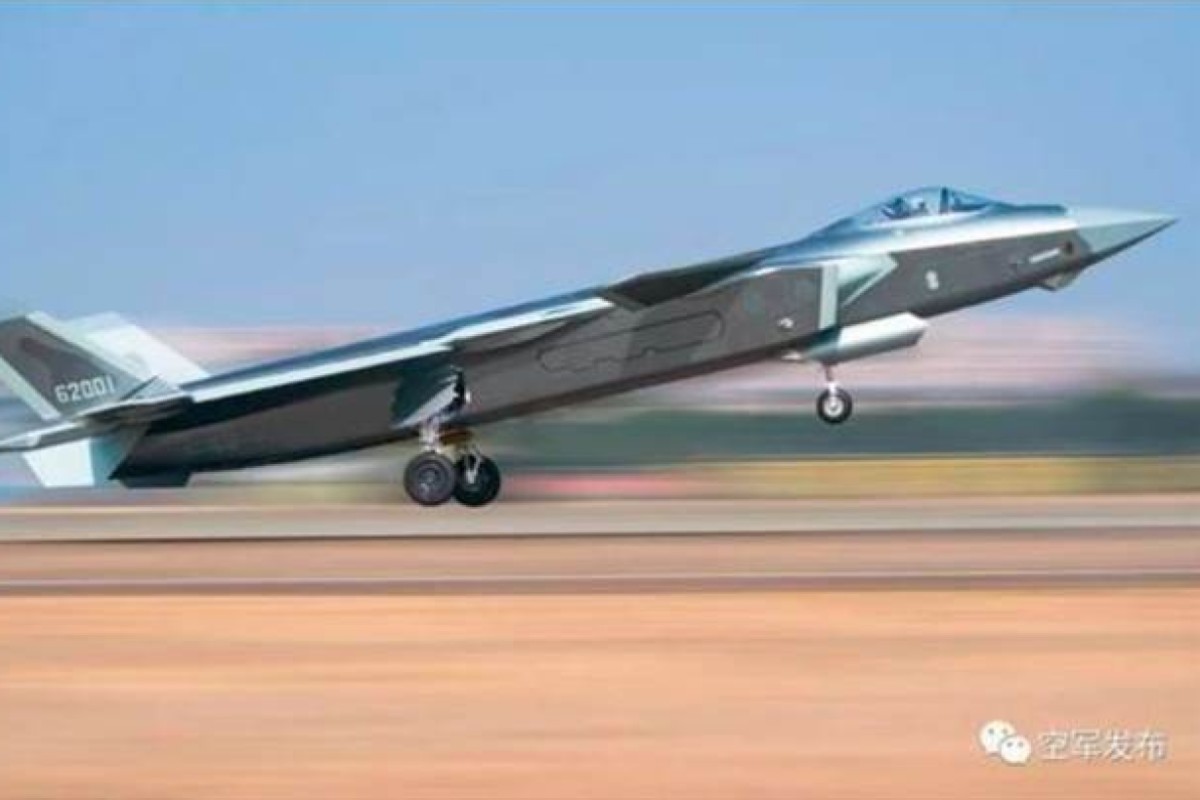
China’s J-20 stealth fighter has gone into service in the Eastern Theatre Command. Photo: PLA Air Force
China’s J-20 stealth fighter has been officially deployed to the country’s Eastern Theatre Command, suggesting it will be focused on the Taiwan Strait and military activities between Japan and the United States, observers said.
The People’s Liberation Army Air Force posted a photo on its social media account this week showing the fifth-generation fighter tagged with the number 62001, designating the aircraft as part of a frontline unit.
Chinese media reported that the stealth fighter had entered the Eastern Theatre Command, which encompasses Taiwan.
Collin Koh, a research fellow at the S Rajaratnam School of International Studies at Nanyang Technological University in Singapore, said the aircraft appeared to have two missions.
“The unit turning operational in Eastern Theatre Command is precisely aimed at Taiwan,” Koh said.
“And to challenge US military activities in Taiwan Strait, besides posing a threat to the median line that Taiwan’s air force patrols along.”
US Air Force gears up for aggressor drills to simulate combat with China’s J-20 fifth-generation fighters
The photo’s release came as China issued a defence white paper, highlighting the risks from “separatist forces”.
In the document, the military said it faced challenges from pro-independence forces in Taiwan but would always defeat those fighting for the island’s independence. It also said there were risks from separatists in the autonomous regions of Tibet and Xinjiang.
A day after the paper was released, an American warship sailed through the Taiwan Strait.
The J-20 is expected to enter mass production this year. If the aircraft was declared ready to go into active operations, it would signal China was a “greater threat” and had “greater capability” in the Pacific, General Charles Brown, the US Air Force’s Pacific commander, said in May.
Brown said US efforts to counter those developments included increasing deployments of next-generation F-35 jets and continuing overflights of strategic areas such as the South China Sea.
China’s J-20 stealth jet may be ready this year, US commander says
According to the US Defence Intelligence Agency, fielding the J-20 would add to what was already the region’s biggest air force and world’s third-largest.
China had more than 2,500 aircraft, including 1,700 combat fighters, strategic bombers, tactical bombers and multi-mission tactical and attack aircraft, in service, the agency said in a report earlier this year.
China’s J-20 fighter was part of a modernisation effort that had been “closing the gap with Western air forces across a broad spectrum of capabilities, such as aircraft performance, command and control and electronic warfare”, the report said.
Macau-based military expert Antony Wong Dong said that in addition to Taiwan, the J-20 fighter could also be used to counterbalance military activities by the United States and Japan.
But Wong added that the Chinese military was still exploring how best the fighter could be used.
“It will take a few years for the aircraft to be fully deployed and to mature. Right now, it’s still in the exploration stage,” he said.
Source: SCMP
Posted in American warship sailed through the Taiwan Strait., China alert, combat fighters, deploys, Eastern Theatre Command, J-20 stealth fighter, Japan, Japanese military activities, keep tabs, Macau, multi-mission tactical and attack aircraft, next-generation F-35 jets, PLA Air Force, S. Rajaratnam School of International Studies, Singapore’s Nanyang Technological University, South China Sea, strategic bombers, tactical bombers, Taiwan, Taiwan Strait, Tibet, Uncategorized, United States, US Air Force, US Air Force’s Pacific commander, US Defence Intelligence Agency, US military activities, Xinjiang |
Leave a Comment »
17/07/2019
HANOI (Reuters) – Vietnamese and Chinese ships have been embroiled in a weeks-long standoff near an offshore oil block in disputed waters of the South China Sea, which fall within Vietnam’s exclusive economic zone, two Washington-based think-tanks said on Wednesday.
China’s U-shaped “nine-dash line” marks a vast expanse of the South China Sea that it claims, including large swathes of Vietnam’s continental shelf where it has awarded oil concessions.
The Haiyang Dizhi 8, a ship operated by the China Geological Survey, on Monday completed a 12-day survey of waters near the disputed Spratly Islands, according to separate reports by the Center for Strategic and International Studies (CSIS) and the Center for Advanced Defense Studies (C4ADS)
One of the oil blocks it surveyed is licensed by Vietnam to Spanish energy firm Repsol, which was forced last year and in 2017 to cease operations in Vietnamese waters because of pressure from China.
As the Haiyang Dizhi 8 conducted its survey, nine Vietnamese vessels closely followed it. The Chinese ship was escorted by three China Coast Guard vessels, according to data from Winward Maritime, compiled by C4ADS.
In a separate incident days earlier, the China Coast Guard ship Haijing 35111 manoeuvred in what CSIS described as a “threatening manner” towards Vietnamese vessels servicing a Japanese-owned oil rig, the Hakuryu-5, leased by Russian state oil firm Rosneft in Vietnam’s Block 06.1, 370 km (230 miles) southeast of Vietnam.
That block is within the area outlined by China’s “nine-dash line”. A series of dashes on Chinese maps, the line is not continuous, making China’s claims often ambiguous.
Last year, Reuters exclusively reported that Rosneft Vietnam BV, a unit of Rosneft, was concerned that its drilling in Block 06.1 would upset China.
“On July 2 the vessels were leaving the Hakuryu-5 when the 35111 manoeuvred between them at high speed, passing within 100 metres of each ship and less than half a nautical mile from the rig,” CSIS said in its report.
It was not clear on Wednesday if any Chinese ships were still challenging the Rosneft rig.
In 2014, tension between Vietnam and China rose to its highest levels in decades when a Chinese oil rig started drilling in Vietnamese waters. The incident triggered boat rammings by both sides and anti-China riots in Vietnam.
‘READY TO FIGHT’
In response to reports of this month’s standoff, which first emerged on social media, Chinese foreign ministry spokesman Geng Shuang said on July 12 that China’s position on the South China Sea was “clear and consistent”.
“China resolutely safeguards its sovereignty in the South China Sea and maritime rights, and at the same time upholds controlling disputes with relevant countries via negotiations and consultations,” Geng said, without elaborating.
On Tuesday, Vietnam’s foreign ministry released a statement in response to unspecified “recent developments” in the South China Sea.
“Without Vietnam’s permission, all actions undertaken by foreign parties in Vietnamese waters have no legal effect, and constitute encroachments in Vietnamese waters, and violations of international law,” foreign ministry spokeswoman Le Thi Thu Hang said.
Neither statements confirmed or elaborated on the standoff.
Neither Rosneft nor Repsol immediately responded to an emailed request from Reuters for comment.
In a new statement on Wednesday, China’s foreign ministry spokesman Geng acknowledged that there had been an incident with Vietnam.
“We hope the Vietnam side can earnestly respect China’s sovereignty, rights, and jurisdiction over the relevant waters, and not take any actions that could complicate the situation,” Geng told a regular news conference.
On July 11, as China was conducting its survey of the blocks, Vietnam’s prime minister, Nguyen Xuan Phuc, visited the headquarters of the Vietnam Coast Guard in Hanoi.
State media did not mention the incident, but showed Phuc speaking to sailors on board vessels via a video link.
Phuc told the sailors to “stay vigilant and ready to fight” and to be aware of “unpredictable developments”, the Vietnam Coast Guard said in a statement on its website.
On the same day, Vietnam’s national assembly chairwoman, Nguyen Thi Kim Ngan, met her Chinese counterpart, Li Zhanshu, in Beijing, China’s Xinhua news agency reported.
The two officials agreed to “jointly safeguard peace and stability at sea”, Xinhua said.
Source: Reuters
Posted in Center for Advanced Defense Studies (C4ADS), Center for Strategic and International Studies (CSIS), China alert, China Coast Guard, China Geological Survey, Chinese ships, embroiled, Hanoi, Repsol, South China Sea, Spanish energy firm, standoff, Uncategorized, vessels, Vietnam, Vietnamese ships, Winward Maritime |
Leave a Comment »
04/07/2019
BEIJING/LONDON (Reuters) – China told Britain to keep its hands off Hong Kong on Wednesday while London called for Beijing to honour the agreements made when the city was handed over in 1997, escalating a diplomatic spat over the former British colony.
Beijing denounced British Foreign Secretary Jeremy Hunt as “shameless” and said it had made a diplomatic complaint to London after he warned of consequences if China neglected its commitments to guarantee basic freedoms.
“In the minds of some people, they regard Hong Kong as still under British rule. They forget … that Hong Kong has now returned to the embrace of the Motherland,” China’s ambassador to London, Liu Xiaoming, said.
“I tell them: hands off Hong Kong and show respect. This colonial mindset is still haunting the minds of some officials or politicians,” Liu told reporters.
The growing war of words between China and Britain follows mass protests in Hong Kong against a now suspended bill that would allow extradition to mainland China.
Hundreds of protesters in the former British colony besieged and broke into the legislature on Monday after a demonstration marking the anniversary of return to Chinese rule.
China called the violence an “undisguised challenge” to the “one country, two systems” model under which Hong Kong has been ruled for 22 years.
On Tuesday, Hunt warned of consequences if China did not abide by the Sino-British Joint Declaration in 1984 on the terms of the return of Hong Kong, which allows freedoms not enjoyed in mainland China, including the right to protest.
“We can make it clear we stand behind the people of Hong Kong in defence of the freedoms that we negotiated for them when we agreed to the handover in 1997 and we can remind everyone that we expect all countries to honour their international obligations,” Hunt told Reuters.
Hunt is one of two contenders vying to replace Theresa May as British prime minister and his rival Boris Johnson told Reuters on Wednesday that he also backed the people of Hong Kong “every inch of the way”.
The comments clearly irked Beijing. China’s London envoy scolded Britain and said meddling in Hong Kong would cause a “problem in the relationship” between them.
“The UK government chose to stand on the wrong side: it has made inappropriate remarks not only to interfere in internal affairs of Hong Kong but also to back up the violent law-breakers,” Liu said.
‘SHAMELESS’
Earlier, Foreign Ministry spokesman Geng Shuang chided Hunt, saying that only after Hong Kong’s return to China did its people get an “unprecedented” guarantee about democracy and freedom.
“To say that the freedoms of Hong Kong residents is something Britain strived for is simply shameless,” he told a news briefing. “I would like to ask Mr. Hunt, during the British colonial era in Hong Kong, was there any democracy to speak of? Hong Kongers didn’t even have the right to protest.”
China had lodged “stern representations” with Britain both in Beijing and London about Hunt’s remarks, he added.
Britain said it had summoned Liu to the foreign office following his “unacceptable” comments, a government source said.
“Message to Chinese govt: good relations between countries are based on mutual respect and honouring the legally binding agreements between them,” Hunt said on Twitter after Liu’s media briefing.
“That is the best way to preserve the great relationship between the UK and China.”
RESETTING TIES
The turbulence in Hong Kong was triggered by an extradition bill opponents say will undermine Hong Kong’s much-cherished rule of law and give Beijing powers to prosecute activists in mainland courts, which are controlled by the Communist Party.
Hong Kong’s Beijing-backed leader Carrie Lam had strongly promoted the bill, but suspended it on June 15 in the face of public protests against it. Critics have called on her to officially kill the bill, but she has resisted.
Britain and China had been seeking to reset ties after a row over the disputed South China Sea last year, with Chinese Vice Premier Hu Chunhua visiting London last month to oversee the start of a link between its stock exchange and that of Shanghai.
Confrontation and lawlessness in Hong Kong could damage its reputation as an international business hub and seriously hurt its economy, China’s top newspaper, the People’s Daily, said in an editorial.
“It will not only serve no purpose, but will also severely hinder economic and social development,” the ruling Communist Party’s official paper said, denouncing what it called artificially created division and opposition.
China has blamed Western countries, particularly the United States and Britain, for offering succour to the protests.
In an editorial, the official China Daily, an English-language newspaper Beijing often uses to send its message to the world, condemned “outside agitations”.
“What has also been notable is the hypocrisy of some Western governments – the United States and United Kingdom most prominently – which have called for a stop to the violence, as if they have had nothing to do with it,” the paper said.
“But, looking back at the whole protest saga, they have been deeply involved in fuelling it since its inception.”
Source: Reuters
Posted in 'colonial' hands, “one country, two systems” model, boris johnson, Britain, British Foreign Secretary, China Daily, China to Britain, chinese foreign ministry spokesman, Chinese Vice Premier, Communist Party, Jeremy Hunt, motherland, off Hong Kong, People’s Daily, Sino-British Joint Declaration, South China Sea, Theresa May, Uncategorized, United States |
Leave a Comment »
22/06/2019
BANGKOK (Reuters) – Southeast Asian leaders opened a two-day summit in Bangkok on Saturday, though it was unclear what progress their 10-country group could make on disputes in the South China Sea and the plight of ethnic Rohingya fleeing Myanmar.
Formed more than half a century ago, the Association of Southeast Asian Nations (ASEAN) has historically struggled with challenges facing the region because it works only by consensus and is reluctant to become involved in any matter regarded as internal to a member state.
Thai Prime Minister Prayuth Chan-ocha was making his debut as a civilian leader representing current chair Thailand, after a general election in March that opposition parties say was designed to ensure his victory five years after the former army chief seized power in a 2014 coup.
Officials are expected to discuss a Code of Conduct (COC) for negotiations over the South China Sea, one of the world’s busiest waterways and a potential flashpoint, as it is claimed by several ASEAN members as well as China.
However, it was unlikely much progress would be made, though member nations might discuss the June 9 collision of a Philippine boat and a Chinese fishing vessel.
“It is encouraging to see that the ASEAN-China talks on the COC have continued,” said Marty Natalegawa, former foreign minister of Indonesia.
“However, there is real risk that developments on the ground – or more precisely at sea – are far outpacing the COC’s progress thereby possibly rendering it irrelevant.”
Philippine President Rodrigo Duterte has accepted China’s proposal to jointly investigate allegations that a Chinese fishing vessel abandoned 22 Filipinos after it sank their boat in the South China Sea, his spokesman said on Saturday.
Rights groups have also called on ASEAN leaders to rethink support for plans to repatriate Rohingya Muslims who have fled member state Myanmar, where activists say returnees could face discrimination and persecution.
More than 700,000 Rohingya crossed into Bangladesh in 2017, according to U.N. agencies, after a crackdown by Myanmar’s military sparked by Rohingya insurgent attacks on the security forces.
However, it is unlikely that there will be any criticism of Myanmar at the summit over the Rohingya, said Prapat Thepchatree, a political science professor at Thailand’s Thammasat University said.
“This issue has been a very sensitive one for ASEAN,” he said.
Host country Thailand deployed about 10,000 security forces around Bangkok for the summit, mindful of a decade ago when Thailand last hosted an ASEAN summit and dozens of protesters loyal to military-ousted former premier Thaksin Shinawatra forced their way into the meeting venue.
But on Saturday morning, only a small group of people had planned to stage a protest to call Prayuth’s election the product of a rigged system.
The group, called Citizens Wanting Elections, was stopped by police before it could reach a meeting point near the summit venue. The group later released a statement welcoming visiting leaders but criticising Prayuth.
“The individual who serves as President of ASEAN, who welcomes everyone today, did not come from a clean and fair election,” the letter said.
Source: Reuters
Posted in Association of Southeast Asian Nations (ASEAN), Bangkok, Bangladesh, Chinese fishing vessel, Citizens Wanting Elections, Code of Conduct (COC), foreign minister, Indonesia, Marty Natalegawa, Myanmar, Philippine boat, Philippine President, political science professor, Prayuth Chan-ocha, Rodrigo Duterte, Rohingya, South China Sea, Southeast Asian leaders, summit, Thai Prime Minister, Thailand, Thammasat University, Uncategorized |
Leave a Comment »
12/06/2019
- Observers will be watching to see if General Wei Fenghe holds talks with his American counterpart
- Forum comes as Beijing and Washington are at odds over issues ranging from security to trade
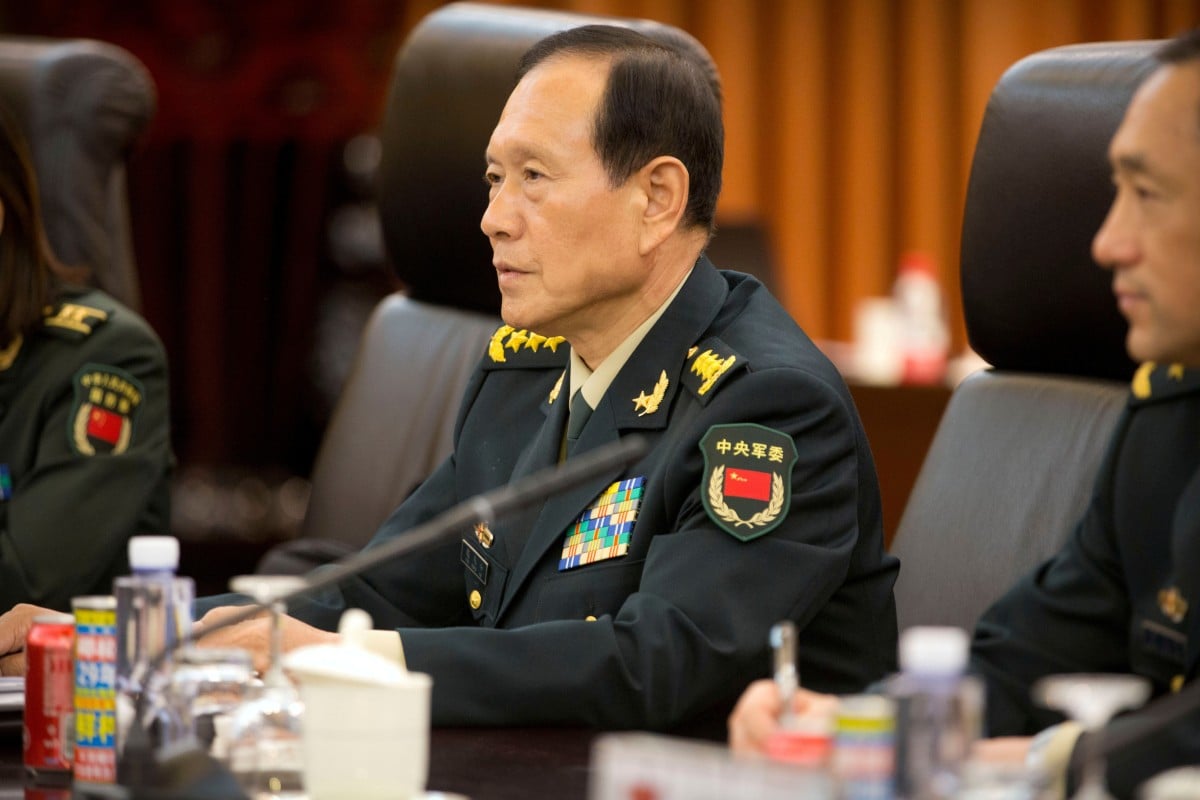
General Wei Fenghe will be the first Chinese defence minister to attend the Shangri-La Dialogue in eight years. Photo: Reuters
China is sending its defence minister to a leading Asian security forum next week, the first time in eight years that a high-ranking Chinese general will represent the country at the conference.
General Wei Fenghe, a State Councillor and China’s defence minister, will speak at the three-day Shangri-La Dialogue in Singapore, a gathering that comes as Beijing and Washington are at odds over issues ranging from security to trade.
“In a highly anticipated speech, General Wei Fenghe will speak on China’s role in the Indo-Pacific at a pivotal time for the region,” the International Institute for Strategic Studies, an organiser of the conference, said on Monday night.
Chinese military sources said that Wei would lead a “relatively big” delegation to the gathering, which starts on May 31 and is co-organised by the Singaporean government.
South China Sea stand-offs ‘a contest of wills’
The last time Beijing sent a high-ranking officer to the event was in 2011 when General Liang Guanglie, then the defence minister, attended.
Acting US secretary of defence Patrick Shanahan will also attend the conference and deliver a speech.
The spoils of trade war: Asia’s winners and losers in US-China clash
Beijing-based military specialist Zhou Chenming said observers would be watching to see whether the two senior defence officials held talks.
“The whole world will keep a close eye on any possible encounters between the Chinese and the Americans … At least now China has shown its sincerity in sending Wei to attend the conference, who is of equal standing as Shanahan, if the latter is willing to hold talks with him in good faith,” Zhou said.
But he said a meeting between Wei and Shanahan would be difficult because of the current distance between Beijing and Washington on major issues.
How Trump’s tweets bested China in the trade war publicity battle
“It’s not realistic to expect they will make a breakthrough because both sides will just sound their own bugles. The … mistrust between China and the US is actually growing every day,” Zhou said.
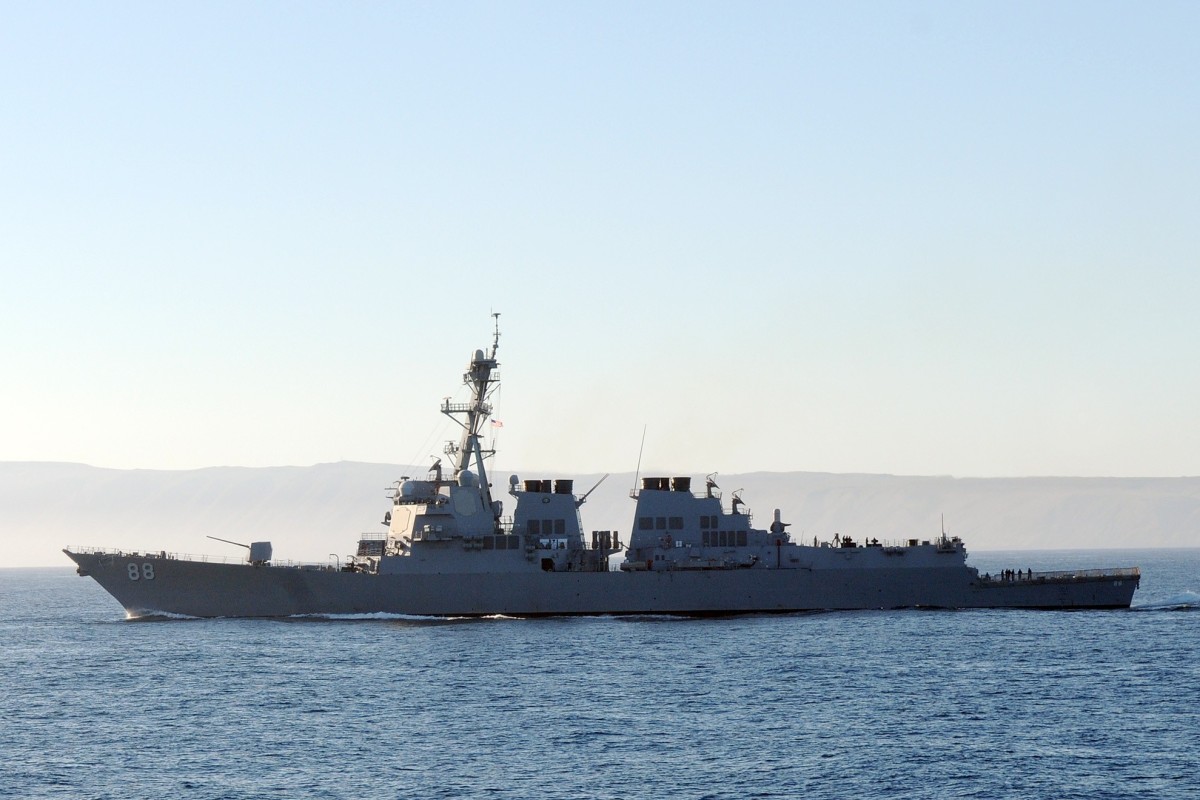
Just on Sunday, the USS Preble, an Arleigh Burke-class guided missile destroyer, sailed within 12 nautical miles of the Scarborough Shoal, an area in the South China Sea claimed by both China and the Philippines.
The
by strongly urging “the US to stop such provocative actions” and saying it would “take all necessary measures” to protect its “national sovereignty”.
Military analysts said the size of the Chinese delegation at the conference would underscore the importance of the People’s Liberation Army (PLA) attached to the event this year.
One military insider said the delegation would also include Lieutenant General He Lei, former vice-president of the Academy of Military Science, who headed China’s delegation in 2017 and 2018; and Senior Colonel Zhou Bo, director of the defence ministry’s Centre for Security Cooperation. In addition, the PLA would send a number of Chinese academics to speak at various sessions of the forum.
China tries to go one on one with Malaysia to settle South China Sea disputes
Singaporean Prime Minister Lee Hsien Loong will deliver a keynote speech on the opening day of the annual dialogue.
Japan and South Korea are also sending their defence ministers, according to a report by The Korean Times on Tuesday. The report also said South Korean Defence Minister Jeong Kyeong-doo was keen to hold one-on-one meetings with his Chinese and Japanese counterparts on the sidelines of the conference.
Source: SCMP
Posted in Academy of Military Sciences, Beijing, China alert, defence minister, defence ministry’s Centre for Security Cooperation, General Wei Fenghe, guided missile destroyer, Japan, Jeong Kyeong-doo, Lee Hsien Loong, Lieutenant General He Lei, Malaysia, Patrick Shanahan, People's Liberation Army (PLA), Philippines, Scarborough Shoal, Security Conference, Shangri-La Dialogue, Singapore, Singaporean Prime Minister, South China Sea, South Korea, South Korean Defence Minister, State Councillor, tensions, The Korean Times, Uncategorized, US, US secretary of defence, USS Preble, Washington |
Leave a Comment »
11/06/2019
- Latest US mission in disputed waters may prompt China to step up its countermeasures
The USS Preble. Photo: Handout
China and the United States have entered a “contest of wills” in the South China Sea, according to analysts.
The assessment follows the latest passage of a US warship through disputed waters near the Scarborough Shoal on Sunday.
It was the second such incident this month and follows a number of missions earlier this year, as the US seeks to challenge China’s activities in the South China Sea.
But analysts predicted that China would step up its countermeasures to show that it would not compromise on sovereignty. However, Beijing and Washington appear to have kept communication channels open to avoid military miscalculations.
Lieutenant Commander Tim Gorman of the US Pacific Fleet defended Sunday’s mission, which saw the USS Preble passing within 12 nautical miles of Scarborough Shoal, an area claimed by both China and the Philippines.
Gorman said the mission was designed “to challenge excessive maritime claims and preserve access to the waterways as governed by international law”.
“All operations are designed in accordance with international law and demonstrate that the United States will fly, sail and operate wherever international law allows,” he continued.
“We conduct routine and regular freedom of navigation operations (FONOPs) as we have done in the past and will continue to in the future. FONOPs are not about any one country, nor are they about making political statements.”
The US is known to have conducted four freedom of navigation operations this year – one in the Paracel Islands and three in the Spratley chain. It carried out seven last year and six in 2016, according to the Pentagon.
‘Divide and conquer Asean’: China tries to go one on one with Malaysia to settle South China Sea disputes
China’s Southern Theatre Command issued a strong response to the latest incident, saying it endangered the ships and personnel of both sides, undermined China’s sovereignty and security, violated basic norms and undermined regional peace and stability.
Senior Colonel Li Huamin, a spokesman for Southern Theatre Command, said its troops would be kept on high alert and take all necessary measures to resolutely safeguard China’s sovereignty and security.
Washington has also urged its allies to help it to counter China’s activities in the region, where it is accused of building up its military infrastructure, and so far this year the US has conducted join exercises with Britain, the Philippines, Japan and India.
The past 12 months have also seen French and British warships sailing through the Taiwan Strait and Paracel Islands respectively.
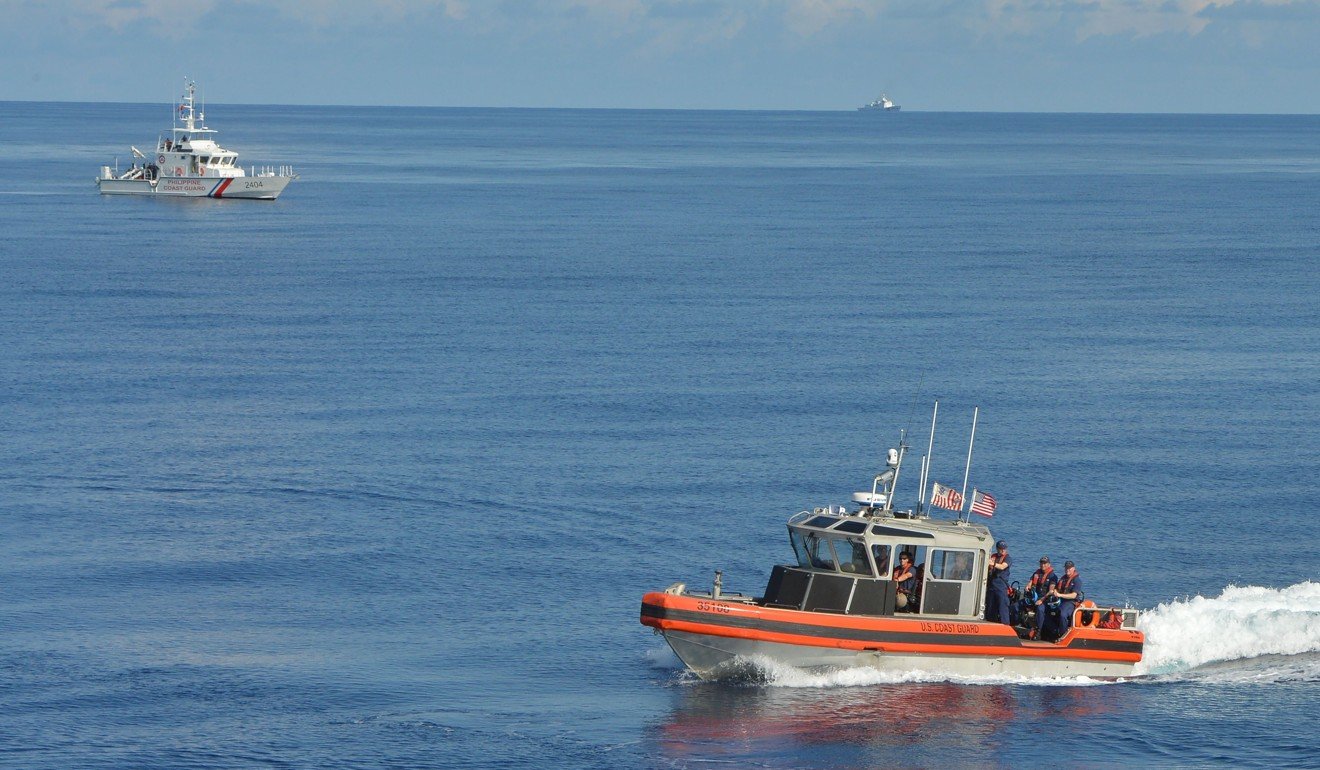
US and Philippine coastguard vessels during a joint operation near the Scarborough Shoal. Photo: AFP
Collin Koh, a maritime security expert at Nanyang Technological University in Singapore, said the US and China were now engaged in a “contest of wills” but “weren’t keen to come to blows considering their mutual interdependence”.
He also said the US military was keen to publicise its operations to “normalise them”, adding: “My sense is that the US side seeks to enhance strategic communication to the wider international community about these operations, and which would also become ‘visible’ to the regional governments as a form of strategic assurance.”
Song Zhongping, a Hong Kong-based military analyst, agreed that “the US has normalised the FONOPs to repeatedly provoke China, which won’t stop”.
He continued: “China should step up its countermeasures to let the US know that Beijing won’t make any concessions on its maritime sovereign claims.”
Song also argued that China also needed to strengthen its coastguard’s capability and the navy and air force’s ability to fight away from China’s coastline.
US naval chief says ‘freedom of navigation’ exercises in South China Sea get more attention than they deserve
Shi Yinhong, an international relations professor specialising in US studies, said US President Donald Trump’s administration “has already greatly increased the frequency and intensity of US FONOPs in the past two years”.
Shi added that this situation “had become or was becoming the new normal” and China was “having to restrain itself a little” to prevent the risk of conflict.
However, he said the country’s programme to reclaim land and step up its military capabilities in the waters had given it “real military advantages” that the US “cannot change by an inch”.
But the US and China have continued their mutual dialogue.
Koh noted that both Chinese Defence Minister Wei Fenghe would be attending the Shangri-La Dialogue in Singapore, an event senior Chinese officials have skipped in recent years.
Wei’s US counterpart, Patrick Shanahan, will also be there and “this could mean that both sides wish to maintain channels of communications to manage their rivalry”, Koh said.
Source: SCMP
Posted in Beijing, contest of wills, South China Sea, Uncategorized, Washington |
Leave a Comment »
10/06/2019
- With a defence budget second only to the US, China is amassing a navy that can circle the globe and developing state-of-the-art autonomous drones
- The build-up is motivating surrounding countries to bolster their own armed forces, even if some big-ticket military equipment is of dubious necessity
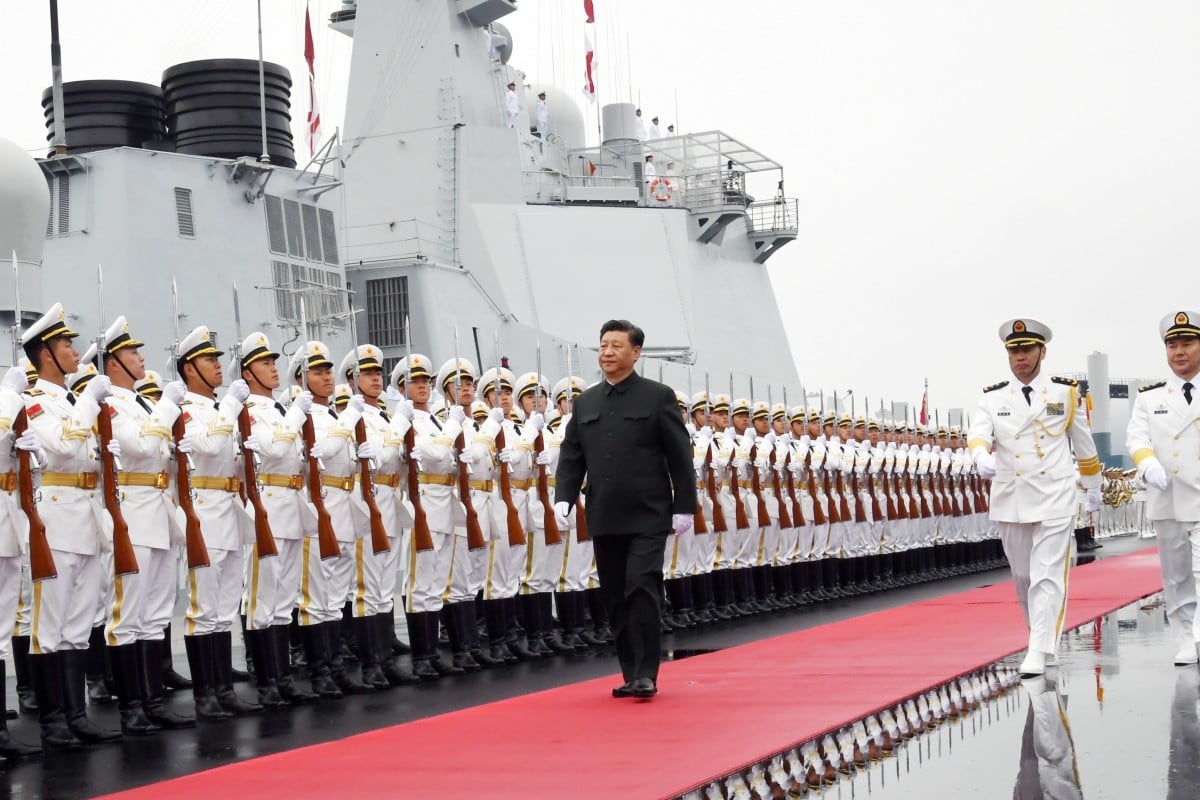
Chinese President Xi Jinping reviews an honour guards before a naval parade in Qingdao. Photo: Xinhua
The Asia-Pacific region is one of the fastest-growing markets for arms dealers, with economic growth, territorial disputes and long-sought military modernisation propelling a 52 per cent increase in defence spending over the last decade to US$392 billion in 2018, according to the Stockholm International Peace Research Institute.
The region accounts for more than one-fifth of the global defence budget and is expected to grow. That was underscored last week by news of
’s bid to strike a
to purchase US tanks and missiles.
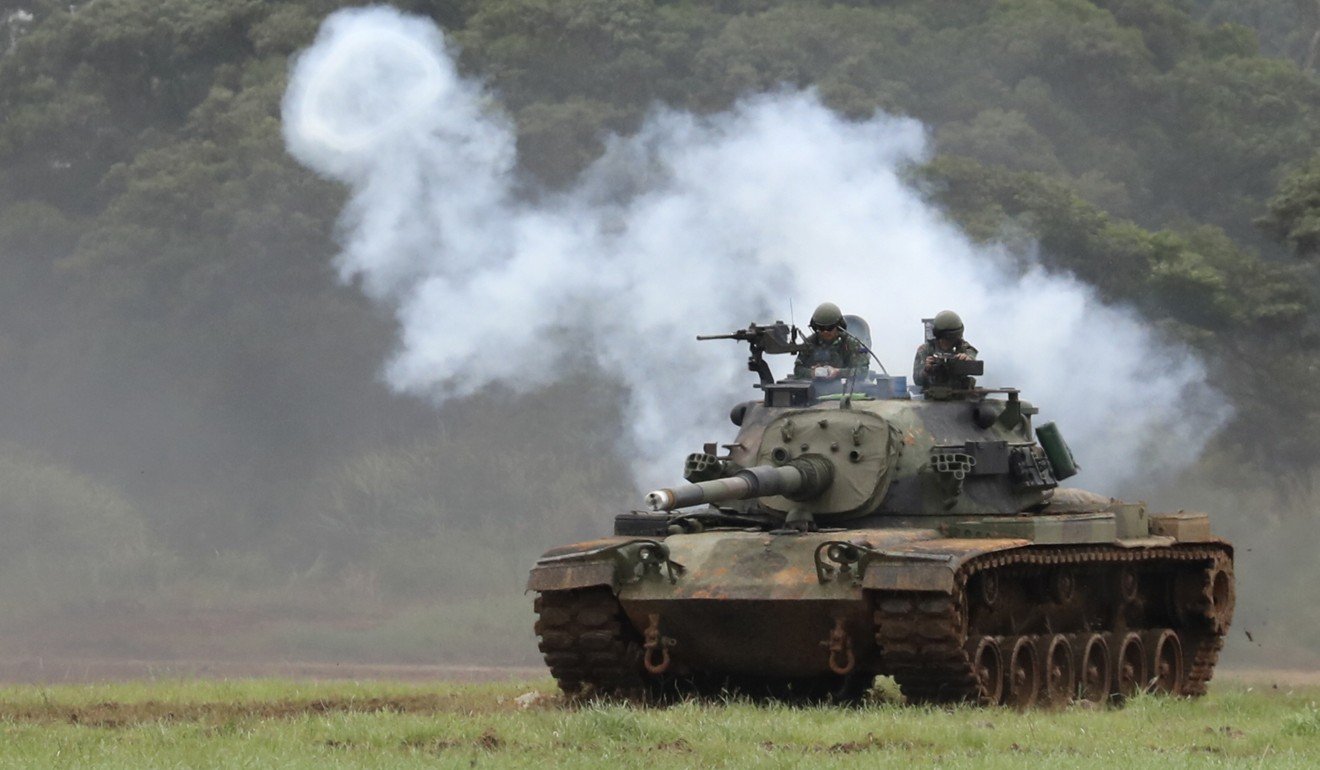
Taiwanese Soldiers on a CM11 battle tank, jointly developed with US arms manufacturer General Dynamics. Photo: EPA
The biggest driver in arms purchases, however, is
– responsible for 64 per cent of military
spending in the region. With a defence budget that is second only to the
, China is amassing a navy that can circle the globe and developing state-of-the-art autonomous drones. The build-up is motivating surrounding countries to bolster their armed forces too – good news for purveyors of submarines, unmanned vehicles and warplanes.
It is no coincidence that the recent
in
, a security conference attended by
chiefs, was sponsored by military contractors including Raytheon,
and
.
Opinion: How the Shangri-La Dialogue turned into a diplomatic coup for China
Kelvin Wong, a Singapore-based analyst for Jane’s, a trade publication that has been covering the defence industry for 121 years, has developed a niche in infiltrating China’s opaque defence industry by attending obscure trade shows that are rarely advertised outside the country.
He said the US is eager to train allies in Asia and sell them arms, while also stepping up its “freedom of navigation” naval operations in contested waters in the
and Taiwan Strait. It has lifted a ban on working with
’s special forces over atrocities committed in
. And it is considering restarting arms sales to the
.
In his speech at the Shangri-La Dialogue, acting US Defence Secretary Patrick Shanahan touted American advancements in technology “critical to deterring and defeating the threats of the future” and said any partner could choose to win access to that technology by joining the US defence network.
Wong said the message was clear: “Buy American.”
Analysts say Chinese soldiers have less training, motivation and lower morale than their Western counterparts. Photo: Reuters
The analyst said there is a growing admission among the Chinese leadership that the
has an Achilles’ heel: its own personnel.
He said one executive at a Chinese defence firm told him: “The individual Chinese soldier, in terms of morale, training, education and motivation, (cannot match) Western counterparts. So the only way to level up is through the use of unmanned platforms and
To that end, China has developed one of the world’s most sophisticated drone programmes, complete with custom-built weapon systems. By comparison, Wong said,
US drones rely on weapons originally developed for helicopters.
Wong got to see one of the Chinese drones in action two years ago after cultivating a relationship with its builder, the state-owned China Aerospace Science & Technology Corporation. He viewed a demonstration of a 28-foot-long CH-4 drone launching missiles at a target with uncanny ease and precision.
“Everyone knew they had this,” Wong said. “But how effective it was, nobody knew. I could personally vouch they got it down pat.”
China unveils its answer to US Reaper drone – how does it compare?
That is what Bernard Loo Fook Weng, a military expert at Singapore’s S. Rajaratnam School of International Studies, told the author Robert Kaplan for his 2014 book, Asia’s Cauldron, about simmering tensions in the South China Sea.
He was describing the competition for big-ticket military equipment of dubious necessity.
is littered with examples of such purchases.
owns an aircraft carrier without any aircraft. Indonesia dedicated about one-sixth of its military budget to the purchase of 11
Su-35 fighter jets. And
splurged on two
submarines it could not figure out how to submerge.
“It’s keeping up with the Joneses,” Wong said. “There’s an element of prestige to having these systems.”
Submarines remain one of the more debatable purchases, Wong said. The vessels aren’t ideal for the South China Sea, with its narrow shipping lanes hemmed in by shallow waters and coral reefs. Yet they provide smaller countries with a powerful deterrence by enabling sneak attacks on large ships.
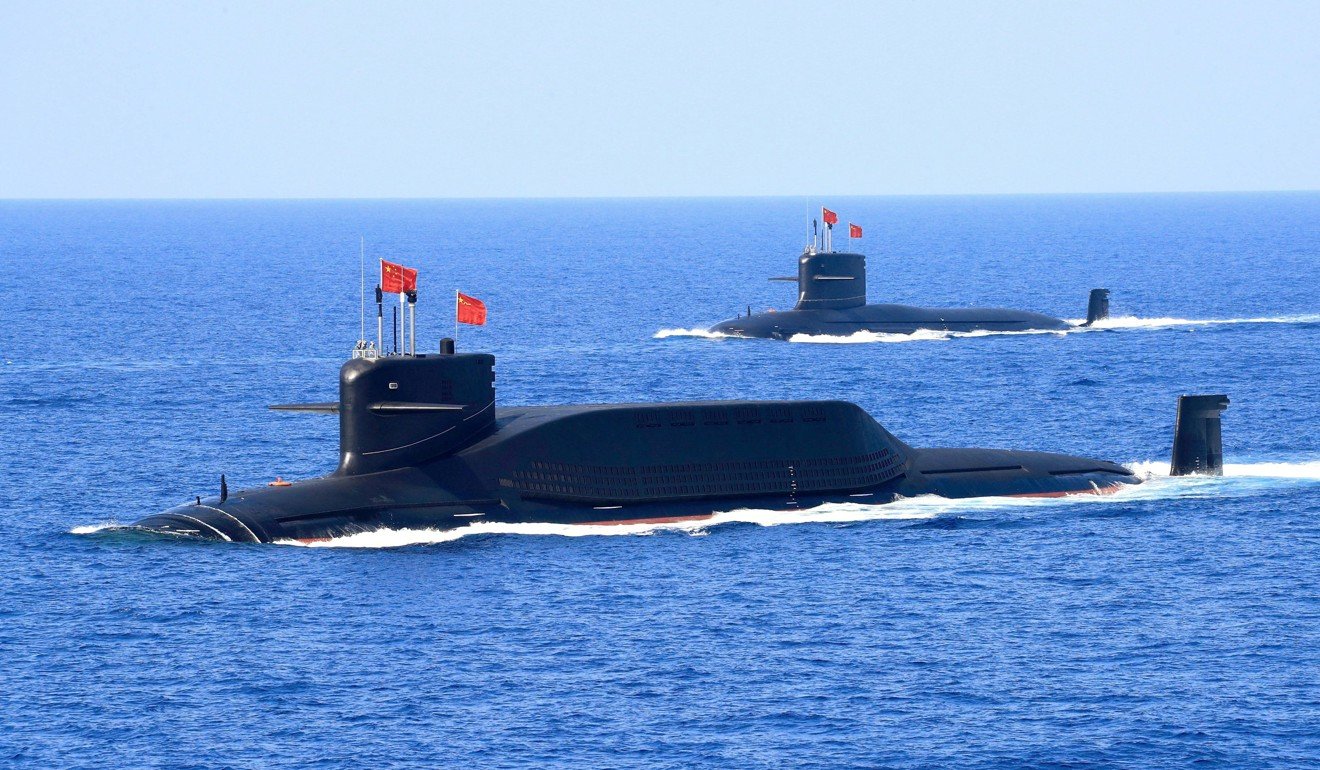
Nuclear-powered PLA Navy ballistic missile submarines in the South China Sea. Photo: Reuters
Asia and
are home to 245 submarines, or 45 per cent of the global fleet, according to the US-based naval market intelligence firm AMI International.
The Philippines remains one of the last coastal nations in the region without a sub – though it is in talks with Russian builders to acquire some.
Singapore recently received the first of four advanced
Type 218 submarines with propulsion systems that negate the need to surface more frequently. If the crew did not need to eat, the submarine could stay under water for prolonged periods. Wong said the craft were specially built for Asian crews.
“The older subs were designed for larger Europeans so the ergonomics were totally off,” he said.
Singapore, China deepen defence ties, plan larger military exercises
Tiny Singapore plays a crucial role securing the vital sea lanes linking the Strait of Malacca with the South China Sea. According to the
the country dedicates 3.3 per cent of its gross domestic product to defence, a rate higher than that of the United States.
State-of-the-art equipment defines the Singapore Armed Forces. Automation is now at the centre of the country’s military strategy, as available manpower is shrinking because of a rapidly ageing population.
Wong said Singapore is investing in autonomous systems and can operate frigates with 100 crew members – 50 fewer than they were originally designed for.
“We always have to punch above our weight,” he said.
Source: SCMP
Posted in artificial intelligence (AI), Asia, Asia-Pacific region, Australia, autonomous drones, BAE Systems, China Aerospace Science & Technology Corporation, East Timor, French, frigates, German, Indonesia, Lockheed Martin, Malaysia, military spending, naval parade, navy, People’s Liberation Army, President Xi Jinping, Qingdao, Raytheon Co, ripple effect, Russian, Shangri-La Dialogue, Singapore, Singapore Armed Forces, South China Sea, Southeast Asia, Stockholm International Peace Research Institute, Strait of Malacca, submarines, Taiwan Strait, Thailand, the Philippines, Uncategorized, unmanned vehicles, US Reaper drone, warplanes, World Bank |
Leave a Comment »
29/05/2019
- President Xi Jinping will meet Russian counterpart Vladimir Putin next month and address economic summit in St Petersburg
- Diplomatic flurry will also include regional security forums in Kyrgyzstan and Tajikistan
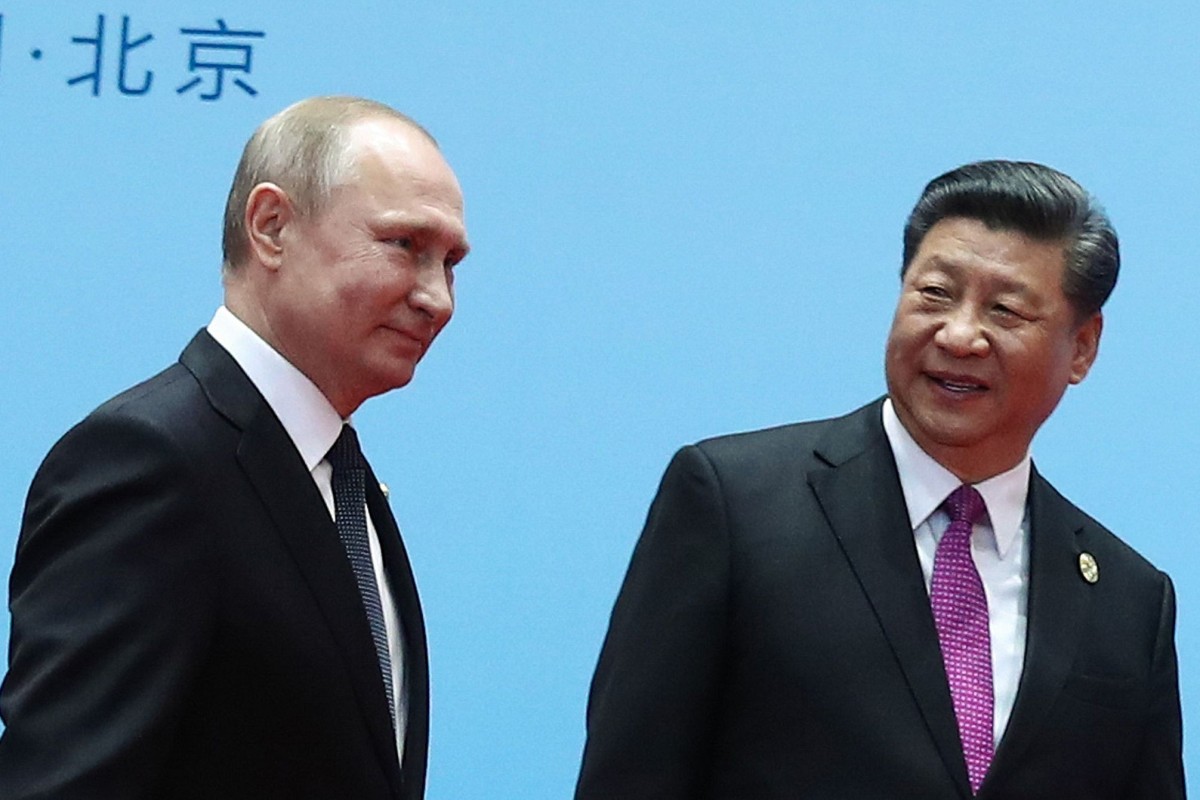
Xi Jinping has met Vladimir Putin more times than any other foreign leader since he took power in 2013. Photo: AFP
Beijing is stepping up efforts to seek support from regional and global players such as Russia and Central Asian nations as its geostrategic rivalry with Washington heats up.
President Xi Jinping is expected to meet his Russian counterpart Vladimir Putin next month, when he will also address the St Petersburg International Economic Summit,
Russian presidential aide Yuri Ushakov told state-run TASS news agency earlier.
The Chinese president will also visit the Kyrgyzstan capital Bishkek for the Shanghai Cooperation Organisation (SCO) summit in June, as well as another regional security forum in Dushanbe, Tajikistan.
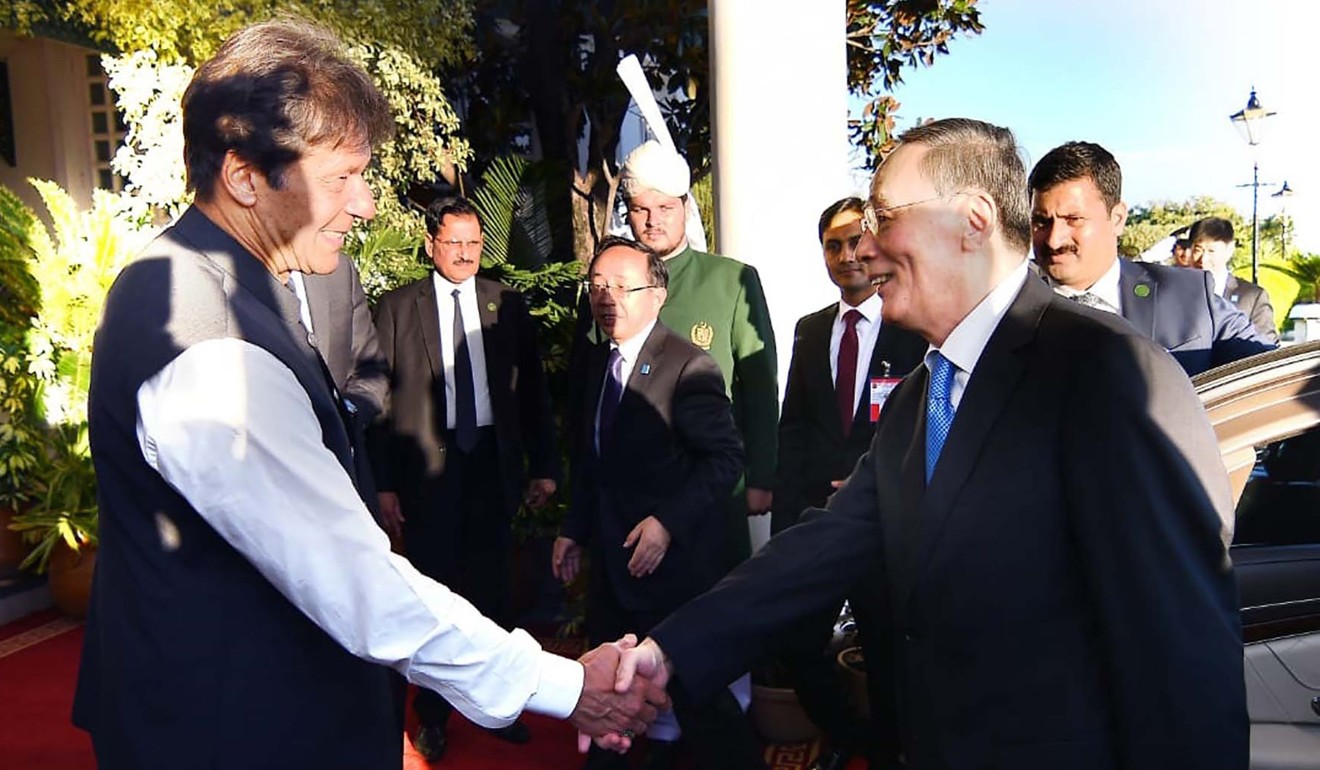
Meanwhile, Vice-President Wang Qishan is visiting Pakistan before he heads to the Netherlands and Germany, according to the Chinese foreign ministry.
Pakistani Prime Minister Imran Khan meets Chinese Vice-President Wang Qishan in Islamabad on Sunday. Photo: AFP
The latest flurry of diplomatic activity comes as competition between China and the US intensifies on several fronts including trade and technology, the South China Sea and the Arctic, where Beijing’s partnership with Moscow –
– has drawn criticism from Washington.
It will be Xi’s second time at the St Petersburg forum, and observers expect the Chinese leader will reaffirm Beijing’s commitment to multilateralism and promote the nation as a champion of openness and cooperation.
China-Russia ties unrivalled, Beijing warns before Pompeo meets Putin
It will also be his second meeting with Putin in two months, after talks on the sidelines of the Belt and Road Forum in Beijing in late April, when the Russian president
for the controversial China-led infrastructure and investment initiative.
With China and Russia edging closer, the latest meeting is likely to see efforts to coordinate their strategies on a range of issues – including Venezuela, North Korea, nuclear weapons and arms control, according to observers. Xi has met Putin more times than any other foreign leader since he took power in 2013.
“This time it is very likely that the latest anti-China moves by the US, such as new tariffs and the Huawei ban, will feature prominently in their conversations,” said Artyom Lukin, an associate professor at Far Eastern Federal University in Vladivostok.
Lukin said Russia’s stagnating economy and sanctions imposed by the West limited its role as a substitute for the foreign markets and technologies China could lose access to because of the US crusade. But he said Putin would “provide political and moral support to Xi”.
“That is also significant as Russia has been withstanding intense US-led sanctions pressure for more than five years already,” Lukin said, referring to sanctions imposed after Russia’s annexation of Crimea in 2014.
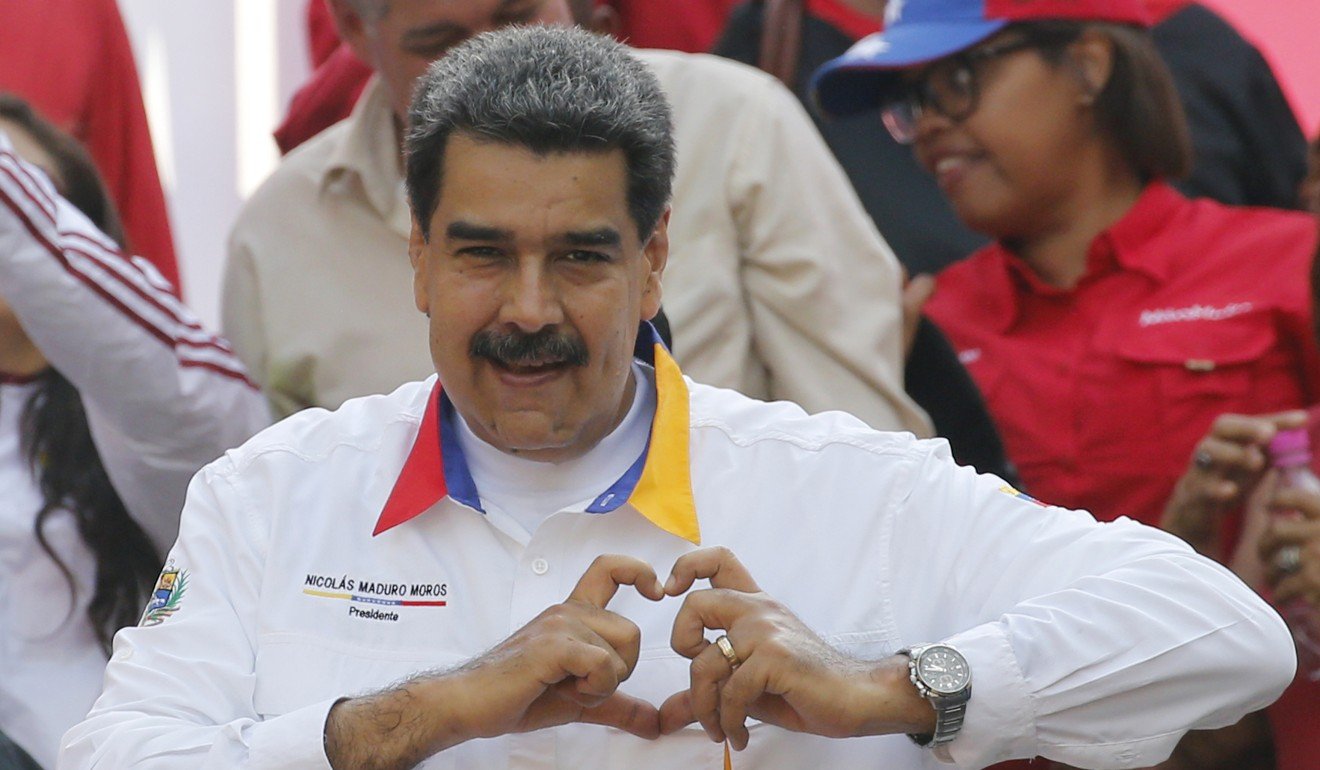
Xi and Putin are also expected to talk about Venezuela, where US-backed opposition leader Juan Guaido is attempting to oust socialist President Nicolas Maduro, who has the support of China and Russia.
Venezuelan President Nicolas Maduro has the backing of China and Russia. Photo: AP
“Moscow and Beijing are not able to seriously hurt Washington by raising tariffs or denying access to high technology. However, there are plenty of areas where coordinated Sino-Russian policies can damage US interests in the short term or in the long run,” Lukin said. “For example, Moscow and Beijing could intensify their joint support for the Venezuelan government of Nicolas Maduro, frustrating Washington’s efforts to dislodge him.”
China and Russia would also be seeking to boost economic ties. Bilateral trade, dominated by Chinese imports of gas and oil, reached US$108 billion last year – falling far short of the target set in 2011 by Xi’s predecessor, Hu Jintao, of US$200 billion by 2020.
China and Russia to forge stronger Eurasian economic ties
Li Lifan, an associate research professor at the Shanghai Academy of Social Sciences, said bilateral trade was a sticking point. “This is one of the potential hindrances in China-Russia relations and Beijing is hoping to [address this] … in the face of a possible global economic slowdown,” Li said.
Given the escalating trade war with Washington, he said China would seek to diversify its investments and markets to other parts of the world, particularly Russia and Europe.
“China will step up its investment cooperation with Europe and Russia and focus more on multilateral investment,” Li said.
But Beijing was not expected to do anything to worsen tensions with Washington.
“China is currently taking a very cautious approach towards the US, trying to avoid heating up the confrontation and further aggravation of the situation,” said Danil Bochkov, a contributing author with the Russian International Affairs Council. “For China it is important to demonstrate that it has a reliable friend – Russia – but that should not be done in an openly provocative manner.”
Stephen Blank, a senior fellow at the American Foreign Policy Council in Washington, said Beijing and Moscow would also seek to contain US influence “as far as possible” from Central Asia, where China has increased its engagement through infrastructure building under the “Belt and Road Initiative”.
Leaders from the region will gather in Bishkek next month for the SCO summit, a security bloc set up in 2001 that now comprises China, Russia, Kazakhstan, Kyrgyzstan, Tajikistan, Uzbekistan, India and Pakistan. Those members account for about 23 per cent of the world’s land mass, 45 per cent of its population, and 25 per cent of global GDP.
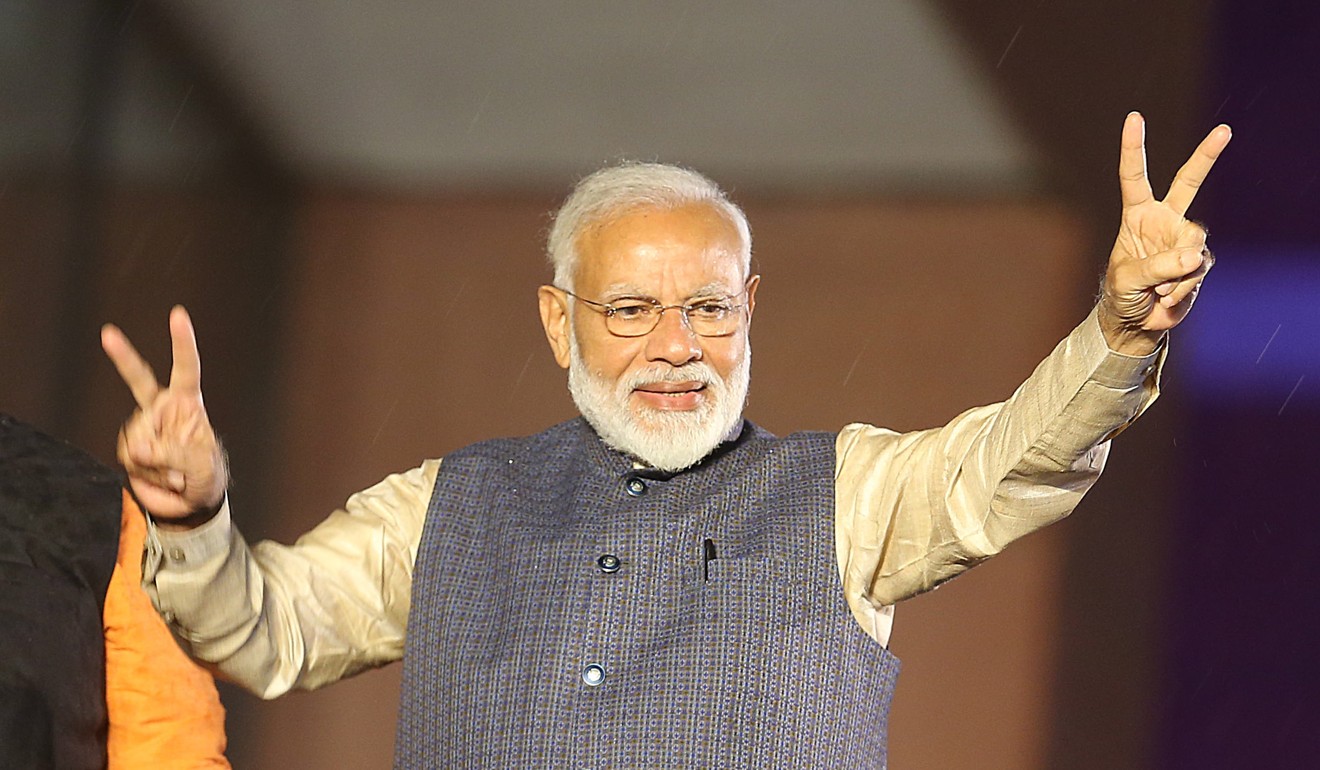
Newly re-elected Indian Prime Minister Narendra Modi could meet the Chinese president for talks in Bishkek next month. Photo: EPA-EFE
There is growing speculation that Xi will meet newly re-elected Indian Prime Minister Narendra Modi on the sidelines of that summit.
Independent analyst and author Namrata Goswami said India would be seeking a commitment to a WTO-led and rules-based multilateral trading system during the SCO talks.
“This is interesting and significant given the current US tendencies under President Donald Trump focused on ‘America first’ and the US-China trade war,” Goswami said.
Counterterrorism will again be a top priority at the SCO summit, amid concerns among member states about the rising number of Islamic State fighters returning from Syria and Iraq. Chinese scholars estimated last year that around 30,000 jihadists who had fought in Syria had gone back to their home countries, including China.
Alexander Bortnikov, chief of the main Russian intelligence agency FSB, said earlier that 5,000 fighters from a group affiliated with Isis had gathered in areas bordering former Soviet states in Central Asia, saying most of them had fought alongside Isis in Syria.
War-torn Afghanistan, which shares a border with four SCO member states – China, Pakistan, Tajikistan and Uzbekistan – is also likely to be high on the agenda at the Bishkek summit.
“With the Trump administration drafting plans to withdraw troops from Afghanistan, the SCO will assess the security situation there and decide whether to provide training for Afghan troops,” Li said.
Eva Seiwert, a doctoral candidate at the Free University of Berlin, expected the security bloc would also discuss Iran after the US withdrew from the 2015 nuclear deal and ordered new sanctions against the country.
Iran, which has observer status with the SCO, was blocked from becoming a full member in 2008 because it was subject to UN sanctions at the time. But its membership application could again be up for discussion.
Iran presses China and Russia to save nuclear deal
“The Trump administration’s unilateral withdrawal from the Iran nuclear deal in 2018 made it easy for China and Russia to present themselves as the proponents of peaceful settlement of conflicts,” Seiwert said. “Discussing the possibility of admitting Iran as a full member state would help the SCO members demonstrate their support of multilateral and peaceful cooperation.
“This would be a strong signal to the US and enhance the SCO’s standing in the international community,” she said.
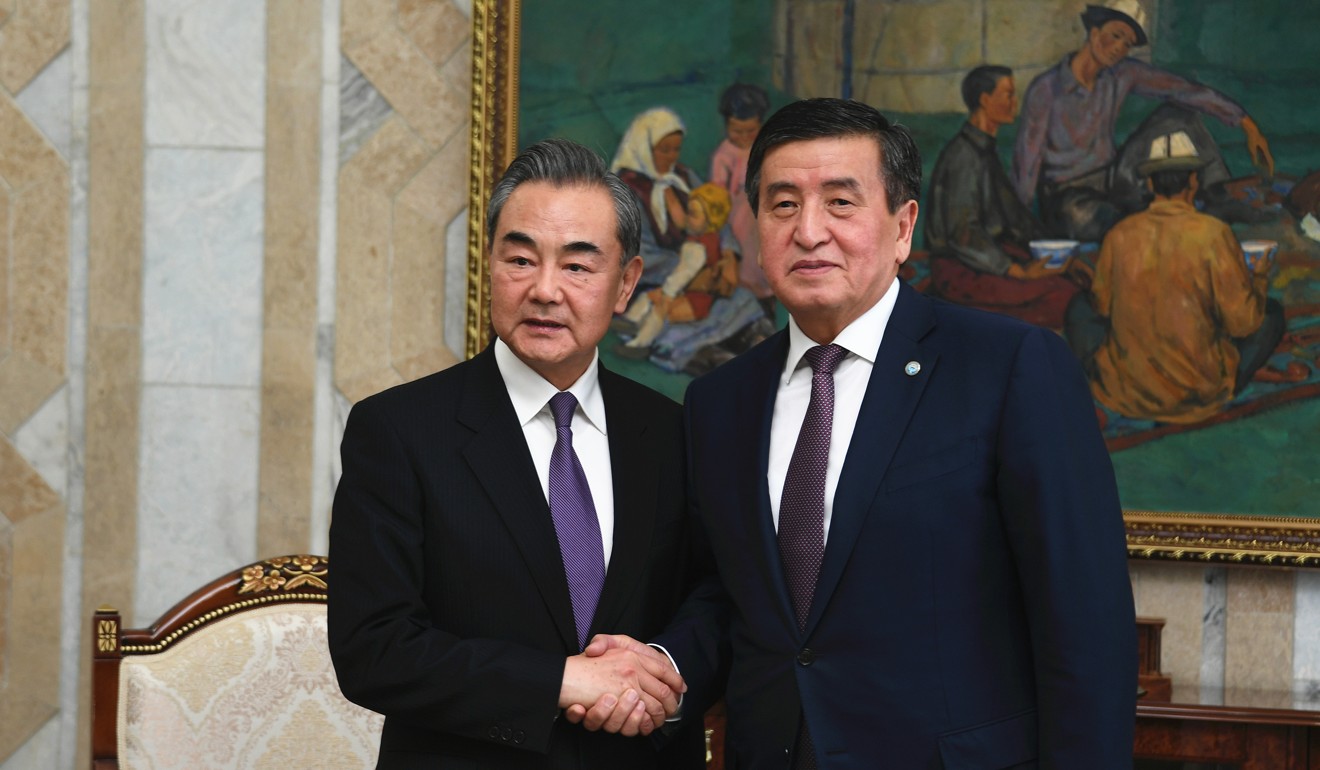
Kyrgyz President Sooronbay Jeenbekov (right) meets Chinese Foreign Minister Wang Yi in Bishkek on Tuesday last week. Photo: Xinhua
As well as security, Xi’s visit to Central Asia is also likely to focus on economic ties. Meeting Kyrgyz President Sooronbay Jeenbekov in Bishkek last week, Chinese Foreign Minister Wang Yi said Beijing would continue to “provide support and help national development and construction in Kyrgyzstan”.
Li said China may increase investment in the Central Asian region, especially in greenfield projects.
“China will continue to buy agriculture products from Central Asia, such as cherries from Uzbekistan, and build hydropower projects to meet local energy demand,” Li said. “Investment in solar and wind energy projects is also expected to increase too.”
Source: SCMP
Posted in American Foreign Policy Council, Arctic, arms control, belt and road forum, Bishkek, Central Asia, Central Asian region, China alert, Chinese foreign minister, Crimea, Eurasian, Europe, Far Eastern Federal University, Free University of Berlin, FSB, Germany, Huawei, Imran Khan, India alert, Iraq, Islamic State fighters, Juan Guaido, Kazakhstan, Kyrgyz President, Kyrgyzstan, Mike Pompeo, Namrata Goswami, Netherlands, North Korea, nuclear weapons, Pakistan, President Nicolas Maduro, President Xi Jinping, Prime Minister Narendra Modi, Russia, Russian intelligence agency, Shanghai Cooperation Organisation (SCO), Sooronbay Jeenbekov, South China Sea, St Petersburg, support, Syria, Tajikistan, tensions, UN sanctions, Uncategorized, US, Uzbekistan, Venezuela, Vice President, Vladimir Putin, Vladivostok, Wang Qishan, Wang Yi, Washington, WTO-led and rules-based multilateral trading system |
Leave a Comment »
29/05/2019
- Academic on-board the HMAS Canberra says pilots were struck by lasers on a voyage from Vietnam to Singapore, during which they were being tailed by a Chinese warship
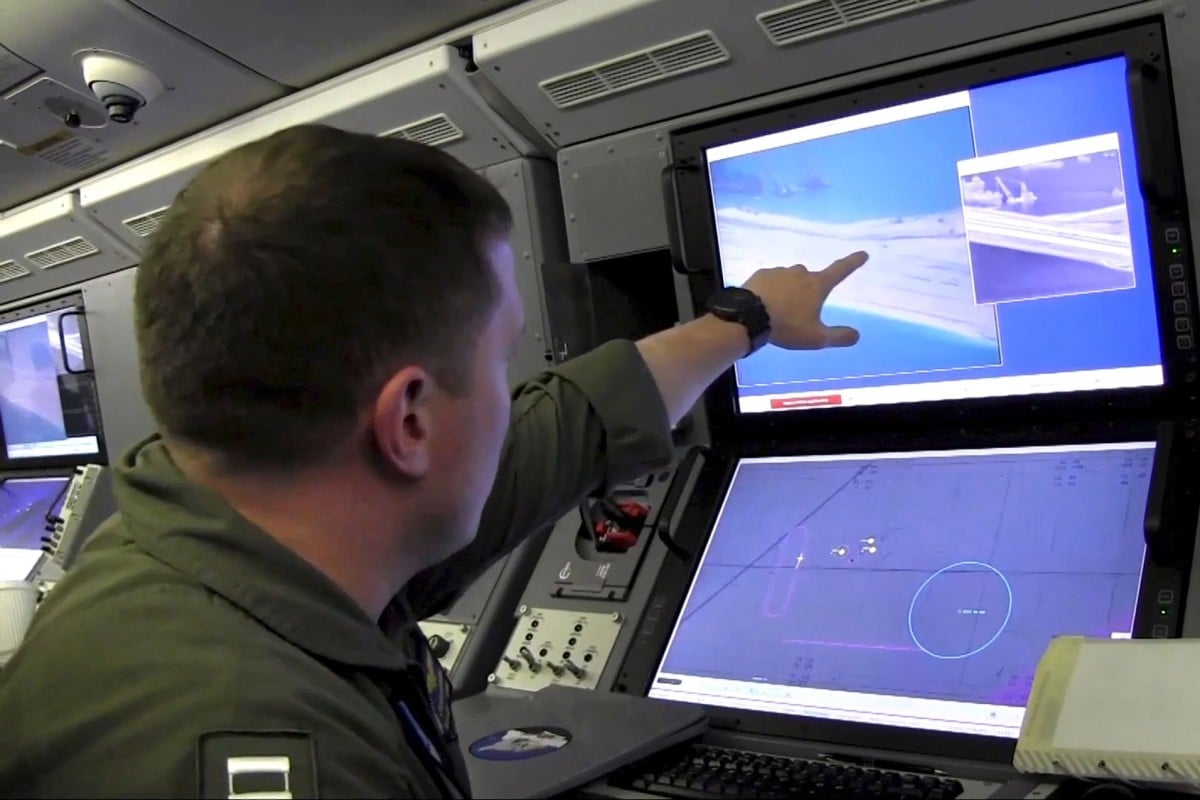
US Navy personnel point at a computer screen showing Chinese activity on the Fiery Cross Reef in the Spratly Islands in the South China Sea. An Australian scholar said
Chinese ships pointed lasers at them during a flight over the disputed sea. Photo: Reuters
Australian navy helicopter pilots were hit by lasers and forced to land during exercises in
, according to one witness on-board the aircraft.
Scholar Euan Graham, who said he was on the Royal
flagship HMAS Canberra during a voyage from Vietnam to Singapore, said the lasers had been pointed from passing fishing vessels while the Canberra was being
.
“Was this startled fishermen reacting to the unexpected? Or was it the sort of coordinated harassment more suggestive of China’s maritime militia? It’s hard to say for sure, but similar incidents have occurred in the western Pacific,” he wrote on the website The Strategist run by the Australian Strategic Policy Institute, an independent, non-partisan think tank based in Canberra.
His account of the incident appeared on Tuesday.
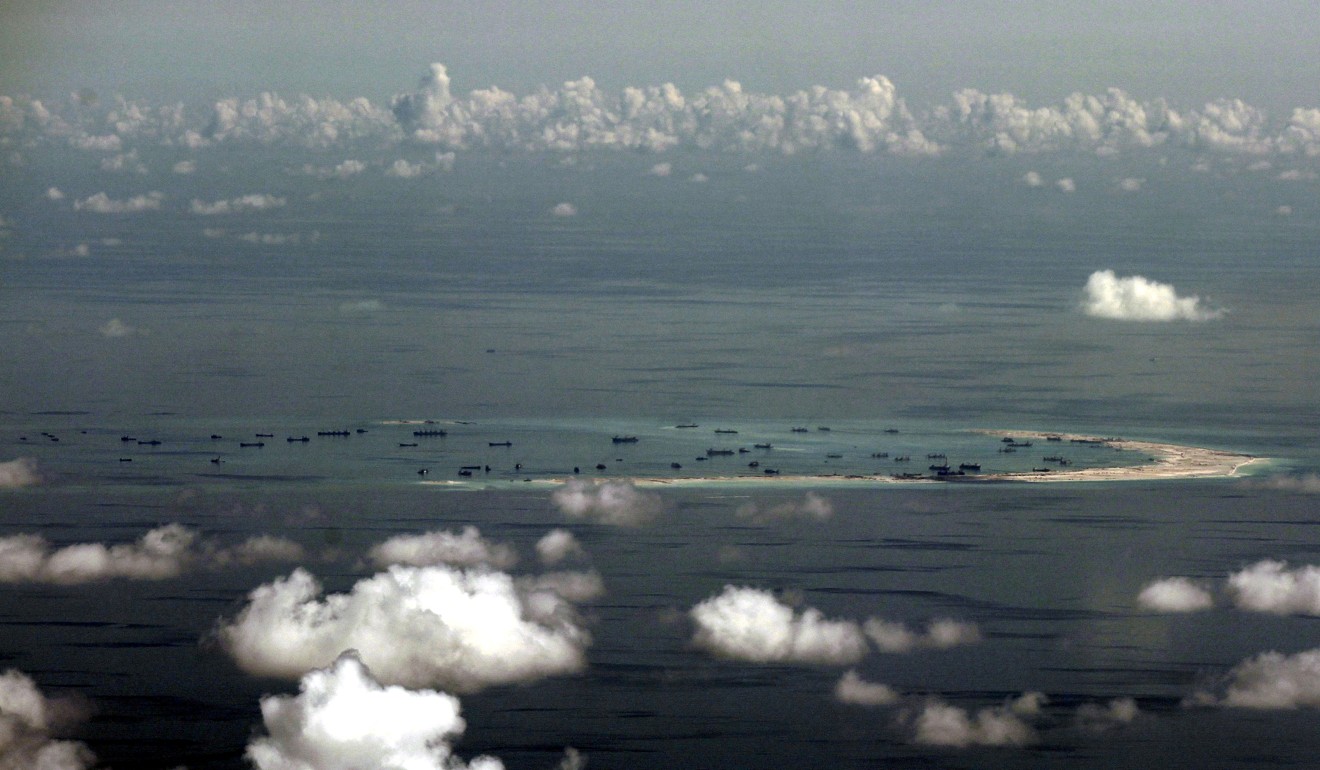
The Mischief Reef in the Spratly Islands in the South China Sea, where China is said to be increasing its military presence. Photo: Reuters
China maintains a robust maritime militia in the South China Sea, composed of fishing vessels equipped to carry out missions just short of combat. China claims the strategic waterway virtually in its entirety and is sensitive to all foreign naval action in the area, especially by
such as Australia.
Similar incidents involving lasers and the Chinese military have been reported as far away as Djibouti, where the US and China have bases. Last year, the US complained to China after lasers were directed at aircraft in the Horn of Africa nation, causing minor injuries to two American pilots.
China denied that its forces targeted the US military aircraft.
Graham said that while bridge-to-bridge communications with the Chinese during the voyage were courteous, the Chinese requested the Australian warships notify them in advance of any corrections to their course.
That was something the Australian navy was “not about to concede while exercising its high-seas freedoms”, Graham wrote.
In South China Sea, Asean has a choice: ‘Asian values’ or rule of law?
He wrote that the constant presence of Chinese vessels shadowing foreign ships appeared to indicate that the Chinese fleet had grown large enough to allow it to have vessels lying in wait for just such orders.
He said their trailing actions also appeared to show that China’s over-the-horizon surveillance capability was also maturing, supported by technology based at points such as Fiery Cross Reef in the contested Spratly island group where China has built military installations and an airstrip atop coral reefs.
Five other governments have claims in the South China Sea that overlap with China’s, and the US and its allies insist on the right to sail and fly anywhere in the area is permitted under international law, despite China’s differing interpretation of such guidelines.
Graham, who is executive director of La Trobe Asia at La Trobe University in Australia, was one of several academics invited to observe Australia’s engagement exercise Indo-Pacific Endeavour 2019.
Source: SCMP
Posted in Australian, Australian Strategic Policy Institute, Australian warships, Beijing’s ‘maritime militia’, bridge-to-bridge communications, Canberra, Chinese fleet, Chinese warship, Fiery Cross Reef, force, HMAS Canberra, Horn of Africa, Indo-Pacific Endeavour, land, lasers, navy helicopter, Scholar, Singapore, South China Sea, Spratly Islands, tailed, Uncategorized, Vietnam |
Leave a Comment »
29/05/2019
- The Asian security forum in Singapore had been seen as an ideal venue for a breakthrough in the growing diplomatic spat – but Tokyo has got cold feet
- That will ease the pressure on Beijing in the South China Sea, analysts say
Hopes are fading for a breakthrough in Japan-South Korea relations at the Shangri-La Dialogue in Singapore. Photo: Kyodo
Hopes that
and
could use the Shangri-La Dialogue in
to address their growing diplomatic spat are receding.
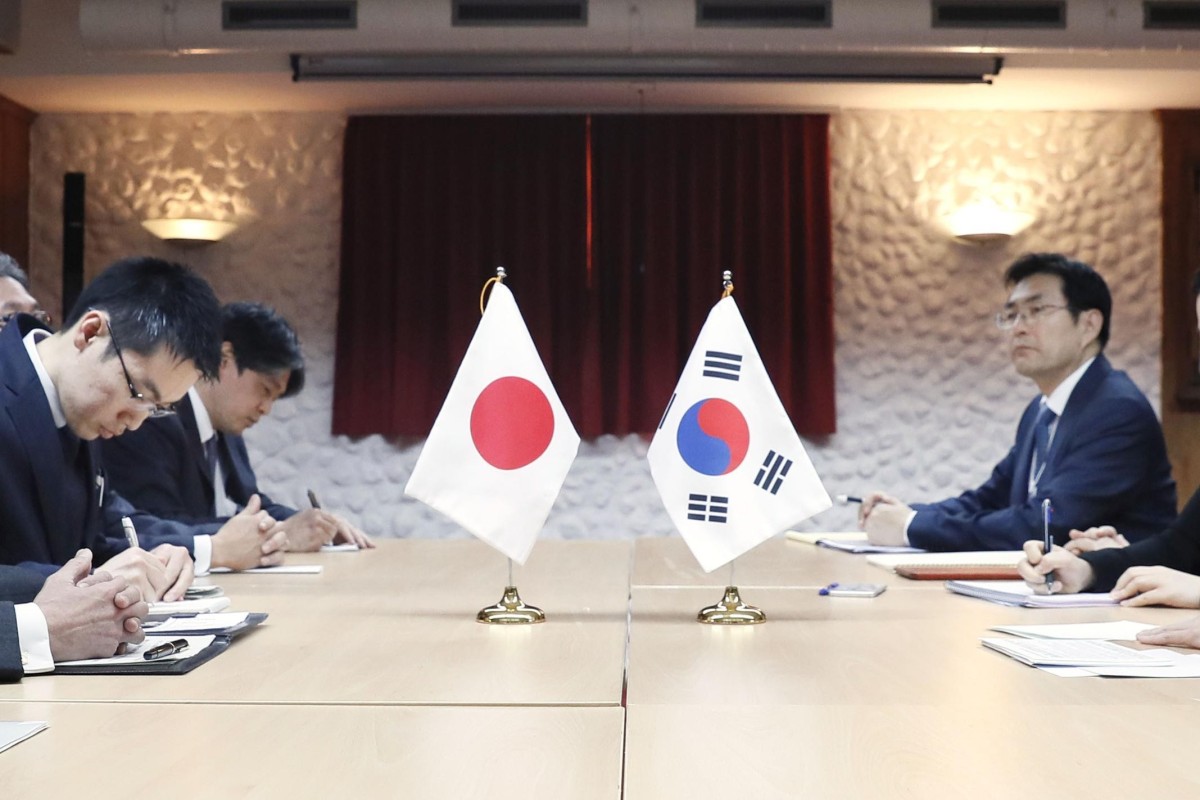
The three-day Asian security forum, which begins on Friday, had been seen as an ideal neutral venue for the two countries’ defence ministers to hold formal talks on issues including Tokyo’s claim that in January a
onto a Japanese reconnaissance aircraft.
The issue is one of the biggest deviling the bilateral relationship, alongside Japan’s perception that Seoul has backtracked on a promise to draw a line under Japan’s use of
– euphemistically known as “comfort women” – in military-run brothels during World War Two.
However, Tokyo appears to have concluded that formal talks on the sidelines of the Shangri-La Dialogue would be premature. The Yomiuri newspaper has reported that a formal meeting will no longer take place and that Takeshi Iwaya and Jeong Kyeong-doo, his South Korean opposite number, will now be restricted to a brief, stand-up exchange of their positions.
Despite the report, South Korean officials were guarded when asked whether the meeting had been shelved. “A detailed plan [on the bilateral talks] has yet to be fixed. Consultations are still underway between authorities of the two countries,” said the South Korean defence ministry spokesperson Choi Hyun-soo on Tuesday.
Analysts suggested Japan had run out of patience with South Korea and that the biggest winner in the stand off between two US allies would be China.
Japanese Defence Minister Takeshi Iwaya. Photo: Kyodo
“My sense is that Japan sees South Korea as not engaging in negotiations on a number of issues and not adhering in good faith to agreements that it has already signed,” said Stephen Nagy, a senior associate professor of international relations at Tokyo’s International Christian University.
Tokyo has been incensed that the administration of
has gone back on a 2015 agreement that was meant to draw a final line under the “comfort women” issue. Its anger deepened when Seoul said it would not intervene in a South Korean Supreme Court ruling, which ordered Japanese companies to pay up to 120 million won (US$100,000) to each of a dozen
of the Korean peninsula from 1910-1945.
Like its stance on “comfort women”, Japan believed a line had been drawn under the issue, this time in a 1965 pact that normalised relations between the two countries. Seoul argues that the 1965 treaty, which it signed after receiving US$800 million in grants and soft loans from Tokyo as compensation, does not cover individual victims of colonial-era atrocities.
As rift between Japan, South Korea deepens, how hard can Seoul afford to push?
“Japan is not ready to get into any more agreements because it fears that Seoul will not follow through or that they will become politicised in the future,” Nagy said.
“Tokyo wants binding, long-lasting agreements rather than having to renegotiate something each time a new Korean government comes in,” he said.
“The biggest winner in this stand-off between the US’ two most important allies in the region is, of course, China,” he added. “They must be delighted to see this playing out because it means the US is not able to exert nearly as much pressure in areas such as the
A long-standing strategic aim in US foreign policy circles has been to form a trilateral alliance with South Korea and Japan to present a united front against common security concerns, including China’s growing influence. However, the seeming inability of the two countries to get along has long thwarted this ambition.
“If Japan, South Korea and the US could find a way to cooperate, imagine the influence they could exert over the South China Sea or over
,” Nagy said. “If Japan and Korea could find a way to put their differences aside and with their security capacity, it would be a powerful deterrent to Beijing and Pyongyang.”
South Korean protesters demonstrate against Japan’s use of sex slaves – euphemistically termed ‘comfort women’ in World War II. Photo: AFP
Toshimitsu Shigemura, a professor of international relations at Tokyo’s Waseda University, agreed that the schism between Seoul and Tokyo would be of serious concern to Washington, but he believed that US pressure had already been brought to bear on the two neighbours.
“By avoiding talks in Singapore, Japan is doing its best to avoid public problems between the two sides and I believe that talks are already taking place between the two governments on these issues,” he said.
US wants Japan and South Korea to tag team China. But history is in the way
“The US will have told Tokyo and Seoul that it does not want to see more disagreements and that it is very important that they cooperate and calm things down a bit,” he said.
“I am sure that Washington knows exactly what happened when the Korean warship locked onto the Japanese aircraft in January, but they’re not publicly taking sides and instead they’re telling both governments to put the dispute behind them and to move on,” he added.
Other analysts were more pessimistic.
“The dynamics in domestic politics in both countries are currently overwhelming any diplomatic motives to improve bilateral ties,” said Bong Young-sik, a researcher at the Asan Institute for Policy Studies in Seoul.
Japanese Prime Minister Shinzo Abe. Photo: AFP
“For President Moon Jae-in, Japan-bashing is a useful political card to appeal to his supporters while for
, giving the impression that South Korea is going too far in pressing Japan is also beneficial for his own political gains.”
Professor Ha Jong-moon at Hansin University said there were “no solutions in sight” to resolve the differences over forced labour and wartime sex slavery, but said there would be a chance to “smooth ruffled feathers” at the G20 summit in Osaka, which takes place at the end of June.
The last time the defence ministers of the two countries met was in October last year, when they held talks on the sidelines of the Asean Defence Ministers’ Meeting in Singapore.
Source: SCMP
Posted in Asian security forum, associate professor of international relations, ‘win for China’, “comfort women”, Beijing, China alert, cold feet, fire control radar, hopes fade, Japan-South Korea talks, Japan’s colonial rul, Japan’s colonial rule, Japanese, Jeong Kyeong-doo, Korean sex slaves, military-run brothels, President Moon Jae-in, professor of international relations, Pyongyang, reconnaissance aircraft, Seoul, Shangri-La Dialogue, Singapore, South China Sea, South Korea, South Korean Supreme Court, South Korean warship, Stephen Nagy, Takeshi Iwaya, Tokyo, Tokyo’s International Christian University., Tokyo’s Waseda University, Toshimitsu Shigemura, Uncategorized, US allies, World War Two, Yomiuri |
Leave a Comment »




 CHINDIA ALERT: You'll be living in their world, very soon