Archive for ‘soybeans’

04/09/2019

China develops superconducting hybrid power line that could span the country

  • Prototype tested last month transports high-voltage power and liquefied natural gas side by side
  • It could cut the high cost and waste involved in sending energy from the far west to the east coast
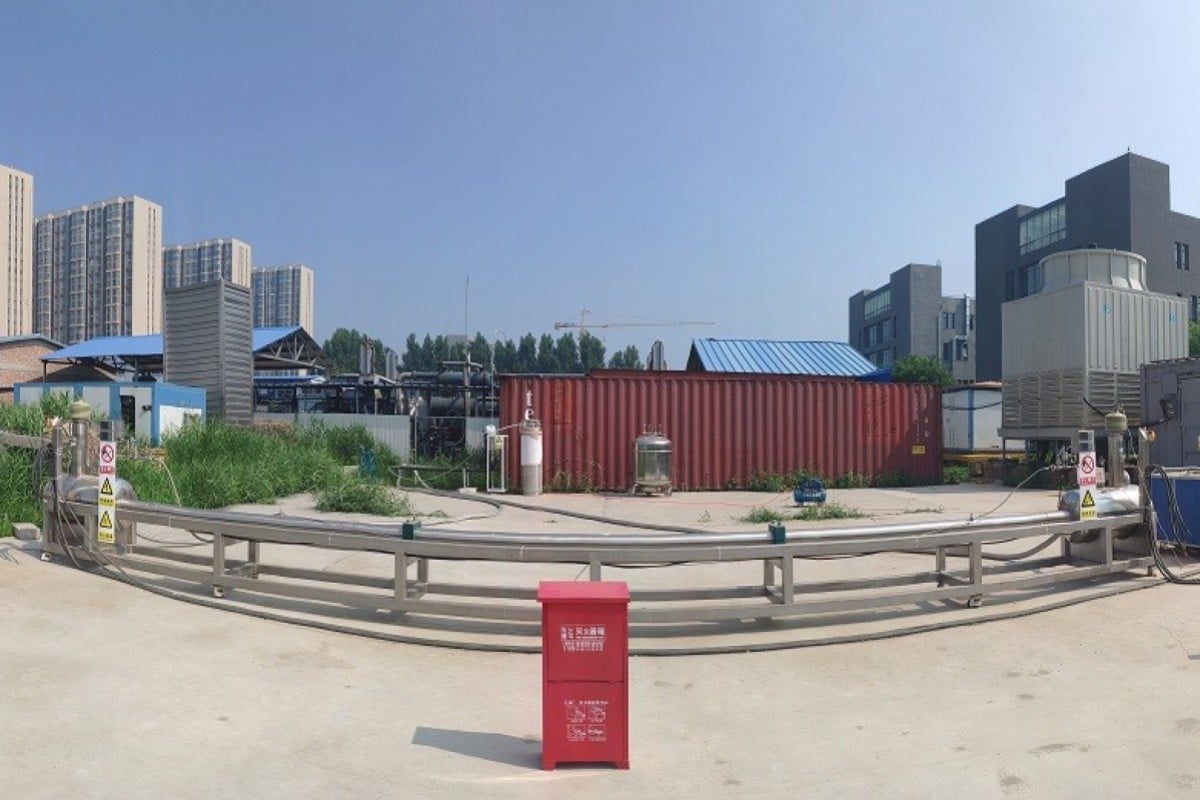
The 10-metre prototype line, combining high-voltage electricity and liquefied natural gas. Photo: Chinese Academy of Sciences

Chinese scientists have developed the world’s first prototype of a superconducting hybrid power line, paving the way for construction of a 2,000km (1,243-mile) line from energy-rich Xinjiang in the country’s far west to its eastern provinces.

The 10-metre, proof-of-concept wire and liquid natural gas hybrid transmission line was up and running at the Chinese Academy of Sciences’ Institute of Electrical Engineering in Beijing last month to show the feasibility of the technology.

The line contains a superconducting wire which can transmit nearly 1,000 amps of electric current at more than 18,000 volts with zero resistance.

In a further difference from a traditional power line, the gap between the superconducting wire and the power line’s outer shell is filled by a flow of slowly moving natural gas liquefied at low temperatures – between minus 183 and minus 173 degrees Celsius (minus 279 to minus 297 Fahrenheit). This allows the line to transfer electricity and fossil fuel at the same time.

Professor Zhang Guomin, the government research project’s lead scientist, told the South China Morning Post that the voltage and current could be much higher in its real-world applications.

“This technology can take the overall efficiency of long-distance energy transport to new heights,” he said.

Existing infrastructure to transfer energy from Xinjiang Uygur autonomous region to the developed eastern areas such as Shanghai has high operational costs because almost 10 per cent of the energy is lost in transmission, according to some studies.

That infrastructure includes the world’s most advanced high-voltage power line and four natural gas pipes, each thousands of kilometres long. One of the natural gas pipelines, from Xinjiang to Shanghai, cost 300 billion yuan (US$42 billion).

The superconductor and natural gas hybrid line offered a possible solution, Zhang said.

Loss of electricity over the superconducting wire would be almost zero because of the elimination of resistance to the movement of electrons, he said.

The transport of liquefied natural gas would also be efficient, because one cubic metre (1,000 litres) of it would be equivalent to 600 cubic metres of the same fuel in gas form.

The temperature needed for liquefaction of natural gas is almost identical to that required for occurrence of superconductivity, at about minus 163 degrees.

Wang Gengchao, professor of physics at East China University of Science and Technology in Shanghai, said the combination was a “smart idea”.

Superconducting materials are not new but their applications have been limited by the difficulty and cost of creating and maintaining the low-temperature environment.

“They are trying to kill two birds with one stone,” Wang, who was not involved in the study, said.

China is preparing to buy US liquefied gas and soybeans again

“But whether the technology can find a use in large-scale infrastructure depends on other things, such as safety. Not everyone will feel comfortable with the idea of putting a high-voltage electric line and flammable natural gas side by side.”

Zhang said another new prototype line, about 30 metres long, was being developed and the 2,000km project was awaiting government approval.

He said the team had solved some major technical obstacles, including reducing the risk of accidents from electrical sparks and gas leakage.

“Many problems remain to be solved, but we are confident this technology will work,” he said. “It will protect the environment. It will save a lot of land from being used for power and gas lines.”

Xinjiang has more energy resources than any other Chinese province or region. It has nearly half of the nation’s coal reserves, a third of its oil and gas, and some of the largest wind and solar farms, according to government statistics.

Source: SCMP
28/07/2019

Latin America trade grows as China and US tussle for influence

  • Chinese Foreign Minister Wang Yi wraps up tour of Brazil and Chile, as Colombian president heads for Beijing
  • Ecuador president tells US Secretary of State Mike Pompeo ‘smaller countries pay when the big ones fight’
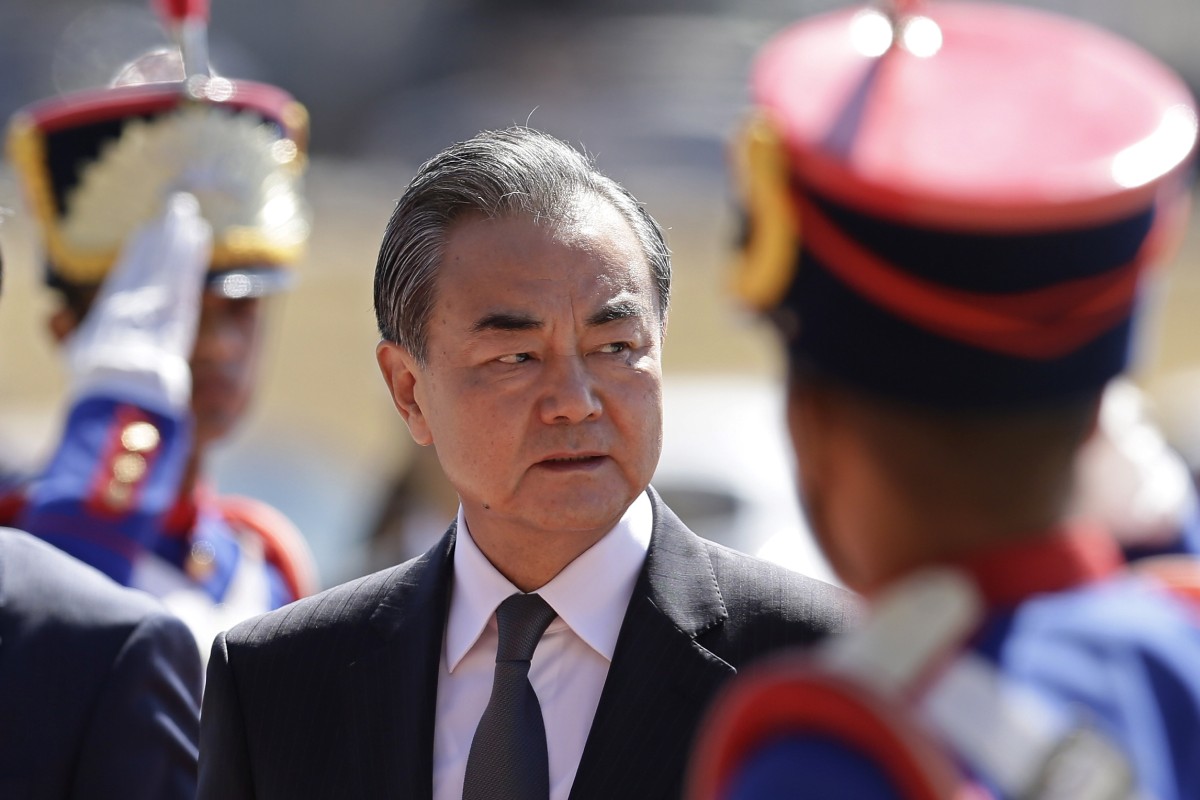
Chinese Foreign Minister Wang Yi is greeted by an honour guard as he arrives at the Itamaraty Palace for a meeting with his Brazilian counterpart Ernesto Araujo on Thursday. Photo: AP
Latin American countries are caught in the middle of a geopolitical tug of war between Beijing and Washington as China boosts its ties in the region in a bid to counterbalance the effects of its trade war with the US.
China’s Foreign Minister Wang Yi wraps up a tour of Latin America on Sunday which began last week in Brazil and ended with an official visit to Chile. He returns to Beijing on the same day Colombia’s President Ivan Duque Marquez arrives for a three-day state visit to China which will include a meeting with Chinese President Xi Jinping.
Wang was in Brazil for the latest summit of foreign ministers from the BRICS countries – an association of emerging countries made up of Brazil, Russia, India, China and South Africa – as well as the third China-Brazil foreign ministers’ comprehensive strategic dialogue with Brazilian Foreign Minister Ernesto Araujo.
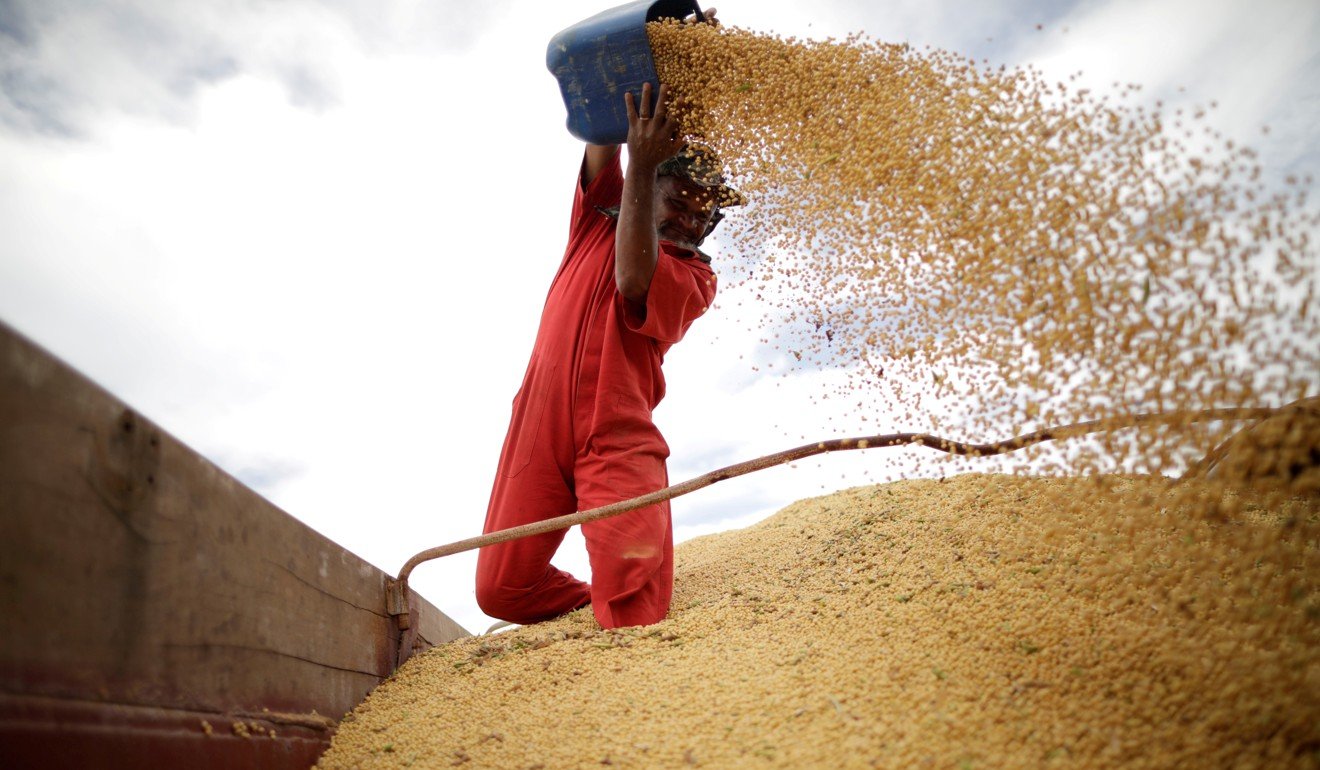
China has overtaken the US as Brazil’s largest trading partner, with Brazilian soybeans – one of the country’s biggest exports – and other agricultural products replacing American imports since the start of the US-China trade war a year ago.
Brazilian soybeans – one of the country’s biggest exports – and other farm products are being sold to China as a result of the trade war. Photo: Reuters

The growing importance of China to Brazil’s economy has created a difficult position for President Jair Bolsonaro, who accused Beijing of trying to buy Brazil during his election campaign, but changed tack on assuming office in January.

In March, Bolsonaro called China his country’s “main partner, politically as well as economically and commercially” and announced plans to travel to Beijing this year, a visit which was confirmed on Tuesday for late October.

China is now Latin America’s second largest trading partner with bilateral trade at US$307.4 billion, growing 18.9 per cent over the previous year, according to China’s ministry of commerce, in a relationship focused on commodity imports, including mining products like copper and energy, as well as soybeans and other agricultural goods.

While the US and China have tentatively agreed to resume talks in Shanghai next week, China and Latin American countries are likely to continue deepening their trade relations as production chains realign as a result of the trade war, according to Gustavo Oliveira, assistant professor of global and international studies at the University of California, Irvine.

“This means Chinese imports of Latin American agricultural and mineral commodities, and Latin American imports of Chinese manufactured products and hi-tech, might contribute to China’s ability to stand its ground against US pressure,” he said.

China in Latin America: partner or predator?
Oliveira said domestic contradictions in most Latin American countries complicated relations with China, as few leaders had the capacity to press or leverage China for much. “Unfortunately, therefore, most in this crop of Latin American leaders are basically placing themselves as junior partners or pawns in the geopolitical tug of war between the US and China.”
US Secretary of State Mike Pompeo put the pressure on Latin American countries over their relationship with China during his four-day tour of the region last weekend, when he visited Argentina, Ecuador, Mexico, and El Salvador.
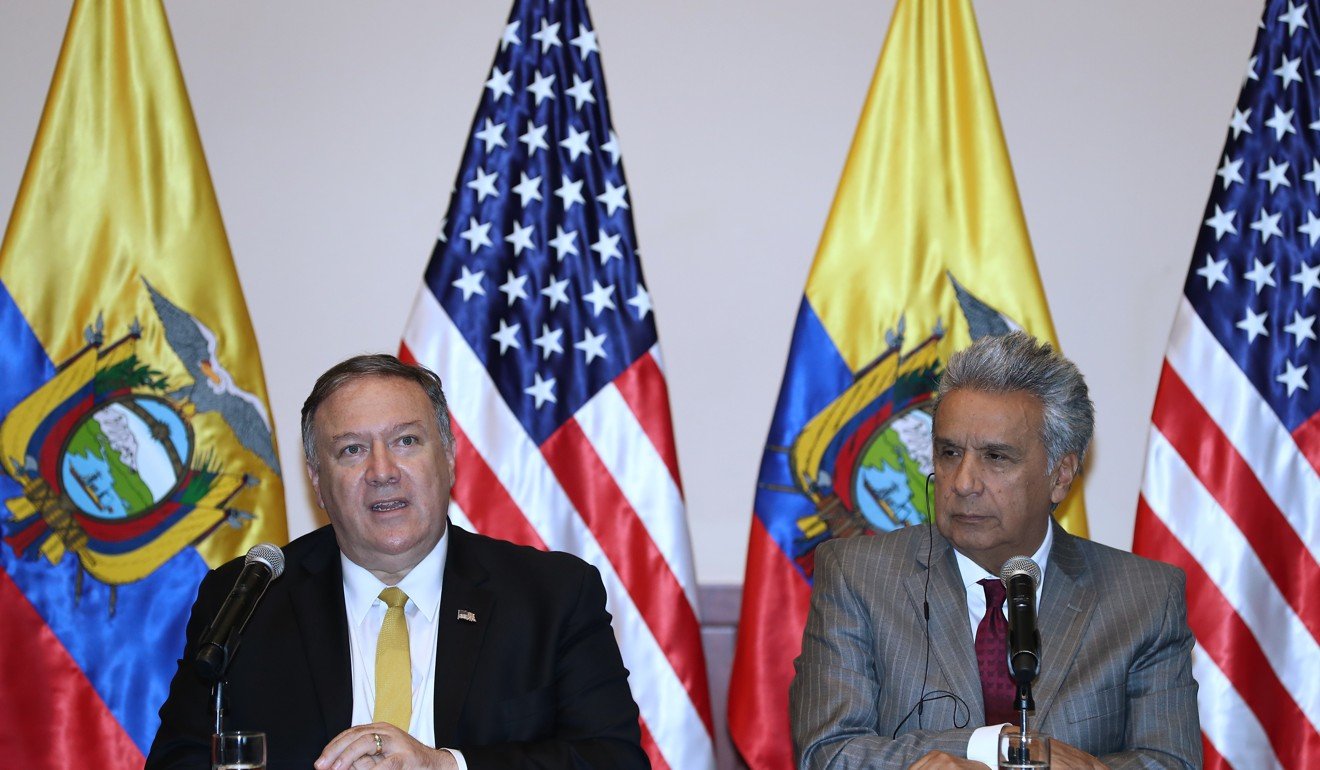
In a joint interview with Pompeo during the visit, Ecuador’s new President Lenin Moreno defended the country’s China ties, and urged Washington and Beijing to resolve their conflicts for the benefit of other nations in the region.
“We hope that the US and China, the greatest powers in the world now, will find agreement easily because, unfortunately, when the big ones are discussing or fighting and have conflicts, the ones that are paying for all of that are the smaller countries,” he said.
“Now, when two elephants fight, the ones who lose are the insects who are of course being crushed by the elephants in the attempt to evade them.”
US Secretary of State Mike Pompeo (left) and Ecuadorian President Lenin Moreno hold a joint press conference during Pompeo’s tour of Latin America on July 20. Photo: EPA-EFE

Pompeo blasted China’s role in the region during a previous tour of South America in April, when he singled out Beijing’s support for President Nicolas Maduro of Venezuela. Maduro is backed by Beijing, Russia and other allies, while the US and many European countries have supported opposition leader Juan Guaido as legitimate president since elections in January.

Speaking from Chile on that tour, Pompeo said Beijing’s calls for non-intervention in Venezuela were “hypocritical” and aimed at protecting Beijing’s investments in the country, as well as debts owed to China by Venezuela.

Pompeo also accused Beijing of “sowing discord” in the region through debt traps. “When China does business in places like Latin America, it often injects corrosive capital into the economic bloodstream, giving life to corruption and eroding good governance,” he said.

Professor Cui Shoujun of Renmin University in Beijing said Washington’s concerns about “debt trap diplomacy” in Latin America reflected concerns that China’s growing involvement in financing infrastructure and development projects would make the region more pro-China.

“China’s interests in Latin America go beyond raw materials extraction,” he said. “The biggest point of tension between the US and China in the region is perhaps that China presents an alternative model for development that is very different from the Western model.”

‘Mr Pompeo, you can stop’: China hits back over Latin America criticism

While the US was drumming up tensions about China across the world, Beijing was not openly retaliating but responding with investment and trade for global partners, said Kevin Gallagher, researcher on China-Latin America ties, and professor at Boston University.

“The US points fingers and makes angry speeches in the region as China cuts investment deals and helps address infrastructure needs,” he said.

“Latin American countries’ governments are rightly keeping their heads down on the broader geopolitical winds, and are getting down to business with their largest trading partner.”

Source: SCMP

02/03/2019

Trump asks China to lift tariffs on U.S. farm products

WASHINGTON (Reuters) – U.S. President Donald Trump said he had asked China to immediately remove all tariffs on U.S. agricultural products because trade talks were progressing well.

He also delayed plans to impose 25 percent tariffs on Chinese goods on Friday, as previously scheduled.
“I have asked China to immediately remove all Tariffs on our agricultural products (including beef, pork, etc.) based on the fact that we are moving along nicely with Trade discussions,” Trump said on Twitter, pointing out that he had not raised tariffs on Chinese goods to 25 percent from 10 percent on March 1 as planned.
“This is very important for our great farmers – and me!” Trump said.
Farmers are a key constituency for Trump’s Republican Party, and the U.S. president’s trade war with China has had a heavy impact on them. Beijing imposed tariffs last year on imports of soybeans, grain sorghum, pork and other items, slashing shipments of American farm products to China.
U.S. Agriculture Secretary Sonny Perdue said this week that U.S. trade negotiators had asked China to reduce tariffs on U.S. ethanol, but it was not immediately clear whether Beijing was willing to oblige.
Trump’s post on Twitter came several hours after the U.S. Trade Representative’s office said that it would delay the scheduled hike in tariffs on $200 billion worth of Chinese goods.

The notice, due to be published in the Federal Register next Tuesday, says it is “no longer appropriate” to raise the rates because of progress in negotiations since December 2018. The tariff would remain “at 10 percent until further notice.”

In a statement on Saturday, China said it welcomed the delay.

Speaking at a separate briefing in Beijing, a Chinese government official said both countries were working on the next steps, though he gave no details.

“China and the United States reaching a mutually-beneficial, win-win agreement as soon as possible is not only good for the two countries, but is also good news for the world economy,” said Guo Weimin, spokesman for the high profile but largely ceremonial advisory body to China’s parliament.

A tariff increase to 25 percent from 10 percent was initially scheduled for Jan. 1, but after productive conversations with Chinese President Xi Jinping, the Trump administration issued a 90-day extension of that deadline.

Trump had said on Sunday he would again delay the increase because of progress in the talks.

Source: Reuters

23/02/2019

Trump says he’s inclined to extend China trade deadline and meet Xi soon

WASHINGTON (Reuters) – President Donald Trump said on Friday there was “a very good chance” the United States would strike a deal with China to end their trade war and that he was inclined to extend his March 1 tariff deadline and meet soon with Chinese President Xi Jinping.

“I think that we both feel there’s a very good chance a deal will happen,” Trump said.

Liu agreed there had been “great progress”.

“From China, we believe that (it) is very likely that it will happen and we hope that ultimately we’ll have a deal. And the Chinese side is ready to make our utmost effort,” he said at the White House.

The Republican president said he probably would meet with Xi in March in Florida to decide on the most important terms of a trade deal.


Optimism that the two sides will find a way to end the trade war lifted stocks, especially technology shares. The S&P 500 stock index reached its highest closing level since Nov. 8. Oil prices rose to their highest since mid-November, with Brent crude reaching a high of $67.73 a barrel. [.N] [O/R]

CURRENCY AGREEMENT

Trump and Treasury Secretary Steven Mnuchin said the two sides had reached an agreement on currency. Trump declined to provide details, but U.S. officials long have expressed concerns that China’s yuan is undervalued, giving China a trade advantage and partly offsetting U.S. tariffs.

Announcement of a pact aimed at limiting yuan depreciation was putting “the currency cart before the trade horse,” but would likely be positive for Asian emerging market currencies, said Alan Ruskin, global head of currency strategy at Deutsche Bank in New York.

“How can you agree to avoid excessive Chinese yuan depreciation or volatility if you have not made an agreement on trade that could have huge FX implications?” Ruskin asked in a note to clients.

In a letter to Trump read aloud by an aide to Liu at the White House, Xi called on negotiators to work hard to strike a deal that benefits both country.

Trump said a deal with China may extend beyond trade to encompass Chinese telecommunications companies Huawei Technologies and ZTE Corp.

The Justice Department has accused Huawei of conspiring to violate U.S. sanctions on Iran and of stealing robotic technology from T-Mobile US Inc.

Chinese peer ZTE was last year prevented from buying essential components from U.S. firms after pleading guilty to similar charges, crippling its operations.

MEMORANDUMS NO MORE

Trump appeared at odds with his top negotiator, U.S. Trade Representative Robert Lighthizer, on the preliminary terms that his team is outlining in memorandums of understanding for a deal with China. Trump said he did not like MOUs because they are short term, and he wanted a long-term deal.

“I don’t like MOUs because they don’t mean anything,” Trump said. “Either you are going to make a deal or you’re not.”

Lighthizer responded testily that MOUs were binding, but that he would never use the term again.

Reuters reported exclusively on Wednesday that the two sides were drafting the language for six MOUs covering the most difficult issues in the trade talks that would require structural economic change in China.

Negotiators have struggled this week to agree on specific language within those memorandums to address tough U.S. demands, according to sources familiar with the talks. The six memorandums include cyber theft, intellectual property rights, services, agriculture and non-tariff barriers to trade, including subsidies.

An industry source briefed on the talks said both sides have narrowed differences on intellectual property rights, market access and narrowing a nearly $400 billion U.S. trade deficit with China. But bigger differences remain on changes to China’s treatment of state-owned enterprises, subsidies, forced technology transfers and cyber theft of U.S. trade secrets.

Lighthizer pushed back when questioned on forced technology transfers, saying the two sides made “a lot of progress” on the issue, but did not elaborate.

The United States has said foreign firms in China are often coerced to transfer their technology to Chinese firms if they want to operate there. China denies this.

The U.S. Chamber of Commerce on Friday urged the U.S. government to ensure the deal was comprehensive and addressed core issues, rather than one based on more Chinese short-term purchases of goods.

China has pledged to increase purchases of agricultural produce, energy, semiconductors and industrial goods to reduce its trade surplus with the United States.

China committed to buying an additional 10 million tonnes of U.S. soybeans on Friday, U.S. Agriculture Secretary Sonny Perdue said on Twitter. China bought about 32 million tonnes of U.S. soybeans in 2017. The commitments are a “show of good faith by the Chinese” and “indications of more good news to come,” Perdue wrote.

China was the top buyer of U.S. soybeans before the trade war, but Beijing’s retaliatory tariffs on U.S. soybeans slashed business that had been worth $12 billion annually.

Source: Reuters

14/12/2018

China buys US soybeans for first time since trade war

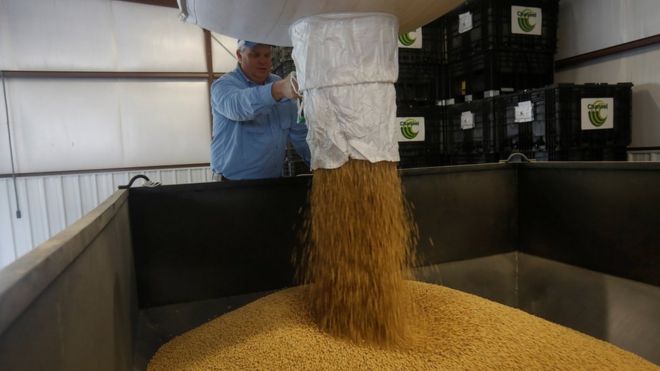
Soybeans coming thru siloImage copyrightREUTERS
Image captionChina’s purchase of 1.13 million tonnes of US soybeans has been hailed as a wonderful, great step by US officials.

China has bought US soybeans for the first time since the trade war between the two countries started in July – a move hailed as a “great step” by US officials.

One of the biggest casualties of the US-China trade war has been the US soybean sector.

China is by far the world’s biggest importer of soybeans.

And Beijing’s high tariffs placed on US soybeans this year has been severely hurting US farmers.

A trade truce between China and the US was reached earlier this month however, and there had been much anticipation that China would soon return to the US soybean market.

But while China’s purchase of 1.13 million tonnes of US soybeans on Thursday was met with much applause from some, others said the purchase was too small, and not a sign that the trade war was cooling.

“Having a million, million-and-a-half tonnes is great, it’s wonderful, it’s a great step,” said Steve Censky deputy secretary of the US Department of Agriculture.

“But there needs to be a lot more as well, especially if you consider it in a normal, typical year, we’ll be selling 30 to 35 million metric tonnes to China.”

The sale also failed to excite traders, who said the numbers fell short of estimates, which saw a sell-off in soybean futures.

“It’s a start, but it’s not nearly enough to fix our problems in regards to soybeans and a soybean oversupply in this country,” said Joe Vaclavik, president of Standard Grain, a Tennessee-based brokerage.

Why do soybeans matter?

In 2017, soybeans were the single biggest US agricultural export to China, which accounts for some 60% of the global trade in the commodity.

And soybeans are vitally important to China because they use the product to feed livestock.

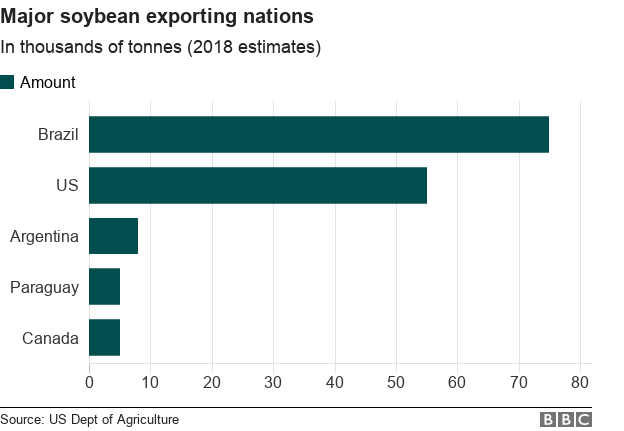
The key supplier globally is Brazil, but China has also relied heavily on the US for soybeans supplies – in part due to seasonality.

Bar chart for major soybean exporters

Chief economist Robert Carnell from ING Bank told the BBC that China’s purchase on Thursday was more about convenience than anything else.

“The simple fact is China needs a lot of soybeans and it’s been buying them from Brazil, not the US,” he said.

“But Brazil could never supply all the soybeans China needed, so ultimately [China has] been driven back to US soybeans. And I think it’s just convenient for them to do that right now.”

Mr Carnell said that the recent arrest of Meng Wanzhou, Huawei’s chief financial officer and deputy chair, was far more indicative of where the trade war between the US and China was really up to.

“[It’s] a battle for technology, a battle for 5G,” he said. “In particular, Huawei has become one of the world’s biggest suppliers of telecoms technology – and the US doesn’t really like that.

“[So that arrest] is giving you a much better, a much clearer message on where the trade war lines in the sand are really being drawn.”

Law of Unintended Consequences

continuously updated blog about China & India

ChiaHou's Book Reviews

continuously updated blog about China & India

What's wrong with the world; and its economy

continuously updated blog about China & India