Chindia Alert: You’ll be Living in their World Very Soon
aims to alert you to the threats and opportunities that China and India present. China and India require serious attention; case of ‘hidden dragon and crouching tiger’.
Without this attention, governments, businesses and, indeed, individuals may find themselves at a great disadvantage sooner rather than later.
The POSTs (front webpages) are mainly 'cuttings' from reliable sources, updated continuously.
The PAGEs (see Tabs, above) attempt to make the information more meaningful by putting some structure to the information we have researched and assembled since 2006.
SEOUL/TOKYO (Reuters) – With more employees working from home to help slow the spread of the coronavirus, demand is surging for laptops and network peripherals as well as components along the supply chain such as chips, as companies rush to build virtual offices.
Many firms have withdrawn earnings forecasts, anticipating a drop in consumer demand and economic slump, but performance at electronics retailers and chipmakers is hinting at benefits from the shift in work culture.
Over the past month, governments and companies globally have been advising people to stay safe indoors. Over roughly the same period, South Korea – home of the world’s biggest memory chip maker, Samsung Electronics Co Ltd – on Monday reported a 20% jump in semiconductor exports.
Pointing to further demand, nearly one in three Americans have been ordered to stay home, while Italy – where deaths have hit 5,476 – has banned internal travel. Worldwide, the flu-like virus has infected over 300,000 people and led to almost 15,000 deaths since China first reported the outbreak in December.
“With more people working and learning from home during the outbreak, there has been rising demand for internet services … meaning data centres need bigger pipes to carry the traffic,” said analyst Park Sung-soon at Cape Investment & Securities.
A South Korean trade ministry official told Reuters that cloud computing has boosted sales of server chips, “while an increase in telecommuting in the United States and China has also been a main driver of huge server demand.”
In Japan, laptop maker Dynabook reported brisk demand which it partly attributed to companies encouraging teleworking. Rival NEC Corp said it has responded to demand with telework-friendly features such as more powerful embedded speakers.
Australian electronics retailer JB Hifi Ltd also said it saw demand “acceleration” in recent weeks from both commercial and retail customers for “essential products they need to respond to and prepare” for the virus, such as devices that support remote working as well as home appliances.
CHINA LEAD
China is leading chip demand, analysts said, as cloud service providers such as Alibaba Group Holding Ltd, Tencent Holdings Ltd and Baidu Inc quickly responded to the government’s effort to contain the virus.
“Cloud companies opened their platforms, allowing new and existing customers to use more resources for free to help maintain operations,” said analyst Yih Khai Wong at Canalys.
“This set the precedent for technology companies around the world that offer cloud-based services in their response to helping organisations affected by coronavirus.”
China’s cloud infrastructure build-up has helped push up chip prices, with spot prices of DRAM chips rising more than 6% since Feb. 20, showed data from price tracker DRAMeXchange.
UBS last week forecast average contract prices of DRAM chips to rise as much as 10% in the second quarter from the first, led by a more than 20% jump in server chips.
It said it expects DRAM chips to be modestly under supplied until the third quarter of 2021, with demand from server customers rising 31% both in 2020 and 2021.
SUPPLY DISRUPTION
Concerns over supply disruption has also contributed to a price rise.
“You’ve got lots of OEMs and systems integrators in the global market who have intense demand for memory now,” said Andrew Perlmutter, chief strategy officer at ITRenew, a company that buys and reworks used data centre equipment for resale.
“Nobody is shutting down their factories – it is still production as normal – but people worry about memory supply in particular, so they want to get out ahead of production.”
About 69% of electronics manufacturers have flagged possible supplier delays averaging three weeks, showed a poll on March 13 by industry trade group IPC International.
Half of those polled expected business to normalise by July, and nearly three-quarters pointed to at least October.
WUHAN, March 14 (Xinhua) — Temporary treating centers converted from public facilities have played a key role in curbing the spread of the novel coronavirus in Wuhan, the central Chinese city at the epicenter of the epidemic outbreak, a medical expert said.
The experience in setting up temporary hospitals in Wuhan should be drawn on in the future and could help other countries fight the pandemic of COVID-19, Wang Chen, a respiratory disease specialist and vice president of the Chinese Academy of Engineering, told Xinhua in a recent interview.
The hospitals were converted from public venues such as exhibition centers and gymnasiums in early February in an effort to treat patients with mild symptoms and isolate the source of infections amid strained medical resources.
Over more than a month, the 16 temporary hospitals have received more than 12,000 patients until the last two of them were shut down Tuesday as the city sees more patients recover and a sharp drop in the number of new infection cases, according to Wang.
The temporary hospitals were set up in Wuhan at the grimmest moment of its fight against the virus, when medical institutions were overwhelmed by an influx of patients and over 10,000 infected patients were unable to receive proper medical treatment, Wang said.
Under the principle of “leaving no patients unattended” established by Chinese central authorities, these hospitals have performed three major functions — isolation, treatment and monitoring, Wang said.
“These hospitals can keep patients under quarantine to block household and social contacts, offer proper treatments to patients with mild symptoms and monitor their conditions in case of exacerbation,” he added.
“One of the characteristics of COVID-19 is that most patients have mild symptoms, but they need proper treatments to avoid possible exacerbation. And the key is to keep them isolated to stem the spread of the virus,” said Wang, explaining why temporary hospitals are important to curbing the epidemic in Wuhan.
(Reuters) – France and Spain joined Italy in imposing lockdowns on tens of millions of people, Australia ordered self-isolation of arriving foreigners, and Argentina and El Salvadore extended entry bans as the world sought to contain the spreading coronavirus.
Panic buying in Australia, the United States and Britain saw leaders appeal for calm over the virus that has infected over 138,000 people globally and killed more than 5,000.
Several countries imposed bans on mass gathering, shuttered sporting, cultural and religious events, while medical experts urged people to practice “social distancing” to curb the spread.
All of Pope Francis’ Easter services next month will be held without the faithful attending, the Vatican said on Sunday, in a step believed to be unprecedented in modern times.
The services, four days of major events from Holy Thursday to Easter Sunday, usually draw tens of thousands of people to sites in Rome and in the Vatican.
RELATED COVERAGE
EU finance ministers to hold video call on virus on Monday
Coronavirus forces closure of all French ski resorts
Australian Prime Minister Scott Morrison said from midnight Sunday international travellers arriving in the country would need to isolate themselves for 14 days, and foreign cruise ships would be banned for 30 days, given a rise in imported cases.
“What we’ve seen in recent weeks, is more countries having issues with the virus and that means the source of some of those transmissions are coming from more and more countries,” Morrison told a news conference.
Australia’s latest restrictions mirror those announced by neighbouring New Zealand on Saturday. Australia has recorded more than 250 coronavirus cases and three deaths.
TRAVEL BANS, AIRLINE CUTBACKS
U.S. President Donald Trump declared a national emergency on Friday. The United States has recorded more than 2,000 cases and 50 deaths, but has been criticised for slow testing.
Travel bans and a plunge in global air travel saw further airline cut backs, with American Airlines Inc (AAL.O) planning to cut 75% of international flights through May 6 and ground nearly all its widebody fleet.
The dramatic announcement by the largest U.S. airline came hours after the White House said the United States would widen new travel restrictions on Europeans to include travellers in the United Kingdom and Ireland, starting Monday night.
Washington has already imposed flight restrictions on China.
China tightened checks on international travellers arriving at Beijing airport on Sunday, after the number of imported new coronavirus infections surpassed locally transmitted cases for a second day in a row.
Anyone arriving to Beijing from abroad will be transferred directly to a central quarantine facility for 14 days for observation starting March 16, a city government official said.
China, where the epidemic began in December, appears to now face a greater threat of new infections from outside its borders as it continues to slow the spread of the virus domestically.
China has reported 80,984 cases and 3,203 deaths, according to a Reuters tally, of which 66,911 have recovered in mainland China, which has imposed draconian containment policies, locking down several major cities.
LOCKDOWNS, STAY HOME
Spain put its 47 million inhabitants under partial lockdown on Saturday as part of a 15-day state of emergency to combat the epidemic in Europe’s second worst-affected country after Italy.
Spain had 193 coronavirus deaths and 6,250 cases, public broadcaster TVE said on Saturday, up from 120 deaths reported on Friday.
France will shut shops, restaurants and entertainment facilities from Sunday with its 67 million people were told to stay home after confirmed infections doubled in 72 hours.
French Prime Minister Edouard Philippe said the government had no other option after the public health authority said 91 people had died in France and almost 4,500 were now infected.
“We must absolutely limit our movements,” he said.
Britain is preparing to ban mass gatherings, while isolating people aged over 70 for up to four months is part of its action plan to tackle coronavirus which will be implemented in the coming weeks, Health Secretary Matt Hancock said on Sunday.
Argentina banned entry to non-residents who have travelled to a country highly affected by coronavirus in the last 14 days, the government officially announced late on Saturday.
The ban will last 30 days. Argentina has 45 cases of coronavirus, the health ministry said, up from 21 on March 12.
Panama said flights arriving from Europe and Asia would be temporarily suspended, with the exception of flights that transport doctors, medical equipment or other humanitarian aid.
Colombia will expel four Europeans for violating compulsory quarantine protocols, just hours after it closed its border with Venezuela, the government said on Saturday.
ANTI-TERRORISM TRACKING TO FIGHT VIRUS
Israel will use anti-terrorism tracking technology and partially shutdown its economy to minimise transmission risks, Prime Minister Benjamin Netanyahu said on Saturday.
Cyber tech monitoring would be deployed to locate people who have been in contact with those carrying the virus, subject to cabinet approval, Netanyahu told a news conference in Jerusalem.
Starting Sunday, South Korea began to subject visitors from France, Germany, Britain, Spain and the Netherlands to stricter border checks, after imposing similar rules for China, Italy and Iran which have major outbreaks.
Visitors from those countries now need to download an app which will report whether they have symptoms. South Korea has been testing hundreds of thousands of people and tracking potential carriers using cell phone and satellite technology.
BANGKOK (Reuters) – Thailand will temporarily suspend issuing visas on arrival to visitors from 19 countries and territories, including China, to contain the spread of the coronavirus, its interior minister said on Wednesday.
The suspensions were the latest measures imposed in the tourism-reliant Southeast Asian country, which has reported 59 cases of the virus and one death so far. Globally, over 113,000 people have been infected in over 100 countries.
“People from any country who want to come will need to apply for a visa with our embassies,” Minister of Interior Anupong Paochinda told reporters.
“Thai embassies everywhere will ensure that no sick people will travel to Thailand.”
Visa on Arrival (VoA) will be suspended for nationals of all 19 countries and territories previously eligible, including Bulgaria, Bhutan, China, Cyprus, Ethiopia, Fiji, Georgia, India, Kazakhstan, Malta, Mexico, Nauru, Papua New Guinea, Romania, Russia, Saudi Arabia, Taiwan, Uzbekistan, and Vanuatu, according to a list provided to reporters by the Ministry of Foreign Affairs.
However, Russian passport holders will not be affected by the suspension of the visa on arrival from Russia, as they can still travel to Thailand and stay for 30 days under a visa waiver agreement, an official at the ministry told Reuters.
Visa exemptions will be cancelled for South Korea, Italy and Hong Kong, Anupong said.
“These measures will solve the problem of foreigners arriving from risky zones,” he said.
Anupong said he would start the process immediately but it was not immediately clear when they will be effective.
Chatree Atchananant, director-general of the foreign ministry’s Consular Affairs Department, said visa applicants will need to present medical certificates and insurance as part of the screening at Thai embassies.
Last week, Thailand designated South Korea, China, Macao, Hong Kong, Italy and Iran as “dangerous communicable disease areas.”
Thai authorities urged people arriving from the six places to self-quarantine for 14 days.
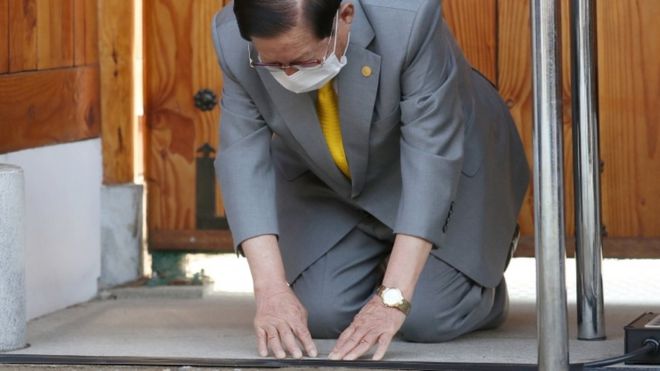
Image copyright EPAImage caption Lee Man-hee is the founder of the Shincheonji Church
The head of the religious sect that has been at the centre of the coronavirus outbreak in South Korea has apologised to the nation for the disease’s spread.
Lee Man-hee, the leader of the Shincheonji Church of Jesus, got on his knees and bowed at a news conference.
About 60% of the country’s more than 4,000 confirmed cases are sect members.
On Monday, South Korea – the biggest hotspot outside China – reported 476 new cases, bringing the total number to 4,212. It has recorded 26 deaths.
Prosecutors have been asked to investigate Mr Lee on possible charges of gross negligence.
“Although it was not intentional, many people have been infected,” said the 88-year-old leader. “We put our utmost efforts, but were unable to prevent it all.”
Media caption Empty shelves as coronavirus ‘panic-buying’ hits Australia
Of the confirmed cases, 3,081 are from the southern city of Daegu and 73% of these cases have been linked to the Shincheonji Church near there.
In the capital Seoul, the mayor urged the city’s 10 million residents to work from home and to avoid crowded places.
But church spokesman Kim Shin-chang told the BBC they had provided a list of members, students, and buildings to authorities.
“We were worried about releasing this information because of the safety of our members,” Mr Kim said.
Media caption ‘We’re often persecuted’: Spokesman for virus-hit S Korean church defends secrecy
Mr Lee claims he is the second coming of Jesus Christ and identifies as “the promised pastor” mentioned in the Bible who will take 144,000 people to heaven with him.
The Shincheonji Church is labelled as a cult within South Korea and also in the Christian community, which results in the group often being discriminated against, persecuted or criticised, Mr Kim told the BBC.
What’s the global situation?
The number of people killed worldwide by the coronavirus has exceeded 3,000, as China reported 42 more deaths. More than 90% of the total deaths are in Hubei, the Chinese province where the virus emerged late last year.
But there have also been deaths in 10 other countries, including more than 50 in Iran and more than 30 in Italy.
Worldwide, there have been almost 90,000 confirmed cases, with the numbers outside China now growing faster than inside China.
In other developments:
In the UK, where there are 36 confirmed cases, Prime Minister Boris Johnson has called a meeting of the emergency Cobra committee on Monday
Indonesia – one of the world’s most populous countries – has announced its first confirmed cases of coronavirus, a 64-year-old woman and her 31-year-old daughter, currently being treated at a Jakarta hospital
Iceland and Andorra also reported their first confirmed cases on Monday
Share prices in Asia and in Europe rose after central banks pledged to intervene to help protect markets from the impact of the coronavirus. Concerns about the outbreak last week wiped more than $5tn (£3.9tn) from global stocks
US sportswear giant Nike has closed its European headquarters in Hilversum city in the Netherlands after an employee tested positive for the virus
In the European hotspot of Italy, the number of infections doubled in 48 hours, the head of the country’s civil protection body said on Sunday.
There have been at least 34 deaths and 1,694 confirmed cases. Amazon said two of its employees in Italy have the virus and are under quarantine.
Countries including Qatar, Ecuador, Luxembourg and Ireland all confirmed their first cases over the weekend. On Monday, Ecuador reported five new cases of the disease, bringing the total number of infected patients in the country to six.
The US state of New York has also confirmed its first case. The patient is a woman in her 30s who contracted the virus during a recent trip to Iran. Two people have died in the US, both in the state of Washington.
A spokesman from China’s National Health Commission said the next stop would be to “focus on the risks brought by the resumption of work”.
China’s economy has taken a hit – with factory activity falling at a record rate.
On Monday, a man was sentenced to death by a Chinese court for fatally stabbing two officials at a virus checkpoint, news agency AFP reported.
Ma Jianguo, 23, refused to co-operate with officials – though it is not clear what he was told to do – and stabbed two checkpoint officials.
What has the WHO said?
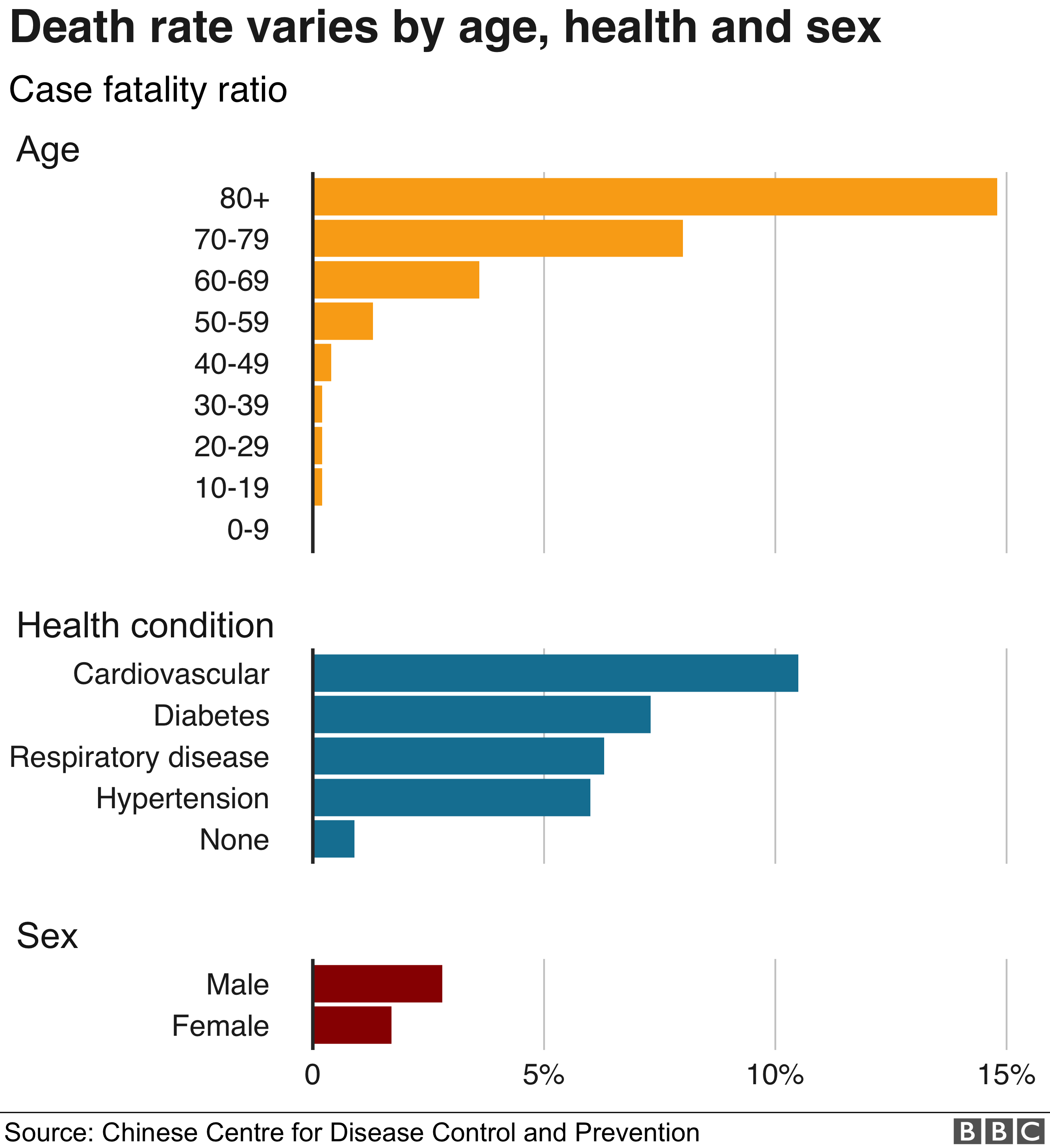
On Sunday, the World Health Organization (WHO) said the virus appears to particularly affect those over 60, and people already ill.
It urged countries to stock up on ventilators, saying “oxygen therapy is a major treatment intervention for patients with severe Covid-19”.
In the first large analysis of more than 44,000 cases from China, the death rate was 10 times higher in the very elderly compared to the middle-aged.
But most patients have only mild symptoms and the death rate appears to be between 2% and 5%, the WHO said.
By comparison, the seasonal flu has an average mortality rate of about 0.1%, but is highly infectious – with up to 400,000 people dying from it each year.
Other strains of coronavirus, such as Severe Acute Respiratory Syndrome (Sars) and Middle East Respiratory Syndrome (Mers), have much higher death rates than Covid-19.
BEIJING (Reuters) – China reported a sharp decrease in new deaths and cases of the coronavirus on Saturday but a doubling of infections in South Korea and 10 new cases in Iran added to unease about its rapid spread and global reach.
Mainland China had 397 new confirmed cases of coronavirus infections on Friday, down from 889 a day earlier, but only 31 cases were outside of the virus epicentre of Hubei province, the lowest number since the National Health Commission started compiling nationwide data a month ago.
But infection numbers continued to rise elsewhere, with outbreaks worsening in South Korea, Italy and Lebanon and Iran, prompting a warning from the World Health Organization that the window of opportunity to contain the international spread was closing..
South Korea saw another spike in infections, with 229 new confirmed cases, taking its tally to 433. Officials warned that could rise substantially as more than 1,000 people who attended a church at the centre of the outbreak had shown flu-like symptoms.
Iran, which had no reported cases earlier this week, saw 10 new cases, one of which had died, taking the number to 28 infections and five deaths.
RELATED COVERAGE
South Korea coronavirus cases more than double in a day
Second coronavirus patient dies in Italy – ANSA news agency
Concerns about the virus weighed on U.S. stocks on Friday, driven by an earlier spike in cases in China and data showing stalling U.S. business activity in February. [MKTS/GLOB]
It has spread to some 26 countries and territories outside mainland China, killing 13 people, according to a Reuters tally.
WHO director-general Tedros Adhanom Ghebreyesus on Twitter expressed concern on Saturday about cases with no clear link to China and called on all countries to invest urgently in preparedness. He made an appeal for $675 million to support the most vulnerable countries.
On Friday, he said now was the time to act decisively.
“We still have a chance to contain it,” he said. “If we don’t, if we squander the opportunity, then there will be a serious problem on our hands.”
An outbreak in northern Italy worsened with its first two deaths, among 17 confirmed cases including its first known instance of local transmission.
Japan confirmed 14 new coronavirus cases on Saturday, among those a teacher who had shown symptoms while working at her school.
Japan is facing growing questions about whether it is doing enough to contain its spread, and concern about whether it could scupper this year’s Tokyo Olympics. Organisers on Saturday postponed the start of training for volunteers as a precaution.
The Bank of Japan’s governor on Saturday shrugged off talk that the widening epidemic is triggering an outflow of funds from Asia.
The total number of confirmed cases in mainland China rose to 76,288, with the death toll at 2,345 as of the end of Friday. Hubei reported 106 new deaths, of which 90 were in Wuhan.
But new, albeit isolated findings about the coronavirus could complicate efforts to thwart it, including the Hubei government’s announcement on Saturday that an elderly man took 27 days to show symptoms after infection, almost twice the presumed 14-day incubation period.
That follows Chinese scientists reporting that a woman from Wuhan had travelled 400 miles (675 km) and infected five relatives without showing signs of infection, offering new evidence of asymptomatical spreading.
State television on Saturday showed the arrival in Wuhan of the “blue whale”, the first of seven river cruise ships it is bringing in to house medical workers, tens of thousands of which have been sent to Hubei to contain the virus.
Senior Chinese central bank officials sought to ease global investors’ worries about the potential damage to the world’s second-largest economy from the outbreak, saying interest rates would be guided lower and that the country’s financial system and currency were resilient.
Chen Yulu, a deputy governor of the People’s Bank of China, said policymakers had plenty of tools to support the economy, and were fully confident of winning the war against the epidemic.
“We believe that after this epidemic is over, pent-up demand for consumption and investment will be fully released, and China’s economy will rebound swiftly,” Chen told state television.
China has recently cut several key lending rates, including the benchmark lending rate on Thursday, and has urged banks to extend cheap loans to the worst-hit companies which are struggling to resume production and are running out of cash.
The transport ministry said businesses would resume operations on a larger scale later this month and said more roads, waterways and ports were returning to normal.
Online media and Weibo users posted footage and images on Saturday of some malls reopening, including in the cities of Wuxi, Hangzhou and in Gansu province, with shoppers queuing in near-empty streets outside for mandatory temperature checks as trickles of customers in masks perused luxury goods shops and makeup counters.
Some analysts believe China’s economy could contract in the first quarter from the previous three months due to the combined supply and demand shocks caused by the epidemic and strict government containment measures. On an annual basis, some warn growth could fall by as much as half from 6% in the fourth quarter.
However, transport restrictions remain in many areas and while more firms are reopening, the limited data available suggests manufacturing is still at weak levels, with disruptions starting to spillover into global supply chains.
Samsung Electronics (005930.KS) said on Saturday that one coronavirus case had been confirmed at its mobile device factory complex in Gumi, causing a shutdown of its entire facility.
Finance leaders from the Group of 20 major economies were set to discuss risks to the world economy in Saudi Arabia this weekend.
The WHO’s Tedros on Twitter said 13 priority countries in Africa had been identified for help because of their direct links to China or high travel volume. That would include 30,000 personal protective kits on the way to six countries and 60,000 more for 19 states in the weeks ahead.
BEIJING/SINGAPORE (Reuters) – China reported on Wednesday its smallest number of coronavirus cases since January, lending weight to a prediction by its top medical adviser for the outbreak to end by April, but a global infectious diseases expert warned of the spread elsewhere.
Financial markets took heart from the outlook of the Chinese official, epidemiologist Zhong Nanshan, who said on Tuesday the number of new cases was falling in some provinces, and forecast the epidemic would peak this month, even as the death toll in China rose to more than 1,100 people.
World stocks, which had seen rounds of sell-offs over the virus, surged to record highs on hopes of a peak in cases. The Dow industrials, S&P 500 and Nasdaq all hit new highs, and Asian shares nudged higher on Wednesday.
But the World Health Organization (WHO) has warned that the epidemic poses a global threat akin to terrorism and one expert coordinating its response said while the outbreak may be peaking at its epicentre in China, it was likely to spread elsewhere in the world, where it had just begun.
RELATED COVERAGE
Chess, squabbles aboard cruise ship cast away by coronavirus fears
Singapore’s DBS evacuates 300 staff after employee contracts coronavirus
See more stories
“It has spread to other places where it’s the beginning of the outbreak,” the official, Dale Fisher, head of the Global Outbreak Alert and Response Network coordinated by the WHO, said in an interview in Singapore.
“In Singapore, we are at the beginning of the outbreak.”
Singapore has reported 47 cases and worry about the spread is growing. Its biggest bank, DBS (DBSM.SI), evacuated 300 staff from its head office on Wednesday after a confirmed coronavirus case in the building.
Hundreds of cases have been reported in dozens of other countries and territories around the world, but only two people have died outside mainland China – one in Hong Kong and another in the Philippines.
WHO chief Tedros Adhanom Ghebreyesus said on Tuesday the world had to “wake up and consider this enemy virus as public enemy number one” and the first vaccine was 18 months away.
In China, total infections have hit 44,653, health officials said, including 2,015 new confirmed cases on Tuesday. That was the lowest daily rise in new cases since Jan. 30.
The number of deaths on the mainland rose by 97 to 1,113 by the end of Tuesday.
But doubts have been aired on social media about how reliable the figures are, after the government last week amended guidelines on the classification of cases.
‘STAY HOPEFUL’
The biggest cluster of cases outside China is aboard the Diamond Princess cruise ship quarantined off Japan’s port of Yokohama, with about 3,700 people on board. Japanese officials on Wednesday said 39 more people had tested positive for the virus, taking the total to 175.
One of the new cases was a quarantine officer.
Thailand said it was barring passengers from another cruise ship, MS Westerdam, from disembarking, the latest country to turn it away amid fears of the coronavirus, despite no confirmed infections on board.
“We try to stay hopeful,” American passenger Angela Jones told Reuters in a video recording. “But each day, that becomes a little bit more difficult, when country after country rejects us.”
Echoing the comparison with the fight against terrorism, China’s state news agency Xinhua said late on Tuesday the epidemic was a “battle that has no gunpowder smoke but must be won”.
The epidemic was a big test of China’s governance and capabilities and some officials were still “dropping the ball” in places where it was most severe, it said, adding: “This is a wake-up call.”
The government of Hubei, the central province at the outbreak’s epicentre, dismissed the provincial health commission’s Communist Party boss, state media said on Tuesday, amid mounting public anger over the crisis.
China’s censors had allowed criticism of local officials but have begun cracking down on reporting of the outbreak, issuing reprimands to tech firms that gave free rein to online speech, Chinese journalists said.
The pathogen has been named COVID-19 – CO for corona, VI for virus, D for disease and 19 for the year it emerged. It is suspected to have come from a market that illegally traded wildlife in Hubei’s capital of Wuhan in December.
The city of 11 million people remains under virtual lockdown as part of China’s unprecedented measures to seal infected regions and limit transmission routes.
Travel restrictions that have paralysed the world’s second-biggest economy have left Wuhan and other Chinese cities resembling ghost towns.
Even if the epidemic ends soon, it has taken a toll of China’s economy, with companies laying off workers and needing loans running into billions of dollars to stay afloat. Supply chains for makers of items from cars to smartphones have broken down.
ANZ Bank said China’s first-quarter growth would probably slow to 3.2% to 4.0%, down from a projection of 5.0%.
The likely slowdown in China could shave 0.1 to 0.2 percentage points off both euro zone and British growth this year, credit rating agency S&P Global estimated.
The decision, which follows a similar move by the US this week, came as the death toll from the outbreak soared to 259
Health officials on Friday confirmed the first cases in the UK after two people tested positive for the virus
A coach carrying British nationals evacuated from Wuhan arrives at the Arrowe Park Hospital in Wirral, near Liverpool in northwest England. Photo: AFP
Britain on Saturday said it was temporarily withdrawing some staff and their families from its diplomatic sites in China, as Beijing struggles to contain the nationwide new
The decision, which follows a similar move by the United States this week, came as the death toll from the outbreak soared to 259 and the total number of cases neared 12,000 within China.
The Sars-like virus has also begun to spread around the world, with more than 100 infections reported in more than 20 countries.
“We are committed to ensuring the safety and well-being of our staff and their families,” a spokesman for the British Foreign Office said.
“We are therefore temporarily withdrawing some UK staff, and their dependents from our embassy and consulates in China.”
He added that Britain’s ambassador in Beijing and staff needed to continue critical work will remain, and that British nationals in China would still have access to constant consular assistance.
The US, which on Friday temporarily banned the entry of foreign nationals, who had travelled to China over the past two weeks, has also made similar changes.
Two people in UK test positive for coronavirus
31 Jan 2020
On Wednesday, it authorised the departure of non-emergency government employees and their family members from its offices in Beijing, Chengdu, Guangzhou, Shanghai, and Shenyang.
And on Friday, it ordered all relatives of staff members under the age of 21 to leave China immediately.
A spokesman for the US Embassy in Beijing said it made the decision “out of an abundance of caution related to logistical disruptions stemming from restricted transportation and overwhelmed hospitals related to the novel coronavirus”.
Coronavirus outbreak: global businesses shut down operations in China
British health officials on Friday confirmed the first cases in the UK, after two members of the same family tested positive for the virus.
One of the two individuals is a student at the University of York, a university spokesman said on Saturday.
Also on Friday, 83 British citizens returned on a UK government-chartered flight from Wuhan, the Chinese city at the centre of the epidemic.
They were immediately taken to a hospital in northwest England for a two-week quarantine.
will close its borders to all new visitors from mainland China, including foreigners who have been there within the past 14 days, becoming the first Southeast Asian country to do so in a bid to stem the spread of the deadly coronavirus
.
The island nation has China as one of its biggest trading partners and is a popular destination for Chinese tourists. Figures from the Singapore Tourism Board showed that 248,000 travellers from the mainland entered Singapore last November, while 3.42 million mainland Chinese tourists visited in 2018.
How Wuhan coronavirus spread anti-Chinese racism like a disease through Asia
30 Jan 2020
The visa suspension will come into effect immediately so travellers can be informed in advance, while the travel restriction will start at 11.59pm on Saturday.
As of Friday, Singapore has 13 confirmed cases of the novel coronavirus, all of whom are travellers from the Chinese city of Wuhan. Health authorities have stressed that there is no evidence of community spread within the city state as of now.
The coronavirus has infected almost 10,000 people around the world, killing 213. The World Health Organisation has declared the outbreak an international public health emergency.
The move is an escalation of Wednesday’s announcement that Singapore was stopping the entry of new travellers who had been to Hubei province, the epicentre of the outbreak. Wuhan is Hubei’s capital.
China coronavirus: Singapore’s seven habits for good hygiene
30 Jan 2020
Residents and citizens of Singapore who have been to China will be able to come into the city state, but will be subject to a 14-day leave of absence during which they are encouraged to stay at home.
The move to close its borders to Chinese visitors comes on the back of local authorities’ assessment that more people in other parts of China are and will be affected by the virus.
The Singapore government will on Saturday announce a fiscal package to help businesses and citizens during the crisis.
Coronavirus: global travel restrictions imposed on Chinese travellers
31 Jan 2020
National development minister Lawrence Wong, who co-chairs a multi-ministry task force to deal with the virus, said the outbreak had already impacted the economy and “will be going on for some time”.
Said Prime Minister Lee Hsien Loong: “It’s going to hurt us. China is a very big source of tourists for Singapore. [With the outbreak], that’s tailed off already considerably.”
Lee said tourism from other sources would also be affected as people took precautions, pinpointing the food and beverage, travel and hotel industries as those that were “bound to be significantly affected”.
“I expect the rest of the economy also to be affected because with China in semi-lockdown mode now, their economy is bound to slow down and our economy is quite tightly engaged with theirs, they are our biggest trading partner.”
BEIJING (Reuters) – An outbreak of a new coronavirus in China has spread to more cities, Chinese authorities said on Monday, as the number of patients tripled and a third person died, stoking concerns about containment of the illness.
The Daxing health commission in the capital Beijing said it had confirmed two cases of coronavirus, while the southern Guangdong province’s health commission confirmed one case in Shenzhen. They mark the first cases in China beyond the central city of Wuhan where the virus first emerged.
The Wuhan Municipal Health Commission said 136 new cases of pneumonia caused by the coronavirus strain had been found in the city over the weekend, adding to 62 already known cases. A third death occurred on Saturday, the authority said in a statement.
RELATED COVERAGE
Masks on, Chinese start holiday travels as alarm mounts over mystery virus
South Korea confirms first case of new coronavirus in Chinese visitor
This brings the total number of known cases worldwide to more than 200, underscoring the challenge for health authorities seeking to contain the outbreak. South Korea on Monday reported its first confirmed case of the coronavirus, a 35-year-old female Chinese national who had travelled from Wuhan, the fourth patient to be reported outside China.
Hundreds of millions of Chinese tourists will be traveling domestically and abroad during the Lunar New Year holiday period that starts later this week.
A report by London Imperial College’s MRC Centre for Global Infectious Disease Analysis estimated that by Jan. 12 there were 1,723 cases in Wuhan City with onset of related symptoms. Chinese health authorities have not commented directly on the report.
CONTAINMENT EFFORTS
Authorities around the globe, including in the United States and many Asian countries, have stepped up screening of travellers from Wuhan. Last week, two cases were reported in Thailand and one in Japan. All three involved people from Wuhan or who recently visited the city.
The virus belongs to the same family of coronaviruses as Severe Acute Respiratory Syndrome (SARS), which killed nearly 800 people globally during a 2002/03 outbreak that also started in China.
Its symptoms include fever and difficulty in breathing, which are similar to many other respiratory diseases and pose complications for screening efforts.
China’s National Health Commission said on Sunday it will step up prevention efforts, but acknowledged it still doesn’t know the source of the virus.
Shares in pharmaceutical firms and mask makers in China surged Monday because of the outbreak.
The outbreak was one of the top trending topics on Chinese social media platform Weibo, where many users expressed concerns about their safety.
“Who knows how many people who have been to Wuhan may be unaware that they have already been infected?,” one user said.
China’s Global Times, published by the ruling Communist Party’s official People’s Daily newspaper, said in an editorial the government needs to disclose all information and not repeat the mistakes made with SARS. Chinese officials covered up the SARS outbreak for weeks before a growing death toll and rumours forced it to reveal the epidemic.
“Concealment would be a serious blow to the government’s credibility and might trigger greater social panic,” the editorial said.









 CHINDIA ALERT: You'll be living in their world, very soon