Archive for ‘spying’

18/05/2019

Kevin Mallory: Ex-CIA agent jailed for spying for China

Kevin MalloryImage copyright ALEXANDRIA SHERIFF’S OFFICE
Image caption Kevin Mallory, 62, was convicted under the Espionage Act

A former CIA officer has been jailed for 20 years for disclosing military secrets to a Chinese agent, the US justice department says.

Kevin Mallory, 62, was found guilty of several spying offences following a two-week trial last June.

The fluent Mandarin speaker from Leesburg, Virginia, held top-level security clearance and had access to sensitive documents.

He was convicted of selling secrets to China for $25,000 (£19,600).

Evidence at his trial included a surveillance video which showed him scanning classified documents onto a digital memory card at a post office.

He also travelled to Shanghai to meet with a Chinese agent in March and April 2017, the justice department said.

“Mallory not only put our country at great risk, but he endangered the lives of [people] who put their own safety at risk for our national defence,” US attorney Zachary Terwilliger said in a statement.

“This case should send a message to anyone considering violating the public’s trust and compromising our national security,” he added. “We will remain steadfast and dogged in pursuit of these challenging but critical national security cases.”

The Justice Department said Mallory held a number of sensitive jobs with government agencies.

He had worked as a covert case officer for the CIA and as an intelligence officer for the Defense intelligence Agency (DIA).

“This case is one in an alarming trend of former US intelligence officers being targeted by China and betraying their country and colleagues,” Assistant Attorney General John Demers said following the sentencing.

Earlier this month, ex-CIA agent Jerry Chun Shing Lee pleaded guilty to spying for China. Prosecutors said the naturalised US citizen was paid to divulge information on US covert assets.

And last June, former US intelligence officer Ron Rockwell Hansen was also charged with attempting to spy for China.

He attempted to pass on information and received at least $800,000 (£600,000) for acting as a Chinese agent, the justice department said at the time.


CIA spy operation in China: Key dates
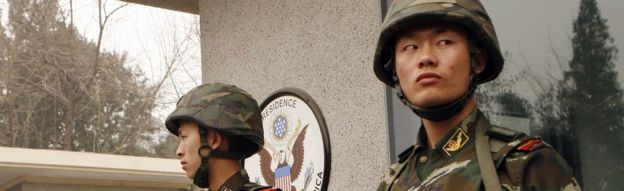
Three armed Chinese policemen guarding the US embassy in BeijingImage copyright AFP
Image caption Chinese police guard the US embassy in the capital, Beijing
  • 2010: Information gathered by the US from sources deep inside the Chinese government bureaucracy start to dry up
  • 2011: Informants begin to disappear. It is not clear whether the CIA has been hacked or whether a mole has helped the Chinese to identify agents
  • 2012: FBI begins investigation
  • May 2014: Five Chinese army officers are charged with stealing trade secrets and internal documents from US companies. Later that same month, China says it has been a main target for US spies
  • 2015: CIA withdraws staff from the US embassy in Beijing, fearing data stolen from government computers could expose its agents
  • April 2017: Beijing offers hefty cash rewards for information on foreign spies
  • May 2017: Four former CIA officials tell the New York Times that up to 20 CIA informants were killed or imprisoned by the Chinese between 2010 and 2012
  • June 2017: Ex-CIA officer Kevin Mallory is arrested and charged with giving top-secret documents to a Chinese agent
  • January 2018: Former CIA officer Jerry Chun Shing Lee is arrested
  • June 2018: Former US intelligence officer Ron Rockwell Hansen is charged with attempting to spy for China
  • Source: The BBC
06/05/2019

Ex-CIA agent Jerry Chun Shing Lee admits spying for China

A man (R, wearing blue tie) identified by local Hong Kong media as former CIA agent Jerry Chun Shing LeeImage copyrightAFP
Image caption A man (R in blue tie) identified as Jerry Chun Shing Lee by Hong Kong media

An ex-CIA agent has pleaded guilty to spying for China, the US justice department says, in a case believed to be linked to the dismantling of a US espionage network.

Jerry Chun Shing Lee, 54, left the CIA in 2007 to live in Hong Kong, where he was recruited by Chinese agents.

Prosecutors say the naturalised US citizen was then paid to divulge information on US covert assets.

This led China to bring down a network of informants between 2010 and 2012.

About 20 informants were killed or jailed during that period – one of the most disastrous failures of US intelligence in recent years.

The US Assistant Attorney General for National Security, John Demers, said Lee’s case was the third involving US agents and China in less than a year.

“Every one of these cases is a tragic betrayal of country and colleagues,” he said.

What did Lee do?

Lee, who worked for the CIA between 1994 and 2007, pleaded guilty to conspiracy to deliver national defence information to aid a foreign government in a court in Virginia on Wednesday, the justice department said in a statement.

It said Lee was contacted by the Chinese intelligence agents in 2010. They offered him money, promising to take care of him “for life” in exchange for the required secret information. Hundreds of thousands of dollars were deposited in his Hong Kong bank account between May 2010 and December 2013.

Mr Lee created a document containing information about CIA activities, including locations to which US agents would be assigned.

In 2012, FBI agents searched a hotel room in Hawaii registered in Mr Lee’s name and found a USB drive. Investigators found the document on unallocated space in the drive, suggesting it had been deleted.

The search also revealed Lee to have a day planner and address book containing notes of intelligence provided by CIA agents, their true identities, operational meeting locations and phone numbers, and information about covert facilities.

Lee was interviewed by CIA officers in 2012 during which he said he had met Chinese intelligence officers but concealed the fact that they had set him tasks, the justice department said. In 2013 he first denied knowing about the document on his USB drive and then admitted he had created it but said he had never handed it on to Chinese agents.

Mr Lee was arrested at New York’s JFK airport in January 2018. He will be sentenced in August.


Spy v Spy

By Tara McKelvey, BBC News, Washington DC

The Lee case shows that the battle between Chinese and US spies has intensified over the past year, turning into a new “Cold War”, as Michael Collins, the deputy assistant director of the CIA’s East Asia mission center, called it.

The Chinese are investing more resources into their efforts to ferret out information about the US government, while the US government has become more aggressive in its pursuit of US citizens who have helped Chinese agents.

And when the guilty party is a former CIA officer, one of their own, the men and women who work in the field of US intelligence are ready to “bring the hammer down”, one senior intelligence official said.


CIA spy operation in China: Key dates

Three armed Chinese policemen guarding the US embassy in BeijingImage copyright AFP
Image caption Chinese police guard the US embassy in the capital, Beijing
  • 2010: Information gathered by the US from sources deep inside the Chinese government bureaucracy start to dry up
  • 2011: Informants begin to disappear. It is not clear whether the CIA has been hacked or whether a mole has helped the Chinese to identify agents
  • 2012: FBI begins investigation
  • May 2014: Five Chinese army officers are charged with stealing trade secrets and internal documents from US companies. Later that same month, China says it has been a main target for US spies
  • 2015: CIA withdraws staff from the US embassy in Beijing, fearing data stolen from government computers could expose its agents
  • April 2017: Beijing offers hefty cash rewards for information on foreign spies
  • May 2017: Four former CIA officials tell the New York Times that up to 20 CIA informants were killed or imprisoned by the Chinese between 2010 and 2012
  • June 2017: Former US diplomatic officer Kevin Mallory is arrested and charged with giving top-secret documents to a Chinese agent
  • January 2018: Former CIA officer Jerry Chun Shing Lee is arrested

Source: The BBC

19/02/2019

The US cannot crush us, says Huawei founder

The founder of Huawei has said there is “no way the US can crush” the company, in an exclusive interview with the BBC.

Ren Zhengfei described the arrest of his daughter Meng Wanzhou, the company’s chief financial officer, as politically motivated.

The US is pursuing criminal charges against Huawei and Ms Meng, including money laundering, bank fraud and stealing trade secrets.

Huawei denies any wrongdoing.

Mr Ren spoke to the BBC’s Karishma Vaswani in his first international broadcast interview since Ms Meng was arrested – and dismissed the pressure from the US.

“There’s no way the US can crush us,” he said. “The world cannot leave us because we are more advanced. Even if they persuade more countries not to use us temporarily, we can always scale things down a bit.”

However, he acknowledged that the potential loss of custom could have a significant impact.

What else did Mr Ren say about the US?

Last week, US Secretary of State Mike Pompeo warned the country’s allies against using Huawei technology, saying it would make it more difficult for Washington to “partner alongside them”.

Australia, New Zealand, and the US have already banned or blocked Huawei from supplying equipment for their future 5G mobile broadband networks, while Canada is reviewing whether the company’s products present a serious security threat.

Mr Ren warned that “the world cannot leave us because we are more advanced”.

“If the lights go out in the West, the East will still shine. And if the North goes dark, there is still the South. America doesn’t represent the world. America only represents a portion of the world.”

What did Mr Ren say about investment in the UK?

The UK’s National Cyber Security Centre has decided that any risk posed by using Huawei technology in UK telecoms projects can be managed.

Many of the UK’s mobile companies, including Vodafone, EE and Three, are working with Huawei to develop their 5G networks.

They are awaiting a government review, due in March or April, that will decide whether they can use Huawei technology.

Commenting on the possibility of a UK ban, Mr Ren said Huawei “won’t withdraw our investment because of this. We will continue to invest in the UK.

“We still trust in the UK, and we hope that the UK will trust us even more.

“We will invest even more in the UK. Because if the US doesn’t trust us, then we will shift our investment from the US to the UK on an even bigger scale.”

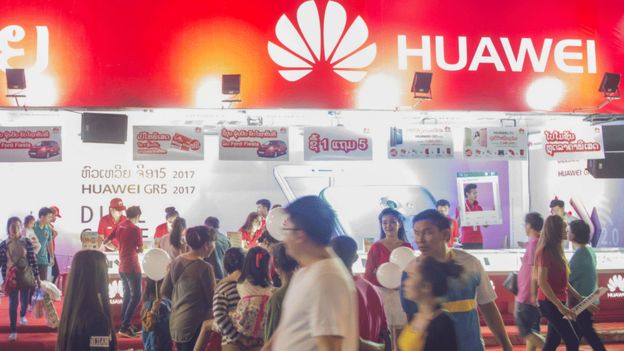
Huawei boothImage copyrightGETTY IMAGES
Image captionHuawei has denied that it poses any risk to the UK or any other country

What does Mr Ren think about his daughter’s arrest?

Mr Ren’s daughter Meng Wanzhou, Huawei’s chief financial officer, was arrested on 1 December in Vancouver at the request of the US, and is expected to be the subject of a formal extradition request.

In total, 23 charges are levelled against Huawei and Ms Weng. The charges are split across two indictments by the US Department of Justice.

The first covers claims Huawei hid business links to Iran – which is subject to US trade sanctions. The second includes the charge of attempted theft of trade secrets.

Mr Ren was clear in his opposition to the US accusations.

“Firstly, I object to what the US has done. This kind of politically motivated act is not acceptable.

“The US likes to sanction others, whenever there’s an issue, they’ll use such combative methods.

“We object to this. But now that we’ve gone down this path, we’ll let the courts settle it.”

Meng Wanzhou, Huawei Technologies Co Ltd"s chief financial officer (CFO), is seen in this undated handout photo obtained by Reuters December 6, 2018.Image copyrightREUTERS
Image captionMeng Wanzhou was arrested in Vancouver last December

What did Mr Ren say about Chinese government spying?

Huawei, which is China’s largest private company, has been under scrutiny for its links to the Chinese government – with the US and others expressing concern its technology could be used by China’s security services to spy.

Under Chinese law, firms are compelled to “support, co-operate with and collaborate in national intelligence work”.

But Mr Ren said that allowing spying was a risk he wouldn’t take.

“The Chinese government has already clearly said that it won’t install any backdoors. And we won’t install backdoors either.

“We’re not going to risk the disgust of our country and of our customers all over the world, because of something like this.

“Our company will never undertake any spying activities. If we have any such actions, then I’ll shut the company down.”

Presentational grey line

Is Huawei part of the Chinese state?

Analysis – Karishma Vaswani, BBC Asia business correspondent – Shenzhen

For a man known as reclusive and secretive, Ren Zhengfei seemed confident in the conviction that the business he’s built for the last 30 years can withstand the scrutiny from Western governments.

Mr Ren is right: the US makes up only a fraction of his overall business.

But where I saw his mood change was when I asked him about his links to the Chinese military and the government.

He refused to be drawn into a conversation, saying only that these were not facts, simply allegations.

Still, some signs of close links between Mr Ren and the government were revealed during the course of our interview.

He also confirmed that there is a Communist Party committee in Huawei, but he said this is what all companies – foreign or domestic – operating in China must have in order to abide by the law.

Source: The BBC

18/02/2019

Britain does not support total Huawei network ban – sources

(Reuters) – British security officials do not support a full ban of Huawei from national telecoms networks despite U.S. allegations the Chinese firm and its products could be used by Beijing for spying, people with knowledge of the matter said.

Huawei, the world’s biggest producer of telecoms equipment, faces intense scrutiny in the West over its relationship with the Chinese government and allegations of enabling state espionage, with the United States calling for its allies not to use its technology.

Although no evidence has been produced publicly and Huawei has denied the claims, the allegations have led several Western countries to restrict its access to their markets.

“We don’t favour a complete ban. It’s not that simple,” one of the sources told Reuters on Monday after a Financial Times report on Sunday said that Britain had decided it could mitigate the risks of using Huawei equipment in 5G networks.

The FT cited two sources familiar with what it said was a conclusion by the government’s National Cyber Security Council (NCSC), which last year said technical and supply-chain issues with Huawei’s equipment had exposed national telecom networks to new security risks. Huawei had no immediate comment.

Any decision to allow Huawei to participate in building next-generation 5G networks would be closely watched by other nations, because of Britain’s membership of the Five Eyes intelligence-sharing group with the United States.

Britain is an important market for Huawei and last month Vodafone, the world’s second-largest mobile operator, said it was “pausing” the deployment of its equipment in core networks until Western governments give the Chinese firm full security clearance.

Other operators in Europe, including Britain’s BT and France’s Orange have already removed Huawei’s equipment or taken steps to limit its future use.

Two sources said the NCSC did not think it was necessary to completely bar Huawei from British networks, believing it could continue to manage any risks by testing the products at a special laboratory overseen by intelligence officials.

Both sources, who spoke on condition of anonymity because of the sensitivity of the matter, said the position was consistent with public statements made by the NCSC and British officials.


“As was made clear in July’s HCSEC oversight board, the NCSC has concerns around Huawei’s engineering and security capabilities. We have set out the improvements we expect the company to make, an NCSC spokeswoman said on Monday.

CONFIDENCE MEASURES

People with knowledge of the matter said the next NCSC report on Huawei’s position in Britain will criticise its slow response to issues raised in last year’s report and detail tense relations with British officials.

The report, which is expected to be released in coming weeks, does not itself set government policy.

The results of a government review of British telecoms infrastructure is expected later in the year and will include recommendations on managing security risks, including in future 5G networks.

Fellow Five Eyes member Australia has banned Huawei from supplying 5G equipment, while New Zealand said on Monday it would make its own independent assessment of the risk of using Huawei equipment in 5G networks.

Huawei has set up security labs in Britain and Germany aimed at building confidence that its equipment does not contain “back doors” for Chinese intelligence services.

It has also offered to build a cyber-security centre in Poland, where authorities have arrested a Chinese Huawei employee along with an ex-Polish security official.

Source: Reuters

Law of Unintended Consequences

continuously updated blog about China & India

ChiaHou's Book Reviews

continuously updated blog about China & India

What's wrong with the world; and its economy

continuously updated blog about China & India