Archive for ‘staff’

24/10/2019

Essex lorry deaths: 39 found dead ‘were Chinese nationals’

The 39 people found dead in a refrigerated trailer in Essex were Chinese nationals, it is understood.

Police are continuing to question lorry driver Mo Robinson, 25, who was arrested on suspicion of murder.

Officers in Northern Ireland have raided two houses and the National Crime Agency said it was working to identify “organised crime groups who may have played a part”.

The trailer arrived in Purfleet on the River Thames from Zeebrugge in Belgium.

Ambulance staff discovered the bodies of the 38 adults and one teenager in the container at Waterglade Industrial Park in Grays just after 01:30 BST on Wednesday.

The lorry and trailer left the port at Purfleet shortly after 01:05.

Police said the tractor unit – the front part of the lorry – came from Northern Ireland and picked up the trailer from Purfleet.

Mo RobinsonImage copyright FACEBOOK
Image caption The lorry driver has been named locally as Mo Robinson, from County Armagh

Councillor Paul Berry said the village of Laurelvale in County Armagh, where the Robinson family live, was in “complete shock”.

He said he had been in contact with Mr Robinson’s father, who had learned of his son’s arrest on Wednesday through social media.

“The local community is hoping that he [Mo Robinson] has been caught up innocently in this matter but that’s in the hands of Essex Police, and we will leave it in their professional hands to try to catch the perpetrators of this,” he said.

The Belgian Federal Public Prosecutor’s Office said it had opened a case which would focus on the organisers and others involved in the transport.

A spokesman said the container arrived in Zeebrugge at 14:29 on Tuesday and left the port later that afternoon before arriving in Purfleet in the early hours of Wednesday.

It was not clear when the victims were placed in the container or if this happened in Belgium, he said.
Media caption Essex lorry deaths: CCTV shows arrival at industrial park

St Peter and St Paul’s Church in Grays will be open for people to light candles and say prayers between 12:00 and 14:00.

A vigil is being held at 18:00 outside the Home Office to “call for urgent action to ensure safe passage” for people fleeing war and poverty.

The lorry was moved to a secure site at Tilbury Docks on Wednesday so the bodies could be “recovered while preserving the dignity of the victims”.

Essex Police initially suggested the lorry could be from Bulgaria, but later said officers believed it entered the UK from Belgium.

The force said formal identification of the 39 bodies “could be a lengthy process”.

A spokesman for the Bulgarian foreign affairs ministry said the truck was registered in the country under the name of a company owned by an Irish citizen.

He said it was “highly unlikely” the deceased were Bulgarians.
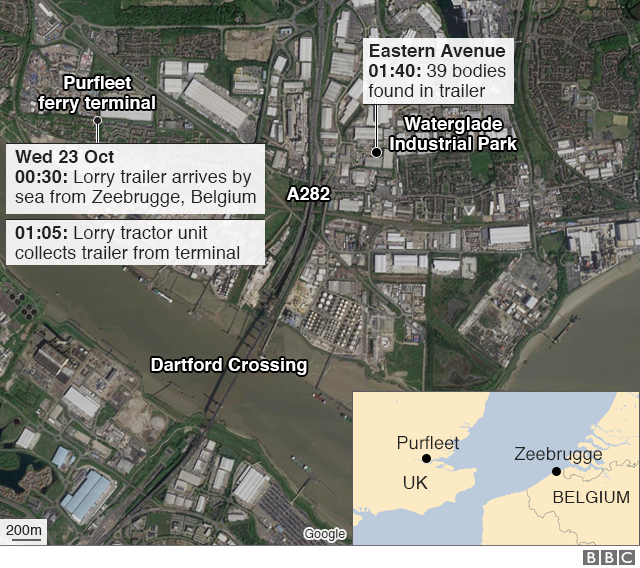
Graphic of Purfleet ferry channel

Shaun Sawyer, the National Police Chiefs Council lead for modern slavery and human trafficking, said while forces had prevented thousands of deaths, “tragically, for 39 people that didn’t work yesterday”.

He told BBC Radio 4’s Today programme even if there were routes perceived as easier to get through, organised criminals would still exploit people who could not access those.

“You can’t turn the United Kingdom into a fortress,” added Mr Sawyer, who is the Chief Constable of Devon and Cornwall Police.
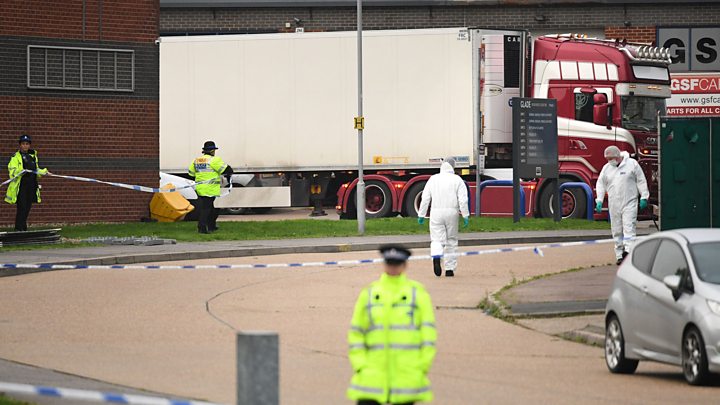
Media caption I’ve seen people running out of a lorry’

Thurrock’s Conservative MP Jackie Doyle-Price said there needed to be an international response.

“We have partnerships in place but those efforts need to be rebooted, this is an international criminal world where many gangs are making lots of money and until states act collectively to tackle that it is going to continue,” she said.

Richard Burnett, chief executive of the Road Haulage Association, said temperatures in refrigerated trailers could be as low as -25C.

He described conditions for anyone inside as “absolutely horrendous”.

Prime Minister Boris Johnson said it was an “unimaginable tragedy and truly heartbreaking”.

Presentational grey line

How many migrants have died in transit?

The number of migrants who die in transit has been recorded by the UN since 2014.

Since then, five bodies of suspected migrants had been found in lorries or containers in the UK before this tragedy.

Data was not collected in the same way before the migrant crisis began in 2014, but such deaths are not new.

In 2000, 58 Chinese migrants were found suffocated to death in a lorry at Dover.

In 2015, the bodies of 71 people were found in an abandoned lorry on an Austrian motorway. Police suspected the vehicle was part of a Bulgarian-Hungarian human trafficking operation.

Source: The BBC

03/10/2019

As protests rack Hong Kong, China watchdog has Cathay staff ‘walking on eggshells’

HONG KONG (Reuters) – Staff at Cathay Pacific Airways, Hong Kong’s flagship airline, are on edge.

A Cathay Pacific Boeing 777-300ER plane lands at Hong Kong airport after it reopened following clashes between police and protesters, in Hong Kong, China August 14, 2019. REUTERS/Thomas Peter
Their city has been gripped by months of anti-government protests, and their company is feeling the wrath of China’s aviation regulator after some staff members took part or expressed support.
Since an Aug.9 directive by the Civil Aviation Authority of China (CAAC) that called for the suspension of staff who supported or participated in the demonstrations, the regulator has rejected some entire crew lists without explanation, two sources with knowledge of the matter told Reuters.
The rejections have forced Cathay to scramble, pulling pilots and flight attendants off standby while it investigates social media accounts in an effort to determine which crew member has been deemed a security threat, one of the sources said.
Other disruptions have come in the form of a huge jump in the number of plane inspections upon landing, four pilots said.
The flexing of regulatory muscle has contributed to a climate of fear within the airline, with employees telling Reuters they felt Cathay’s longer-term future as an independent company was highly uncertain and subject to Beijing’s whims.
The CAAC’s labelling of employees who support the protest as a security risk and its demand that they be suspended from flying over mainland airspace has been a de facto career killer.
Around three quarters of Cathay flights use mainland airspace and due to the directive, 30 rank-and-file staff, including eight pilots and 18 flight attendants, have been fired or resigned under pressure, according to the Hong Kong Cabin Crew Federation.
Cathay CEO Rupert Hogg and his top deputy also resigned in August amid the mounting regulatory scrutiny on the 73-year-old airline, one of the region’s most high-profile brands that draws on Hong Kong’s British heritage.
“Things changed very quickly,” said Jeremy Tam, a pro-democracy lawmaker and pilot who resigned from the airline after the CAAC directive, likening the atmosphere to a political trial. “The threat is huge and it’s almost like zero to 100 in two seconds.”
Reuters talked to 14 current and former employees for this article. Nearly all declined to be identified for fear of being fired or due to the sensitivity of the matter.
The CAAC did not respond Reuters requests for comment on the rejections of crew lists or the increase in plane checks.Cathay said in a statement it must comply with all regulatory requirements. “Quite simply, this is our licence to operate; there is no ground for compromise,” it said.
The airline declined to comment on the number of employee departures, but said any terminations took into account factors such as a person’s ability to perform their role.

DEMERIT SYSTEM

Aviation regulators around the world conduct occasional plane inspections at airports to ensure an airline is in compliance with safety regulations.

But after the CAAC’s Aug. 9 directive, the once-infrequent inspections occurred almost daily and included the new and unusual step of checking phones owned by crew for anti-China photos and messages, the pilots said, adding that this had led to flight delays.

The step-up in checks has increased the likelihood of regulators finding minor issues to write up, which pilots said had included dirt on the plane’s exterior and scratches on a fire extinguisher.

Infractions can have outsized consequences under the CAAC’s strict demerit points system, they said, noting the regulator could force Cathay to reduce its number of flights, cut destinations or in a worst-case scenario, revoke the airline’s right to fly to mainland China.

Management has urged staff to do their utmost to avoid infractions.

“It is nothing less than the survival of the airline at stake,” said a senior employee. “Management have made that abundantly clear at meetings.”

Executives are particularly sensitive after seven incidents outside mainland China in the past two months in which pre-flight checks found emergency oxygen bottles for crew were depleted.

The CAAC is more public than many regulatory peers about disclosing safety violations, warnings and punishments.

In 2017, Emirates was banned from expanding its operations for six months following two safety incidents, while flag carrier Air China Ltd was ordered last year to cut Boeing Co 737 flights by 10% after an emergency descent linked to a pilot smoking an e-cigarette in the cockpit.

Cathay declined to provide information on its points under the CAAC system but said it wanted to emphasise that there had been no impact on its flight services into mainland China.

The pilots said the high frequency of airplane checks, which one described as “very intimidatory”, was starting to recede.

A THOUSAND CUTS

Employees are also feeling pressure from other regulatory bodies.

Last week, ahead of China’s National Day on Oct.1, immigration officers at some mainland airports requested photos of crew with the Chinese flag, said a pilot at regional arm Cathay Dragon who flies to the mainland regularly.

He said to his knowledge, most pilots – many of whom are expats from Western countries – had refused but Hong Kong cabin crew were “too nervous to say no” given the scrutiny on their actions by the company and the Chinese government.
“Everyone is walking on eggshells in China,” the pilot said.
Cathay did not respond to a request for comment, while China’s Ministry of Public Security, which oversees immigration, did not respond to a request for comment during a week of public holidays.
There has been no let-up in the widespread, sometimes violent, unrest that has beset Hong Kong. Triggered by a now-withdrawn extradition bill, it has morphed into an outpouring of opposition to the former British colony’s Beijing-backed government.

The crisis has also meant a sharp drop in travel demand to Hong Kong, putting more pressure on Cathay.

Cathay’s overall passenger numbers were down 11.3% in August. Flights at Cathay Dragon, which does most of Cathay’s mainland flying, were on average 60-65% full in September, down from the usual 80%, according to estimates from two pilots.

The pilots said while the sharp drop in demand was in some ways similar in scale to that weathered by Cathay during the SARS epidemic and the global financial crisis, there were key differences that felt more threatening to the company’s future.

Some state-controlled firms such as China CITIC Bank International and Huarong International have told employees to avoid flying with Cathay, and it has been attacked by Chinese state news organisations as well as by many mainland consumers on social media.

CAAC’s Aug.9 statement which called staff who supported the protests a security risk has also put Cathay’s reputation as one of the world’s safest airlines under a cloud it does not deserve, employees said.

Many acknowledged the new management team, which oversees around 33,000 employees, has few palatable options in dealing with the situation given the sway Beijing holds over the airline’s operations.

But they lamented the loss of freedom of speech and sense of job security, saying employees are afraid to speak about anything even vaguely political or voice support for protests on social media for fear of being reported by colleagues under a whistleblower policy.

“It has become a Hong Kong company with mainland employment terms,” a pilot at Cathay Dragon said. “The risk is death by a thousand cuts.”

Source: Reuters

18/09/2019

Chinese head teacher sacked over canteen washing up scandal

  • Video of staff washing tableware with laundry detergent goes viral
A primary school principal has been sacked after it emerged laundry detergent was used in the canteen to wash tableware. Photo: Thepaper.cn

The head of a primary school in northeastern China has been sacked and a government investigation is underway into the use of laundry washing powder to clean tableware in the school canteen.

The scandal came to light when a video of canteen staff washing up at Dongfeng Primary School in Zuanghe, Liaoning province, went viral on Chinese social media.

The video shows staff, wearing white uniforms and aprons, cleaning plates and bowls in basins containing water tainted with laundry detergent. It is unclear when the incident happened.

In a statement on Weibo, China’s version of Twitter, on Tuesday, the municipal government said the head of the school had been dismissed and representatives had been assigned by the authorities to take charge of the school’s daily operation. Due diligence investigations of the relevant department would begin “immediately”, the statement said.
Chinese school heads told to eat with pupils after string of scandals
The local administration for market regulation had also been ordered to speed up an examination of the food samples, tableware and washing products at the school, and the results would be made public in a timely manner, the authorities said.

Until the investigation is concluded, meals at the school, which has about 400 pupils, will be the responsibility of the municipal education department.

As an added precaution, food safety inspections would be carried out at all elementary and middle schools in the region.

The prompt action by the authorities reflects the wide public attention in China to any food safety scandal which involves children.

The principal of an international school in Shanghai was dismissed in October after parents of students found mouldy tomatoes and onions in a kitchen where food was prepared for pupils. In May, video footage showing mouldy food in the canteen of a middle school in Chengdu, Sichuan province, triggered angry parents to stage protests outside the school and the local government building.

Source: SCMP

13/08/2019

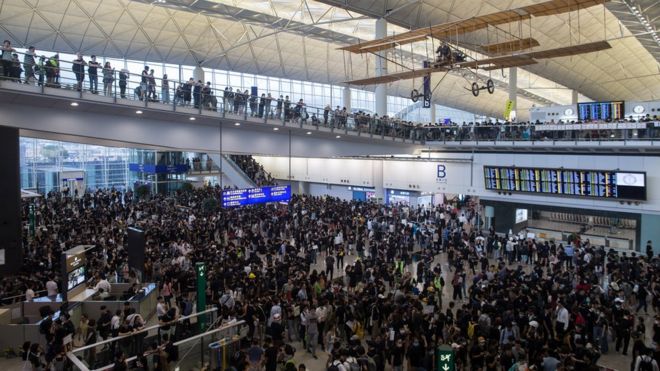
Hong Kong protests: Airport cancels flights as thousands occupy

Protesters occupy Hong Kong Chek Lap Kok International Airport in Hong Kong, China,Image copyright EPA
Image caption Officials say about 5,000 gathered for the fourth day of protests at the airport

Hong Kong International Airport cancelled all departures on Monday, as thousands of anti-government protesters occupied and caused disruption.

Passengers have been told not to travel to the airport, which is one of the world’s busiest transport hubs.

In a statement, officials blamed “seriously disrupted” operations.

Many of those protesting are critical of the actions of police, who on Sunday were filmed firing tear gas and rubber bullets at close range.

Some protesters wore bandages over their eyes in response to images of a woman bleeding heavily from her eye on Sunday, having reportedly been shot by a police projectile.

In a statement on Monday afternoon, Hong Kong’s Airport Authority said they were cancelling all flights that were not yet checked in.

More than 160 flights scheduled to leave after 18:00 local time (10:00 GMT) will now not depart.

Arrivals already heading into Hong Kong will still be allowed to land, but other scheduled flights have been cancelled.

Officials are now working to reopen the airport by 06:00 on Tuesday, a statement said.

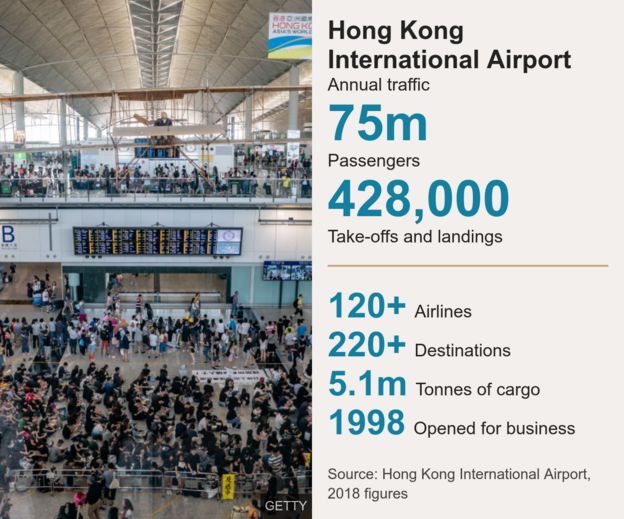
Graphic shows the scale of Hong Kong airport's operations
Some passengers expressed annoyance at the disruption. “It’s very frustrating and scary for some people,” one man from Pakistan told the BBC. “We’ll just have to wait for our next flight.”

Helena Morgan, from the UK, said she was set to return to the UK to get her exam results on Thursday. “I’m hoping we get back for them and we’re not on a flight,” she said.

But others were more understanding of the protests. “I was expecting something, given all the news,” one arrival, Gurinda Singh, told Reuters news agency.

As rumours spread that police plan to move in on protesters on Monday evening, thousands opted to leave on foot. There are large backlogs for transport back into the centre, local reports say.

The BBC’s Stephen McDonell, who is at the scene, says the airport has effectively shut down while authorities work out how to deal with the crisis.

Hong Kong’s mass demonstrations and unrest show no sign of abating, more than two months after they were sparked by a controversial extradition bill.

Beijing officials have strongly condemned Sunday’s violence and linked violent protesters to “terrorism”.

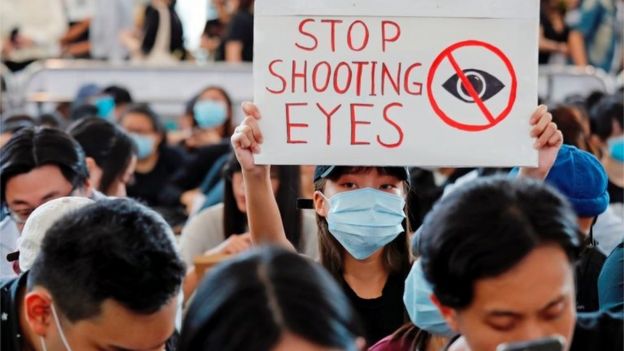
A protester in the airport holds a sign that says "stop shooting eyes"Image copyright REUTERS
Image caption Many of those who gathered carried signs condemning police conduct

What happened on Sunday?

On Sunday afternoon, a peaceful rally in the city’s Victoria Park led to clashes when protesters moved out of the area and marched along a major road despite a police ban.

There were confrontations in several central districts and police used rubber bullets in an attempt to disperse the demonstrators.

In the bustling central Wan Chai district, petrol bombs and bricks were thrown at police, who responded by charging at protesters.

A number of people, including a police officer, were injured in the clashes.

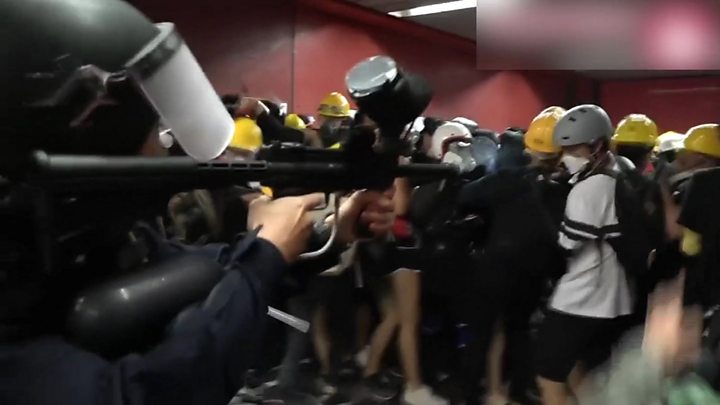
Videos on social media also showed officers storming enclosed railway stations and firing tear gas.

Footage inside another station showed officers firing what appeared to be rubber bullets at close range and several police officers beating people with batons.

Media caption Violence erupts in HK train stations

Local media outlets reported that suspected undercover police officers had dressed-up as protesters to make surprise arrests.

While protests in the city have turned increasingly violent, there were no reports of arrests during the three previous days of the airport sit-in.

What has the reaction been?

On Monday the Chinese authorities, who have not yet physically intervened to quell the unrest, used their strongest language yet to condemn violent protesters.

“Hong Kong’s radical demonstrators have repeatedly used extremely dangerous tools to attack police officers, which already constitutes a serious violent crime, and also shows the first signs of terrorism emerging,” Yang Guang, a spokesman for the Hong Kong and Macau Affairs Office (HKMAO), said at a press briefing.

“This wantonly tramples on Hong Kong’s rule of law and social order.”

Elsewhere, Cathay Pacific has warned staff they could be fired if they “support or participate in illegal protests” in Hong Kong. The development comes days after Beijing mounted pressure on the airline and a #BoycottCathayPacific campaign began to spread.

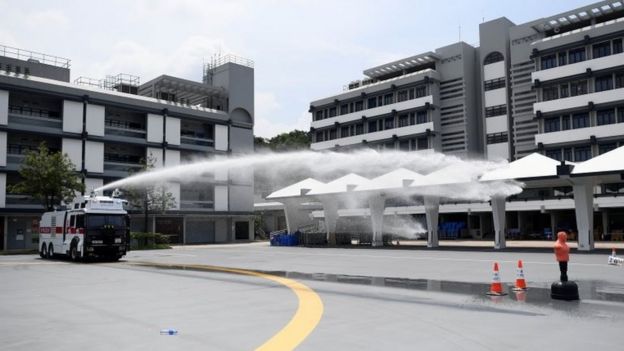
Hong Kong police have also unveiled a water cannon vehicle as a new tool to combat the protests.

Hong Kong Police demonstrate their new water cannon equipped vehicle at the Police Tactical Unit compound in Hong KongImage copyright AFP

Amnesty International has previously warned that the tool could cause serious injuries and inflame tensions.

Why are there protests in Hong Kong?

Demonstrations started in June in opposition to a proposed extradition bill, which would have allowed suspected criminals to be sent to mainland China for trial.

Critics said it would undermine Hong Kong’s legal freedoms, and could be used to silence political dissidents.

Although the government has now suspended the bill, demonstrators want it to be fully withdrawn.

Their demands have broadened to include calls for an independent inquiry into alleged police brutality, and an amnesty for all arrested protesters.

Hong Kong is part of China but its citizens have more autonomy than those on the mainland.

It has a free press and judicial independence under the so-called “one country, two systems” approach – freedoms which activists fear are being increasingly eroded.

Source: The BBC

Law of Unintended Consequences

continuously updated blog about China & India

ChiaHou's Book Reviews

continuously updated blog about China & India

What's wrong with the world; and its economy

continuously updated blog about China & India