23/04/2020
BENGALURU (Reuters) – The Indian economy is likely to suffer its worst quarter since the mid-1990s, hit by the ongoing lockdown imposed to stem the spread of coronavirus, according to a Reuters poll, which predicted a mild and gradual recovery.
Over 2.6 million people tmsnrt.rs/3aIRuz7 have been infected by the coronavirus worldwide and more than 180,000 have died. Business and household lockdowns have disrupted supply chains globally, bringing growth to a halt.
The April 17-22 Reuters poll predicted the economy expanded at an annual pace of 3.0% last quarter but will shrink 5.2% in the three months ending in June, far weaker than expectations in a poll published last month for 4.0% and 2.0% growth, respectively.
The predicted contraction would be the first – under any gross domestic product calculation, which has changed a few times – since the mid-1990s, when official reporting for quarterly data began.
“The extended lockdown until early May adds further downside risk to our view of a 5% year-on-year GDP fall in the current quarter, the worst in the last few decades,” said Prakash Sakpal, Asia economist at ING.
“We don’t consider economic stimulus as strong enough to position the economy for a speedy recovery once the pandemic ends,” he said.
(Graphic: Reuters poll graphic on coronavirus impact on the Indian economy IMAGE link: here)
The Indian government announced a spending package of 1.7 trillion rupees in March to cushion the economy from the initial lockdown, which has been extended until May 3.
In an emergency meeting last week, the Reserve Bank of India cut its deposit rate again, after reducing it on March 27 and lowering the main policy rate by 75 basis points. It also announced another round of targeted long-term repo operations to ease liquidity.
But even with those measures, 40% of economists, or 13 of 32 – who provided quarterly figures – predicted an outright recession this year. Only one had expected a recession last month.
In the worst case, a smaller sample of respondents predicted, the economy would contract 9.3% in the current quarter. That compares with 0.5% growth in the previous poll’s worst-case forecast in late March, underscoring how rapidly the outlook has deteriorated.
The latest poll’s consensus view still shows the economy recovering again slowly in the July-September quarter, growing 0.8%, then 4.2% in October-December and 6.0% in the final quarter of the fiscal year, in early 2021.
But that compares with considerably more optimistic near-term forecasts of 3.3%, 5.0% and 5.6%, respectively, in the previous poll.
“A rebound in economic activity following the disruption is expected, but the low starting point of growth implies a gradual recovery,” said Upasana Chachra, chief India economist at Morgan Stanley.
“Indeed, before disruptions related to COVID-19, growth was slowing, with domestic issues of risk aversion in financial sector … (and) those concerns will likely stay after the COVID-19 disruptions have passed unless the policy response is much larger than expected,” she said.
The unemployment rate has tripled to 23.8% since the lockdown started on March 25, according to the Centre for Monitoring Indian Economy, a Mumbai-based research firm.
The Indian economy was now forecast to expand 1.5% in the fiscal year ending on March 31, 2021 – the weakest since 1991 and significantly lower than 3.6% predicted in late March. It probably grew 4.6% in the fiscal year that just ended.
Under a worst-case scenario, the median showed the economy shrinking 1.0% this fiscal year. That would be the first officially reported economic contraction for a 12-month period since GDP was reported to have contracted for calendar year 1979.
“Unless fiscal policy is also loosened aggressively alongside monetary policy, there is a big risk the drastic economic slowdown currently underway morphs into an annual contraction in output and that the recovery is hampered,” said Shilan Shah, senior India economist at Capital Economics.
All 37 economists who answered a separate question unanimously said the RBI would follow up with more easing, including lowering the repo and reverse repo rates and expanding the new long-term loans programme.
The RBI was expected to cut its repo rate by another 40 basis points to 4.00% by the end of this quarter. Already lowered twice over the past month by a cumulative 115 basis points, the reverse repo rate was forecast to be trimmed by another 25 points by end-June to 3.50%.
Source: Reuters
Posted in 5, according, after, again, announced, annual pace, another, any, Asia economist, basis points, began, Bengaluru, bringing, Business, but, calculation, Capital Economics, consider, contraction, coronavirus, coronavirus impact, COVID-19, cushion, cut, decades, deposit, died, disrupted, downside, ease, economic stimulus, Economists, economy, emergency, ending, ends, enough, even with, expanded, EXPECTATIONS, expected, extended, fall, figures, first, Fiscal policy, GDP, globally, gradual, Gross domestic product, growth, halt, Household, imposed, India economist, Indian economy, Indian governments, infected, initial, June, last few, last month, last quarter, last week, liquidity, lockdown, lockdowns, Locked-down, long term, lowering, main policy\, March, May, measures, meeting, mid-1990s, mild, million, months, more than, Official, once, ongoing, Only one, operations, outright, pandemic, People, position, predicted, provided, published, quarter, quarterly, rate, Recession, recovery, reducing, repo, reporting, Reserve Bank of India, respectively, respondents, Reuters Poll, Risk, round, rupees, sample, shrink, since, smaller, speedy, spending package, spread, stem, strong, suffer, supply chains, targeted, this year, Three, trillion, Uncategorized, under, Until, view, weaker, worldwide, worst, worst case, year-on-year |
Leave a Comment »
31/01/2020
- The island nation is the first Southeast Asian country to bar all visitors from the mainland
- The visa suspension will come into effect immediately, while the travel restriction will start at 11.59pm on Saturday
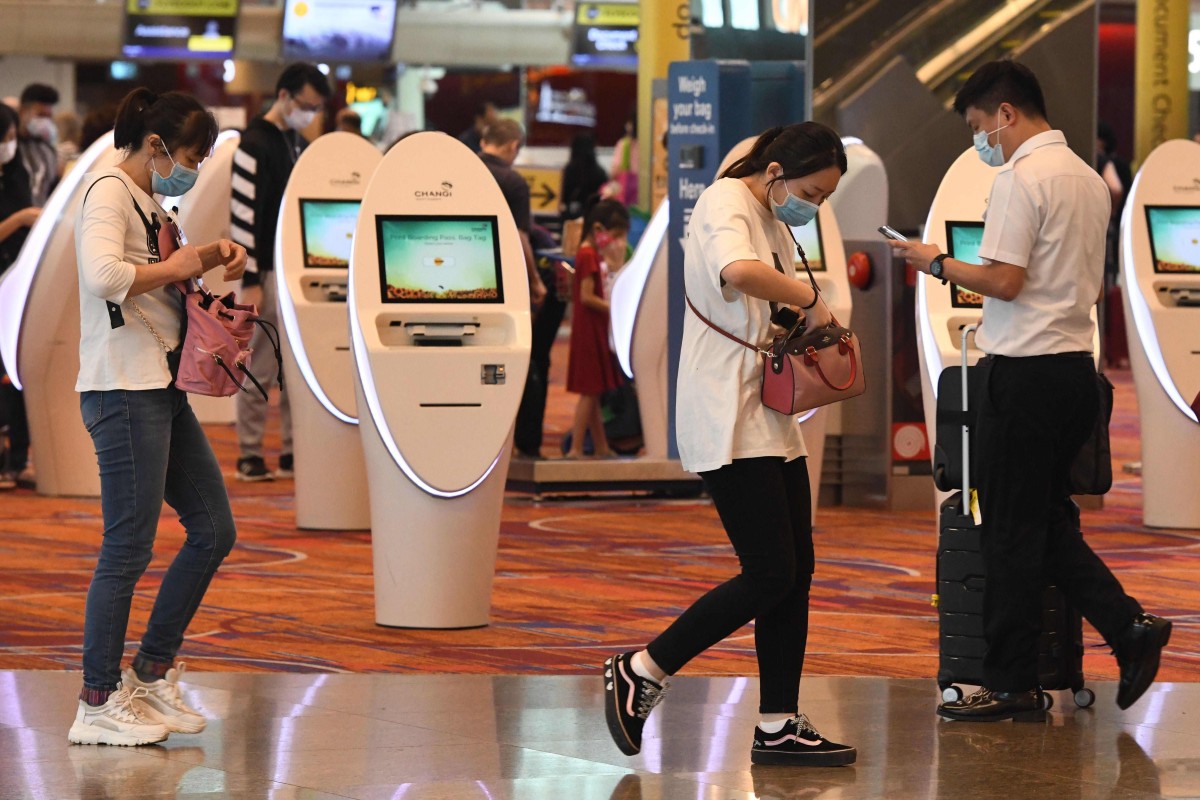
Travellers wearing face masks at Changi International Airport in Singapore. Photo: AFP
will close its borders to all new visitors from mainland China, including foreigners who have been there within the past 14 days, becoming the first Southeast Asian country to do so in a bid to stem the spread of the deadly coronavirus
.
The island nation has China as one of its biggest trading partners and is a popular destination for Chinese tourists. Figures from the Singapore Tourism Board showed that 248,000 travellers from the mainland entered Singapore last November, while 3.42 million mainland Chinese tourists visited in 2018.
How Wuhan coronavirus spread anti-Chinese racism like a disease through Asia
The visa suspension will come into effect immediately so travellers can be informed in advance, while the travel restriction will start at 11.59pm on Saturday.
As of Friday, Singapore has 13 confirmed cases of the novel coronavirus, all of whom are travellers from the Chinese city of Wuhan. Health authorities have stressed that there is no evidence of community spread within the city state as of now.
The coronavirus has infected almost 10,000 people around the world, killing 213. The World Health Organisation has declared the outbreak an international public health emergency.
The move is an escalation of Wednesday’s announcement that Singapore was stopping the entry of new travellers who had been to Hubei province, the epicentre of the outbreak. Wuhan is Hubei’s capital.
China coronavirus: Singapore’s seven habits for good hygiene
Residents and citizens of Singapore who have been to China will be able to come into the city state, but will be subject to a 14-day leave of absence during which they are encouraged to stay at home.
The move to close its borders to Chinese visitors comes on the back of local authorities’ assessment that more people in other parts of China are and will be affected by the virus.
The Singapore government will on Saturday announce a fiscal package to help businesses and citizens during the crisis.
Coronavirus: global travel restrictions imposed on Chinese travellers
National development minister Lawrence Wong, who co-chairs a multi-ministry task force to deal with the virus, said the outbreak had already impacted the economy and “will be going on for some time”.
Said Prime Minister Lee Hsien Loong: “It’s going to hurt us. China is a very big source of tourists for Singapore. [With the outbreak], that’s tailed off already considerably.”
Lee said tourism from other sources would also be affected as people took precautions, pinpointing the food and beverage, travel and hotel industries as those that were “bound to be significantly affected”.
“I expect the rest of the economy also to be affected because with China in semi-lockdown mode now, their economy is bound to slow down and our economy is quite tightly engaged with theirs, they are our biggest trading partner.”
Source: SCMP
Posted in borders, Changi International Airport, Chinese, closes, coronavirus, hubei province, international public health emergency, island nation, mainland, Singapore, Singapore Tourism Board, Southeast Asian country, spread, stem, travellers, Uncategorized, visa suspension, World Health Organisation, Wuhan |
Leave a Comment »




 CHINDIA ALERT: You'll be living in their world, very soon
