Archive for ‘Stockholm International Peace Research Institute’

28/10/2019

Putin accepts Duterte invite, just before Manila-Beijing South China Sea oil talks. Coincidence?

  • The president is set to become the first Russian leader to make a state visit to the Philippines for more than 40 years, according to a former envoy
  • Moscow is aware of China’s entry into the Philippines, and could have its eye on some projects there, while the US is also watching developments
Russian President Vladimir Putin and Philippine President Rodrigo Duterte shake hands during a 2016 meeting in Peru. Photo: EPA
The timing of Moscow’s announcement over the weekend that President Vladimir Putin
has accepted an invitation to visit Manila has raised eyebrows, as it comes on the eve of crucial bilateral talks between the Philippines and China on joint oil exploration in the

South China Sea

.

In a statement immediately welcomed by the Philippine presidential palace, Igor Khovaev, Russia’s ambassador to the Philippines, on Saturday told reporters Putin had accepted Duterte’s invitation “with gratitude”.

No date has been set for the visit, with Khovaev only saying Moscow would “do our best to arrange this meeting as soon as possible”.

A steering committee with representatives from both Manila and Beijing is set to meet this week to discuss the joint oil exploration deal. China has proposed a 60 per cent-40 per cent split in favour of the Philippines, according to Hermogenes Esperon, 

Courting Russia with South China Sea oil is a ‘dangerous gamble’ for Duterte

Neither side has clarified if the split refers to ownership or revenue, and no other details were disclosed.

After an August meeting with Duterte, Chinese President Xi Jinping said the countries could take a “bigger step” in jointly developing oil and gas resources if they could properly handle their sovereignty dispute in the South China Sea.

But defence and security analysts say the Philippine president took a “dangerous gamble” on a visit to Russia last month, when he invited the Russian state oil company Rosneft to explore for oil in Philippine waters – which include parts of the South China Sea claimed by China.

The timing of Moscow’s announcement has not gone unnoticed.
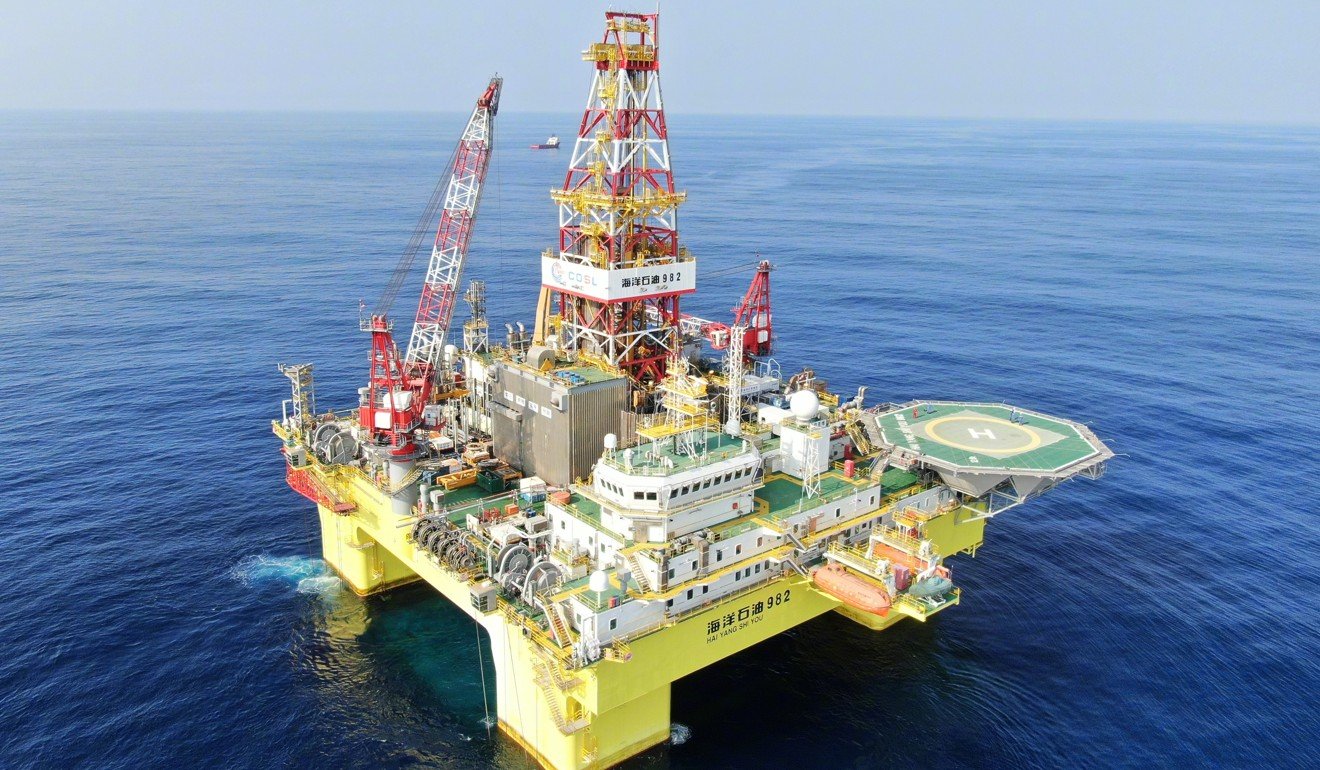
A Chinese deepwater oil rig in the South China Sea. Photo: Weibo

“It’s a welcome and historic development. Some wise guy in the Duterte government thought about timing [the invitation to Putin around the oil talks with Beijing],” said retired Philippine ambassador Lauro Baja, who once served as president of the United Nations Security Council.

Baja told the Post that no Russian president had visited the Philippines during his more than 40 years with the Department of Foreign Affairs.

“The Philippines then was almost a nonentity as far as Russia was concerned, [but] maybe now Russia recognises the strategic importance of the Philippines [in terms of] regional politics,” he said.

Baja said Moscow was aware of China’s entry into the Philippines, and could have its eye on some projects there.

“For all their so-called alliance, China and Russia are fierce competitors for influence and other benefits. And I think Russia has some objectives in mind like selling armaments and [forging] technological agreements,” he said, while cautioning that the situation remained “nebulous”.

New Philippines military chief sees no ‘shooting war’ in South China Sea despite disputes

“It’s a fascinating development but things are still early … For now, this is [just] an invitation extended by Duterte and accepted in principle by Putin.”

The United States will also be monitoring developments in the Philippines, according to Greg Poling, director of the Washington-based Centre for Strategic and International Studies’ Asia Maritime Transparency Initiative.

“Russia is eager to boost its influence in the region, and doubtless doing so with a long-standing US ally is seen as a bonus by Moscow,” he said. “There is nothing that prevents the Philippines from engaging in security cooperation with Russia, but the devil will be in the details.”

Poling added that the US would be concerned if Russia-Philippine cooperation involved acquiring military platforms that were incompatible with the shared platforms and doctrines used by Washington and Manila, as well as the latter’s other major security partners, namely Australia, Japan and South Korea.
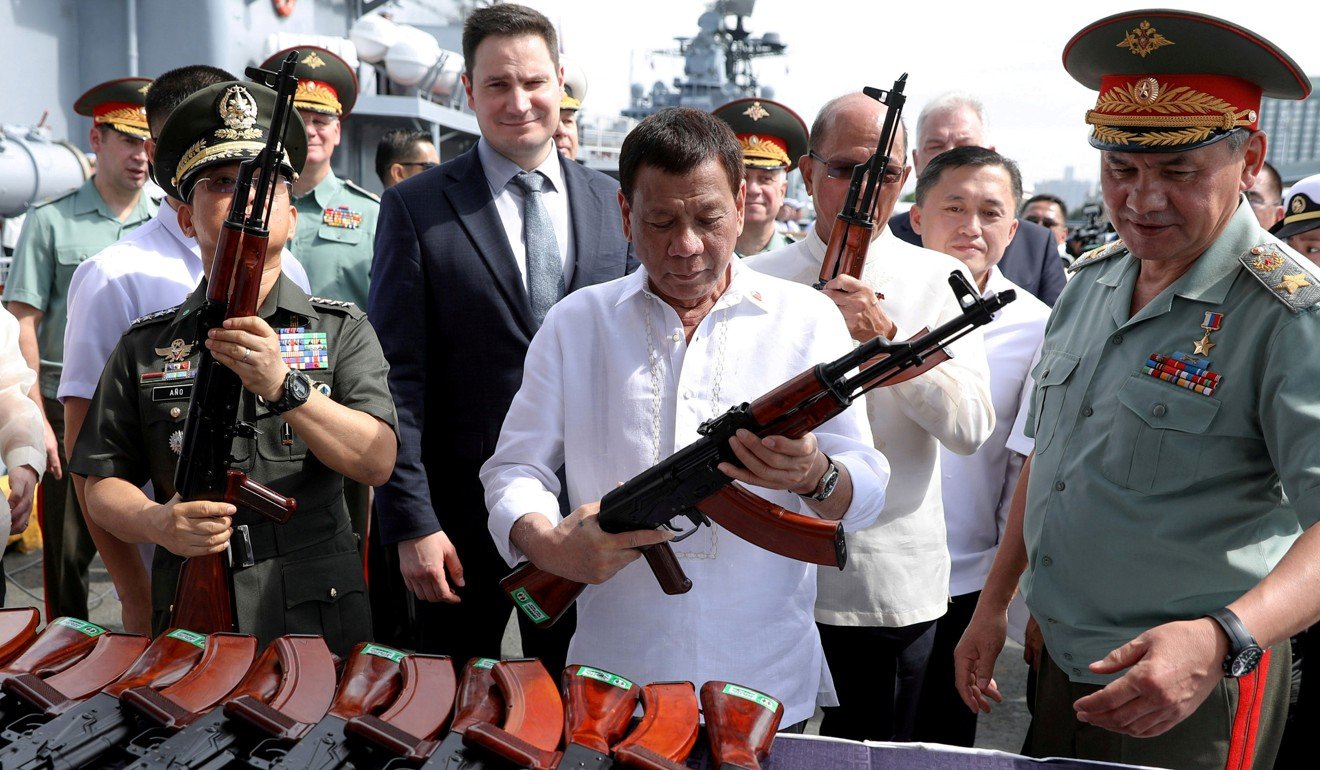
Philippine President Rodrigo Duterte inspects firearms donated by Russia in 2017. Photo: Reuters

“The US will also be concerned if any acquisitions or cooperation with Russia might threaten information security or intelligence cooperation between the US and the Philippines,” he said.

“And finally, any major platforms acquired from Russia would likely require the US to impose sanctions on the Philippines unless a waiver is granted, and the US government has been very stingy about awarding those waivers because they undermine the effectiveness of the sanctions regime.”

Moscow last week offered to help the Philippines produce its own arms for both domestic use and export with the help of Russian technology. Max Montero, an Australia-based Filipino security consultant, viewed that offer as “a swipe at the US”.

“Imagine a US stronghold and long-time ally and former colony becoming a manufacturing hub for Russian arms. And it makes it worse if [the Philippine armed forces] buys them too,” he said.

“Weakening the US alliances in Asia will benefit Russia [as it is] one of the US’ competitors in arms sales and geopolitics.”

Russia offers arms technology to the Philippines with ‘no conditions’ as US ties falter

The Philippines, Montero said, would benefit from such an arrangement since it is “a laggard in defence technology”. However, he pointed out that the country’s armed forces continue to buy weapons from the US and receive American arms as grants, potentially limiting the domestic market for Russian arms.

Navy cooperation has also been on the agenda, as Moscow and Manila discussed signing a new naval pact in March, while warships from each country have visited the other this year. Philippine naval vessels made their first-ever visit to Russia in October, while three Russian ships docked in the Philippines for a goodwill visit in January.

Russia is the top supplier of arms to Southeast Asia, and the No 2 global arms supplier, behind the US. Southeast Asia bought US$6.6 billion of Russian arms between 2010 and 2017, or more than 12 per cent of Russia’s sales, according to the Stockholm International Peace Research Institute, a Swedish think tank that publishes global arms tracking data.

Source: SCMP
10/06/2019

China’s massive military spending is creating a ripple effect across the Asia-Pacific region

  • With a defence budget second only to the US, China is amassing a navy that can circle the globe and developing state-of-the-art autonomous drones
  • The build-up is motivating surrounding countries to bolster their own armed forces, even if some big-ticket military equipment is of dubious necessity
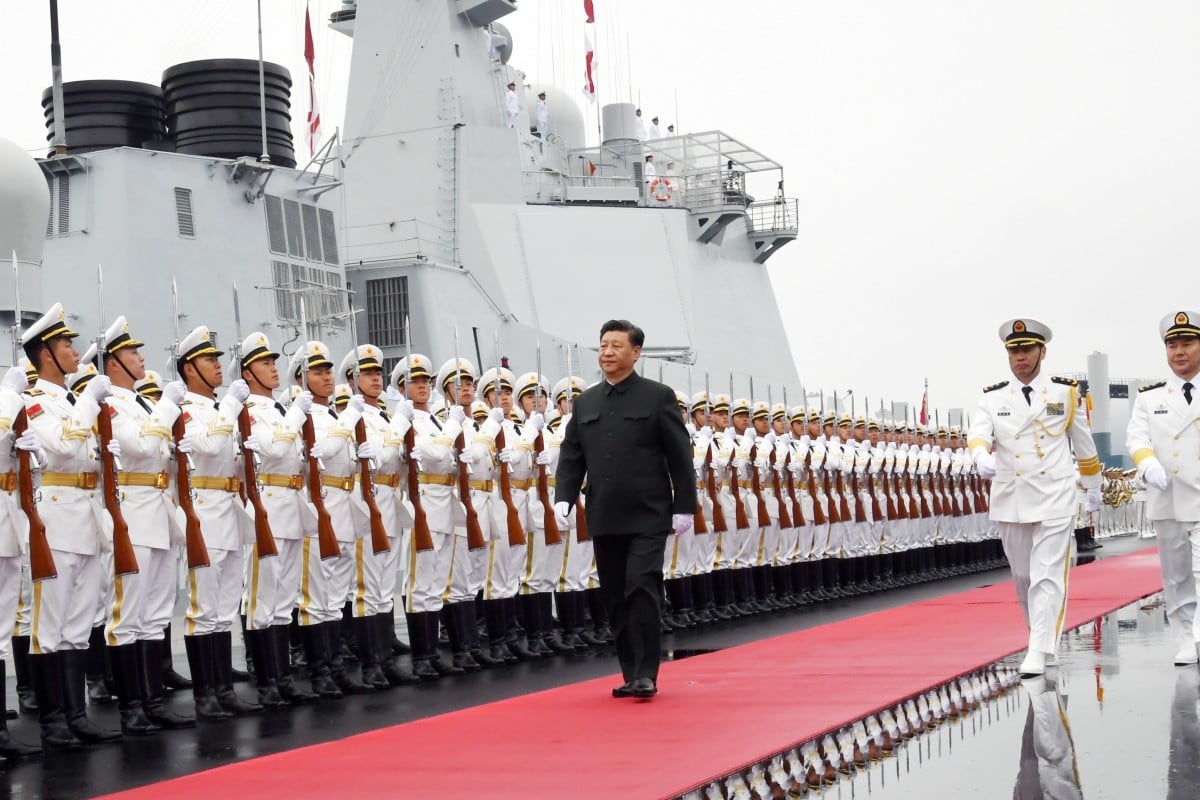
Chinese President Xi Jinping reviews an honour guards before a naval parade in Qingdao. Photo: Xinhua
The Asia-Pacific region is one of the fastest-growing markets for arms dealers, with economic growth, territorial disputes and long-sought military modernisation propelling a 52 per cent increase in defence spending over the last decade to US$392 billion in 2018, according to the Stockholm International Peace Research Institute.
The region accounts for more than one-fifth of the global defence budget and is expected to grow. That was underscored last week by news of 
Taiwan

’s bid to strike a

US$2 billion deal

to purchase US tanks and missiles.

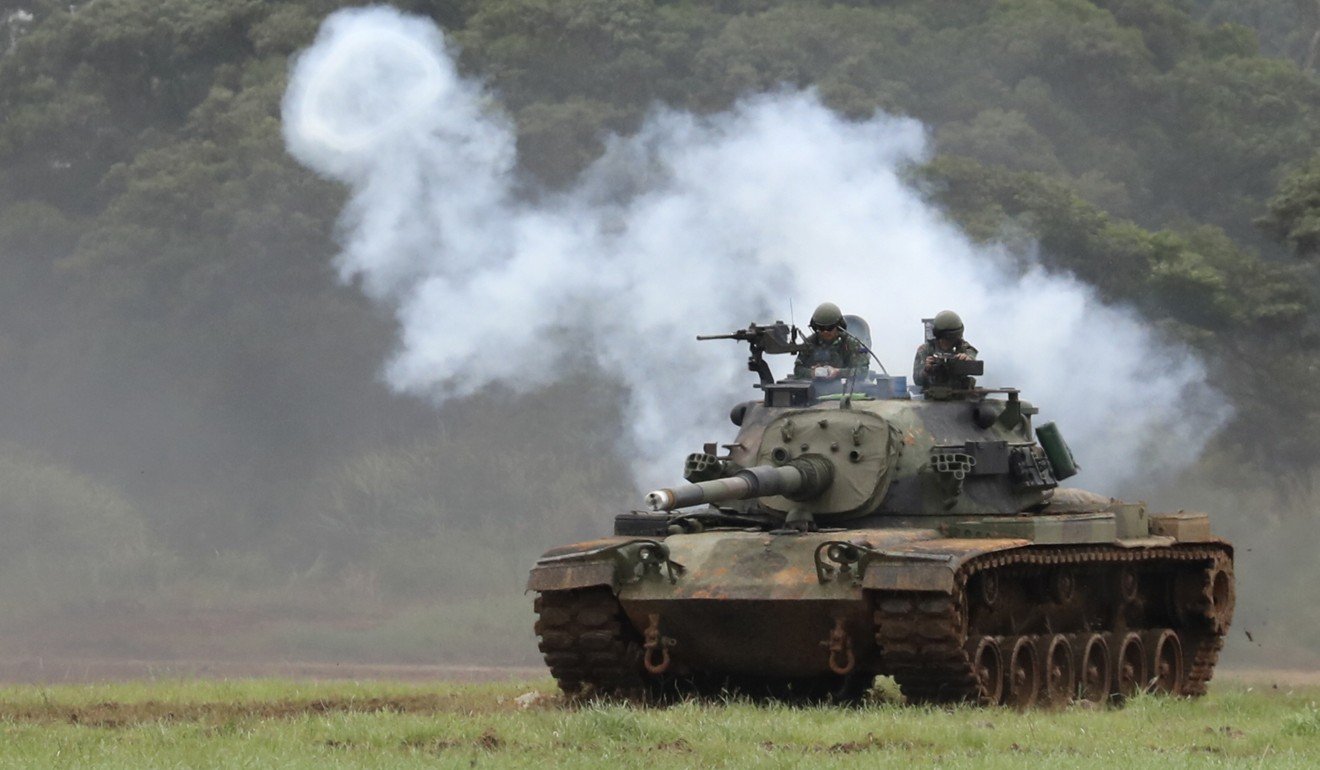
Taiwanese Soldiers on a CM11 battle tank, jointly developed with US arms manufacturer General Dynamics. Photo: EPA
The biggest driver in arms purchases, however, is 
China

– responsible for 64 per cent of military

spending in the region. With a defence budget that is second only to the

US

, China is amassing a navy that can circle the globe and developing state-of-the-art autonomous drones. The build-up is motivating surrounding countries to bolster their armed forces too – good news for purveyors of submarines, unmanned vehicles and warplanes.

It is no coincidence that the recent 
Shangri-La Dialogue

in

Singapore

, a security conference attended by

defence

chiefs, was sponsored by military contractors including Raytheon,

Lockheed Martin

and

BAE Systems

.

Opinion: How the Shangri-La Dialogue turned into a diplomatic coup for China

Kelvin Wong, a Singapore-based analyst for Jane’s, a trade publication that has been covering the defence industry for 121 years, has developed a niche in infiltrating China’s opaque defence industry by attending obscure trade shows that are rarely advertised outside the country.

He said the US is eager to train allies in Asia and sell them arms, while also stepping up its “freedom of navigation” naval operations in contested waters in the

South China Sea

and Taiwan Strait. It has lifted a ban on working with

Indonesia

’s special forces over atrocities committed in

East Timor

. And it is considering restarting arms sales to the

Philippines

.

In his speech at the Shangri-La Dialogue, acting US Defence Secretary Patrick Shanahan touted American advancements in technology “critical to deterring and defeating the threats of the future” and said any partner could choose to win access to that technology by joining the US defence network.
Wong said the message was clear: “Buy American.”
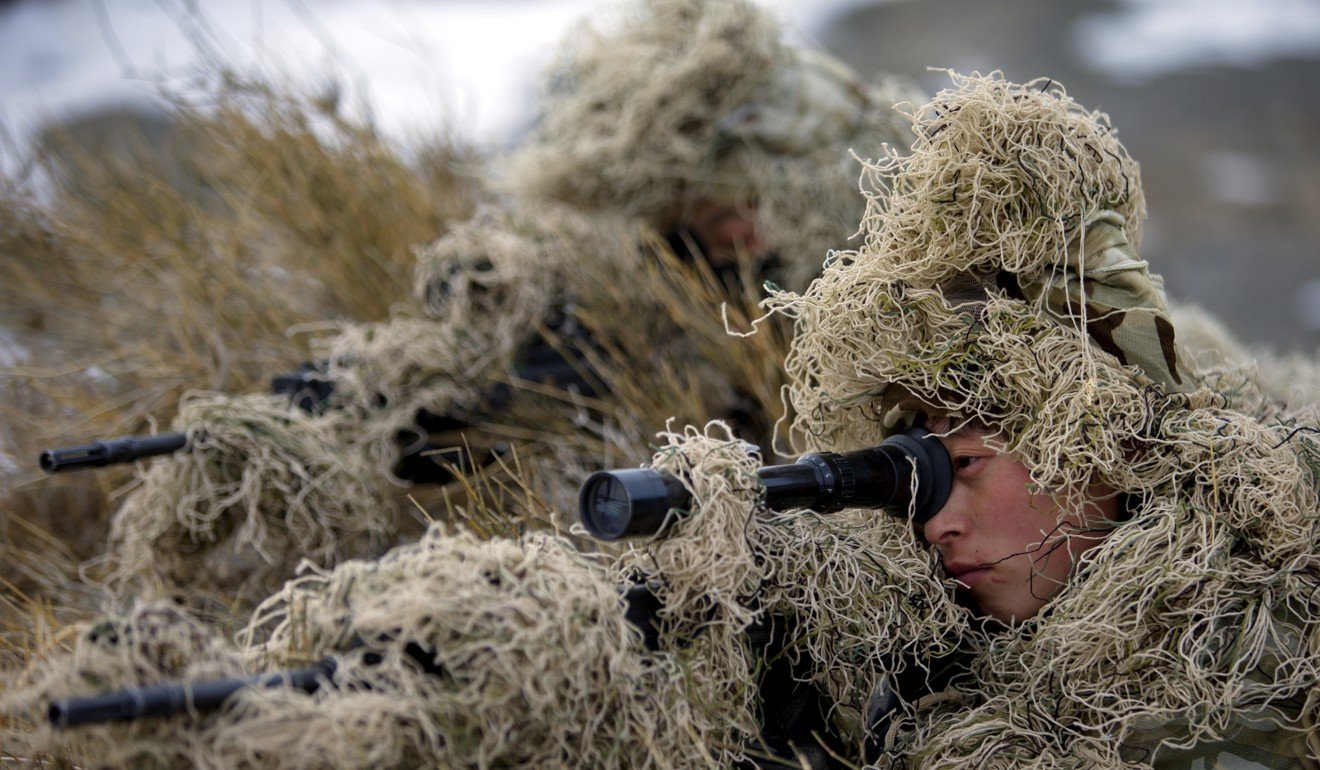
Analysts say Chinese soldiers have less training, motivation and lower morale than their Western counterparts. Photo: Reuters
The analyst said there is a growing admission among the Chinese leadership that the

People’s Liberation Army

has an Achilles’ heel: its own personnel.

He said one executive at a Chinese defence firm told him: “The individual Chinese soldier, in terms of morale, training, education and motivation, (cannot match) Western counterparts. So the only way to level up is through the use of unmanned platforms and 
artificial intelligence

.”

To that end, China has developed one of the world’s most sophisticated drone programmes, complete with custom-built weapon systems. By comparison, Wong said,
US drones rely on weapons originally developed for helicopters.
Wong got to see one of the Chinese drones in action two years ago after cultivating a relationship with its builder, the state-owned China Aerospace Science & Technology Corporation. He viewed a demonstration of a 28-foot-long CH-4 drone launching missiles at a target with uncanny ease and precision.
“Everyone knew they had this,” Wong said. “But how effective it was, nobody knew. I could personally vouch they got it down pat.”
China unveils its answer to US Reaper drone – how does it compare?

That is what Bernard Loo Fook Weng, a military expert at Singapore’s S. Rajaratnam School of International Studies, told the author Robert Kaplan for his 2014 book, Asia’s Cauldron, about simmering tensions in the South China Sea.

He was describing the competition for big-ticket military equipment of dubious necessity.

Southeast Asia

is littered with examples of such purchases.

Thailand

owns an aircraft carrier without any aircraft. Indonesia dedicated about one-sixth of its military budget to the purchase of 11

Russian

Su-35 fighter jets. And

Malaysia

splurged on two

French

submarines it could not figure out how to submerge.

“It’s keeping up with the Joneses,” Wong said. “There’s an element of prestige to having these systems.”

Submarines remain one of the more debatable purchases, Wong said. The vessels aren’t ideal for the South China Sea, with its narrow shipping lanes hemmed in by shallow waters and coral reefs. Yet they provide smaller countries with a powerful deterrence by enabling sneak attacks on large ships.

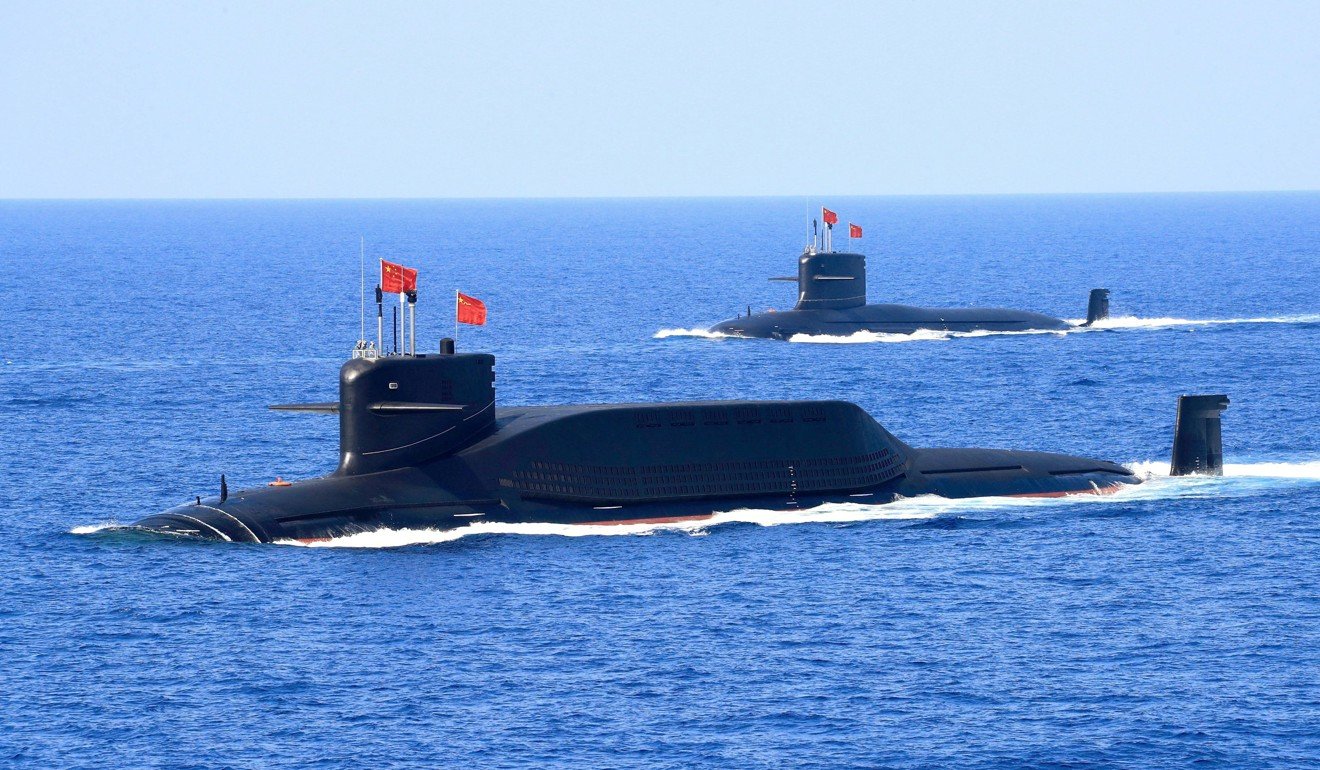
Nuclear-powered PLA Navy ballistic missile submarines in the South China Sea. Photo: Reuters
Asia and

Australia

are home to 245 submarines, or 45 per cent of the global fleet, according to the US-based naval market intelligence firm AMI International.

The Philippines remains one of the last coastal nations in the region without a sub – though it is in talks with Russian builders to acquire some.
Singapore recently received the first of four advanced

German

Type 218 submarines with propulsion systems that negate the need to surface more frequently. If the crew did not need to eat, the submarine could stay under water for prolonged periods. Wong said the craft were specially built for Asian crews.

“The older subs were designed for larger Europeans so the ergonomics were totally off,” he said.
Singapore, China deepen defence ties, plan larger military exercises
Tiny Singapore plays a crucial role securing the vital sea lanes linking the Strait of Malacca with the South China Sea. According to the

World Bank,

the country dedicates 3.3 per cent of its gross domestic product to defence, a rate higher than that of the United States.

State-of-the-art equipment defines the Singapore Armed Forces. Automation is now at the centre of the country’s military strategy, as available manpower is shrinking because of a rapidly ageing population.
Wong said Singapore is investing in autonomous systems and can operate frigates with 100 crew members – 50 fewer than they were originally designed for.

“We always have to punch above our weight,” he said.

Source: SCMP

Law of Unintended Consequences

continuously updated blog about China & India

ChiaHou's Book Reviews

continuously updated blog about China & India

What's wrong with the world; and its economy

continuously updated blog about China & India