30/05/2020
- Chinese groups calling for more ‘fighting spirit’ are getting the upper hand on those who favour calm and cooperation, government adviser says
- From Hong Kong to Covid-19, trade to the South China Sea, Beijing and Washington are clashing on a growing number of fronts and in an increasingly aggressive way
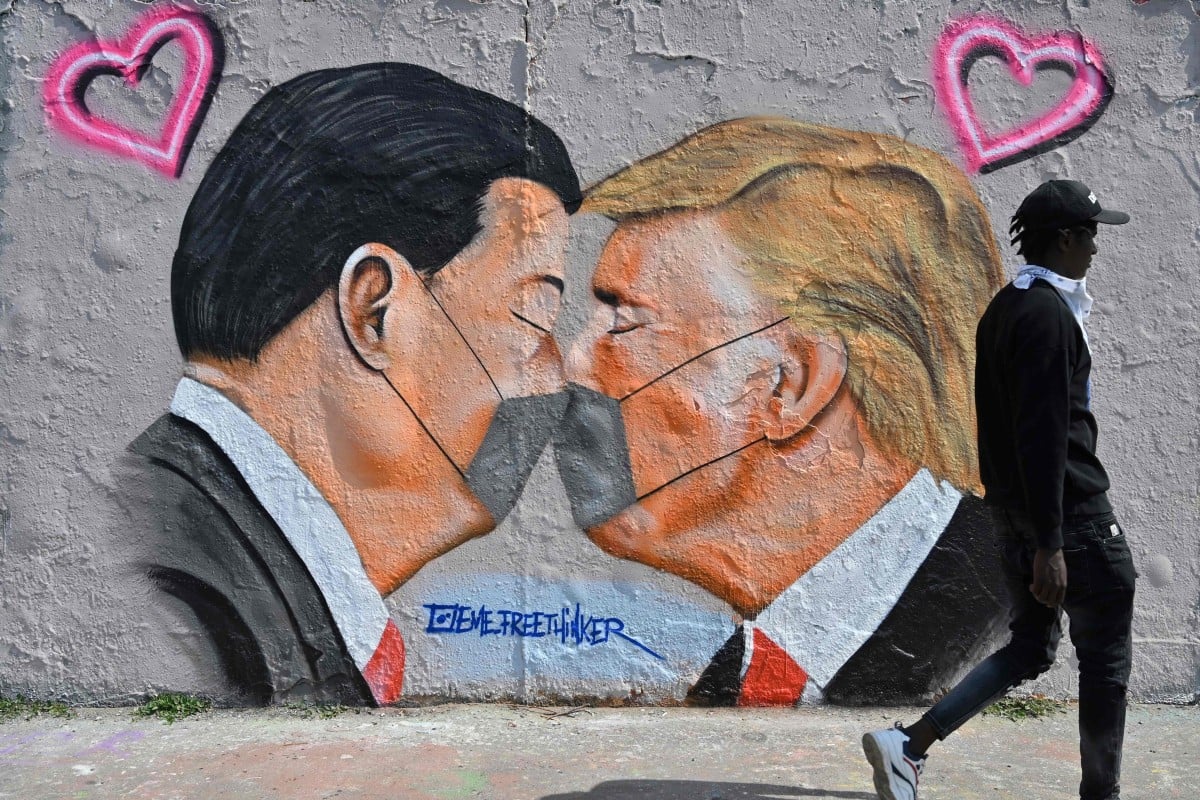
Efforts to promote dialogue and cooperation between the US and China are failing, observers say. Photo: AFP
Moderates who favour dialogue and cooperation as a way to resolve China’s disputes with the
United States are losing ground to hardline groups bent on taking the fight to Washington, according to political insiders and observers.
“There are two camps in China,” said a former state official who now serves as a government adviser and asked not to be named.
“One is stressing the combat spirit, the other is trying to relieve tensions. And the former has the upper hand.”
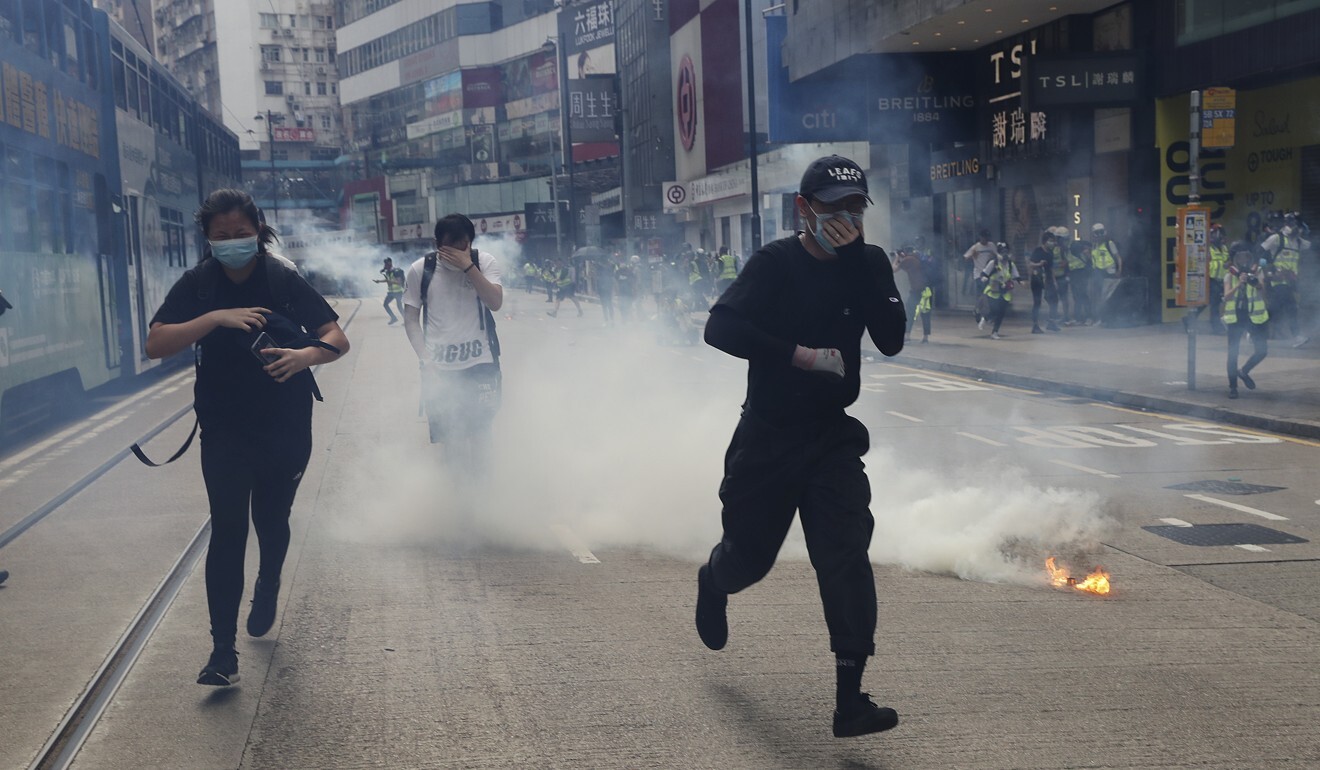
Relations between China and the US are under intense pressure. After Beijing moved to introduce a national security law for Hong Kong, US President Donald Trump said on Friday that Washington would begin eliminating the special policy exemptions it grants the city, as it no longer considers it autonomous from mainland China.
Beijing’s decision to enact a national security law for Hong Kong was met with anger from the US and other Western countries. Photo: Sam Tsang
The two nations have also clashed over trade, Xinjiang, Taiwan and the South China Sea, with the US passing several acts denouncing Beijing and sanctioning Chinese officials.
China has also experienced turbulence in its relations with other countries, including Australia and members of the European Union, mostly related to the Covid-19 pandemic
and Beijing’s efforts to position itself as a leader in the fight against the disease with its policy of “mask diplomacy”.
After Canberra appealed for an independent investigation to be carried out to determine the origins of the coronavirus, Beijing responded by imposing tariffs on imports of Australian barley, showing it is prepared to do more than just trade insults and accusations with its adversaries.
Pang Zhongying, a professor of international relations at Ocean University of China in Qingdao, said there was a worrying trend in China’s relations with other nations.
“We need political and diplomatic means to resolve the challenges we are facing, but … diplomatic methods have become undiplomatic,” he said.
“There are some who believe that problems can be solved through tough gestures, but this will never work. Without diplomacy, problems become confrontations.”
said during his annual press conference on the sidelines of the National People’s Congress last weekend that China and the United States must work together to prevent a new Cold War.
His words were echoed by
Chinese Premier Li Keqiang, who said during a press conference after the closure of the legislative session on Thursday that the many challenges facing the China-US relations could only be resolved through cooperation.
However, the government adviser said there was often quite a chasm between what China’s leaders said and what happened in reality.
“Even though we say we do not want a Cold War, what is happening at the working level seems to be different.” he said. “The implementation of policies is not properly coordinated and often chaotic.”
Tensions between China and the US have been in a poor state since the start of a trade war almost two years ago. After multiple rounds of negotiations, the sides in January signed a phase one deal, but the positivity that created was short-lived.
In February, Beijing expelled three reporters from The Wall Street Journal over an article it deemed racist, while Washington has ramped up its military activity in the South China Sea and Taiwan Strait, and threatened to revoke the visas of Chinese students studying science and technology in the US over concerns they might be engaged in espionage.
Beijing has also used its state media and army of “
Wolf Warrior” diplomats to promote its narrative, though many Chinese scholars and foreign policy advisers have said the latter’s nationalistic fervour has done more harm than good and appealed to Beijing to adopt a more conciliatory tone.
However, Hu Xijin, editor-in-chief of Chinese tabloid Global Times, said China had no option but to stare down the US, which regarded the world’s most populous nation as its main rival.
“Being contained by the US is too high a price for China to pay,” he said. “I think the best thing people can do is forget the old days of China-US ties”.
Jin Canrong, a professor of international relations at Renmin University in Beijing, wrote in a recent newspaper article that Beijing’s actions – notably enacting a national security law for Hong Kong – showed it was uncompromising and ready to stand its ground against the US.
Wu Xinbo, dean of international studies at Fudan University in Shanghai, agreed, saying relations between the two countries were likely to worsen in the run-up to the US presidential election in November and that Beijing should be prepared for a fight.
But Adam Ni, director of China Policy Centre, a think tank in Canberra, said the issue was not that the moderate camp had been sidelined, but rather Beijing’s perception of the US had changed.
“Beijing has woken up to the idea that America’s tough policy on China will continue and it is expecting an escalation of the tensions,” he said.
“The centre of gravity in terms of Beijing’s perception of the US has shifted, in the same way the US perception of China has shifted towards a more negative image”.
Beijing was simply responding in kind to the hardline, assertive manner of the US, he said.
Source: SCMP
Posted in aggressive way, annual, appealed, Australia, Australian, autonomous, ‘fighting spirit, “Wolf Warrior”, barley, Beijing, calm and cooperation, Canberra, chaotic, chasm, China-US relations, China-US ties, Chinese foreign minister Wang Yi, Chinese groups, Chinese premier Li Keqiang, Chinese scholars, Chinese students, Chinese tabloid, clashing, Cold War, conciliatory, confrontations, contained, cooperation, coordinated, coronavirus, COVID-19, Covid-19 pandemic, diplomacy, diplomats, editor-in-chief, Espionage, European Union, favour, foreign policy advisers, Fudan University, Global Times, growing, hardliners, Hong Kong, implementation, increasingly, independent investigation, lose out, main rival, Mainland China, moderate camp, moderates, more harm than good, narrative, National People’s Congress, national security law, November, number of fronts, observers, origins, policies, political insiders, presidential election, press conference, problems, promote, Qingdao, Renmin University, resolved, revoke, science and technology, Shanghai, sidelines, South China Sea, special policy exemptions, studying, Taiwan, Taiwan Strait, tariffs, The Wall Street Journal, think tank, threatened, tone, Trade, two camps, Uncategorized, uncompromising, undiplomatic, United States, upper hand, US President Donald Trump, US-China tensions, Visas, Washington, Western countries, world’s most populous nation, worsen, Xinjiang |
Leave a Comment »
18/05/2020

A graduating foreign student takes selfies at Zhejiang University in Hangzhou, east China’s Zhejiang Province, June 28, 2018. (Xinhua/Long Wei)
BEIJING, May 18 (Xinhua) — Chinese President Xi Jinping extended welcome to excellent youth from all countries in the world to study in China in his Sunday reply to a letter from all Pakistani students studying in the University of Science and Technology Beijing (USTB).
In his letter, Xi encouraged the students to communicate more with their Chinese peers and join hands with youth from all countries to contribute to promoting people-to-people connectivity and building a community with a shared future for humanity.
Learning that the students have enriched their knowledge and made quite a few Chinese friends while studying in China, Xi said he felt happy for the achievements they have made.
“As you have felt, since the COVID-19 epidemic broke out, the Chinese government and schools have always cared for the lives and health of foreign students studying in China, providing all-round help for them,” Xi noted.
The Chinese government and people put people’s lives first and treat foreigners in the country the same as Chinese nationals, making no exception in offering them care, Xi wrote.

Photo taken on Nov. 7, 2019 shows the autumn scenery of the University of Science and Technology Beijing in Beijing, capital of China. (Xinhua/Chen Yehua)
Xi said he learned that many foreign students have expressed their support to the Chinese people in various ways during China’s fight against COVID-19.
“A friend in need is a friend indeed,” he said, adding that China will continue providing various help to all foreign students studying in the country.
While welcoming excellent youth from other countries to study in China, Xi encouraged them to learn more about the country, communicate more with their Chinese peers and tell the world more about the China they see.
The USTB currently has 52 Pakistani students. They recently wrote about their experiences and feelings of studying in China in a letter to Xi and expressed their gratitude to the university for providing care and help for them after the COVID-19 outbreak.
They also expressed their aspirations to join in building the Belt and Road after graduation and contribute to enhancing China-Pakistan friendship.
Source: Xinhua
Posted in Beijing, Belt and Road, capital, China, China-Pakistan friendship, chinese government, Chinese President Xi Jinping, community, connectivity, countries, COVID-19 epidemic, foreign students, Foreigners, Hangzhou, humanity, letter, Pakistani, people-to-people, schools, shared future, students, study, studying, Sunday, Uncategorized, University of Science and Technology Beijing (USTB), welcome, World, Youth, zhejiang province, Zhejiang University |
Leave a Comment »
02/05/2020

People work at a construction site of a utility tunnel in Wuhan, central China’s Hubei Province, April 30, 2020. (Xinhua/Xiao Yijiu)
BEIJING, May 1 (Xinhua) — China is getting the world’s largest workforce back to work as the nationwide battle against COVID-19 has secured major strategic achievements.
The unprecedented fight has nurtured new trends in the workplace. For example, more attention is being paid to public health and e-commerce to boost consumption and emerging sectors brought by new applications based on the country’s rapid new infrastructure development of 5G networks and data centers.

In this aerial photo taken on April 29, 2020, representatives of frontline health workers fighting COVID-19 attend a bell-ringing ceremony at the Yellow Crane Tower, or Huanghelou, a landmark in Wuhan, central China’s Hubei Province. (Xinhua/Xiao Yijiu)
ANGELS OF PUBLIC HEALTH
Ye Man, head nurse of gastrointestinal department of Hubei General Hospital East District, one of the five remaining COVID-19 designated hospitals in Wuhan, is taking her first weeklong vacation since January.
The 34-year-old mother of two started to take a week off on Monday, one day after her hospital cleared all remaining confirmed COVID-19 patients. The nine ICU wards in her hospital had been kept occupied over the past several months.
Friday marked International Workers’ Day, and the start of China’s five-day public holiday. Ye said she planned to visit urban parks with her family during the holiday.
At her busiest point, she and her colleagues took care of a ward filled with 40 COVID-19 patients.
“It was a really tough time,” she recalled. She had to wear a protective gown and a mask for nine hours a day and be separated from her family to avoid possible cross-infections.
Wuhan, capital of central China’s Hubei Province and once hard hit by COVID-19, cleared all confirmed cases in hospitals on April 26. Over 42,000 medical workers mobilized nationwide to aid Hubei have contributed to achieving a decisive outcome in the fight to defend Hubei and Wuhan.
In an inspection tour to Wuhan on March 10, President Xi Jinping, also general secretary of the Communist Party of China Central Committee and chairman of the Central Military Commission, lauded medical workers as “the most beautiful angels” and “messengers of light and hope.”
To reward brave and dedicated medics, major tourist sites in Hubei are offering free entry to medical staff over the following two years.

Chinese President Xi Jinping, also general secretary of the Communist Party of China Central Committee and chairman of the Central Military Commission, learns about development of the black fungus industry in Jinmi Village of Xiaoling Township in Zhashui County, Shangluo City, northwest China’s Shaanxi Province, April 20, 2020. (Xinhua/Xie Huanchi)
LIVESTREAMING ANCHORS
“We have a new batch of supplies today. Those who did not get the goods should hurry to buy now,” said Li Xuying, a livestreaming anchorwoman selling agaric mushrooms in Zhashui, a small county deep in the Qinling Mountains in northwest China’s Shaanxi Province.
Li has been prepared for a boom of online shopping in the holiday, because online buyers rushed to her livestreaming website to place orders, after Xi inspected the county and chatted with her in the village of Jinmi during a recent tour to Shaanxi.
“I used to sell goods worth about 50,000 yuan (7,070 U.S. dollars) on average after a six-hour livestreaming session. Now the sales are 10 times that,” she said.
Li was one of the 10 sales staff sent by the local agricultural e-commerce firm to Chinese e-commerce platform Taobao’s headquarters for livestreaming training. She said livestreaming is effective in bridging buyers and farmers, through which viewers can watch planting and harvesting online.
With the number of netizens in China reaching 904 million in March, e-commerce has been one of the popular means of promoting the sale of farm produce and helping farmers shake off poverty. Despite the impact of COVID-19, the country is determined to eradicate absolute poverty by the end of this year.

Workers work at the construction site of a 5G base station at Chongqing Hi-tech Zone in Chongqing, southwest China, April 15, 2020. (Xinhua/Wang Quanchao)
HI-TECH WORKERS IN “NEW INFRASTRUCTURE” BUILDING
As an elasticity calculation engineer of Alibaba Cloud, Zhao Kun and his colleagues always stay on alert for high data flow, for example, brought by the anticipated online shopping spike during the holiday.
“The profession, which may sound obscure, is actually closely connected to everyone’s life, as cloud computing is the infrastructure supporting high-tech applications of artificial intelligence and blockchain,” said Zhao.
The Chinese leadership has underscored expediting “new infrastructure” development to boost industrial and consumption upgrading and catalyze new growth drivers.
Seizing the opportunities of industrial digitization and digital industrialization, China needs to expedite the construction of “new infrastructure” projects such as 5G networks and data centers, and deploy strategic emerging sectors and industries of the future including the digital economy, life health services and new materials, President Xi has said.
During the epidemic, Zhao and his colleagues expanded more than 100,000 cloud servers to ensure the stable operation of “cloud classrooms” and “cloud offices” for millions of people working and studying from home.
In the “new infrastructure” building, people like Zhao contribute to constructing the virtual infrastructure of an ecosystem, which enables e-commerce, e-payment, online teaching and the digital transformation of manufacturing and supply chain management.
In early April, China released a plan on promoting the transformation of enterprises toward digitalization and intelligence by further expanding the application of cloud and data technologies, to nurture new business models of the digital economy.
Source: Xinhua
Posted in "cloud classrooms", "cloud offices", "messengers of light and hope.", "new infrastructure", "the most beautiful angels", 2020, 5G base station, 5G networks, achievements, against, agaric mushrooms, Alibaba Cloud, ANGELS, anticipated, application, April, Artificial intelligence, attend, attention, back, based on, battle, Beijing, bell-ringing ceremony, black fungus industry, blockchain, boost, brave, brought by, Building, busiest point, capital, central China's, Chairman of the Central Military Commission, China, China's, Chinese e-commerce platform, Chinese leadership, Chongqing, Chongqing Hi-tech Zone, cleared, cloud and data technologies, Cloud computing, cloud servers, colleagues, confirmed, connected, constructing, construction site, consumption, contribute, country's, COVID-19, data centers, dedicated, designated hospitals, digital economy, digital industrialization, digital transformation, digitalization, driving, E-commerce, e-payment, ecosystem, elasticity calculation engineer, emerging sectors, end of this year., endorses, enterprises, eradicate absolute poverty, everyone's life, expanding, expediting, Family, farm produce, farmers, fight, fighting, first, five, five-day, following, For example, free entry, Friday, frontline, gastrointestinal department, general secretary of the Communist Party of China Central Committee, getting, health workers, helping, HI-TECH WORKERS, high data flow, high-tech applications, Holiday, Home, Hospital, Huanghelou, Hubei, Hubei General Hospital East District, hubei province, ICU wards, industrial digitization, Infrastructure, intelligence, International Workers' Day, January, Jinmi Village, kept occupied, landmark, lauded, LIVESTREAMING ANCHORS, local agricultural e-commerce firm, Major, Management, Manufacturing, March, marked, mask, medical staff, medical workers, medics, mobilized, Monday, mother, nationwide, netizens, new applications, new business models, new growth, new infrastructure development, new trends, nine, northwest China's, nurtured, obscure, offering, on alert, Online shopping, online teaching, patients, plan, planned, popular, poverty, President Xi Jinping, professional, promoting, protective gown, Public health, public holiday, Qinling Mountains, rapid, released, remaining, representatives, reward, secured, selling, several months, shake off, Shangluo City, Southwest China, spike, stable operation, start, strategic, studying, Supply chain, Taobao's headquarters, to nurture, to work, tourist sites, transformation, two years, Uncategorized, underscored, unprecedented, urban parks, utility tunnel, virtual infrastructure, visit, ward, weeklong vacation, workers, working, workplace, world's largest workforce, Wuhan, Xi, Xiaoling Township, Yellow Crane Tower, Zhashui, Zhashui County |
Leave a Comment »
22/03/2020
BEIJING (Reuters) – China on Sunday reported 46 new cases of coronavirus, the fourth straight day with an increase, with all but one of those imported from overseas, and further stepped up measures to intercept cases from abroad as the outbreak worsens globally.
While China says it has drastically reduced the number of domestically transmitted cases – the one reported on Sunday was the first in four days – it is seeing a steady rise in imported cases, mostly from Chinese people returning from overseas.
In a sign of how seriously China is taking the threat of imported cases, all international flights due to arrive in Beijing starting Monday will first land at another airport, where passengers will undergo virus screening, government agencies said on Sunday, in an expansion of existing measures.
International flights that were scheduled to arrive in the capital will land instead at one of 12 airports. Passengers who clear screening will then be permitted to reboard the plane, which will then fly to Beijing, the regulator said.
Separately, Shanghai and Guangzhou both announced that all arriving international passengers will undergo an RNA test to screen for coronavirus, expanding a program that previously only applied to those coming from heavily-hit countries.
Among the new cases from abroad reported on Sunday, a record 14 were in the financial hub of Shanghai and 13 were in Beijing, a decline from 21 the previous day.
The new locally transmitted case was in the southern metropolis of Guangzhou and was also the first known case where the infection of a local person was linked to the arrival of someone from overseas, according to Guangdong province.
Hu Xijin, the editor-in-chief of the Global Times newspaper, called for all cities in China to implement 14-day quarantines for people arriving from abroad.
He also called for quarantine policies to apply to people from Hong Kong and Macau as well, he said on his Weibo account on Sunday.
“I am worried that there are similar cases to the Guangzhou one existing in other parts of the country. There were reports previously that people coming back from abroad returned to their homes in Shanghai without any obstacles,” Hu said.
“It matters to the overall situation of China’s next prevention and control efforts if we can plug the leaks.”
The Global Times is a tabloid published by the Ruling Communist Party’s People’s Daily.
The latest figures from China’s National Health Commission bring total reported coronavirus cases in the country to 81,054, with 3,261 deaths, including six on Saturday. On Saturday, China reported 41 new coronavirus cases for the previous day, all of them imported.
Of all 97 imported cases as of end-Saturday, 92 of them are Chinese nationals and 51 are Chinese students returning from studying abroad, said Gao Xiaojun, spokesman for the Beijing Municipal Health Commission during a press conference on Sunday.
The Beijing health commission announced separately on its website it had two more imported cases on Sunday, bringing the city’s total number of imported cases to 99 as of Sunday noon.
BACK TO A KIND OF NORMAL
China is trying to revive an economy that is widely expected to contract deeply in the current quarter, with life slowly returning to normal in cities such as Beijing and Shanghai, albeit with everyone wearing masks in public.
Still, numerous shops and restaurants remain shut – many have gone out of business – and factories and other workplaces are still not operating at full capacity.
On Sunday, a central bank official called for stepped-up global policy coordination to manage the economic impact of the pandemic. He said China’s recent policy measures were gaining traction, and it has capacity for further action.
Chen Yulu, a deputy governor at the People’s Bank of China (PBOC), also said he expects significant improvement in the Chinese economy in the second quarter.
And while the virus will continue putting upward pressure on near-term consumer prices, there is no basis for long-term inflation or deflation, he told a news briefing.
Globally, roughly 275,000 people have been infected with the virus, and more than 11,000 have died, according to a Reuters tally, with the number of deaths in Italy recently surpassing those in China.
“Now I think the epidemic has been controlled. But this definitely doesn’t mean that it’s over,” said a 25-year-old woman surnamed He who works in the internet sector and was visiting the vast Summer Palace complex in Beijing on Saturday.
“I’m willing to come out today but of course I am still afraid,” she told Reuters.
The central province of Hubei, where the outbreak first emerged late last year in its capital Wuhan, reported its fourth straight day of no new cases.
China has used draconian measures to contain the spread of the virus, including locking down Hubei province.
Source: Reuters
Posted in 14-day quarantines, abroad, Beijing, Beijing Municipal Health Commission, central bank official, China, China’s National Health Commission, Chinese economy, Chinese nationals, Chinese students, coronavirus cases, curb, deaths, draconian measures, Emirates airline, epidemic, factories, Global Times, Guangzhou, Hong Kong, hubei province, imported, Italy, locking down, Macau, newspaper, People’s Bank of China (PBOC), People’s Daily, restaurants, Reuters tally, rise, Ruling Communist Party’s, scrambles, Seattle, Shanghai, shops, shut, studying, Summer Palace, Uncategorized, Virus, Weibo, workplaces |
Leave a Comment »
02/11/2019
NEW DELHI (Reuters) – German Chancellor Angela Merkel and Indian Prime Minister Narendra Modi signed wide-ranging agreements in New Delhi on Friday to deepen strategic cooperation and exchanged notes on ways to boost bilateral trade.
Merkel, accompanied by several cabinet colleagues and a business delegation, is in India on a three-day visit that began on Thursday.
“We’re encouraging our private sectors to give an impetus to our growing bilateral trade and Chancellor Merkel and I will meet some of the top business and industry leaders,” Modi told a joint news conference with the German leader.
“We’re encouraging our private sectors to give an impetus to our growing bilateral trade and Chancellor Merkel and I will meet some of the top business and industry leaders,” Modi said.
Bilateral trade between the two countries rose to $24.06 billion (18.5 billion pounds) in the 2018/19 fiscal year ending in March from $22 billion the previous year, while German companies have invested nearly $12 billion in India since 2000.
Germany is India’s largest trading partner in Europe and more than 1,700 German companies are operating in India.
The agreements struck on strategic cooperation, included agriculture, cyber security and artificial intelligence. Modi said the two countries would also bolster ties to combat “terrorism and extremism”.
Germany and India also agreed to join hands in the area of education.
“As many as 20,000 Indian nationals are studying in Germany and we would like to see more,” Merkel said.
Although Merkel and Modi didn’t mention anything about restarting talks on finalising a free trade agreement between India and the European Union, sources earlier said the two leaders could take up the trade deal.
Eric Schweitzer, president of the Association of German Chambers of Commerce and Industry (DIHK), earlier said India had enormous potential but there has been uncertainty among companies after an investment protection agreement between the two countries ended in 2016.
“Small and medium-sized German companies stand in a labyrinth of regulations and shy away from larger investment. Negotiations should restart and Merkel’s visit could help,” he said.
VDA, Germany’s car industry association that counts automakers like Volkswagen (VOWG_p.DE), Daimler, BMW and Audi as members, also wanted India to restart the FTA talks.
Daimler’s Mercedes-Benz, BMW and Audi dominate India’s luxury car market.
Source: Reuters
Posted in agreements, Angela Merkel, Association of German Chambers of Commerce and Industry (DIHK), Audi, bilateral ties, BMW, Daimler, deepen, education, European Union, FTA, German Chancellor, Germany, India alert, Indian nationals, Indian prime minister, Indian Prime Minister Narendra Modi, Mercedes-Benz, New Delhi, sign, studying, Uncategorized, VDA, Volkswagen (VOWG_p.DE), wide-ranging |
Leave a Comment »



 CHINDIA ALERT: You'll be living in their world, very soon