Chindia Alert: You’ll be Living in their World Very Soon
aims to alert you to the threats and opportunities that China and India present. China and India require serious attention; case of ‘hidden dragon and crouching tiger’.
Without this attention, governments, businesses and, indeed, individuals may find themselves at a great disadvantage sooner rather than later.
The POSTs (front webpages) are mainly 'cuttings' from reliable sources, updated continuously.
The PAGEs (see Tabs, above) attempt to make the information more meaningful by putting some structure to the information we have researched and assembled since 2006.
More than 15,000 workers infected as hospitals struggle with a lack of test kits and protective gear
Chronic shortages are forcing emergency teams to ration equipment and come up with their own makeshift solutions
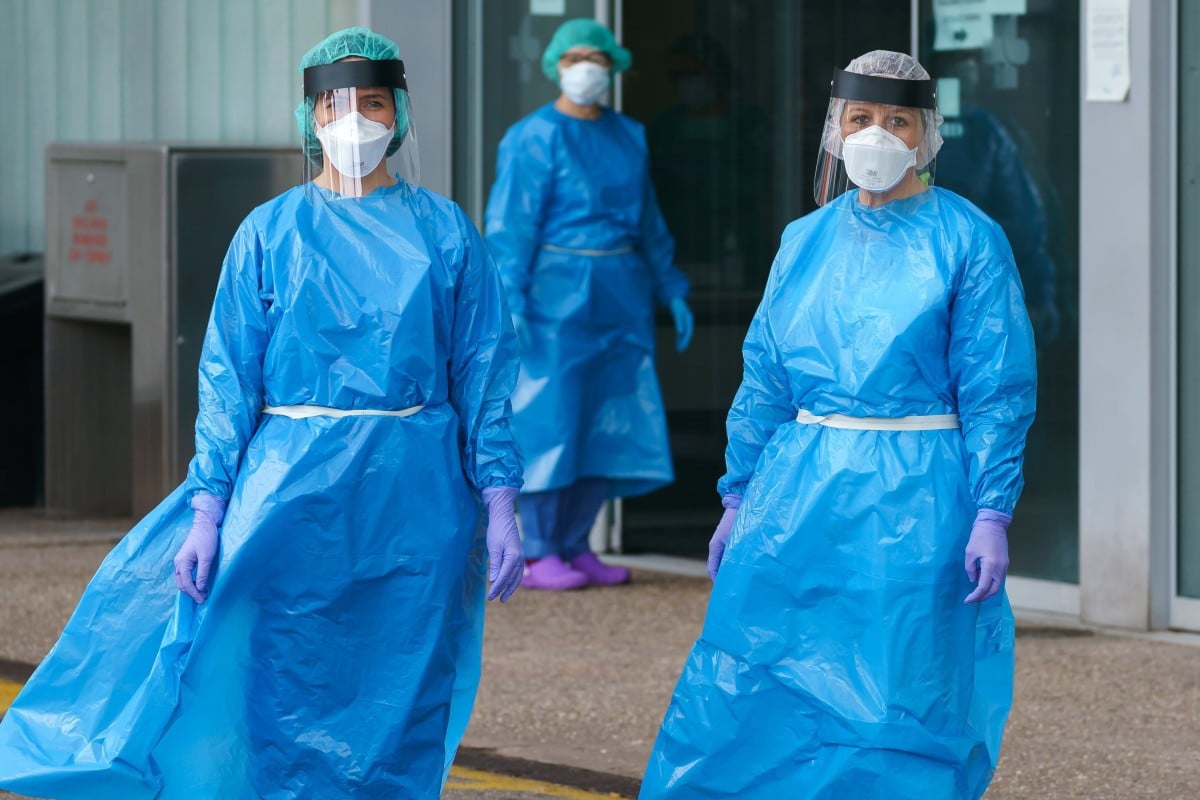
Health workers in protective gear outside an emergency entrance to a hospital in northern Spain. Photo: AFP
Overburdened hospitals and a shortage of protective measures and tests are taking a toll on Spanish medical professionals who are contracting Covid-19 – the illness caused by the new coronavirus – at an alarming rate.
To date, more than 15,000 health professionals in Spain – about 14 per cent of the national total – have been infected. In contrast, Italy reported that health workers accounted for about 10 per cent of its infections.
“I have tried to be careful, but when you work in a hospital, no one can guarantee that one of your colleagues doesn’t have the virus in the asymptomatic phase,” said ambulance crew member Xevi Mateu, who tested positive for the virus a week ago.
Mateu, who lives and works in Catalonia, said he thought he might have got infected during a meal break at the hospital or while on duty in the cramped space of an emergency vehicle.
Europe faces Easter indoors as Spain’s virus cases surge past 100,000
2 Apr 2020
Information on how to protect himself from the rampaging pandemic was conflicting, he said, and with no guarantee on future supplies he was forced to ration his use of protective equipment as soon as the demand for ambulance services began to exceed capacity.
Albert Gual, another emergency worker in Catalonia, said protocols had changed since he first started transferring Covid-19 patients to hospital, and he believes the shortage of protective equipment is to blame.
“At the beginning of the crisis, we threw away the glasses, the medical suit and the mask after one use. Now we are using one mask per day, until the stock runs out,” Gual said.
“Yesterday I talked to a colleague from the emergency service who told me they are overwhelmed – without material, without resources, without people. The medical suits are reused and sterilised until they have holes,” he said.
There have also been reports of doctors and nurses in Spain making their own protective clothing out of bin liners.
To ease the burden on Spain’s medical workforce, retirees have been asked to return to practice and newly licensed personnel have been recruited to make up the shortfall. One of the new recruits is Candela Lebrero, who completed her medical degree last year and is now a nurse at a hospital in Madrid.
The Spanish capital has seen the country’s largest number of infections – with more than 36,000 – and staff at the Madrid Principe de Asturias Hospital, where Lebrero works have been among those falling ill from the disease.
Reports of an overload of patients were very real, she said, with emergency rooms forced to send less serious cases to “medicalised hotels” and additional hospital wards switched to caring for Covid-19 patients.
As for rapid testing, it “hadn’t arrived yet” at Lebrero’s hospital, which was relying on PCR tests – the swab technique which identifies the presence of any genetic material belonging to the virus – as a diagnostic for both patients and health personnel who presented with symptoms, she said.
Similar problems have been reported across Spain and last week the health ministry’s coordinator for the emergency response, Fernando Simon, acknowledged the difficulties for health care workers to access protective equipment.
On March 25, Simon admitted the jump in infections among medical staff was due to “a market access problem” as supplies “are scarce and there is non availability” – a problem not limited to Spain.
“We are on the way to a solution,” he said. On Monday, Simon also tested positive for the disease.
While equipment shortages are a global problem, Spain was hit particularly hard after its two largest distributors of medical supplies – located in France and Germany – were ordered to stop selling by their governments in early March, fearful of depleted stocks in their own countries as the pandemic spread.
The decision, which was criticised for being contrary to the spirit of the European Union, forced the Spanish government to turn to other measures, including the purchase of €432 million (US$467 million) worth of supplies from China.
A freight corridor was also opened to speed deliveries, and Spanish manufacturers were put on a “war footing” to urgently switch to making medical supplies. The car industry is now turning out respirators and gels, while textile manufacturers have turned their hand to producing gowns and face masks.
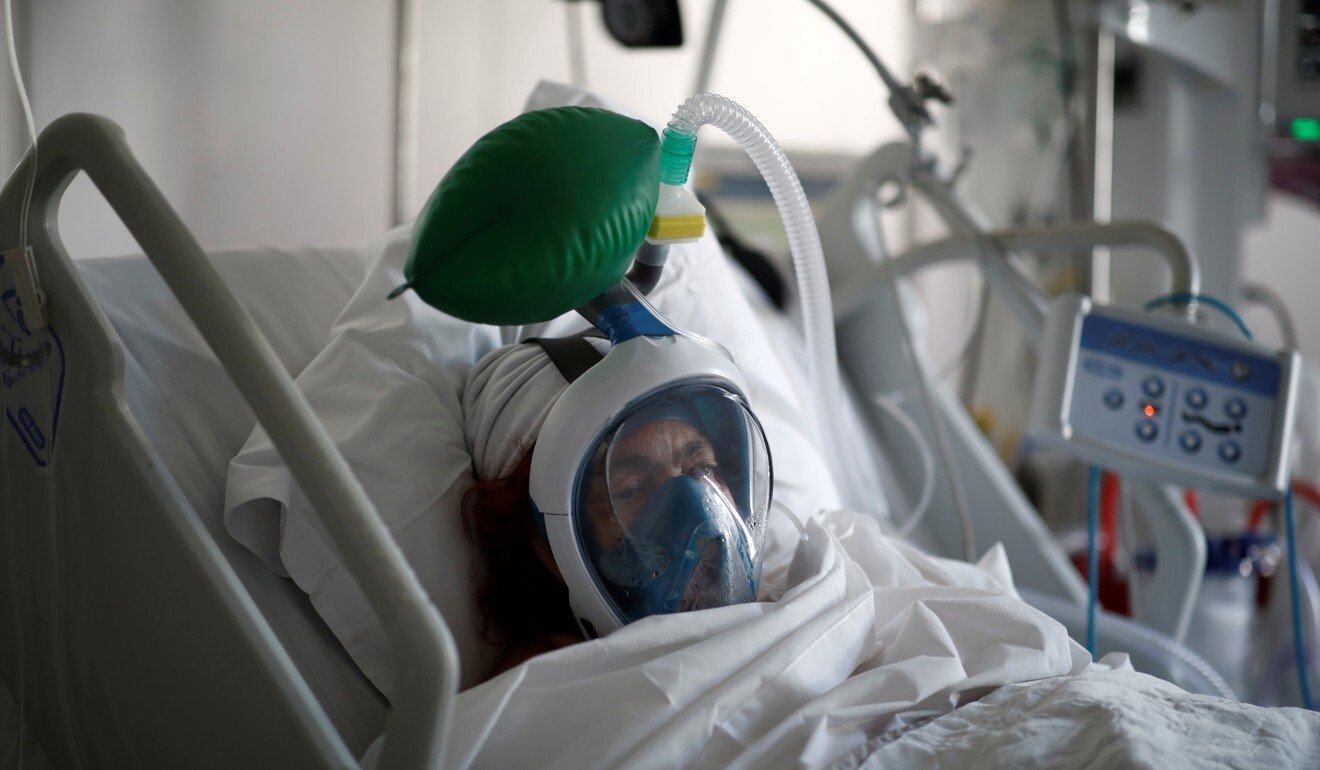
Sports equipment chain Decathlon has even adapted its snorkel goggles for medical use and donated its entire stock to Spanish hospitals.
A Covid-19 patient wears a full-face snorkelling mask which has been converted into a ventilator. Photo: Reuters
The scramble to address shortages in Spain’s overstretched health system has not been without problems. Last week, the government withdrew 58,000 Covid-19 rapid test kits
it bought from a Chinese company, after their accuracy rate was reported to be just 30 per cent.
China said the kits were not approved for sale and not included in supplies sent by Beijing to Spain.
It is not clear if the supplies from China have arrived, but on the ground medical personnel said they had not yet seen the equipment.
“It is assumed that the new ones have already arrived, but they have to pass the approval of the Carlos III Public Health Institute [a Spanish public health research institute], and their use is not yet widespread,” Laura Díez, press officer for the State Confederation of Medical Unions said.
“Their arrival will improve the situation since at least it would be known if someone in contact with the infected could transmit the disease, especially health personnel,” she said.
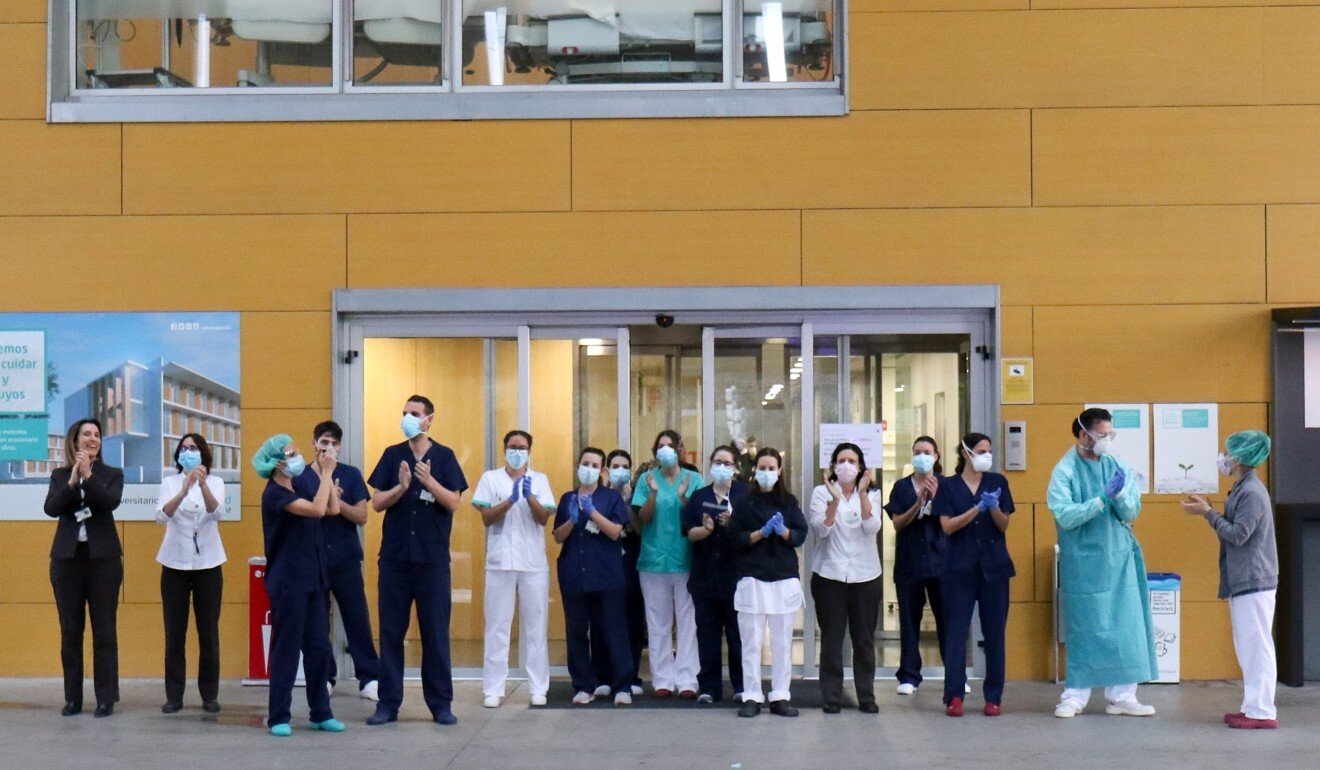
Medical staff in Spain acknowledge the daily applause from the public which has become a feature of the coronavirus pandemic. Photo: DPA
Several health organisations have appealed to the courts in their desperate bid to get hold of protective equipment. A Madrid court did accept the argument by an association of doctors that the authorities should be forced to provide adequate supplies to all health personnel.
But the Supreme Court refused to support the claim, saying it recognised the government was doing everything it could.
“We presented precautionary measures and they were dismissed, we have filed an appeal,” Díez said.
“At the moment we have no answer. Authorities said that planes with the material are arriving, but at the hospitals, they are not seen.”
Spain says Covid-19 can lead to closer ties with Chinese medical suppliers
29 Mar 2020
Meanwhile, the General Councils of Dentists, Nurses, Pharmacists, Doctors, and Veterinarians, which represent more than 700,000 health professionals in Spain, expressed its “absolute rejection” of new guidelines for medical workers set by the health ministry.
In a notice issued on Friday, the ministry said that health professionals that had not been tested for Covid-19 but who took time off should return to work seven days after the onset of symptoms as long as they did not have a fever or respiratory problems.
Once back at work, they should wear a surgical mask for 14 days from the onset of symptoms and avoid contact with other people.
The general councils said some of the guidelines represented “a serious risk” to the health of professionals and their patients.
Ambulance worker Mateu is currently in isolation at home as he recovers from the disease, but his thoughts are with his colleagues and their daily struggle. He said he thanked his supervisors and coordinators for working hard every day.
With so many of the staff themselves sick, there was a lot of stress on those who were still at work, he said.
“I have the feeling that the effort and management is not being done from the top down, but from the bottom up: from us who work directly with the patients, our supervisors and they are continuing the chain of gestures and efforts,” he said.
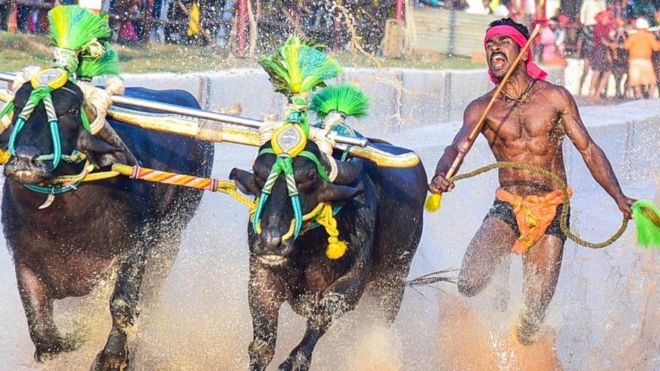
Image copyright ANNU PAIImage caption Srinivas Gowda also praised the efforts of his teammates, the two buffalo
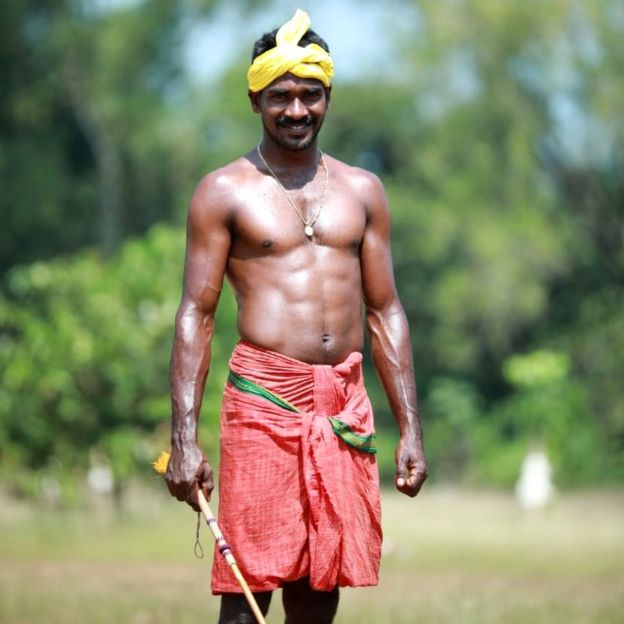
A construction worker in south India is being compared to the Olympic gold medallist sprinter Usain Bolt after a record-breaking win in a buffalo race.
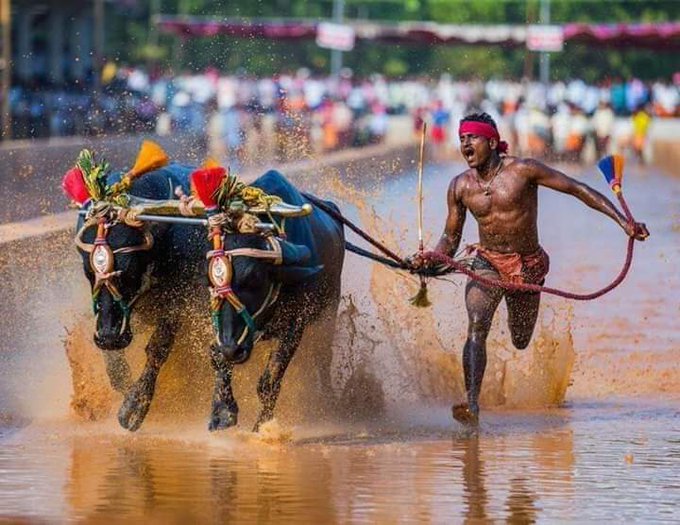
Srinivas Gowda, 28, was competing in Kambala, a sport from the southern state of Karnataka where people sprint 142m through paddy fields with buffalo.
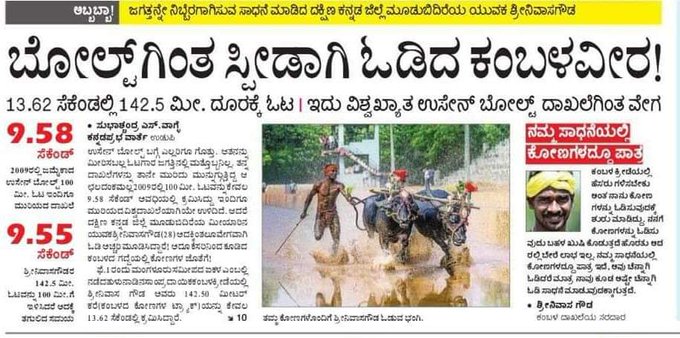
Mr Gowda is said to have finished in 13.42 seconds. Bolt holds the world 100m record of 9.58 seconds.
But the governing body for Kambala has warned against comparing him to Bolt.
“We would not like to indulge in any comparison with others,” Prof K Gunapala Kadamba, president of the Kambala Academy, told BBC Hindi.
“They [Olympic event monitors] have more scientific methods and better electronic equipment to measure speed.”
Prof Kadamba’s response came after several local newspapers and journalists made the comparison between Mr Gowda’s performance and the Jamaican sprinter’s world record time.
He is Srinivasa Gowda (28) from Moodabidri in Dakshina Kannada district. Ran 142.5 meters in just 13.62 seconds at a “Kambala” or Buffalo race in a slushy paddy field. 100 meters in JUST 9.55 seconds! @usainbolt took 9.58 seconds to cover 100 meters. #Karnataka
But Mr Gowda, from Moodabidri in Karnataka’s coastal district of Dakshina Kannada, was excited about his record-breaking win and praised his teammates – the two buffalo he ran alongside – for doing so well.Image copyright ANNU PAIImage caption Srinivas Gowda, 28, has been taking part in Kambala for seven years
He told BBC Hindi he had taken part in Kambala for seven years, adding: “I got interested in it because I used to watch Kambala during my school days.”
What is Kambala?
Kambala, which roughly translates to “paddy-growing mud field” in the local language Tulu, is a traditional sport originating from part of Karnataka’s coast.
Participants sprint through a field, which is normally either 132m or 142m, with two buffalo that are tethered together.
It is controversial, and in the past the sport has attracted strong criticism from international animal rights groups.
In 2014, India’s Supreme Court issued a ban on races with bulls, prompted primarily by campaigns against the practice of Jallikattu, a form of bull-fighting from the neighbouring state of Tamil Nadu.
Two years later, Karnataka’s state court issued an interim order stopping all Kambala events.
Prof Kadamba said that the organising body had responded to this, updating the sport in order to make it more humane.
He said their current and former students – including Mr Gowda – are now taught how to deal with buffalo “in a humane manner without unnecessarily hurting the animal”.
In 2018, the state started allowing Kambala races to take part again, but issued several conditions – including a ban on the use of whips.
But the practice is still under threat. International animal rights group Peta has a petition pending in the Supreme Court, arguing that Karnataka’s reinstatement of Kambala was illegal.
“This Kambala is quite different from the traditional Kambala that used to be practised some decades ago,” Prof Kadamba added.
NEW DELHI/MUMBAI (Reuters) – The Indian government ordered mobile carriers on Friday to immediately pay billions of dollars in dues after the Supreme Court threatened the companies and officials with contempt proceedings for failing to implement an earlier ruling.
The court, which had ordered companies including Vodafone Idea (VODA.NS) and Bharti Airtel (BRTI.NS) to pay 920 billion Indian rupees ($13 billion) in overdue levies and interest by Jan. 23, last month rejected petitions seeking a review of the order it issued back in October.
“This is pure contempt, 100% contempt,” Justice Arun Mishra told lawyers for the companies and the government on Friday.
Later in the day, the Department of Telecommunications called for “immediate payments” from the telcos. A second order instructed relevant offices to stay open on Saturday to “facilitate the Telecom Licensees to make payments or contact them with respect to any matter related to that.”
The companies had contested the government’s definition of revenues subject to tax and Vodafone Idea and Bharti Airtel both flagged risks to their ability to continue as ongoing concerns following the October order. They did not immediately respond to calls seeking comment on the new ruling.
The companies, along with Reliance Jio, which is backed by Asia’s richest man, Mukesh Ambani, control more than 90% of India’s mobile market.
Jio, a relatively new entrant which has disrupted the market with its cut-price offerings, has paid its dues.
Shares in Vodafone Idea, in which Britain’s Vodafone Group (VOD.L) owns a sizable stake, closed down 24.4% after the order. The company’s future is in doubt, with Vodafone Group having said it has no plans to commit any more equity into India.
Shares in Bharti Airtel rose 4.64%, as many investors expect it will be able to survive the payment, leaving it and Jio with a potential opportunity to win market share and enjoy an effective duopoly in the sector. In a letter to the government, Bharti Airtel said it would deposit 100 billion rupees by Thursday and pay the balance “well before” the next hearing on March 17.
Justice Mishra rebuked the government for having failed to implement the court order on collecting the dues. “A desk officer in the government stays a Supreme Court order … Is there any law left in the country?,” he said.
“We will draw up contempt against everyone,” he added, implying that both company and government officials could be fined or jailed if the dues are not paid by March 17.
Analysts said the court’s move could harm the government more broadly, as well as the companies.
“It can’t be in anybody’s interest if a company as high profile as Vodafone Idea shuts shop. Also, the government’s own dues from the sector are at risk,” said Mahesh Uppal, director at ComFirst, a telecom consultancy firm.
BANKS BURDENED
Indian banks are burdened with nearly $140 billion of bad loans and face another huge hit if Vodafone Idea is forced into bankruptcy.
Banks in India are owed roughly 300 billion rupees by Vodafone Idea, according to a Macquarie report from last year.
“Banks were yet to make additional provisioning for these loans as they were expecting some sort of a relief from the court,” said Siddharth Purohit, an analyst at SMC Institutional Equities.
Banks that have the highest exposure to Vodafone Idea include State Bank of India (SBI.NS), Punjab National Bank (PNBK.NS), Canara Bank (CNBK.NS) and Bank of India (BOI.NS), among others, the Macquarie report said.
Vodafone Idea, which owes the government about $4 billion in dues related to the ruling, has seen its shares slide more than 40% since the court ruling in October.
The broader Indian stock market also reversed early gains to trade lower after the ruling as investors worried about the fallout.
Still, some analysts remained hopeful the government could appeal to the court to review its decision.
“Let’s see how the government reacts and what they do. If the government appeals to the court they could still settle it out, and we may see some positives emerge for everyone,” said a senior industry analyst, who asked not to be named.
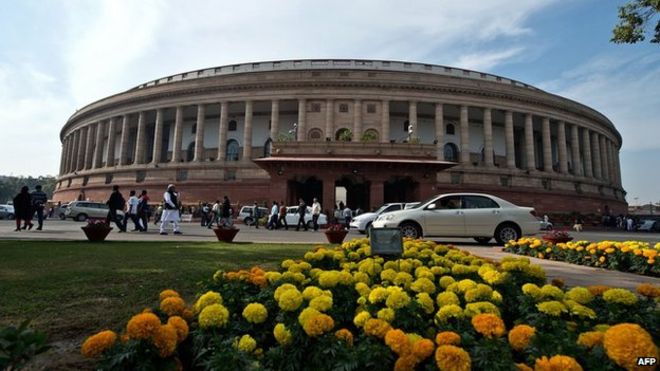
Image copyright AFPImage caption A third of the current members of parliament have criminal cases pending against them
“We need to build a consensus on how to prevent individuals with a criminal record from contesting elections.”
A necessary, even obvious fundamental you would think of building the world’s largest democracy.
And when Sonia Gandhi, India’s most powerful politician, uttered those words three years ago, even her main opponent, the leader of the BJP agreed.
Yet since then, things have gone in the opposite direction – with more alleged lawbreakers among India’s lawmakers than ever, a third of the current parliament according to a watchdog called the Association for Democratic Reforms.
By some calculations, politicians with a criminal record are more likely to be elected than those with a clean slate – because, says the ADR, they have more illicit funds with which to buy votes.
And on Tuesday night, India’s cabinet sought to ensure there was even less chance of criminal politicians facing their own laws.
It issued an order overturning a Supreme Court ruling demanding the disqualification of any politician convicted for crimes punishable with more than two years in jail.
This was “to ensure that governance is not adversely impacted“, the government had argued, with no apparent irony intended.
Unusual speed
Arguably, of course, the government is right. Losing tainted local or national politicians – among them many accused murderers, rapists and fraudsters – could upset delicate political alliances and make it even harder to get laws passed.
So often derided for doing nothing, this time round the cabinet acted with unusual speed.
The urgency it appears is the impending conclusion of two cases involving key politicians, due before Prime Minister Manmohan Singh gets back to India from a trip to the US.
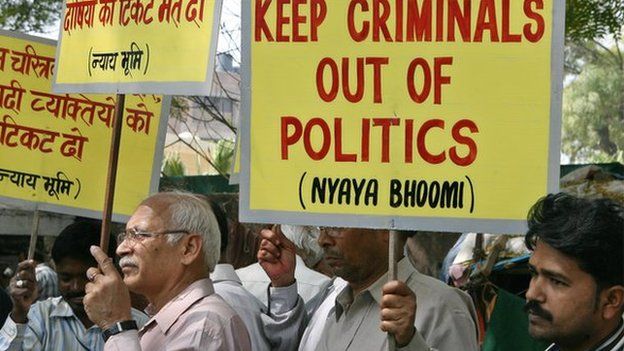
Image copyright AFPImage caption There’s been some criticism of criminal politicians
One concerns Lalu Prasad Yadav, a former railways minister and Congress party ally, charged with pocketing millions of dollars in subsidies for non-existent livestock.
Another concerns Congress MP Rashid Masood, already convicted of corruption and due to be sentenced next week. When the BBC asked his office for a comment, his assistant told us “he is unwell”.
“Don’t know whether to laugh or cry” tweeted MP Baijayant Panda in response to the government’s protective move.
He is a rare voice though inside the chamber campaigning against criminals sitting alongside him.
There’s been some other criticism outside, but not much. Indians have become very used to these kinds of shenanigans.
Almost forgotten already are calls in the Verma commission report into the December 16 Delhi gang rape case for all politicians accused of sexual crimes to be barred from office. Instead, six politicians charged with rape remain in office.
The opposition BJP has said it will oppose the cabinet order. But its record is just as murky, with even more accused criminals among its elected members in parliament and state assemblies than the Congress.
And with elections round the corner, none of the parties want to risk real reform right now, whatever they have signed up to in the past.
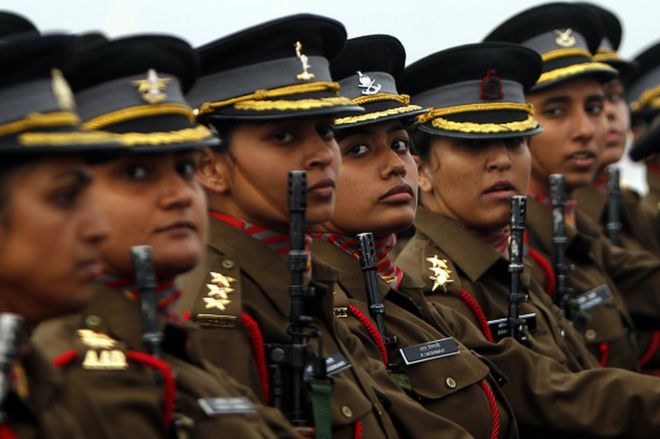
Image copyright GETTY IMAGESImage caption India’s armed forces began inducting women officers in 1992
Last month, India’s Supreme Court appeared to nudge the government to consider lifting the military’s official ban on women in combat roles – and to give them commanding roles.
“Test them on [the] same footing as men. Do not exclude them [women officers] as a class. [A] change of mindset is required,” the court said.
Earlier this week, the government responded. Its lawyers told the top court that women were not fit to serve in ground combat roles. For one, male soldiers are not “yet mentally schooled to accept women officers in command”. Then there were the “challenges of confinement, motherhood and childcare”.
This, according to military historian Srinath Raghavan, is an “extraordinary and regressive” claim, reminiscent of the claims of colonial rulers that Indian soldiers would never accept Indian commanders. “Military training is about fundamentally reshaping norms and attitudes that soldiers bring from their social backgrounds,” he says.
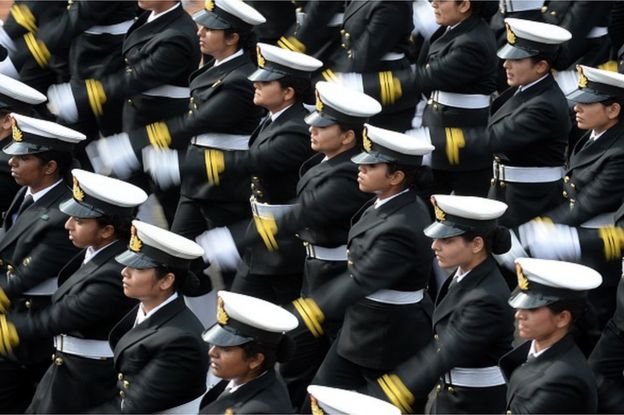
India’s armed forces began inducting women officers in 1992. Over the decades, they have been given combat roles in the air force. Women have been inducted as fighter pilots and have flown sorties into combat zones; they will be inducted as sailors as soon as ships that can accommodate them are ready. Last year, a 24-year-old became the navy’s first woman maritime reconnaissance pilot.
The army is a striking exception. Women have worked here as doctors, nurses, engineers, signallers, administrators and lawyers. They have treated soldiers on battlefields, handled explosives, detected and removed mines, and laid communication lines. Women officers have also been given permanent commission – a 20-year service, depending on eligibility and rank. Last year, women were cleared to join the military police.
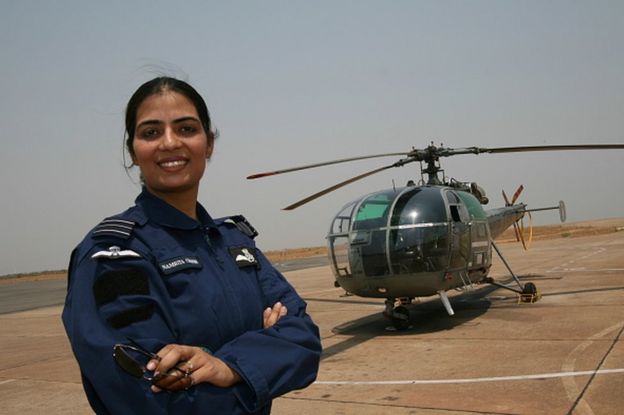
Image copyright GETTY IMAGESImage caption Namrita Chandi Naidu is a senior woman pilot in India’s air force
So they have ended up doing almost everything except combat roles: women are still not allowed to serve in infantry and the armoured corps. According to 2019 figures, women comprise only 3.8% of the world’s second-largest army – compared to 13% of the air force and 6% of the navy. There are some 1,500 female officers compared to more than 40,000 male officers.
All this, says Akanksha Khullar, a researcher at Delhi’s Institute of Peace and Conflict Studies, cannot really be considered a “milestone for women empowerment, as the doors have opened up with an extremely limited capacity”. India’s national security narrative, she told me, is “shaped, limited, and permeated by ideas about gender – with an overt masculine predominance and the structural exclusion of women”.
Media caption The all-women crew from the Indian navy that is sailing around the world
She says the gender disparities are “well reflected in institutional attitudes right at the top” and that “patriarchal notions are probably more ingrained in the army” than the other forces.
She’s correct. In 2018, former army chief and the current Chief of Defence Staff Gen Bipin Rawat told a news network that there weren’t any women soldiers serving in front line combat positions because “a woman would feel uncomfortable at the front line”.
He said maternity leave was an issue, women need more privacy and protection, and that India was not yet ready to accept “body bags of women” killed in combat. He also said that women need to be “cocooned” from the eyes of subordinate soldiers. Mr Rawat’s comments had sparked considerable outrage.
Image copyright AFPImage caption A contingent of women belonging to the Indian navy march during a parade in Delhi
Around the world, getting women into combat roles has been a hard won battle. More than a dozen nations allow women in combat roles.
“While some can argue that women, in general, may not be able to cope with the rigour of combat due to the sheer physical strength required, why deny the opportunity to those who can? In my view, the right of a woman to serve in any role in the armed forces must be equal to a man’s as long as the physical and qualitative standards are not compromised,” says HS Panag, a retired Indian general.
In other words, patriarchy should not come in the way of equality and common sense.
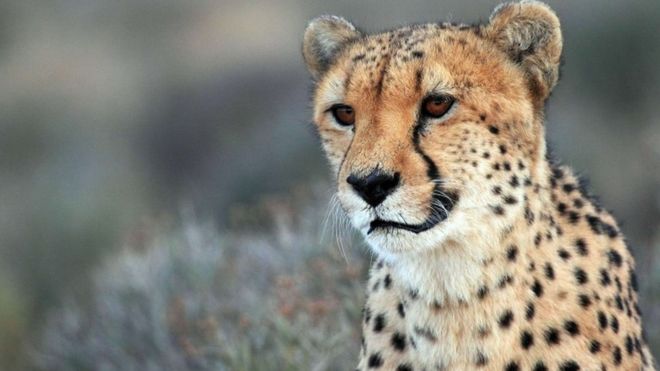
Image copyright AFPImage caption The majority of the 7,100 cheetahs left in the world are in Africa
India’s top court has said cheetahs can be reintroduced in the country, 70 years after they were wiped out.
Responding to a plea by the government, the Supreme Court said African cheetahs could be introduced to the wild in a “carefully chosen location”.
Cheetahs are an endangered species, according to the Convention on International Trade in Endangered Species (Cites).
Only 7,100 cheetahs are left in the wild, almost all of them in Africa.
The Asiatic cheetah, which once roamed parts of India, is now only found in Iran, where there are thought to be about 50 left.
India’s Supreme Court said the animal would have to be introduced on an experimental basis to find out if it could adapt to Indian conditions.
Studies show that at least 200 cheetahs were killed in India, largely by sheep and goat herders, during the colonial period. It is the only large mammal to become extinct after the country gained independence in 1947.
India’s former environment minister Jairam Ramesh welcomed the decision to reintroduce the animal.
Delighted that Supreme Court has just given OK to reintroducing cheetah from Namibia. This was something I had initiated 10 years ago. Cheetah which derives from the Sanskrit ‘chitra’ (speckled) is the only mammal hunted to extinction in modern India.
For more than a decade, wildlife officials, cheetah experts and conservationists from all over the world have discussed the reintroduction of the spotted big cat to India and have agreed that there is a strong case for it.
But leading conservationists have harboured doubts about the plan. They fear that in its haste to bring back the cheetah, India will end up housing the animals in semi-captive conditions in huge, secured open air zoos rather than allowing them to live free.
They add that without restoring habitat and prey base, and given the high chances of a man-animal conflict, viable cheetah populations cannot be established.
They have also pointed to India’s chequered record of reintroducing animals to the wild.
Lions were reintroduced in the Chandraprabha sanctuary in northern Uttar Pradesh state in the 1950s, but were then poached out of existence.
You may also be interested in…
Media caption Curious cheetah joins safari group in Tanzania
However, conservationists who have led the initiative insist that these fears are unfounded. They say a decision will only be taken after shortlisted sites are fully examined for habitat, prey and potential for man-animal conflict.
The first cheetah in the world to be bred in captivity was in India during the rule of Mughal emperor Jahangir. His father, Akbar, recorded that there were 10,000 cheetahs during his time.
Much later, research showed that were at least 230 cheetahs in India between 1799 and 1968 – and the cat was reportedly sighted for the last time in the country in 1967-68.
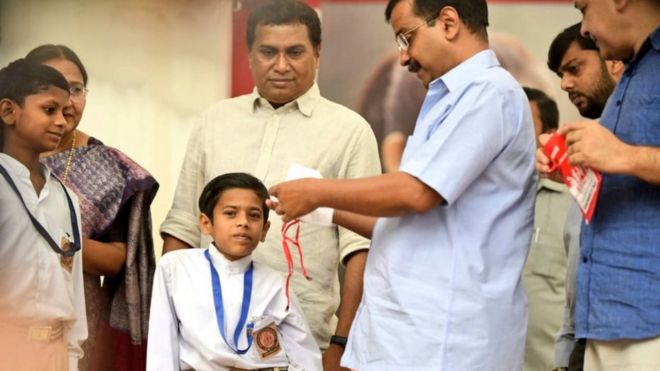
Image copyright TWITTER/@ARVINDKEJRIWALImage caption Delhi Chief MinisterArvind Kejriwal has been handing out masks to school students
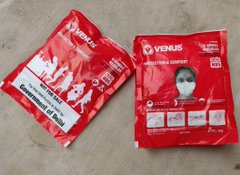
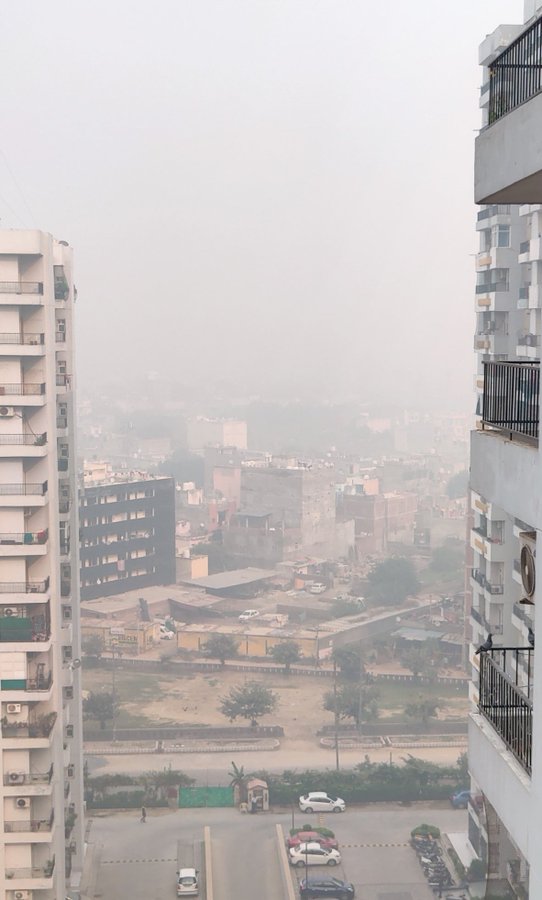
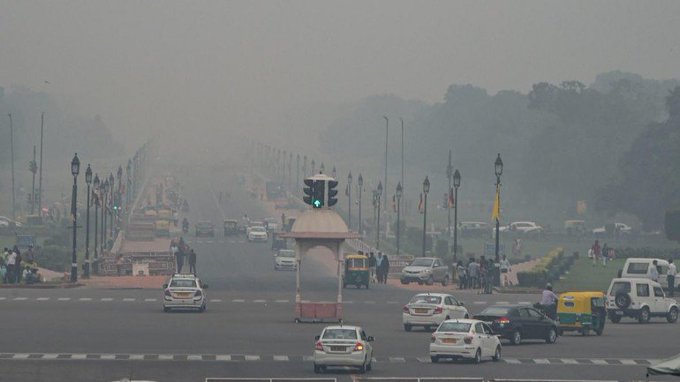
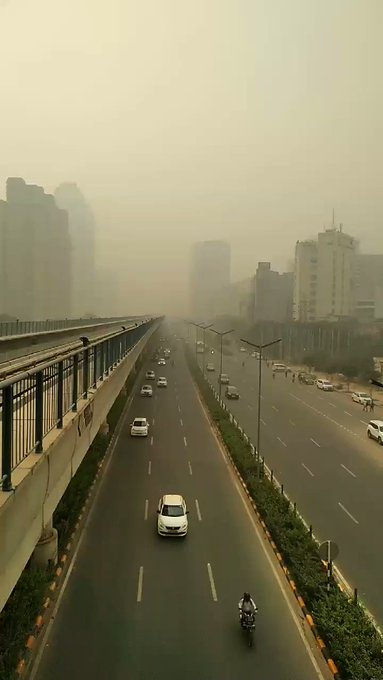
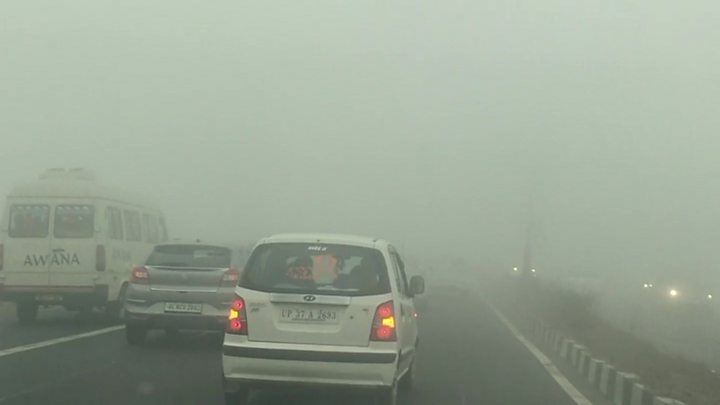
Five million masks are being distributed at schools in India’s capital, Delhi, after pollution made the air so toxic officials were forced to declare a public health emergency.
A Supreme Court mandated panel imposed several restrictions in the city and two neighbouring states, as air quality deteriorated to “severe” levels.
All construction has been halted for a week and fireworks have been banned.
The city’s schools have also been closed until at least next Tuesday.
Delhi’s Chief Minister Arvind Kejriwal said Delhi had been turned into a “gas chamber”.
The masks are being handed out to students and their parents, and Mr Kejriwal has asked people to use them as much as possible.
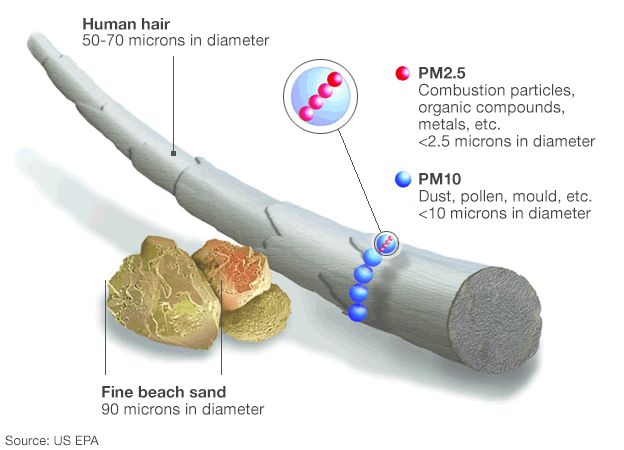
The levels of tiny particulate matter (known as PM2.5) that enter deep into the lungs are 533 micrograms per cubic metre in the city. The WHO recommends that the PM2.5 levels should not be more than 25 micrograms per cubic metre on average in 24 hours.
As thick white smog blanketed the city, residents started tweeting pictures of their surroundings. Many are furious that the situation remains the same year after year.
The hashtags #DelhiAirQuality and #FightAgainstDelhiPollition are trending on Twitter.
One of the main reasons for air quality in the city worsening every year in November and December is that farmers in the neighbouring states of Punjab and Haryana burn crop stubble to clear their fields. It’s made worse by the fireworks during the Hindu festival of Diwali.
There are other reasons too, including construction dust, factory and vehicular emissions, but farm fires remain the biggest culprit.
Media caption A hair-raising drive through the Delhi smog
More than two million farmers burn 23 million tonnes of crop residue on some 80,000 sq km of farmland in northern India every winter.
The stubble smoke is a lethal cocktail of particulate matter, carbon dioxide, nitrogen dioxide and sulphur dioxide.
Using satellite data, Harvard University researchers estimated that nearly half of Delhi’s air pollution between 2012 and 2016 was due to stubble burning.
The burning is so widespread that it even shows up in satellite photos from Nasa.
What are PM 2.5 particles?
Particulate matter, or PM, 2.5 is a type of pollution involving fine particles less than 2.5 microns (0.0025mm) in diameter
A second type, PM 10, is of coarser particles with a diameter of up to 10 microns
Some occur naturally – e.g. from dust storms and forest fires, others from human industrial processes
They often consist of fragments that are small enough to reach the lungs or, in the smallest cases, to cross into the bloodstream as well
Black market imports from China, confusing regulations and pollution concerns are undermining India’s fireworks industry
Industry sources say Diwali sales this year were down by 30 per cent
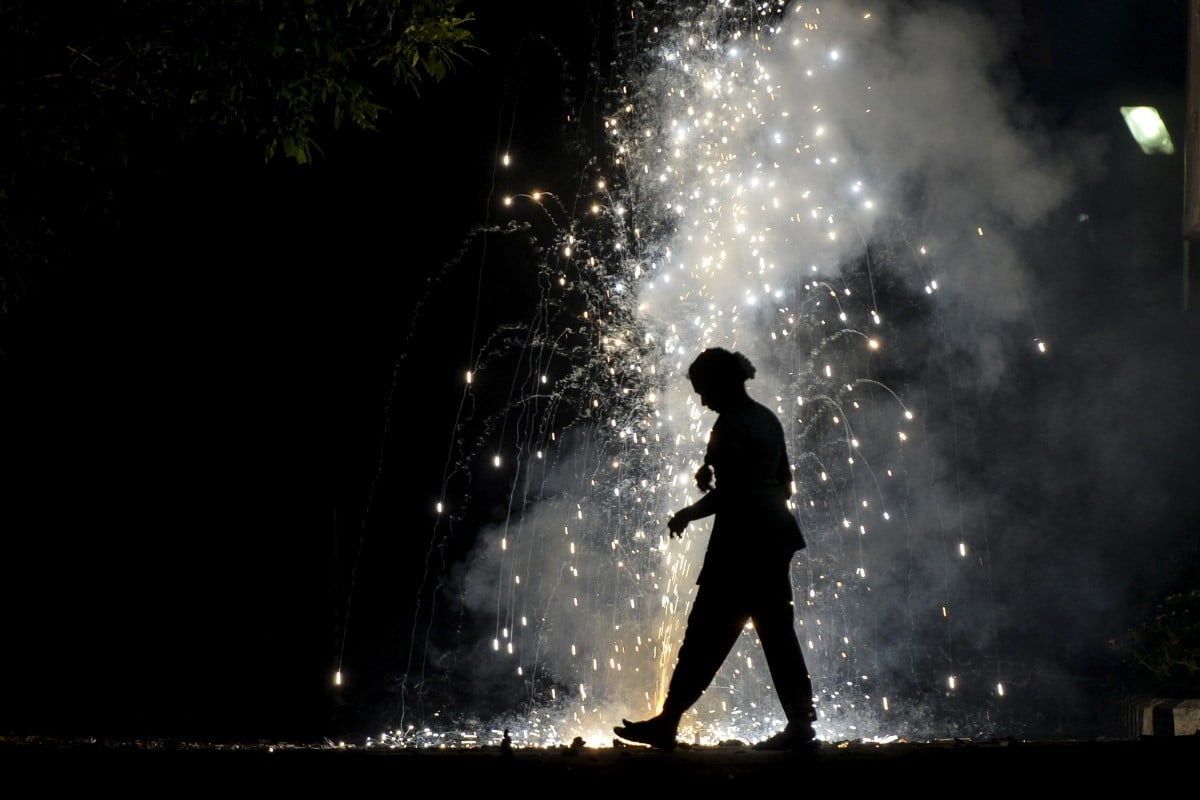
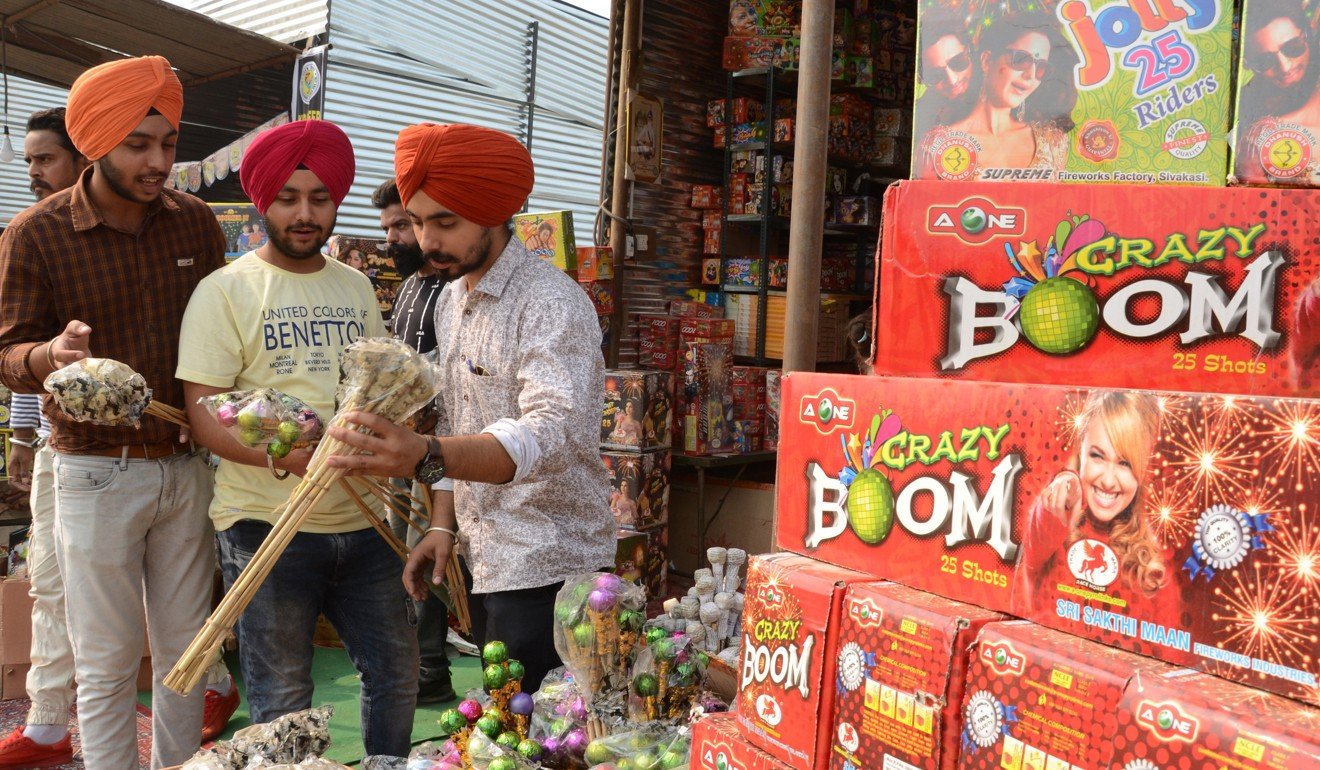
A woman is silhouetted by lit firecrackers during Diwali celebrations in Chennai. Photo: AFP
Arumugam Chinnaswamy set up his makeshift booth selling firecrackers in a Chennai neighbourhood a week ahead of Diwali, the Hindu festival of lights, with great expectations of doing a brisk trade.
Yet a week later, he has been forced to pack up more than half his stock in the hope he’ll have better luck next year.
“Four years ago, I sold firecrackers worth 800,000 rupees (US$11,288) on the eve of Diwali alone. This year, the sales have not even been a quarter of that,” said Chinnaswamy, 65, painting a grim picture that will be recognised by many in the Indian fireworks industry.
Chinnaswamy buys his firecrackers in Sivakasi, an industrial town in the southern Indian state of Tamil Nadu that produces more than 90 per cent of the country’s fireworks.
Sivakasi’s dry climate has helped to make it the firework capital of India and many production facilities in the town have been in the business for close to a century. For the most part, the industry has resisted mechanisation and still deals in handmade products. Its 1,100-plus manufacturing units provide jobs for 800,000 mostly uneducated workers and its diligent labour force have earned the town the nickname of ‘Little Japan’.
A worker lays firecrackers in an outdoor yard at a manufacturing unit involved in the production of firecrackers ahead of the Hindu festival of Diwali, in Sivakasi. Photo: AFP
But this reputation is under threat, struggling under the weight of an anti-pollution campaign, regulatory uncertainty and the arrival of cheap black-market Chinese imports. Irregular monsoons and a slowdown-induced cash crunch have not helped matters either.
Industry figures estimate the Diwali sales of India’s 80 billion-rupee firecracker industry took a 30 per cent drop this year.
A TOXIC PROBLEM
With pollution in Indian cities among the worst in the world, the government has come under pressure to do something about the nation’s toxic air – a problem that becomes more acute during Diwali due to the toxic fumes emitted when celebratory fireworks are set off. This Diwali, for instance, many areas in New Delhi recorded an Air Quality Index (AQI) of 999, the highest possible reading (the recommended limit is 60).
That makes the fireworks industry seem like an easy target when it comes to meeting government air quality targets.
Trouble began brewing in October last year when the Supreme Court banned the manufacture of traditional fireworks containing barium nitrate, a chief polluter. That decision put a rocket under the industry, as barium nitrate is cheap and is used in about 75 per cent of all firecrackers in India.
Factories in Sivakasi responded with a four-month shutdown protest that decimated annual production levels by up to a third.
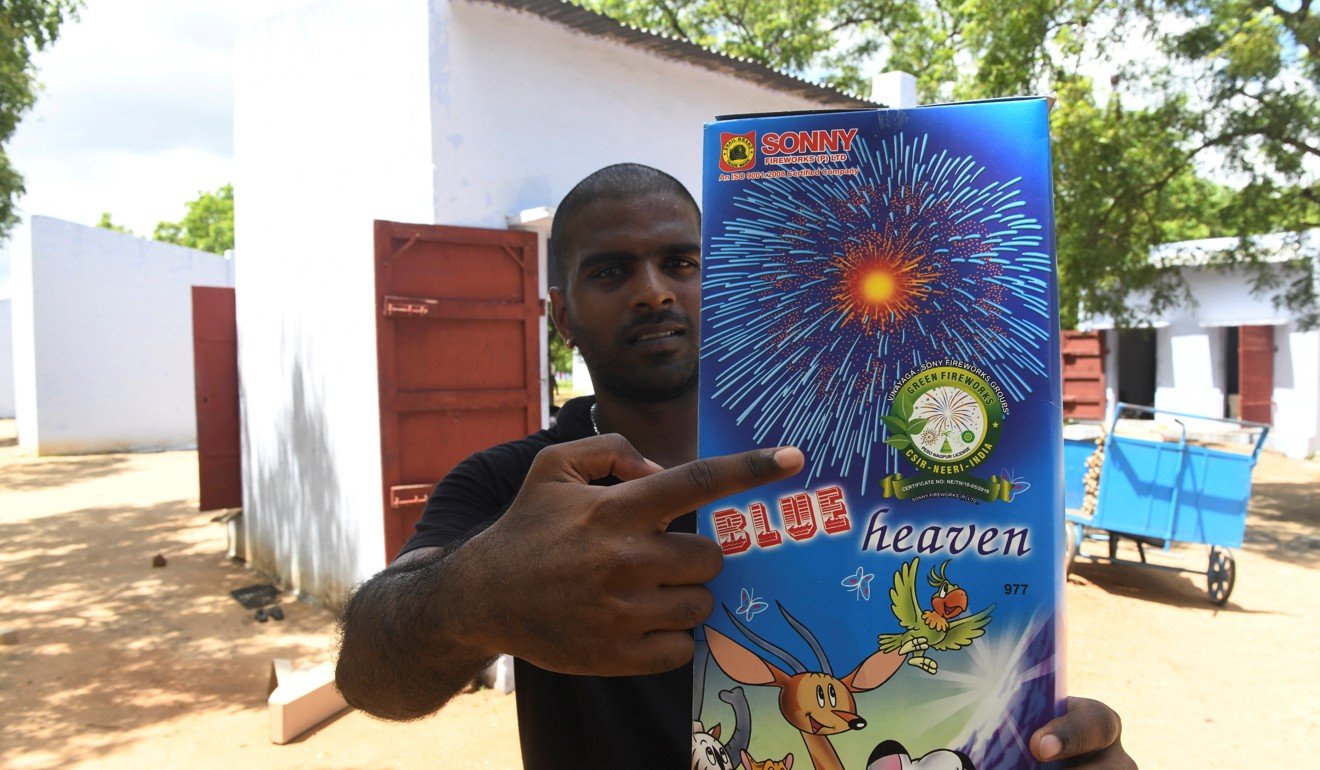
A seal denotes environment friendly ‘Green Fireworks’ at a manufacturing unit in Sivakasi. Photo: AFP
Apparently realising it had overstepped the mark – and that enforcing the Supreme Court regulations would be next to impossible – the government stepped in to rescue the industry, offering its assistance in the manufacture of environment-friendly crackers containing fewer pollutants, but it was too little, too late.
“The Supreme Court verdict was simply Delhi-centric with the vague idea of [cracking down on] urban pollution. It lacked any on-the-ground knowledge of the fireworks industry,” said Tamil Selvan, president of the Indian Fireworks Association, which represents more than 200 medium and large manufacturers.
Singapore travellers give Hong Kong a miss over Diwali long weekend
“Fireworks are low-hanging fruit for the anti-pollution drive as the industry is unorganised. Could the government or judiciary place a similar blanket ban on more pollution-causing industries like automobiles, plastics or tobacco?” asked Selvan.
CHINESE COMPETITION
The industry has also been hit by a flood of cheap Chinese firecrackers that are smuggled into the country on the black market.
In September, the country’s federal anti-smuggling agency, the Directorate of Revenue Intelligence, cautioned various government departments that huge quantities of Chinese-produced firecrackers had reached Indian soil in the lead up to Diwali.
But industry sources complain they have seen little action from the government to combat the problem.
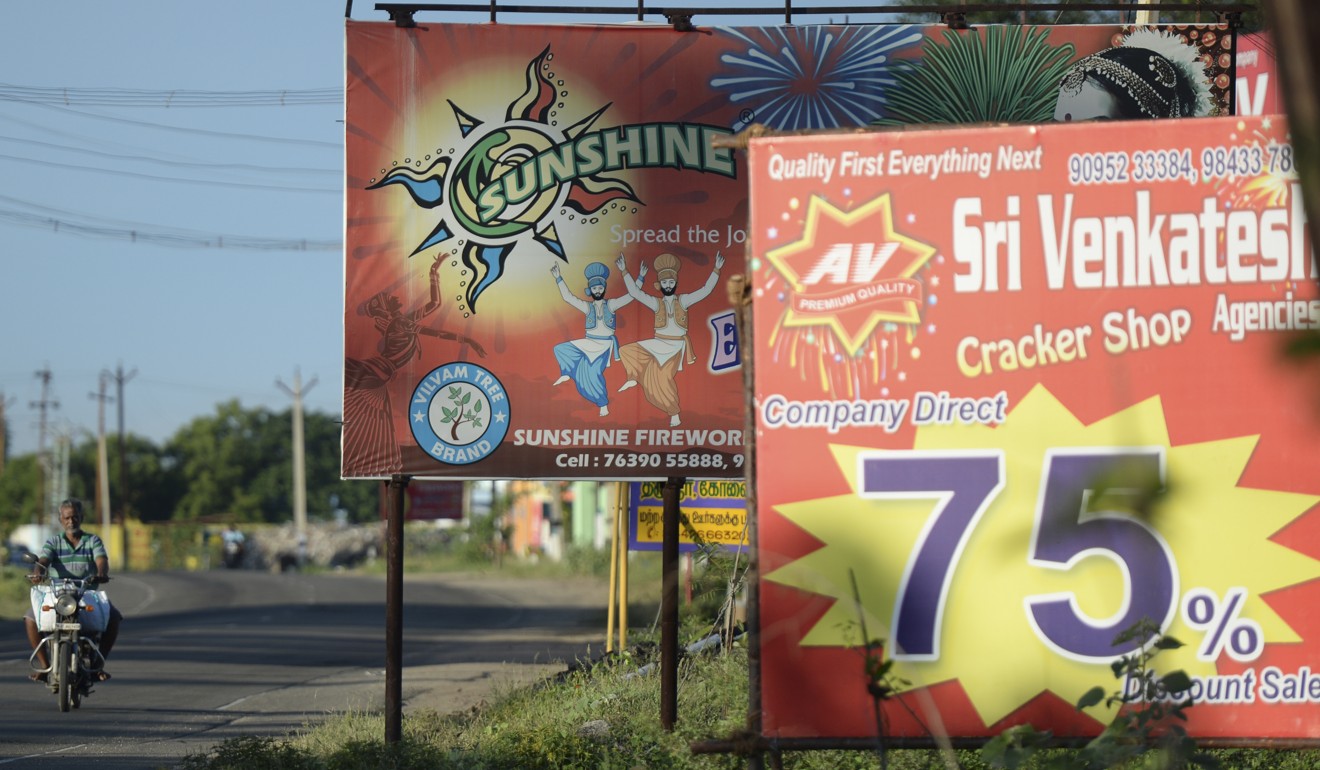
An advert for firecrackers ahead of the Hindu festival of Diwali, in Sivakasi. Photo: AFP
Legally, Indian manufacturers can neither import nor export firecrackers. The Indian firecracker industry is the second-largest in the world after China’s.
Raja Chandrashekar, chief of the Federation of Tamil Nadu Fireworks Traders, a lobbying body, said low-end Indian-manufactured firecrackers such as roll caps and dot caps – popular among children – had struggled to compete with Chinese-made pop pops and throw bombs.
“Despite our repeated complaints to government bodies, Chinese firecrackers find a way into India, particularly in the northern parts. This is severely affecting our business,” said Chandrashekar.
While more Chinese fireworks might be entering India, the effect has been to undermine the industry, resulting in fewer sales overall.
FIZZLING OUT?
The Sivakasi fireworks industry faces other problems, too. Not least among these is the use of child labour, which had been rampant until a government crackdown a few years ago, and the practice of some factories to operate without proper licences and with questionable safety standards.
But despite the darker aspects of the industry, its role goes beyond merely helping Diwali celebrations go with a bang every year.
India is crazy about gold. But can the love last as prices skyrocket?
“The livelihoods of over five million people who are indirectly involved in the business, in areas such as trade and transport, depend on the survival of the industry,” said Chandrashekar.
That survival looks increasingly in question. Dull sales of fireworks have been reported in major cities including New Delhi, Mumbai, Bangalore and Hyderabad, though exact numbers can be hard to come by due to the unregulated nature of the industry and unreliable numbers shared by manufacturers.
So great has the resultant outcry been that some cynics even wonder whether the industry is struggling as much as it claims or whether it is part of a ploy by manufacturers to gain more government concessions and avoid any further crackdown.
“These firecracker manufacturers lie through their teeth about the Diwali sales for self-serving motives such as tax avoidance. The overall business is healthy,” said Vijay Kumar, editor of the Sivakasi-based monthly magazine Pyro India News.
“Though there was a 30-40 per cent shortage in annual production, all the manufactured products have been sold this year. No large stockpile is left with any manufacturer.”
Customers buy firecrackers on the eve of the Hindu festival of Diwali in Amritsar. Photo: AFP
Still, regardless of the manufacturers’ motives, the result of the industry’s struggles has been that street sellers like Chinnaswamy have fewer fireworks to sell – and they are struggling even to sell those.
Chinnaswamy says people are confused about the government’s anti-pollution drive and about what firecrackers are now legal and this has discouraged them from buying. Despite the government’s effort to promote “green crackers” he says these are too hard to come by to be a ready solution, at least for this year.
“There was no clarity on what type of firecrackers, whether green crackers or otherwise, can be set off and at what time of the day. Many consumers even asked me whether or not the conventional firecrackers are totally banned while there was much misinformation floating about on social media,” said Chinnaswamy.
Shaking his head, all he can do is hope that next year his Diwali goes with more of a bang.
Image copyright AFPImage caption The dispute turned to violence in 1992 when a Hindu mob destroyed a mosque at the site
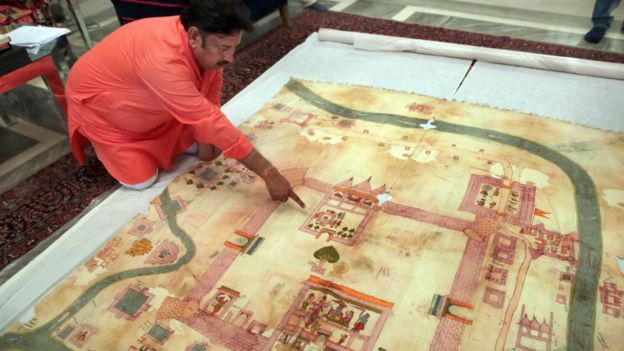
The Ayodhya dispute, which stretches back more than a century, is one of India’s thorniest court cases and goes to the heart of its identity politics.
Hindus believe that Ayodhya, a city in the northern state of Uttar Pradesh, is the birthplace of one of their most revered deities, Lord Ram.
But Muslims say they have worshipped there for generations.
A court case pertaining to the ownership of the land has been dragging on in the Supreme Court for years, but a verdict is expected next month.
The court concluded its final hearing into the case on Wednesday.
What is the row actually about?
At the centre of the row is a 16th Century mosque that was demolished by Hindu mobs in 1992, sparking riots that killed nearly 2,000 people.
Many Hindus believe that the Babri Masjid was actually constructed on the ruins of a Hindu temple that was demolished by Muslim invaders.
Muslims say they offered prayers at the mosque until December 1949 when some Hindus placed an idol of Ram in the mosque and began to worship the idols.
Over the decades since, the two religious groups have gone to court many times over who should control the site.
Since then, there have been calls to build a temple on the spot where the mosque once stood.
The case currently being heard by five judges in the top court is to determine who the land in question belongs to.
A verdict is expected between 4 and 15 November.
Hinduism is India’s majority religion and is thought to be more than 4,000 years old. India’s first Islamic dynasty was established in the early 13th Century.
Who is fighting the case?
The long and complicated property dispute has been dragging in various courts for more than a century.
This particular case is being fought between three main parties – two Hindu groups and the Muslim Waqf Board, which is responsible for the maintenance of Islamic properties in India.
Image copyright GETTY IMAGES
The Hindu litigants are the Hindu Mahasabha, a right-wing political party, and the Nirmohi Akhara, which is a sect of Hindu monks.
They filed a title dispute in the Allahabad High Court in 2002, a decade after the mosque was demolished.
A verdict in that case was pronounced in September 2010 – it determined that the 2.77 acres of the disputed land would be divided equally into three parts.
The court ruled that the site should be split, with the Muslim community getting control of a third, Hindus another third and the Nirmohi Akhara sect the remainder. Control of the main disputed section, where the mosque once stood, was given to Hindus.
The judgement also made three key observations.
It affirmed the disputed spot was the birthplace of Lord Ram, that the Babri Masjid was built after the demolition of a Hindu temple and that it was not built in accordance with the tenets of Islam.
The Supreme Court suspended this ruling in 2011 after both Hindu and Muslim groups appealed against it.
What are the other important legal developments?
In 1994 the Supreme Court, which was ruling on a related case, remarked that the concept of a mosque was “not integral to Islam”. This has bolstered the case made by Hindus who want control of the entire site.
In April 2018, senior lawyer Rajeev Dhavan filed a plea before the top court, asking judges to reconsider this observation.
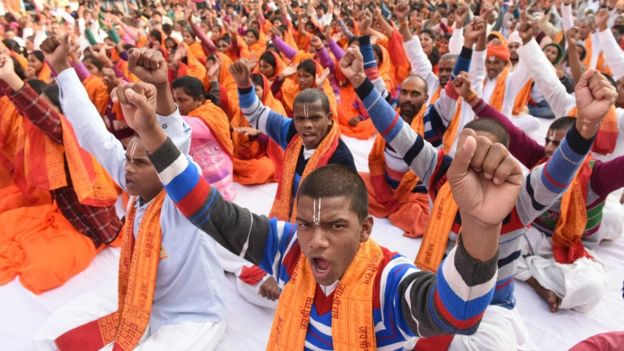
Image copyright GETTY IMAGESImage caption Hindu activists are demanding the construction of the Ram Temple
Have religious tensions eased in India in recent years?
Ever since the Narendra Modi-led Hindu nationalist BJP first came to power in 2014, India has seen deepening social and religious divisions.
The call for the construction of a Hindu temple in Ayodhya has grown particularly loud, and has mostly come from MPs, ministers and leaders from the BJP since it took office.
Restrictions on the sale and slaughter of cows – considered a holy animal by the majority Hindus – have led to vigilante killings of a number of people, most of them Muslims who were transporting cattle.
An uninhibited display of muscular Hindu nationalism in other areas has also contributed to religious tension.
Most recently, the country’s home minister Amit Shah said he would remove “illegal migrants” – understood to be Muslim – from the country through a government scheme that was used recently in the north-eastern state of Assam.
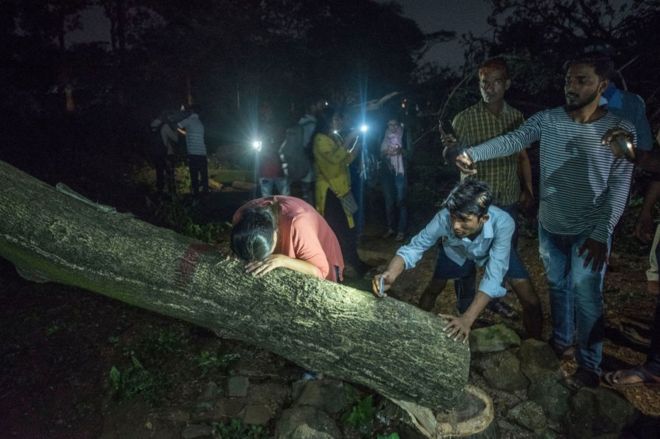
Image copyright GETTY IMAGESImage caption Protesters cry over felled trees in Aarey colony
India’s top court has asked officials to stop cutting trees in a forested area in Mumbai city after protesters clashed with police over the weekend.
The trees, part of a green strip known as Aarey colony, were being cut to make way for a new metro rail project.
Locals have long opposed the move, and filed petitions seeking Aarey to be declared a protected area.
But a high court dismissed the petitions on Friday, sparking protests as officials began felling the trees.
They planned to cut 2,185 trees, and admitted in the Supreme Court that more than 1,500 had already been cut. But petitioners claim that officials have cut around 2,500 trees.
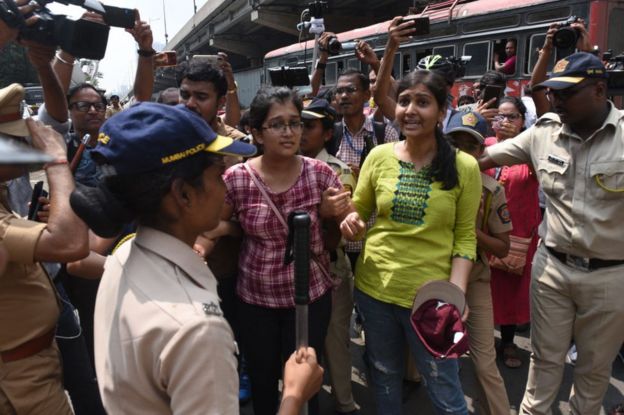
Local residents, students and environmental activists clashed with police on Friday as they took to the streets to stop authorities, and even broke through barricades to enter Aarey colony. More than 50 people were arrested and police imposed restrictions on public gatherings.
The protests grabbed the national spotlight over the weekend, and the Supreme Court took suo moto (without a formal complaint from any party) notice.
What did the Supreme Court say?
A special two-judge bench heard the matter on Monday after students wrote to the chief justice, asking the court to intervene and save the trees.
The court asked the state government of Maharashtra, where Mumbai is located, to not cut any more trees.
Image copyright GETTY IMAGESImage caption Police arrested more than 50 protesters
The court also asked the government to maintain “status quo” – which means that no construction can take place – until 21 October when it will hear the matter again.
The court also ordered the release of all activists who were arrested or detained on bail.
What is Aarey colony?
Spread over 1,300 hectares (3,212 acres), Aarey is a densely forested area dotted with lakes and has the Mithi river flowing through it. It lies at the heart of Mumbai and is often referred to as its last green lung.
It’s locally known as the Aarey “milk colony” because most of the land was given to the department of dairy development in 1951. But they are allowed to grow cattle fodder only on a fraction of the land.
Image copyright GETTY IMAGESImage caption Protesters broke through barricades and clashed with police on Friday
Earlier this year, officials cleared some 40 hectares of the forested area to build a zoo, complete with a night safari. And now, locals complain, another slice of it is in danger from the metro construction.
They also fear that the government will eventually clear the way for private builders to encroach on the Sanjay Gandhi National Park, which lies to the north of Aarey colony.
Officials, however, dismiss these fears as unfounded and point out that the construction for the metro only requires 30 hectares.
How crucial is the metro rail for Mumbai?
The city badly needs a “mass rapid transport system,” Ashwini Bhide, managing director of the Mumbai metro rail corporation, had told the BBC earlier.
The land in Aarey colony, she said, was “the most suitable land due to its size, shape and location”.
She has also been defending the decision to cut the trees on Twitter.
India’s financial hub is congested and infamous for its crawling traffic jams.
Its colonial-era local train system ferries some 7.5 million people between the city’s suburbs and its centre on a daily basis.
Officials say that the metro will eventually carry around 1.7 million passengers every day and bring down the number of vehicles on the road by up to 650,000.























 CHINDIA ALERT: You'll be living in their world, very soon