Chindia Alert: You’ll be Living in their World Very Soon
aims to alert you to the threats and opportunities that China and India present. China and India require serious attention; case of ‘hidden dragon and crouching tiger’.
Without this attention, governments, businesses and, indeed, individuals may find themselves at a great disadvantage sooner rather than later.
The POSTs (front webpages) are mainly 'cuttings' from reliable sources, updated continuously.
The PAGEs (see Tabs, above) attempt to make the information more meaningful by putting some structure to the information we have researched and assembled since 2006.
BEIJING, Oct. 6 (Xinhua) — While fireworks and festivities drew the largest crowds during this year’s National Day holiday, many Chinese chose to celebrate the occasion with a bowl of patriotic noodles and homegrown films.
This year marks the 70th anniversary of the People’s Republic of China which was founded on Oct. 1, 1949. The weeklong National Day holiday, introduced in 1999 by the State Council, or China’s cabinet, saw “National Day noodles” become a popular choice among some Chinese this year.
Birthday noodles are to Chinese people what birthday cakes are to Westerners. In accordance with the Chinese custom, people enjoy a bowl of noodles on their birthday as a symbol of longevity. Many restaurants will prepare a bowl of birthday noodles for free if there is a diner celebrating their birthday.
Beijing Huatian Catering Group, a leading catering company in Beijing that has more than 20 time-honored brands, sold more than 25,000 bowls of National Day noodles and gave away more than 120 bowls of birthday noodles, according to a Saturday report by Beijing Daily.
Beijing Honghua Dahaiwan Catering Group said that it has sold 3,800 bowls of noodles during the first three days of the National Day holiday, up 25 percent compared to the same period of last year.
Moviegoers meanwhile got their fill of National Day celebrations in an entirely different manner.
“My People, My Country,” “The Climbers” and “The Captain” were all set for theatrical release on the Chinese mainland on Sept. 30, a day ahead of the weeklong National Day holiday, according to the China Film Distribution and Exhibition Association.
Featuring seven short stories from seven directors, “My People, My Country” draws on important historical moments since the founding of the PRC, aiming to awaken the shared memories of Chinese around the world.
“The Climbers” dramatizes the real-life expedition of Chinese mountaineers to ascend Mount Qomolangma in 1960 and 1975.
“The Captain” is a cinematic portrayal of a real-life event that occurred on May 14, 2018, when a captain of Sichuan Airlines managed a successful emergency landing after the windshield of his plane broke in the air, safely bringing home the 119 passengers and nine crew members on board.
According to the real-time statistics of MaoYan Movie, the leading online movie ticketing platform in China, the three movies ranked as the top three films at the box office over the holiday. “My People, My Country” has raked in more than 2 billion yuan (around 279.8 million U.S. dollars) as of Sunday, “The Captain,” 1.7 billion yuan, and “The Climbers,” 743 million yuan.
Cheng Qiang was just 12 when a magnitude 8 tremor destroyed his village, but he never forgot the heroism of the soldiers sent to help and swore one day to join their ranks
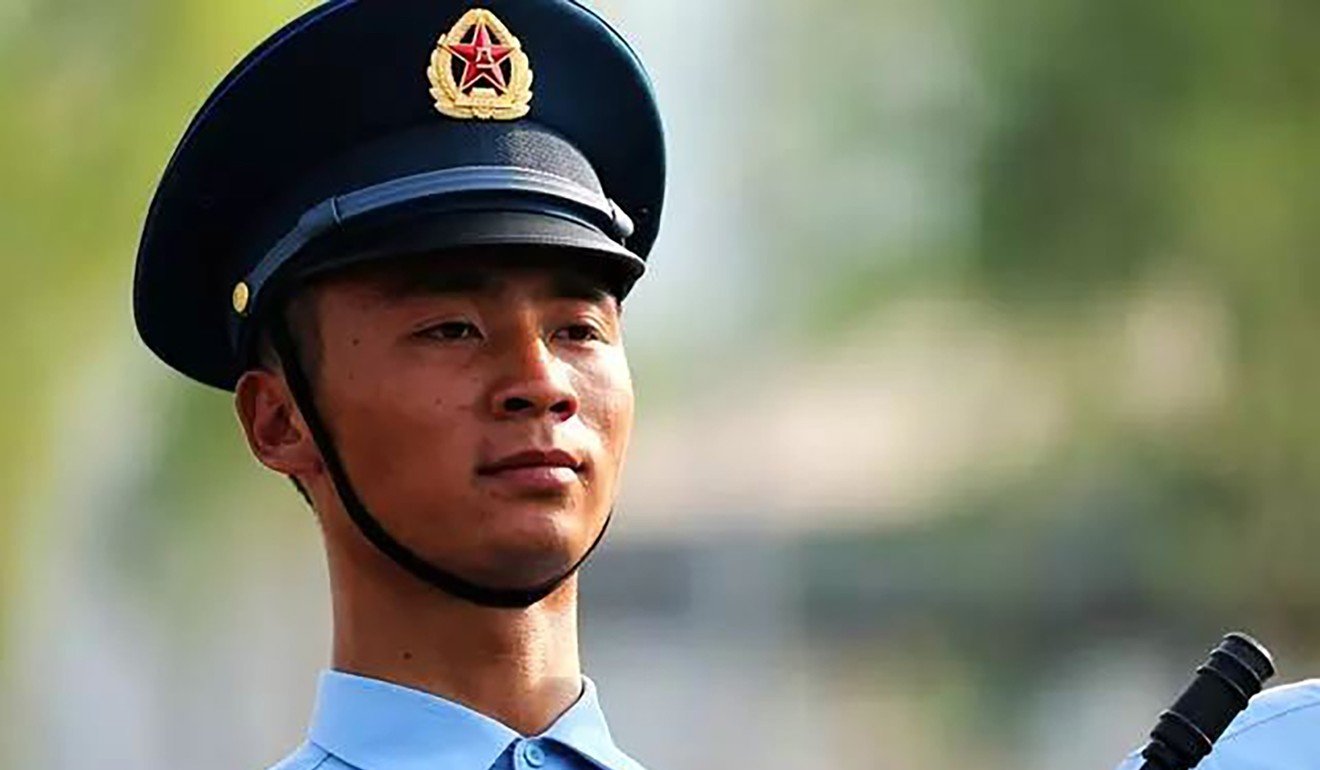
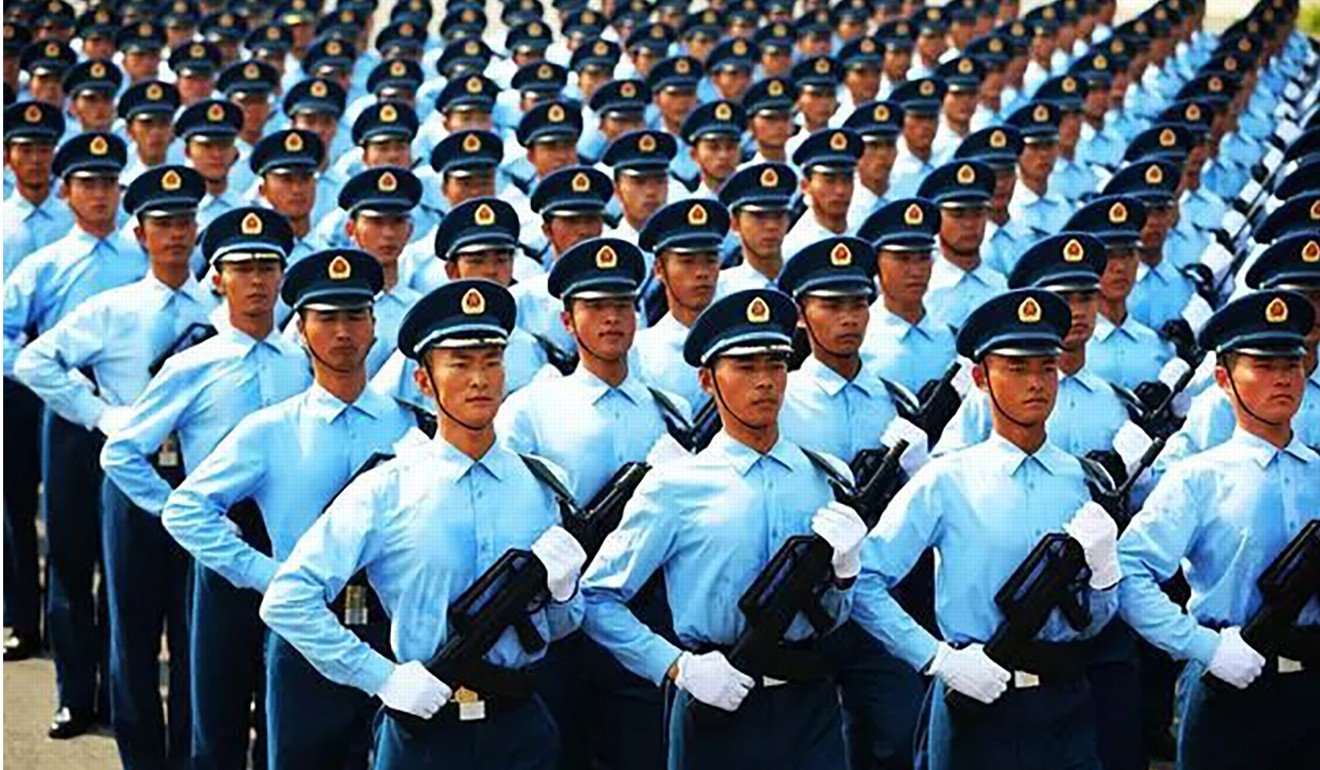
Now a squad leader, on October 1 he will also be part of the National Day celebrations in Tiananmen Square
Cheng Qiang was just 12 when his home in Sichuan was hit by a massive earthquake and airborne troops were sent to help. Photo: People.cn
A young man who survived the devastating Sichuan earthquake and vowed to one day join the ranks of the soldiers who spent months rescuing people from the rubble will on Tuesday lead his very own squad of airborne troops in Tiananmen Square as part of the celebrations for the country’s 70th anniversary.
Now 23, Cheng Qiang was just 12 when on May 12, 2008 he and a group of friends played truant from school to go swimming in a local river, Xinhua reported on Thursday.
When the boys had finished their fun they returned to their village in the township of Luoshui to find their school and many other buildings had been razed to the ground. The death toll from the magnitude 8 quake would eventually rise to 87,000, with 370,000 people injured.
Cheng says he is ready to “continue the glory of the airborne troops” at Tuesday’s parade. Photo: Thepaper.cn
In the days and weeks that followed the devastation, tens of thousands of people from around China and the world descended on towns and villages across Sichuan to help with the rescue effort.
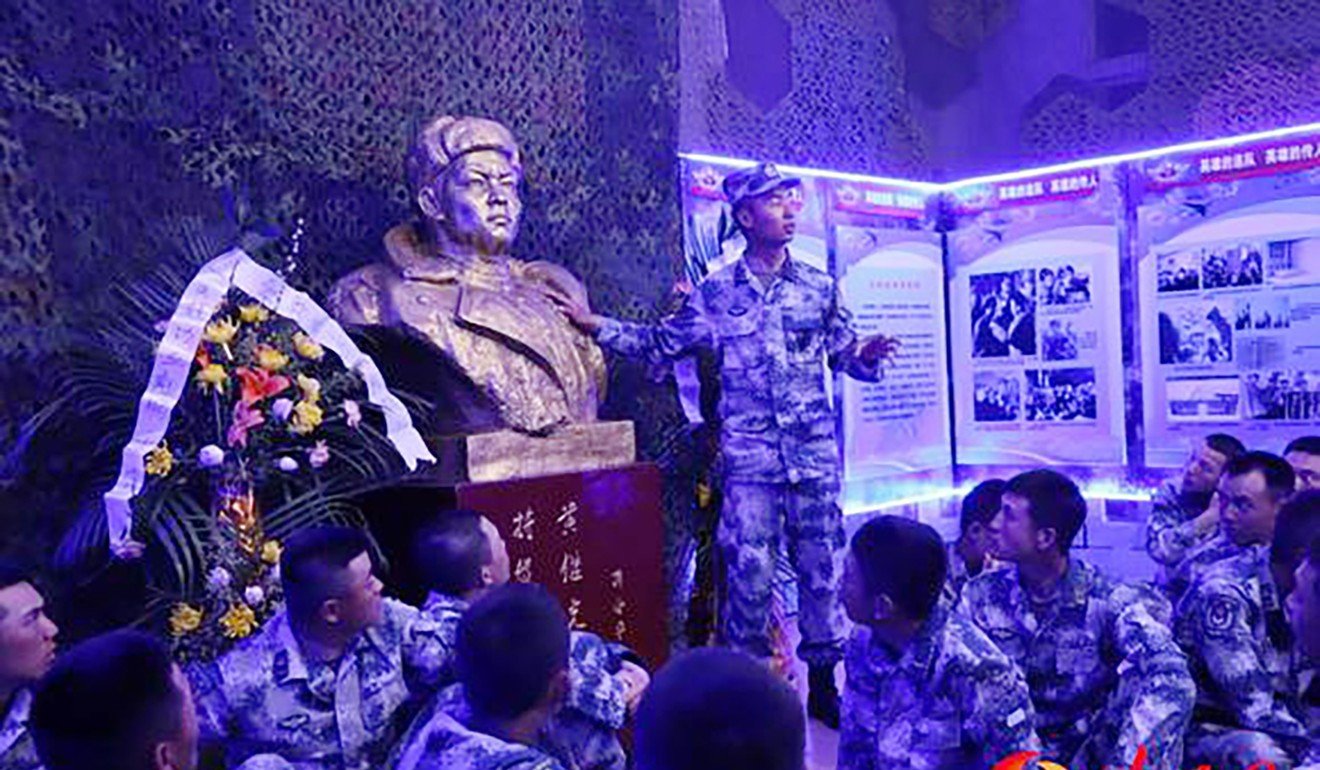
But the ones who impressed Cheng the most were the soldiers from the People’s Liberation Army (PLA) with the word “Airborne” printed on the helmets.
“Sometimes they had to remove the debris with their bare hands which were already covered in blood,” he said.
“But they just carried on and eventually pulled dozens of people out of the rubble. I knew then that I wanted to be one of them.”
Cheng said that after the quake having the troops in his village made him feel safe. Photo: People.cn
Having the troops in his village made Cheng feel safe, he said, and he spent his days following them around and doing what he could to help.
Three months later, when the soldiers had completed their work and were preparing to pull out, Cheng said he was determined to show his new heroes just how grateful he was to them.
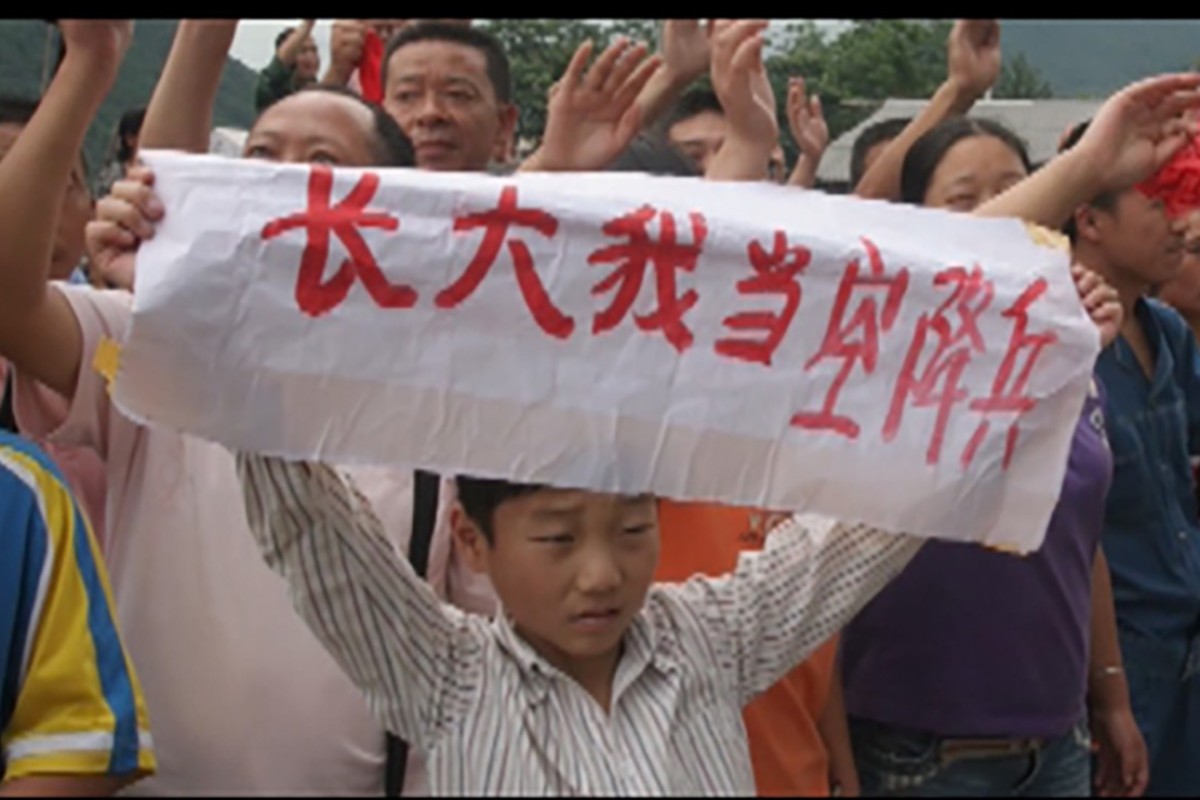
As the villagers gathered at the roadside to bid farewell to the men who had become their saviours, the young boy held up a handwritten sign. It said simply: “I want to be an airborne soldier when I grow up.”
The moment was captured on camera by a press photographer, and the image soon became a symbol of the gratitude felt by the people who had seen their lives and communities shattered but knew they had not been forsaken.
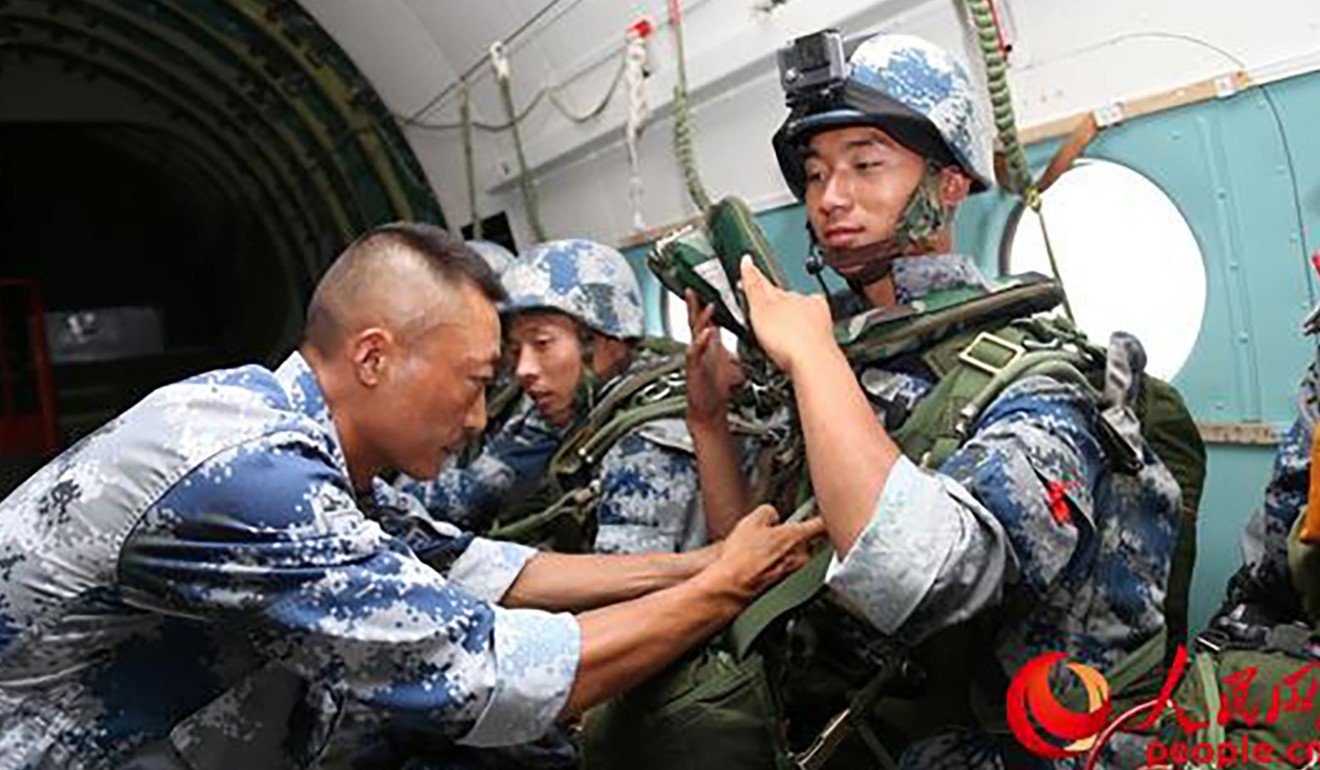
Cheng said he felt dizzy when he first jumped out of a plane. Photo: People.cn
Five years after the troops rolled out, Cheng was preparing to go to college when he heard the PLA was recruiting and that there were places available with the airborne division.
The teenager did not need a second invitation, and after securing a place on a training course and successfully completing it he joined the ranks of his heroes in 2013.
Not that everything was plain sailing, however.
“When I first jumped out of a plane I felt very dizzy and didn’t really know what was going on,” he said.
Thankfully Cheng managed to overcome his vertigo and went on to become a squad leader.
Tens of thousands of troops will take part in China’s National Day parade on October 1. Photo: Thepaper.cn
When the preparations were being made for next week’s anniversary celebrations in Beijing, Cheng said he and his squad were chosen to take part.
He said that during the rehearsals for the grand parade, he was repeatedly reprimanded by his trainer for not keeping his knees close enough together, for lifting his feet too high and for letting his gun slip off shoulder.
But he was determined to get it right, and after weeks of hard work and 11 years on from the tragedy that devastated his world, he said he was now ready to put his best foot forward.
“The nightmare of earthquake has long gone,” he said. “I am here to continue the glory of the airborne troops. I am ready for inspection.”
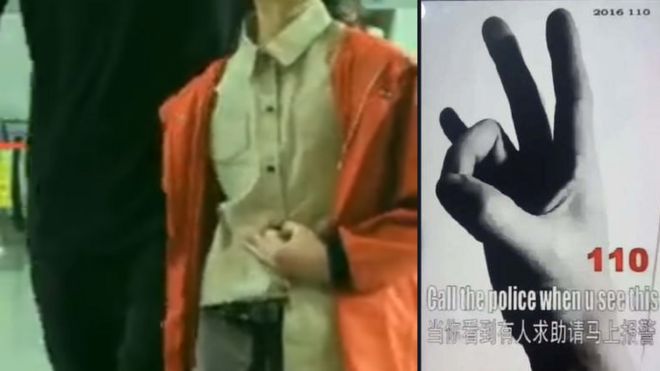
Image copyright TIKTOK/SINA WEIBOImage caption A video and associated posters went viral showing a girl making an OK signal as a subtle way of asking for help
A video showing a Chinese girl using a clever technique to signal she needs help has been widely shared on popular social network TikTok – and is making the authorities nervous.
She is shown being escorted away by a stranger in an airport. Unable to make a cry for help, she makes a subtle hand gesture that looks like the signal for “OK”.
This alerts a passerby, who immediately begins to argue with the man, and helps others recognise that the girl is being held against her will. She is then reunited with her parents.
So why has the video created such a big reaction on Chinese social media, and made the authorities so upset?
The hand gesture
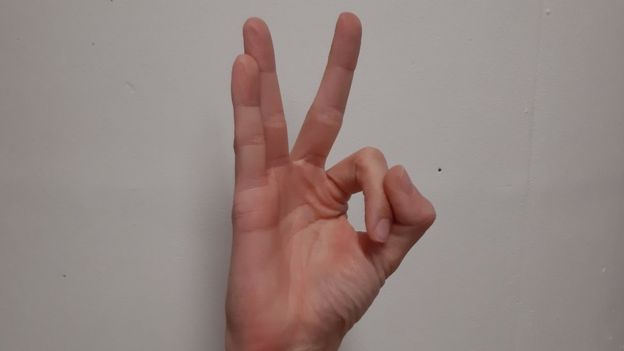
Image caption The “OK” hand gesture reversed looks like the number sequence “110”
While the “OK” gesture is pretty widely understood around the world as a positive gesture, simply turning your hand so that you are facing your palm conveys a subtle message in China.
If two fingers are pressed together, your hand can look like the numbers “110” – which in China is the emergency contact number for the police.
Consequently, the video, which features actors, shows a subtle way that a child can get a message out if they are in trouble.
To push this message home, at the end of the video, a man tells viewers to “spread this gesture” so that people can signal if they are in need of help “in the event of coercion, kidnapping, or fear of your life”.
The authorities don’t like it
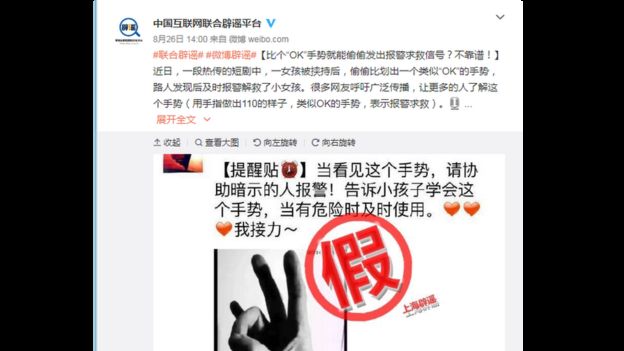
Image copyright PIYAOImage caption China’s top disinformation bureau said the ‘OK’ signal as a sign of distress was absolutely not OK
The video has the appearance of a public service announcement, so many social media users assumed it had the backing of the police.
The Chengdu Economic Daily says that videos being shared on TikTok predominantly attributed the footage to the police. However, the actual origins of the video are unknown.
Today, official media are spreading the message of China’s official disinformation platform Piyao, which criticises the video for being misleading, and says the police had no involvement with it.
“Such a gesture is meaningless as an alarm,” it says, and argues that it might actually be counter-productive in allowing an individual to find help if they need it.
It says that it has “never publicised or promoted such an alarm method in public”, and urges readers to follow the traditional method of calling the police if they need assistance or suspect someone else needs help.
Social media users think it’s a good idea
Despite the authorities distancing themselves from the footage and associated advertising campaigns that have suddenly sprung up on TikTok, a huge debate has broken out online about whether the simple signal might actually be effective in helping Chinese people understand if somebody is under duress.
Some on the popular Sina Weibo microblog say that “shouting for help is more practical than gestures”, and others note that the simple signal might “mislead people” and could lead to accidental interventions where none are necessary.
But in a country where tight authoritarian controls are in place and people are unable to freely speak openly, some are praising this seemingly small action to attract attention if someone’s under duress.
“In fact, this kind of gesture could really be promoted for help in the country”, one user says.
“As long as everyone is in agreement, we can still use it, it is still possible,” another says. “As long as we’re united in our understanding.”
Numbers as a symbol of rebellion
Image copyright TAOBAOImage caption Taylor Swift’s 1989 album caused problems for Chinese censors as the singer is popular, but the number “1989” is sensitive
Number sequences have long proven an effective way for social media users to criticise the authorities, without immediately alerting government censors, who regularly screen platforms for sensitive words.
People have found ways to talk about the Tiananmen Square massacre of 1989 – which the government has heavily censored for three decades – by using number sequences such as “46” (4 June), “64” (June 4) or “1989”.
The authorities have wised up to number sequences being used and are known for censoring many of these. But such strict censorship does mean that sometimes innocuous posts are removed by mistake.
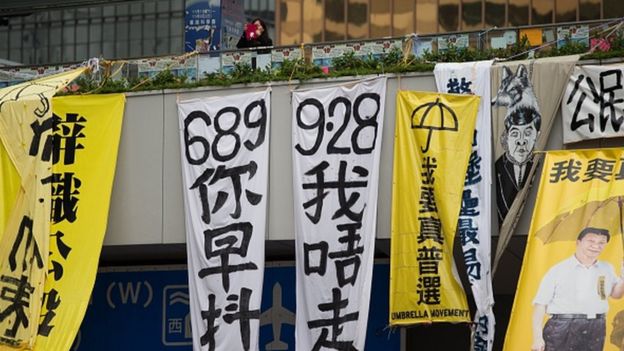
Image copyright AFPImage caption During the 2014 Hong Kong protests, demonstrators showed their anger for then-leader CY Leung by calling him “689”
Cryptic number sequences and hand gestures have proven particularly effective in helping protesters in Hong Kong unite on a shared message.
Online users have been able to voice criticism of their leadership in recent years by referring to them based on the number of votes that elected them into office.
Consequently, “777” has become a nickname for Hong Kong’s chief executive Carrie Lam. Her predecessor, CY Leung, was known as “689”.
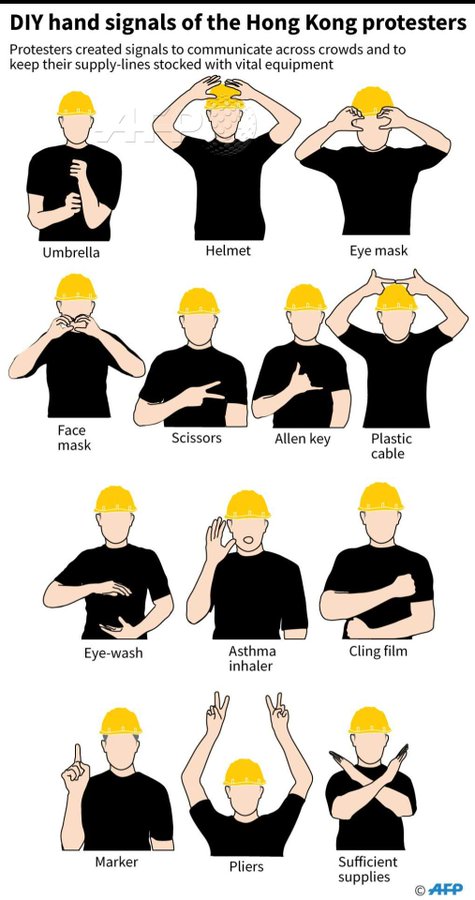
Graphic on hand signals used by protesters in Hong Kong to communicate and to keep their supply-lines stocked with vital equipment http://u.afp.com/Jsjm
As protests have dominated Hong Kong in recent months, it has also become apparent that demonstrators have been able to organise themselves by communicating subtle hand signals across crowds.
Graphics showing DIY hand signals that they can use if they need supplies such as eye masks, helmets or face masks, have circulated widely on platforms like Twitter.
Which is why a small, seemingly innocuous hand gesture, going viral in mainland China and getting huge public support, would undoubtedly unsettle the authorities.
Delicate balance for Disney in its portrayal of China’s classic tale of female heroism
Too Americanised, or pandering to a mainland Chinese audience?
Chinese-American actress Crystal Liu Yifei plays the title role in Disney’s Mulan. Photo: Disney
Since the trailer for Disney’s live-action film Mulan was released last weekend, both mainland Chinese in the East and the diaspora in the West have been abuzz about their cultural identity and its representation in Hollywood – albeit for different reasons.
Chinese viewers have, on one hand, been enthusiastic about the casting of Chinese-American actress Crystal Liu Yifei in the lead role and the chance for a seemingly more “authentic” Chinese story to be told on the global stage.
On the other hand, they have pointed out historical inaccuracies – such as the southern Chinese setting when the source material states that Mulan is from the north – and expressed concerns that the plot has been too “Americanised”.
Meanwhile, many Chinese-Americans were surprised to discover upon watching the trailer that the beloved 1998 animation had changed beyond recognition – most notably with the absence of talking dragon Mushu and male love interest Li Shang. Some also felt that the new film pandered too much to a mainland Chinese audience.
“The idea of a mythic mash-up of China [in the new film] … seems to play to the idea of a unified, singular China, an artistic representation of the one-China policy, which is troubling to me,” said Jeannette Ng, a British sci-fi author with Hong Kong heritage.
“A lot of the time, this conversation acts like the only Chinese people who matter are the ones who live in mainland China – that they are the only truly authentic ones and everyone else is too Westernised to count,” she said.
The online discussion indicates the delicate balance Hollywood interpretations of Chinese classics have to strike in portraying Chinese versus American values, as big US-China co-productions try their hardest to integrate the two for bigger global box office takings.
Despite ticket sales in China falling 3.6 per cent in the first half of 2019, owing to tightened government censorship, China is still projected to overtake the US box office next year, according to a recent report by professional services firm PwC.
Disney has tried hard to make the new film more true to its ancient Chinese source material, with a detailed – if inaccurate – historical setting featuring the ancient tulou roundhouses of the southeastern province of Fujian, and a star-studded, all-Asian cast with several icons of Chinese cinema such as Jet Li, Hong Kong actor Donnie Yen and Gong Li.
Disney’s live-action version of Mulan is truer to the ancient source material. Photo: Handout
“Disney’s tent pole movies are aiming at a global audience. That being said, given that China is the largest international market and the story is based on a Chinese folk tale, Disney will definitely take the Chinese audience’s taste into consideration,” said a Chinese film producer, who asked to remain anonymous, at a major US studio in Beijing.
“However, this is also a double-edged sword, as people tend to be more picky when they see things they are familiar with.”
Indeed, several Chinese media think pieces have questioned whether elements of the original legend had become too Americanised in the film, leading to an inauthentic representation of a beloved Chinese heroine.
For instance, the Disney trailer suggests that Mulan joins the army to escape an arranged marriage, breaking away from family traditions and establishing her independence as a woman unbound by gender roles.
But in the original folk song Ballad of Mulan, on which the film is based, she volunteers to take the place of her ageing father in the army – making her a symbol of filial piety, courage and patriotism in traditional Chinese culture.
Some critics say Mulan has been Americanised. Photo: YouTube
In a widely shared analysis discussing whether Disney’s Mulan was a feminist icon, Peking University Press wrote: “Perhaps this is a cross-cultural creative misunderstanding that reflects the core differences between Chinese and Western culture. If Mulan is seen as a feminist symbol, I fear this may be wishful thinking.”
However, both Chinese-Americans and Chinese nationals agree that the film, slated for release in March, is an inspiring tale for young girls.
“I feel like the people who are criticising the film are too attached and focused on the nostalgia factor. They are not seeing the bigger picture and the positive implications of this movie,” said Alex Diep, a 23-year-old American of Vietnamese-Chinese descent.
“They are disregarding that this film gives an opportunity for young Asian girls to look up to Mulan and see her as a role model,” he said.
Some Chinese have interpreted it as an inspiring fable of female strength and liberation, especially when ingrained patriarchal values and government initiatives such as the one-child policy have restricted women’s rights over the years.
“[Mulan] remains one of the very few fighters and not conventionally feminine figures in the Disney princess canon,” Ng said.
“[T]his is some sort of feminism education for a single-child generation in China that girls can fight like men do,” tweeted Chinese journalist Li Jing.
Chinese-Americans are also optimistic that it will be a sure-fire win for Asian representation on the big screen, especially after the success of last year’s romantic comedy Crazy Rich Asians.
“[Critics of the trailer] are disregarding the fact that this movie is another opportunity to showcase Asian people in a movie where we are not perceived as a negative stereotype,” Diep said.
Others feel that the film can help build a bridge between East and West.
“Mulan is a Chinese story. It comes from a completely different culture, one which I’m not at all convinced that Hollywood, or the West at large, truly understands yet,” said
New Yorker Jonathan Pu, who is of Taiwanese descent. He said he enjoyed the lighthearted animation, but that it did not define his expectations for the remake.
“If Disney can stay true to the source material and convey [filial piety] in a way that even just some of the audience can grasp, then it will go a long way towards building bridges,” Pu said.
Ultimately, the success of this American spin on Chinese culture will rest on box office sales, which Disney hopes will exceed the 1998 animation that flopped in mainland cinemas. Recent Disney live-action remakes have had a mixed reception in China – Dumbo flopped in March, while The Lion King did moderately well on its release last weekend.
“I’m sure there will be a mixed response when the movie is released but it should have enough buzz and do well,” said the Beijing film producer.
“I hope it will be able to convey the spirit of Mulan and inspire millions of young girls.”






 CHINDIA ALERT: You'll be living in their world, very soon