20/05/2020
TAIPEI (Reuters) – Taiwan cannot accept becoming part of China under its “one country, two systems” offer of autonomy , President Tsai Ing-wen said on Wednesday, strongly rejecting China’s sovereignty claims and likely setting the stage for an ever worsening of ties.
China responded that “reunification” was inevitable and that it would never tolerate Taiwan’s independence.
In a speech after being sworn in for her second and final term in office, Tsai said relations between Taiwan and China had reached an historical turning point.
“Both sides have a duty to find a way to coexist over the long term and prevent the intensification of antagonism and differences,” she said.
Tsai and her Democratic Progressive Party won January’s presidential and parliamentary elections by a landslide, vowing to stand up to China, which claims Taiwan as its own and says it would be brought under Beijing’s control by force if needed.
“Here, I want to reiterate the words ‘peace, parity, democracy, and dialogue’. We will not accept the Beijing authorities’ use of ‘one country, two systems’ to downgrade Taiwan and undermine the cross-strait status quo. We stand fast by this principle,” Tsai said.
China uses the “one country, two systems” policy, which is supposed to guarantee a high degree of autonomy, to run the former British colony of Hong Kong, which returned to Chinese rule in 1997. It has offered it to Taiwan, though all major Taiwanese parties have rejected it.
China’s Taiwan Affairs Office, responding to Tsai, said Beijing would stick to “one country, two systems” – a central tenet of Chinese President Xi Jinping’s Taiwan policy – and “not leave any space for Taiwan independence separatist activities”.
“Reunification is a historical inevitability of the great rejuvenation of the Chinese nation,” it said. “We have the firm will, full confidence, and sufficient ability to defend national sovereignty and territorial integrity.”
China views Tsai as a separatist bent on formal independence for Taiwan. Tsai says Taiwan is an independent state called the Republic of China, its official name, and does not want to be part of the People’s Republic of China governed by Beijing.
TAIWAN OPEN TO DIALOGUE
China has stepped up its military drills near Taiwan since Tsai’s re-election, flying fighter jets into the island’s air space and sailing warships around Taiwan.
Tsai said Taiwan has made the greatest effort to maintain peace and stability in the narrow Taiwan Strait that separates the democratic island from its autocratic neighbour China.
“We will continue these efforts, and we are willing to engage in dialogue with China and make more concrete contributions to regional security,” she added, speaking in the garden of the old Japanese governor’s house in Taipei, in front of a socially-distanced audience of officials and diplomats.
Taiwan has become a rising source of friction between China and the United States, with the Trump administration strongly backing Taiwan even in the absence of formal diplomatic ties.
U.S. Secretary of State Mike Pompeo sent his congratulations to Tsai on Tuesday, praising her “courage and vision in leading Taiwan’s vibrant democracy”, in a rare high-level message from Washington direct to Taiwan’s government.
China’s Foreign Ministry condemned Pompeo’s remarks, and said the government would take “necessary countermeasures”, though did not elaborate.
China cut off a formal talks mechanism with Taiwan in 2016 after Tsai first won election.
Yao Chia-wen, a senior adviser to Tsai, told Reuters the chance of talks with China were small given ongoing tensions.
“We are ready to engage with them any time, but China is unlikely to make concessions to Taiwan,” he said. “In the next four years there’s little chance for the cross-strait relationship to improve.”
Source: Reuters
Posted in antagonism, authorities, autocratic, autonomy, ‘peace, parity, democracy, and dialogue’, “necessary countermeasures”, Beijing, by force, central tenet, China, China’s Foreign Ministry, China’s sovereignty, Chinese President Xi Jinping’s, claims, coexist, condemned, congratulations, cross-strait, democratic island, Democratic Progressive Party, differences, downgrade, elaborate, Elections, former, former British colony, Government, guarantee, historical, Hong Kong, independence, inevitable, intensification, Japanese governor’s house, Landslide, Mike Pompeo, military drills, neighbour, parliamentary, People’s Republic of China, President, President Tsai Ing-wen, presidential, principle, rejects, rejuvenation, remarks, Republic of China, reunification, rule, status quo, Taipei, Taiwan, Taiwan Affairs Office, Taiwan Strait, Trump administration, turning point, U.S. Secretary of State, Uncategorized, undermine, United States, Washington |
Leave a Comment »
29/04/2020
- Hardline politicians want president to fulfil promise to overhaul constitution to reflect the self-ruled island’s political reality
- A petition calls for two referendums on the issue – proposing it either be replaced with a new one or revised
The push for constitutional change could lead to a cross-strait conflict. Photo: Handout
Taiwanese President Tsai Ing-wen is under growing pressure from the hardline camp to push for constitutional change to reflect the self-ruled island’s independent status – something observers say could provoke a cross-strait conflict.
With Tsai due to be sworn in for a second four-year term next month after a landslide victory in January’s election, hardline pro-independence politicians want her to fulfil a 2015 campaign promise: to overhaul the constitution so that it reflects Taiwan’s political reality. The process has been stalled since Tsai’s first term, which began in 2016.
Leading the charge is the Taiwan New Constitution Foundation, a group formed last year by a Tsai adviser and long-time independence advocate Koo Kwang-ming.
The foundation launched a petition at the end of March calling for two referendums on the constitution – proposing that it either be replaced with a new one or revised.
The existing constitution was adopted when Kuomintang leader Chiang Kai-shek and the KMT fled to Taiwan and set up an interim government in 1949 following their defeat by Mao Zedong’s communists in mainland China.
Drawn up in 1947, the constitution still puts the mainland and Mongolia under the Republic of China jurisdiction – Taiwan’s official name for itself. In reality, its jurisdiction extends only to Taiwan and its outlying islands of Penghu, Matsu and Quemoy, which is also known as Kinmen.
Taiwan’s constitution was adopted when KMT leader Chiang Kai-shek fled to the island in 1949. Photo: Handout
“We have garnered more than 3,000 signatures from the public for the first phase of initiating the proposals to hold two referendums asking the president to push for constitutional change,” Lin Yi-cheng, executive director of the Taiwan New Constitution Foundation, said on Wednesday.
He said they would propose that voters be asked two questions in the referendums: “Do you support the president in initiating a constitutional reform process for the country?”
And: “Do you support the president in pushing for the establishment of a new constitution reflecting the reality of Taiwan?”
“We’re ready to send the two referendum proposals to the Central Election Commission on Thursday,” he said.
Confusion prompts call for China Airlines name change in Taiwan, but at what cost?
Under Taiwan’s Referendum Act, the process for holding a referendum involves three stages: a proposal, endorsement and voting.
Lin said there should be no problem for the commission to approve the proposal stage since they had gathered far more than the minimum 1,931 signatures needed under the act.
The endorsement stage requires a minimum of 290,000 signatures, and if the referendum is held, they will need at least 5 million votes.
Lin said if the process went smoothly, he expected a referendum could be held in August next year, allowing time for review and making the necessary arrangements.
He said if the referendum questions got enough public support, Tsai would need to deal with the issue.
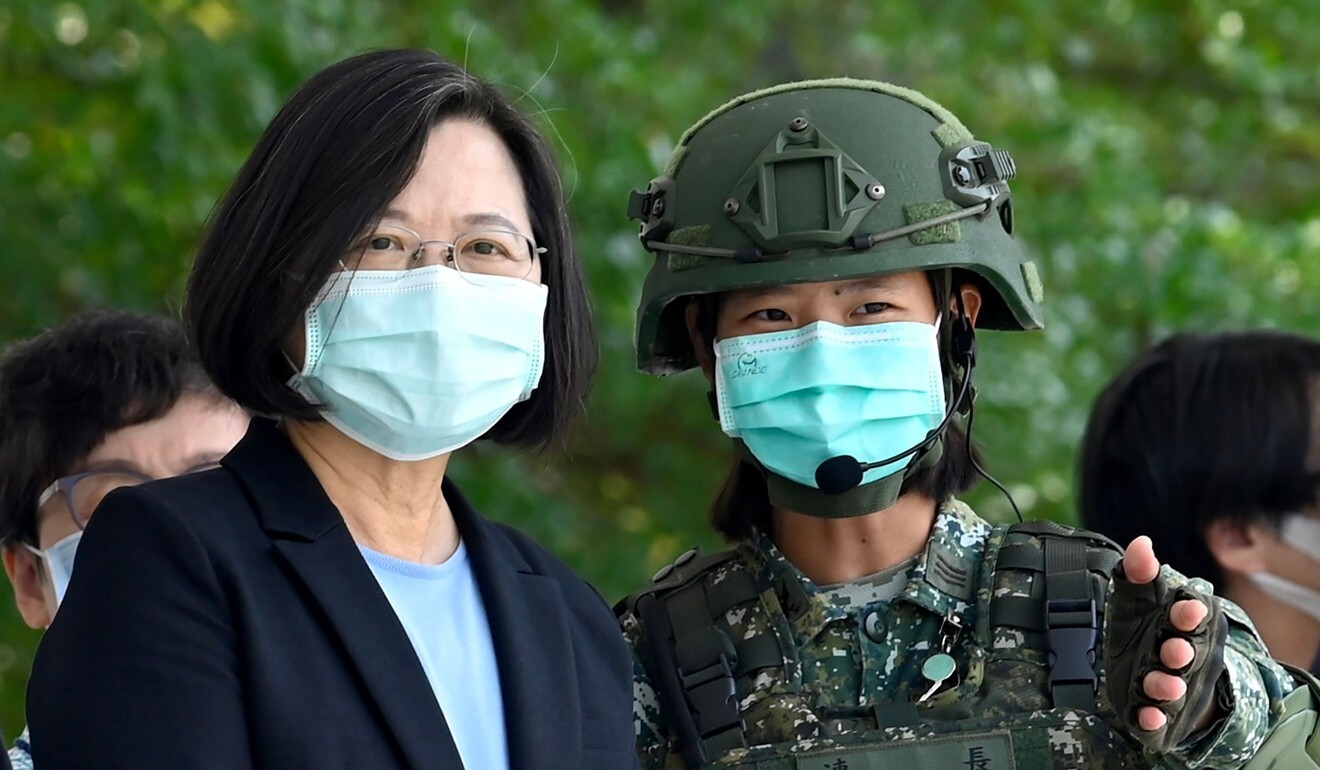
Tsai Ing-wen visits a military base in Tainan earlier this month. The pressure for constitutional change creates a dilemma for the president. Photo: AFP
Tsai’s Democratic Progressive Party government has been tight-lipped over the constitutional change issue, which Beijing sees as a move for the island to declare formal independence from the mainland.
Beijing considers Taiwan a wayward province that must be returned to the mainland fold, by force if necessary, and it has warned Tsai against declaring formal independence.
A DPP official said the foundation’s push would put Tsai in a difficult position.
“If she ignores the referendums, she will come under constant pressure from the hardline camp, and if she seriously considers taking action and instituting a new Taiwan constitution, she will risk a confrontation with Beijing, the consequence of which could be a cross-strait conflict,” said the official, who requested anonymity.
On Tuesday, Zhu Fenglian, a spokeswoman for the mainland’s Taiwan Affairs Office, warned the island against holding any referendum on constitutional revision, saying it would be doomed to end in an impasse and would ultimately fail.
“It will only push Taiwan towards an extremely dangerous abyss and bring disasters to Taiwanese compatriots,” she said.
Chinese air force’s drill ‘aimed at signalling deterrent around Taiwan’
But according to Wang Kung-yi, a political science professor at Chinese Culture University in Taipei, Tsai should not be too worried about the hardline camp move.
“The hardline camp has been marginalised greatly in the past several years as reflected by the poor showing in the legislative elections in January,” Wang said, adding that he expected Tsai to continue her relatively moderate cross-strait policy of not sharply provoking the mainland.
Source: SCMP
Posted in 1949, 2015, 2016, also known as, amid, August, be replaced, Beijing, by force, call for, calls for, campaign, Central Election Commission, Change, Chiang Kai-shek, China Airlines, Communists, confusion, considers, Constitution, constitutional, creates, cross-strait conflict, declare, defeat, Democratic Progressive Party, dilemma, earlier, either, Election, endorsement, fled, formal independence, four-year term, Hardline politicians, independent, island, islands, issue, January’s, jurisdiction, Kinmen, KMT, Kuomintang, mainland, Mainland China, Mao Zedong’s, March, marginalised, Matsu, military base, Mongolia, move for, name change, necessary, new one, next month, next year, observers, outlying islands, overhaul, Penghu, Petition, political reality, political science professor, politicians, President, pressure, pro-independence, promise, prompts, proposal, proposing, provoke, push for, Quemoy, Referendum Act, referendums, Republic of China, returned, revised, second, sees, self-ruled, status, sworn, Tainan, Taipei, Taiwan, Taiwan Affairs Office, Taiwan New Constitution Foundation, Taiwanese President, this month, Thursday, tight-lipped, to fulfil, to reflect, Tsai, Tsai Ing-wen, two, Uncategorized, under pressure, Voting, warned, wayward province |
Leave a Comment »
23/01/2020
- H-6 bomber, early warning and control plane part of long-haul exercise that bypassed island’s southern tip en route to western Pacific, Taipei says
- Taiwan’s military will remain on high alert over Lunar New Year holiday, ministry says
A KJ-500 early warning and control aircraft was among the PLA military planes that staged an exercise close to Taiwan on Thursday. Photo: Weibo
A group of military aircraft from mainland China flew close to the southernmost tip of
on Thursday, just a week after President Tsai Ing-wen angered Beijing by saying the island was an independent country.
According to Taiwan’s defence ministry, the formation, which included a KJ-500 early warning and control aircraft and an H-6 bomber, passed through the Bashi Channel near Taiwan’s Orchid Island en route to the western Pacific Ocean.
It did not say how many aircraft were involved but said they had taken off from different airbases in southern China.
“They returned to their airbases from their morning flight path after a long-haul exercise,” the ministry said in a statement.
The ministry urged the public not to be alarmed by the aircraft’s presence, saying it constantly monitored the activities of the
People’s Liberation Army (PLA), both in the air and at sea.
Taiwan’s armed forces would also remain on high alert over the
Lunar New Year
holiday, which starts on Friday, it said.
“There is no holiday for national security,” it said.
The PLA exercise came just a week after Tsai said on January 15 that Beijing needed to face the reality of Taiwan’s independence.
“We don’t have a need to declare ourselves an independent state,” she said in an interview with the BBC. “We are an independent country already and we call ourselves the Republic of China, Taiwan.”
Tsai urges mainland China to review strained ties
Tsai’s comments came just days after she secured a second term as president with a record 8.2 million votes.
In her victory speech, she promised to continue to stand up to Beijing’s intimidation, while also strengthening Taiwan’s defences, partly by developing more home-grown military equipment, including submarines.
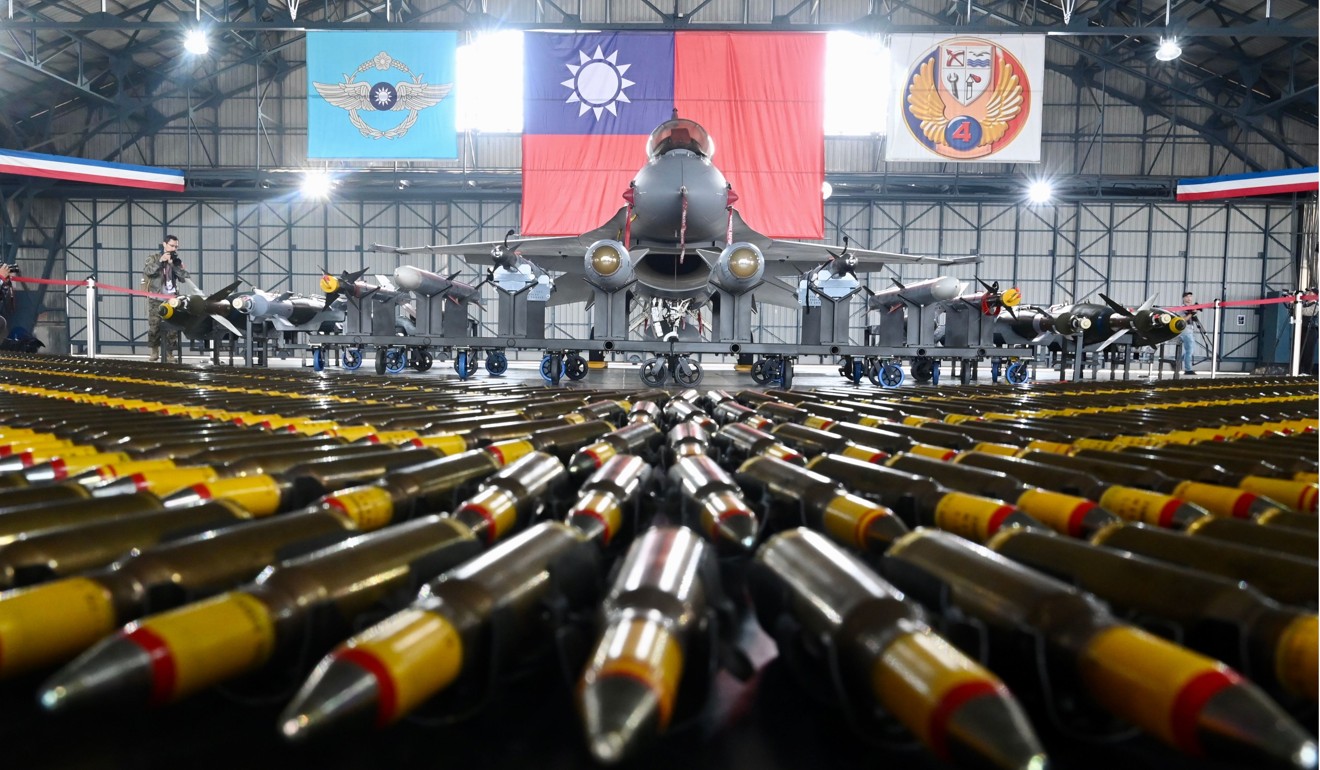
US-made F-16V fighters took part in a show of Taiwan’s military might last week. Photo: AFP
In response to Tsai’s “independent country” comments, Ma Xiaoguang, a spokesman for the mainland’s Taiwan Affairs Office, said: “We firmly attack and counter various forms of Taiwan independence and separatist activities to maintain overall peace and stability in the Taiwan Strait.”
Beijing regards Taiwan as part of its territory awaiting reunification, by force if necessary. Official ties between the two sides have been suspended since Tsai took office in 2016 and refused to accept the one-China principle – the political understanding that there is only one China with ambiguity over whether it is governed by Taipei or Beijing.
Over the past four years Beijing has ramped up the pressure on the island, by poaching its diplomatic allies and staging military drills.
Taiwanese Minister of National Defence Yen Te-fa said earlier that the mainland staged about 2,000 bomber patrols a year near the Taiwan Strait.
For their part, Taiwan’s army and air force last week gave two demonstrations of their readiness to defend the island against attack.
Posted in airbases, Bashi Channel, Beijing, Chinese military aircraft, defence ministry, early warning and control plane, F-16V fighters, fly, H-6 bomber, high alert, home-grown military equipment, independent country, island, KJ-500 early warning and control aircraft, Lunar New Year holiday, Minister of National Defence, one-China principle, Orchid Island, People's Liberation Army (PLA), PLA military planes, Republic of China, submarines, Taipei, Taiwan, Taiwan Affairs Office, Taiwan Strait, Taiwan’s army and air force, Taiwan’s military, Uncategorized |
Leave a Comment »
04/11/2019
- Latest measures grant island’s people and enterprises more equal treatment with their mainland counterparts
- Package in March last year was dismissed by Taiwan’s Mainland Affairs Council as an attempt to buy political support
Taipei’s elections in January could influence the tone of cross-strait relations. Photo: EPA-EFE
Beijing announced a series of sweeteners for Taiwanese businesses and individuals on Monday – including participation in its 5G research and allowing Taiwanese to use mainland consular services – only two months before
Taiwan’s critical presidential election.
The latest 26 measures drawn up by 20 government departments, including the State Council’s Taiwan Affairs Office and the National Development and Reform Commission, are designed to attract more Taiwanese to live and work in mainland China, despite worsening cross-strait relations.
But Taiwan’s Mainland Affairs Council criticised the move as an attempt by the Chinese Communist Party to “divide Taiwan internally, and was a further reflection of attempts to try to interfere in and influence Taiwan’s election”.
It follows a similar package of 31 measures unveiled by Beijing in March last year, which included tax incentives, preferential land-use policies for Taiwanese businesses on the mainland and benefits for Taiwanese individuals in studying or living on the mainland.
Taiwan charges pro-Beijing politicians with accepting mainland cash
The latest measures to grant Taiwan-funded enterprises more equal treatment with their mainland counterparts include offering access to research and development in 5G technology, investment in passenger and cargo air services, the establishment of microlending and financing companies and the right to apply for financial guarantees from local government funds.
Taiwanese individuals will also be officially entitled to mainland Chinese consular protection abroad, will be treated the same as their mainland counterparts when buying residential property on the mainland, and will be able to train in Beijing for the 2020 Olympic Games.
Beijing claims sovereignty over self-ruled Taiwan, and has not renounced the use of force to take the democratic island into its fold. Beijing’s ruling Communist Party has stressed its intention to promote “peaceful reunification”, pledging in its communique from the
fourth plenary meeting of the party’s elite last week to “deepen cross-strait integration and development” while opposing Taiwanese independence.
The latest measures from Beijing came ahead of Taiwan’s presidential and legislative elections in January. Relations across the Taiwan Strait have been frozen under the administration of independence-leaning Taiwanese President, ostensibly over her refusal to accept the “1992 consensus”, or the understanding that there is only “one China” – something that Beijing considers a prerequisite for any talks with Taipei.
Taiwan’s Mainland Affairs Council said on Monday that the roll-out of the 26 measures one year later was intended to “cover up” the fact that the 31 measures had not been executed properly, and reflected administrative problems on the mainland amid slowing economic growth.
“Even more than that, it also reflects that during this period Taiwanese people have rejected ‘one country, two systems’ and do not agree with the results of the Communist Party’s united front divisions,” the council said.
“We urge the Communist Party officials to specifically implement protections for Taiwanese businesses and Taiwanese people in their investments and lives.”
Joseph Wu, Taipei’s foreign minister, also responded with a tweet written in simplified Chinese – which is used on the mainland – rather than the traditional Chinese used in Taiwan.
“China’s Taiwan Affairs Office came out with 26 measures and last year there were 31 – it looks like there are so many measures,” he wrote. “But we in Taiwan do not need one country, two systems, so there is really no need to be so polite. Giving your people more freedom is also good!”
Ongoing
anti-government protests in Hong Kong – which is semi-autonomous from Beijing under the one country, two systems model – have highlighted for many Taiwanese voters the threat from Beijing to the island’s sovereignty.
The latest polling by the MAC found that 89 per cent of respondents opposed the one country, two systems framework that Beijing proposed for Taiwan, up from 75 per cent in a similar survey in January.
Edward I-hsin Chen, a political-science professor at Chinese Culture University in Taipei, said the impact of the 26 measures on the election would depend on how they were implemented, but that one country, two systems was clearly not palatable for Taiwanese voters, whether they supported Tsai’s Democratic Progressive Party (DPP) or the mainland-friendly Kuomintang (KMT).
“Taiwan, of course, will not accept one country, two systems, so these policies will need to be more long-term. Mainland officials did not handle the Hong Kong issue very well, so it will be very hard for one country, two systems in Taiwan – blue and green will both reject it,” he said, referring to the party colours for the KMT and DPP. “But it is good for Taiwanese people and businesses to be able to take part in the 5G sector, and there will be more cooperation in the future.”
Lin Chingfa, former chairman of the Beijing-based Association of Taiwan Investment Enterprises, said he believed the new measures were intended to appeal to Taiwanese youth.
“A very important direction for cross-strait cooperation nowadays is to bridge the opportunities available in mainland China for young people who feel deprived from the slow Taiwanese economy. Some of these policies should be especially appealing to them because it shows that the country hopes to make it more convenient for young Taiwan people willing to come,” Lin said.
He said this approach was especially obvious in the measures that were introduced to provide equal treatment for Taiwan people on the mainland – for example the opportunities for Taiwan people to apply for scholarships and the expansion of places for Taiwanese students at universities.
Source: SCMP
Posted in 5G research, 5G technology, anti-government protests, Association of Taiwan Investment Enterprises, Beijing, cargo air services, China’s State Council, chinese communist party, Chinese Culture University, Democratic Progressive Party (DPP), Election, extends, Hong Kong, Mainland Affairs Council, microlending and financing companies, National Development and Reform Commission, National Development and Reform Commission (NDRC), ne country, two systems model, one China, One country, two systems, passenger air services, presidential, sovereignty, State Council Taiwan Affairs Office, Sweeteners, Taipei, Taiwan Affairs Office, Taiwan’s, Taiwanese, Taiwanese President, Uncategorized |
Leave a Comment »
27/02/2019
- Different social systems should not be ‘a barrier to unification or an excuse for separation’, according to mainland’s cross-strait affairs office
- After Quemoy began importing water from Fujian in August, preliminary research has been done to supply water to Matsu chain and electricity to both
Taiwan-controlled Quemoy Island – which is just 2km from Xiamen – began importing water from the mainland in August. Photo: Weibo
Beijing says it is prepared to supply electricity and water to islands controlled by Taipei in the Taiwan Strait despite escalating tensions between the two sides.
An Fengshan, spokesman for the Taiwan Affairs Office in Beijing, also said their different social systems should not be “an excuse” to separate the country, and any deal between the mainland and Taipei should be struck in the interests of a “peaceful unification” agenda.
Speaking at a monthly press briefing on Wednesday, An said the mainland could supply power and water to meet the needs of residents on Quemoy, also known as Kinmen, and the Matsu island group. Controlled by Taipei, the islands are located off the mainland’s southeastern Fujian coast – Quemoy is just 2km from Xiamen – and have been on the front line of cross-strait tensions since 1949.
Taiwan’s cold war island begins to thaw
“The people of the Quemoy and Matsu islands have long hoped that the mainland could help to resolve the difficulties they face with power and water shortages, and they have made numerous appeals for gas and bridge connections [with the mainland],” An said.
“Our attitude is very clear – that in regards to these demands, the mainland will make every effort to provide opportunities and conditions to help them achieve bigger and better development.”
An said Fujian province authorities had completed preliminary research and planning to supply electricity to the Quemoy and Matsu islands, as well as water to the Matsu chain. Plans to supply gas and build bridges were expected in the future, he said, without elaborating.
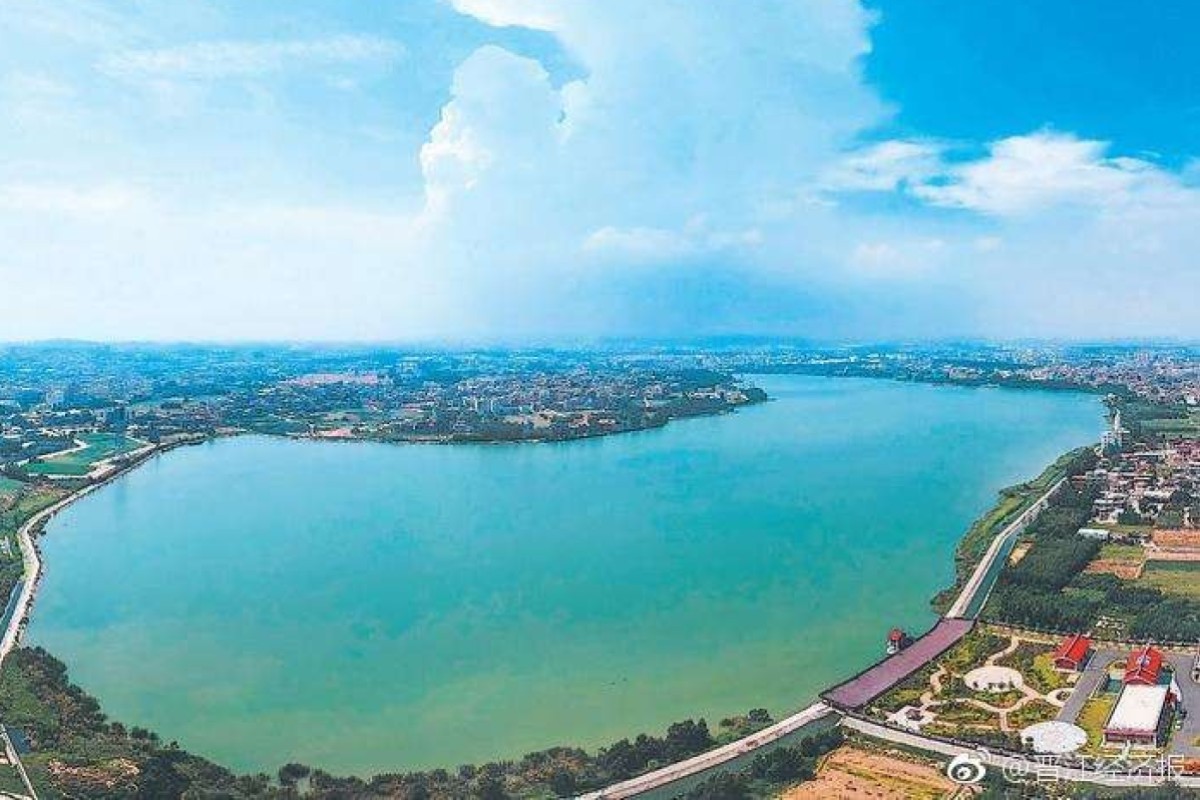
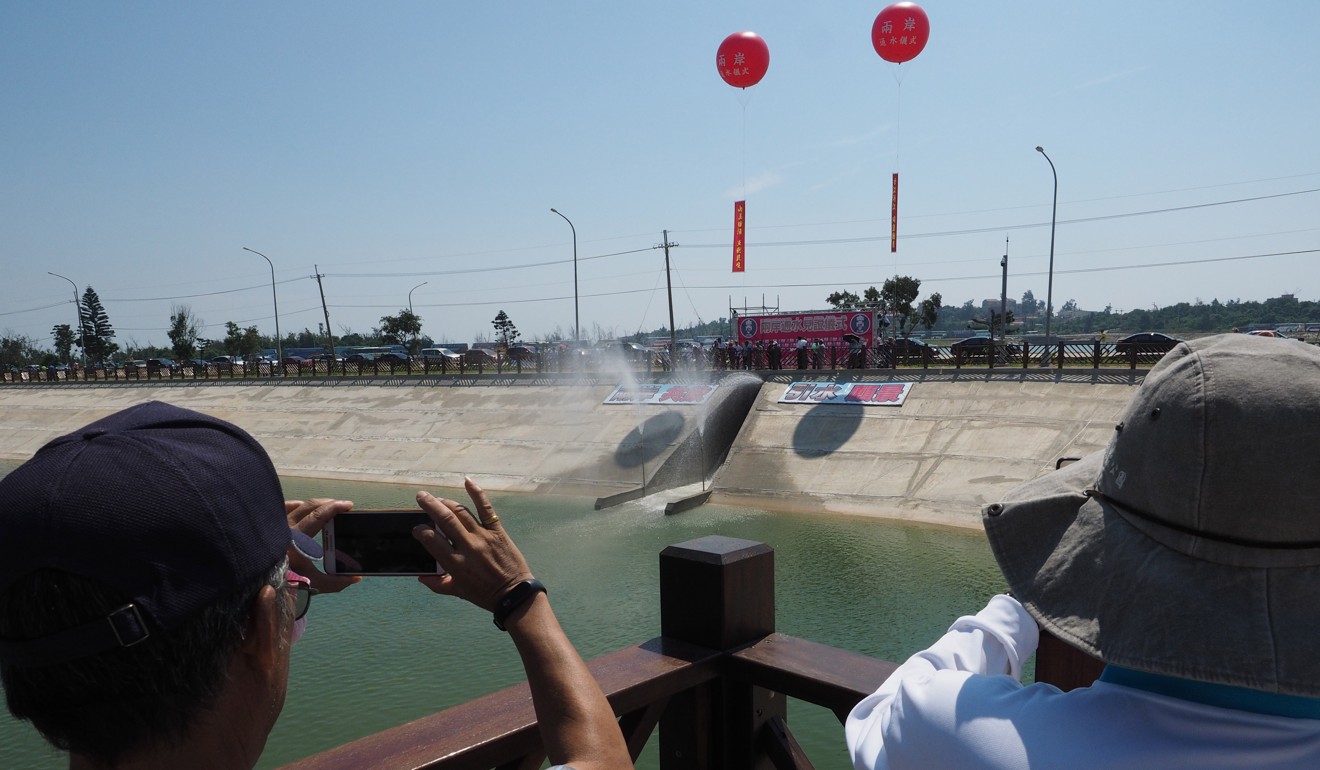
Water is released into the Tianbu Reservoir on Quemoy island in August when the mainland supply began. Photo: EPA-EFE
Quemoy began importing water from Fujian to ease its water shortage in August, three years after it signed a 30-year agreement with the mainland province to supply water via an undersea pipeline.
Beijing sees Taiwan as a breakaway province subject to eventual reunification, by force if necessary. Relations across the strait soured after Tsai Ing-wen, of the independence-leaning Democratic Progressive Party, became president in 2016 and refused to accept the one-China principles.
Since then, mainland China has stepped up pressure on Taiwan, suspending official communications with the Tsai government, poaching its diplomatic allies and staging war games near the self-ruled island, which is edging closer to Washington.
In an interview with CNN last week, Tsai said she would seek re-election next year and there would be no peace deal with the mainland unless Beijing ruled out using force against Taiwan.
On Wednesday, An said the different social systems across the strait should not be a barrier to unification, which President Xi Jinping sees as part of his Chinese dream of national rejuvenation but has been rejected by Tsai.
“Peaceful unification and ‘one country, two systems’ are the basic policies for us to resolve the Taiwan issues, and the best way to realise the motherland’s unification,” An said.
He was referring to a
speech by Xi in January calling for Beijing and Taipei to start talks on “one country, two systems” in Taiwan – first proposed by late paramount leader Deng Xiaoping in the 1980s – as the path to bring the island back into the China fold.
“The differences in the systems should not be a barrier to unification or an excuse for separation,” An said.
China protests against US ‘provocation’ after two American warships pass through Taiwan Straits.
Asked about Beijing-friendly Kuomintang chairman Wu Den-yih’s recent remarks that Taipei would sign a peace deal with the mainland if his party won the election in 2020, An said the two sides could explore a deal “as long as it benefits and safeguards the peace of the Taiwan Strait, increases the peaceful development of relations and pushes the peaceful unification process of the motherland”.
Posted in An Fengshan, Beijing, China alert, CNN, Democratic Progressive Party, Fujian, gas and bridge connections, Kuomintang, Matsu, motherland, One country, two systems, power and water shortages, President Xi Jinping, Quemoy, Taipei, Taiwan, Taiwan Affairs Office, Taiwan Straits, Tianbu Reservoir, Tsai Ing-wen, Uncategorized, undersea pipeline, unification, war games, Washington, Wu Den-yih, Xiamen |
Leave a Comment »







 CHINDIA ALERT: You'll be living in their world, very soon