15/04/2020
TAIPEI (Reuters) – Taiwan waded into the hotly contested politics of the Pacific on Wednesday, donating face masks and thermal cameras to its four diplomatic allies there to combat the coronavirus in a region where China is challenging traditional power of the United States.
The small developing nations lie in the highly strategic waters of the Pacific, dominated since World War Two by the United States and its friends, who have been concerned over China’s moves to expand its footprint there.
Democratic Taiwan has faced intense pressure from China, which claims the island as its territory with no right to state-to-state ties, and is bent on wooing away its few allies.
Taiwan has only 15 formal allies left worldwide after losing two Pacific nations, the Solomon Islands and Kiribati, to China in September.
Beijing has ramped up its diplomatic push into the Pacific, pledging virus aid and medical advice.
In its own aid programme, Taiwan has donated 16 million masks to countries around the world.
“We are a very small country, so it’s easier for us to work with Taiwan than mainland China,” Neijon Edwards, the Marshall Islands ambassador to Taiwan, told Reuters at the donation ceremony in Taipei.
China has been too overbearing, she added.
“It’s pressing too much, and it’s been trying to come to the Marshall Islands, several times, but up to this time we haven’t even opened the door yet.”
While the masks presented at the ceremony are going to Taiwan’s Pacific allies, all its 15 global allies are sharing the thermal cameras.
“Today’s ceremony once again shows that Taiwan is taking concrete actions not only to safeguard the health of Taiwanese people but also to contribute to global efforts to contain COVID-19,” said Foreign Minister Joseph Wu.
Though Pacific Island states offer little economically to either China and Taiwan, their support is valued in global forums such as the United Nations and as China seeks to isolate Taiwan.
China has offered to help developing countries including those of the Pacific, and many see Chinese lending as the best bet to develop their economies.
But critics say Chinese loans can lead countries into a “debt trap”, charges China has angrily rejected.
The debt issue was a serious problem and would only lead to the spread of Chinese influence regionwide, said Jarden Kephas, the ambassador of Nauru.
“They will end up dominating or having a lot of say in those countries because of the amount of debt,” he told Reuters, wondering how the money could ever be repaid. “We are not rich countries.”
Source: Reuters
Posted in 15, 16, aid programme, allies, Ambassador, Beijing, challenging, China, China’s, claims, combat, coronavirus, countries, Country, COVID-19, debt trap, democratic, developing nations, diplomacy, diplomatic, diplomatic push, dominated, donated, donating, donation ceremony, expand, face masks, footprint, foreign minister, formal allies, four, friends, hotly contested, intense, island, isolate, Kiribati, losing, Mainland China, Marshall Islands, masks, Medical advice, million, moves, Nauru, overbearing, Pacific, pledging, Politics, power, pressure, ramped up, region, Reuters, right, September, Solomon Islands, strategic waters, Taipei, Taiwan, Taiwanese, territory, thermal cameras, traditional, two, Uncategorized, United Nations, United States, virus aid, wades, Wednesday, wooing, World, World War Two, worldwide |
Leave a Comment »
01/04/2020
TAIPEI (Reuters) – Anger at being confused with China amid the coronavirus outbreak and Beijing’s stepped-up efforts to assert sovereignty is stirring heated debate in Taiwan about how to further distance itself from its giant and often threatening neighbour
At its core is a debate about whether to drop “China” from the island’s official name, the Republic of China.
During the virus crisis, the World Health Organization (WHO), which considers the island part of China, has listed Taiwan’s far lower case number under China’s, and China has repeatedly insisted only it has the right to speak for Taiwan on the global stage, including about health issues.
Taipei says this has confused countries and led them to impose the same restrictions on Taiwanese travellers as on Chinese, and has minimised Taiwan’s own successful efforts to control the virus.
Taiwan has been debating for years who it is and what exactly its relationship should be with China – including the island’s name. But the pandemic has shot the issue back into the spotlight.
Lin I-chin, a legislator for the ruling Democratic Progressive Party (DPP), said in parliament last month that Taiwan should change its English name to “Republic of Chunghwa”, an English rendering of the word Taiwan uses for China in its name.
“Taiwan has been brought to grief by China,” she said.
On Sunday, the New Power Party, one of Taiwan’s smaller opposition groups, released the results of a survey in which almost three-quarters of respondents said Taiwan passports should only have the word “Taiwan” on them, removing any reference to China.
“During this epidemic period, our people have been misunderstood by other countries, highlighting the urgency of changing the English name,” it said in a statement.
Taiwan’s Foreign Ministry has given a cautious response to the passport idea, noting that according to the constitution, the official name is Republic of China and that the word Taiwan was already added to passport covers in 2003.
“In the future, if there is consensus between the ruling and opposition parties on this new name, the Foreign Ministry shall cooperate in handling it,” spokeswoman Joanne Ou said.
But the government is wary of a name change for Taiwan, saying there is no consensus for such a radical move.
Although the DPP supports the island’s independence – theoretically meaning the official formation of a Republic of Taiwan – President Tsai Ing-wen says there is no need to do so, as the island is already an independent country called the Republic of China. She often refers to the island as the Republic of China, Taiwan.
‘REPUBLIC OF TAIWAN’
Premier Su Tseng-chang has said changing the island’s name isn’t the most urgent issue facing Taiwan.
“If we want to change then it might as well be to ‘Republic of Taiwan’. Taiwan is more well known,” Su said in parliament. “But if there’s no national consensus, a name change isn’t the most important thing for now.”
Taiwan’s official name is a throwback to when the Kuomintang party fled to the island after losing the Chinese civil war to the Communists in 1949, and continued to claim to be China’s legitimate government.
“The Republic of China is a country, Taiwan is not,” Chen Yu-jen, a Kuomintang legislator from the island of Kinmen, which sits just offshore from the Chinese city of Xiamen, told parliament on Monday.
The statement drew a sharp rebuke from Su, who told reporters it meant Chen had no right to be a member of the legislature. Chen said she was simply stating the facts, and that Taiwan is a geographic name, not a national name.
China’s pressure on Taiwan diplomatically and militarily during the virus crisis has also reduced Beijing’s already low standing in the eyes of many Taiwanese.
A March poll commissioned by Taiwan’s China-policy making Mainland Affairs Council and carried out by Taipei’s National Chengchi University showed more than three-quarters of respondents believed China’s government was unfriendly to Taiwan’s, the highest level in a decade.
Any name change would infuriate China, which has a law mandating the use of force to stop Taiwan independence.
Source: Reuters
Posted in 1949, anger, ‘Republic of Taiwan’, “Republic of Chunghwa”, Beijing’s, China, civil war, Communists, confused, coronavirus outbreak, Foreign Ministry, identity debate, infuriate, Kuomintang Party, National Chengchi University, New Power Party, pandemics, parliament, Premier Su Tseng-chang, President Tsai Ing-wen, Republic of China, sovereignty, Taipei, Taipei’s, Taiwan, Taiwanese, travellers, Uncategorized, Virus, World Health Organization (WHO) |
Leave a Comment »
25/03/2020
- Large-scale drills conducted across island in what defence ministry describes as test of combat-readiness
- Exercise follows US Navy live-fire exercise last month and a series of incursions by Chinese warplanes in recent weeks
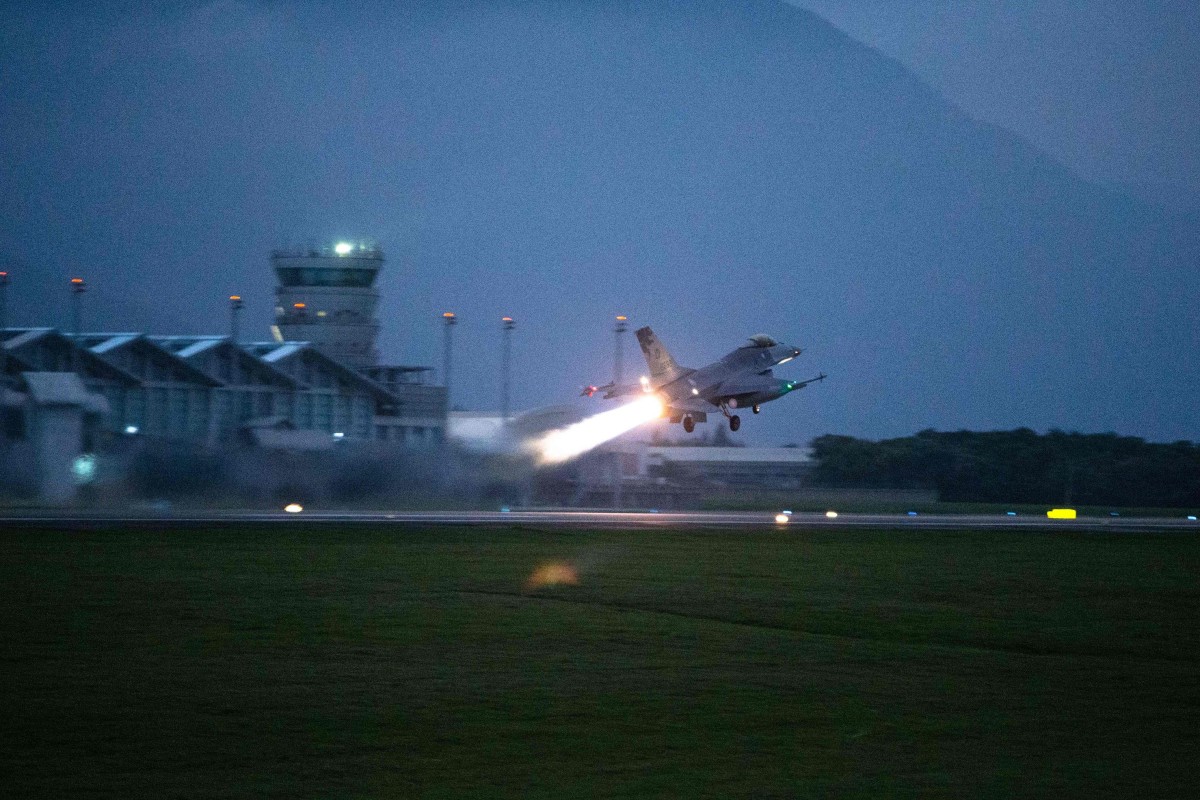
An F-16 fighter takes off from Hualien air base in eastern Taiwan. Photo: Military News Agency/ AFP
Taiwan has staged large-scale military drills throughout the island, including an exercise to repel an invading force, against a backdrop of rising tensions with Beijing.
The exercises, dubbed “Lien Hsiang,” involved the air force, army and the navy and were conducted on Tuesday from various military bases and strongholds in Taiwan, the island’s defence ministry said in a statement.
“The drills were designed to test the combat readiness of our forces and their responses to an all-out invasion by the enemy,” the ministry said, referring to the People’s Liberation Army, which has threatened to attack the self-ruled island.
The exercise follows a live-fire US drill in the region last week.
Taipei says Chinese military aircraft flew night exercise across Taiwan Strait
Eight F-16 fighter jets took off from the air force base in the eastern county of Hualien at dawn on Tuesday, simulating an emergency mission to scramble and intercept enemy warplanes entering the island’s airspace, the defence ministry said.
Elsewhere on the island, F-16 and other fighter jets were spotted taking off from other air force bases in the southwestern county of Chiayi, the northern county of Hsinchu, Ching Chuan Kang in central Taiwan and the southern city of Tainan, according to Taiwanese media.
The exercises also involved operations testing cyberwarfare capabilities, while the air force ground crew simulated an emergency repair of the aircraft runway, the ministry said.
Anti-air units of both the army and the navy also joined the air force in the drills, while various types of naval warships, including Kidd-class destroyers, plus Perry and Kang Ding-class frigates, were deployed near Taiwan’s coast for separated training drills, it added.
The ministry said the training mission, carried out without live ammunition, was also designed to test the military response and make improvements based on the results.
Hundreds of Taiwanese to return from coronavirus centre after Beijing and Taipei reach deal
Beijing considers Taiwan a wayward province that must be returned to the mainland fold, by force if necessary.
Beijing has staged a series of war games close to the island and poached seven of Taiwan’s diplomatic allies to heap pressure on President Tsai Ing-wen, from the independence-leaning Democratic Progressive Party, who was re-elected in January.
The exercises came after recent missions by PLA warplanes which briefly crossed the midpoint of the Taiwan Strait into the Taiwanese side in what analysts saw as testing the response from Taiwan and the US.
Three separate groups of warplanes approached Taiwan on their way to the western Pacific over the Bashi Channel for long-distance training exercises before returning home over the Miyako Strait to the northeast of Taiwan on February 9, 10 and 28.
Coronavirus threat shows ‘unacceptability’ of Beijing isolating Taiwan, US official says
On March 17, another flight of PLA warplanes approached Taiwan in a rare exercise which analysts said was aimed at showing off their night navigation and all-weather capabilities.
Taiwan’s air force scrambled fighter jets to shadow, intercept and disperse the PLA warplanes through radio warnings during each approach by the mainland’s planes, according to the ministry.
Those actions also prompted the US to send two B-52 bombers on southbound flights off Taiwan’s east coast, while a transport plane flew over the Taiwan Strait, the defence ministry said.
On Tuesday, the US Navy’s 7th Fleet also revealed that the US Navy had carried out live-fire missile tests in the Philippine Sea last week, in what analysts said was a message that it was up to the challenge of the Chinese military’s new systems.
DPP legislator Wang Ting-yu asked the Tsai government to take note of developments in the South China Sea, saying the US actions indicated that Washington must have learned “certain information suggesting that the Chinese government is planning certain military activities” or the 7th Fleet would not have made such a bold move.
Posted in 7th Fleet, air force, aircraft runway, army, ‘unacceptability’, B-52 bombers, Bashi Channel, Beijing, Chiayi, Chinese warplanes, Ching Chuan Kang, coronavirus, cyberwarfare capabilities, Democratic Progressive Party, emergency repair, exercise, F-16 fighter, fight off, Hsinchu, Hualien air base, incursions, isolating, Kidd-class destroyers, Kuomintang, Military, Miyako Strait, mock invasion, naval warships, navy, Pacific, Perry and Kang Ding-class frigates, PLA warplanes, President Tsai Ing-wen, stages, Taipei, Taiwan, Taiwan Strait, Taiwanese, threat, Uncategorized, US Navy live-fire exercise, Washington, wayward province |
Leave a Comment »
23/02/2020
- An extended Lunar New Year holiday provides people from the self-ruled island with the opportunity to rethink their careers as the death toll from the deadly infection continues to rise
- Online poll finds 63 per cent of Taiwanese unwilling to return to mainland China over health concerns
Many Taiwanese are opting not to return to their jobs in mainland China because of the coronavirus epidemic. Photo: EPA-EFE
Taiwanese account manager Douglas Liu values his life more than his job, which is why he will be staying at home on Monday rather than going back to work in the mainland China city of Suzhou.
Liu returned to his home in Taipei on January 10 for an extended Lunar New Year
holiday – and to vote in the island’s presidential election – and planned to go back to work on February 1. But as the
coronavirus epidemic worsened, the 45-year-old changed his plans.
“Last week, my company told me I should resume work on February 24, but after I argued in vain over the risk of returning to Suzhou, I tendered my resignation,” he said. “After all, my life is more important.”
Liu works for a firm that manufactures chest freezers for the mainland Chinese market.
“With more than 80 coronavirus infections in Suzhou and little sign of it subsiding, who knows what could happen to me if I return,” he said.
More than 78,700 people have contracted the virus since it was first detected in Wuhan, the capital of central China’s Hubei province, at the end of last year, and close to 2,500 have lost their lives to it.
As of Saturday, about 98 per cent of the infections and 99 per cent of the fatalities were in mainland China, two figures that have prompted many Taiwanese to rethink their employment plans.
According to a survey conducted last week by online recruitment agency 104 Job Bank, 63 per cent of Taiwanese with jobs on the mainland said they would not be returning to work after the extended Lunar New holiday. Before Wuhan was placed under lockdown on January 23 in a bid to contain the coronavirus outbreak, the figure was just 50 per cent.
“The intensification of the outbreak has created panic and insecurity for Taiwanese who work in mainland China and the lockdown of many cities has further discouraged them from returning to their jobs,” said Jason Chin, a senior vice-president at the recruitment agency.
Wuhan has been on lockdown since January 23. Photo: Reuters
Dozens of cities across China have introduced some form of restriction on the movement of residents, and several remain under total lockdown.
Chin said that the containment efforts had made it impossible for many companies to resume normal operations and provided a catalyst for Taiwanese workers to seek employment elsewhere.
“Taiwanese often to change jobs after the Lunar New Year, so the mainland government’s policy of delaying the resumption of regular business activities has given them more time to look for work outside mainland China,” he said.
Shannon Chiu is another Taiwanese who decided to call time on the mainland because of the coronavirus outbreak.
After two years working for an agricultural technology company in Zhengzhou, the capital of central China’s Henan province, she said she already had concerns about the standards of health care there.
“Being sick in Zhengzhou is a nightmare for Taiwanese because of the poor organisation and registration procedures,” she said.
“You either have to wait hours to see a doctor or go hospital-hopping in the hope of getting an appointment somewhere else.”
Chiu said she was still working in Zhengzhou after the outbreak had been reported in Wuhan – about 500km (310 miles) to the south – but no one in the city was wearing a face mask.
“I was lucky because I came back to Taiwan a week before the lockdown and my company allowed me to continue working from Taipei,” she said.
“Although I no longer enjoy the expatriate benefits, I feel a lot safer here because I don’t think I would survive if I was put in a mainland hospital because of Covid-19.”
Source: SCMP
Posted in agricultural technology company, call time, chest freezers, coronavirus, COVID-19, Fears, Henan province, Lunar New Year holiday, Mainland China, Mainland Chinese, manufactures, market, Suzhou, Taiwanese, Uncategorized, workers, Wuhan, Zhengzhou |
Leave a Comment »
07/02/2020
- Hong Kong and Thailand are likely to suffer most from the novel coronavirus outbreak because of close their economic ties with China
- A drop in Chinese tourist arrivals and imports, as well as supply chain disruptions are likely to weigh on regional economy
Thailand’s economy could be one of the most affected by the coronavirus outbreak due to its close ties with China, especially in the tourism sector. Photo: Bloomberg
Hong Kong and Thailand are likely to be the hardest hit Asian economies outside mainland China from the deadly coronavirus outbreak, according to analysts.
The 2019-nCoV, which had claimed the lives of nearly 640 people and infected more than 31,000 in mainland China by Friday, is viewed as even more damaging than the severe acute respiratory syndrome (Sars) epidemic in 2002-2003 because of prolonged factory closures and transport restrictions that have locked down many Chinese cities.
China has become more closely integrated with the rest of Asia since the Sars outbreak, meaning the disruptions to China’s industrial and export sectors, combined with a sharp drop in economic activity in the first quarter, will have significant repercussions across the region, particularly through tourism and trade, analysts said.
“A collapse in tourism arrivals from China will be the first shock wave for the rest of the region,” said Gareth Leather, senior Asia economist at Capital Economics. “Factory closures in China will affect the rest of the region by disrupting regional supply chains.”
A collapse in tourism arrivals from China will be the first shock wave for the rest of the region. Factory closures in China will affect the rest of the region by disrupting regional supply chainsGareth Leather
Hong Kong would likely be the most affected because of its status as a trade hub, its tight linkages to the Chinese economy and the sharp decline in tourism expenditure that is expected, UBS economist William Deng noted.
“Due to the risk of infection, domestic households significantly reduced such activities as dining out, shopping and entertainment,” Deng wrote in a recent note. He cut Hong Kong’s gross domestic product (GDP) growth forecast to minus 1.8 per cent for 2020, against his previous projection of a 0.5 per cent drop.
A community outbreak spread by human-to-human transmission has started in the city, said
Professor Yuen Kwok-yung, a top microbiologist at the University of Hong Kong on Wednesday.
Thailand could be the next most affected due to its dependence on Chinese tourism. Outside Hong Kong and Macau, the country has the highest exposure to China as a share of GDP in the region.
China locks down Hangzhou, mega-city far from epicentre of coronavirus outbreak
ANZ Bank’s head of Asia research Khoon Goh said that the novel coronavirus could knock US$760 million from Thailand’s economy in the first quarter. Hong Kong could could see losses of US$1.4 billion. Travel services as a share of GDP were 11.2 per cent in Thailand and 9.4 per cent in Hong Kong.
“The Thai economy would expand at a slower rate in 2020 than previously forecast and much further below its potential due to the outbreak of coronavirus,” Bank of Thailand said in a statement after it slashed interest rates to a record low on Wednesday.
South Korean and Taiwanese businesses will also have negative spillover effects from the coronavirus outbreak because of
supply chain disruptions and weaker consumer sentiment inside and outside China, analysts said.
South Korean car and tech companies that rely on parts from Chinese suppliers are exposed to potential production disruptions stemming from factory closures and the evacuation of Korean workers from China-based production lines, said Sean Hwang, corporate finance group analyst at Moody’s Investors Group.
Coronavirus: here are the places and airlines restricting travel to China
For instance, Hyundai Motor Company closed some if its South Korea-based plants on February 4 because of a shortage of wiring harnesses.
Korean customers are also limiting their trips to bricks-and-mortar retail stores such as E Mart and Lotte Shopping to avoid crowds amid the outbreak, potentially leading to a significant decline in revenue and earnings, Hwang said.
Although Singapore is not as closely tied to China as Hong Kong, the city state could still see a knock-on effect from China’s expected near-term downturn, as its economy has become much more integrated with the world’s second largest economy since the Sars outbreak.
The number of Chinese tourists rose six times from 568,000 in 2003 to 3.4 million in 2018, said Irvin Seah, senior economist at DBS Bank.
Coronavirus outbreak: global businesses shut down operations in China
“We expect a decline of about 1 million tourists or about SGD1 billion (US$722 million) of lost tourism receipts for every three months of travel ban,” Seah said. “We have lowered our full-year GDP growth forecast to 0.9 per cent, down from 1.4 per cent previously.”
Taiwan has banned Chinese visitors as well as foreigners who have visited Hong Kong and Macau from entering the island due the coronavirus. International cruise ships are also unable to dock on the island, which will lead to at least 112 liner visits cancelled by the end of March, affecting around 144,000 passengers, said the Taiwan International Ports Corporation.
Capital Economics’ Leather said the economic impact on Taiwan from 2019-nCoV could stand out from the rest of Asia, as it had the most exposure in value-added, intermediate exports to China – 18 per cent of GDP.
20 coronavirus infections confirmed on cruise ship in Japan, as thousands remain under quarantine
Elsewhere, Malaysia’s commodity driven trade growth this year has been threatened by the almost 20 per cent fall in crude oil prices, a decline triggered by fears that the coronavirus outbreak would dampen China’s imports. Malaysia’s purchasing managers’ index, a survey of manufacturers, dropped to 48.8 in January from 50.0 the prior month prior, data released this week showed. The drop was blamed on slowing output, with new orders dropping the most since September amid a decline in exports.
“The Bank Negara Malaysia’s surprising policy rate cut at the last meeting on 22 January, just around the time the coronavirus started to dominate headlines, tells us that the central bank is ahead of the curve in recognising the risk,” said Prakash Sakpal, Asia economist at ING Bank said.
India and Indonesia will be the least affected given the small contribution the tourism sector makes to their economies, and the low share of visitors from China, ANZ’s Goh said.
Source: SCMP
Posted in ANZ, Asia, Bank of Thailand, bricks-and-mortar retail stores, businesses, Chinese cities, Chinese visitors, consumer sentiment, coronavirus outbreak, Cruise Ship, DBS Bank, E Mart, evacuation, first shock wave, Foreigners, Hangzhou, hit, Hong Kong, Hyundai Motor Company, imports, India, Indonesia, industrial and export sectors, ING Bank, International cruise ships, Japan, Korean workers, locked down, Lotte Shopping, Macau, Malaysia’s, microbiologist, Moody’s Investors Group, prolonged factory closure, quarantine, regional economy, severe acute respiratory syndrome (Sars) epidemic, shortage, Singapore, South Korea-based plants, South Korean, supply chain disruptions, Taiwan, Taiwan International Ports Corporation, Taiwanese, Thailand, The Bank Negara, tourist arrivals, transport restrictions, Uncategorized, University of Hong Kong, wiring harnesses |
Leave a Comment »
04/11/2019
- Latest measures grant island’s people and enterprises more equal treatment with their mainland counterparts
- Package in March last year was dismissed by Taiwan’s Mainland Affairs Council as an attempt to buy political support
Taipei’s elections in January could influence the tone of cross-strait relations. Photo: EPA-EFE
Beijing announced a series of sweeteners for Taiwanese businesses and individuals on Monday – including participation in its 5G research and allowing Taiwanese to use mainland consular services – only two months before
Taiwan’s critical presidential election.
The latest 26 measures drawn up by 20 government departments, including the State Council’s Taiwan Affairs Office and the National Development and Reform Commission, are designed to attract more Taiwanese to live and work in mainland China, despite worsening cross-strait relations.
But Taiwan’s Mainland Affairs Council criticised the move as an attempt by the Chinese Communist Party to “divide Taiwan internally, and was a further reflection of attempts to try to interfere in and influence Taiwan’s election”.
It follows a similar package of 31 measures unveiled by Beijing in March last year, which included tax incentives, preferential land-use policies for Taiwanese businesses on the mainland and benefits for Taiwanese individuals in studying or living on the mainland.
Taiwan charges pro-Beijing politicians with accepting mainland cash
The latest measures to grant Taiwan-funded enterprises more equal treatment with their mainland counterparts include offering access to research and development in 5G technology, investment in passenger and cargo air services, the establishment of microlending and financing companies and the right to apply for financial guarantees from local government funds.
Taiwanese individuals will also be officially entitled to mainland Chinese consular protection abroad, will be treated the same as their mainland counterparts when buying residential property on the mainland, and will be able to train in Beijing for the 2020 Olympic Games.
Beijing claims sovereignty over self-ruled Taiwan, and has not renounced the use of force to take the democratic island into its fold. Beijing’s ruling Communist Party has stressed its intention to promote “peaceful reunification”, pledging in its communique from the
fourth plenary meeting of the party’s elite last week to “deepen cross-strait integration and development” while opposing Taiwanese independence.
The latest measures from Beijing came ahead of Taiwan’s presidential and legislative elections in January. Relations across the Taiwan Strait have been frozen under the administration of independence-leaning Taiwanese President, ostensibly over her refusal to accept the “1992 consensus”, or the understanding that there is only “one China” – something that Beijing considers a prerequisite for any talks with Taipei.
Taiwan’s Mainland Affairs Council said on Monday that the roll-out of the 26 measures one year later was intended to “cover up” the fact that the 31 measures had not been executed properly, and reflected administrative problems on the mainland amid slowing economic growth.
“Even more than that, it also reflects that during this period Taiwanese people have rejected ‘one country, two systems’ and do not agree with the results of the Communist Party’s united front divisions,” the council said.
“We urge the Communist Party officials to specifically implement protections for Taiwanese businesses and Taiwanese people in their investments and lives.”
Joseph Wu, Taipei’s foreign minister, also responded with a tweet written in simplified Chinese – which is used on the mainland – rather than the traditional Chinese used in Taiwan.
“China’s Taiwan Affairs Office came out with 26 measures and last year there were 31 – it looks like there are so many measures,” he wrote. “But we in Taiwan do not need one country, two systems, so there is really no need to be so polite. Giving your people more freedom is also good!”
Ongoing
anti-government protests in Hong Kong – which is semi-autonomous from Beijing under the one country, two systems model – have highlighted for many Taiwanese voters the threat from Beijing to the island’s sovereignty.
The latest polling by the MAC found that 89 per cent of respondents opposed the one country, two systems framework that Beijing proposed for Taiwan, up from 75 per cent in a similar survey in January.
Edward I-hsin Chen, a political-science professor at Chinese Culture University in Taipei, said the impact of the 26 measures on the election would depend on how they were implemented, but that one country, two systems was clearly not palatable for Taiwanese voters, whether they supported Tsai’s Democratic Progressive Party (DPP) or the mainland-friendly Kuomintang (KMT).
“Taiwan, of course, will not accept one country, two systems, so these policies will need to be more long-term. Mainland officials did not handle the Hong Kong issue very well, so it will be very hard for one country, two systems in Taiwan – blue and green will both reject it,” he said, referring to the party colours for the KMT and DPP. “But it is good for Taiwanese people and businesses to be able to take part in the 5G sector, and there will be more cooperation in the future.”
Lin Chingfa, former chairman of the Beijing-based Association of Taiwan Investment Enterprises, said he believed the new measures were intended to appeal to Taiwanese youth.
“A very important direction for cross-strait cooperation nowadays is to bridge the opportunities available in mainland China for young people who feel deprived from the slow Taiwanese economy. Some of these policies should be especially appealing to them because it shows that the country hopes to make it more convenient for young Taiwan people willing to come,” Lin said.
He said this approach was especially obvious in the measures that were introduced to provide equal treatment for Taiwan people on the mainland – for example the opportunities for Taiwan people to apply for scholarships and the expansion of places for Taiwanese students at universities.
Source: SCMP
Posted in 5G research, 5G technology, anti-government protests, Association of Taiwan Investment Enterprises, Beijing, cargo air services, China’s State Council, chinese communist party, Chinese Culture University, Democratic Progressive Party (DPP), Election, extends, Hong Kong, Mainland Affairs Council, microlending and financing companies, National Development and Reform Commission, National Development and Reform Commission (NDRC), ne country, two systems model, one China, One country, two systems, passenger air services, presidential, sovereignty, State Council Taiwan Affairs Office, Sweeteners, Taipei, Taiwan Affairs Office, Taiwan’s, Taiwanese, Taiwanese President, Uncategorized |
Leave a Comment »





 CHINDIA ALERT: You'll be living in their world, very soon