Archive for ‘Tamil Nadu’

31/05/2020

India coronavirus: Why is India reopening amid a spike in cases?

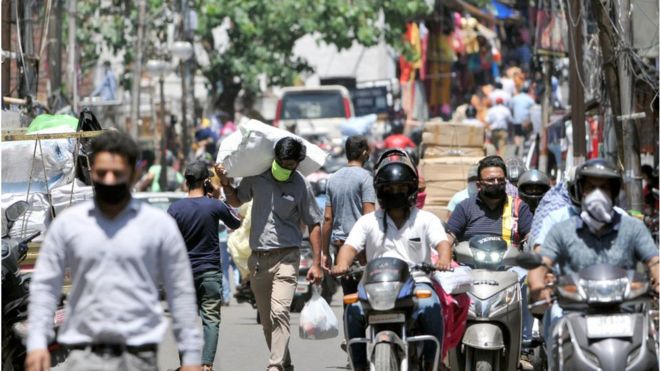
A rush of people and motorists in a marketplace area as shops start opening in the city under specific guidelines, on May 20, 2020 in Jammu, IndiaImage copyright GETTY IMAGES
Image caption Within a week of reopening, India has seen a sharp spike in cases

India is roaring – rather than inching – back to life amid a record spike in Covid-19 infections. The BBC’s Aparna Alluri finds out why.

On Saturday, India’s government announced plans to end a national lockdown that began on 25 March.

This was expected – the roads, and even the skies, have been busy for the last 10 days since restrictions started to ease for the first time in two months. Many businesses and workplaces are already open, construction has re-started, markets are crowded and parks are filling up. Soon, hotels, restaurants, malls, places of worship, schools and colleges will also reopen.

But the pandemic continues to rage. When India went into lockdown, it had reported 519 confirmed cases and 10 deaths. Now, its case tally has crossed 173,000, with 4,971 deaths. It added nearly 8,000 new cases on Saturday alone – the latest in a slew of record single-day spikes.
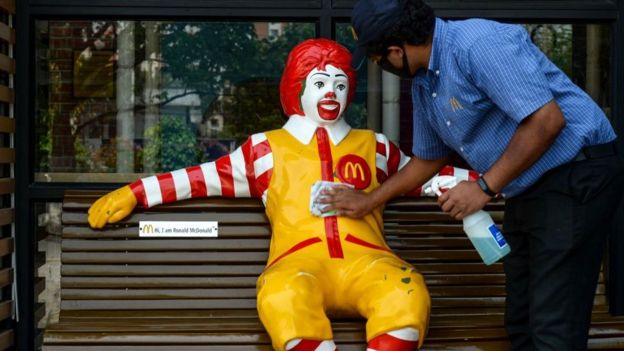
A worker cleans the mascot of fast-food company McDonald's for the reopening of the outlet in Hyderabad on May 20.Image copyright GETTY IMAGES
Image caption Fast food chains like McDonald’s have begun reopening outlets in parts of India.

So, why the rush to reopen?

The lockdown is simply unaffordable

“It’s certainly time to lift the lockdown,” says Gautam Menon, a professor and researcher on models of infectious diseases.

“Beyond a point, it’s hard to sustain a lockdown that has gone on for so long – economically, socially and psychologically.”

From day one, India’s lockdown came at a huge cost, especially since so many of its people live on a daily wage or close to it. It put food supply chains at risk, cost millions their livelihood, and throttled every kind of business – from car manufacturers to high-end fashion to the corner shop selling tobacco. As the economy sputtered and unemployment rose, India’s growth forecast tumbled to a 30-year-low.

Raghuram Rajan, an economist and former central bank governor, said at the end of April that the country needed to open up quickly, and any further lockdowns would be “devastating”.

The opinion is shared by global consultant Mckinsey, whose report from earlier this month said India’s economy must be “managed alongside persistent infection risks”.
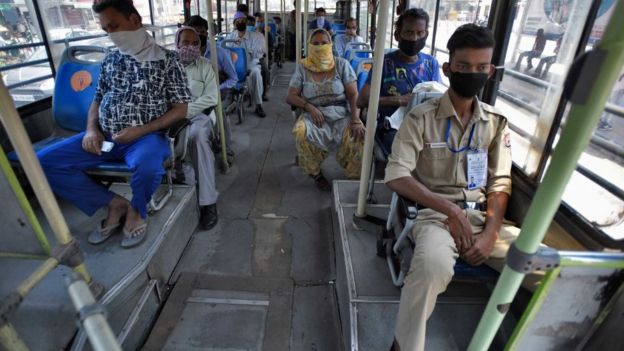
Passengers maintaining social distance as they are on board in a DTC Bus after government eased lockdown restriction, at AIIMS on May 20, 2020 in New Delhi, India.Image copyright GETTY IMAGES
Image caption As restrictions ease, Indians are slowly getting used to the new normal

“The original purpose of the lockdowns was to delay the spike so we can put health services and systems in place, so we are able handle the spike [when it comes],” says Dr N Devadasan, a public health expert. “That objective, to a large extent, has been met.”

In the last two months, India has turned stadia, schools and even train coaches into quarantine centres, added and expanded Covid-19 wards in hospitals, and ramped up testing as well as production of protective gear. While grave challenges remain and shortages persist, the consensus seems to be that the government has bought as much time as possible.

“We have used the lockdown period to prepare ourselves… Now is the time to revive the economy,” Delhi Chief Minister Arvind Kejriwal said last week.

The silver lining

For weeks, India’s relatively low Covid-19 numbers baffled experts everywhere. Despite the dense population, disease burden and underfunded public hospitals, there was no deluge of infections or fatalities. Low testing rates explain the former, but not the latter.

In fact, India made global headlines not for its caseload but for its botched handling of the lockdown – millions of informal workers, largely migrants, were left jobless overnight. Scared and unsure, many tried to return home, often desperate enough to walk, cycle or hitchhike across hundreds of kilometres.

Perhaps the choice – between a virus that didn’t appear to be wreaking havoc yet, and a lockdown that certainly was – seemed obvious to the government.

But that is changing quickly as cases shoot up. “I suspect we will keep finding more and more cases, but they will mostly be asymptomatic or will have mild symptoms,” Dr Devadasan says.

The hope – which is also encouraging the government to reopen – is that most of India’s undetected infections are not severe enough to require hospitalisation. And so far, except in Mumbai city, there has been no dearth of hospital beds.

India’s Covid-19 data is spotty and sparse, but what it does have suggests that it hasn’t been as badly hit by the virus as some other countries.

The government, for instance, has been touting India’s mortality rate as a silver lining – at nearly 3%, it’s among the lowest in the world.

But some are unconvinced by that. Dr Jacob John, a prominent virologist, says India has never had, and still doesn’t have, a robust system for recording deaths – in his view, the government is certainly missing Covid-19 deaths because they have no way of knowing of every fatality.
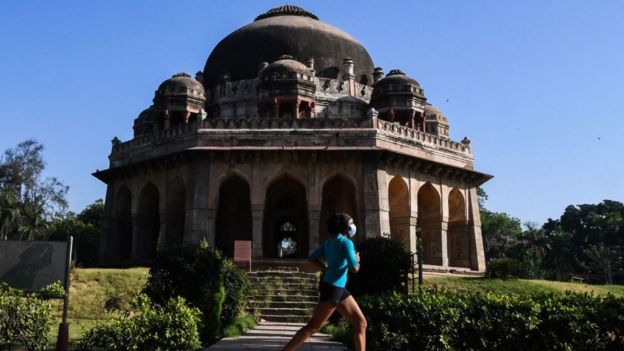
A woman jogs at Lodhi Garden after the local government eased restrictions imposed as a preventive measure against the spread of the COVID-19 coronavirus in New Delhi on May 21, 2020.Image copyright GETTY IMAGES
Image caption Indians are venturing out again but it’s unclear how many of them are asymptomatic.

And, he says, “what we must aim for is flattening the mortality curve, not necessarily the epidemic curve”.

Dr John, like several other experts, also predicts a peak in July or August, and believes the country is reopening so quickly because the “government realised the futility of such leaky lockdowns”.

A shift in strategy

So is the government gearing up for another lockdown when the peak comes?

While Dr Menon believes the lockdown was well-timed, he says it was too focused on cases coming from abroad.

“There was a hope that by controlling that, we could prevent epidemic spread, but how effective was our screening [at airports]?”

Now, he adds, is the time for “localised lockdowns”.
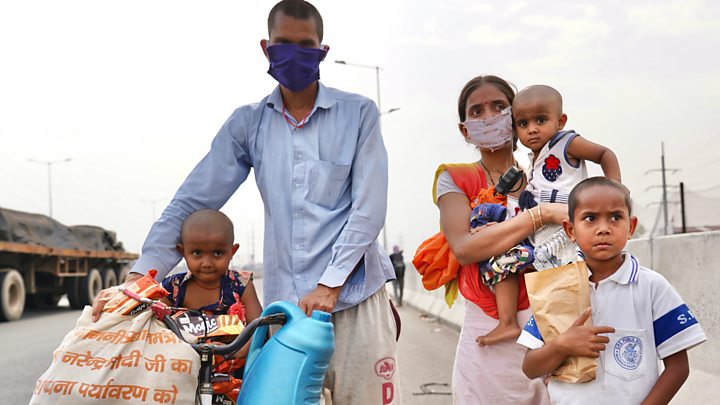
Media caption Coronavirus: Death and despair for migrants on Indian roads

The federal government has left it to states to decide where, how and to what extent to lift the lockdown as the virus’ progression varies wildly across India.

Maharashtra alone accounts for more than a third of India’s active cases. Add Tamil Nadu, Gujarat and Delhi, and that makes up 67% of the national total.

But other states – such as Bihar – are already seeing a sharp uptick as migrant workers return home.

“Initially, most of your cases were in the cities,” Dr Devadasan says. “But we kept the migrant workers in cities and didn’t allow them to go home. Now, we are sending them back. We have facilitated transporting the virus from urban areas to rural areas.”

While the government has said how many infections have been avoided – up to 300,000 – and lives saved – up to 71,000 – by the lockdown, there is no indication of what lies ahead.

There is only advice: The day the government began to ease restrictions, Mr Kejriwal tweeted, urging people to “follow discipline and control the coronavirus disease” as it was their “responsibility”.
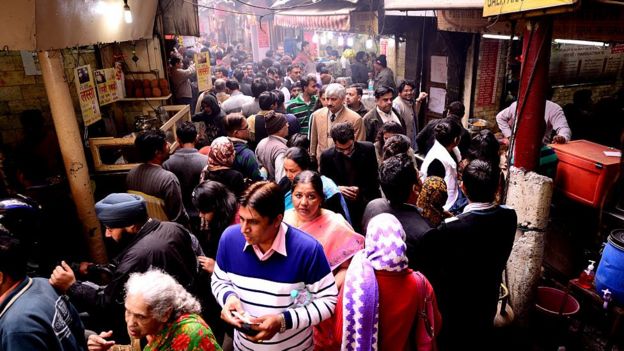
The famous Paranthe wali gali (bylane of fried bread) in Chandni Chowk, on August 20, 2014 in New Delhi, India.Image copyright GETTY IMAGES
Image caption Social distancing will prove to be India’s biggest post-lockdown challenge

Because the alternative – of curfews and constant policing – is unsustainable.

“My worry is more the circumstances of people – it’s not as though they have an option to practise social distancing,” Dr Menon says.

And they don’t – not in joint family homes or one-room hovels packed together in slums, not in crowded markets or busy streets where jostling is second nature, or in temples, mosques, weddings or religious processions where more is always merrier.

The overwhelming message is that the virus is here to stay, and we have to learn to live with it – and the only way to do that, it appears, is to let people live with it.

Source: The BBC
28/05/2020

India coronavirus: Trouble ahead for India’s fight against infections

Coronavirus in IndiaImage copyright GETTY IMAGES
Image caption India has more than 150,000 reported infections

On the face of it, things may not look bad.

Since the first case of coronavirus at the end of January, India has reported more than 150,000 Covid-19 infections. More than 4,000 people have died of the infection.

To put this in some context, as of 22 May, India’s testing positivity rate was around 4%, the death rate from the infection around 3% and the doubling rate of infection – or the amount of time it takes for the number of coronavirus cases to double – was 13 days. The recovery rate of infected patients was around 40%.

All this is markedly lower than in the countries badly hit by the pandemic.

Like elsewhere in the world, there are hotspots and clusters of infection.

More than 80% of the active cases are in five states – Maharashtra, Tamil Nadu, Delhi, Gujarat and Madhya Pradesh – and more than 60% of the cases in five cities, including Mumbai, Delhi and Ahmedabad, according to official data.

More than half of people who have died of the disease have been aged 60 and older and many have underlying conditions, hewing to the international data about elderly people being more vulnerable to the disease.

The more than two-month-long grinding lockdown, official data suggests, has prevented the loss of between 37,000 and 78,000 lives. A paper published in Harvard Data Science Review appears to support that – it shows an eight-week lockdown can prevent about two million cases and, at a 3% fatality rate, prevent some 60,000 deaths.

“Infection has remained limited to certain areas. This also gives us confidence to open up other areas. It is so far an urban disease,” says VK Paul, who heads the medical emergency management plan on Covid-19.

This is where such claims enter uncertain territory.

India testingImage copyright GETTY IMAGES
Image caption India has conducted some 180,000 tests so far

India is now among the top 10 countries worldwide in terms of total reported infections, and among the top five in the number of new cases.

Infections are rising sharply, up from 536 cases on 25 March when the first phase of the world’s harshest lockdown was imposed. The growth of infections is outpacing growth in testing – tests have doubled since April but cases have leapt fourfold.

Epidemiologists say the increase in reported infections is possibly because of increased testing. India has been testing up to 100,000 samples a day in the past week. Testing criteria has been expanded to include asymptomatic contacts of positive patients.

Yet, India’s testing remains one of the lowest in the world per head of population – 2,198 tests per million people.

The bungled lockdown at the end of March triggered an exodus of millions of informal workers who lost their jobs in the cities and began returning home in droves, first on foot and then by train. Some four million workers have travelled by rail from cities to their villages in more than half a dozen states in the past three weeks.

There is mounting evidence that this has already led to the spread of infection from the cities to the villages. And with the messy easing of the lockdown earlier this month, there are growing fears of infections spreading further in the cities.

Rising infections and a still-low fatality rate possibly points to milder infection in a younger population and a large number of asymptomatic cases. The focus, says Amitabh Kant, CEO of the government think-tank NITI Aayog, should be “bringing down fatalities and improving the recovery rate”.

But if the infection rate continues to grow, “things are going to get pretty grim in a few weeks time,” a leading virologist told me.

India lockdownImage copyright GETTY IMAGES
Image caption Millions of workers have fled the cities and returned to their villages after the lockdown

Doctors in the capital, Delhi, and the western city of Mumbai tell me they are already seeing a steady surge in Covid-19 admissions and worry about a looming shortage of hospital beds, including in critical care.

When the infection peaks in July, as is expected, a spike in infections could easily lead to many avoidable deaths as hospitals run out of beds for, or delay treatment to, infected patients who need timely oxygen support and clinical care to recover.

“That is the real worry. A critical-care bed needs an oxygen line, a ventilator, doctors, nursing staff. Everything will be under pressure,” Dr Ravi Dosi, who is heading a Covid-19 ward at a hospital in Indore, told me. His 50-bed ICU is already full of patients battling the infection.

With the lockdown easing, doctors are feeling jittery. “It’s a tactical nightmare because some people have begun going to work but there is a lot of fear”, says Dr Dosi.

“One co-worker sneezed in the office and 10-15 of his colleagues panicked and came to the hospital and demanded they get tested. These are the pressures that are building up.”

One reason for the confusion is the lack of – or the opacity of – adequate data on the pandemic to help frame a strategic and granular response.

Most experts say a one-size-fits-all strategy to contain the pandemic and impose and lift lockdowns will not work in India where different states will see infection peaks at different times. The reported infection rate – the number of infections for every 100 tests – in Maharashtra state, for example, is three times the national average.

“The infection is not spreading uniformly. India will see staggered waves,” a leading virologist, who insisted on anonymity, told me.

The lack of data means questions abound.

What about some 3,000 cases, which are not being assigned to any state because these people were found infected in places where they don’t live? (To put this into context, nine states in India have more than 3,000 cases.) How many of these cases have died or recovered?

Also, it is not clear whether the current data – sparse, and sporadic – is sufficient to map the future trajectory of the disease.

There is, for example, no robust estimate of carriers of the virus who have no symptoms – last month a senior government scientist said at least “80 out of every 100 Covid-19 patients may be asymptomatic or could be showing mild symptoms”.

coronavirus victim burial in IndiaImage copyright GETTY IMAGES
Image caption More than 4,000 people have died of Covid-19 in India

If that is indeed true, then India’s fatality rate is bound to be lower. Atanu Biswas, a professor of statistics, says the predicted trajectory could change “with the huge inclusion of asymptomatic cases”. But, in the absence of data, India cannot be sure.

Also, epidemiologists say, measures like the doubling time of the infections and the reproduction number or R0 have their limitations. R0, or simply the R value, is a way of rating a disease’s ability to spread. The new coronavirus, Sars-CoV-2, has a reproduction number of about three, but estimates vary.

“These measures are good when we are in the middle of a pandemic, less robust with fewer cases. You do need forecasting models for at least a month’s projection to anticipate healthcare needs. We should always evaluate an aggregate of evidence, not just one measure, but a cascade of measures,” Bhramar Mukherjee, a professor of biostatistics and epidemiology at the University of Michigan, told me.

Others say even calculating the number of recorded infections every day is “not always a good indicator of how an infection is spreading”.

A better option would be to look at the number of new tests and new cases every day that would provide a “degree of standardisation”, K Srinath Reddy, president of the Public Health Foundation of India, told me.

Likewise, he believes, a measure of how many Covid-19 deaths have occurred compared with the size of a country’s population – the numbers of deaths per million people – is a better indicator of the fatality rate. Reason: the denominator – the country’s population – remains stable.

In the absence of robust and expansive data, India appears to be struggling to predict the future trajectory of the infection.

It is not clear yet how many deaths are not being reported, although there is no evidence of large scale “hidden deaths”.

Coronavirus isolation ward in KolkataImage copyright GETTY IMAGES
Image caption A Covid-19 isolation ward in India

Epidemiologists say they would like to see clearer data on deaths due to pneumonia and influenza-like illnesses at this time over the past few years to quantify excess deaths and help with accurate reporting of Covid-19 deaths.

They would also like to see what racial disparities in infections and deaths there are to help improve containment in specific community areas. (In Louisiana, for example, African Americans accounted for 70% of Covid-19 deaths, while comprising 33% of the population.)

What is clear, say epidemiologists, is that India is as yet unable to get a grip on the extent of the spread of infection because of the still limited testing.

“We need reliable forecasting models with projection for the next few weeks for the country and the states,” says Dr Mukherjee.

Epidemiologists say India needs more testing and contact-tracing for both asymptomatic and symptomatic infections, as well as isolation and quarantine.

There’s also the need to test based on the “contact network” to stop super-spreader events – frontline workers, delivery workers, essential workers, practically anybody who interacts with a large group of people.

“We have to learn how to manage and minimise risk in our daily lives as the virus is going to be with us,” says Dr Mukherjee.

Without knowing the true number of infected cases India is, in the words of an epidemiologist, “flying blindfolded”.

That can seriously jeopardise India’s fight against the virus and hobble its response in reviving the broken economy.

Source: The BBC
09/04/2020

Coronavirus: Why India cannot afford to lift its lockdown

India man during lockdownImage copyright GETTY IMAGES
Image caption More than a billion people have been staying at home during the lockdown

Will India extend its rigorous 21-day lockdown to slow the spread of coronavirus beyond its end date next week? By all accounts, yes.

On 24 March, India shut its $2.9 trillion economy, closing its businesses and issuing strict stay-at-home orders to more than a billion people. Air, road and rail transport systems were suspended.

Now, more than two months after the first case of Covid-19 was detected in the country, more than 5,000 people have tested positive and some 150 people have died. As testing has ramped up, the true picture is emerging. The virus is beginning to spread through dense communities and new clusters of infection are being reported every day. Lifting the lockdown could easily risk triggering a fresh wave of infections.

A harsh lockdown is certain to slow down the disease. Virologists I spoke to believe India is still at an early stage of the infection. The country still doesn’t have enough data on the transmissibility of the virus or even how many people could have been infected and recovered to develop adequate herd immunity. (It is slowly beginning finger prick blood tests to look at the presence of protective antibodies.)

More than 250 of India’s 700-odd districts have reported the infection. Reports say at least seven states have a third of all infections, and want the lockdown extended. Six states have reported clusters of rapidly growing infections – from the capital Delhi in the north to Maharashtra in the west and Tamil Nadu in the south.

Economic fallout

Not surprisingly, the lockdown is already hurting the economy. Many of the early hotspots are economic growth engines and contribute heavily in revenues to the exchequer. Mumbai, India’s financial capital and Maharashtra’s main city, accounts for more than a third of overall tax collection. The densely populated city has reported more than 500 cases and 45 deaths, and numbers are steadily rising. Authorities say the infection is now spreading through the community. Mumbai has made wearing face masks mandatory.

Testing in IndiaImage copyright GETTY IMAGES
Image caption India has ramped up testing during the lockdown

Many of these hotspot clusters are also thriving manufacturing bases. The spread of infection means that they will be under lockdown for a longer period of time.

The services industry, which generates almost half of India’s GDP, is also likely to remain shut for some more time. Construction, which employs a bulk of migrant workers, will remain similarly suspended. The unemployment rate may have already climbed to more than 20% after the lockdown, according to a report by the Center for Monitoring Indian Economy.

For the moment, economists say, the government will have to prioritise farming over everything else to ensure the livelihoods of millions and secure the country’s future food supplies.

Half of India’s labour force work on farms. The lockdown happened at a time when a bumper winter crop had to be harvested and sold, and the rain-fed summer crop had to be sowed. The immediate challenge is to harvest and market the first crop, and secure the second.

Moving trucks to pick up produce and take them to markets, with adequate social distancing and hand washing will be something the government will have to move on quickly.

“The immediate challenge is to ensure that rural India is not hit,” says Rathin Ray, an economist. “Realistically, a complete lockdown cannot be continuously maintained beyond early May. We don’t have a choice but to reopen gradually after that.”

Mumbai street signImage copyright GETTY IMAGES
Image caption India has been under a lockdown from 24 March

There is little doubt about that. For his part, SK Sarin, who heads a government advisory panel on combating the disease, says the lockdown can be only eased in a “graded manner in areas that are not hotspots” and that the hotspots remained cordoned off.

Like other affected countries, India will have to prepare itself for what Gabriel Leung, an infectious disease epidemiologist and dean of medicine at the University of Hong Kong, describes as several rounds of “suppress and lift” cycles.

During these periods “restrictions are applied and relaxed, applied again and relaxed again, in ways that can keep the pandemic under control but at an acceptable economic and social cost.”

Also, Dr Leung observes, “how best to do that will vary by country, depending on its means, tolerance for disruption and its people’s collective will. In all cases, however, the challenge essentially is a three-way tug of war between combating the disease, protecting the economy and keeping society at an even keel”.

It is now clear that shutdowns need to continue until transmission has slowed down markedly, and testing and health infrastructure has been scaled up to manage the outbreak.

Experts from the southern state of Kerala, a striking outlier that is containing the infection thanks to a transparent government and a robust public health system, say it isn’t time to lift the lockdown yet and have recommended a three-phase relaxation.

For most countries, easing the lockdown is a tricky policy choice. It sparks fears of triggering a fresh wave of infection and presents the inevitable trade-off between lives and livelihoods. French Prime Minister Edouard Phillipe, says relaxing the lockdown in his country is going to be “fearsomely complex”. In a crisis like this, according to his Dutch counterpart Mark Rutte, leaders have to “make 100% of the decisions with 50% of the knowledge, and bear the consequences.”

MumbaiImage copyright GETTY IMAGES
Image caption India’s financial capital, Mumbai, is emerging as a hotspot

It is going to be tougher for India with its vast size, densely packed population and enfeebled public health system. Also, no country in the world possibly has so much inter-state migration of casual workers, who are the backbone of the services and construction industries.

How will India manage to return these workers to their work places – factories, farms, building sites, shops – without a substantial easing of public transport at a time when crowded trains and buses can be a vector of transmission and easily neutralise the gains of the lockdown? Even allowing restricted mobility – allowing social distancing, temperature checks and passenger hygiene – would put considerable pressure on the public transport system.

The policy choices are fiendishly tough, and the answers are far from easy. India bungled the lockdown by not anticipating the exodus of millions of migrant workers from cities. The weeks ahead will tell whether the fleeing men, women and children carried the infection to their villages. The country simply cannot afford to make similar mistakes again while trying to relax the lockdown. Nitin Pai of The Takshashila Institution, a think tank, believes states should be left to decide on easing restrictions, and decisions “should be based on threat [of infection], which should be determined by extensive testing”.

This week Prime Minister Narendra Modi said that the “situation in the country is akin to a social emergency”. His government now needs make sure that the looming threat to the nation’s health and economic progress is tackled skilfully.

Source: The BBC
15/02/2020

Srinivas Gowda: The Indian buffalo racer compared to Usain Bolt

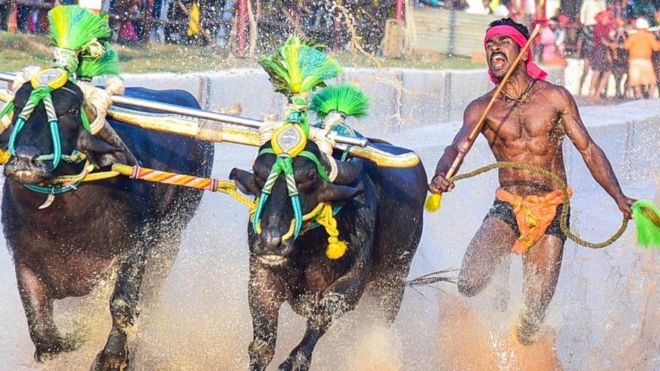
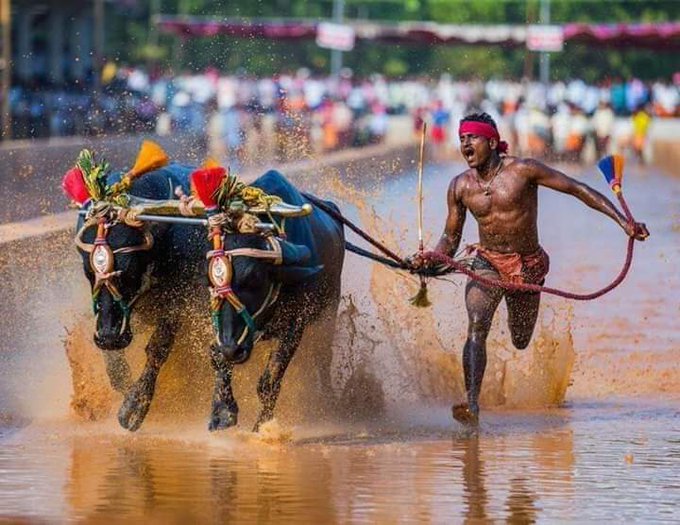
Srinivas Gowda in his winning Kambala raceImage copyright ANNU PAI
Image caption Srinivas Gowda also praised the efforts of his teammates, the two buffalo

A construction worker in south India is being compared to the Olympic gold medallist sprinter Usain Bolt after a record-breaking win in a buffalo race.

Srinivas Gowda, 28, was competing in Kambala, a sport from the southern state of Karnataka where people sprint 142m through paddy fields with buffalo.

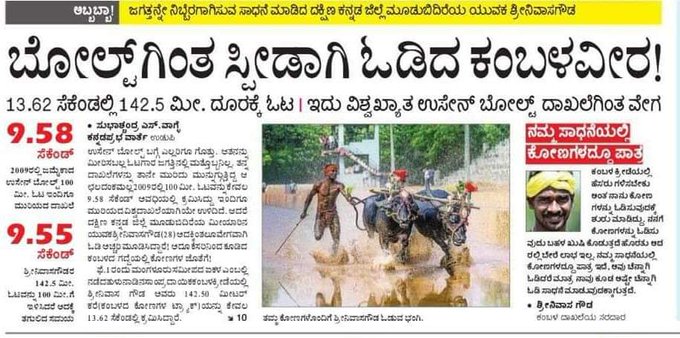
Mr Gowda is said to have finished in 13.42 seconds. Bolt holds the world 100m record of 9.58 seconds.

But the governing body for Kambala has warned against comparing him to Bolt.

“We would not like to indulge in any comparison with others,” Prof K Gunapala Kadamba, president of the Kambala Academy, told BBC Hindi.

“They [Olympic event monitors] have more scientific methods and better electronic equipment to measure speed.”

Prof Kadamba’s response came after several local newspapers and journalists made the comparison between Mr Gowda’s performance and the Jamaican sprinter’s world record time.

Skip Twitter post by @dp_satish
But Mr Gowda, from Moodabidri in Karnataka’s coastal district of Dakshina Kannada, was excited about his record-breaking win and praised his teammates – the two buffalo he ran alongside – for doing so well.
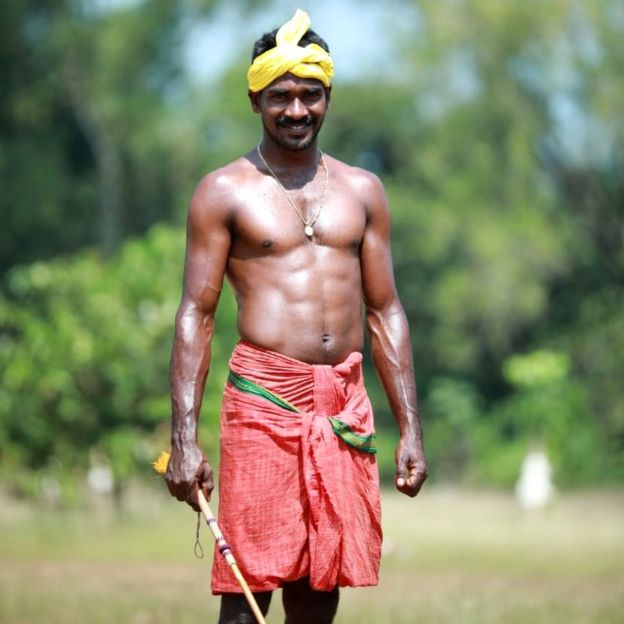
Srinivas GowdaImage copyright ANNU PAI
Image caption Srinivas Gowda, 28, has been taking part in Kambala for seven years

He told BBC Hindi he had taken part in Kambala for seven years, adding: “I got interested in it because I used to watch Kambala during my school days.”

What is Kambala?

Kambala, which roughly translates to “paddy-growing mud field” in the local language Tulu, is a traditional sport originating from part of Karnataka’s coast.

Participants sprint through a field, which is normally either 132m or 142m, with two buffalo that are tethered together.

It is controversial, and in the past the sport has attracted strong criticism from international animal rights groups.

In 2014, India’s Supreme Court issued a ban on races with bulls, prompted primarily by campaigns against the practice of Jallikattu, a form of bull-fighting from the neighbouring state of Tamil Nadu.

Two years later, Karnataka’s state court issued an interim order stopping all Kambala events.

Prof Kadamba said that the organising body had responded to this, updating the sport in order to make it more humane.

He said their current and former students – including Mr Gowda – are now taught how to deal with buffalo “in a humane manner without unnecessarily hurting the animal”.

In 2018, the state started allowing Kambala races to take part again, but issued several conditions – including a ban on the use of whips.

But the practice is still under threat. International animal rights group Peta has a petition pending in the Supreme Court, arguing that Karnataka’s reinstatement of Kambala was illegal.

“This Kambala is quite different from the traditional Kambala that used to be practised some decades ago,” Prof Kadamba added.

Source: The BBC
12/02/2020

An ‘unhappy marriage’ that has saved thousands of lives

Uma Preman

Arranged marriages can often throw up surprises. Uma Preman’s unhappy marriage transformed not only her life, but also the lives of thousands of others – because it left her with the skills and motivation to help disadvantaged Indians gain access to medical treatment.

The moment

Uma always dreamed of a perfect wedding in a traditional south Indian temple. She imagined it decorated throughout with colourful flowers – and a big party by the beach.

But it never happened.

Uma still remembers the grey February morning 30 years ago when her mother introduced her to Preman Thaikad. Uma was only 19, and Preman was 26 years older.

They had never met before, but she was told he was her husband. There were no festivities and no music – in fact there wasn’t even a wedding.

“My mother told me that I was now Preman’s property. He told me that I was his wife but I had no rights over his property,” says Uma.

Uma Preman

Preman took her to his house and left her there for the night. She still remembers that she couldn’t sleep and just stared at the pale yellow ceiling and the rickety fan.

The next morning, Preman returned at 6am and asked her to accompany him to a bar. He kept drinking for several hours while she sat in silence, trying to figure out the strange direction her life had taken.

He told her that she was his second wife, but she quickly learned that she was actually his fourth. He also revealed that he had a severe form of tuberculosis – and that her main job was to be his carer.

Before

Uma grew up in Coimbatore, a busy town in the southern Indian state of Tamil Nadu. As a child, she wanted to become a doctor like her father, TK Balakrishnan.

Balakrishnan had studied medicine for a year before his uncle asked him to drop out and work on his farm. He had learned the basics and would use his knowledge to dress wounds, change dressings and treat fevers with basic medicines. Uma heard that the families of the patients would often give him treats – so she began to accompany him on his rounds.

“I just loved food and eating and that’s why I went with him,” she says.

But one day she saw something that made her realise how serious her father’s work was. Her father was treating a patient with gangrene. The stench, Uma says, was unbearable.

“He was using gardening gloves because he didn’t have surgical ones, but he was so calm.”

Short presentational grey line

Find out more

Short presentational grey line

But Uma’s mother hated the fact that her husband was spending most of his time helping others, Uma says.

When she was eight, her mother gave her some money to buy firecrackers for the Hindu festival of Diwali – and when she came back, her mother was gone.

“I found out later that she loved another man and she left with him,” Uma says.

Suddenly it was up to Uma to take care of her three-year-old brother. She says she didn’t know how to cook, but she decided to learn because she couldn’t bear the food her father made for them.

Uma Preman

“I went to nearby homes and requested the ladies to teach me. They said I wouldn’t be able to cook because I was small,” Uma says. But within days they had taught her to make a variety of dishes, and cooking became part of her daily routine.

“I would wake up at 5am to make breakfast and lunch. Then I would go to school at 9am. I would come back in the evening and take care of my brother and cook dinner,” Uma says.

“My friends played every evening – they were enjoying their life. But I was happy taking care of my family.”

She kept thinking about her mother though, and worrying that she might never see her again.

Years later, when Uma was 17, she went with some neighbours to visit a famous temple in Guruvayur – 87 miles from Coimbatore – and there she met a man who told her he’d seen a woman who looked exactly like her.

Uma left her address with him and a few days later a letter arrived in the post.

It was from her mother.

Uma Preman

Uma rushed back to Guruvayur to be reunited with her, but it quickly became clear there was a problem. Her second husband had borrowed large sums of money, then abandoned her – and the lenders were demanding payment.

“I would see people coming to her house every day to harass her for money,” Uma says. “It was painful to see.”

Her mother’s solution was for her to marry Preman, who was wealthy enough to clear her debts. Uma was reluctant. She tried to get work instead, but failed. Then she returned to her father – but he felt betrayed by her decision to resume contact with her mother, and turned his back on her.

Eventually, Uma gave in.

“I felt worthless. I just accepted my fate and went with Preman.”

After

“Every day before he left for work, Preman would lock me inside the house,” Uma remembers.

“I wasn’t allowed to meet anybody or to go out – not even for a minute. For six months, I was alone. I started talking to walls. I lost my confidence and self-respect.”

As the years passed, Preman’s tuberculosis worsened. The couple started spending most of their time in hospitals, and in 1997, seven years after Uma had moved in with him, Preman died. Although he had once said she would have no right over his property, he left her comfortably off.

Uma says she felt free for the first time in her life.

“I didn’t want him to die, but I couldn’t help but feel that life had given me a second chance.”

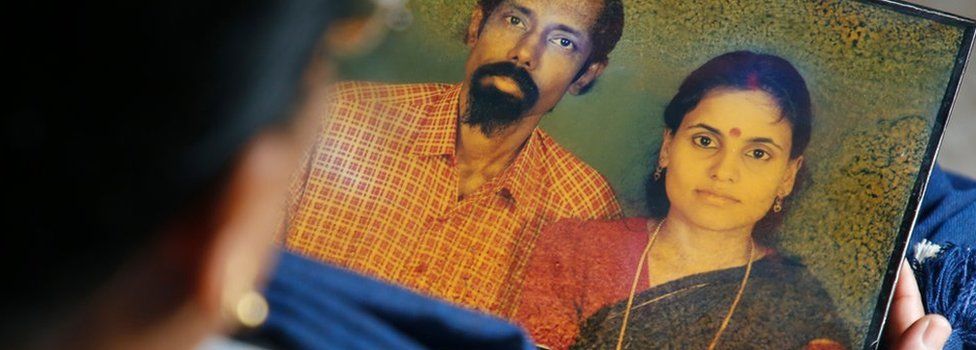
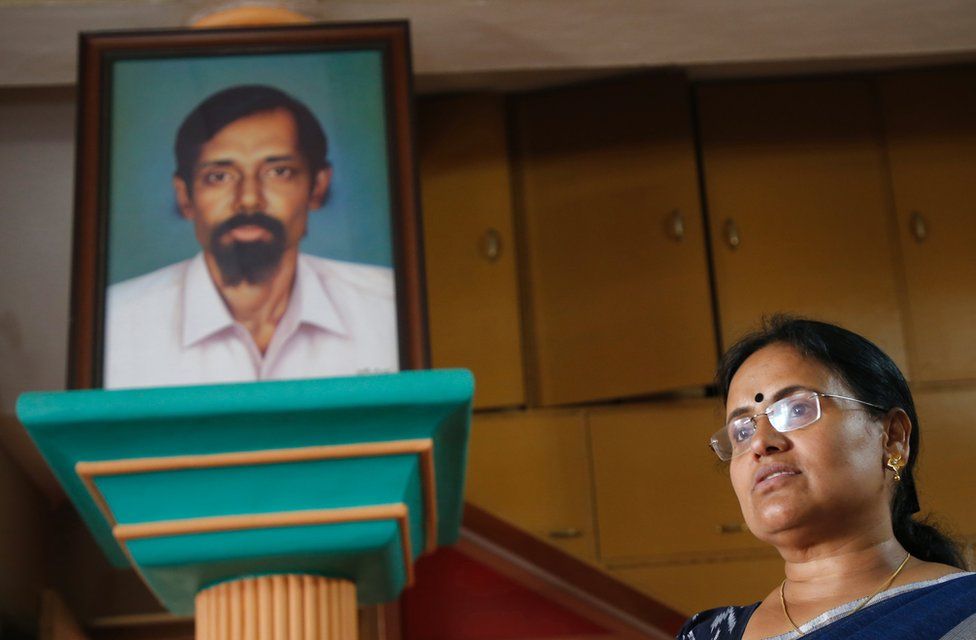
Uma with Preman's photograph
Image caption Uma with Preman’s portrait in the background

It took a while for it to become clear what she would do with this new freedom.

During her years with Preman, Uma had observed that poor people were often unable to get proper medical treatment, not only because they couldn’t afford it but also because they didn’t have the right information – they didn’t know what treatments and facilities were available.

So Uma had started helping them, filling in forms for them, guiding them to the right doctors and sometimes just listening to their problems.

When she left the hospital in Trivandrum where Preman had spent the last six months of his life, she was missed. But she wasn’t completely beyond reach. There was a booth where she had often called Preman’s family, she says, and the person who owned it gave her number to people in need of help.

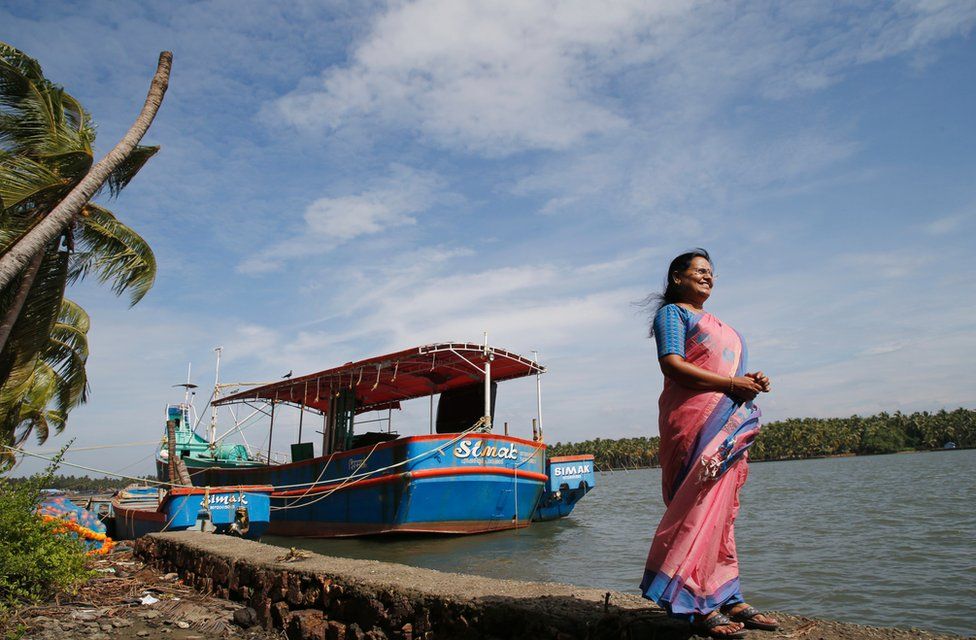
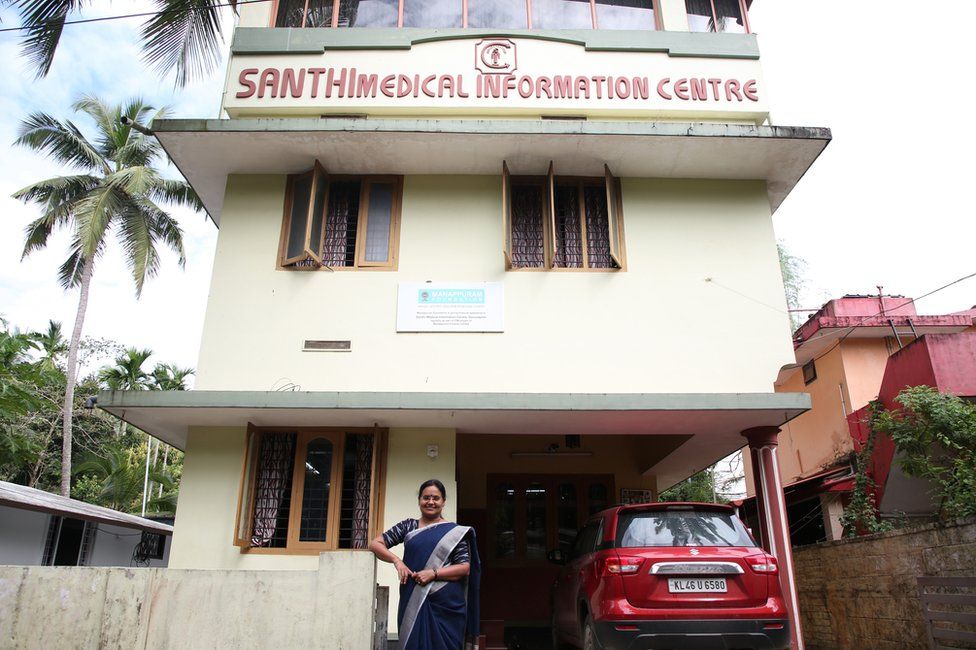
Soon hundreds of people started calling for advice and that’s how the Santhi Medical Information Centre was born. Uma had found her life’s calling – she wasn’t treating people, as her father had done, but she was helping them get treatment.

Uma Preman

However, to help other people Uma had to acquire knowledge herself, and in the late 1990s the internet wasn’t yet widely available in India. She had to travel across the country to collect data about treatments, hospitals and the places where people could get free or subsidised treatment.

“I had to travel because no hospital replied to my letters,” she says.

Even when she met people face to face, they often didn’t take her seriously. In other Indian states there was also a language barrier, as Uma spoke only Tamil.

In the past decade, the Santhi Centre’s top priority has been helping people with kidney disease.

Uma Preman

There are not enough dialysis centres in the country and the rate of kidney donation is poor. Uma has been working to change this, raising funds for new facilities open to all.

“Our first dialysis centre started in Thrissur district in Kerala. Now we have 20 centres across India. Many rich people donated for the cause,” she says.

Uma says persuading people to donate a kidney is not easy because they often worry about the impact on their own health.

So she decided to set an example, and donated one of her own kidneys. She gave it to an orphan whose kidneys had failed.

Uma Preman with Salil
Image caption One of Uma’s kidneys enables Salil to live a normal life

Salil says he owes his life to her.

“I was 26 when I was undergoing dialysis. When she met me, she told me that she would donate her kidney on the condition that I continued to work after the transplant.”

He did continue to work – in fact, after a while he went to work for Uma.

Salil says Uma is a woman who truly believes in Mahatma Gandhi’s words that “you have to be the change you want to see”.

“Everyone wants to change the world but no-one is ready to change themselves,” Uma says. “I changed my attitude and I donated one kidney, but I also got a brother in return.”

Source: The BBC

30/10/2019

The explosive truth about the link between Chinese fireworks and India’s dim Diwali

  • Black market imports from China, confusing regulations and pollution concerns are undermining India’s fireworks industry
  • Industry sources say Diwali sales this year were down by 30 per cent
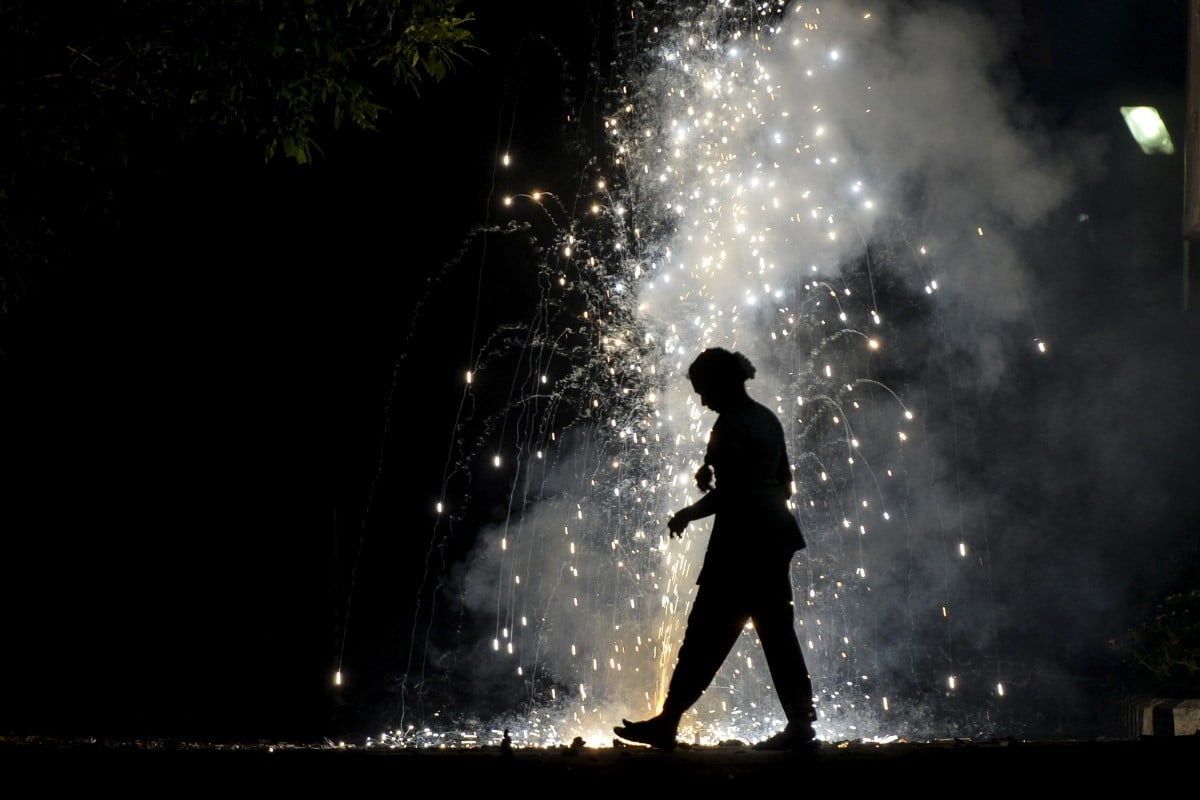
A woman is silhouetted by lit firecrackers during Diwali celebrations in Chennai. Photo: AFP

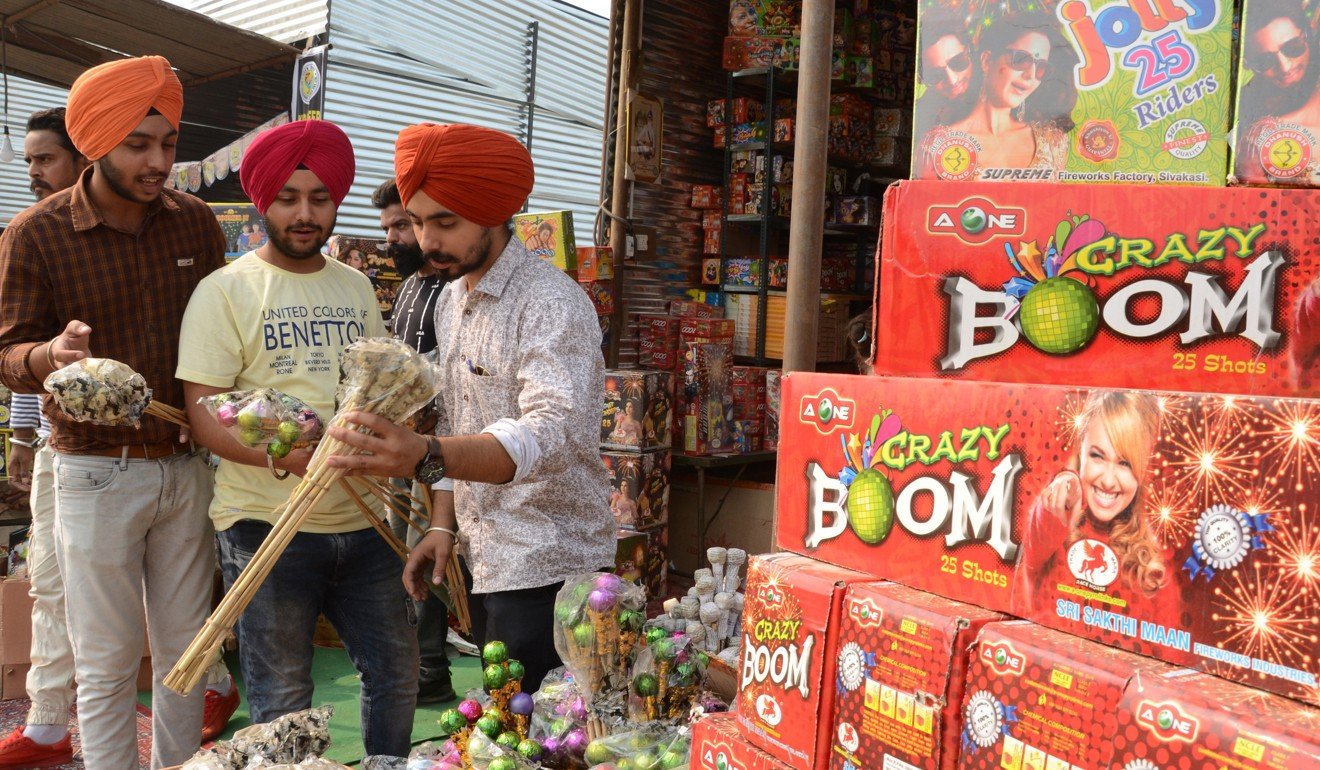
Arumugam Chinnaswamy set up his makeshift booth selling firecrackers in a Chennai neighbourhood a week ahead of Diwali, the Hindu festival of lights, with great expectations of doing a brisk trade.

Yet a week later, he has been forced to pack up more than half his stock in the hope he’ll have better luck next year.

“Four years ago, I sold firecrackers worth 800,000 rupees (US$11,288) on the eve of Diwali alone. This year, the sales have not even been a quarter of that,” said Chinnaswamy, 65, painting a grim picture that will be recognised by many in the Indian fireworks industry.

Chinnaswamy buys his firecrackers in Sivakasi, an industrial town in the southern Indian state of Tamil Nadu that produces more than 90 per cent of the country’s fireworks.

Sivakasi’s dry climate has helped to make it the firework capital of India and many production facilities in the town have been in the business for close to a century. For the most part, the industry has resisted mechanisation and still deals in handmade products. Its 1,100-plus manufacturing units provide jobs for 800,000 mostly uneducated workers and its diligent labour force have earned the town the nickname of ‘Little Japan’.
A worker lays firecrackers in an outdoor yard at a manufacturing unit involved in the production of firecrackers ahead of the Hindu festival of Diwali, in Sivakasi. Photo: AFP

But this reputation is under threat, struggling under the weight of an anti-pollution campaign, regulatory uncertainty and the arrival of cheap black-market Chinese imports. Irregular monsoons and a slowdown-induced cash crunch have not helped matters either.

Industry figures estimate the Diwali sales of India’s 80 billion-rupee firecracker industry took a 30 per cent drop this year.

A TOXIC PROBLEM

With pollution in Indian cities among the worst in the world, the government has come under pressure to do something about the nation’s toxic air – a problem that becomes more acute during Diwali due to the toxic fumes emitted when celebratory fireworks are set off. This Diwali, for instance, many areas in New Delhi recorded an Air Quality Index (AQI) of 999, the highest possible reading (the recommended limit is 60).

That makes the fireworks industry seem like an easy target when it comes to meeting government air quality targets.

Trouble began brewing in October last year when the Supreme Court banned the manufacture of traditional fireworks containing barium nitrate, a chief polluter. That decision put a rocket under the industry, as barium nitrate is cheap and is used in about 75 per cent of all firecrackers in India.

Factories in Sivakasi responded with a four-month shutdown protest that decimated annual production levels by up to a third.

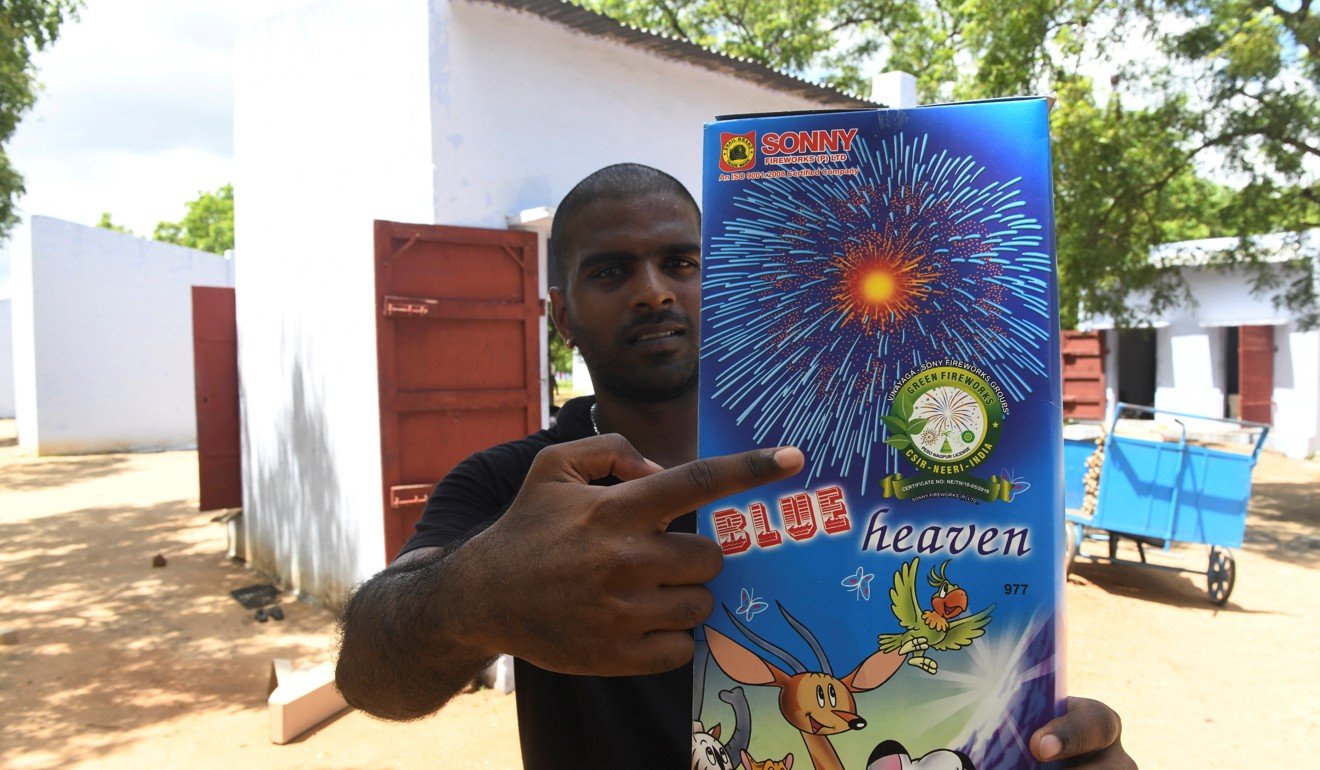
A seal denotes environment friendly ‘Green Fireworks’ at a manufacturing unit in Sivakasi. Photo: AFP

Apparently realising it had overstepped the mark – and that enforcing the Supreme Court regulations would be next to impossible – the government stepped in to rescue the industry, offering its assistance in the manufacture of environment-friendly crackers containing fewer pollutants, but it was too little, too late.

“The Supreme Court verdict was simply Delhi-centric with the vague idea of [cracking down on] urban pollution. It lacked any on-the-ground knowledge of the fireworks industry,” said Tamil Selvan, president of the Indian Fireworks Association, which represents more than 200 medium and large manufacturers.

Singapore travellers give Hong Kong a miss over Diwali long weekend

“Fireworks are low-hanging fruit for the anti-pollution drive as the industry is unorganised. Could the government or judiciary place a similar blanket ban on more pollution-causing industries like automobiles, plastics or tobacco?” asked Selvan.

CHINESE COMPETITION

The industry has also been hit by a flood of cheap Chinese firecrackers that are smuggled into the country on the black market.

In September, the country’s federal anti-smuggling agency, the Directorate of Revenue Intelligence, cautioned various government departments that huge quantities of Chinese-produced firecrackers had reached Indian soil in the lead up to Diwali.

But industry sources complain they have seen little action from the government to combat the problem.

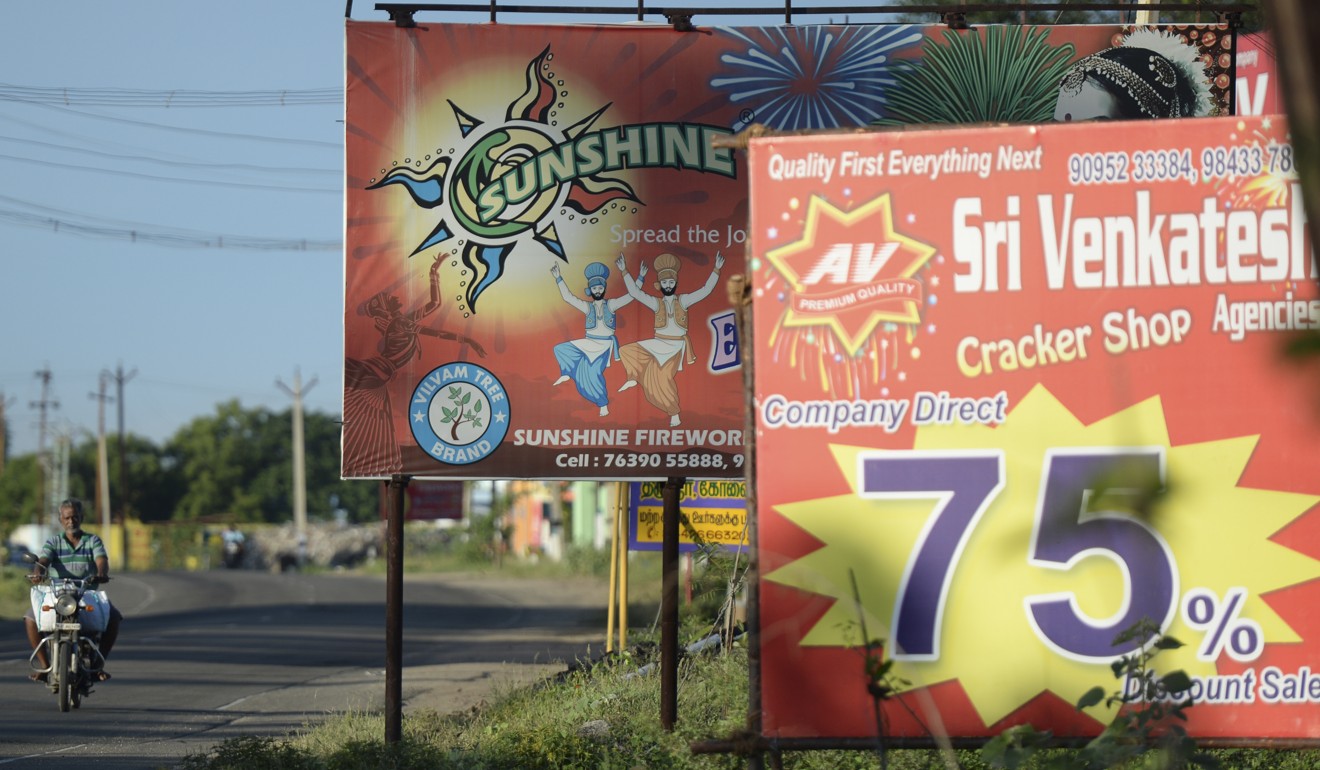
An advert for firecrackers ahead of the Hindu festival of Diwali, in Sivakasi. Photo: AFP

Legally, Indian manufacturers can neither import nor export firecrackers. The Indian firecracker industry is the second-largest in the world after China’s.

Raja Chandrashekar, chief of the Federation of Tamil Nadu Fireworks Traders, a lobbying body, said low-end Indian-manufactured firecrackers such as roll caps and dot caps – popular among children – had struggled to compete with Chinese-made pop pops and throw bombs.

“Despite our repeated complaints to government bodies, Chinese firecrackers find a way into India, particularly in the northern parts. This is severely affecting our business,” said Chandrashekar.

While more Chinese fireworks might be entering India, the effect has been to undermine the industry, resulting in fewer sales overall.

FIZZLING OUT?

The Sivakasi fireworks industry faces other problems, too. Not least among these is the use of child labour, which had been rampant until a government crackdown a few years ago, and the practice of some factories to operate without proper licences and with questionable safety standards.

But despite the darker aspects of the industry, its role goes beyond merely helping Diwali celebrations go with a bang every year.

India is crazy about gold. But can the love last as prices skyrocket?

“The livelihoods of over five million people who are indirectly involved in the business, in areas such as trade and transport, depend on the survival of the industry,” said Chandrashekar.

That survival looks increasingly in question. Dull sales of fireworks have been reported in major cities including New Delhi, Mumbai, Bangalore and Hyderabad, though exact numbers can be hard to come by due to the unregulated nature of the industry and unreliable numbers shared by manufacturers.

So great has the resultant outcry been that some cynics even wonder whether the industry is struggling as much as it claims or whether it is part of a ploy by manufacturers to gain more government concessions and avoid any further crackdown.

“These firecracker manufacturers lie through their teeth about the Diwali sales for self-serving motives such as tax avoidance. The overall business is healthy,” said Vijay Kumar, editor of the Sivakasi-based monthly magazine Pyro India News.

“Though there was a 30-40 per cent shortage in annual production, all the manufactured products have been sold this year. No large stockpile is left with any manufacturer.”

Customers buy firecrackers on the eve of the Hindu festival of Diwali in Amritsar. Photo: AFP

Still, regardless of the manufacturers’ motives, the result of the industry’s struggles has been that street sellers like Chinnaswamy have fewer fireworks to sell – and they are struggling even to sell those.

Chinnaswamy says people are confused about the government’s anti-pollution drive and about what firecrackers are now legal and this has discouraged them from buying. Despite the government’s effort to promote “green crackers” he says these are too hard to come by to be a ready solution, at least for this year.

“There was no clarity on what type of firecrackers, whether green crackers or otherwise, can be set off and at what time of the day. Many consumers even asked me whether or not the conventional firecrackers are totally banned while there was much misinformation floating about on social media,” said Chinnaswamy.

Shaking his head, all he can do is hope that next year his Diwali goes with more of a bang.

Source: SCMP

08/10/2019

Indian selfie deaths: Four drown in reservoir in Tamil Nadu

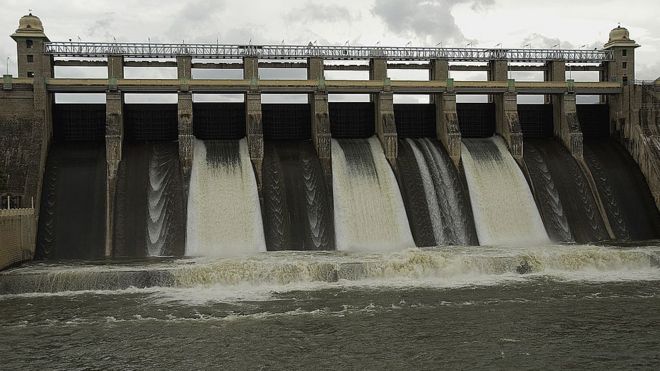
Amaravathi Dam, Coimbatore District, Tamil Nadu, IndiaImage copyright GETTY IMAGES
Image caption Tamil Nadu is home to many dams and reservoirs that are popular with visitors

A newly married woman and three of her family drowned in a reservoir after trying to take a selfie, said police in the southern Indian state of Tamil Nadu.

The dead were among a group of six who held hands and stood in waist deep water near Pambar dam before one of them slipped, pulling the others.

The woman’s husband was able to save his sister but the others drowned.

India has the highest number of recorded selfie deaths in the world.

India accounted for about half of the 259 reported fatalities between 2011 and 2017, according to a study by the US National Library of Medicine. It was followed by Russia, the US and Pakistan.

In Tamil Nadu on Sunday, the young married couple, from Bargur in Krishnagiri, were visiting relatives in Uthangarai along with the bridegroom’s sister, The Hindu newspaper reported.

The three entered the water together with three teenage siblings when one of them, a boy aged 14, slipped and dragged his two sisters aged 18 and 19 with him, along with the newly married woman and the bridegroom’s sister.

The sister was pulled to safety by her brother but the other four disappeared under the water. Police said the bodies were later recovered and that post-mortem examinations would be carried out.

It was the latest in a series of tragedies linked to selfies in India. Experts have warned that people are taking unnecessary risks to impress their family and friends on social media.

In Haryana state in May, three teenagers taking selfies on a railway track jumped out of the way when they saw a train approaching, only to be killed by another train coming in the other direction.

In 2017, the Indian state of Karnataka launched a campaign to warn people that “selfies can kill” after the deaths of four students.

The same year, a man died in Odisha when an elephant he was taking a selfie alongside wrapped its trunk around him and crushed him.

Source: The BBC
02/07/2019

Viewpoint: Why India’s Chennai has run out of water

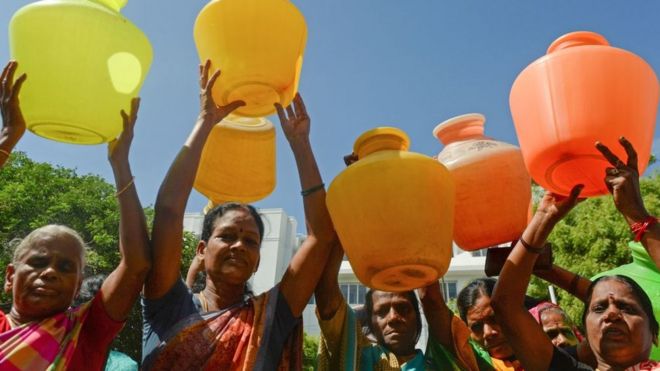
Indian women with empty plastic pots protest as they demand drinking water in Chennai on June 22, 2019.Image copyright GETTY IMAGES

Chennai (formerly Madras), the capital of India’s southern Tamil Nadu state, is gaining notoriety as the disaster capital of the world – floods one year, cyclone the next, and drought the year after. But it is not alone. Environmental activist Nityanand Jayaraman explains why.

As I write this, it has rained in Chennai – the first real welcome shower, but one that lasted only 30 minutes. But, still, that has been enough to flood the streets and stall traffic. The irony is that Chennai’s vulnerability to floods and its water scarcity have common roots. Blinded by a hurry to grow, the city has paved over the very infrastructures that nurtured water.

Between 1980 and 2010, heavy construction in the city meant its area under buildings increased from 47 sq km to 402 sq km. Meanwhile, areas under wetlands declined from 186 to 71.5 sq km.

The city is no stranger to drought or heavy rains. The north-east monsoon, which brings most of the water to this region in October and November, is unpredictable. Some years it pours, and in other years, it just fails to show up.

Any settlement in the region ought to have been designed for both eventualities – with growth limited not by availability of land but of water. Early agrarian settlements in Chennai and its surrounding districts did exactly this.

Shallow, spacious tanks – called erys in Tamil- were carved out on the region’s flat coastal plains by erecting bunds with the same earth that was scooped out to deepen them. Essentially, the infrastructure for water to stay and flow was created first; the settlements came later.

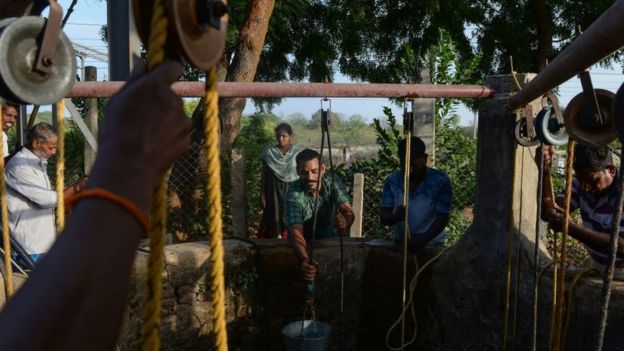
In this photo taken on June 20, 2019, Indian residents collect water from a community well in Chennai after reservoirs for the city ran dry.Image copyright GETTY IMAGES

This agrarian logic valourised open spaces. Each village had vast tracts of land, including water bodies, grazing grounds and wood lots, demarcated as Poromboke or commons. Construction was outlawed in the commons. The three districts of Chennai, Thiruvallur and Kanchipuram alone had more than 6000 erys – some as old as 1,500 years.

So rather than transport water over long distances against gravity, early settlers had the technology and good sense to harvest water where it fell.

But this faded with the advent of modern technology.

As urban logic took root, built-up spaces began to be seen as more valuable than open earth. In fact, one could argue that Chennai’s date with “zero water” was made in the 17th Century when it was incorporated as a city by Royal Charter. Born a colony of the British, the city rapidly became a coloniser of the countryside.

The British commandeered a small irrigation ery in a village called Puzhal, and vastly expanded its capacity to supply drinking water to the city, in response to the Madras famine of 1876. Renamed the Redhills Reservoir, this was Chennai’s first centralised, big-budget drinking water project.

Presentational grey line

For more on the Chennai water crisis:

Presentational grey line

Reliance on a distant water source disconnected residents of the fast urbanising settlement from local water and landscapes. For the urban agenda, this was great as it freed up inner-city water bodies for real estate development.

In the 1920s for instance, the ancient 70 acre Mylapore tank was filled up to create what is now a bustling residential and commercial area called T Nagar.

That tank was part of a larger complex called the Long Tank that extended nearly 10 km (6.21 miles) to the north. Now all that remains of these tanks are thoroughfares named Spurtank Road and Tank Bund Road.

The city has pursued its aspirations to become an economic hub by promoting itself as a major IT and automotive manufacturing centre. In addition to attracting new settlers to Chennai and vastly increasing the pressure on scant resources, these industries have dealt death blows to the region’s water infrastructure.

Land-use planning today is a far cry from the simple principles that prevailed in medieval Tamil Nadu.

Wetlands were off-limits for construction, and only low-density buildings were permitted on lands immediately upstream of tanks. The reason: These lands have to soak up the rainwater before letting it to run to the reservoir.

It is this sub-surface water that will flow to the lake as the levels go down with use and time. Unmindful of such common sense, the IT Corridor (a road which houses a large number of IT companies in the city) was built almost entirely on Chennai’s precious Pallikaranai marshlands.

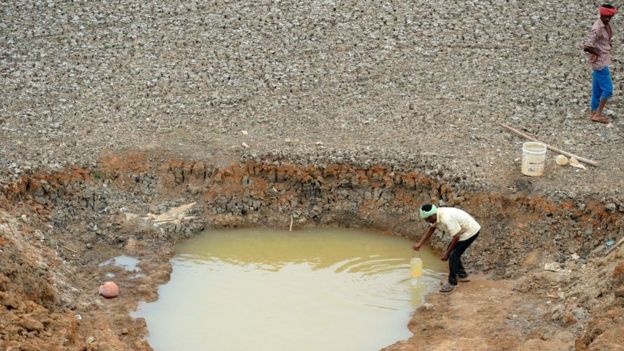
Indian workers collect water from the Puzhal reservoir on the outskirts of Chennai on June 20, 2019. - Water levels in the four main reservoirs in Chennai have fallen to one of its lowest levels in 70 years, according to local media reportsImage copyright GETTY IMAGES
Image caption Puzhal reservoir was Chennai’s first centralised, big-budget drinking water project

And the area immediately upstream of Chembarambakkam – the city’s largest drinking water tank – has now been converted into an automotive special economic zone (SEZ).

Other water bodies have been treated with similar disdain.

The Perungudi garbage dump spreads out through the middle of the Pallikaranai marshlands.

The Manali marshlands were drained in the 1960s for Tamil Nadu’s largest petrochemical refinery. Electricity for the city comes from a cluster of power plants built on the Ennore Creek, a tidal wetland that has been converted into a dump for coal-ash.

The Pallavaram Big Tank, which is perhaps more than 1,000 years old, has over the last two decades been bisected by a high-speed road with the remainder serving as a garbage dump for the locality.

In Chennai, the water utility supplies are barely a fourth of the total water demand. The remainder is supplied by a powerful network of commercial water suppliers who are sucking resources in the region dry.

Along the periphery of Chennai, and far into the hinterland, the land is dotted with communities whose water and livelihoods have been forcibly taken to feed the city. The water crises in these localities desiccated by the city never make it to the news.

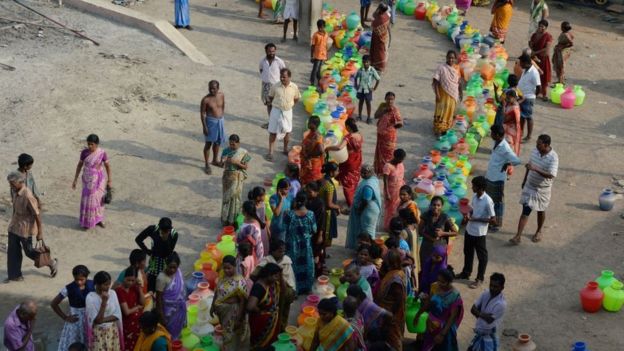
Indian residents queue with plastic recipients to get drinking water from a distribution tanker in the outskirts of Chennai on May 29, 2019.Image copyright GETTY IMAGES

The world won’t change unless we replace capitalism with other ways of doing business that are not premised on the exploitation of nature and people.

Our dominant economic model, with its blind faith in technology, is doomed.

Modern economy views open, un-built land as useless. It believes that value can be extracted from such lands only by digging, drilling, filling, mining, paving or building on it.

Degrading land use change is colliding with climate change in all the modern cities of the world, exposing their vulnerabilities.

Chennai’s struggles with water – be it flooding or scarcity – cannot be addressed unless the city re-examines its values, and how it treats its land and water.

Further growth and more buildings are not an option – it needs to actively shrink in size instead.

By ushering in policies to promote land-friendly economies in the state’s hinterland, the government can make it easier for people to migrate out of the city in a planned and feasible way.

Although difficult, this would be less painful than what would happen if they were to wait for nature to do the job.

Source: The BBC
03/06/2019

No compulsory Hindi in India schools after Tamil Nadu anger

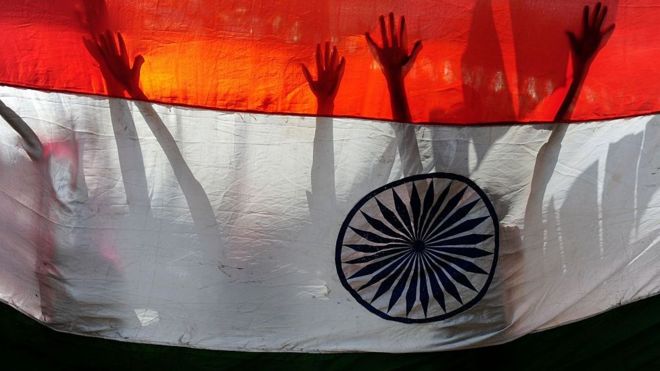
Indian schoolchildren are silhouetted against a national flag as they participate in Independence Day celebrations in Chennai on August 15, 2016.Image copyright GETTY IMAGES
Image caption Tamils argue that imposing Hindi will jeopardise their language

The Indian government has revised a controversial draft bill to make Hindi a mandatory third language to be taught in schools across the country.

The draft bill had met particularly strong opposition in the southern state of Tamil Nadu, which has always resisted the “imposition” of Hindi.

In 1965, it saw violent protests against a proposal that Hindi would be India’s only official language.

Tamil is one of the oldest languages and evokes a lot of pride in the state.

However the government decision has not calmed tensions in Tamil Nadu.

The two main political parties in the state, the DMK and AIADMK, have both said that simply revising the draft to say Hindi would not be mandatory is not enough.

The state teaches only two languages – Tamil and English – in the government school curriculum, and the parties do not want a third language introduced at all.

A DMK spokesman told the NDTV news channel that the third language clause would be used as a “back door” to introduce Hindi anyway.

Their rivals, the AIADMK, which allied with the Bharatiya Janata Party (BJP) in the general elections but lost badly in the state, had a similar view.

“Our party has always been clear in our stand. We have always followed a two-language policy. Though mandatory Hindi has been revised in the draft now, we still cannot support this three-language system. Our government will talk to the union government for our rights,” former state education minister and AIADMK spokesman Vaigaichelvan told BBC Tamil.

On Monday, #HindiIsNotTheNationalLanguage began trending on Twitter in India, which saw many from Tamil Nadu facing off against people from other parts of the country and asserting their right not to have the language “imposed” on them.

Skip Twitter post by @Akahrsh
Skip Twitter post by @AkbarHussaine
Presentational white space“There is no opposition to actually learning Hindi. In fact with the recent IT boom in the south, so many people from the north have migrated here that its use has become more widespread here. It is true that if you know Hindi you will find it easier to get work in other parts of India, so there are also many people here who willingly learn it. But that should be their choice. What people are opposing is the imposition of it,” senior journalist and political analyst KN Arun told the BBC.

Mr Arun also warned that there was a chance that the issue could lead to further protests in the state, saying that a few hardline Tamil groups had been using the issue to whip up anger among the people.

It is also a particularly emotive issue. Politics in the state is still centred around the ideas and principles of the Dravidian movement, which among other things reveres the Tamil language and links it closely to regional identity.

“Tamil is very rich in literature and different to other languages like Hindi which branched out of Sanskrit. There is fear that the Indian government is trying to slowly introduce Hindi, which will threaten the status of Tamil,” author and journalist Vaasanthi told the BBC.

Source: The BBC
29/04/2019

Cyclone Fani may be headed to Odisha; NDRF, Coast Guard on alert

The NDRF and the Indian Coast Guard have been put on high alert and placed at the disposal of the state governments concerned.

INDIA Updated: Apr 29, 2019 14:37 IST

HT Correspondent
HT Correspondent
New Delhi
Cyclone fani,NDRF,Coast Guard
Representational Image(REUTERS File)

The NDRF and the Indian Coast Guard have been put on high alert and fishermen asked not to venture into the sea, the Home Ministry said Monday.

According to the India Meteorological Department (IMD), its landfall over Tamil Nadu and Andhra Pradesh is ruled out. However, the possibility of landfall in Odisha is under continuous watch.

On Monday morning, it was located at 880 km of South-East of Chennai and it will continue to move North-West and change its path to North-East from Wednesday.

The National Disaster Response Force (NDRF) and the Indian Coast Guard have been put on high alert and placed at the disposal of the state governments concerned. Regular warnings have been issued since April 25 to fishermen not to venture into the sea and asking those at sea to return to coast, it said.

The IMD has been issuing three hourly bulletins with latest forecast to all the states concerned and the home ministry is also in continuous touch with the state governments and the central agencies concerned, the statement said.
Source: Hindustan Times
Law of Unintended Consequences

continuously updated blog about China & India

ChiaHou's Book Reviews

continuously updated blog about China & India

What's wrong with the world; and its economy

continuously updated blog about China & India