Archive for ‘tax cuts’

27/08/2019

Viewpoint: How serious is India’s economic slowdown?

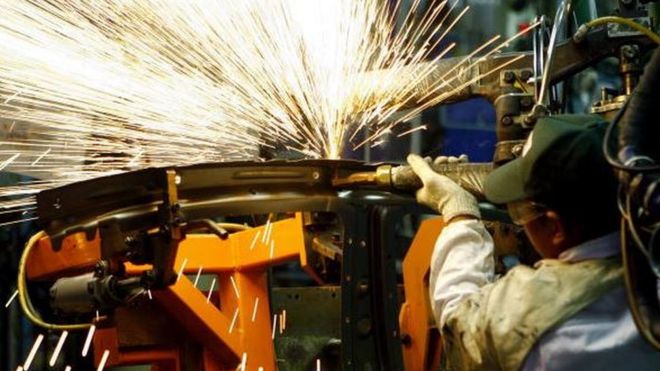
Indian factory worker
Image caption Private sector investment is at a 15-year low

Top Indian government officials are engaged in a vociferous public debate over the state of the country’s economy.

Rajiv Kumar, the head of the government’s think tank Niti Aayog, recently claimed that the current slowdown was unprecedented in 70 years of independent India and called for immediate policy interventions in specific industries.

The Chief Economic Adviser, K Subramanian, disagreed with the idea of industry-specific incentives and argued for structural reforms in land and labour markets. Members of Prime Minister Narendra Modi’s economic advisory council sound inchoate, resorting to social media and opinion editorials to counter one another.

In essence, the quibble among the members of the economic team of Mr Modi and his government is not about whether India is facing an economic slowdown or not, but about how grave the current economic crisis is.

This is a remarkable reversal in stance of the same group of economists who, until a few months ago, waxed eloquent about how India was the fastest growing economy in the world, generating seven million jobs a year.

To put all this in context, it was less than just two years ago, in November 2017, that the global ratings agency Moody’s upgraded India’s sovereign ratings – an independent assessment of the creditworthiness of a country – for the first time in 14 years.
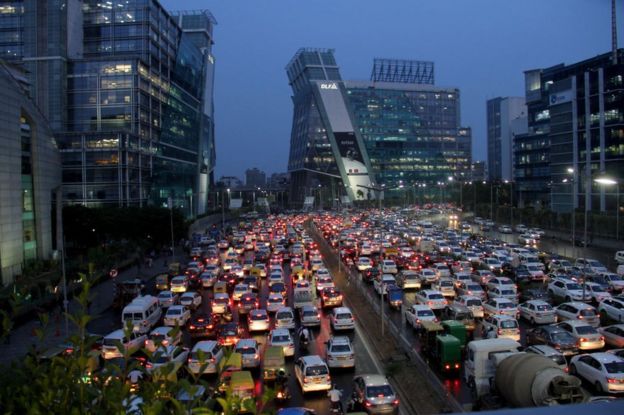
GurgaonImage copyrightGETTY IMAGES
Image captionSales of cars and SUVs have slumped to a seven-year low

Justifying the upgrade, Moody’s had then argued that the economy was undergoing dramatic “structural” reforms under Mr Modi.

In the two years since, Moody’s has downgraded its 2019 GDP growth forecast for India thrice – from 7.5% to 7.4% to 6.8% to 6.2%.

The immediate questions that arise now are: is India’s economic condition really that grim and, if yes, how did it deteriorate so rapidly?

Presentational grey line

Read more about the Indian economy

Presentational grey line

One of India’s most celebrated entrepreneurs, the founder of the largest coffee store chain, Café Coffee Day, recently killed himself, ostensibly due to unmanageable debt, slowing growth and alleged harassment by tax authorities.

The auto industry is expected to shed close to a million direct and indirect jobs due to a decline in vehicle sales. Sales growth of men’s inner wear clothing, a key barometer of consumption popularised by former Federal Reserve Chair Alan Greenspan, is negative. Consumption demand that accounts for two-thirds of India’s GDP is fast losing steam.

To make matters worse, Finance Minister Nirmala Sitharaman presented her first budget recently with some ominous tax proposals that threatened foreign capital flows and dented investor confidence. It sparked criticism and Ms Sitharaman was forced to roll back many of her proposals.
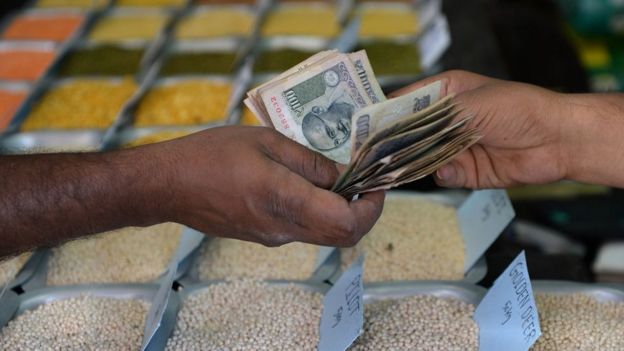
An Indian customer hands over cash to a food grain merchant at a wholesale trading shop in BangaloreImage copyright GETTY IMAGES
Image caption In 2016, India withdrew 85% of all currency notes from the economy

So, it is indeed true that India is facing a sharp economic downturn and severe loss of business confidence.

The alarm over the economic condition is not merely a reflection of a slowdown in GDP growth but also the poor quality of growth.

Private sector investment, the mainstay of sustainable growth in any economy, is at a 15-year low.

In other words, there is almost no investment in new projects by the private sector. The situation is so bad that many Indian industrialists have complained loudly about the state of the economy, the distrust of the government towards businesses and harassment by tax authorities.

But India’s economic slowdown is neither sudden nor a surprise.

Behind the fawning headlines in the press over the past five years about the robustness of India’s growth was a vulnerable economy, straddled with massive bad loans in the financial sector, disguised further by a macroeconomic bonanza from low global oil prices.

India’s largest import is oil and the fortuitous decline in oil prices between 2014 and 2016 added a full percentage point to headline GDP growth, masking the real problems. Confusing luck with skill, the government was callous about fixing the choked financial system.

To make matters worse, Mr Modi embarked on a quixotic move in 2016 to withdraw all high-value banknotes from circulation overnight. This effectively removed 85% of all currency notes from the economy.
Media caption What is really happening with India’s economy?

This move destroyed supply chains and impacted agriculture, construction and manufacturing that together account for three-quarters of all employment in the country.

Before the economy could recover from the currency ban shock, the government enacted a transition to a new indirect taxation system of the Goods and Services Tax (GST) in 2017. The GST rollout wasn’t smooth and many small businesses initially struggled to understand it.

Such massive external shocks to the economy, coupled with a reversal in low oil prices, dealt the final blow to the economy. Millions of Indians started to lose their jobs and rural wages remained stagnant. This, in turn, impacted consumption, slowing down the economy sharply.

Not easy

The wobbly state of the economy has also thrown government finances in disarray: tax revenues are much below expectations.

On Monday, the government got a much-needed breather when India’s central bank announced a $24bn (£19bn) one-time payout for the cash-starved government. (This amount is more than the dividend paid by the central bank to the government in all five years of the Congress rule between 2009 and 2014.)

The solutions to the economic crisis are not easy.

Indian industry, fed and fattened with government protection through decades, is once again clamouring for tax cuts and financial incentives.

But it is not clear that such benefits will revive private sector investment and domestic consumption immediately.

For all the hype about the Make in India programme, hailed as the harbinger of the country’s emergence as a manufacturing power, India’s dependence on China for goods has only doubled in the past five years.

India today imports from China the equivalent of 6,000 rupees ($83; £68) worth of goods for every Indian, which has doubled from 3,000 rupees in 2014.

India’s exports have remained stuck at 2011 levels and not grown.

So, India is neither making goods for itself nor for the world.
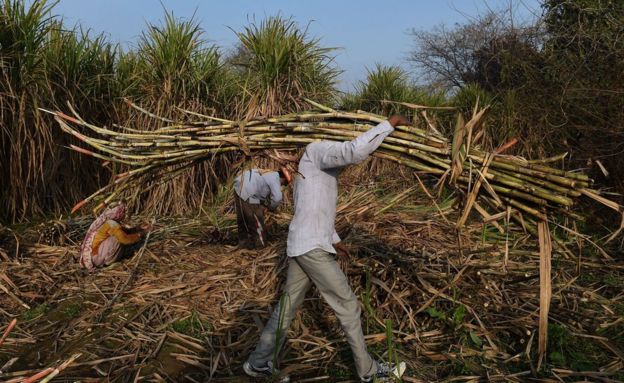
An Indian farmer carries sugarcane to load on a tractor to sell it at a nearby sugar mill in Modinagar in Ghaziabad, some 45km east of New Delhi, on January 31, 2018Image copyright AFP
Image caption India’s agrarian crisis is a major stumbling block

Ornamental tax and other fiscal incentives to specific industries are not suddenly going to make Indian manufacturers competitive and stop India’s addiction for affordable Chinese goods. If any, the trade spat between China and the United States only saw countries such as Vietnam and Bangladesh benefit and not India.

More currency or trade tariffs are not the solutions either. The central bank has lowered interest rates and there is some push to lowering the cost of capital for industry. But again, Indian industry will invest more only when demand for goods and services increases. And demand will increase only when wages increase, or there is money in the hands of people.

So, the only immediate solution for India seems to be to boost consumption through a stimulus given directly to people, in the classical Keynesian mould.

Of course, such a stimulus should be combined with reforms to boost business morale and confidence.

In sum, India’s economic picture is not pretty.

It is important for India’s political leadership to see this not-so-pretty picture and not hide behind rose tinted glasses. Prime Minister Modi has a unique electoral mandate to embark on bold moves to truly transform the economy and pull India out of the woods.

Source: The BBC

11/05/2019

Premier Li underlines tax cuts to benefit enterprises, boost market vitality

CHINA-BEIJING-LI KEQIANG-SYMPOSIUM ON TAX CUTS (CN)

Chinese Premier Li Keqiang, also a member of the Standing Committee of the Political Bureau of the Communist Party of China (CPC) Central Committee, presides over a symposium on the implementation of reducing taxes and fees in Beijing, capital of China, May 10, 2019. Vice Premier Han Zheng, also a member of the Standing Committee of the Political Bureau of the CPC Central Committee, attended the symposium. (Xinhua/Pang Xinglei)

BEIJING, May 10 (Xinhua) — Chinese Premier Li Keqiang on Friday called for more efforts to implement tax and fee cuts in a bid to let enterprises enjoy concrete benefits and further boost the vitality of market entities.

Li, a member of the Standing Committee of the Political Bureau of the Communist Party of China (CPC) Central Committee, made the remarks at a symposium on the implementation of reducing taxes and fees.

Larger-scale tax and fee reductions are a key measure to improve the business environment and boost the vitality of market entities, which not only contribute to steady economic growth and stable employment but also encourage enterprises to increase investment on innovation and enhance competitiveness, Li said.

As a key task for this year, tax and fee cuts have been carried out and are proceeding as expected, Li said, demanding more efforts to ensure the complete implementation of related policies.

At the meeting, several entrepreneurs shared their opinions and made suggestions on tax and fee reductions.

The tax burden for the manufacturing sector should be lowered significantly and industries which create many jobs such as construction should also see tax reductions.

Li urged efforts to ensure the tax burden for all industries is lowered and micro and small enterprises should see a substantive reduction of their tax burden.

Measures, including stricter market supervision, will be taken to guarantee the effects of tax and fee cuts.

Besides tax and fee-reduction policies, China plans to unveil more measures to deepen reform and opening-up, encourage entrepreneurship and innovation as well as foster fair competition to withstand economic hardship amid downward pressure, he said.

Vice Premier Han Zheng, also a member of the Standing Committee of the Political Bureau of the CPC Central Committee, attended the symposium.

Source: Xinhua

06/03/2019

China’s February exports seen falling most in 2 years, imports down again – Reuters Poll

BEIJING (Reuters) – China’s exports likely contracted in February after a surprise bounce in January, while imports fell for a third straight month, a Reuters poll showed, heightening anxiety over whether Washington and Beijing can resolve deep differences over trade.

China’s exports in February are expected to have fallen 4.8 percent from a year earlier, according to the median estimate of 32 economists in a Reuters poll, following a 9.1 percent rise in January.

Such a drop would be the biggest since December 2016, and suggest a further weakening in global demand.

Imports in February are expected to have fallen 1.4 percent from a year earlier, compared with the previous month’s 1.5 percent decline.Stronger-than-expected imports could prompt some China watchers to say the economy is showing signs of bottoming out in response to a string of stimulus measures in 2018.

But most analysts typically caution that China’s data early in the year can be highly distorted by the timing of the Lunar New Year holidays, when some business rush out shipments or scale back output before shutting for a extended break. As such, analysts’ estimates for February varied widely.

TRADE DEAL NOT A SILVER BULLET

In recent weeks, the United States and China appear to have moved closer to a trade deal that would roll back tit-for-tat tariffs on each others’ goods, with Beijing making pledges on structural economic changes, a source briefed on negotiations said on Sunday.

But President Donald Trump will reject any pact that is not perfect, Secretary of State Mike Pompeo said this week.
Even if concrete steps such as dismantling tariffs are agreed, it would not be a panacea for all of China’s economic woes. Its exporters would have to piece supply chains back together, win back market share and contend with slowing demand globally.
Factory surveys have suggested exports and imports will remain weak in coming months, with February’s official gauge showing export orders fell to their weakest level since the global financial crisis.
China’s overall trade surplus is seen to have shrunk sharply to $26.38 billion in February from $39.16 billion the previous month, according to the Reuters poll.
In response to growing domestic and global pressure, China’s government this week unveiled a 2019 economic growth target of 6.0-6.5 percent, down from an actual 6.6 percent in 2018, the slowest pace in nearly 30 years.
China to slash taxes, boost lending to prop up slowing economy
Premier Li Keqiang told parliament on Tuesday that China will shore up the economy through billions of dollars in additional tax cuts and infrastructure spending, and will lower real interest rates.
“A set of pro-growth measures are planned despite positive progress in U.S.-China trade talks, which makes us think that either China doesn’t have full confidence in a trade truce or that the damages from the trade conflict cannot easily be undone,” said Iris Pang, Greater China economist at ING.
Source: Reuters
12/01/2019

China’s premier says tax cuts support employment, economic stability

SHANGHAI (Reuters) – China’s plans for tax cuts targeting smaller companies will help to support employment and economic stability, and will expand the country’s tax base over the long term, Premier Li Keqiang was quoted as saying on Saturday.

“Implementing tax cuts for small and micro enterprises is mainly to support employment,” Li said in comments posted on the Chinese government’s website.

Developing and strengthening small companies is linked to economic stability and stable employment, he said.

“Looking at the long term, this will continue to expand the tax base, conserve tax resources and ultimately achieve wins for mass employment, corporate profits and fiscal revenues,” he was quoted as saying, referring to the corporate tax cuts.

Li’s comments come amid growing official concern over China’s slowing economic growth and its impact on the labour market.

Chinese authorities plan to set a lower economic growth target of 6 to 6.5 percent in 2019, compared with “around” 6.5 percent in 2018, sources told Reuters, as weakening domestic demand and a damaging trade war with the United States drag on business activity and consumer confidence.

Analysts expect that China’s economy grew around 6.6 percent last year, its slowest pace since 1990, and it is expected to cool further in coming months before a slew of support measures start to kick in.

“The bottom line for the policymakers is social stability, which is crucially tied to the unemployment rate and job creation,” analysts at BoAML said in a recent note. “With U.S.-China trade risks still looming large, we believe policymakers would not hesitate to take pre-emptive measures to stabilise expectations on job stability.”

More growth boosting steps are expected this year as policymakers seek to avert the risk of a sharper slowdown.

China’s State Council, or cabinet, said on Jan. 9 that it would further reduce taxes for smaller companies. On Friday, Finance Minister Liu Kun said authorities would step up tax and fee cuts to lower corporate burdens.

12/01/2019

Larger tax cut in pipeline, says China’s finance minister

BEIJING, Jan. 11 (Xinhua) — China is mulling tax reductions on a larger scale this year to bring down the burden on the real economy and improve market confidence, Minister of Finance Liu Kun has said.

Liu said in an interview on Thursday that the tax cut in the pipeline would be inclusive, simple and practical, and be implemented at an early date.

His remarks came on the heels of a new batch of tax breaks for small and micro firms, which comprised of lower tax rates, higher tax thresholds and favorable policies for investors of tech startups.

“Some 17.98 million businesses in China are covered by the inclusive tax reduction, accounting for more than 95 percent of the total corporate taxpayers and with 98 percent of them privately owned,” Liu said.

China will also step up efforts to push forward value-added tax reform for substantive tax cuts, implement special individual income tax deductions, and ease the business burden from social insurance payments, Liu said.

With intensive tax breaks, China is estimated to save a total of 1.3 trillion yuan (nearly 200 billion U.S. dollars) for market entities in 2018, outshining similar moves by any other countries in terms of scale and ratio to GDP.

While persisting in tax cuts, China will take bolder and more effective measures to implement proactive fiscal policy, Liu said.

“The fiscal expenditure will be improved moderately according to the economic situation and demand, and there will be a relatively substantial increase in the issuance of special-purpose local government bonds to support projects under construction and fix shortcomings,” Liu said.

China will make fiscal funds more effective and channel more capital into weak areas including poverty relief, agriculture, innovation and environmental protection, Liu said, adding that the general government spending would be cut by more than 5 percent.

Liu denied concerns about massive stimulus and stressed that the measures were counter-cyclical, aimed to strike a balance between stable growth and risk prevention, and would be more market-oriented and law-based.

China has assigned 1.39 trillion yuan worth of bonds to local governments, which Liu said would be used to finance the development of poor areas and major projects of railways, water conservation and rural revitalization.

Law of Unintended Consequences

continuously updated blog about China & India

ChiaHou's Book Reviews

continuously updated blog about China & India

What's wrong with the world; and its economy

continuously updated blog about China & India