Archive for ‘3d printing’

13/01/2019

China’s first 3D-printed footbridge opens in Shanghai

  • Developer says 15-metre span is an example of the many possibilities of the new technology
  • Sturdy design means bridge is strong enough to support four adults per square metre, engineer says

PUBLISHED : Sunday, 13 January, 2019, 7:03pm
UPDATED : Sunday, 13 January, 2019, 7:03pm

The span, which opened for business on Friday, was created by Shanghai Machinery Construction Group using materials made by Polymaker, the state-run China News Service reported.

“It’s both an everyday, practical application and an interactive one that involves people touching and even relying upon … a 3D printed thing,” Polymaker said on its website.

“Many people have never touched a 3D printed object and they still think of it as part fantasy and part future tech, so projects like this do a lot of good in terms of exposing the public to the reality and the possibilities of 3D printing,” it said.
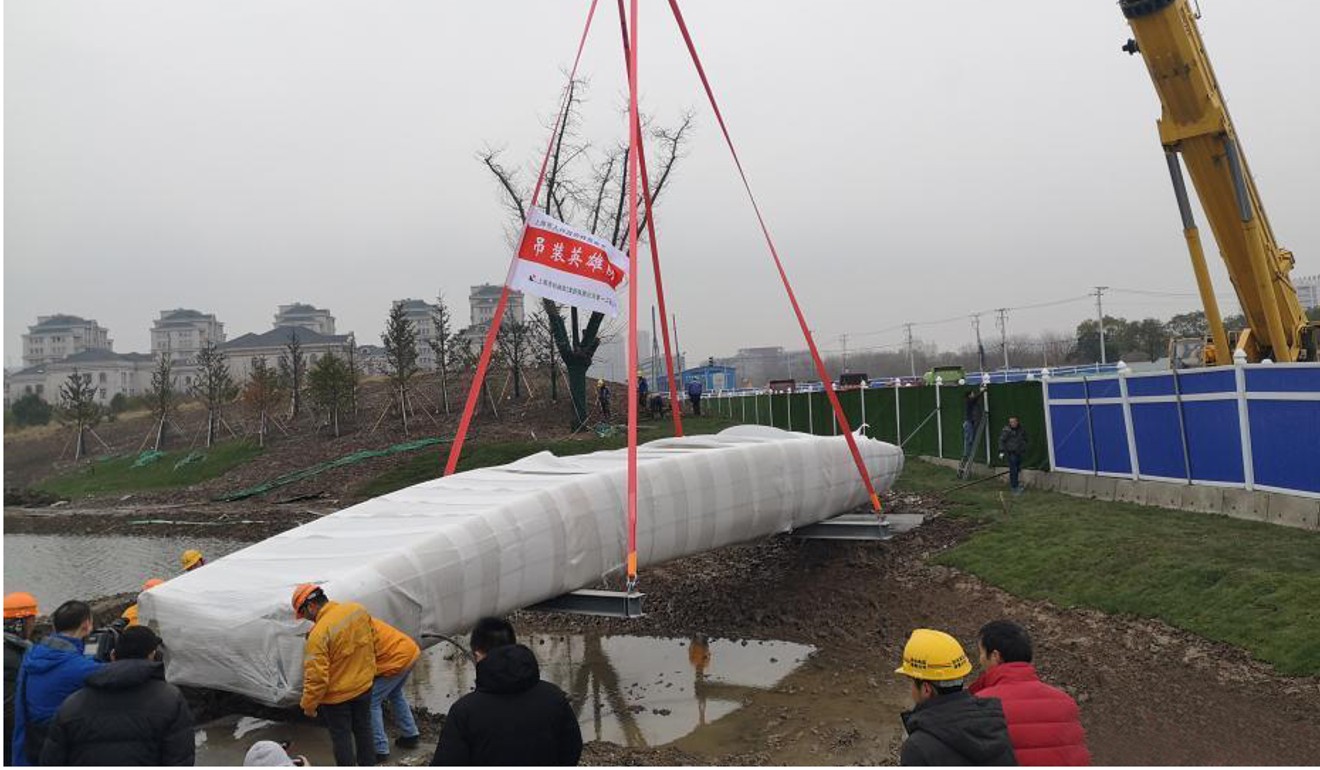
The footbridge, which engineers said should last about 30 years, was installed over a narrow creek at the Taopu Smart City complex in Shanghai’s Putuo district, the news report said.
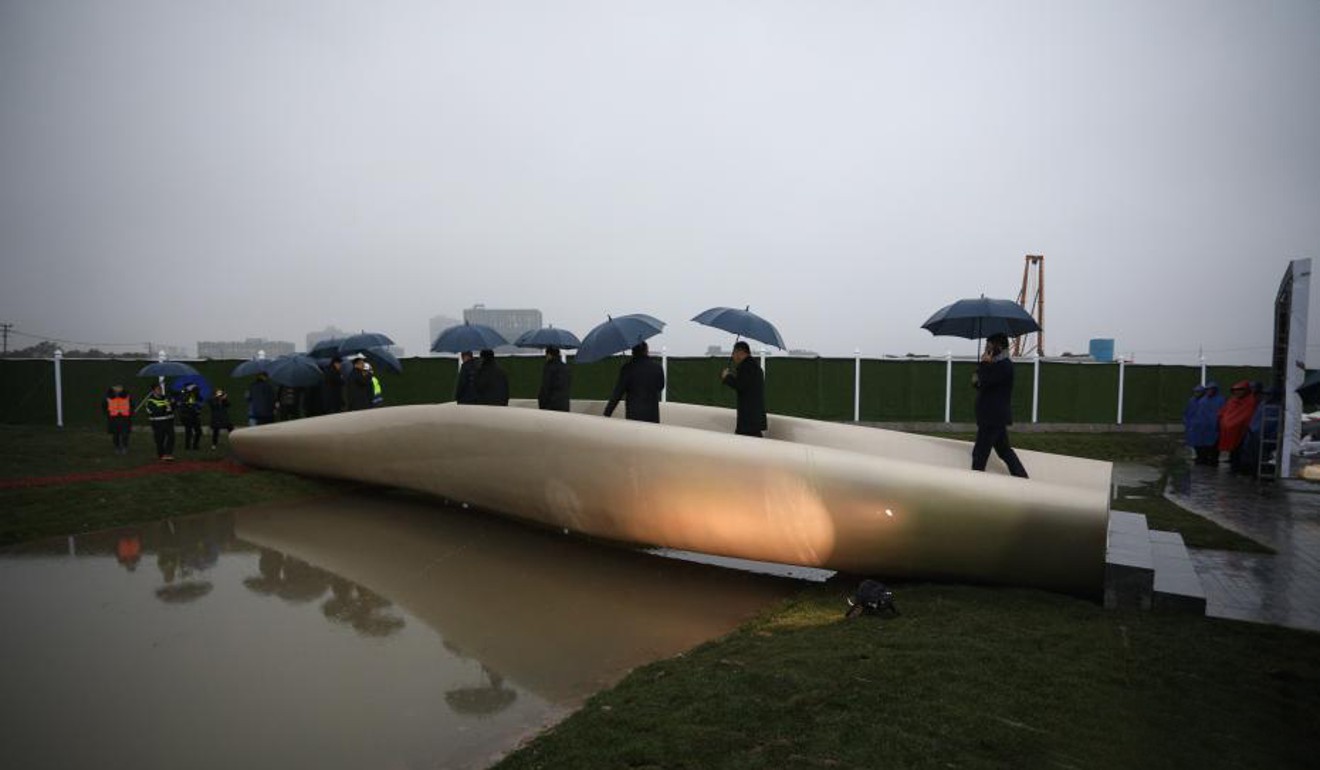
On its website the Shanghai government described the new bridge as an “innovative way to promote 3D printing technology and popularise it in urban construction”.

Polymaker said the machine used to print the bridge, which is 3.8 metres wide, 1.2 metres deep and about 5,800kg (12,800lbs) in weight, cost US$2.8 million.

The span was made as a single piece from a combination of glass fibre and a printable plastic filament known as acrylonitrile styrene acrylate, it said.
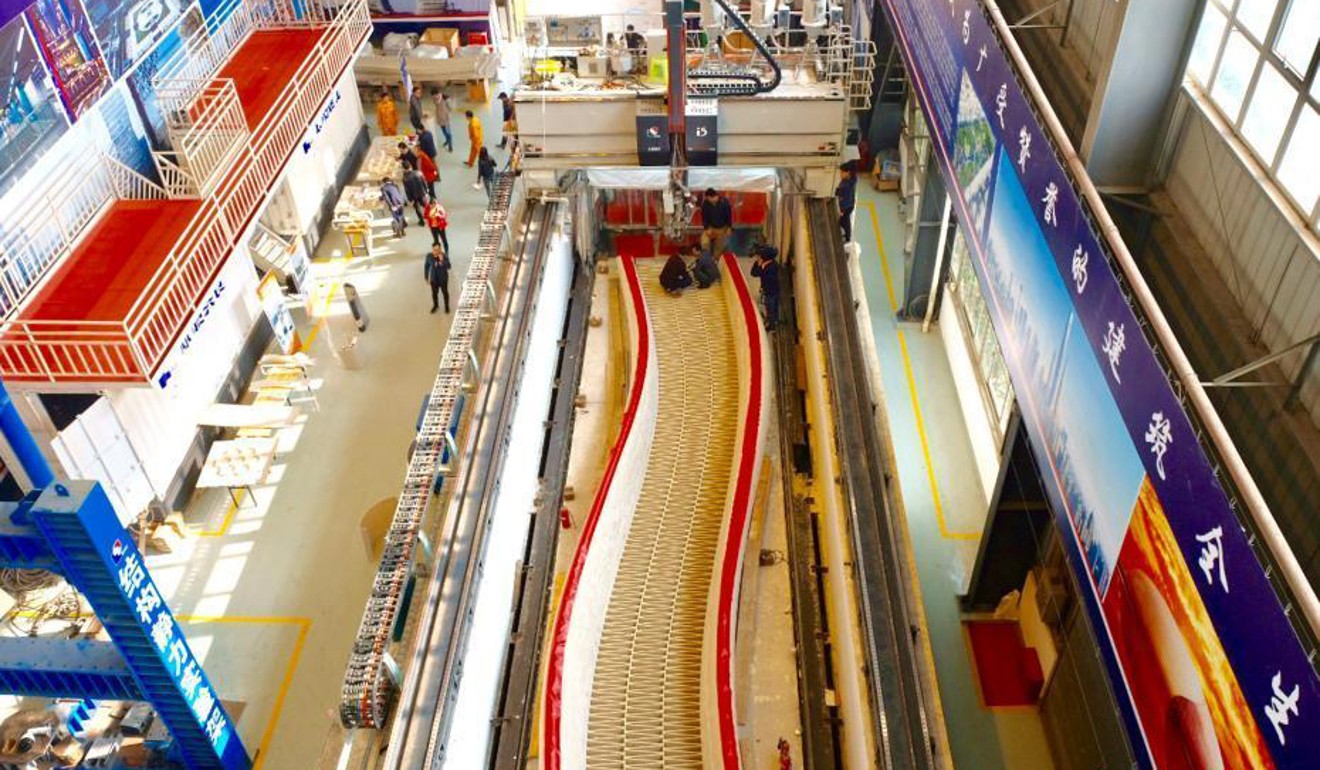
A separate report by Xinming Evening News quoted an engineer as saying the bridge was capable of bearing a load of 250kg per square metre, or about the weight of four adults.

Before starting the printing process, the build team spent 18 months in research and planning, it said.

While the Shanghai bridge is the first of its kind in China, it is not a world first in terms of 3D printing.

That honour goes to a 12-metre walkway installed at a park in Madrid in 2017, while a 3D-printed steel bridge was unveiled in the Netherlands in October.

30/08/2014

Houses in Shanghai are not built, they’re printed[1]- Chinadaily.com.cn

A Chinese company recently built 10 full-sized houses using a giant printer.

Houses in Shanghai are not built, they're printed

The detached, one-story houses now standing in the Shanghai Hi-Tech Industrial Park, in the city’s Qingpu district, look like ordinary buildings. But they were “printed out” in less than a day with “contour crafting“, commonly known as 3-D printing technology.

‘Mirror’ perfect fit for shoppers  Four huge printers measuring 32 meters long, 10 meters wide and 6.6 meters tall were used to make the houses, which were built layer by layer.

“It’s not only cost-effective but also environmentally friendly,” said Ma Yihe, inventor of the printers, who is also president of the Shanghai Winsun decoration and design company.

“Unlike traditional construction, the new technology doesn’t produce any waste,” said Ma, who has been working in the 3-D printing construction industry for 12 years.

The materials used to make the houses are a mixture of quick-drying cement and recycled industrial waste, which help lower construction costs by up to 50 percent. For the moment, the company is keeping the recipe for the cement a secret.

Meanwhile, the houses can withstand just about any safety test, Ma said.

via Houses in Shanghai are not built, they’re printed[1]- Chinadaily.com.cn.

27/06/2014

China’s Maker Movement Gets Government Support for DIY Workshops – Businessweek

On a Wednesday night in late May, about 60 people assembled in a warehouse in downtown Shanghai for a presentation on how to make mini sports cameras like the popular GoPro (GPRO). The meeting was organized by XinCheJian, one of China’s first hackerspaces, which offers workshops for participants interested in design and technology to create everything from robots to smartphone apps.

A 3D printer makes a miniature chair during the China International Technology Fair in Shanghai on May 8, 2013

The weekly gatherings attract 30 to 150 people and offer them a way to share ideas, skills, and inspiration. After attending a meeting in 2012, Rockets Xia, an environmental advocate with a Chinese nongovernmental organization, was so impressed by a 3D printing demonstration that he quit his job and went to work for DFRobot, a Shanghai-based company that makes robotics kits and other hardware for hobbyists.

The popularity of XinCheJian, which means “new factory,” is a sign of China’s joining the growing maker movement—what former Wired editor Chris Anderson in his 2012 book Makers described as the “third industrial revolution,” in which entrepreneurs use open-source design, 3D printing, and crowdfunding to manufacture goods on their own. In China, 30 independent hackerspaces, including XinCheJian, have opened across the country.

via China’s Maker Movement Gets Government Support for DIY Workshops – Businessweek.

15/04/2014

How a Chinese Company Built 10 Homes in 24 Hours – China Real Time Report – WSJ

Chinese companies have been known to build major real-estate projects very quickly. Now, one company is taking it to a new extreme.

Suzhou-based construction-materials firm Winsun New Materials says it has built 10 200-square-meter homes using a gigantic 3-D printer that it spent 20 million yuan ($3.2 million) and 12 years developing.

Such 3-D printers have been around for several years and are commonly used to make models, prototypes, plane parts and even such small items as jewelry. The printing involves an additive process, where successive layers of material are stacked on top of one another to create a finished product.

Winsun’s 3-D printer is 6.6 meters (22 feet) tall, 10 meters wide and 150 meters long, the firm said, and the “ink” it uses is created from a combination of cement and glass fibers. In a nod to China’s green agenda, Winsun said in the future it plans to use scrap material left over from construction and mining sites to make its 3-D buildings.

Winsun says it estimates the cost of printing these homes is about half that of building them the traditional way. And although the technology seems efficient, it’s unlikely to be widely used to build homes any time soon because of regulatory hurdles, Mr. Chen said.

The Chinese firm isn’t the first to experiment with printing homes. Architects in Amsterdam are building a house with 13 rooms, with plans to print even the furniture. The Dutch architect in charge of the project said on the project’s website it would probably take less than three years to complete.

via How a Chinese Company Built 10 Homes in 24 Hours – China Real Time Report – WSJ.

Enhanced by Zemanta
15/07/2013

Hello 3D printing, goodbye China

If the following article’s predictions do come true, then the world economy as we know it will be destroyed as the unintended consequence. No trucks, freight trains, container ships, no major manufacturing facilities, no major hub warehouses. No truck and freight train drivers, no container ship crews, no depot warehousemen. No truck, freight train, container ship manufacturers; less construction workers and companies. And there will be further knock-on effects. I wonder …

Sunday Times: “A SPECTRE is haunting the great container ship ports of China, with their highways jammed by lorries and the vast factory estates stretching from the coast of the South China Sea to the mountainous inland provinces.

Cheap Chinese labour could be made redundant by 3D printers (Chu Yang)

It is the spectre of a revolution led by a quiet, software-driven 3D printer, a machine that can laser up layers of liquid or granular resin — or even cell tissue — into a finished product.

Some 3D printers are huge devices that make complete components such as aircraft parts. Others are small units that could stand next to a desk and create a small plastic prototype.

Maplin, the British electronics retailer, said last week it would start selling one for just £700. The Velleman K8200 will allow those who are so inclined to make simple objects — mobile phone covers, perhaps, or toys.

“The only restriction is your imagination. You can make whatever you want,” said Pieter Nartus, export manager at Velleman.

To visionaries in the West, the digital 3D printer promises to disrupt conventional manufacturing and supply chains so radically that advocates compare its impact to the advent of the production line, or the internet.

In China, whose big factories are thinking of using giant 3D printers for manufacturing, the technology does not seem to pose an immediate threat.

“It is on their horizon but it is not a factor right now,” says a British buying agent who sources plastics in China.

However, as Chinese leaders ought to know from their compulsory classes in Karl Marx, control of the means of production is everything. And if 3D printing takes off, production will come back to a place near you.

The implications, economists say, are limitless. No huge factories. No fleets of trucks. No ships. No supply chain. No tariffs. Few middlemen. Orders tailored exactly to demand, so no need for stock and warehouses. Just a printer, raw materials, software and a design.

The advantages do not end there. Because the item is “sintered” — created from a powdered material — to precise settings using a laser, there is no waste such as metal shavings. To customise a product, the user simply changes the software. An operator presses a button and the printer spits out the item.

“The first implication is that more goods will be manufactured at or closer to their point of purchase or consumption,” said Richard D’Aveni, a professor at Dartmouth College in America.

Writing in the Harvard Business Review, D’Aveni predicted the elimination of the long supply chain linked to a huge factory staffed by cheap workers and sited on the other side of the world.

It may be the most significant, if underplayed, article in that distinguished publication in decades.

via Hello 3D printing, goodbye China | The Sunday Times.

24/02/2013

* China commercializes 3D printing in aviation

ZDNet: “China looks to lower the cost of 3D printing and make large titanium components to build the next-gen fighter jet and self-developed passenger plane.

63494380232763359210

By using laser additive manufactured titanium parts in its aviation industry, China is looking to become a global leader in commercializing 3D printing technology.

The laser additive manufacturing technology not only lowers the cost of titanium parts to only 5 percent of the original, it also reduces the weight of the components and enhances the strength of complicated parts.

As much as 40 percent of the weight can be reduced if the forged titanium parts on an American F-22 were made using the Chinese 3D printing technology, according to a a report on Chinese Web site, Guancha Zhe.

With funding from the government, especially from the military, the Chinese aviation laser technology team is making headways in making titanium parts for the country’s fifth generation of fighter jets, the J-20 and J-31, by lowering the cost and raising the jets’ thrust-weight ratio.

The Northwestern Polytechnical University of China is also making five meter-long titanium wing beams for the C919 passenger plane, which is scheduled to be put into commercial operation in 2016.

“As the aviation technology develops, the components are also getting lighter, more complicated, and also need to have better mechanical properties,” said Huang Weidong, director of the university’s laboratory, to a local newspaper. “It is very hard to use traditional technologies to make such parts, but 3D printing could just meet such demands.”

via China commercializes 3D printing in aviation | ZDNet.

Law of Unintended Consequences

continuously updated blog about China & India

ChiaHou's Book Reviews

continuously updated blog about China & India

What's wrong with the world; and its economy

continuously updated blog about China & India