Archive for ‘AI’

08/04/2020

Internet giant Tencent pledges to invest in Wuhan as city emerges from coronavirus lockdown

  • Wuhan, where the first cases of the novel coronavirus were detected, is ending a 76-day lockdown
  • A day before the lockdown was fully lifted, Tencent announces a slew of initiatives focused on helping to revive the digital industry in the city
Passengers leaving Wuhan city are pictured at the Hankou Railway Station in Wuhan city, central China's Hubei province, on Wednesday morning, April 08, 2020. Photo: SCMP/Simon Song
Passengers leaving Wuhan city are pictured at the Hankou Railway Station in Wuhan city, central China’s Hubei province, on Wednesday morning, April 08, 2020. Photo: SCMP/Simon Song
A day before China lifted a months-long lockdown of Wuhan city, the initial epicentre of the coronavirus pandemic, Chinese internet giant Tencent Holdings pledged to invest in digital government, online education and artificial intelligence (AI) in the city, among other fields.
“During the epidemic, Tencent has been supporting Hubei and Wuhan’s fight against the virus through funds and technology,” the company best known for its gaming business said in a statement posted on Tuesday on WeChat. “In the future, we will also fully support Wuhan’s post-pandemic reconstruction and continue to support the development of Wuhan’s digital industry.”
China’s major tech companies have played a big role in the fight against the coronavirus, and are now playing their part in the economic recovery of Wuhan and other areas that have suffered under extended travel restrictions and business closures.
Last week, China’s biggest e-commerce services providers Alibaba Group Holding
JD.com

and Pinduoduo each announced their own initiatives to help revive sales of farm goods from Hubei as the province emerges from its months-long lockdown.

Popular mobile payments app Alipay also created a dedicated section for Wuhan merchants to allow users to buy from merchants in the city, and offered loans to small local merchants in need of financial support, according to an Alipay statement. Alipay is operated by Ant Financial, an affiliate of Alibaba, which owns the South China Morning Post.
How tech has helped China in its public health battle with coronavirus
23 Mar 2020

Wuhan, an industrial powerhouse for the steel, semiconductors and automotive sectors, is emerging from an unprecedented lockdown which began on January 23 and prevented people from moving in and out of the city.

Since restrictions began easing gradually in late March, business activity has shown signs of recovery: Tencent’s mobile payment platform WeChat Pay recorded a 162 per cent increase in offline transactions in a 10-day period from March 25, compared to the same period the previous month, according to a separate statement by Tencent on Wednesday.

Searches for “work resumption certificates” – which businesses need to submit to local authorities to prove their staff can safely restart work – also increased 320 per cent on Baidu, China’s biggest search engine, in the past month, Baidu said in a report on Wednesday.

Tencent declined to provide specific details regarding the size of its latest investment in Wuhan or a timeline for its implementation, but said in the statement that it will involve closer cooperation with city authorities in the areas of digital government, education, smart mobility, AI and cybersecurity to help the city with its digital industries.

Among these initiatives, it will push ahead with a plan to build a headquarters focusing on digital industries in Wuhan, specifically digitalisation for the government and smart city initiatives.

It will also establish a base in Wuhan for its online education initiatives, set up an AI lab and cybersecurity academy and build a school focusing on smart mobility in collaboration with Chinese carmaker Dongfeng Motor Corporation, the company said in the statement.

Source: SCMP

22/12/2019

Economic Watch: Smart economy fledging in China as AI empowers industries, individuals

BEIJING, Dec. 21 (Xinhua) — Ask the silver-haired residents of the elderly care community Yinheyuan in central Beijing what they know about artificial intelligence (AI), and they will probably throw the question to the smart speakers within their reach.

These smart speakers, capable of interacting with users with voice-recognition technologies, are also part of the answer. Via voice command, senior residents can control lights, TVs and other home appliances, order food or ask for help.

AI is no longer a technical term used exclusively by professionals in China. Both young and old are enjoying the benefits of the growing smart economy.

After personal computers (PC), PC internet and mobile internet, the growth focus of China’s digital economy is shifting to smart technologies like AI, said Baidu Chairman and CEO Robin Li at the World Internet Conference in October.

In the smart economy era, Li predicted a declining reliance on cellphones and a rising popularity of other smart devices. AI chips, cloud computing services, among others, would become the new digital infrastructure, while innovative businesses will flourish as transport, health, education and other sectors go smart.

Wearable devices, smart home appliances, autonomous driving and smart cities are among the fastest-growing fields in the smart economy.

China is the largest smart speaker market in the world, accounting for 36 percent of global shipments in the third quarter of 2019, according to global market firm Strategy Analytics. It found in a July and August survey that 63 percent of Chinese people without a smart speaker planned to buy one within the following year. Another 22 percent planned to make a purchase later on.

Chinese firms are stepping up investment in 5G, AI and the Internet of Things to gain a foothold in the emerging field. By end-June, China had over 1,200 AI-related enterprises, according to the Ministry of Industry and Information Technology.

Baidu launched its autonomous driving open platform ApollBo in 2017 to coordinate cross-sector efforts in this field. It has launched several L4 autonomous driving vehicles in partnership with leading automobile companies, and a fleet of Apollo-powered robotaxis are now taking test runs in central China’s Changsha.

Nurturing a smart economy is also on the government agenda. China has passed a guideline to boost the integration of AI and the real economy this year, and plans to build some 20 national AI innovative development pilot zones by 2023.

The country’s AI sector is forecast to be worth more than 160 billion yuan (about 22.83 billion U.S. dollars) in 2020, spurring related sectors to exceed 1 trillion yuan, said Lin Nianxiu, deputy director with the National Development and Reform Commission, citing industrial data.

Lin said China would focus on 100 firms dedicated to AI technologies and relevant applications, improve the industrial ecosystem, facilitate the deep integration of AI and the real economy, and intensify its international collaboration on AI technology, standards, industries, laws and regulations and ethics.

Source: Xinhua

17/12/2019

Beijing’s hopes for AI dominance may rest on how many US-educated Chinese want to return home

  • This is the third instalment in a four-part series examining the brewing US-China tech war over the development and deployment of artificial intelligence tech
  • The US is home to five of the world’s top 10 universities in the AI field, which includes computer vision and machine learning, while China has three
For those Chinese with long-term plans to stay in the US, a major obstacle lies in getting work visas, especially in the current trade war environment. Illustration: Perry Tse

After working in the United States for more than a decade, Zheng Yefeng felt he had hit a glass ceiling. He also saw that the gap in artificial intelligence between China and the US was narrowing.

Last year Zheng, who worked as a researcher at Siemens Healthcare in New Jersey, made a decision that addressed both problems. He accepted an offer to head up the medical research and development team at Tencent’s YouTu artificial intelligence lab in Shenzhen, known as China’s Silicon Valley.

“There was almost no room for promotion if I stayed in the US,” he said, expressing a common dilemma faced by experienced Chinese tech workers in America.

With the US-China trade war leading to tighter scrutiny of Chinese nationals working in the US tech industry, people like Zheng are moving back to China to work in the burgeoning AI sector, especially after Beijing designated AI a national priority. The technology’s varied applications have attracted billions of dollars of venture capital investment, created highly valued start-ups like SenseTime and ByteDance, and sparked a talent war among companies.

That has created an odd symbiotic relationship between the two countries vying for AI supremacy. The US, with its superior higher education system, is the training ground for Chinese AI scientists like Zheng, who obtained a PhD from the University of Maryland after earning bachelor’s and master’s degrees at China’s premier Tsinghua University.

“Many professors in China have great academic ability, but in terms of the number [of top professors], the US is ahead,” said Luo Guojie, who himself accepted an offer from Peking University to become an assistant professor after studying computer science in the US.

Among international students majoring in computer science and maths in US universities, Chinese nationals were the third largest group behind Indians and Nepalese in the 2018-2019 academic year, representing 19.9 per cent, according to the Institute of International Education.

[To build] the best universities is not easy. The university is a free speech space, whereas in China, this is not the case Gunther Marten, a senior official with the European Union delegation to China

The South China Morning Post spoke with several Chinese AI engineers who decided to stay and work in the US after their studies. They only agreed to give their surnames because of the sensitivity of the issues being discussed.

A 25-year-old Beijinger surnamed Lin graduated from one of China’s best engineering schools in the capital before heading to a US university for a master’s degree in computer science in 2017. Like some of his peers, he found the teaching methods in China to be outdated.

“It’s hard to imagine that a final exam of a coding course still asked you to hand write code, instead of running and testing it on a computer,” said Lin, who now works as a software engineer for Google in Silicon Valley.

“Although we still had to take writing tests [in the US], we had many practical opportunities in the lab and could do our own projects,” he added.

A Facebook software engineer surnamed Zhuang had a similar experience at his university in Shanghai.

“Many engineering students [in China] still get old-school textbooks and insufficient laboratory training,” he said. “Engineering practices for AI have been through a fast iteration over the past few decades, which means many Chinese students are not exposed to the most updated knowledge in the field, at least not in the classroom.”

Zhuang also noted out that many classes in China are taught in Chinese, meaning engineering graduates are not fluent in English, the preferred language of the global AI research community.

The US is home to five of the world’s top 10 universities in the AI field, which includes computer vision and machine learning, while China has three. Carnegie Mellon University (CMU) in Pennsylvania ranks No 1 while China’s Tsinghua University is No 2, according to CSrankings, which bases the list on papers published since 2009.

US tech chief: China is threatening US’ lead in global AI race
With its top institutions and an open culture that encourages freedom of speech, including unfettered internet access, the US has become a magnet for the brightest AI students the world over.
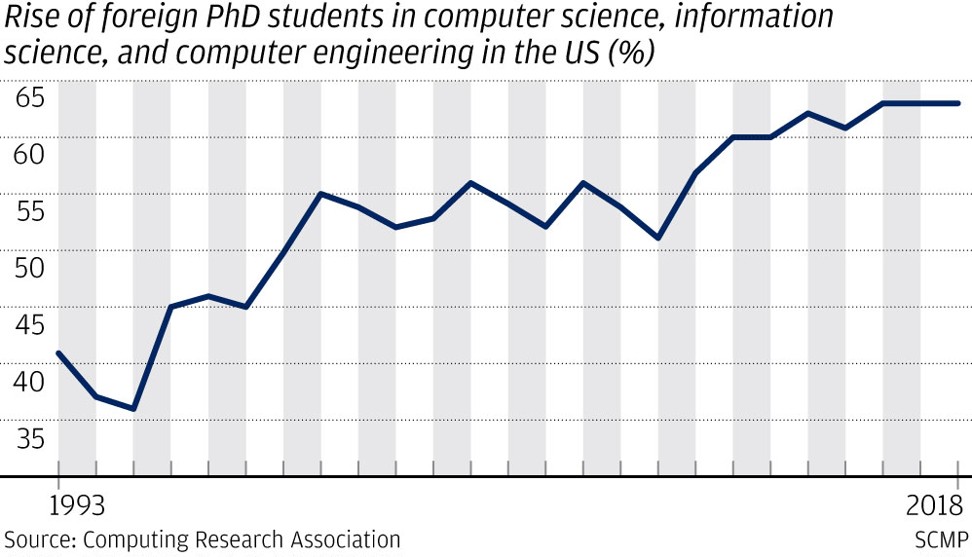
In 2018, 62.8 per cent of PhD degrees and 65.4 per cent of master’s degrees in computer science, information science and computer engineering programmes in the US were granted to “non-resident aliens”, according to a survey by the Computing Research Association.
“[To build] the best universities is not easy,” Gunther Marten, a senior official with the European Union delegation to China, said on the sidelines of the World Internet Conference in Wuzhen in October. “The university is a free speech space, whereas in China, this is not the case.”

When these US-educated AI scientists finish studying, most take advantage of a rule allowing them to stay in the country for three years to gain work experience.

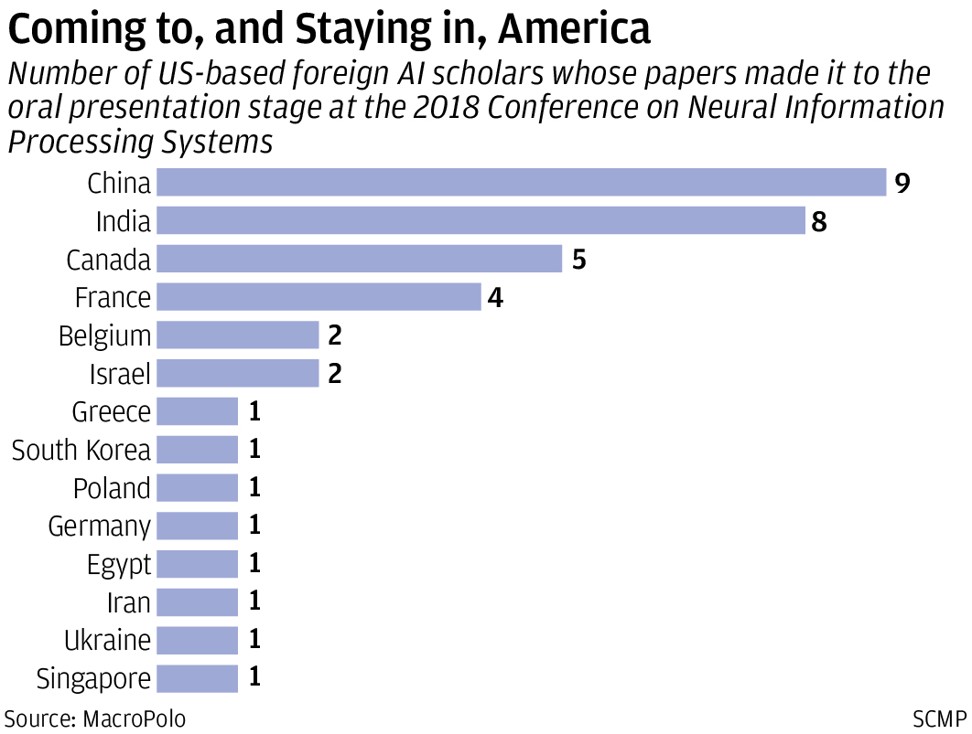
Of the foreign nationals taking part in last year’s Conference on Neural Information Processing Systems (NIPS), a major machine learning event for AI professionals, 87 per cent of those whose papers made it to the oral presentation stage went to work for American universities or research institutes after earning their PhD, according to MacroPolo, a think tank under the Paulson Institute.

“China has many great universities and companies, especially in certain subfields of AI such as computer vision, but many people remain hesitant to move to China due to the political environment, quality of life concerns and workplace issues,” said Remco Zwetsloot, a research fellow at Georgetown University’s Center for Security and Emerging Technology (CSET).

China’s PhD students miserable, yet hopeful: survey

Some of the US-trained Chinese AI engineers told the Post they were scared off by China’s “996” working culture: 9am to 9pm, six days a week. Tech firms in China typically expect their employees to work long hours to prove their dedication.

Lin, the Beijinger who now works for Google, used to be an intern at one of China’s largest internet giants. “I worked from the time I woke up until going to bed,” he said, “At Google, I’ve been confused because many people here only work till 5pm but Google is still a global leader.” Lin said he would be happy to return to China if the 996 work culture eases.

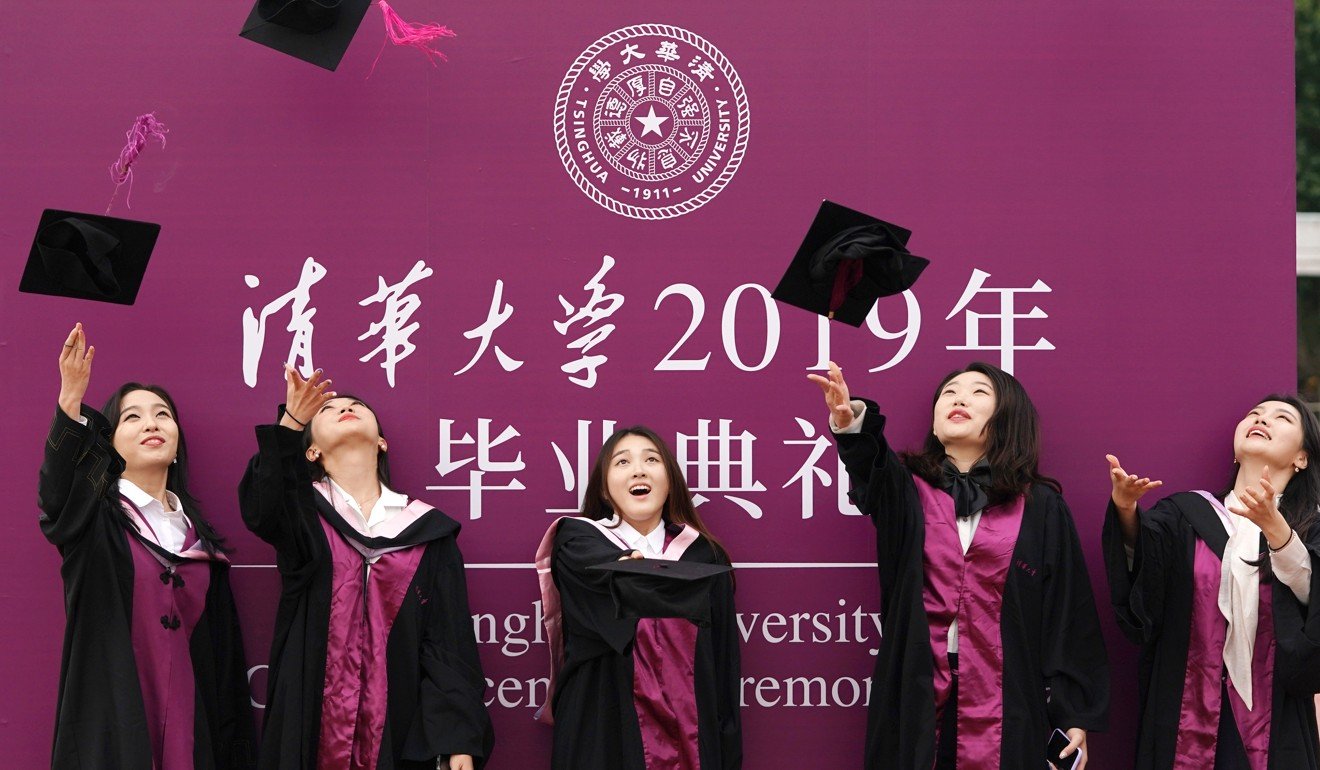
Graduates throw their caps in the air as they pose for a group photo during the 2019 commencement ceremony of Tsinghua University in Beijing. Tsinghua ranks as China’s top university for AI. Photo: Xinhua
Chen, a female postgraduate student at Carnegie Mellon, who recently accepted a job offer from Google, once interned at Beijing-based AI unicorn SenseTime, where she worked from 10am to between 8pm and 10pm most days.
A SenseTime spokesperson said the company has adopted flexible working hours for its employees.
Besides a better work-life balance, Chinese graduates look for jobs in Silicon Valley because of the higher pay.
“If you include pre-tax income, many of us get offers that pay more than 1 million yuan (US$142,000) a year but in China the salaries offered to the best batch of fresh undergraduates are about 200,000 to 300,000 yuan (US$28,000 to US$43,000),” Chen said.
Still, for those Chinese with long-term plans to stay in the US, a major obstacle lies in getting work visas, especially in the current trade war environment. Most AI-related workers are on H-1B visas that allow US companies to employ non-US nationals with expertise in specialised fields such as IT, finance and engineering.
However, the number of non-immigrant H-1B visas granted has started to fall since 2016, when it peaked at 180,000, according to the US Department of State, and US tech companies have complained that a policy shift by the Trump administration has made the approval process longer and more complicated.
In 2017, President Donald Trump requested an overhaul of the H-1B visa programme, saying he did not want it to enable US tech companies to hire cheaper foreign workers at the expense of American jobs. He also wants to give priority to highly skilled people and restrict those wanting to move to the US because of family connections.

Science graduates from overseas countries can stay in the US with their student visas for up to three years while competing for the hard to get work visas, which are granted based on undisclosed mechanisms. Overseas students already working in the US can apply for so-called green cards, which offer permanent residency.

After working for a major US tech company for almost three years on a student visa, one Chinese software engineer, who spoke to the Post on condition of anonymity, said she was relocated to the US firm’s Beijing office last year after failing to obtain a H-1B work visa.

“While there might be individual cases, it seems like the current tensions have not – at least as of a few months ago – led to noticeable changes in the overall number of Chinese students staying in the US after graduating,” said CSET’s Zwetsloot.

Some Chinese AI scientists use Twitter to announce their decision to stay. Chen Tianqi, who just obtained a PhD at the University of Washington in Seattle, and Jun-Yan Zhu, a CMU and UC Berkeley alumnus currently working at Adobe, each tweeted that they would join Carnegie Mellon as assistant professors next year.

To achieve the goal of turning China into “the world’s primary AI innovation centre” by 2030, according to a 2017 blueprint issued the State Council, the central government has stepped up efforts to attract US-educated talent.

The Thousand Talents Plan has seen more than 6,000 overseas Chinese students and academics return since its was established in 2008, but because of escalating tensions with the US, Beijing has played down the initiative.

Longer term, Beijing’s willingness to invest significant sums into the AI sector could see more Chinese return for the better employment opportunities. Between 2013 and the first quarter of 2018, China attracted 60 per cent of global investment in AI, according to a Tsinghua University report.

China’s spending on AI may be far lower than people think

Chinese authorities are investing heavily in the sector, with the city of Shanghai setting up a 10 billion yuan (US$142 million) AI fund in August and Beijing city government announcing in April it would provide a 340 million yuan (US$48 million) grant to the Beijing Academy of Artificial Intelligence.

“More and more senior people like me have come back, and some start their own businesses,” said Zheng, the Siemens Healthcare researcher who joined Tencent. “It’s easier for Chinese to seek venture capital in China than in other countries.”

Source: SCMP

10/09/2019

China’s border region to promote AI cooperation with ASEAN

NANNING, Sept. 9 (Xinhua) — South China’s Guangxi Zhuang Autonomous Region on Monday pledged to enhance cooperation with the Association of Southeast Asian Nations (ASEAN) on artificial intelligence (AI).

Chen Wu, chairman of the regional government, said at the First China-ASEAN AI Summit that Guangxi will actively promote technical cooperation, trade, investment and industrial exchange in the AI sector with the ASEAN countries.

Toward this end, the region will speed up the construction of platforms for infrastructure, information sharing and technical cooperation, among others, Chen said.

Guangxi, which boasts both sea and overland links with ASEAN, is building the China-ASEAN Information Harbour to boost digital cooperation with Southeast Asia.

“The summit has sounded the clarion call for the development of AI and big data industry in Guangxi,” said Wang Jingjing, Guangxi regional director of the Chinese AI firm iFlytek.

Hailing the region’s policy and geographical advantages on ASEAN cooperation, Wang said iFlytek hopes to set up an institute on ASEAN languages in Guangxi to facilitate communication between China and ASEAN countries

Source: Xinhua

09/12/2018

China’s core AI industry to exceed 145 bln USD by 2030: report

NEW YORK, Dec. 8 (Xinhua) — The value of China’s core Artificial Intelligence (AI) industries could exceed 1 trillion yuan (145.47 billion U.S. dollars) by 2030, with that of AI-enabled industries more than 10 trillion yuan, a latest report by Bloomberg Intelligence (BI) said.

Titled “China’s great tech leap forward”, the report said that China’s push to commercialize AI technologies, supported by the rollout of the world’s biggest 5G network, could position the country as a global leader for technology and innovation.

“Based on the growth trajectory in the past decade, China may overtake the U.S. in global technology-patents share by 2025,” said the report.

AI-related industries may exceed 6 percent of China’s GDP by 2030, according to the report.

In the report, BI analysts said the country’s abundance of data may fuel the acceleration of the industry.

China’s breakneck pace of consumer-lifestyle digitization potentially gives researchers unique access to Chinese-language data generated by its 1.4 billion people as they go about their daily activities both online and offline.

Vey-Sern Ling, senior industry analyst at Bloomberg intelligence, said China may overtake global peers in the commercialization of AI technologies, as large amount of capital is likely to continue pouring into the industry.

According to Tsinghua University, private funding for Chinese AI-related companies in 2017 totaled 27.7 billion dollars, equivalent to 70 percent of global investments in the industry.

Data showed China’s cumulative venture-capital investments in AI startups had already caught up with the United States by 2016.

Ling, also the lead analyst of the report, said the top-down support is an important factor apart from the multi-faceted user data and the funding available in China to the industry’s fast development.

“I don’t think anywhere else in the world you have the government so strongly behind, identifying the technology pillar and bearing full weight,” said Ling.

He added that China’s potential dominance in AI by 2030 may be led by developments in transportation, corporate services, health care and finance.

02/05/2017

Infosys plans to hire 10,000 U.S. workers after Trump targets outsourcing firms | Reuters

India-based IT services firm Infosys Ltd said it plans to hire 10,000 U.S. workers in the next two years and open four technology centers in the United States, starting with a center this August in Indiana, the home state of U.S. Vice President Mike Pence.

The move comes at a time when Infosys and some of its Indian peers such as Tata Consultancy Services and Wipro Ltd have become political targets in the United States for allegedly displacing U.S. workers’ jobs by flying in foreigners on temporary visas to service their clients in the country.

The IT service firms rely heavily on the H1-B visa program, which U.S. President Donald Trump has ordered federal agencies to review.A

In a telephone interview with Reuters from Indiana, Infosys Chief Executive Vishal Sikka said his company plans to hire U.S. workers in fields such as artificial intelligence.

“When you think about it from a U.S. point of view, obviously creating more American jobs and opportunities is a good thing,” Sikka said.

While Indian outsourcing firms have recruited in the United States, Infosys is the first to come out with concrete hiring numbers and provide a timeline in the wake of Trump’s visa review.

Last month, two industry sources told Reuters that Infosys was applying for just under 1,000 H-1B visas this year. One of the sources said that was down from about 6,500 applications in 2016 and some 9,000 in 2015.Indian IT service firms, which typically flood the lottery system each year with thousands of applications, have been among the largest H1-B recipients annually.

Indian politicians and IT industry heads have been lobbying U.S. lawmakers and officials from the Trump administration to not make drastic changes to visa rules, as this could hurt India’s $150 billion IT service sector.

The 10,000 new U.S. jobs would be a small part of Infosys’ overall workforce of more than 200,000.Sikka said Infosys has already hired 2,000 U.S. workers as part of a previous effort started in 2014.

“We started small at first and have been growing since then,” Sikka said. “The reality is, bringing in local talent and mixing that with the best of global talent in the times we are living in and the times we’re entering is the right thing to do. It is independent of the regulations and the visas.”

The four hubs being set up will not only have technology and innovation focus areas, but will also closely serve clients in sectors such as financial services, manufacturing, healthcare, retail and energy, said Infosys.

The first hub, which will open in Indiana in August 2017, is expected to create 2,000 jobs by 2021, the company said.

Infosys did not disclose the financial impact of its plans. It declined to comment on whether the planned U.S. jobs would account for a large percentage of overall hiring in the coming two years.

Based on Infosys’ recent hiring trends, however, the planned hirings in the U.S. could account for a substantial portion of the company’s net workforce additions over the period.

Infosys, which added nearly 18,000 jobs in 2015, slowed its hiring pace considerably, creating just about 6,000 jobs in 2016 amid market uncertainty caused by Brexit and heightened clamor for tougher U.S. immigration laws that led some U.S. clients to hold-off on new projects.

“Hiring locally is a compulsion and it’s not just because of what’s happening in the U.S.,” said Harit Shah, research analyst at Reliance Securities. “The model itself is not sustainable.”

The company cautioned last month that it would struggle to reach its ambitious $20 billion revenue target by 2020, as the Indian software service sector has been hit by cautious client spending due to a rising protectionist wave globally.

The United States is the largest market for Indian software service companies, but other countries like Australia have also begun to target Indian IT service companies that use temporary visa programs.Shares in Infosys were down less than 1 percent in midday trading in India, following news of the U.S. hiring plans.

Source: Infosys plans to hire 10,000 U.S. workers after Trump targets outsourcing firms | Reuters

27/04/2017

Artificial intelligence: Implications for China | McKinsey & Company

The country is becoming a hub for global AI development. Five priorities can help China harness AI for productivity growth and prepare for the societal shifts it may unleash.

Artificial intelligence, or the idea that computer systems can perform functions typically associated with the human mind, has gone from futuristic speculation to present-day reality. A new discussion paper from the McKinsey Global Institute, originally presented at the 2017 China Development Forum, explores AI’s potential to fuel China’s productivity growth—and to disrupt the nation’s workforce.

Where computer systems once had to be programmed to execute rigidly defined tasks, they can now be given a generalized strategy for learning, enabling them to adapt to new data inputs without being explicitly reprogrammed. Advances in data collection and aggregation, algorithms, and processing power have paved the way for computer scientists to achieve significant breakthroughs in artificial intelligence. AI has now moved beyond the lab, with many machine-learning systems already in commercial use for a wide variety of applications. Adoption is growing rapidly in sectors such as finance, healthcare, and manufacturing.

As its capacity for innovation deepens, China has become one of the leading global hubs for AI development. Recognizing that the nation’s vast population and diverse industry mix can generate huge volumes of data and provide an enormous market, China’s biggest tech companies are making significant R&D investments in AI.

These technologies can dramatically boost productivity—and that could be a crucial capability for China to sustain its future economic growth as the country’s working-age population declines. Automating workplaces with AI could add 0.8 to 1.4 percentage points to GDP growth annually, depending on the speed of adoption. Realizing AI’s economic potential in China also depends on its actual adoption—not just among the technology giants but across China’s traditional industries. Achieving this goal will require building strategic awareness among business leaders, developing technical know-how, and overcoming implementation costs.

But wide adoption of these technologies would represent a profound shift for hundreds of millions of Chinese workers and for Chinese society as a whole. MGI estimates that half of all work activities in China could be automated, making it the nation with the world’s largest automation potential. Jobs made up of routine work activities and predictable, programmable tasks will be particularly vulnerable. While the impact on the labor market is likely to be gradual at the aggregate level, it can be sudden and dramatic at the level of specific work activities, rendering some jobs obsolete fairly quickly. Overall, AI will raise the premium placed on digital skills while reducing demand for medium- and low-skilled workers, potentially exacerbating income inequality.

Although the market will drive the development and adoption of AI, the right policy framework can establish a healthy environment for growth. Five priorities can form the basis of China’s AI strategy: building a robust data ecosystem, spurring adoption of AI within traditional industries, strengthening the pipeline of specialized AI talent, ensuring that education and training systems are up to the challenge, and establishing an ethical and legal consensus among Chinese citizens and in the global community.

AI technologies have exciting and far-reaching potential to improve healthcare, the environment, security, and education. At the same time, they raise serious and complex ethical, legal, and security questions. China has the capability and opportunity to lead international collaboration in the development and governance of AI, ensuring that the necessary frameworks are in place to ensure that these breakthrough technologies make a positive contribution to global growth and human welfare.

Source: Artificial intelligence: Implications for China | McKinsey & Company

Tags:
Law of Unintended Consequences

continuously updated blog about China & India

ChiaHou's Book Reviews

continuously updated blog about China & India

What's wrong with the world; and its economy

continuously updated blog about China & India