Archive for ‘Tehran’

19/03/2020

Rich world pumps aid to fight coronavirus, epicentre Europe reeling

LONDON/BEIJING (Reuters) – The world’s wealthiest nations poured unprecedented aid into the traumatized global economy on Thursday as coronavirus cases ballooned in the current epicentre Europe even as they waned at the pandemic’s point of origin, China.

With almost 219,000 infections and more than 8,900 deaths so far, the epidemic has stunned the world and drawn comparisons with painful periods such as World War Two, the 2008 financial crisis and the 1918 Spanish flu.

“This is like an Egyptian plague,” said Argentinian hotelier Patricia Duran, who has seen bookings dry up for her two establishments near the famous Iguazu Falls.

“The hotels are empty – tourist activity has died.”

Tourism and airlines have been particularly battered, as the world’s citizens hunker down to minimize contact and curb the spread of the flu-like COVID-19. But few sectors have been spared by a crisis threatening lengthy global recession.

On markets, investors have dumped assets everywhere, many switching to U.S. dollars as a safe haven. Other currencies hit historic lows, with Britain’s pound near its weakest since 1985.

Policymakers in the United States, Europe and Asia have slashed interest rates and opened liquidity taps to try to stabilise economies hit by quarantined consumers, broken supply chains, disrupted transport and paralysed businesses.

The virus, thought to have originated from wildlife on mainland China late last year, has jumped to 172 other nations and territories with more than 20,000 new cases reported in the past 24 hours – a new daily record.

Cases in Germany, Iran and Spain rose to over 12,000 each. An official in Tehran tweeted that the coronavirus was killing one person every 10 minutes.

LONDON LOCKDOWN?

Britain, which had sought to take a gradual approach to containment, was closing dozens of underground stations in London and ordering schools shut from Friday.

Some 20,000 military personnel were on standby to help and Queen Elizabeth was due to leave Buckingham Palace in the capital for her ancient castle at Windsor. Britain has reported 104 deaths and 2,626 cases, but scientific advisers say the real number of infections may be more than 50,000.

Italian soldiers transported corpses overnight from an overwhelmed cemetery in Europe’s worst-hit nation where nearly 3,000 people have died. Germany’s military was also readying to help despite national sensitivities over its deployment dating back to the Nazi era.

Supermarkets in many countries were besieged with shoppers stocking up on food staples and hygiene products. Some rationed sales and fixed special hours for the elderly.

Solidarity projects were springing up in some of the world’s poorest corners. In Kenya’s Kibera slum, for example, volunteers with plastic drums and boxes of soap on motorbikes set up handwashing stations for people without clean water.

Russia reported its first coronavirus death on Thursday.

Amid the gloom, China provided a ray of hope, as it reported zero new local transmissions in a thumbs-up for its draconian containment policies since January. Imported cases, however, surged, accounting for all 34 new infections.

The United States, where President Donald Trump had initially played down the coronavirus threat, saw infections close in on 8,000 and deaths reach at least 151.

Trump has infuriated Beijing’s communist government by rebuking it for not acting faster and drawn accusations of racism by referring to the “Chinese virus”.

“EXTRAORDINARY TIMES”

In a bewildering raft of financial measures around the world, the European Central Bank launched new bond purchases worth 750 billion euros ($817 billion). That brought some relief to bond markets and also halted European shares’ slide, though equities remained shaky elsewhere.

“Extraordinary times require extraordinary action,” ECB President Christine Lagarde said, amid concerns that the strains could tear apart the euro zone as a single currency bloc.

The U.S. Federal Reserve rolled out its third emergency credit programme in two days, aimed at keeping the $3.8 trillion money market mutual fund industry functioning.

China was to unleash trillions of yuan of fiscal stimulus and South Korea pledged 50 trillion won ($39 billion).

The desperate state of industry was writ large in Detroit, where the big three automakers – Ford Motor Co (F.N), General Motors Co (GM.N) and Fiat Chrysler Automobiles NV (FCHA.MI) (FCAU.N) – were shutting U.S. plants, as well as factories in Canada and Mexico.

With some economists fearing prolonged pain akin to the 1930s Great Depression but others anticipating a post-virus bounceback, gloomy data and forecasts abounded.

In one of the most dire calls, J.P. Morgan economists forecast the Chinese economy to drop more than 40% this quarter and the U.S. economy to shrink 14% in the next.

There was a backlash against conspiracy theories and rumours circulating on social media, with Morocco arresting a woman who denied the disease existed.

And in Brazil, where President Jair Bolsonaro initially labelled the virus “a fantasy”, more members of the political elite fell ill. At night, housebound protesters banged pots and pans, shouting “Bolsonaro out!” from their windows.

Source: Reuters
22/02/2020

Coronavirus: ‘Narrowing window’ to contain outbreak, WHO says

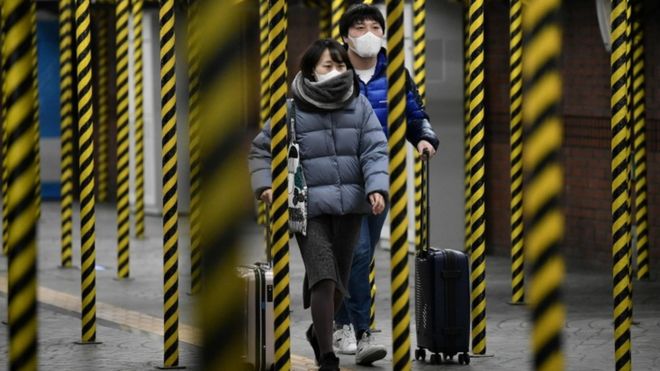
Passengers wearing face masks walk between columns at a subway station being renovated in SeoulImage copyright GETTY IMAGES
Image caption Cases of coronavirus have risen sharply in South Korea, where the outbreak is worsening

The head of the World Health Organization (WHO) has expressed concern at the number of coronavirus cases with no clear link to China or other confirmed cases.

Dr Tedros Adhanom Ghebreyesus said the window of opportunity to contain the virus was “narrowing”.

Chinese health authorities reported a decrease in deaths and new cases of the coronavirus on Saturday.

But cases are on the rise in South Korea, Italy, Iran and other countries.

Outside China, more than 1,200 cases of the virus have been confirmed in 26 countries and there have been eight deaths, the WHO says.

They include two deaths in South Korea, which has the biggest cluster of confirmed cases apart from China and a cruise ship quarantined in Japan.

On Saturday, South Korea reported 142 new confirmed cases of the coronavirus, bringing the national tally to 346.

An evacuation flight carrying 32 British and other European passengers has taken off from Japan and is due to land in England later on Saturday.

On Friday, doctors in Italy said a 78-year-old man became the first person in the country to die from the new coronavirus, Ansa news agency reported.

Earlier Italy had announced 16 more cases and its health minister said schools and offices would be closed and sports events cancelled in the affected regions.

China has reported 76,288 cases including 2,345 deaths. The new virus, which originated last year in Hubei province in China, causes a respiratory disease called Covid-19.

What did the WHO chief say?

Dr Tedros said the number of coronavirus cases outside China was “relatively small” but the pattern of infection was worrying.

“We are concerned about the number of cases with no clear epidemiological link, such as travel history to or contact with a confirmed case,” he said.

The new deaths and infections in Iran were “very concerning”, he said.

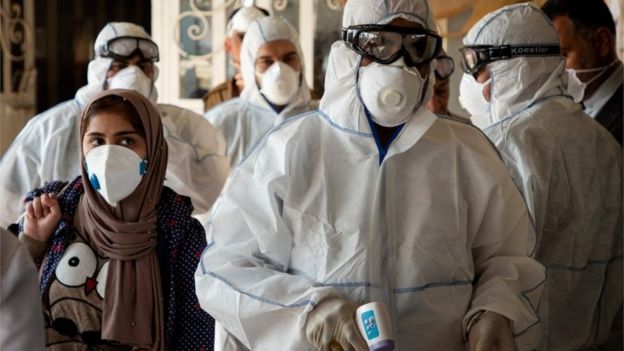
Iraqi medics check people returning from IranImage copyright AFP
Image caption Iraq has been checking people at its border with Iran

But he insisted that the measures China and other countries had put in place meant there was still a “fighting chance” of stopping further spread and called on countries to put more resources into preparing for possible outbreaks.

What is the latest in South Korea?

Prime Minister Chung Sye-kyun declared a public health emergency as the total number of cases surpassed 300 on Saturday.

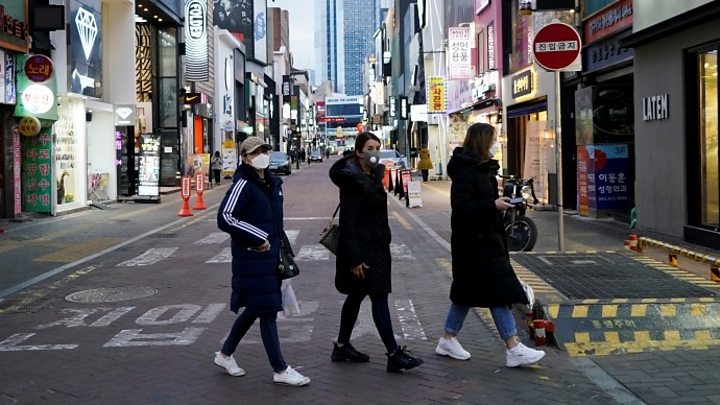
The southern cities of Daegu and Cheongdo have been declared “special care zones”. The streets of Daegu are now largely abandoned.

The nation’s capital, Seoul, banned demonstrations in central areas.

Two cases were also reported in Busan, South Korea’s second-largest city, and one on the Island of Jeju on Saturday – the first in both places.

Media caption People in Daegu have voiced concern over the spread of the virus

All military bases are in lockdown after three soldiers tested positive.

About 9,000 members of a religious group were told to self-quarantine, after the sect was identified as a coronavirus hotbed.

The authorities suspect the current outbreak in South Korea originated in Cheongdo, pointing out that a large number of sect followers attended the funeral of the founder’s brother from 31 January to 2 February.

Presentational white space

The sect – known as Shincheonji – which has been accused of being a cult, said it had now shut down its Daegu branch and that services in other regions would be held online or individually at home.

As of Friday, more than 400 members of the church were showing symptoms of the disease, though tests were still ongoing, the city mayor said.

Can we answer your question on the coronavirus?

Here’s what others have been asking
Once you’ve had coronavirus, will you be immune?
Could the coronavirus become a pandemic?
Is the coronavirus worse than flu or Sars?
Presentational grey line

Hand sanitizers and warning signs

By Hyung Eun Kim, BBC Korean Service, Seoul

Many people in South Korea are wearing masks on a daily basis.

Hand sanitizers have been placed at public transport stops and building entrances.

Warning government signs are everywhere. They say: “Three ways to prevent further infection: wear a mask at all times; wash your hands properly with soap for more than 30 seconds; and cover yourself when coughing.”

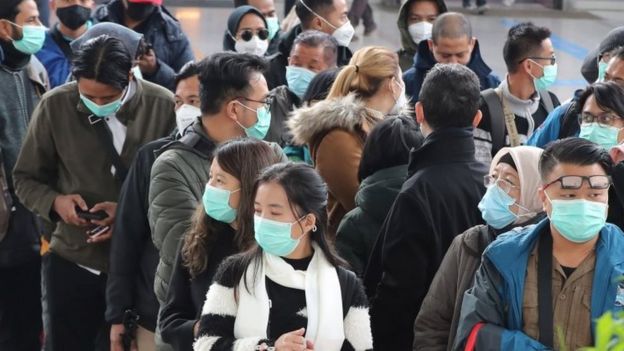
People wear masks in Seoul, South Korea. Photo: 21 February 2020Image copyright EPA
Image caption New norm: Mask-wearing crowd in Seoul

Koreans have also developed several apps and websites that tell you how much risk you face where you are. They show where the infected people are within a 10km radius.

“I can’t miss work, what I can do is minimise contact with others and stay at home during the weekend,” Seung-hye Lim, a Seoul resident, told the BBC.

“I do wonder if we reacted too laxly initially or if it really is because of the specific service practices of the Shincheonji sect.”

So-young Sung, a mother of two in Seoul, told the BBC: “It feels like my daily life is collapsing.”

She said she was struggling to find pharmacies that had masks.

She added that checking coronavirus-related alarms from her children’s schools and kindergartens was now a daily routine for her.

Presentational grey line

What about the Iran cases?

In Iran the outbreak is centred on the holy city of Qom, south of the capital Tehran, which is a popular destination for Shia Muslims in the region.

Iran reported two more deaths in Qom on Friday, adding to the two deaths it reported on Thursday. A total of 18 cases have been confirmed in the country.

Lebanon has reported its first confirmed case – a 45-year-old woman who was detected as she arrived in Beirut from Qom. The UAE, Israel and Egypt have also reported cases.

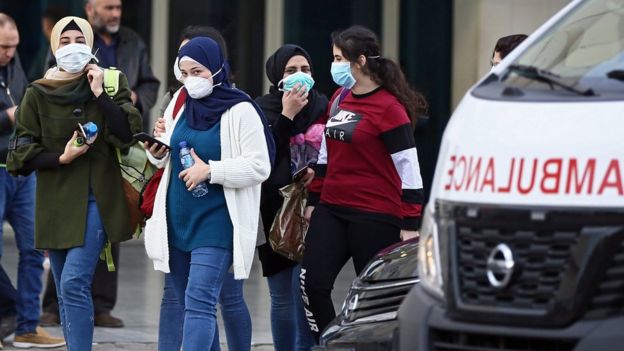
people outside Beirut hospital where the virus patient is being treatedImage copyright EPA
Image caption Lebanon has confirmed its first case – a woman returning from the Iranian city of Qom

Meanwhile Canadian officials said one of the nine cases there was a woman who had recently returned from Iran.

WHO officials said both Iran and Lebanon had the basic capacity to detect the virus and the WHO was contacting them to offer further assistance.

But Dr Tedros said the organisation was concerned about the virus’s possible spread in countries with weaker health systems.

What about China and elsewhere?

The virus has now hit the country’s prison system, with more than 500 inmates confirmed infected.

They include 230 patients in a women’s prison in Wuhan. More cases have been found in a prison in the eastern province of Shandong and the south-eastern province of Zhejiang.

Some 36 people at a hospital in Beijing have also tested positive.

Senior officials have been sacked for mishandling management of the outbreak.

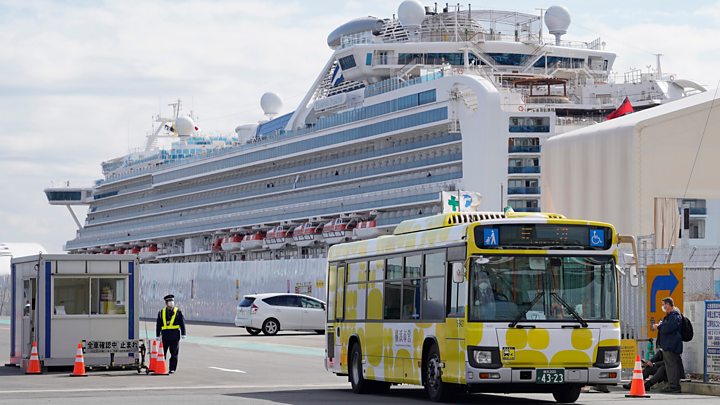
Passengers of the Diamond Princess cruise ship who have tested negative continue to disembark the ship in Yokohama after more than 14 days quarantined on board.

However, 18 American evacuees from the ship tested positive after arriving in the US, officials said. More than 300 other US nationals have arrived back in the US after disembarking.

Media caption Coronavirus: Quarantined passengers released from Japan ship

More than 150 Australian passengers have been evacuated from the ship and have already arrived in Darwin, where they will begin two more weeks of quarantine.

Australian officials said on Friday that six people had reported feeling unwell on arrival in Darwin and were immediately tested. Two of those people tested positive despite having received negative tests before leaving Japan.

The first batch of people from Hong Kong have also flown back to the city, where they will similarly be quarantined.

Source: The BBC

21/02/2020

Coronavirus: South Korea ’emergency’ measures as infections increase

South Korea has stepped up measures to contain the spread of the deadly new coronavirus, as confirmed infections increased sharply for a second day.

PM Chung Sye-kyun said it was now an emergency as 100 new cases and the country’s second death were confirmed.

The southern cities of Daegu and Cheongdo have been declared “special care zones”. The streets of Daegu are now largely abandoned.

All military bases are in lockdown after three soldiers tested positive.

About 9,000 members of a religious group were told to self quarantine, after the sect was identified as a coronavirus hotbed.

The authorities suspect the current outbreak in South Korea originated in Cheongdo, pointing out that a large number of sect followers attended a funeral of the founder’s brother from 31 January to 2 February.

On Friday, a second person who contracted the coronavirus died.

The victim was a woman in her 50s. She died in the south-western city of Busan after being transferred there from a hospital in a nearby country, according to Yonhap news agency.

Reports say she had earlier been a patient at the same mental hospital in Cheongdo as the country’s first victim – an elderly man. Another 15 patients there have also tested positive.

On Thursday, 53 new cases were reported. South Korea now has a total of 204 cases making it the largest cluster outside mainland China and the cruise ship docked off Japan.

The new virus, which originated last year in Hubei province in China, causes a respiratory disease called Covid-19.

What measures are being taken?

From the 100 new cases reported on Friday, 86 were in Daegu, a city 300km (186 miles) south-east of the capital Seoul, and nearly all of those were from a cluster involving the religious sect.

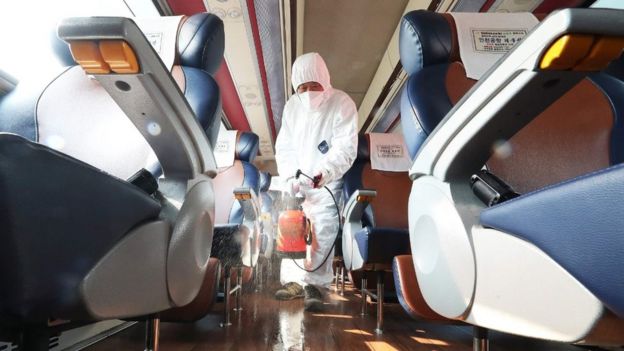
Worker disinfecting a trainImage copyright AFP
Image caption South Korea is trying hard to stop the local spread of the new coronavirus

Reacting to the quickly deteriorating situation, the government promised swift measures to prevent further spread of the virus.

“It is urgent to find people who have contacted infected people and cure patients,” PM Chung said, according to Yonhap.

He said the government was readying resources like sickbeds, medical equipment and health workers and warned the virus was now spreading locally.

“The government has so far focused on curbing infections coming from outside the country. From now on, the government will further prioritise preventing the virus from spreading locally.”

line

Health Minister Park Neung-hoo said authorities would allow hospitals to isolate respiratory patients from others in an effort to prevent any spread within medical institutions.

He also said that all pneumonia patients in Daegu hospitals would be checked for the virus.

What happened in Daegu?

The city’s biggest cluster appears to be at a branch of a religious sect which calls itself the Shincheonji Church of Jesus, Temple of the Tabernacle of the Testimony.

South Korean health officials believe these infections are linked to a 61-year-old woman who tested positive for the virus earlier this week.

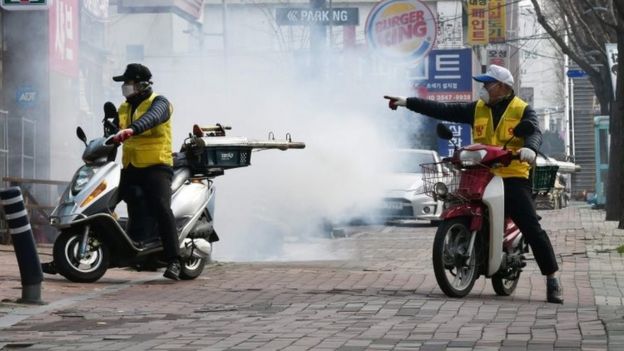
Workers on scooters disinfect the streets of Daegu, South Korea. Photo: 21 February 2020Image copyright AFP/GETTY IMAGES
Image caption Workers have been disinfecting the streets of Daegu, South Korea’s fourth-largest city

The Shincheonji, which has been accused of being a cult, said it had now shut down its Daegu branch and that services in other regions would be held online or individually at home.

As of Friday, more than 400 members of the church were showing symptoms of the disease, though tests were still ongoing, the city mayor said.

Can we answer your question on the coronavirus?

Here’s what others have been asking

Once you’ve had coronavirus, will you be immune?
Could the coronavirus become a pandemic?
Is the coronavirus worse than flu or Sars?

Daegu is the country’s fourth-largest city, with a population of 2.5 million people.

Residents are now being asked to remain at home after authorities described the church cluster as “super-spreading event”.

Presentational grey line

Hand sanitizers and warning signs

By Hyung Eun Kim, BBC Korean Service, Seoul

Many people in South Korea are wearing masks on a daily basis.

Hand sanitizers have been placed at public transport stops and building entrances.

Warning government signs are everywhere. They say: “Three ways to prevent further infection: wear a mask at all times; wash your hands properly with soap for more than 30 seconds; and cover yourself when coughing.”

People wear masks in Seoul, South Korea. Photo: 21 February 2020Image copyright EPA
Image caption New norm: Mask-wearing crowd in Seoul

Koreans have also developed several apps and websites that tell you how much risk you face where you are. They show where the infected people are within a 10km radius.

“I can’t miss work, what I can do is minimise contact with others and stay at home during the weekend,” Seung-hye Lim, a Seoul resident, told the BBC.

“I do wonder if we reacted too laxly initially or if it really is because of the specific service practices of the Shincheonji sect.”

So-young Sung, a mother of two in Seoul, told the BBC: “It feels like my daily life is collapsing.”

She said she was struggling to find pharmacies that had masks.

She added that checking coronavirus-related alarms from her children’s schools and kindergartens was now a daily routine for her.

Presentational grey line

What about China and elsewhere?

The latest figures from China put the death toll from the disease at 2,236 people and total infections at more than 75,000.

The virus has now hit the country’s prison system, with more than 500 inmates confirmed infected.

Senior officials have already been sacked for mishandling management of the outbreak.

The virus has also spread around the globe with more than 1,000 cases and several deaths in the rest of Asia, in Europe, the Middle East, the US and Africa.

On Friday, Iran confirmed 13 new cases, saying that two of those infected had died.

Health ministry official Minou Mohrez was quoted by the state-run Iran news agency as saying the coronavirus has spread to several cities, including the capital Tehran.

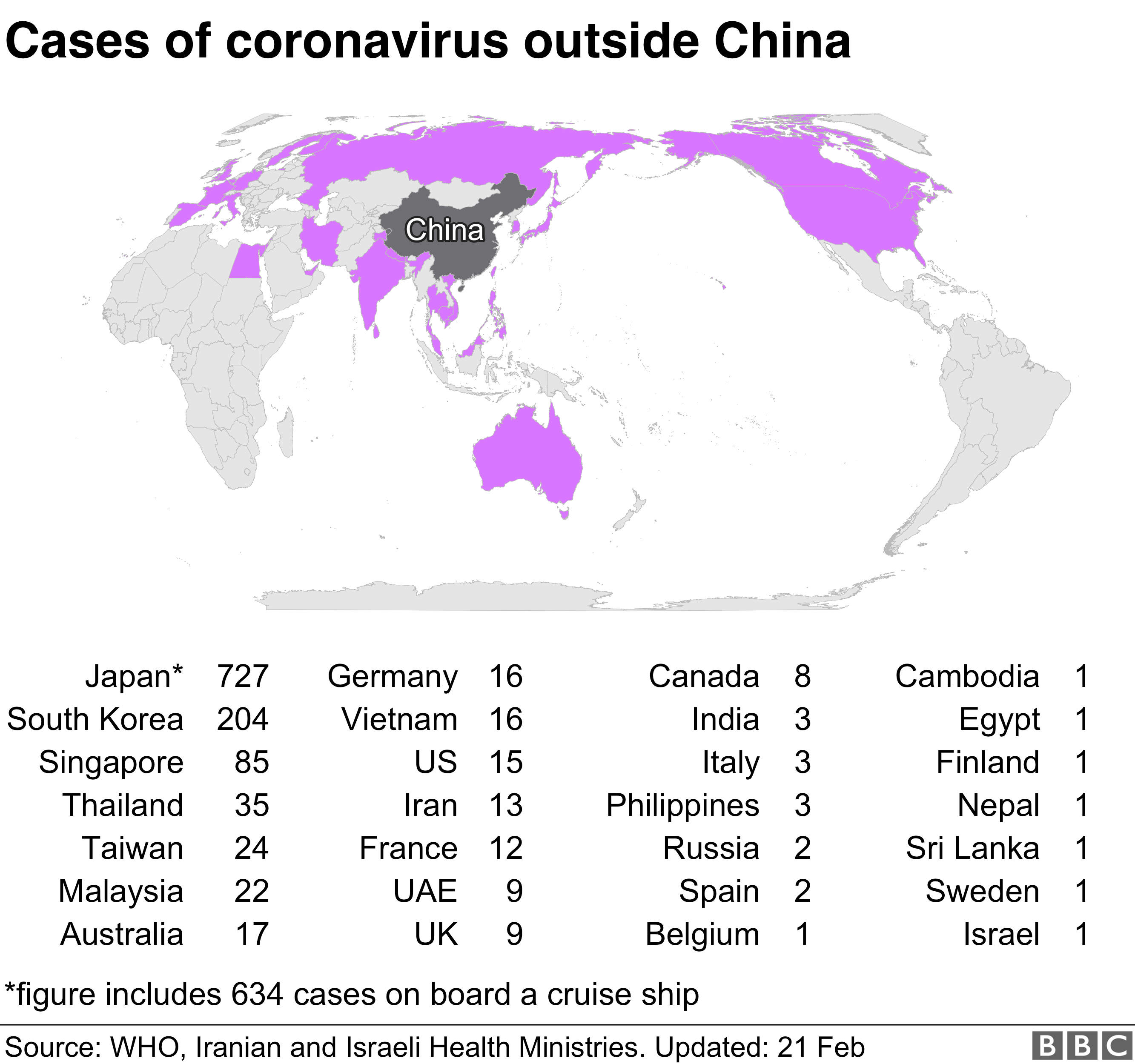
Cases of coronavirus outside China

South Korea is now the worst affected country after mainland China and the more than 600 infections on a cruise ship docked in Japan.

Media caption Coronavirus: Quarantined passengers released from Japan ship

Passengers of the Diamond Princess who have tested negative continue to disembark the ship in Yokohama after more than 14 days quarantined on board.

More than 150 Australian passengers have been evacuated from the ship and have already arrived in Darwin, where they will begin two more weeks of quarantine.

Australian officials said on Friday that six people had reported feeling unwell on arrival in Darwin and were immediately tested.

Two of those people tested positive despite having received negative tests before leaving Japan.

The first batch of people from Hong Kong have also flown back to the city, where they will similarly be quarantined.

Source: The BBC

21/09/2019

China, Russia, Iran ‘plan joint naval drill in international waters’

  • Iranian news outlet quotes military official as saying exercise will be held soon, but Chinese media silent on reported manoeuvres
An Iranian news source says China, Russia and Iran are planning a joint naval exercise soon. Photo: Xinhua
China, Russia and Iran are planning a joint naval drill in the Sea of Oman and northern Indian Ocean “soon” a semi-official Iranian news outlet reported on Saturday, just days after the United States blamed Iran for a drone attack on Saudi Arabian oil facilities.
General Ghadir Nezami Pour, head of international affairs and defence diplomacy of the Iranian Armed Forces General Staff, said the drill would take place in international waters, Iran Press news agency reported.
“The exercises have different goals including the exchange of tactical and military experiences and sometimes they seek political goals which show a kind of convergence between participants,” he was quoted as saying.

“Officials at the level of defence minister, chief of staff of the armed forces and commanders of the armed forces will come to Iran in the near future and these actions reflect Iran’s active defence diplomacy.”

The comments came in the aftermath of the September 14 missile strikes on Saudi Arabia’s Abqaiq and Khurais oil facilities.

Washington accused Tehran of masterminding the attacks, allegations that Iran denied.

Tehran warned that any military action by the United States or Saudi Arabia would result in “all-out war”.

US Secretary of State Mike Pompeo initially condemned the attacks on the oil facilities as an “act of war” but later said the US was seeking a peaceful solution to the crisis.

On Friday, Chinese President Xi Jinping condemned the attacks during a phone conversation with Saudi Arabia’s King Salman, adding that he hoped the incident would receive a full and fair investigation.

There was no report of the joint drill plan in Chinese media.

Analysts said the exercise was possible as China might want to show support for Iran.

“The timing of the joint exercise might be a bit sensitive and some might take it as a show of China’s support for Iran should there be any military conflicts between countries,” Beijing-based naval expert Li Jie said.

“But it might well be a regular military exchange between the countries if it is held in international waters and without targeting another country.”

China calls for calm in aftermath of drone strikes on Saudi oil facilities

Ni Lexiong, a military specialist and professor at Shanghai University of Political Science and Law, said the drill was to send the message that China would side with Iran “in extreme scenarios”.

“I don’t see things will go that far, but the navy drill is to send the intimidating message,” Ni said.

Two years ago China and Iran conducted a joint naval exercise near the Strait of Hormuz in the Persian Gulf after Washington accused ­Tehran of sending fast attack boats to harass US warships passing through the area.

Major General Mohammad Baqeri, Chief of Staff of the Iranian Armed Forces, was in Beijing for a three-day visit earlier this month and agreed that the two countries would have more visits with senior military officials and advance cooperation in training.

China still accounts for more than half of Iran’s oil exports, according to the United States, complicating Washington’s efforts to economically isolate Tehran in its “maximum pressure campaign”.

Source: SCMP

19/08/2019

Oil rises after drone attack on Saudi field

LONDON (Reuters) – Crude oil prices rose on Monday following a weekend attack on a Saudi oil facility by Yemeni separatists and as traders looked for signs that U.S.-China trade tensions could ease.

Price gains were, however, capped to some degree by an unusually downbeat OPEC report that stoked concerns about growth in oil demand.

Brent crude LCOc1, the international benchmark for oil prices, was up 65 cents, or about 1.1%, at $59.29 a barrel at 1024 GMT,

U.S. West Texas Intermediate (WTI) crude futures CLc1 were up 61 cents, or 1.1%, at $55.48 a barrel.

A drone attack by Yemen’s Houthi group on an oilfield in eastern Saudi Arabia on Saturday caused a fire at a gas plant, adding to Middle East tensions, but state-run Saudi Aramco said oil production was not affected.

“The oil market seems to be pricing in again a geopolitical risk premium following the weekend drone attacks on Saudi Arabia, but the premium might not sustain if it does not result in any supply disruptions,” said Giovanni Staunovo, oil analyst for UBS.

Tensions around Iran appeared to ease after Gibraltar released an Iranian tanker it seized in July though Tehran warned the United States against any new attempt to seize the tanker in open seas.

Concerns about a recession also limited crude price gains, as traders looked for signs of progress in U.S.-China trade talks.

Meanwhile, China’s announcement of key interest rate reforms over the weekend has fueled expectations of an imminent reduction in corporate borrowing costs in the struggling economy, boosting share prices on Monday.

U.S. energy firms this week increased the number of oil rigs operating for the first time in seven weeks despite plans by most producers to cut spending on new drilling this year.

“WTI in recent weeks has performed relatively better than Brent… Pipeline start ups in the United States have been supportive for WTI, while the ongoing trade war has had more of an impact on Brent,” said Warren Patterson, head of commodities strategy at Dutch bank ING.

The Organization of the Petroleum Exporting Countries (OPEC) cut its forecast for global oil demand growth in 2019 by 40,000 barrels per day (bpd) to 1.10 million bpd and indicated the market would be in slight surplus in 2020.

It is rare for OPEC to give a bearish forward view on the market outlook.

“Such a bearish prognosis will heap more pressure on OPEC to take further measures to support the market,” said Stephen Brennock of oil broker PVM.

Source: Reuters

17/06/2019

Oil tanker attacks: did Iran’s ties with China just go up in smoke?

  • Washington has blamed Tehran for an attack on two oil tankers near the Strait of Hormuz, putting pressure on Iran’s allies like China
  • Beijing usually backs its trade partner – but experts say the trade war with the US and problems with Huawei may have changed the equation
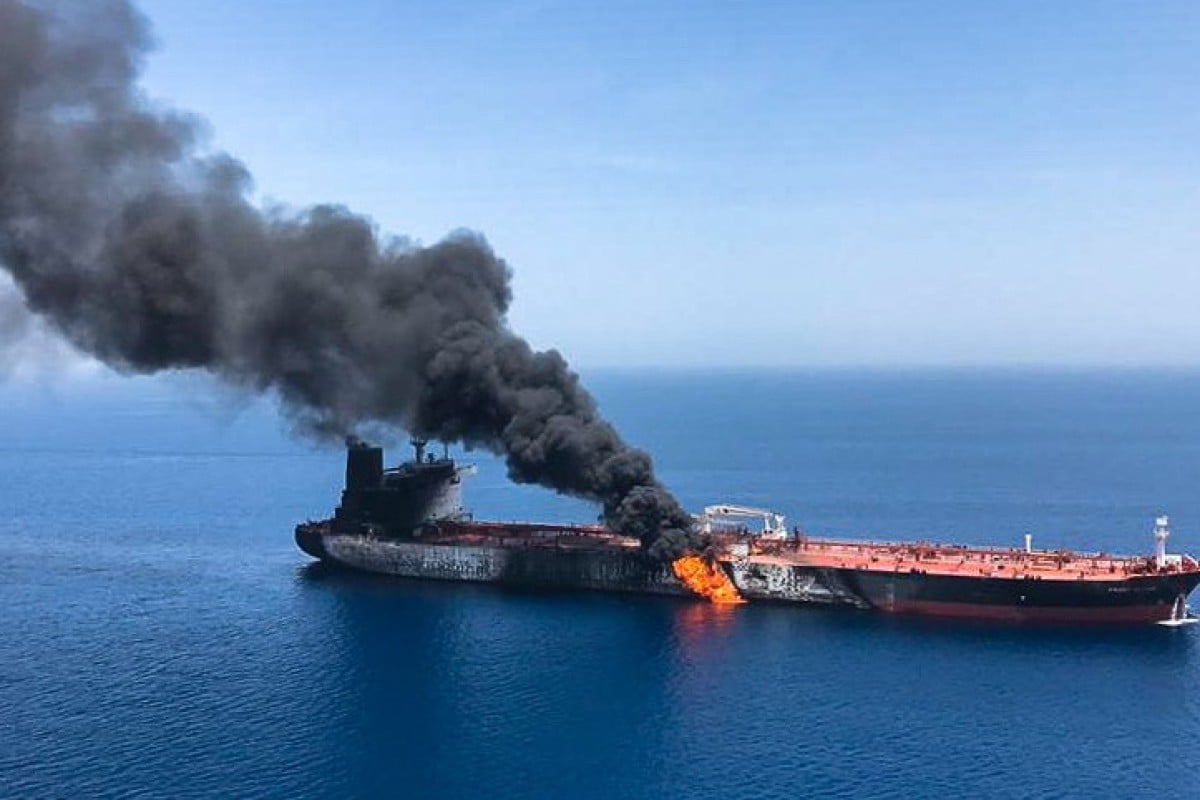
A tanker burns in the Gulf of Oman after a mystery attack that the United States has blamed on Iran. Photo: AFP
When 
Shinzo Abe

headed to Tehran this week for the first visit by a sitting Japanese prime minister in four decades, some in the diplomatic world imagined he could be the man to bring

Iran

back to the negotiating table with the

United States

.

Those hopes were torpedoed on Thursday when, on the same day Abe was meeting Iran’s supreme leader Ayatollah Khamenei, explosions ripped through two oil tankers, one Japanese and one Norwegian, near the Strait of Hormuz, a strategically significant shipping lane.
The attack immediately overshadowed an earlier success for Abe, who had met President Hassan Rowhani a day before and was assured Iran would stick to the terms of a 2015 agreement limiting its nuclear activities.
Washington accused Iran of being behind the attack on the tankers, releasing a video on Friday that it said showed Iran’s revolutionary guard removing an unexploded mine from one of the ships, and warning that it would “defend its interests”.
Iranian President Hassan Rowhani and Japanese Prime Minister Shinzo Abe meet Iran’s Supreme Leader Ayatollah Ali Khamenei in Tehran. Photo: Reuters

Tehran, for its part, claimed to have been set up, with its foreign minister Mohammad Javad Zarif saying “suspicious doesn’t begin to describe” the incident. So much, then, for hopes of mediation.

US President

Donald Trump

, who had encouraged the Japanese leader’s visit, admitted on Twitter soon afterwards that when it came to negotiating, “they are not ready, and neither are we!”

Still, the incident exposed more than just the naivety of those hoping for an Abe-led breakthrough. In raising the stakes in Washington’s confrontation with Tehran, it also threw the spotlight on Iran’s dwindling number of allies – and perhaps most significantly on its largest trading partner, China – which face mounting pressure to rethink the relationship.

Tanker attacks: world divided over Iran role as Saudi prince breaks silence
The day after the attack, China’s President

Xi Jinping

said Beijing would promote its ties with Iran “however the situation changes” – a comment made during a meeting with Iranian President Hassan Rowhani on the sidelines of the Shanghai Cooperation Organisation summit in Kyrgyzstan – but diplomatic observers question just how far China can go in accommodating its controversial trading partner.

BEST FRIENDS FOREVER?

Iran has long been able to count on support from China, which accounts for 30 per cent of the Islamic republic’s exports and imports, and its willingness to defy US pressure is a gamble at least partly based on an assumption it can continue to count on Beijing’s support.

As Iran’s largest economic partner – Chinese direct investment in Iran hit a record high of nearly US$4 billion last year, according to data analysis project ChinaMed – Beijing already plays a key role in relieving US pressure on Iran, said Mohsen Shariatinia, assistant professor of regional studies at Shahid Beheshti University in Tehran.

But experts warn that reliance will come into question as China becomes increasingly hamstrung by its own problems.

China has enough problems of its own, starting with US pressure on Huawei. Photo: EPA
Chief among Beijing’s headaches are its

trade war

with Washington and the related assault on its

5G

giant

Huawei

– which, as analysts point out, originally ignited over allegations it was defying US sanctions on Iran. Beijing will also be well aware of the need to keep

Saudi Arabia

, its second-biggest oil supplier and Tehran’s critic-in-chief, happy.

On the other hand, analysts say, China will be wary of being seen to abandon its old friend, as doing so would send a message to other nations at odds with Washington that they could no longer look to China as a diversification strategy.
“This could mean Chinese investment is vulnerable to US interference,” said Esfandyar Batmanghelidj, founder of Bourse Bazaar, a media company that supports business diplomacy between Europe and Iran.
Sanctions drive Iranian students away from US towards Asia
Doing so, Batmanghelidj said, would put a question mark over one of China’s most significant foreign policies of recent years – President Xi’s signature

Belt and Road Initiative

to fund infrastructure across Eurasia.

THE BELT AND ROAD QUESTION
Tensions between Iran and the US have reached boiling point in recent weeks, after the Trump administration last month ended waivers on sanctions for nations importing Iranian oil – a move the US says is aimed at making the republic “radioactive to the international community” and which Rowhani has described as an “economic war against Iran”.
So far, China has largely stuck by the Islamic Republic, continuing to buy fuel from it despite the latest wave of US sanctions on Iranian oil that followed Trump’s decision last year to withdraw the US from the landmark 2015 agreement curbing Tehran’s nuclear development.
The deal had been widely lauded as a triumph of multilateralism and the dawning of a new economic era for Iran.
US releases video of ‘Iranian forces removing unexploded mine’ from ship
Part of its eagerness to support Iran has stemmed from the Islamic Republic’s key position in the Belt and Road plan. In 2017 alone, China signed deals for more than US$15 billion in Iranian infrastructure investment, according to the

Chinese Communist Party

mouthpiece China Daily.

Planned projects include high-speed rail lines, upgrades to the nation’s electrical grid, and natural gas pipelines. The two nations have also vowed to boost bilateral trade to US$600 billion in the next seven years.
“China sees Iran as its Western gateway, where not only is it a big market in itself, but it will also be the gateway to the rest of the 
Middle East

and ultimately to Europe for China,” said Anoush Ehteshami, professor of international relations at Durham University in Britain.

Nisha Mary Mathew, at the Middle East Institute in Singapore, said that China’s relationship with Iran was not just economic – but primarily strategic, with both nations envisioning an international order that was no longer dominated by the US and its Western allies.
DEFIANCE, FOR NOW
If the belt and road gives China good reason to stick with Iran, there are plenty of voices urging just that action. As Andrea Ghiselli at Shanghai’s Fudan University pointed out, US sanctions until now have only strengthened the hardline factions in Iran’s government.
The combination of the US withdrawal from the nuclear deal – which had the support of the international community – along with Europe’s tepid efforts to rescue it, may have emboldened those favouring resistance over negotiation.
Xi’s supportive comments in Kyrgyzstan were only the latest in a string of remarks from China that could encourage such factions.
If Trump kills off Huawei, do Asia’s 5G dreams die?
After China’s Foreign Minister Wang Yi met Iranian Foreign Minister Mohammad Javad Zarif in Beijing last month, the ministry’s spokesman Lu Kang said China’s economic relationship with Iran was “reasonable and lawful”.
Two months prior to that, China’s Minister of Commerce Zhong Shan, while hosting his Iranian counterpart Farhad Dejpasand, had claimed China’s “determination to maintain and develop the China-Iran comprehensive strategic partnership is unshakeable”.
Chinese President Xi Jinping with Iranian President Hassan Rowhani. Photo: AFP

Even so, the pressure is getting to some. In February, Foreign Minister Zarif temporarily resigned, in what Andrea Ghiselli at Fudan University in Shanghai called a clear sign of the “changing and precarious power balance with Iran’s foreign policy establishment”.

And nowhere is the pressure felt more keenly than the economy and China’s ability to serve as a lifeline.

“The real anxiety in Iran right now is about market share,” said Bourse and Bazaar’s Batmanghelidj. “If you’re exporting zero oil and your customers are buying oil elsewhere, you lose market share.

“The government wants to know if it agreed to go back to the negotiating table and the US promised sanctions relief, that there are people who are going to buy in significant volume.”

TURNING POINT: HUAWEI

For many analysts, the event most likely to have changed the equation in Beijing’s eyes is the arrest by the Canadian authorities of 

Meng Wanzhou

, the chief financial officer of Chinese telecom giant Huawei.

Meng’s arrest came at the request of the US government, which claimed her company had violated sanctions by selling equipment to Iran.
Many observers saw the action as Washington’s way of signalling to Chinese companies that they would face repercussions if they eased the pressure on Iran by continuing to trade.
Huawei’s chief financial officer Meng Wanzhou. Photo: Reuters

“Going after Huawei was about going after Chinese enterprises – signalling that they can no longer trade with Iran with impunity,” Batmanghelidj said.

Since then, Chinese firms have shown increased skittishness towards trading with Iran. According to China’s General Customs Administration, Chinese exports to Iran declined by more than half between October 2018 and February 2019, from over US$1 billion to just under US$500 million.

Mohammad Ali Shabani, a researcher at the School of Oriental and African Studies in London, said other countries in the region were now watching to see if China would blink in the face of US pressure. “This could have dire consequences for China’s image as a reliable partner,” he said.

NOT JUST ABOUT AMERICA

There are reasons beyond US pressure that may factor into Beijing’s thinking. It has long stated its opposition to Iranian nuclear weapons development, and Chinese Foreign Minister Wang Yi has said that China is “ready” to take on “its due responsibilities and make a greater contribution to world peace and common development”.

Trade war: here are Beijing’s options – and none look any good

Zhao Hong, at the Research School of Southeast Asian Studies at Xiamen University, said that in stepping up as a responsible world power Beijing faced a dilemma over its approach to Iran.
“Chinese leaders have to painfully balance an impulse towards economic cooperation with Iran against other vital interests, including convincing Washington that China is a responsible stakeholder,” he wrote in the Journal of Contemporary China.
Saudi Aramco's Ras Tanura oil refinery. The country is China’s second-largest oil supplier after Russia. Photo: Reuters
Saudi Aramco’s Ras Tanura oil refinery. The country is China’s second-largest oil supplier after Russia. Photo: Reuters

Then there is China’s relationship with Iran’s chief adversary, Saudi Arabia, to consider. Riyadh is China’s second-largest oil supplier, behind Russia, and it plays a central role in Beijing’s energy strategy.

According to International Trade Centre data, more than 12 per cent of China’s imported oil came from Saudi Arabia last year, compared with just 6 per cent from Iran. Last year, Saudi Arabia shipped 56.73 million tonnes of oil to China, or 1.135 million barrels per day.

Why would Kim Jong-un trust Trump, now that he’s ripped up Iran’s nuclear deal?

This April, China imported 6.3 million tonnes of oil from Saudi Arabia, nearly twice the 3.24 million tonnes it imported from Iran, according to China’s General Administration of Customs.

Iran’s comparatively small share of China’s oil imports market and its heavy reliance on China as a trading partner add up to a deeply uneven relationship, experts say, and it is this imbalance that will encourage the US that China may be open to rethinking its ties.

As Jon Alterman, director of the Middle East programme at Washington DC think tank the Centre for Strategic and International Studies, pointed out, while China was Iran’s largest trading partner, Iran represented less than 1 per cent of China’s international trade.

“Iran needs China,” Alterman said. “But to China, Iran is expendable.”

Source: SCMP

30/04/2019

Boxed in: $1 billion of Iranian crude sits at China’s Dalian port

SINGAPORE (Reuters) – Some 20 million barrels of Iranian oil sitting on China’s shores in the northeast port of Dalian for the past six months now appears stranded as the United States hardens its stance on importing crude from Tehran.

Iran sent the oil to China, its biggest customer, ahead of the reintroduction of U.S. sanctions last November, as it looked for alternative storage for a backlog of crude at home.

The oil is being held in so-called bonded storage tanks at the port, which means it has yet to clear Chinese customs. Despite a six-month waiver to the start of May that allowed China to continue some Iranian imports, shipping data shows little of this oil has been moved.

Traders and refinery sources pointed to uncertainty over the terms of the waiver and said independent refiners had been unable to secure payment or insurance channels, while state refiners struggled to find vessels.

The future of the crude, worth well over $1 billion at current prices, has become even more unclear after Washington last week increased its pressure on Iran, saying it would end all sanction exemptions at the start of May.

“No responsible Chinese company with any international exposure will have anything to do with Iran oil unless they are specifically told by the Chinese government to do so,” said Tilak Doshi of oil and gas consultancy Muse, Stancil & Co in Singapore.

Iran previously stored oil in 2014 at Dalian during the last round of sanctions that was later sold to buyers in South Korea and India. reut.rs/2yo9Se6

China last week formally complained to the United States over the unilateral Iran sanctions, but U.S. officials have said Washington is not considering a further short-term waiver or a wind-down period.

The 20 million barrels is equal to about a month’s worth of China’s imports from Iran over the past six months, or about two days of the country’s total imports.

Iran says it will continue to export oil in defiance of U.S. sanctions.

A senior official with the National Iranian Tanker Company (NITC), who spoke on condition of anonymity, told Reuters: “We will continue to sell our oil.”

“Iran is now desperate and will deal with anyone with steep discounts as long as they get paid somehow,” said Doshi.

SOME OIL TAKEN

Some Iranian oil sent to Dalian has moved, according to a ship tracking analyst at Refinitiv.

Dan, a supertanker owned by NITC moved 2 million barrels of oil from Dalian more than 1,000 km (620 miles) to the south to the Ningbo Shi Hua crude oil terminal in March, according to Refinitiv data.

Ningbo is home to Sinopec’s Zhenhai refinery, one of the country’s largest oil plants with a capacity of 500,000 barrels a day and a top processor of Iranian oil.

Sinopec declined to comment.

The Iranian tanker was chartered by state-run Chinese trader Zhuhai Zhenrong Corp, according to Refinitiv analyst Emma Li. The NITC official confirmed the oil was taken by Zhuhai Zhenrong.

Zhenrong was started in the 1990s and brokered the first oil supply deals between Iran and China. At that time, Iran was supplying oil to China to pay for arms supplied by Beijing during the 1980-88 Iran-Iraq war. Zhuhai Zhenrong still specializes mainly in buying Iranian oil.(reut.rs/2IHlvEx)

An official at the general manager’s office with Zhuhai Zhenrong’s office in Beijing said he could not immediately comment. The company did not reply to a fax seeking comment.

For now, more Iranian oil is heading to China, with the supertankers Stream and Dream II due to arrive in eastern China from Iran on May 5 and May 7, respectively, Refinitiv data showed.

Some of this crude may be from Chinese investments into Iranian oilfields, a sanctions grey area.

Whether China will keep buying oil from Iran remains unclear, but analysts at Fitch Solutions said in a note “there may be scope for imports via barter or non-compliance from … China.”

Muse, Stancil & Co’s Doshi said the only way to get the Iranian oil out of Dalian now was by cheating.

“Only rogue parties might try to cheat the system and try to pass the Iranian oil at Dalian as something else via fraudulent docs. But I doubt this is easy or can amount to much in terms of volume.”

(MAP: Iranian supertanker frees some oil from China storage in March, tmsnrt.rs/2W1FJvK)

Source: Reuters

Law of Unintended Consequences

continuously updated blog about China & India

ChiaHou's Book Reviews

continuously updated blog about China & India

What's wrong with the world; and its economy

continuously updated blog about China & India