Chindia Alert: You’ll be Living in their World Very Soon
aims to alert you to the threats and opportunities that China and India present. China and India require serious attention; case of ‘hidden dragon and crouching tiger’.
Without this attention, governments, businesses and, indeed, individuals may find themselves at a great disadvantage sooner rather than later.
The POSTs (front webpages) are mainly 'cuttings' from reliable sources, updated continuously.
The PAGEs (see Tabs, above) attempt to make the information more meaningful by putting some structure to the information we have researched and assembled since 2006.
Image copyright ANIImage caption People participating in the chariot-pulling festival
Indian officials have suspended a local magistrate and a police official for allowing large crowds to attend a chariot-pulling festival at a Hindu temple on Thursday morning.
A case has also been filed against the trustees of the temple and another 20 people, police told the BBC.
Pictures of the crowds caused outrage after they surfaced on social media.
It comes weeks after Covid-19 clusters were linked to a Muslim religious gathering in the capital, Delhi.
Revoor village, which is in the state’s Kalburagi district, has been sealed off and officials are rushing teams of medical personnel to set up fever clinics there, the deputy commissioner of the district, told the BBC.
Kalburagi recorded India’s first coronavirus-related death – it is also the first district to implement “containment areas”, which involves sealing off villages where infections are reported.
Revoor is also close to another village that has been sealed off after a two-year-old tested positive for coronavirus.
The festival was held despite temple trustees giving officials an undertaking that it would not go ahead, a state lawmaker, Priyank Kharge, told the BBC.
Officials say that the daily rituals were performed at the temple on Wednesday evening in the presence of a few priests and temple trustees.
But early the next morning, the chariot was brought out of the temple premises and was pulled by “hundreds of people,” according to one official. They estimate that under 1,000 devotees attended the event.
Image copyright AFPImage caption The dispute turned to violence in 1992 when a Hindu mob destroyed a mosque at the site
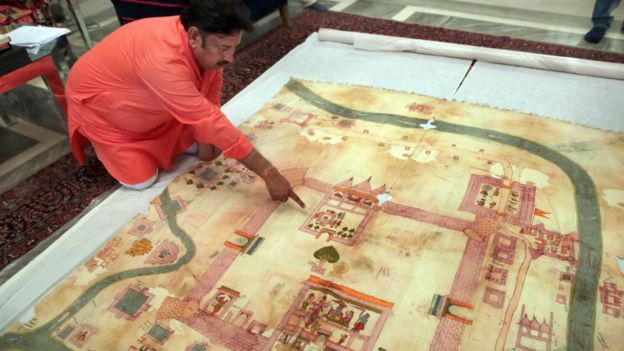
The Ayodhya dispute, which stretches back more than a century, is one of India’s thorniest court cases and goes to the heart of its identity politics.
Hindus believe that Ayodhya, a city in the northern state of Uttar Pradesh, is the birthplace of one of their most revered deities, Lord Ram.
But Muslims say they have worshipped there for generations.
A court case pertaining to the ownership of the land has been dragging on in the Supreme Court for years, but a verdict is expected next month.
The court concluded its final hearing into the case on Wednesday.
What is the row actually about?
At the centre of the row is a 16th Century mosque that was demolished by Hindu mobs in 1992, sparking riots that killed nearly 2,000 people.
Many Hindus believe that the Babri Masjid was actually constructed on the ruins of a Hindu temple that was demolished by Muslim invaders.
Muslims say they offered prayers at the mosque until December 1949 when some Hindus placed an idol of Ram in the mosque and began to worship the idols.
Over the decades since, the two religious groups have gone to court many times over who should control the site.
Since then, there have been calls to build a temple on the spot where the mosque once stood.
The case currently being heard by five judges in the top court is to determine who the land in question belongs to.
A verdict is expected between 4 and 15 November.
Hinduism is India’s majority religion and is thought to be more than 4,000 years old. India’s first Islamic dynasty was established in the early 13th Century.
Who is fighting the case?
The long and complicated property dispute has been dragging in various courts for more than a century.
This particular case is being fought between three main parties – two Hindu groups and the Muslim Waqf Board, which is responsible for the maintenance of Islamic properties in India.
Image copyright GETTY IMAGES
The Hindu litigants are the Hindu Mahasabha, a right-wing political party, and the Nirmohi Akhara, which is a sect of Hindu monks.
They filed a title dispute in the Allahabad High Court in 2002, a decade after the mosque was demolished.
A verdict in that case was pronounced in September 2010 – it determined that the 2.77 acres of the disputed land would be divided equally into three parts.
The court ruled that the site should be split, with the Muslim community getting control of a third, Hindus another third and the Nirmohi Akhara sect the remainder. Control of the main disputed section, where the mosque once stood, was given to Hindus.
The judgement also made three key observations.
It affirmed the disputed spot was the birthplace of Lord Ram, that the Babri Masjid was built after the demolition of a Hindu temple and that it was not built in accordance with the tenets of Islam.
The Supreme Court suspended this ruling in 2011 after both Hindu and Muslim groups appealed against it.
What are the other important legal developments?
In 1994 the Supreme Court, which was ruling on a related case, remarked that the concept of a mosque was “not integral to Islam”. This has bolstered the case made by Hindus who want control of the entire site.
In April 2018, senior lawyer Rajeev Dhavan filed a plea before the top court, asking judges to reconsider this observation.
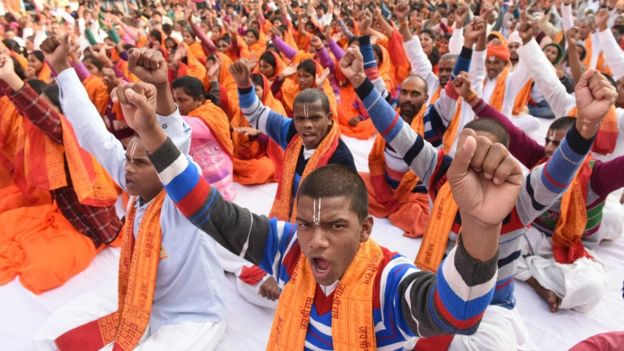
Image copyright GETTY IMAGESImage caption Hindu activists are demanding the construction of the Ram Temple
Have religious tensions eased in India in recent years?
Ever since the Narendra Modi-led Hindu nationalist BJP first came to power in 2014, India has seen deepening social and religious divisions.
The call for the construction of a Hindu temple in Ayodhya has grown particularly loud, and has mostly come from MPs, ministers and leaders from the BJP since it took office.
Restrictions on the sale and slaughter of cows – considered a holy animal by the majority Hindus – have led to vigilante killings of a number of people, most of them Muslims who were transporting cattle.
An uninhibited display of muscular Hindu nationalism in other areas has also contributed to religious tension.
Most recently, the country’s home minister Amit Shah said he would remove “illegal migrants” – understood to be Muslim – from the country through a government scheme that was used recently in the north-eastern state of Assam.
Image copyright AFPImage caption Decorated elephants lead the procession at the Jagannath temple’s annual festival in Ahmedabad
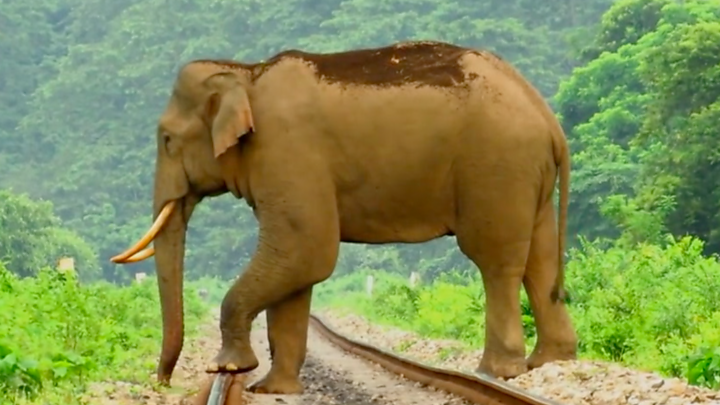
Animal rights activists in India have criticised a plan by the Assam state government to send four elephants on a perilous train journey of more than 3,100km (1,926 miles) to participate in a temple ritual. They say the long journey could be dangerous for the animals and may even kill them, writes the BBC’s Geeta Pandey in Delhi.
The elephants are to be moved from Tinsukia town in the north-eastern state of Assam to the extreme west of the country – Ahmedabad city in Gujarat state.
Reports say the railway authorities in Assam, who have been asked to make travel arrangements for the elephants, are looking for a coach to transport them.
No date is set for their departure yet, but they are expected to reach Ahmedabad before 4 July to participate in the annual Rath Yatra (chariot procession) at the Jagannath temple. The train journey is expected to take three to four days.
In previous years, Prime Minister Narendra Modi, who hails from Gujarat, has participated in the festival and the elephant procession, although temple officials say he’s not expected to attend this year.
Temple trustee Mahendra Jha told BBC Gujarati that they decided to “borrow” the animals from Assam “for two months” because three of their own elephants died from old age last year.
But activists and conservationists say the plan to move the elephants is “cruel and completely inhuman”, especially since temperatures are more than 40C (104F) in many places along the northern Indian route these elephants are expected to take.
Media caption Human-elephant conflict destroying lives in India
“Most of north-western India is reeling under a heatwave. There have been reports of people dying from heat during train journeys,” Kaushik Barua, a wildlife conservationist based in the Assam state capital, Guwahati, told the BBC.
“The wagon in which the elephants will be transported is not climate-controlled. It will be hitched to a passenger train which will be travelling at a speed of 100km/h (62mph), so can you imagine the plight of the animals?”
Mr Barua warns the journey may prove “dangerous” for the animals.
“They can suffer from heatstroke, from shock, and even die.”
Under the law, he says, there’s no problem moving these elephants since all the paperwork is in order, “but where’s the animal welfare?”
Also weighing in on the debate is the opposition Congress party MP from Assam, Gaurav Gogoi, who’s petitioned India’s Environment Minister Prakash Javadekar to intervene.
“Roughly half of the country is struggling through its worst drought in six decades…. These are extreme conditions for the elephants to travel… The elephants may suffer from acute skin infection and dehydration,” Mr Gogoi wrote in his letter on Thursday.
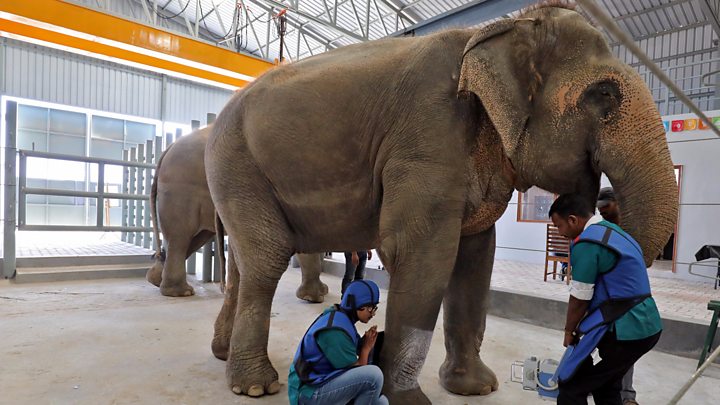
Media caption India’s first elephant hospital is run by the charity Wildlife SOS
“Therefore, I request the central government to intervene and instruct the state government to withdraw the decision as soon as possible.”
Elephants – both wild and captive – are a protected species in India and there are strict guidelines for their transportation, wildlife biologist Dr Bibhuti Prasad Lahkar told the BBC.
According to the rules, no elephant can be made to walk for more than 30km (18 miles) at a stretch or transported for more than six hours in one go.
The state’s wildlife officials, who’ve issued transit permits for the elephants, have so far refused to comment on the controversy. But after protests from activists and conservationists, “they have gone into a huddle, discussing a plan B,” according to a wildlife expert.
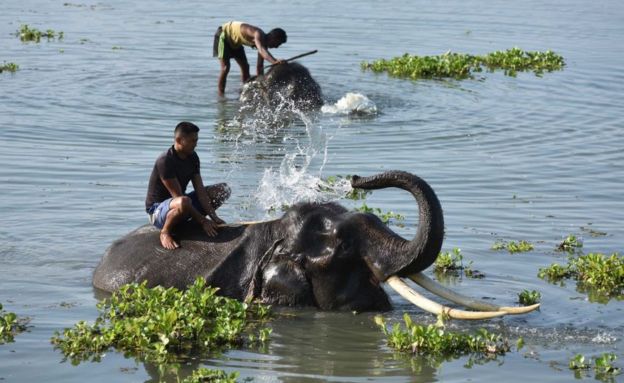
Image copyright GETTY IMAGESImage caption Elephants are a protected species in India
“There’s some suggestion that the pachyderms may be moved in trucks to allow them the flexibility to stop if needed and that they could be accompanied by a forest department veterinarian to look after them,” he said.
Mr Barua, however, is blunt.
“Gujarat doesn’t need these elephants,” he says. “Wildlife laws prevent [the] display and exhibition of elephants. Laws ban performances by elephants in circuses, zoos are not allowed to exhibit them, so why should temples be allowed to use them in rituals or processions? Don’t elephants have rights?
“We worship Ganesha, the Elephant God. Why are the Gods then being put through such cruelty by a temple?”
The two women had tried to enter the temple once before, in December, but were prevented from doing so by protesters.
Image copyrightGETTY IMAGESImage captionThe entry of two women into the Sabarimala temple sparked violent protests in Kerala
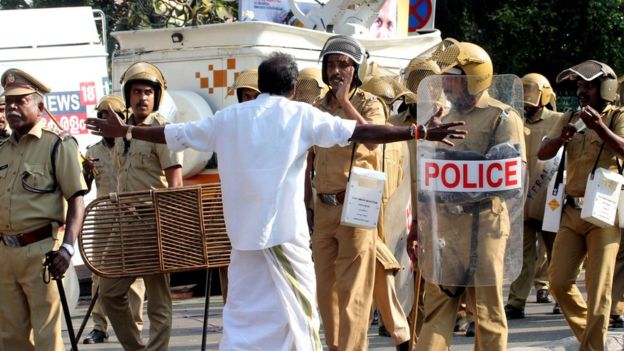
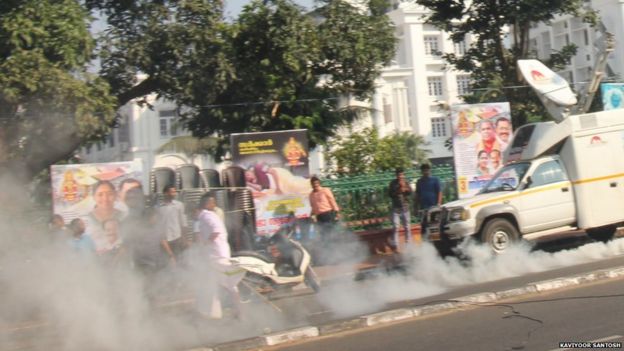
As news of their entry into the temple spread, violence broke out in several cities and towns as groups of protesters clashed with police, who fired tear gas to disperse crowds.
Police told news agency AFP that at least 15 people were injured after protesters hurled stones at them.
The Supreme Court decision to let women worship at the Sabarimala shrine came after a petition argued that the custom banning them violated gender equality.
But India’s ruling party, the Hindu nationalist Bharatiya Janata Party (BJP), has argued that the ruling is an attack on Hindu values.
The issue has become increasingly contentious in the run-up to India’s general election, scheduled for April and May. Critics have accused Prime Minister Narendra Modi of pursuing a religiously divisive agenda to court the BJP’s mostly-Hindu support base.
Hinduism regards menstruating women as unclean and bars them from participating in religious rituals – but most temples allow women to enter as long as they are not menstruating, rather than banning women in a broad age group from entering at all.
Image copyrightKAVIYOOR SANTOSHImage captionPolice used tear gas to break up protests
Protesters have consistently argued that the court ruling goes against the wishes of the temple’s deity, Lord Ayappa.
They say that the ban on women entering Sabarimala is not about menstruation alone – it is also in keeping with the wish of the deity, who is believed to have laid down clear rules about the pilgrimage to seek his blessings.
According to the temple’s mythology, Lord Ayyappa is an avowed bachelor who has taken an oath of celibacy and hence, women of a certain age are not allowed into the temple.
Two other women had managed to reach the temple’s premises in October, with more than 100 police protecting them from stone-throwing protesters as they walked the last 5km stretch to the shrine. But they were forced to turn around after a stand-off with devotees, just metres from Sabarimala’s sanctum.
Image copyrightCV LENINImage captionThe demonstration was a response to protests that prevented women from entering a Hindu temple
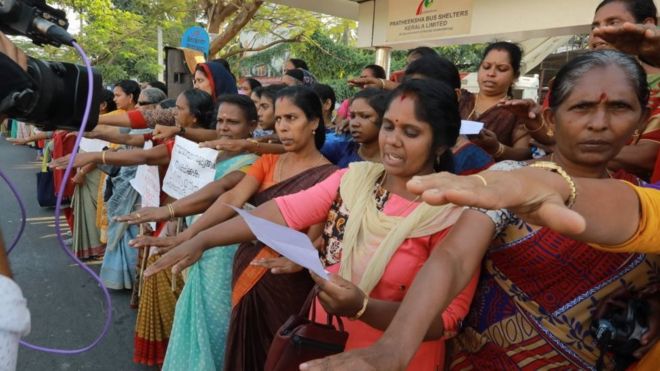
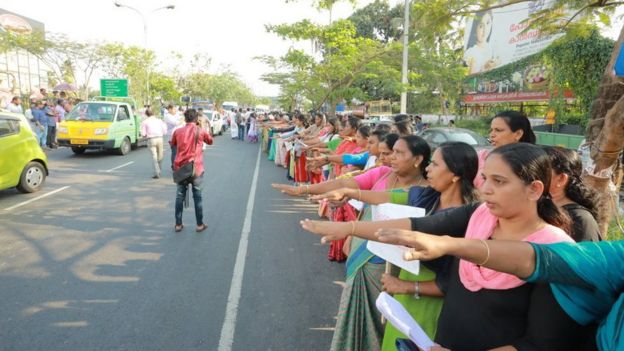
Women in the southern Indian state of Kerala have formed a 620km (385-mile) human chain “in support of gender equality”, amid a row over access to a prominent Hindu temple.
The Sabarimala shrine was historically closed to women of “menstruating age” – defined as between 10 and 50.
The “women’s wall” was organised by the state’s left-wing coalition government.
Officials told BBC Hindi’s Imran Qureshi that around five million women from various parts of Kerala had gathered across all national highways to form the chain, which stretched from the northern tip of Kasaragod to the southern end in Thiruvanthapuram.
Organisers had predicted a turnout of around three million.
Officials said the short demonstration was to combat inequality and counter the efforts of right-wing groups that support the ban on women.
One young demonstrator, Kavita Das, told BBC Hindi: “This is a great way of saying how powerful women are, and how we can empower ourselves and help each other. Of course, I support the move to allow women of all ages into the temple. I don’t think tradition or any kind of backwardness should stop women. Those who want to pray must have the right to pray.”
Another woman, Tanuja Bhattadri, observed: “Sabarimala is not the main issue here today. I believe men and women are equal.”
Why is the ban so political?
The Supreme Court decision to let women worship at the Sabarimala shrine came after a petition argued that the custom banning them violated gender equality.
The issue has become increasingly contentious in the run-up to India’s general election, scheduled for April and May. Critics have accused Prime Minister Narendra Modi of pursuing a religiously divisive agenda to court the BJP’s mostly-Hindu support base.
Hinduism regards menstruating women as unclean and bars them from participating in religious rituals – but most temples allow women to enter as long as they are not menstruating, rather than banning women in a broad age group from entering at all.
Image copyrightCV LENINImage captionOfficials said millions of women formed a human chain stretching across the state
‘The temple god is a bachelor’
Protesters have also argued that the court ruling goes against the wishes of the temple’s deity, Lord Ayappa.
They say that the ban on women entering Sabarimala is not about menstruation alone – it is also in keeping with the wish of the deity, who is believed to have laid down clear rules about the pilgrimage to seek his blessings.
According to the temple’s mythology, Lord Ayyappa is an avowed bachelor who has taken an oath of celibacy – and hence the ban.
Very few women have tried to enter the temple amid massive protests in the state, and many who tried have been forced to turn back.
Two women managed to reach the main temple premises in October, with more than 100 police protecting them from stone-throwing protesters as they walked the last 5km stretch to the shrine. They were ultimately forced to turn round after a stand-off with devotees, just metres from Sabarimala’s sanctum.
Image copyrightA S SATHEESHImage captionThe transwomen were accompanied by some 20 police officers
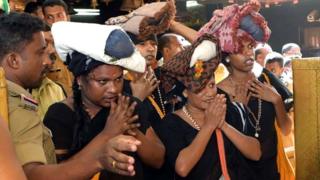
Four transgender women have been allowed to pray at an Indian temple at the centre of a bitter row over whether women should be permitted to enter.
Despite a Supreme Court ruling allowing women devotees into the Sabarimala shrine in Kerala state, they have been blocked repeatedly by mobs.
The transgender women, all wearing black sarees, were allowed to enter on Tuesday under police protection.
The temple has historically been closed to women of “menstruating age”.
The group of transgender women had been blocked from accessing the temple on Sunday by police, citing security concerns.
Image captionThe four joined prayers at the temple on Tuesday
Before September’s Supreme Court ruling, transgender women were allowed to enter the shrine, but since the decision – which sparked violent protests – some police officials had suggested that transgender women should dress as men in order to gain access.
They refused and took their case to a committee set up by the Kerala High Court.
The panel agreed that they could pray at the shrine, and temple officials also said they did not object to the transgender women because they do not menstruate.
‘We followed the rituals’
The earlier ban on women between the ages of 10 to 50 entering the Sabarimala shrine was in place partly because the temple deity, Lord Ayyappa, was a bachelor, the shrine’s management had said.
The court ruling ending the ban led to security concerns as women, including activists, were met with protests from members of the Hindu nationalist Bharatiya Janata Party (BJP) and other allied organisations.
These organisations wanted tradition to be followed, despite the ruling of the court on 28 September based on the fundamental rights of women.
Image captionTheir presence was not met with protests or resistance, police said
One of the transgender women, 33-year-old Trupthi, told BBC Hindi on Tuesday that women like her were “very much part of Hinduism” and were respected as such.
“I am very happy that we were able to pray [to Ayyappa]. We are devotees… we had followed all the rituals that a pilgrim should follow to visit the shrine,” Trupthi said.
She added that the other transgender women to pray at the shrine were Ananya, 26, Renjimol, 30, and Avantika, 24.
They were accompanied by some 20 police officers, but their presence at the temple was not met with protests or resistance, police said.


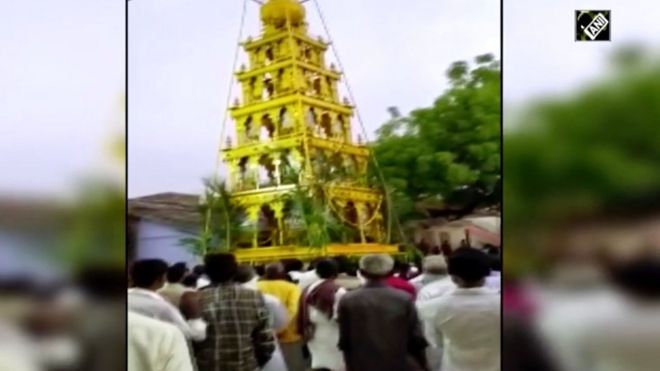 Image copyright ANI


 CHINDIA ALERT: You'll be living in their world, very soon