Archive for ‘TENCENT’

11/11/2019

Spotlight: China-Brazil trade set to reach new heights

SAO PAULO, Nov. 11 (Xinhua) — Though separated by oceans and continents, China and Brazil have fostered deepening bilateral cooperation over the years, especially in  investment, trade and finance.

With the upcoming 11th BRICS summit in Brazil’s capital Brasilia, expectations are high for the development of closer ties between the two countries.

STRENGTHENING INVESTMENT

China and Brazil have bolstered investment ties in recent years, and the Asian country has become Brazil’s largest source of foreign investment.

The two countries are not only deepening cooperation in the traditional areas of agriculture, electricity, mining and infrastructure, but also fostering growth in new areas such as technology innovation and the digital economy.

Last month, Brazilian telecommunications giant Oi put Chinese company Huawei’s 5G technology to the test during a local music festival — the largest trial of the 5G technology in Brazil.

Chinese Internet giant Alibaba’s website AliExpress has become one of Brazil’s most popular cross-border e-commerce platforms. Chinese Internet company Tencent and mobile ride-hailing platform DiDi have also invested in Brazilian companies.

Finally, the participation of Latin American countries — including Brazil — in jointly building the Belt and Road will provide a great opportunity for these countries to enhance investment cooperation with China, said Oliver Stuenkel, an expert of international relations at Brazil’s Getulio Vargas Foundation.

INCREASING TRADE

Although the global economy is facing downward pressure, bilateral trade between China and Brazil has continuously climbed, as both countries are committed to opening up their markets.

China has been Brazil’s largest trading partner and largest export market for a decade. In 2018, bilateral trade hit a record 100 billion U.S. dollars, official data showed.

Cheese bread, Brazil’s favorite breakfast and snack food, is now available at cafeterias in China, thanks to the first China International Import Expo (CIIE) in Shanghai last year.

In May, Brazil’s leading cheese bread maker Forno de Minas shipped its first container of 10 tons of cheese bread to China, supplying cafeterias in Shanghai. Two months later, the bakery shipped a second batch of 18 tons to China.

Brazil is also dedicated to opening up by optimizing its business environment. Li Tie, general manager of the Brazilian branch of BYD, a leading Chinese manufacturer of electric vehicles and batteries, said that the Brazilian government has actively promoted pension and labor law reforms and is planning to carry out tax reforms.

China and Brazil should further enhance their economic and trade relations, which have been fruitful and mutually beneficial, said Sergio Segovia, president of the Brazilian Trade and Investment Promotion Agency.

FINANCIAL COOPERATION

The two countries have enhanced cooperation in the financial sector.

In September, the Brazil government relaxed restrictions on the establishment of financial institutions. Bank XCMG, affiliated to China’s Xuzhou Construction Machinery Group, has become the first foreign bank that was approved by Brazil’s central bank after the release of the new regulation, and the bank’s foreign shareholding ratio is as high as 100 percent.

Wang Yansong, XCMG’s vice president, said that Bank XCMG will carry out financial leasing and other services in Brazil and help companies reduce exchange rate risks and financing costs.

As cross-border trade grows, fin-tech companies from both countries have carried out in-depth cooperation, such as that between Brazilian financial payment company Ebanx and AliExpress, in providing consumers with cross-border payment solutions.

In 2018, Ebanx handled 35 million cross-border transactions related to Chinese merchants, said its co-founder and CFO Wagner Ruiz. He expressed the hope that the company can help Chinese merchants sell more in Latin America in the future.

The BRICS leaders’ meeting is an excellent opportunity for Brazil to deepen business, investment and financial cooperation with China and other BRICS countries, said Marcos Trojan, special secretary for foreign trade and international affairs of Brazil’s Ministry of Economy.

Source: Xinhua

30/09/2019

Go China! Big screen turns patriotism into big box office hits as 70th anniversary celebrations take off

  • Three films that opened on Monday morning rake in US$76.6 million by midday
  • Palme d’Or winner Chen Kaige heads bill with ensemble that has movie-goers in tears
My People, My Country looks at seven events in the past 70 years through the eyes of seven Chinese directors. Photo: Baidu

Three films that paid tribute to the People’s Republic of China on the eve of its 70th anniversary grossed a total of 546 million yuan (US$76.6 million) at the box offices hours after opening on Monday, Maoyan Entertainment, China’s largest movie ticketing app, said.

My People, My Country, consisting of seven short stories by seven directors led by Cannes Palme d’Or winner Chen Kaige, recounted major events since 1949. It took in 225 million yuan.

Milestones including the detonation of China’s atomic bomb in 1964; the handover of Hong Kong from the UK to China in 1997, and the staging of the Summer Olympics in Beijing in 2008, brought back many memories and stirred feelings of national pride, film-goers said.

“I went to see the movie today and saw many primary school students with their parents. Tears welled in my eyes, and I felt touched and proud at the same time. Go China!” one Weibo user wrote.

True-life drama The Captain has proved to a big screen hit with mainland cinema-goers. Photo: Baidu

“This movie used directors of commercial movies, and most of those born in the 1960s and 1970s lived through these moments. I think young people will bring their parents to see the film,” another Weibo user wrote.

True-life drama The Captain, directed by Hong Kong director Andrew Lau Wai-Keung, ran in second with a box office take of 175 million yuan by noon on Monday. The film was based on events in May 2018, when the cockpit window of a Sichuan Airlines flight was shattered at 30,000 feet over the Tibetan Plateau in western China. The decompression pulled the co-pilot halfway out of the cabin as the pilot fought to land the flight safely.

Big-budget film The Climbers, directed by Hong Kong’s Daniel Lee Yan-Kong and featuring stars such as Wu Jing and Zhang Ziyi, retraced the steps of two generations of Chinese mountaineers who scaled Mount Everest by the perilous North Ridge in 1960 and 1975. The film posted earnings of 146 million yuan.

Tencent’s homage to modern China tops gaming charts on eve of 70th anniversary celebrations
Patriotic feelings have been running high this week as the celebration of the 70th anniversary draws near.

My People, My Country’s theme song, Me and My Mother Country, an oldie recorded by Hong Kong’s Faye Wang, has been heard in shops, restaurants and workplaces all across the mainland.

The Climbers was directed by Hong Kong’s Daniel Lee Yan-Kong. Photo: Baidu

Last week, 200 million WeChat users responded to a campaign by internet company Tencent to add a national flag or Happy National Day sticker to their social media profile picture, The Beijing News reported. Demand was so heavy Tencent’s servers were overwhelmed for a short time.

Source: SCMP

10/09/2019

Chinese police detain 100 over US$7 million ‘fortune-telling’ scam

  • Suspects rounded up after people complain of being duped into making donations to support non-existent temples
  • One woman says she handed over US$4,600 after being told that charitable gesture would help her live to be 400
One victim of the alleged scams said she was told she could live for 400 years if she handed over her money. Photo: Thepaper.cn

Police in southeast China have detained 100 people on suspicion of being part of a criminal network that cheated members of the public out of 50 million yuan (US$7 million) by preying on their superstitions and generosity.

Authorities in Ningguo, Anhui province launched an investigation in May after receiving a number of complaints about the activities of several groups posing as fortune-tellers on social media platforms like Weibo, financial news outlet Caijing reported on its website on Tuesday.

One of the groups, which operated on the Twitter-like service under the name “Kanxiang Zen Master”, was run by a local man surnamed Zhang and had 12 million followers, the report said.

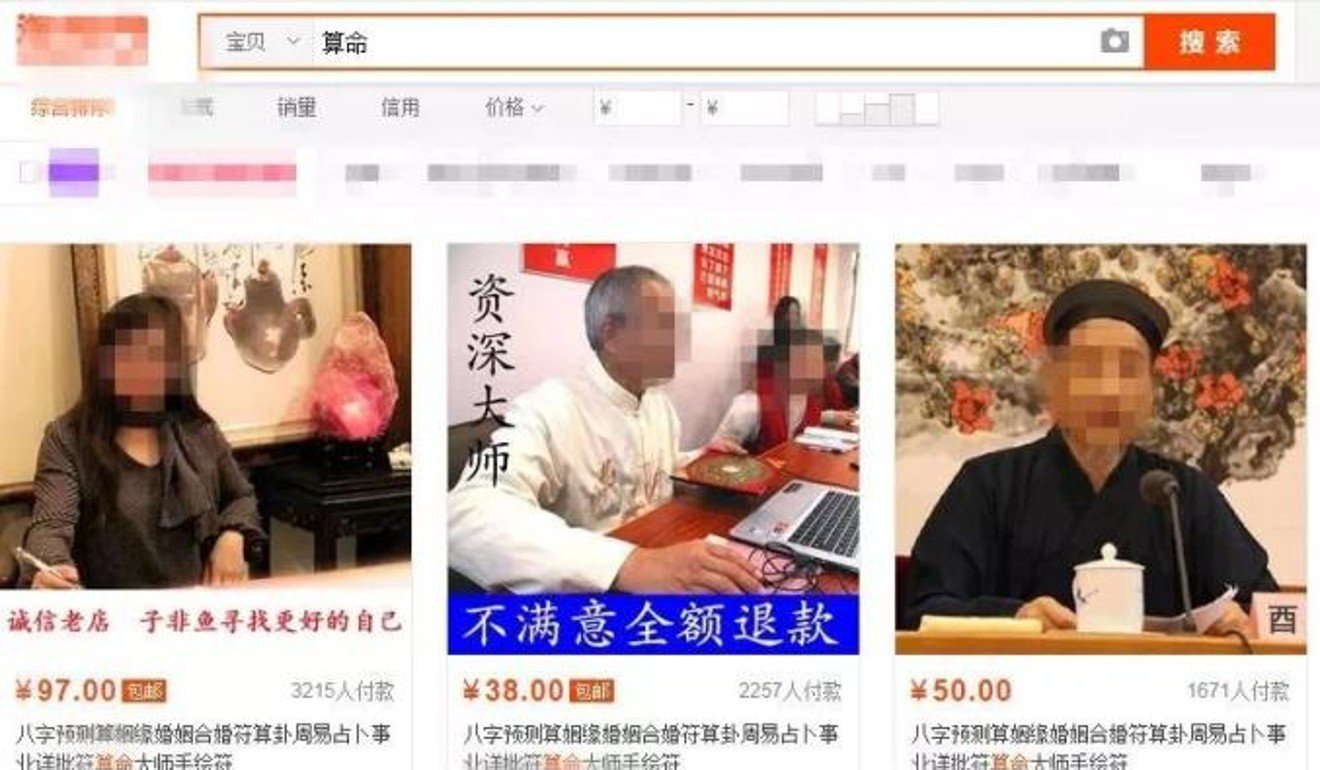
Adverts for online fortune-telling services are common in China. Photo: Thepaper.cn
In one alleged scam, members of the group were told they would receive good luck if they made a donation to support a “famous temple”. But when a man who gifted 10,000 yuan via WeChat Pay checked on the address of the recipient, he found it was a residential address in the city of Xuancheng and not a place of worship, the report said.
When police investigated, they found Zhang had links to seven criminal groups in Anhui and neighbouring Jiangsu province, which between them operated about 60 fortune-telling accounts on Weibo, several of which had more than 10 million followers. The Kanxiang Zen Master account has since been removed from the platform.
Six Chinese wanted for internet scam arrested in Vanuatu

A number of the gangs were registered as media companies and operated as semi-professional organisations with formal recruiting procedures and regular conferences to plan their fraudulent activities, the report said, adding that they had been operating for at least two years.

Police in July staged a series of raids to round up the suspects and confiscated associated equipment, including computers, vehicles and mobile phones, the report said.

Authorities in Ningguo have appealed for more victims to come forward.

A separate report by Shanghai-based news outlet Thepaper.cn said that some of the suspects also used e-commerce sites such as Taobao and the messaging service WeChat to promote their fortune-telling services.

Taobao is owned by Alibaba Group, which also owns the South China Morning Post.

In one case, a woman from the city of Changshu in Jiangsu said she made multiple payments – totalling about 33,000 yuan – to a fortune-teller she met on WeChat who said the money would be used to buy incense for use in offerings to the gods.

She said she reported the alleged fraud after starting to doubt the fortune-teller’s claims, including one that said if she made the donations she could live for up to 400 years.

Alibaba, Weibo and Tencent, which owns WeChat, have been contacted for comment.

Source: SCMP

05/06/2019

National WeChat mini-program launched to promote e-government services

BEIJING, June 5 (Xinhua) — A national WeChat mini-program was launched Wednesday to enable users to enjoy over 200 e-government services via the cross-region and cross-department digital platform.

The mini-program, a small application embedded within China’s popular social media platform WeChat, connects users with services offered by six government agencies including the National Development and Reform Commission and the Ministry of Commerce, according to a statement from WeChat’s developer Tencent.

Individual users can search information about their education and traffic violation record, among others, while enterprises can apply for certain licenses and certificates online via the mini-program.

The mini-program is also connected with local government online service platforms in several provinces including Guangdong and Zhejiang, while more local e-government services will be connected in the future, the statement said.

E-government services via apps and mini-programs are increasingly popular in China amid national and local efforts to cut administrative red tape to benefit residents and businesses alike.

A total of 30 provincial-level regions have established integrated e-government platforms that incorporate the services of provincial, city and county governments, according to a report released in May.

In 2018, the number of real-name users on provincial e-government platforms reached 145 million, an increase of 38 million over the previous year, the report showed.

Source: Xinhua

Law of Unintended Consequences

continuously updated blog about China & India

ChiaHou's Book Reviews

continuously updated blog about China & India

What's wrong with the world; and its economy

continuously updated blog about China & India