Archive for ‘thanks’

29/05/2020

Under shadow of Beijing’s security law, Taiwan president thanks Hong Kong bookseller for supporting democracy

  • Tsai Ing-wen visited exiled Hong Kong bookseller a day after NPC voted in favour of legislation
  • Lam Wing-kee said fleeing Hongkongers saw Taiwan as a step towards applying for asylum in the West
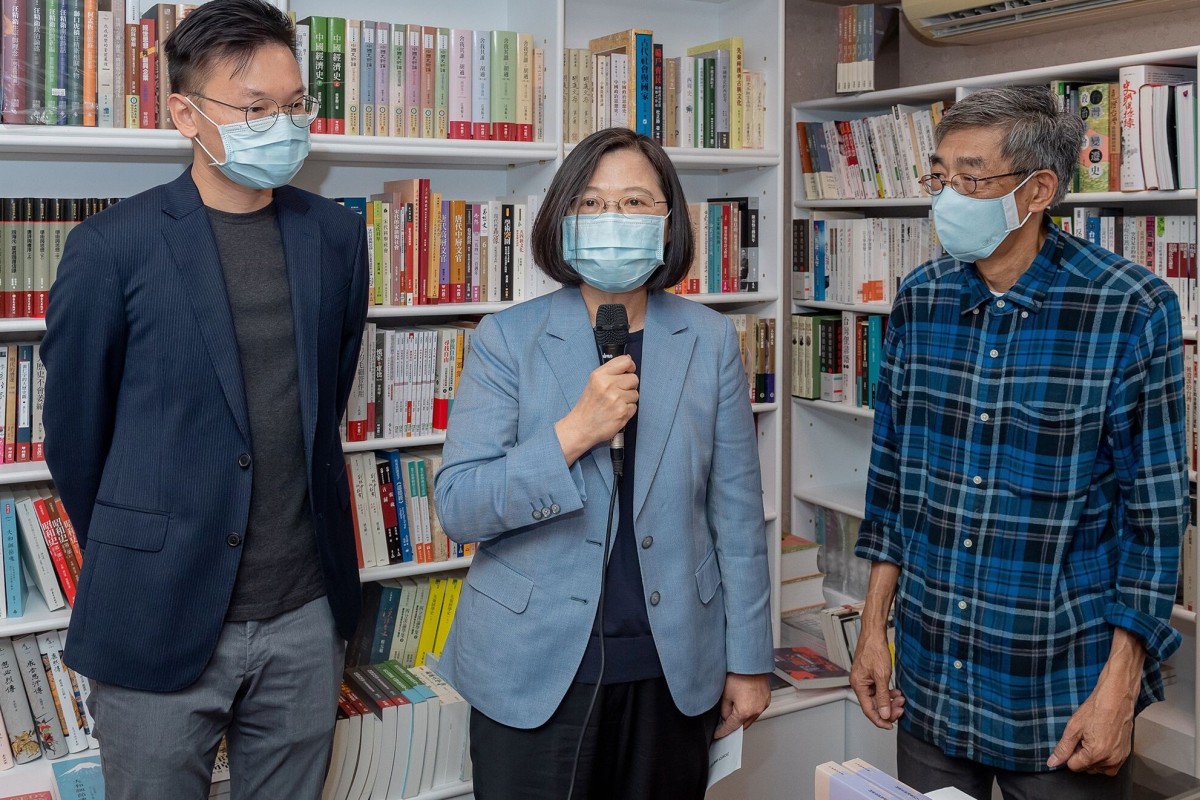
President Tsai Ing-wen (centre) shows her support for Hong Kong bookseller Lam Wing-kee (right) with Lin Fei-fan, deputy secretary general of the ruling Democratic Progressive Party. Photo: Taiwan presidential office/AFP
Taiwan’s President Tsai Ing-wen visited exiled Hong Kong bookseller Lam Wing-kee
on Friday in a show of support for Hongkongers amid Beijing’s plan to introduce a controversial national security law.
Her visit came a day after China’s legislature, the National People’s Congress, voted in favour of a resolution to initiate the legal process for a national security law to be imposed on Hong Kong, despite concerns from the United States, the European Union and elsewhere that the move would erode human rights, freedom and autonomy in the city.
“We want to thank the bookstore boss Lam Wing-kee for his persistent support of human rights, freedom and democracy in Hong Kong from the past to the present stage,” Tsai told Lam, who recently reopened the now-defunct Hong Kong Causeway Bay Books in Taipei.

Tsai said on behalf of all Taiwanese people, she welcomed Lam to stay in Taiwan where he could bolster the island’s efforts to further freedom and democracy.

Hongkongers who want to flee to Taiwan ‘will go through strict screening’

28 May 2020

Lam, one of the five shareholders and staff at Hong Kong’s Causeway Bay Books, fled to Taiwan in April last year after he was detained by Chinese agents for eight months in 2015 for selling books critical of the Chinese leadership.

All five went missing

between October and December that year and it emerged they had been detained on the Chinese mainland.
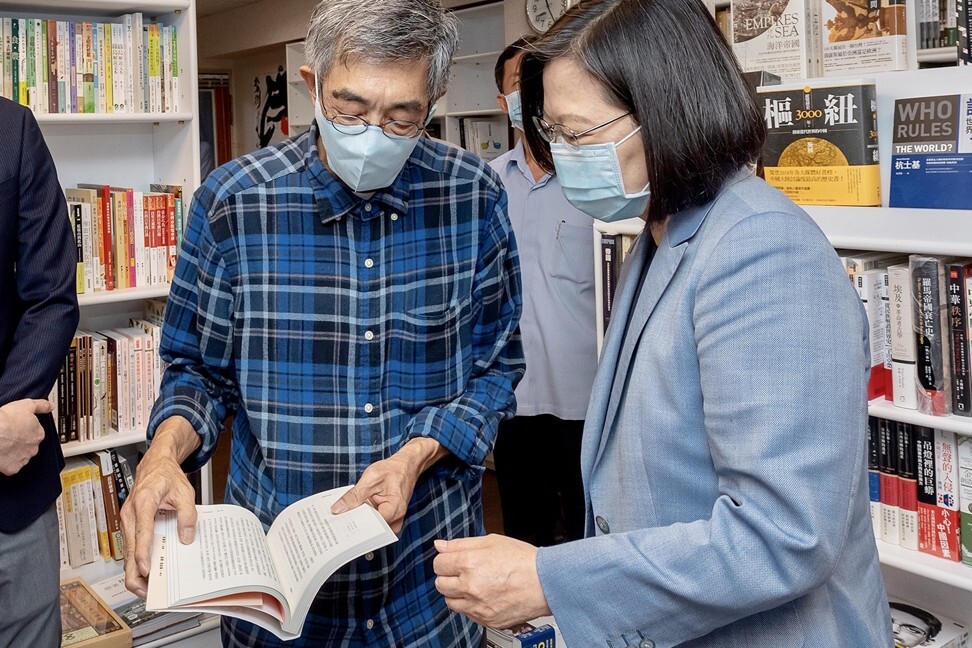
President Tsai Ing-wen looks at a book while visiting Lam Wing-kee on Friday. Photo: Taiwan presidential office/AFP
Lam later said he had been detained and blindfolded by police after crossing the border into mainland China from Hong Kong in October 2015.

The case triggered a huge controversy and raised fears of growing Chinese control in the city.

Seeing Lam as a representative of Hongkongers fleeing to Taiwan to avoid political persecution, Tsai said she wanted to understand what challenges these exiles faced and what help they needed during their stay on the self-ruled island.

“I want to tell Boss Lam [Wing-kee] and our Hong Kong friends that the government here has set up an ad hoc committee to offer help to them very soon,” she said.

On Wednesday, Tsai called for the government to set up an ad hoc committee to work out a “humanitarian help action plan” for Hong Kong people seeking to live in Taiwan or immigrate to the island. It was borne out of concern they would be arrested or prosecuted for taking part in months of anti-government protests triggered last year by the now-shelved extradition bill.

Chen Ming-tong, head of the Mainland Affairs Council, the island’s top mainland policy planner, said on Thursday his council would draft the measures for cabinet’s approval in a week.

Under the plan, the Mainland Affairs Council would issue special measures and coordinate with the island’s authorities on how to help Hongkongers relocate to Taiwan and take care of them.

Bookseller Lam told Tsai what Hongkongers needed most was to have their stay in Taiwan extended.

Lam said that currently, because of the absence of a political asylum law, Hongkongers could only apply to live in Taiwan through study, work, investment, their professional skills or close relatives.

He said fleeing Hongkongers usually came to Taiwan on tourist permits, which at most allowed them to stay for up to six months, giving them not enough time to apply for long-term residence in Taiwan.

“It would be better if they can stay for nine months and preferably one year,” he said.

Lam said some fleeing Hongkongers saw Taiwan as an intermediary base as they hoped to apply for asylum in the West, but it took a long time for Western countries to screen and approve their asylum requests.

Meanwhile, Premier Su Tseng-chang said Article 18 of the Laws and Regulations Regarding Hong Kong and Macau Affairs was good enough to deal with the current crisis in the absence of a political asylum law in Taiwan.

That article states that “necessary help shall be provided to Hong Kong or Macau residents whose safety and liberty are immediately threatened for political reasons”.

Source: SCMP

15/02/2020

Trump thanks Cambodia over ship in rare message to China-ally

SIHANOUKVILLE, Cambodia (Reuters) – U.S. President Donald Trump has thanked Cambodia for taking in the castaway cruise ship MS Westerdam in a rare message to a country that is one of China’s closest allies and has often been at odds with Washington.

Five countries turned away the Westerdam, worried its passengers could be carrying the coronavirus despite it having no known cases before Cambodia’s authoritarian prime minister, Hun Sen, agreed the passengers could disembark there.

“Thank you to the beautiful country of Cambodia for accepting the @CarnivalCruise ship Westerdam into your port. The United States will remember your courtesy,” Trump said in a post on Twitter late on Friday.

The Westerdam, operated by Carnival Corp (CCL.N) unit Holland America Inc, docked in the port of Sihanoukville on Thursday after being shunned for two weeks.

Its 1,455 passengers began to disembark on Friday.

The passengers were tested regularly on the cruise ship and Cambodia also tested 20 once it docked. None were found to have the new coronavirus that has killed more than 1,500 people, the vast majority in China.

Cambodia’s Hun Sen has often sparred with the United States over its accusations of human rights abuses and its condemnation of a crackdown on the opposition since 2017.

He has brought Cambodia much closer to China, which has provided billions of dollars in aid for infrastructure projects and stood by Cambodia in the face of Western criticism.

“We are very grateful that Cambodia opened its port … We hope that other countries can be equally as helpful to people in need,” U.S. Ambassador to Cambodia W. Patrick Murphy told reporters at the Westerdam.

MOUNTING SCRUTINY

The cruise line industry has come under mounting scrutiny amid the virus outbreak after more than 200 people tested positive for the infection onboard a ship quarantined in Japan.

Two ships, German-owned AIDAvita and the Norwegian Jade, were denied entry by Vietnam amid the worries. [L4N2AF052]

These two have, however, docked at Thai ports.

AIDAvita docked at Laem Chabang port on Friday, a Thai Marine Department official told Reuters.

“The ship will leave the port tomorrow.”

The Jade, operated by Norwegian Cruise Line Holdings Ltd (NCLH.N), docked at Ko Samui on Saturday morning, another Thai Marine Department official said.

Health checks show nobody was sick on the ships.

Source: Reuters

Law of Unintended Consequences

continuously updated blog about China & India

ChiaHou's Book Reviews

continuously updated blog about China & India

What's wrong with the world; and its economy

continuously updated blog about China & India