Chindia Alert: You’ll be Living in their World Very Soon
aims to alert you to the threats and opportunities that China and India present. China and India require serious attention; case of ‘hidden dragon and crouching tiger’.
Without this attention, governments, businesses and, indeed, individuals may find themselves at a great disadvantage sooner rather than later.
The POSTs (front webpages) are mainly 'cuttings' from reliable sources, updated continuously.
The PAGEs (see Tabs, above) attempt to make the information more meaningful by putting some structure to the information we have researched and assembled since 2006.
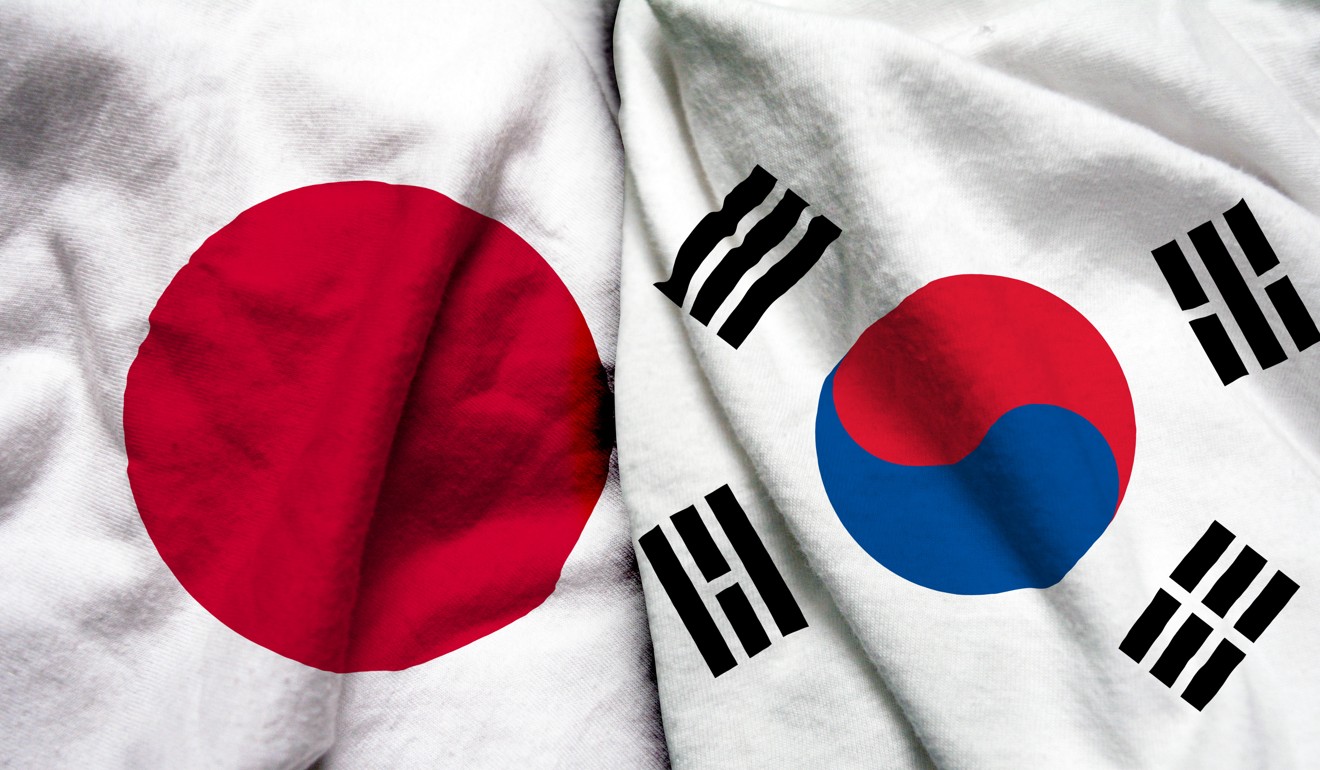
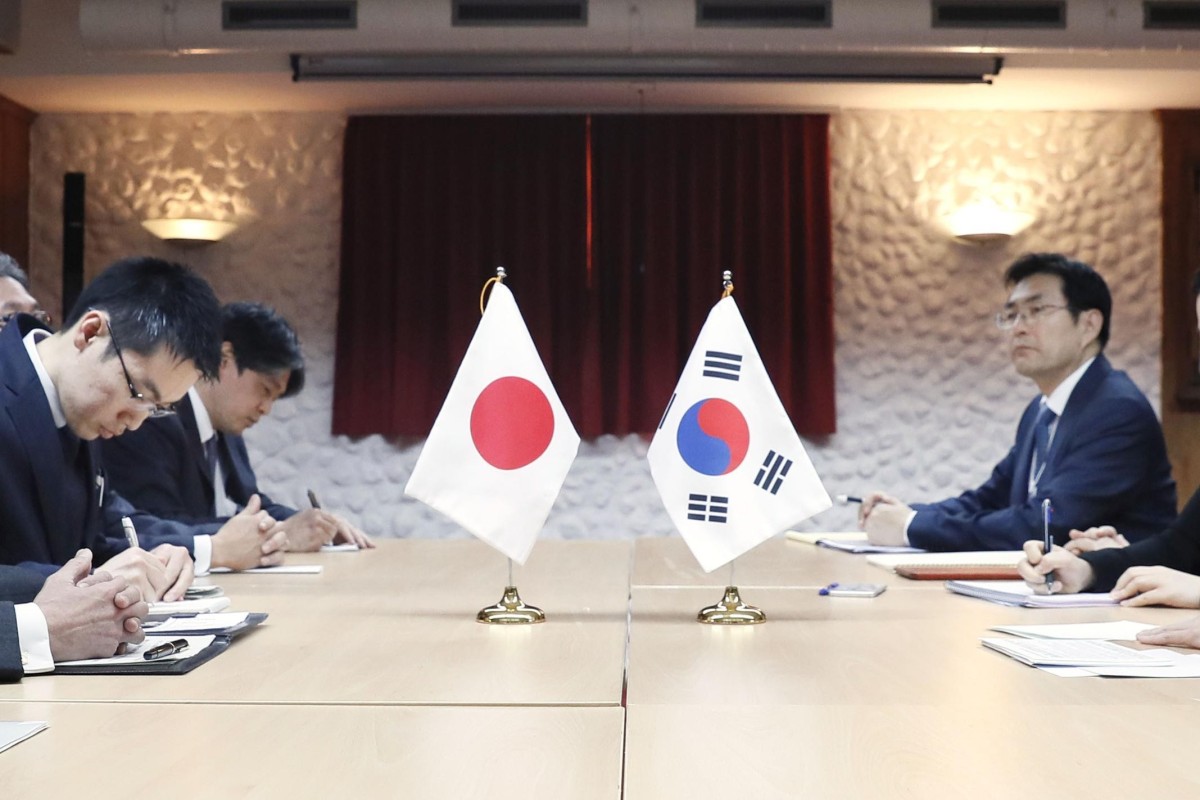
Three-year-old security treaty between US and two key allies under threat as tensions between Seoul and Tokyo continue to escalate
End of General Security of Military Information Agreement risks undermining Washington’s influence in the region
South Korean protesters hold signs saying “No Abe” during a rally demanding the abolition of the General Security of Military Information Agreement. Photo: AP
The possible termination of a military information-sharing pact between South Korea and Japan would be a symbolic victory for China, a security analyst has warned.
Recent tension between the two countries recently threatened to spill over into the sphere of intelligence after Seoul signalled that it may pull out of the General Security of Military Information Agreement (GSOMIA) pact.
The agreement signed in 2016 enables three-way intelligence gathering between the US and its two allies and provides a crucial framework for coping with North Korea’s nuclear and missile threats.
But the escalating trade dispute between Seoul and Tokyo, prompted by a dispute about Japan’s colonial legacy, has left the future of the deal in jeopardy as the annual deadline for its renewal looms.
Japan approves first hi-tech exports to South Korea since start of ‘trade war’ – but with a warning
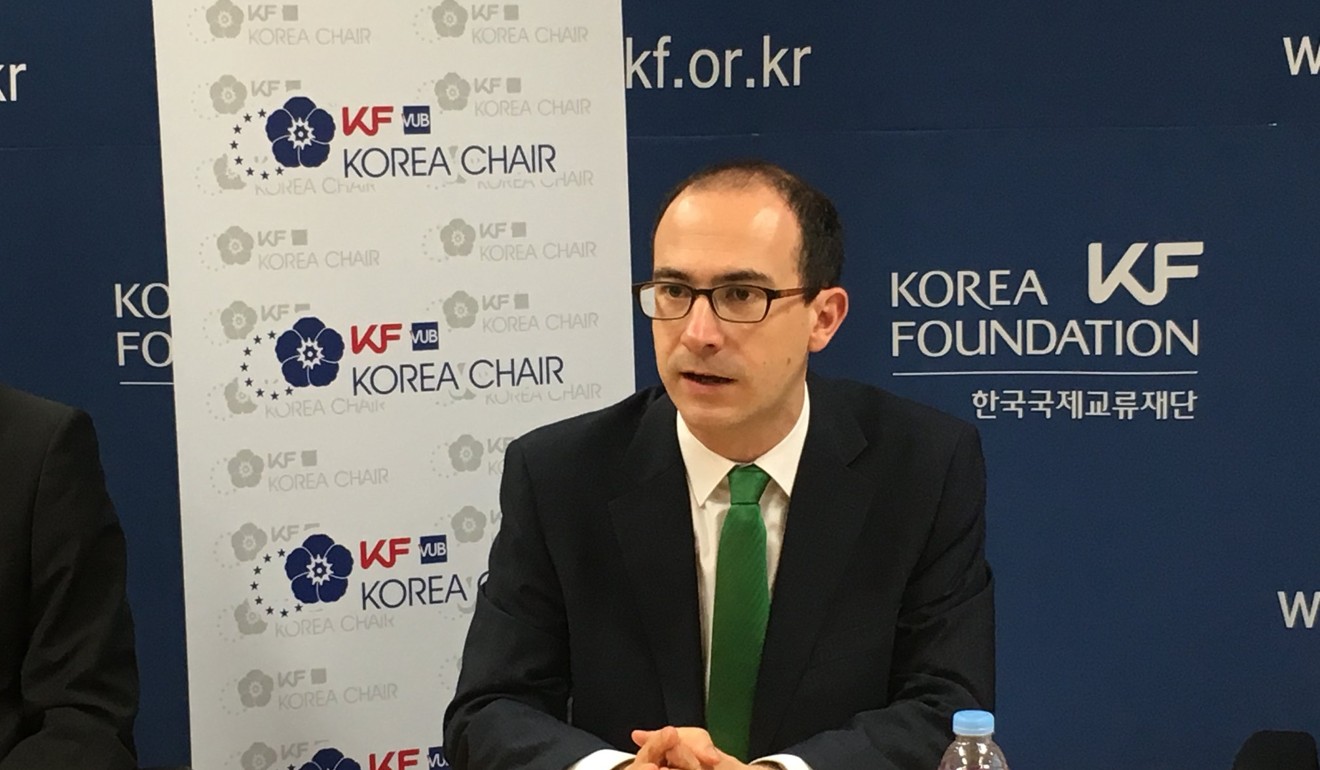
Ramon Pacheco Pardo, the first Korea chair at the Institute for European Studies at Vrije Universiteit Brussel in Belgium, said scrapping the pact would help strengthen China’s influence in the Asia-Pacific region at the expense of the US.
“It is undeniable that termination of GSOMIA would dent the US-South Korea-Japan alliance. The alliance system in northeast Asia will be weaker, strengthening China in relative terms in the process. “This could embolden China and Russia to strengthen their military cooperation in northeast Asia, said Pardo, a member of the non-governmental EU Council for Security Cooperation in the Asia-Pacific.
“Ending GSOMIA would signal that South Korea and Japan are not ready to follow Washington’s lead in the way the latter would like, given the political capital that successive US administrations spent in convincing both countries to share intelligence.”
Ramon Pacheco Pardo said the collapse of the pact would have a largely symbolic impact on China. Photo: Facebook
But Pardo also stressed that the intelligence alliance was not directly targeting China.
“While it is true that GSOMIA serves to connect the weakest link of the US-South Korea-Japan security triangle, ultimately South Korea’s security posture and the capabilities of each country independently mean that it is difficult to argue that the agreement is a concerted effort to contain China.”
“After all, Beijing does not share any significant information on North Korea’s nuclear and missile programmes with South Korea, Japan or the US.
“This is not going to change any time soon. So the good news for China would be symbolic rather than substantial.”
US missiles, jittery neighbours and South Korea’s big security dilemma
Beijing warned on Tuesday that it would take “countermeasures” if the US deployed ground-based missiles in either Japan or South Korea, and Pardo argued that scrapping the intelligence-sharing pact would expose the weaknesses in their co-ordinated approach towards China.
The security deal is automatically renewed every year unless one party decides to pull out. To do so, it must notify the others 90 days before its expiry – a deadline that falls on August 23.
The trade row was sparked by a recent South Korean court ruling that Japanese should compensate individual victims of wartime forced labour. Tokyo believes it settled all necessary compensation under a treaty signed in 1965, but Seoul believes that individual victims’ right to file a claim has not expired.
Relations between South Korea and Japan have deteriorated following a court ruling over forced labour in the wartime era. Photo: Shutterstock
Last week Japan said it would remove South Korea from its “white list” of countries with preferential trade status. Seoul has threatened to respond in kind, but also warned that it may reconsider whether to renew the intelligence-sharing pact.
Both the US and Japan have said they want the arrangement to continue, but Pardo said the effect of the termination would remain largely symbolic.
South Korea has already been investing in its own satellite and anti-submarine programmes to monitor the North’s activities, while Japan has also been developing its own intelligence programmes.
“This shows that neither South Korea nor Japan wants to rely on each other or third parties, namely the US, when it comes to monitoring North Korea’s military activities,” Pardo said.
But he argued that this behaviour already indicated that the alliance was weakening and suggested that terminating the treaty would increase China’s room for manoeuvre.
South Korea buys helicopters worth US$800 million after Trump seeks contribution for US presence
Since the 1990s successive US administrations have pushed for intelligence-sharing arrangements with Japan and South Korea to help build a framework to check Chinese and Russian military expansion in the Pacific.
“Beijing and Moscow are clearly moving in the direction of closer cooperation anyway. GSOMIA or not, military cooperation will continue … as long as Xi Jinping and Vladimir Putin lead each country and most probably even beyond then,” Pardo said.
China and Russia flexed their muscles in the region last month as the trade dispute between the two key allies intensified.
Russian and Chinese long-range military aircraft conducted their first-ever joint air patrol over the Sea of Japan – also known as the East Sea – and the East China Sea.
“The East Asian security landscape would be reshaped insofar that China, North Korea and Russia would see that their main opponent in the region – the US – is unable to convince its two key allies, South Korea and Japan, to cooperate on a key issue,” Pardo said.
“The current dispute between South Korea and Japan will need a negotiated solution … In any case, Japan will have to learn to live with the fact that former colonisers will, from time to time, receive criticism by many of their former colonies, criticism that sometimes will escalate.
“It happens to former European colonial powers, for example, and it is only logical because the interpretation of the past is always in flux.”
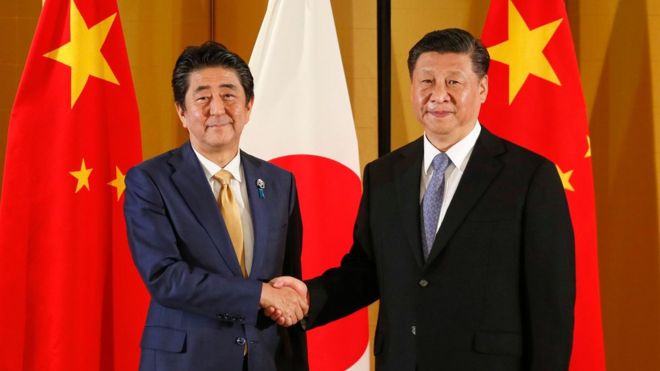
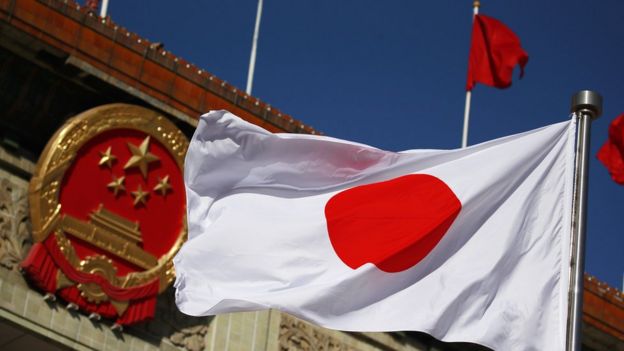
The pair agreed to work together to promote “free and fair trade” following a “very frank exchange”, a Japanese official said.
It is the first official visit Mr Xi has made to Japan since becoming president in 2013. At the outset of their talks on Thursday, Mr Abe invited him to return on a state visit next year.
“Around the time of the cherry blossoms next spring, I would like to welcome President Xi as a state guest to Japan,” he said. “[I] hope to further elevate ties to the next level.”
What did the leaders discuss?
Japan and China are by far Asia’s largest economies and the talks on Thursday focused strongly on business.
Last year, the two sides signed a deal to maintain annual dialogue and to co-operate on innovation. This time around, officials say, they pledged to develop a “free and fair trading system” in a “complicated” global economic landscape.
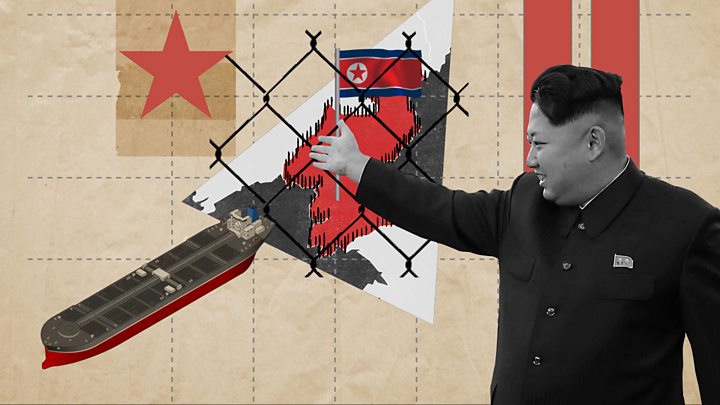
Media caption North Korea has been called out for evading UN sanctions
Another topic on the schedule would probably have been North Korea. While China is North Korea’s biggest trading partner, both Tokyo and Beijing want it to abandon its nuclear programme.
Mr Abe has only very limited leverage on the matter and will try to sway both the US and China to keep Tokyo’s interests in mind in any negotiations.
The G20 summit will begin on Saturday, but the main meeting is likely to be overshadowed by the many bilateral talks that are set to happen on the sidelines.
For example, Mr Xi will meet President Trump as China and the US try to resolve their trade dispute.
Do Japan and China get along?
In the past, relations have been tense. While the two countries do have close trade ties, politically things have been much more fragile.
Image copyright EPAImage caption Japan and China have not always had warm relations
Japan’s World War Two occupation of parts of China remains a very emotional issue. There are also several ongoing territorial disputes between Tokyo and Beijing.
But tensions with Washington over its protectionist trade policy have driven Japan and China into an unlikely friendship.
In 2018, Mr Abe hailed his high-profile visit to Beijing as an historic turning point. Both leaders have since promised to establish positive, constructive, relations.
may be a dominant military force in Asia for now but short of going to war, it will be unable to stop its economic and diplomatic clout from declining relative to China’s power.
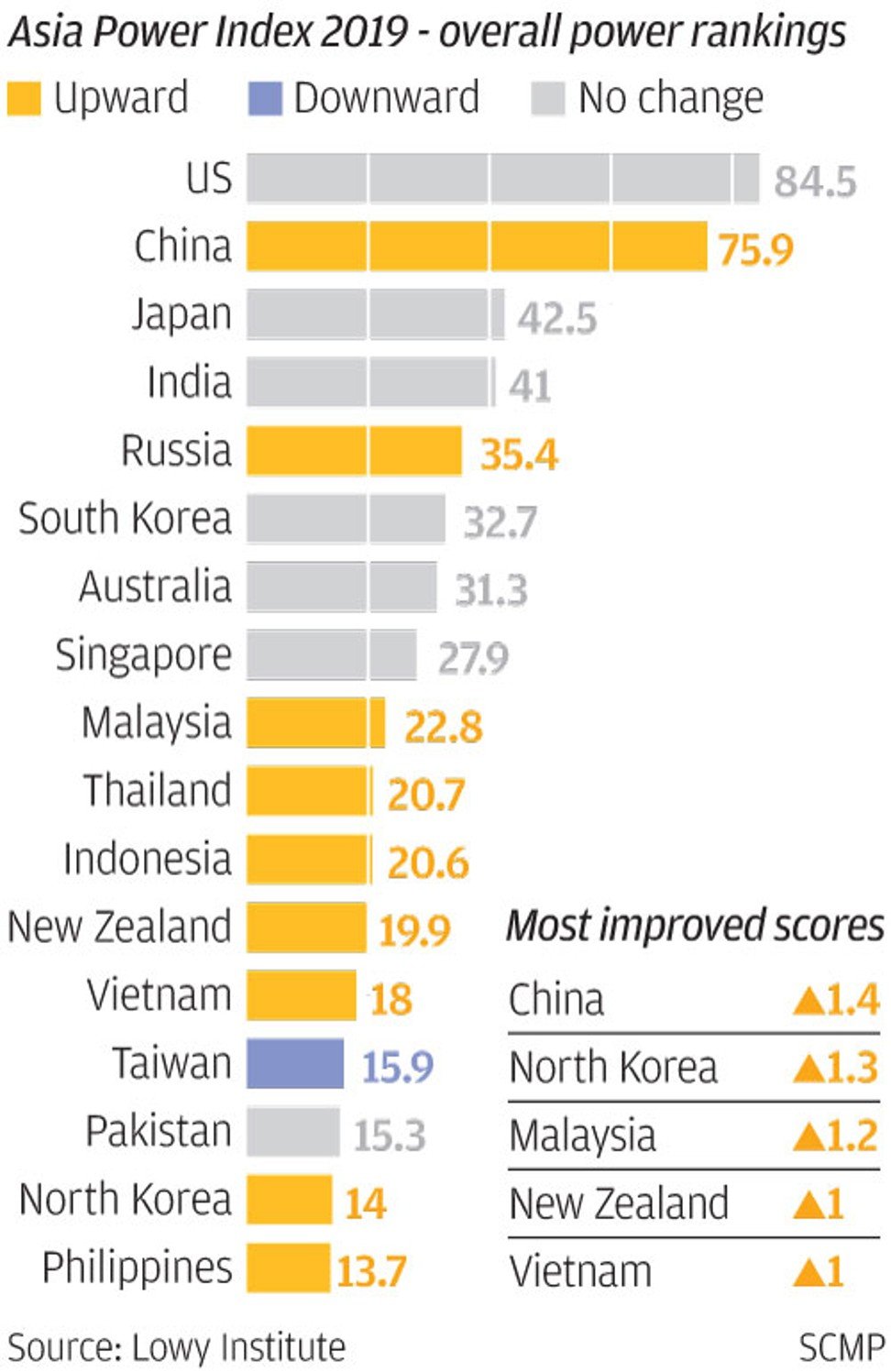
That’s the view of Australian think tank the Lowy Institute, which on Tuesday evening released its 2019 index on the distribution of power in Asia.
However, the institute also said China faced its own obstacles in the region, and that its ambitions would be constrained by a lack of trust from its neighbours.
The index scored China 75.9 out of 100, just behind the US, on 84.5. The gap was less than America’s 10 point lead last year, when the index was released for the first time.
“Current US foreign policy may be accelerating this trend,” said the institute, which contended that “under most scenarios, short of war, the United States is unlikely to halt the narrowing power differential between itself and China”.
The Lowy Institute’s Asia Power Index. Click to enlarge.
. He most recently hiked a 10 per cent levy on US$200 billion worth of Chinese goods to 25 per cent and has also threatened to impose tariffs on other trading partners such as the European Union and Japan.
Herve Lemahieu, the director of the Lowy Institute’s Asian Power and Diplomacy programme, said: “The Trump administration’s focus on trade wars and balancing trade flows one country at a time has done little to reverse the relative decline of the United States, and carries significant collateral risk for third countries, including key allies of the United States.”
The index rates a nation’s power – which it defines as the ability to direct or influence choices of both state and non-state actors – using eight criteria. These include a country’s defence networks, economic relationships, future resources and military capability.
It ranked Washington behind both Beijing and Tokyo in terms of diplomatic influence in Asia, due in part to “contradictions” between its recent economic agenda and its traditional role of offering consensus-based leadership.
The spoils of trade war: Asia’s winners and losers in US-China clash
Toshihiro Nakayama, a fellow at the Wilson Centre in Washington, said the US had become its own enemy in terms of influence.
“I don’t see the US being overwhelmed by China in terms of sheer power,” said Nakayama. “It’s whether America is willing to maintain its internationalist outlook.”
But John Lee, a senior fellow at the Hudson Institute, said the Trump administration’s willingness to challenge the status quo on issues like trade could ultimately boost US standing in Asia.
“The current administration is disruptive but has earned respect for taking on difficult challenges which are of high regional concern but were largely ignored by the Obama administration –
illegal weapons and China’s predatory economic policies to name two,” said Lee.
“One’s diplomatic standing is not just about being ‘liked’ or ‘uncontroversial’ but being seen as a constructive presence.”
CHINA’S RISE
China’s move up the index overall – from 74.5 last year to 75.9 this year – was partly due to it overtaking the US on the criteria of “economic resources”, which encompasses GDP size, international leverage and technology.
China’s economy grew by more than the size of Australia’s GDP in 2018, the report noted, arguing that its growing base of upper-middle class consumers would blunt the impact of US efforts to restrict Chinese tech firms in Western markets.
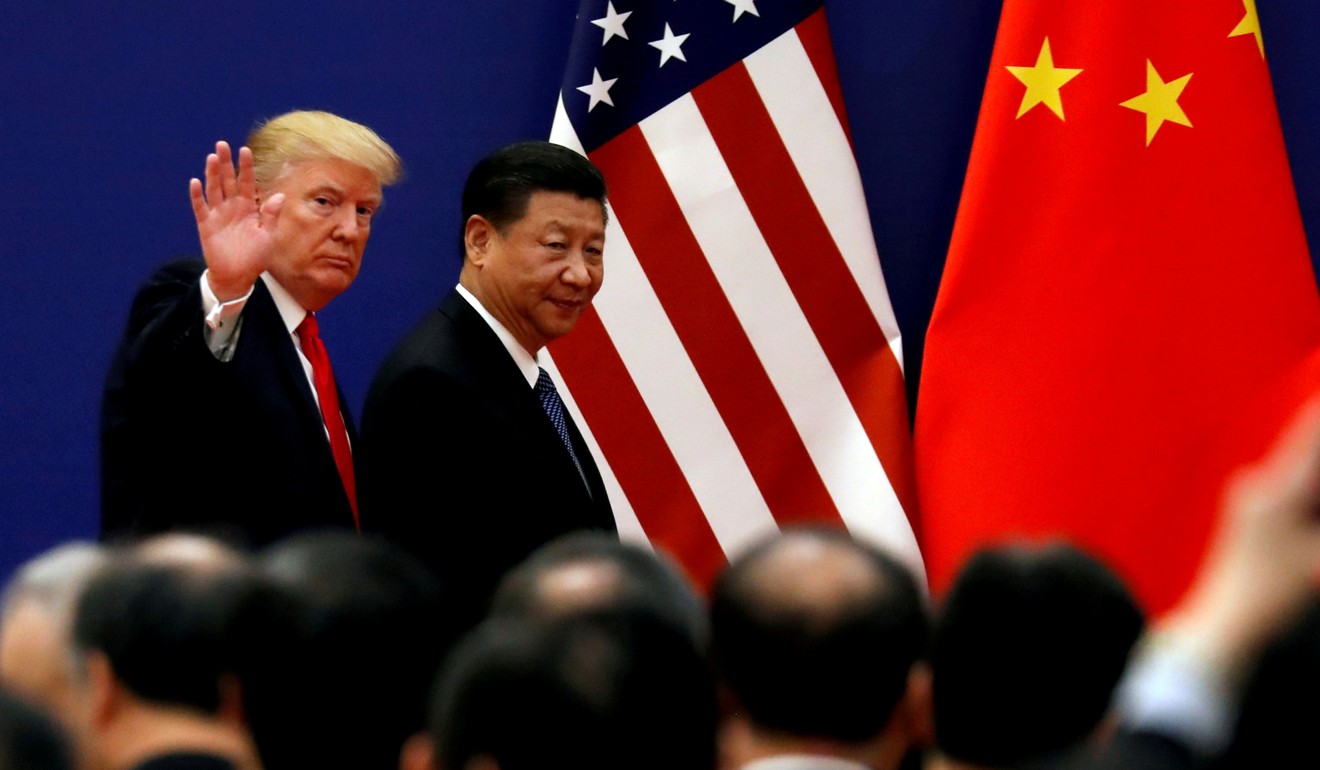
US President Donald Trump with Chinese counterpart Xi Jinping. Photo: Reuters
“In midstream products such as smartphones and with regard to developing country markets, Chinese tech companies can still be competitive and profitable due to their economies of scale and price competitiveness,” said Jingdong Yuan, an associate professor at the China Studies Centre at the University of Sydney.
“However, to become a true superpower in the tech sector and dominate the global market remains a steep climb for China, and the Trump administration is making it all the more difficult.”
The future competitiveness of Beijing’s military, currently a distant second to Washington’s, will depend on long-term political will, according to the report, which noted that China already spends over 50 per cent more on defence than the 10
stands in the way of its primacy in Asia, according to the index, which noted Beijing’s unresolved territorial and historical disputes with 11 neighbouring countries and “growing degrees of opposition” to its signature
and Myanmar due to concerns over feasibility and cost.
If Trump kills off Huawei, do Asia’s 5G dreams die?
Xin Qiang, a professor at the Centre for American Studies at Fudan University in Shanghai, said Beijing still needed to persuade its neighbours it could be a “constructive, instead of a detrimental, force for the region”.
“There are still many challenges for [China to increase its] power and influence in the Asia-Pacific,” Xin said.
Wu Xinbo, also at Fudan University’s Centre for American Studies, said Beijing was having mixed success in terms of winning regional friends and allies.
“For China, the key challenge is how to manage the maritime disputes with its neighbours,” said Wu. “I don’t think there is growing opposition to the Belt and Road Initiative from the region, actually more and more countries are jumping aboard. It is the US that is intensifying its opposition to the project as Washington worries it may promote China’s geopolitical influence.”
would persist and shape the global order into the distant future.
“They can still and do wish to cooperate where both find it mutually beneficial, but I think the more important task for now and for some time to come, is to manage their disputes in ways that do not escalate to a dangerous level,” Yuan said. “These differences probably cannot be resolved given their divergent interests, perspectives, etc, but they can and should be managed, simply because their issues are not confined to the bilateral [relationship] but have enormous regional and global implications.”
Elsewhere in Asia, the report spotlighted Japan, ranked third in the index, as the leader of the liberal order in Asia, and fourth-placed India as an “underachiever relative to both its size and potential”.
China’s wrong, the US can kill off Huawei. But here’s why it won’t
Lee said the index supported a growing perception that Tokyo had emerged as a “political and strategic leader among democracies in Asia” under
“This is important because Prime Minister Abe wants Japan to emerge as a constructive strategic player in the Indo-Pacific and high diplomatic standing is important to that end,” Lee said.
, Malaysia and Thailand rounded out the top-10 most powerful countries, in that order. Among the pack, Russia, Malaysia and Thailand stood out as nations that improved their standing from the previous year.
to address their growing diplomatic spat are receding.
The three-day Asian security forum, which begins on Friday, had been seen as an ideal neutral venue for the two countries’ defence ministers to hold formal talks on issues including Tokyo’s claim that in January a
The issue is one of the biggest deviling the bilateral relationship, alongside Japan’s perception that Seoul has backtracked on a promise to draw a line under Japan’s use of
– euphemistically known as “comfort women” – in military-run brothels during World War Two.
However, Tokyo appears to have concluded that formal talks on the sidelines of the Shangri-La Dialogue would be premature. The Yomiuri newspaper has reported that a formal meeting will no longer take place and that Takeshi Iwaya and Jeong Kyeong-doo, his South Korean opposite number, will now be restricted to a brief, stand-up exchange of their positions.
Despite the report, South Korean officials were guarded when asked whether the meeting had been shelved. “A detailed plan [on the bilateral talks] has yet to be fixed. Consultations are still underway between authorities of the two countries,” said the South Korean defence ministry spokesperson Choi Hyun-soo on Tuesday.
Analysts suggested Japan had run out of patience with South Korea and that the biggest winner in the stand off between two US allies would be China.
Japanese Defence Minister Takeshi Iwaya. Photo: Kyodo
“My sense is that Japan sees South Korea as not engaging in negotiations on a number of issues and not adhering in good faith to agreements that it has already signed,” said Stephen Nagy, a senior associate professor of international relations at Tokyo’s International Christian University.
Tokyo has been incensed that the administration of
has gone back on a 2015 agreement that was meant to draw a final line under the “comfort women” issue. Its anger deepened when Seoul said it would not intervene in a South Korean Supreme Court ruling, which ordered Japanese companies to pay up to 120 million won (US$100,000) to each of a dozen
Like its stance on “comfort women”, Japan believed a line had been drawn under the issue, this time in a 1965 pact that normalised relations between the two countries. Seoul argues that the 1965 treaty, which it signed after receiving US$800 million in grants and soft loans from Tokyo as compensation, does not cover individual victims of colonial-era atrocities.
As rift between Japan, South Korea deepens, how hard can Seoul afford to push?
“Japan is not ready to get into any more agreements because it fears that Seoul will not follow through or that they will become politicised in the future,” Nagy said.
“Tokyo wants binding, long-lasting agreements rather than having to renegotiate something each time a new Korean government comes in,” he said.
“The biggest winner in this stand-off between the US’ two most important allies in the region is, of course, China,” he added. “They must be delighted to see this playing out because it means the US is not able to exert nearly as much pressure in areas such as the
A long-standing strategic aim in US foreign policy circles has been to form a trilateral alliance with South Korea and Japan to present a united front against common security concerns, including China’s growing influence. However, the seeming inability of the two countries to get along has long thwarted this ambition.
“If Japan, South Korea and the US could find a way to cooperate, imagine the influence they could exert over the South China Sea or over
,” Nagy said. “If Japan and Korea could find a way to put their differences aside and with their security capacity, it would be a powerful deterrent to Beijing and Pyongyang.”
South Korean protesters demonstrate against Japan’s use of sex slaves – euphemistically termed ‘comfort women’ in World War II. Photo: AFP
Toshimitsu Shigemura, a professor of international relations at Tokyo’s Waseda University, agreed that the schism between Seoul and Tokyo would be of serious concern to Washington, but he believed that US pressure had already been brought to bear on the two neighbours.
“By avoiding talks in Singapore, Japan is doing its best to avoid public problems between the two sides and I believe that talks are already taking place between the two governments on these issues,” he said.
US wants Japan and South Korea to tag team China. But history is in the way
“The US will have told Tokyo and Seoul that it does not want to see more disagreements and that it is very important that they cooperate and calm things down a bit,” he said.
“I am sure that Washington knows exactly what happened when the Korean warship locked onto the Japanese aircraft in January, but they’re not publicly taking sides and instead they’re telling both governments to put the dispute behind them and to move on,” he added.
Other analysts were more pessimistic.
“The dynamics in domestic politics in both countries are currently overwhelming any diplomatic motives to improve bilateral ties,” said Bong Young-sik, a researcher at the Asan Institute for Policy Studies in Seoul.
Japanese Prime Minister Shinzo Abe. Photo: AFP
“For President Moon Jae-in, Japan-bashing is a useful political card to appeal to his supporters while for
, giving the impression that South Korea is going too far in pressing Japan is also beneficial for his own political gains.”
Professor Ha Jong-moon at Hansin University said there were “no solutions in sight” to resolve the differences over forced labour and wartime sex slavery, but said there would be a chance to “smooth ruffled feathers” at the G20 summit in Osaka, which takes place at the end of June.
The last time the defence ministers of the two countries met was in October last year, when they held talks on the sidelines of the Asean Defence Ministers’ Meeting in Singapore.
HANGZHOU, April 6 (Xinhua) — The city of Ningbo in east China’s Zhejiang Province will launch direct flights to Tokyo and Seoul this year, the city’s Lishe International Airport said.
Sources with the airport said it would also increase flights to domestic cities like Beijing and Qingdao in 2019.
Ningbo has one of the busiest ports in the world.
The airport is expanding its terminal facilities amid a surging passenger volume. The airport handled 11.7 million passengers in 2018, a yearly increase of 24.8 percent.
Middle-aged man seen taking a nap mid-flight said to be senior pilot with the Taiwanese carrier
His co-pilot who took the video has also been reprimanded
China Airlines pilot punished after he’s filmed sleeping in cockpit
23 Feb 2019
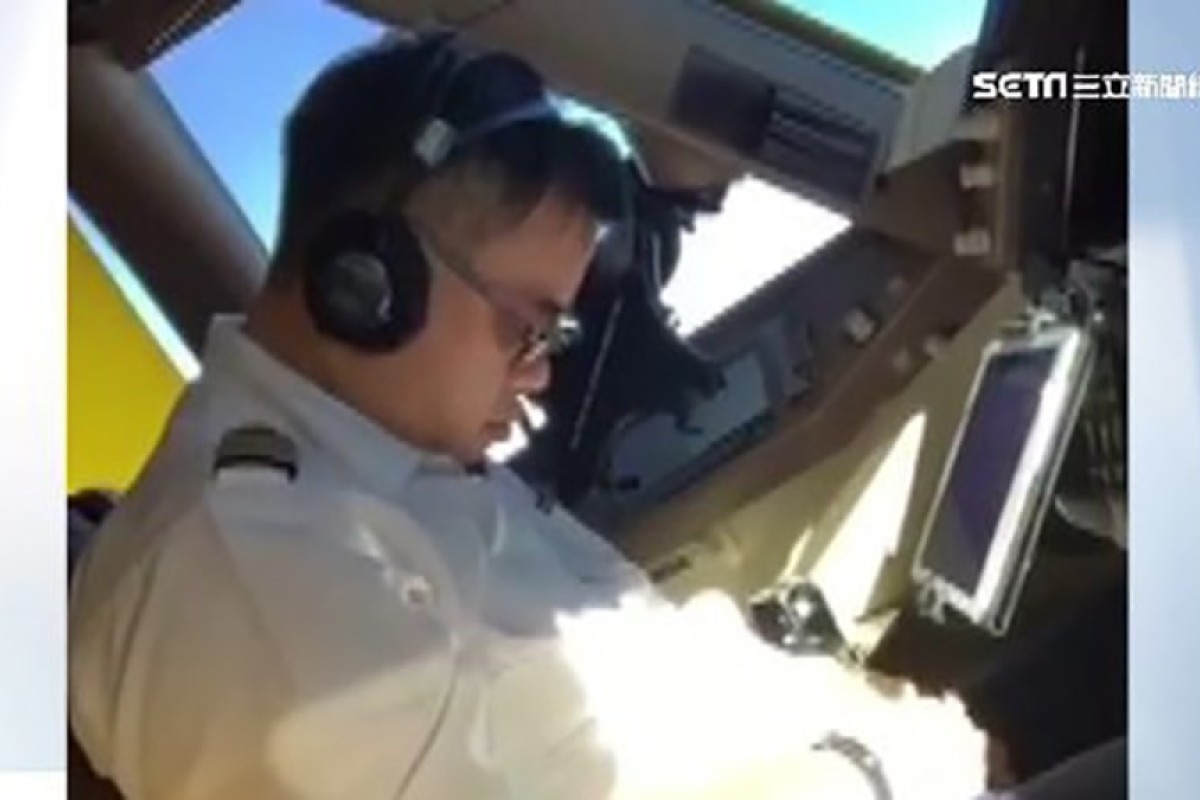
The video shows the pilot in the cockpit with his head down and eyes closed. Photo: setn.com
China Airlines, Taiwan’s biggest carrier, says it has punished a pilot after a video of him taking a nap in the cockpit mid-flight was posted online.
His co-pilot, who filmed the incident, has also been reprimanded, local television station SETN reported.
In the video, a middle-aged man in a pilot uniform and headphones appears to be asleep with his head down and eyes closed while in the cockpit of a Boeing 747.
The footage drew attention after it was shown in a report on Taiwanese TV network EBC on Wednesday. The man was identified as Weng Jiaqi, a senior pilot with almost 20 years of experience who was promoted to chief pilot last year.
Chinese airline Donghai suspends and fines pilot for allowing wife in cockpit
It was unclear when or on which flight the video was filmed, but the airline confirmed that Weng had reported his behaviour and been punished while his co-pilot had been reprimanded for “improper behaviour”, SETN reported.
Weng, who also supervises training, is a short-haul pilot to cities including Hong Kong, Shanghai, Beijing, Guangzhou, Tokyo, Okinawa and Seoul, according to the EBC report.
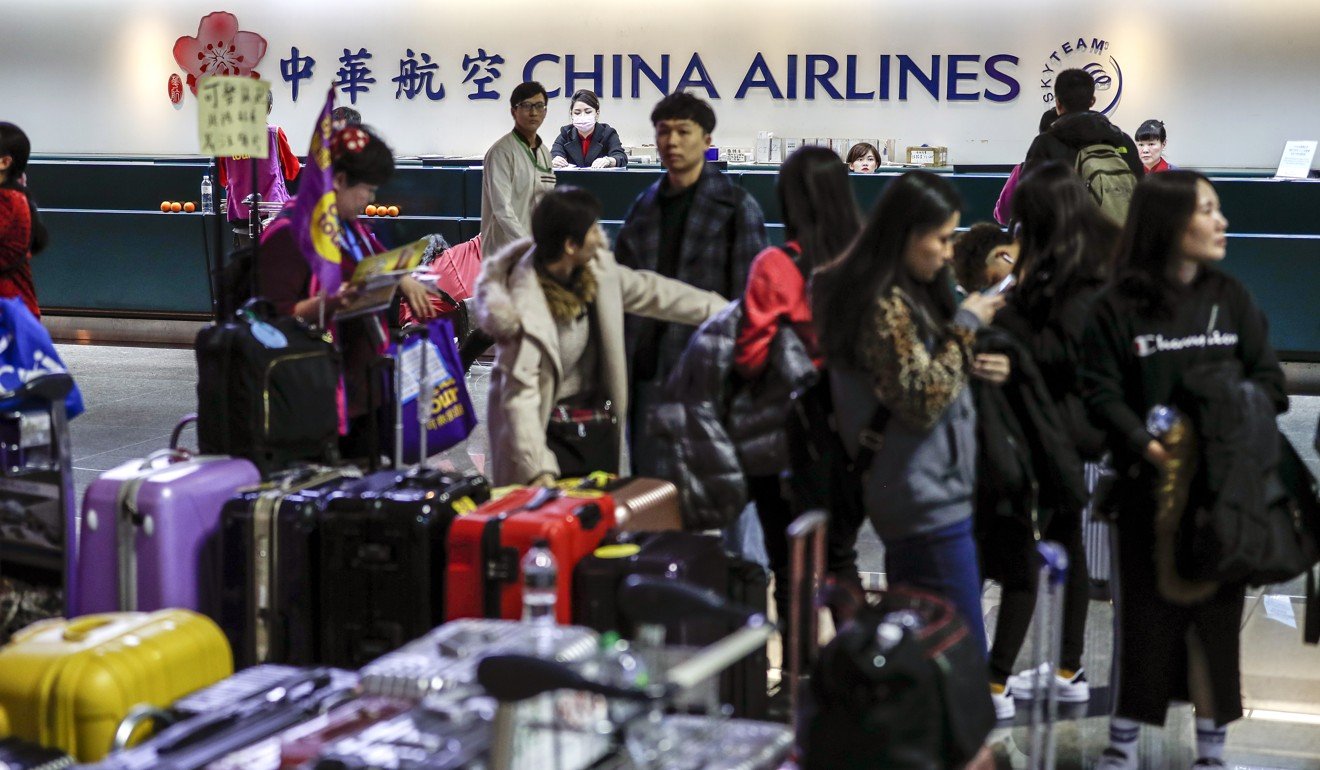
The China Airlines pilots went on strike on February 8, during the Lunar New Year holiday season. Photo: EPA-EFE
Share:
The incident comes after the airline last week reached a deal with the pilots’ union to
over working conditions and benefits that forced the cancellation of more than 200 flights.
But China Airlines told EBC that the video was filmed before the pilots walked off the job.
The Taoyuan Union of Pilots began the industrial action on February 8, stranding close to 50,000 passengers and inflicting over NT$500 million (US$16.2 million) in losses on the carrier.
Under a deal signed on February 14, the union agreed not to strike again in the next 3½ years. In return, China Airlines agreed to the union’s main demand to increase the number of pilots on various flights to combat fatigue and improve safety.
Chinese pilots, cabin crew told no more smoking in cockpits on domestic flights
The carrier will roster three pilots on flights of more than eight hours – up from the present two – and will have four pilots on flights over 12 hours, up from three.
China Airlines president Hsieh Shih-chien said the staffing increases were expected to sharply add to the cost of the company’s operations, but the carrier agreed to the terms in the interest of safety.
LONDON (Reuters) – World shares and bond yields rode a renewed surge in risk appetite on Tuesday, as investors were optimistic about U.S.-China trade talks and cheered Washington’s deal to avoid another government shutdown.
Tokyo’s Nikkei set the tone with its best day of the year so far and Europe wasted little time in trying to lift the STOXX 600 back to the two-month high it set last week.
Germany’s DAX jumped more than 1.2 percent, after rising 1 percent on Monday, and Paris and Milan were up 0.8 percent, while London’s FTSE approached a four-month peak despite ongoing Brexit uncertainty.
The dollar hovered at a two-month high and the Australian dollar also gained. The yen and Swiss franc dipped while U.S. Treasury and German bund yields edged up as investors jettisoned safe havens.
“We have had two bits of relatively good news overnight – optimism about the U.S. shutdown not resuming and optimism about a trade deal,” said Societe Generale strategist Kit Juckes.
“Equities are higher, bond yields are a little bit higher, yen and Swiss franc weakest overnight of the major currencies so it’s sort of risk-on rules OK!”
Juckes said he reckoned there was now a 75 percent chance that a ratcheting up of U.S. tariffs on Chinese goods at the start of March will be avoided and a 95 percent chance that another U.S. government shutdown will be dodged.
Those odds got a boost on Monday after U.S. lawmakers reached a tentative deal on border security funding, though aides cautioned that it did not contain the $5.7 billion President Donald Trump wants to build a wall on the Mexican border.
S&P 500 e-mini futures were up nearly 0.5 percent, pointing to a solid start on Wall Street later after a choppy day on Monday.
U.S. and Chinese officials expressed hopes the new round of talks, which began in Beijing on Monday, would bring them closer to easing their months-long trade war.
Beijing and Washington are trying to hammer out a deal before a March 1 deadline, without which U.S. tariffs on $200 billion worth of Chinese imports are scheduled to increase to 25 percent from 10 percent.
“There will be no winner in a trade war. So at some point they will likely strike a deal,” said Mutsumi Kagawa, chief global strategist at Rakuten Securities in Tokyo.
BIG IN JAPAN
MSCI’s broadest index of Asia-Pacific shares outside Japan edged up 0.3 percent.
Shanghai rose 0.35 percent, South Korea’s KOSPI climbed 0.6 percent and Australian shares gained 0.3 percent.
The Nikkei rallied though, shooting up 2.6 percent after closing on Friday at its lowest level since early January. The Tokyo market was closed on Monday.
With the yen backtracking again, shares of exporters such as automakers and machinery makers led the charge. Separately, Deutsche Bank noted it was 20 years since Japan cut interest rates to zero, something now standard in large parts of Europe.
The dollar held firm, having gained for eight straight sessions against a basket of six major currencies until Monday, its longest rally in two years.
Although the Federal Reserve’s dovish turn dented the dollar earlier this month, some analysts noted the U.S. currency still has the highest yield among major peers and that the Fed continues to shrink its balance sheet.
Wall St wavers as investors eye trade talks, growth fears
“The dollar is the market’s pet currency at present regardless of whether concerns about the global economy are on the rise,” currency strategists at Commerzbank said in a note.
The dollar popped up to a six-week high of 110.65 yen. In contrast, the euro dropped to as low as $1.1267, its weakest in 2-1/2 months, and last traded at $1.1277.
In commodity markets, oil prices also ticked up as traders weighed support from OPEC-led supply restraint and a slowdown in the global economy.
U.S. crude futures traded at $52.68 per barrel, up 0.5 percent. Brent crude rose 0.6 percent to $61.89 per barrel. Gold was a touch stronger at $1,312 an ounce.





 CHINDIA ALERT: You'll be living in their world, very soon