Chindia Alert: You’ll be Living in their World Very Soon
aims to alert you to the threats and opportunities that China and India present. China and India require serious attention; case of ‘hidden dragon and crouching tiger’.
Without this attention, governments, businesses and, indeed, individuals may find themselves at a great disadvantage sooner rather than later.
The POSTs (front webpages) are mainly 'cuttings' from reliable sources, updated continuously.
The PAGEs (see Tabs, above) attempt to make the information more meaningful by putting some structure to the information we have researched and assembled since 2006.
Image copyright TWITTER/@ARVINDKEJRIWALImage caption Delhi Chief MinisterArvind Kejriwal has been handing out masks to school students
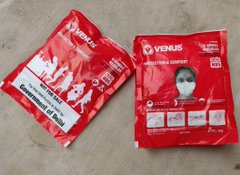
Five million masks are being distributed at schools in India’s capital, Delhi, after pollution made the air so toxic officials were forced to declare a public health emergency.
A Supreme Court mandated panel imposed several restrictions in the city and two neighbouring states, as air quality deteriorated to “severe” levels.
All construction has been halted for a week and fireworks have been banned.
The city’s schools have also been closed until at least next Tuesday.
Delhi’s Chief Minister Arvind Kejriwal said Delhi had been turned into a “gas chamber”.
The masks are being handed out to students and their parents, and Mr Kejriwal has asked people to use them as much as possible.
The levels of tiny particulate matter (known as PM2.5) that enter deep into the lungs are 533 micrograms per cubic metre in the city. The WHO recommends that the PM2.5 levels should not be more than 25 micrograms per cubic metre on average in 24 hours.
As thick white smog blanketed the city, residents started tweeting pictures of their surroundings. Many are furious that the situation remains the same year after year.
The hashtags #DelhiAirQuality and #FightAgainstDelhiPollition are trending on Twitter.
One of the main reasons for air quality in the city worsening every year in November and December is that farmers in the neighbouring states of Punjab and Haryana burn crop stubble to clear their fields. It’s made worse by the fireworks during the Hindu festival of Diwali.
There are other reasons too, including construction dust, factory and vehicular emissions, but farm fires remain the biggest culprit.
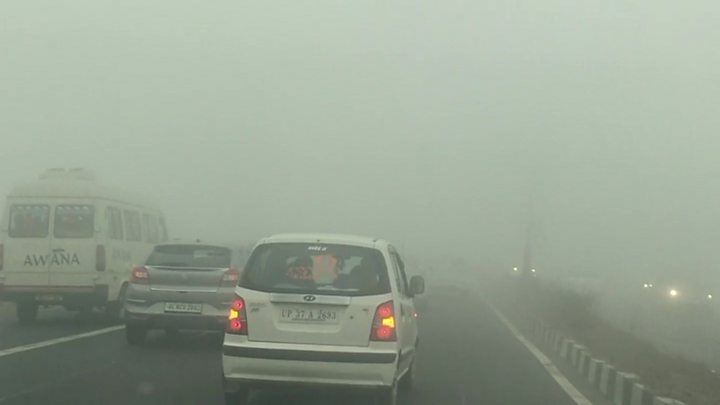
Media caption A hair-raising drive through the Delhi smog
More than two million farmers burn 23 million tonnes of crop residue on some 80,000 sq km of farmland in northern India every winter.
The stubble smoke is a lethal cocktail of particulate matter, carbon dioxide, nitrogen dioxide and sulphur dioxide.
Using satellite data, Harvard University researchers estimated that nearly half of Delhi’s air pollution between 2012 and 2016 was due to stubble burning.
The burning is so widespread that it even shows up in satellite photos from Nasa.
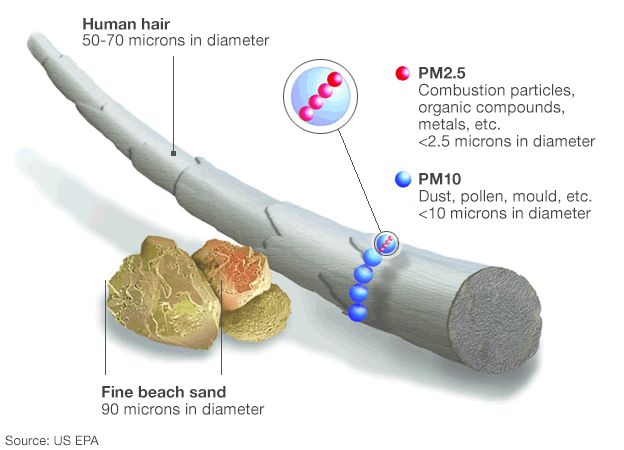
What are PM 2.5 particles?
Particulate matter, or PM, 2.5 is a type of pollution involving fine particles less than 2.5 microns (0.0025mm) in diameter
A second type, PM 10, is of coarser particles with a diameter of up to 10 microns
Some occur naturally – e.g. from dust storms and forest fires, others from human industrial processes
They often consist of fragments that are small enough to reach the lungs or, in the smallest cases, to cross into the bloodstream as well
NEW DELHI (Reuters) – Tens of thousands of runners have signed up for the Indian capital’s half marathon and other races on Sunday, officials said, despite the air quality hitting dangerous levels in one of the most heavily polluted cities in the world.
New Delhi’s air quality index was around 300 on Thursday, classified as very poor and meaning prolonged exposure can cause respiratory illness.
Delhi Chief Minister Arvind Kejriwal, who has described the city as a “gas chamber” in winter, has ordered emergency measures, including restricting the number of private vehicles on the roads under an “odd-even” scheme based on number plates.
Race organisers said pollution was a worry but they would take steps to reduce the impact on runners. Hours ahead of and throughout the race, the course will be sprayed with water.
“The air quality is a concern and will remain a concern, there is no question about it,” said Vivek Singh, joint managing director of Procam International that conducts the race sponsored by telecom operator Bharti Airtel.
“The measures that we take for those few hours to give our runners a good experience have worked in the past.”
The race has been moved this year to avoid a sharp rise in pollutants during Diwali, the Hindu festival of lights, when hundreds of thousands of firecrackers are lit.
But farmers burning crop stubble in the states north of Delhi have turned the air over Delhi toxic. The forecast for the next few days and into Sunday is “very poor”.
A record 40,633 people have signed up for the 21-km, 10-km and a 5-km races. Last year there were 34,916 runners, many of whom wore masks.
A former Olympic gold medallist, Carmelita Jeter of the United States, is the international event ambassador.
Doctors have advised citizens to restrict their outdoor activities and said runners must be made aware of the risks they are taking.
“Just two weeks before the odd-even scheme comes into play, how have the civic authorities allowed more than 30,000 people to expose themselves to toxic air?” asked said Desh Deepak, senior chest physician at the city’s Ram Manohar Lohia Hospital.
NEW DELHI (Reuters) – The Ganges river, holy to most Indians, flows from the western Himalayas down to the Bay of Bengal through crowded cities, industrial hubs and some of the most populated areas in the world.
The river begins as pristine, clear waters in the icy heights of the tallest mountain range in the world. But pollution, untreated sewage and use by hundreds of millions of people transform parts of it into toxic sludge by the time it reaches the sea, about 2,525 kilometres downstream.
Personified by Hindus as the goddess Ganga, the river is the site of thousands of cremations and ash scatterings every day. The Hindu nationalist government of Prime Minister Narendra Modi has launched a nearly $3 billion five-year plan to clean up the river by 2020, but Reuters found last year that only a tenth of the funds had been used in the first two years of the project.
A Reuters team that investigated the state of the holy river has compiled data and photographs to portray its condition.
The government maintains it is on track to clean up the river.
Water Resources Minister Nitin Gadkari said last month that the Ganges will be 70 percent to 80 percent clean within three months and 100 percent clean by March 2020. He did not give details on how the government had arrived at the figures and did not respond to requests for further comment.


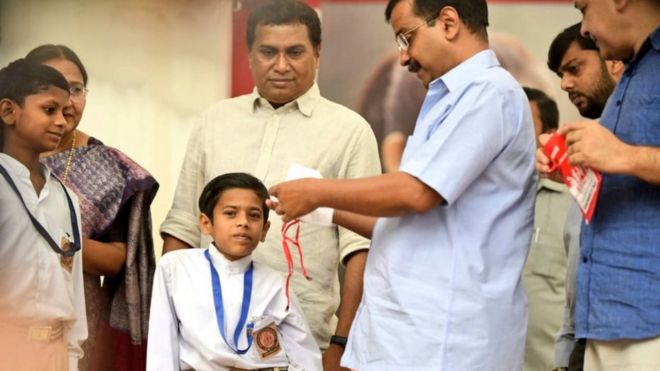 Image copyright TWITTER/@ARVINDKEJRIWAL
 Arvind Kejriwal



 Mrigshira Tripathi@MrigshiraT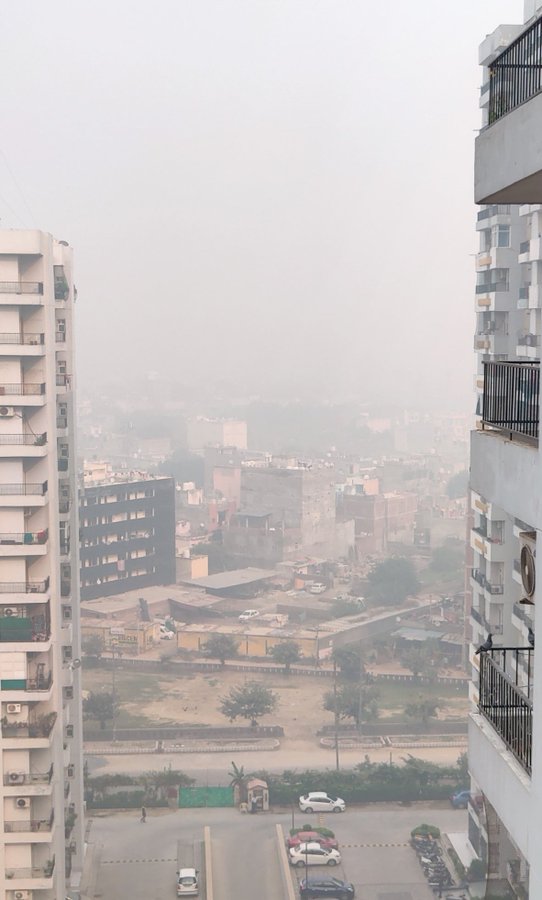
 Kashish Garg@erkashishgarg01
 BihariBabu@mayanksledger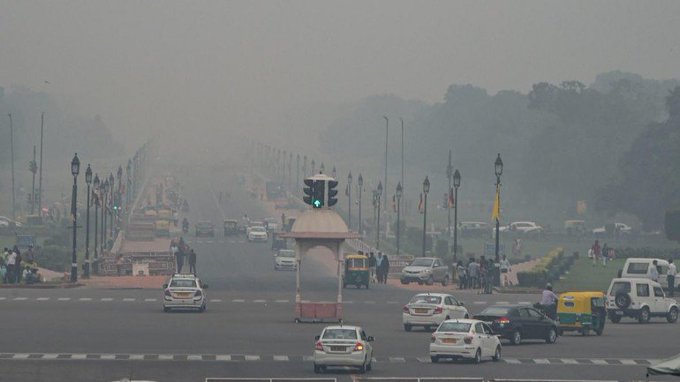
 Vishal L@vishmlondhe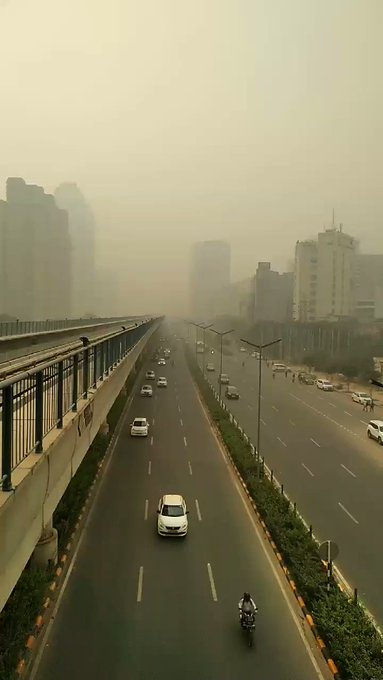

 CHINDIA ALERT: You'll be living in their world, very soon