Archive for ‘traffic jams’

12/11/2019

Hong Kong protests: Rule of law on ‘brink of collapse’, police say

Hong Kong’s rule of law has been pushed to the “brink of total collapse” after more than five months of protests, police have warned.

The warning came as protesters clashed with police across the city on Tuesday.

At the Chinese University of Hong Kong, police fired tear gas and rubber bullets at protesters who built barricades on the campus.

Earlier in the day, around 1,000 protesters rallied in central Hong Kong during the lunch hour blocking roads

Protesters, wearing office clothes, were seen chanting: “Fight for freedom, stand with Hong Kong!”

The demonstrations come just a day after the territory saw a marked escalation in violence, with police shooting one activist in the torso. A pro-Beijing supporter was set on fire by anti-government protesters.

The protests started in June against a now-withdrawn plan to allow extradition to mainland China, but have since morphed into wider demonstrations, with activists demanding greater democracy and police accountability in Hong Kong.

On Tuesday afternoon, police spokesman Kong Wing-cheung hit out at the protesters, saying they had “countless examples of rioters using random and indiscriminate violence against innocent” people.

“Hong Kong’s rule of law has been pushed to the brink of total collapse as masked rioters recklessly escalate their violence under the hope that they can get away with it,” he told reporters, adding that Monday’s attack on the pro-Beijing supporter was being investigated as attempted murder.
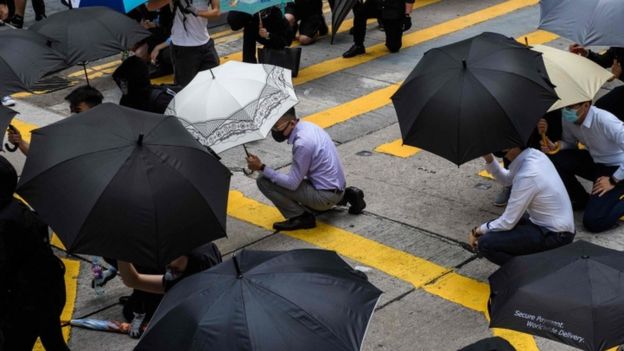
Office workers and protesters gather in CentralImage copyright AFP
Image caption Protesters and office workers were seen blocking roads in Hong Kong’s financial district

Speaking at the same conference, Supt Li Kwai-wah defended the officer’s decision to shoot the protester on Monday.

“We found out that our colleague did not only face threat from one person, instead it was a group of people with an organised plan attempting to steal the gun,” he said.

“In a situation like this, we believe our police are reacting according to the guideline, to protect themselves as well as the people around them.”

Both the protester and the pro-Beijing supporter remain in hospital, with the latter in a critical condition.

What happened on Tuesday?

Clashes erupted at the Chinese University of Hong Kong, with police firing tear gas to disperse students, while at City University there was a standoff between students and riot police which continued into the evening.

Police continued to use tear gas to try to disperse the protesters who responded with bricks and petrol bombs. Hundreds of protesters remain at the Chinese University of Hong Kong.
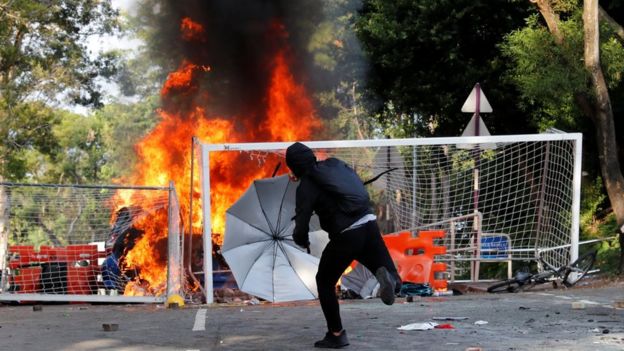
A university students throws an object at riot policeImage copyright REUTERS
Image caption Students at Hong Kong’s Chinese University fought with police throughout the day

Students built roadblocks on streets in and around City University campus to stop police from entering. At one stage, a van used as part of a street barricade was set on fire.

Students at Hong Kong Polytechnic also tried to disrupt traffic near their campus.

In the morning, suspended railway services and road closures had already led to long traffic jams in the early rush hour. At noon, protesters moved into the city’s central business district for a flash mob protest.
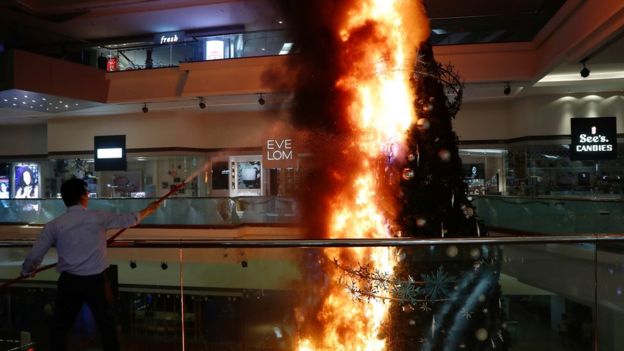
A Christmas tree inside a shopping mall on fireImage copyright REUTERS
Image caption At Festival Walk shopping mall, a Christmas tree was set on fire

Protests continued to intensify throughout the day. A Christmas tree inside Festival Walk shopping mall was set on fire by protesters while others were seen smashing a glass railing with hammers.

Train stations were closed across the city.
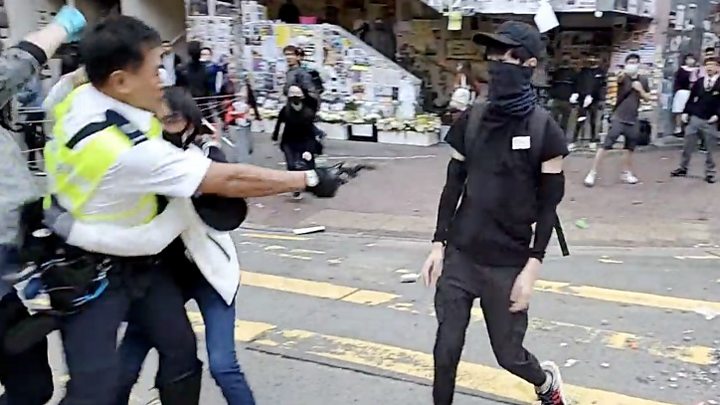
Media caption This Hong Kong protester’s shooting was livestreamed on Facebook

Eight universities have announced they will suspend classes on Wednesday.

Monday’s protests saw 260 people arrested bringing the number to more than 3,000 since the protests began in June.


Students swear they will not surrender

Grace Tsoi, BBC World Service, at the Chinese University of Hong Kong
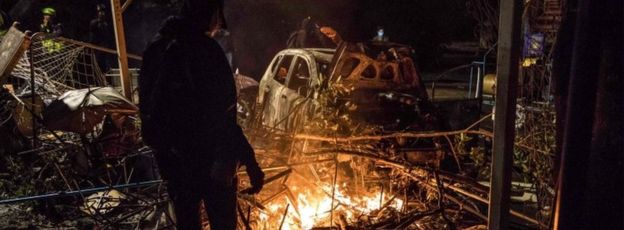
A protester looks at destruction at the Chinese University of Hong KongImage copyright AFP
Image caption Hundreds of protesters remain at the university

The ground was strewn with bricks. The air was filled with the smell of tear gas. Fire was raging on campus. Hundreds of protesters, most of them clad in black, formed human chains to pass bricks and petrol bombs to the front line.

One of the best universities in Hong Kong has turned into a battlefield after another day of intense clashes between students, who have been at the forefront of anti-government protests, and police.

The Chinese University students have been putting up resistance since the morning. On Monday, police seemed to change strategy by deploying forces to campuses. Students told me they should not be allowed there.

The university’s management has tried to deescalate the situation. Vice-chancellor Rocky Tuan was also tear gassed as he was negotiating with police.

Dozens of students have been injured, including at least one hit in the eye by a projectile. The night is young and students swear they will not surrender.


Why are there protests in Hong Kong?

Hong Kong is part of China but as a former British colony it has some autonomy and people have more rights.

The protests started in June against plans to allow extradition to the mainland – which many feared would undermine the city’s freedoms.

The bill was withdrawn in September but demonstrations continued and now call for full democracy and an inquiry into police behaviour.

Clashes between police and activists have become increasingly violent and in October the city banned all face masks.

Source: The BBC
07/10/2019

Aarey protests: Supreme Court steps in to save Mumbai trees after protests

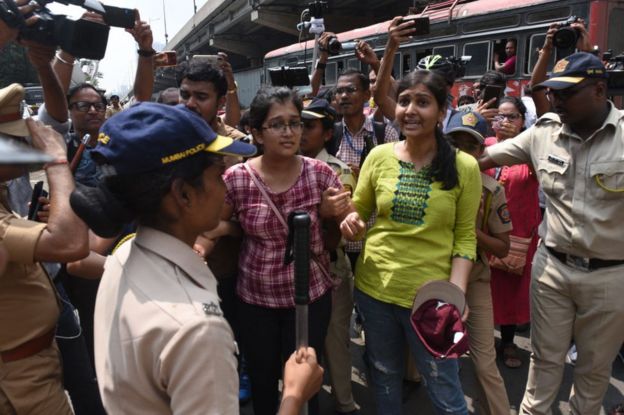
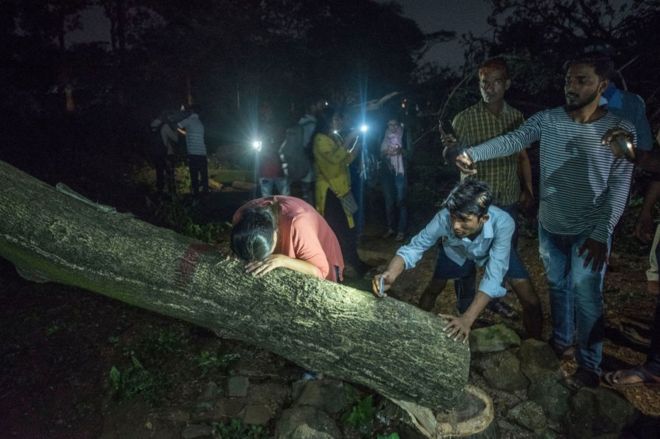
Protesters cry over felled trees in Aarey colony on October 5, 2019 in Mumbai, India.Image copyright GETTY IMAGES
Image caption Protesters cry over felled trees in Aarey colony

India’s top court has asked officials to stop cutting trees in a forested area in Mumbai city after protesters clashed with police over the weekend.

The trees, part of a green strip known as Aarey colony, were being cut to make way for a new metro rail project.

Locals have long opposed the move, and filed petitions seeking Aarey to be declared a protected area.

But a high court dismissed the petitions on Friday, sparking protests as officials began felling the trees.

They planned to cut 2,185 trees, and admitted in the Supreme Court that more than 1,500 had already been cut. But petitioners claim that officials have cut around 2,500 trees.

Local residents, students and environmental activists clashed with police on Friday as they took to the streets to stop authorities, and even broke through barricades to enter Aarey colony. More than 50 people were arrested and police imposed restrictions on public gatherings.

The protests grabbed the national spotlight over the weekend, and the Supreme Court took suo moto (without a formal complaint from any party) notice.

What did the Supreme Court say?

A special two-judge bench heard the matter on Monday after students wrote to the chief justice, asking the court to intervene and save the trees.

The court asked the state government of Maharashtra, where Mumbai is located, to not cut any more trees.

Activists were forcefully evacuated from Aarey Checknaka and taken to local Police Station at Goregaon, on October 5, 2019 in Mumbai, India.Image copyright GETTY IMAGES
Image caption Police arrested more than 50 protesters

The court also asked the government to maintain “status quo” – which means that no construction can take place – until 21 October when it will hear the matter again.

The court also ordered the release of all activists who were arrested or detained on bail.

What is Aarey colony?

Spread over 1,300 hectares (3,212 acres), Aarey is a densely forested area dotted with lakes and has the Mithi river flowing through it. It lies at the heart of Mumbai and is often referred to as its last green lung.

It’s locally known as the Aarey “milk colony” because most of the land was given to the department of dairy development in 1951. But they are allowed to grow cattle fodder only on a fraction of the land.

Activists break barricades to stop authorities from cutting at the main gate of Metro car shed , Picnic point, Aarey colony , Goregaon east, on October 5, 2019 in Mumbai.Image copyright GETTY IMAGES
Image caption Protesters broke through barricades and clashed with police on Friday

Earlier this year, officials cleared some 40 hectares of the forested area to build a zoo, complete with a night safari. And now, locals complain, another slice of it is in danger from the metro construction.

They also fear that the government will eventually clear the way for private builders to encroach on the Sanjay Gandhi National Park, which lies to the north of Aarey colony.

Officials, however, dismiss these fears as unfounded and point out that the construction for the metro only requires 30 hectares.

How crucial is the metro rail for Mumbai?

The city badly needs a “mass rapid transport system,” Ashwini Bhide, managing director of the Mumbai metro rail corporation, had told the BBC earlier.

The land in Aarey colony, she said, was “the most suitable land due to its size, shape and location”.

She has also been defending the decision to cut the trees on Twitter.

Presentational white space

India’s financial hub is congested and infamous for its crawling traffic jams.

Its colonial-era local train system ferries some 7.5 million people between the city’s suburbs and its centre on a daily basis.

Officials say that the metro will eventually carry around 1.7 million passengers every day and bring down the number of vehicles on the road by up to 650,000.

Source: The BBC

26/09/2019

Can catering robots plug labour shortfall in China with ability to juggle hundreds of orders and not complain?

  • An increasing proportion of young people no longer willing to wait tables in China as restaurant owners look to new technology for answers
Catering robots developed by Pudu Tech, the three-year-old Shenzhen start-up, have been adopted by thousands of restaurants in China, as well as some foreign countries including Singapore, Korea, and Germany. Photo: Handout

Two years ago, Bao Xiangyi quit school and worked as a waiter in a restaurant for half a year to support himself, and the 19 year-old remembers the time vividly.

“It was crazy working in some Chinese restaurants. My WeChat steps number sometimes hit 20,000 in a day [just by delivering meals in the restaurant],” said Bao.

The WeChat steps fitness tracking function gauges how many steps you literally take and 20,000 steps per day can be compared with a whole day of outdoor activity, ranking you very high in a typical friends circle.

Bao, now a university student in Hangzhou, Zhejiang province, quit the waiter job and went back to school.

“I couldn’t accept that for 365 days a year every day would be the same,” said Bao.
“Those days were filled with complete darkness and I felt like my whole life would be spent as an inferior and insignificant waiter.”
Olivia Niu, a 23-year-old Hong Kong resident, quit her waiter job on the first day. “It was too busy during peak meal times. I was so hungry myself but I needed to pack meals for customers,” said Niu.

Being a waiter has never been a top career choice but it remains a big source of employment in China. Yang Chunyan, a waitress at the Lanlifang Hotel in Wenzhou in southeastern China, has two children and says she chose the job because she needs to make a living.

Catering robots developed by Pudu Tech, the three-year-old Shenzhen start-up. Photo: Handout

Today’s young generation have their sights on other areas though. Of those born after 2000, 24.5 per cent want careers related to literature and art. This is followed by education and the IT industry in second and third place, according to a recent report by Tencent QQ and China Youth Daily.

Help may now be at hand though for restaurants struggling to find qualified table staff who are able to withstand the daily stress of juggling hundreds of orders of food. The answer comes in the form of robots.

Japan’s industrial robots industry becomes latest victim of the trade war
Shenzhen Pudu Technology, a three-year-old Shenzhen start-up, is among the tech companies offering catering robots to thousands of restaurant owners who are scrambling to try to plug a labour shortfall with new tech such as machines, artificial intelligence and online ordering systems. It has deployed robots in China, Singapore, Korea and Germany.
With Pudu’s robot, kitchen staff can put meals on the robot, enter the table number, and the robot will deliver it to the consumer. While an average human waiter can deliver 200 meals per day – the robots can manage 300 to 400 orders.
“Nearly every restaurant owner [in China] says it’s hard to recruit people to [work as a waiter],” Zhang Tao, the founder and CEO of Pudu tech said in an interview this week. “China’s food market is huge and delivering meals is a process with high demand and frequency.”
Pudu’s robots can be used for ten years and cost between 40,000 yuan (US$5,650) and 50,000 yuan. That’s less than the average yearly salary of restaurant and hotel workers in China’s southern Guangdong province, which is roughly 60,000 yuan, according to a report co-authored by the South China Market of Human Resources and other organisations.
As such, it is no surprise that more restaurants want to use catering robots.
According to research firm Verified Market Research, the global robotics services market was valued at US$11.62 billion in 2018 and is projected to reach US$35.67 billion by 2026.
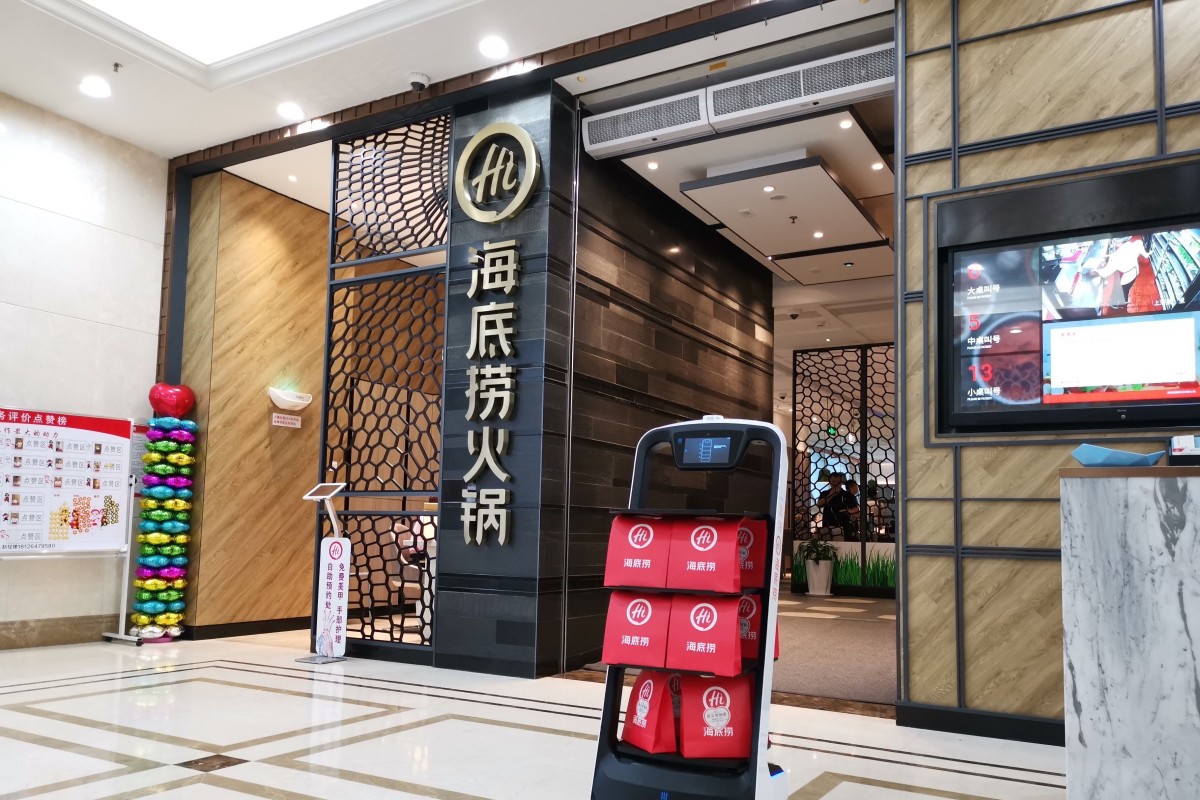
Haidilao, China’s top hotpot restaurant, has not only adopted service robots but also introduced a smart restaurant with a mechanised kitchen in Beijing last year. And in China’s tech hub of Shenzhen, it is hard to pay without an app as most of the restaurants have deployed an online order service.
Can robots and virtual fruit help the elderly get well in China?
China’s labour force advantage has also shrank in recent years. The working-age population, people between 16 and 59 years’ old, has reduced by 40 million since 2012 to 897 million, accounting for 64 per cent of China’s roughly 1.4 billion people in 2018, according to the national bureau of statistics.
By comparison, those of working age accounted for 69 per cent of the total population in 2012.
Other Chinese robotic companies are also entering the market. SIASUN Robot & Automation Co, a hi-tech listed enterprise belonging to the Chinese Academy of Sciences, introduced their catering robots to China’s restaurants in 2017. Delivery robots developed by Shanghai-based Keenon Robotics Co., founded in 2010, are serving people in China and overseas markets such as the US, Italy and Spain.
Pudu projects it will turn a profit this year and it is in talks with venture capital firms to raise a new round of funding, which will be announced as early as October, according to Zhang. Last year it raised 50 million yuan in a round led by Shenzhen-based QC capital.
To be sure, the service industry is still the biggest employer in China, with 359 million workers and accounting for 46.3 per cent of a working population of 776 million people in 2018, according to the national bureau of statistics.
And new technology sometimes offers up new problems – in this case, service with a smile.

“When we go out for dinner, what we want is service. It is not as simple as just delivering meals,” said Wong Kam-Fai, a professor in engineering at the Chinese University of Hong Kong and a national expert appointed by the Chinese Association for Artificial Intelligence. “If they [robot makers] can add an emotional side in future, it might work better.”

Technology companies also face some practical issues like unusual restaurant layouts.

“Having a [catering robot] traffic jam on the way to the kitchen is normal. Some passageways are very narrow with many zigzags,” Zhang said. “But this can be improved in future with more standardised layouts.”

Multi-floor restaurants can also be a problem.

Dai Qi, a sales manager at the Lanlifang Hotel, said it is impossible for her restaurant to adopt the robot. “Our kitchen is on the third floor, and we have boxes on the second, third, and fourth floor. So the robots can’t work [to deliver meals tdownstairs/upstairs],” Dai said.

But Bao says he has no plans to return to being a waiter, so the robots may have the edge.

“Why are human beings doing something robots can do? Let’s do something they [robots] can’t,” Bao said.

Source: SCMP

11/09/2019

Chinese man who scattered US$14,000 in street after bad day at work pleads for his money back

  • Police in Fujian ask people who picked up notes to ‘be rational and return the money’
  • Impulse move caused traffic jams as pedestrians ran into road to grab what they could
The man from Shishi city in Fujian province who tossed US$14,000 into the air after a bad day at work has asked for help in getting it back. Photo: Weibo

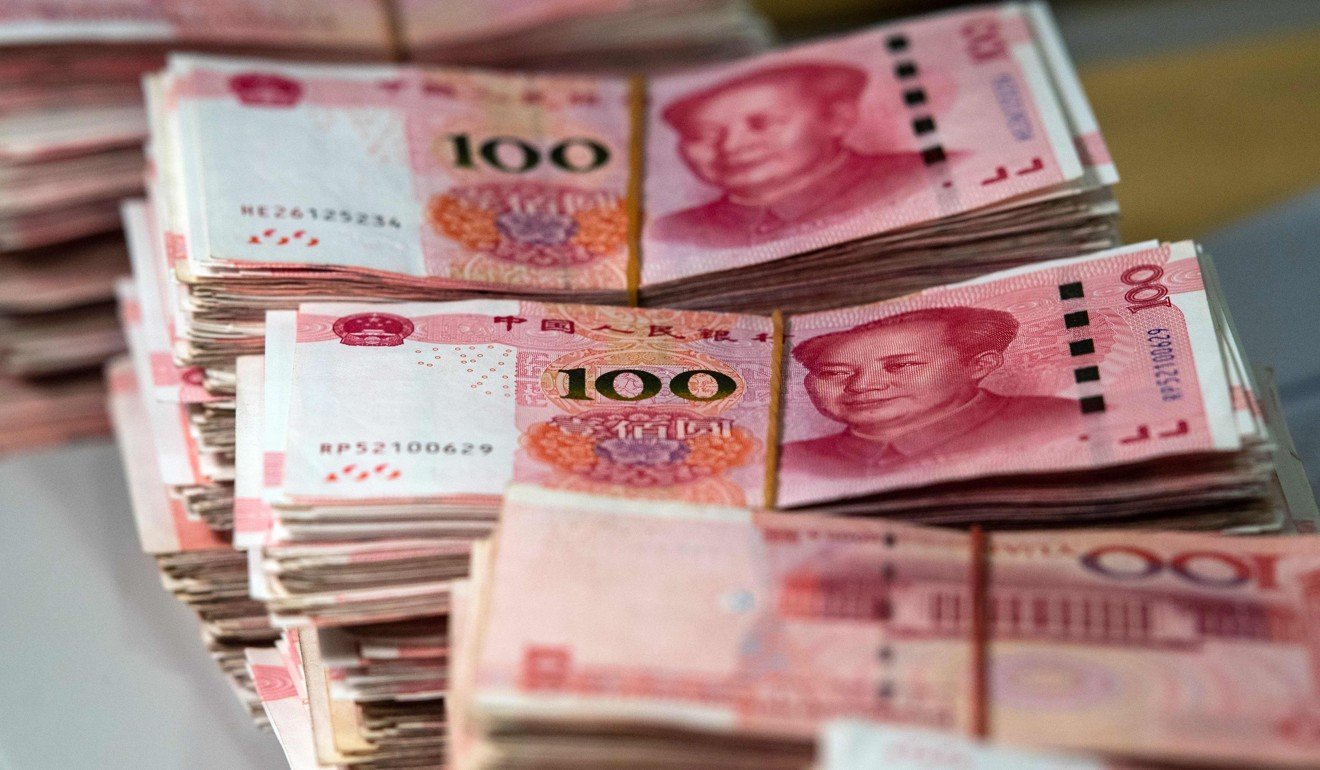
The man from southeastern China who caused a cash frenzy on the street after he threw more than 100,000 yuan (US$14,052) into the air because he’d had a bad day at work is asking for his money back, authorities said.

Huang, 42, said he acted on impulse after he withdrew cash from a bank in Shishi city, Fujian province, on Monday.

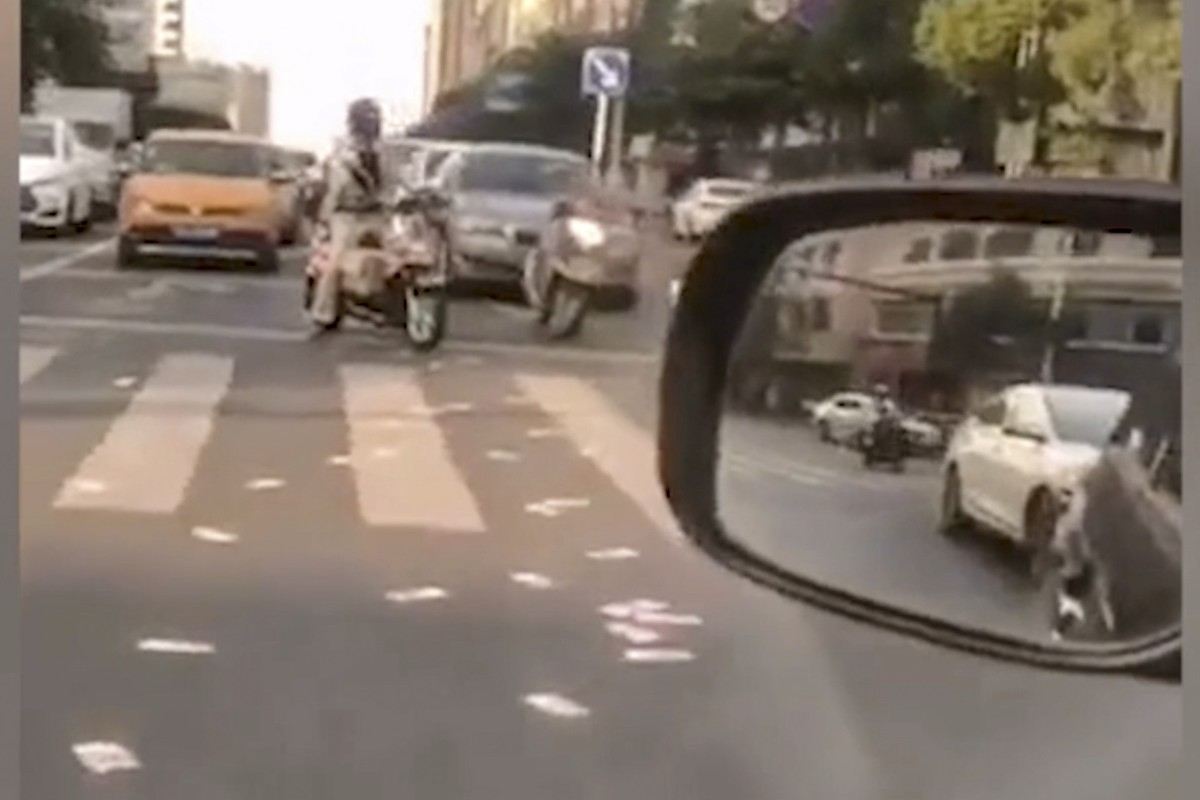
His actions caused a traffic jam and passers-by fell over each other to grab what they could, the municipal police bureau said on Tuesday.

The man, who said he was having trouble at work, now regrets what he did and is hoping he will get the money back, the police statement issued on Weibo, China’s Twitter-like microblogging platform, said.

Police in Fujian said Huang’s impulsive move had caused him a lot of trouble and asked the public to return the money he threw away. Photo: AFP

Officers criticised Huang for his “inappropriate behaviour” and urged those who picked up the cash to take it to the police.

A video clip shared on Weibo on Tuesday showed motorists pulling up sharply in the street to pick 100 yuan banknotes off the road.

In another video, pedestrians were seen rushing into the middle of the road to join in the frenzy.

Banknotes falling from the sky send crowd into a frenzy in Hong Kong neighbourhood of Sham Shui Po
Some of the money had been returned by Tuesday evening, the Shishi police Weibo account said.

“Huang is from an ordinary family and not rich at all. A sudden impulse has caused big trouble for himself and his family. Please be rational and return the money,” it said.

On December 24, 2014, Hong Kong Police appealed to the public for help after a G4S Hong Kong van carrying HK$525 million (US$66.9 million) crashed on a main road near Wan Chai district, causing major traffic jams as motorists abandoned their cars to collect notes.

While armed police were quickly on the scene and closed off two lanes of the road, witnesses reported money being taken. One office worker said she saw a “regular Hong Kong lady” walking briskly away from the scene with 10 bricks of notes.

In March 2017, a woman threw away more than 16,000 yuan (US$2,250) in cash at a busy crossing in southwestern Chongqing municipality, but passers-by simply looked on instead of scrambling to pick up the money, the Chongqing Morning Post reported.

Police collected the bills quickly and found the owner. She said she threw the money because she was “in a bad mood”.

Source: SCMP

Law of Unintended Consequences

continuously updated blog about China & India

ChiaHou's Book Reviews

continuously updated blog about China & India

What's wrong with the world; and its economy

continuously updated blog about China & India