Chindia Alert: You’ll be Living in their World Very Soon
aims to alert you to the threats and opportunities that China and India present. China and India require serious attention; case of ‘hidden dragon and crouching tiger’.
Without this attention, governments, businesses and, indeed, individuals may find themselves at a great disadvantage sooner rather than later.
The POSTs (front webpages) are mainly 'cuttings' from reliable sources, updated continuously.
The PAGEs (see Tabs, above) attempt to make the information more meaningful by putting some structure to the information we have researched and assembled since 2006.
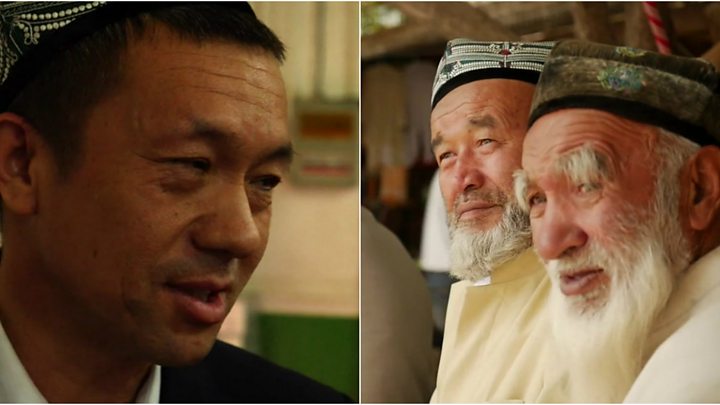
Image copyright GETTY IMAGESImage caption Protests calling for Uighur freedom have been happening all year
The US has said it will impose visa restrictions on Chinese officials accused of involvement in repression of Muslim populations.
It follows the decision on Monday to blacklist 28 Chinese organisations linked by the US to allegations of abuse in the Xinjiang region.
US Secretary of State Mike Pompeo said the Chinese government had instituted “a highly repressive campaign”.
China has dismissed the allegations as groundless.
In a statement, Mr Pompeo accused the Chinese government of a string of abuses against Uighurs, ethnic Kazakhs, Kyrgyz Muslims and other minority Muslim groups.
These included “mass detentions in internment camps; pervasive, high-tech surveillance; draconian controls on expressions of cultural and religious identities; and coercion of individuals to return from abroad to an often perilous fate in China”.
China has rebuffed the US moves.
“There is no such thing as these so-called ‘human rights issues’ as claimed by the United States,” foreign ministry spokesman Geng Shuang said on Monday.
“These accusations are nothing more than an excuse for the United States to deliberately interfere in China’s internal affairs.”
Media caption The BBC visits the camps where China’s Muslims have their “thoughts transformed”
Visa restrictions are to be imposed on Chinese government and Communist Party officials, as well as their family members.
“The United States calls on the People’s Republic of China to immediately end its campaign of repression in Xinjiang, release all those arbitrarily detained, and cease efforts to coerce members of Chinese Muslim minority groups residing abroad to return to China to face an uncertain fate,” the US statement said.
The US and China are currently embroiled in a trade war, and have sent delegations to Washington for a meeting about the tensions later this week.
China has been carrying out a massive security operation in Xinjiang, in its far west, in recent years.
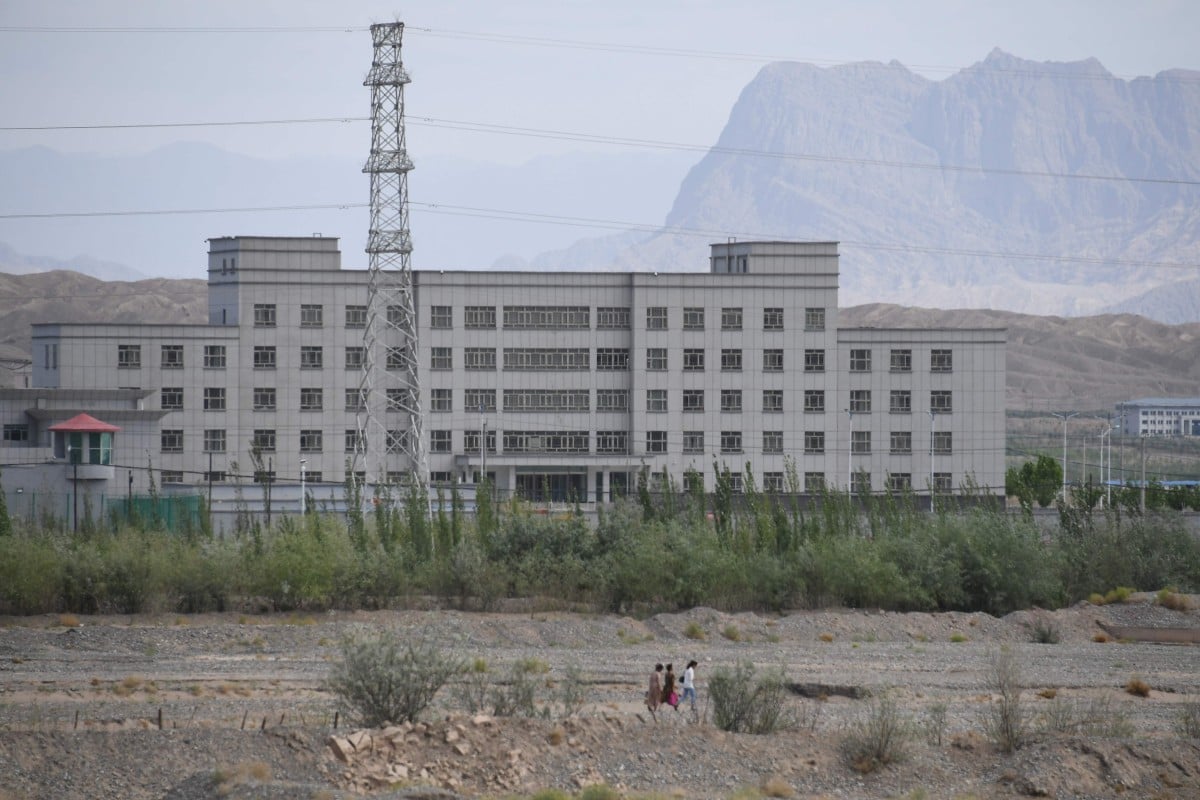
Human rights groups and the UN say China has rounded up and detained more than a million Uighurs and other ethnic minorities in vast detention camps, where they are forced to renounce Islam, speak only in Mandarin Chinese and learn obedience to the communist government.
But China says they are attending “vocational training centres” which are giving them jobs and helping them integrate into Chinese society, in the name of preventing terrorism.
Media caption The BBC’s John Sudworth meets Uighur parents in Turkey who say their children are missing in China
There have been increasingly vocal denunciations from the US and other countries about China’s actions in Xinjiang.
ANKARA (Reuters) – Turkey sees opportunity to boost trade with the United States amid Washington’s trade war with Beijing, the Turkish trade minister said on Tuesday, reinforcing an ambitious goal of quadrupling the bilateral trade to $100 billion (81.1 billion pounds) a year.
“We have determined that the issues between the U.S. and China will create a significant opportunity for trade in various sectors,” Trade Minister Ruhsar Pekcan told a joint press conference with U.S. Secretary of Commerce Wilbur Ross.
“We have expressed to the U.S. side our readiness to provide goods,” she said.
Pekcan added that trade and investment would be the main topic when U.S. President Donald Trump and Turkish counterpart Tayyip Erdogan meet during the United Nations General Assembly later this month in New York.
On Saturday, Turkey asked the United States to lift trade barriers during talks aimed at sharply increasing bilateral commerce.
Washington and Ankara’s goal of $100 billion in trade a year comes despite the prospect of U.S. sanctions over Turkey’s purchase of Russian S-400 missile defence systems. The United States says trade with Turkey totalled $24 billion in 2017, with the U.S. surplus standing at $1.5 billion.
The White House said in May it was ending a preferential trade agreement with Turkey, saying Turkey’s level of economic development meant it was no longer eligible for the support.
Islam was forced on ethnic group ‘by religious wars and the ruling class’, Beijing says in latest report defending its actions in far western region
Uygurs’ ancestors were enslaved by the Turks, document says
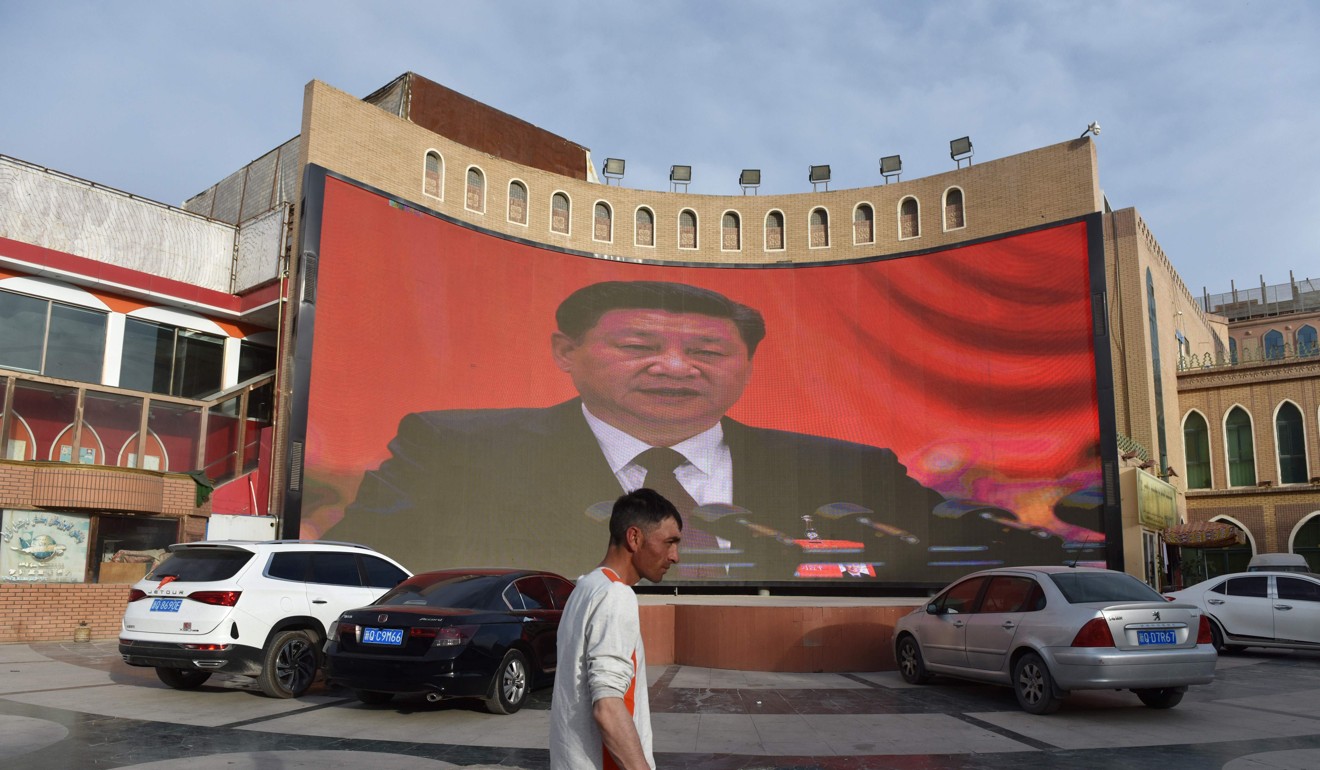
Beijing has issued a white paper seemingly designed to defend its actions in Xinjiang where as least 1 million Uygurs are being held in detention centres. Photo: AFP
Uygurs became Muslims not by choice but by force, and Islam is not their only religion, Beijing said in a white paper published on Sunday, as it continued its propaganda campaign to justify its controversial policies in the far western province of
“The Uygur people adopted Islam not of their own volition … but had it forced upon them by religious wars and the ruling class,” according to the document released by the State Council Information Office.
Islamic beliefs were forced on the Uygurs during the expansion of Arabic states. This is a historical fact, the report said, though that did not undermine the Uygurs’ religious rights now.
The report said also that there are Uygurs who hold to faiths other than Islam, and others who do not practise any religion at all.
The paper also took aim at the Uygurs’s historic links with Turkey.
“Historically, the Uygurs’ ancestors were enslaved by the Turks,” it said, citing a history of conflicts between the two groups dating back to the 8th century.
China promotes Xinjiang as tourist idyll
The white paper was issued amid a campaign by Beijing to justify its policies in the restive region, which is home to more than 10 million Uygurs, most whom are Muslim.
Earlier this month, the ambassadors of 22 countries signed a letter calling on Beijing to halt its mass detention of Uygurs in Xinjiang, the first such joint move on the issue at the UN Human Rights Council.
The signatories included envoys from Britain, France, Germany, Australia, Canada, Japan and Switzerland. The United States, which quit the forum a year ago, did not sign the letter.
China responded by issuing a letter signed by the ambassadors of 37 countries, including several Muslim majority states like Saudi Arabia and Pakistan, backing its policies in the region.
Beijing said the show of support was “a powerful response to the groundless accusations made against China by a small number of Western countries”.
UN experts and activists say at least 1 million Uygurs and other Muslims are currently being held in detention centres in Xinjiang. China describes the facilities as training and education centres that aim to stamp out religious extremism and provide people with useful skills. It has never said how many people are being detained in them.
The United States has repeatedly criticised Beijing over its policies in Xinjiang.
On Wednesday, US President Donald Trump met victims of religious persecution from around the world, including Jewher Ilham, a Uygur woman whose father Ilham Tohti was sentenced to life imprisonment in 2014 after being found guilty of promoting separatism.
“That’s tough stuff,” Trump said after hearing Ilham’s account of her father’s ordeal.
China describes the detention camps in Xinjiang as training and education centres. Photo: AFP
In January, US lawmakers nominated the imprisoned economist, writer and former professor at Minzu University in Beijing, for the 2019 Nobel Peace Prize in a bid to pressure China to stop its crackdown on the minority group.
Sunday’s white paper is the latest in a string of similar documents published recently by Beijing as it seeks to defend the legitimacy of its policies in Xinjiang. In a document issued in March, it said that over the past five years it had arrested nearly 13,000 “terrorists” in the region.
Xinjiang camps defended at UN human rights forum
Neither the March report nor Sunday’s white paper mentioned Beijing’s other controversial policies in the region, such as the collection of DNA samples and extensive surveillance on local people.
“Xinjiang has borrowed from international experiences, combined them with local realities, and taken resolute measures against terrorism and extremism,” it said.
The measures have been effective, it said, though did not elaborate.
Over the past year, China has increased its efforts to defend the camps, including organising strictly controlled visits by selected diplomats and journalists to see the people who live in them.
State media has also released videos showing seemingly happy and healthy people inside the camps in a bid to counter accounts of harsh conditions and abuse published by the Western media.
China is deliberately separating Muslim children from their families, faith and language in its far western region of Xinjiang, according to new research.
At the same time as hundreds of thousands of adults are being detained in giant camps, a rapid, large-scale campaign to build boarding schools is under way.
Based on publicly available documents, and backed up by dozens of interviews with family members overseas, the BBC has gathered some of the most comprehensive evidence to date about what is happening to children in the region.
Records show that in one township alone more than 400 children have lost not just one but both parents to some form of internment, either in the camps or in prison.
Formal assessments are carried out to determine whether the children are in need of “centralised care”.
Alongside the efforts to transform the identity of Xinjiang’s adults, the evidence points to a parallel campaign to systematically remove children from their roots.
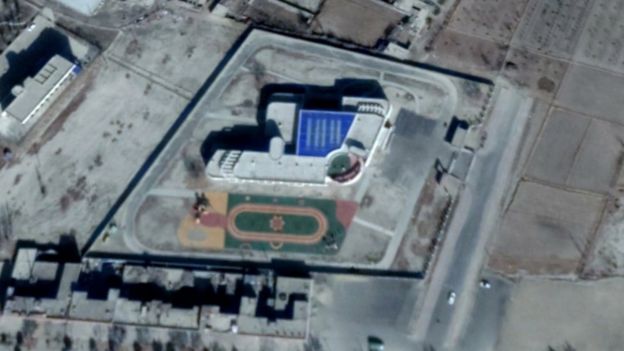
Image caption The Hotan Kindness Kindergarten, like many others, is a high security facility
China’s tight surveillance and control in Xinjiang, where foreign journalists are followed 24 hours a day, make it impossible to gather testimony there. But it can be found in Turkey.
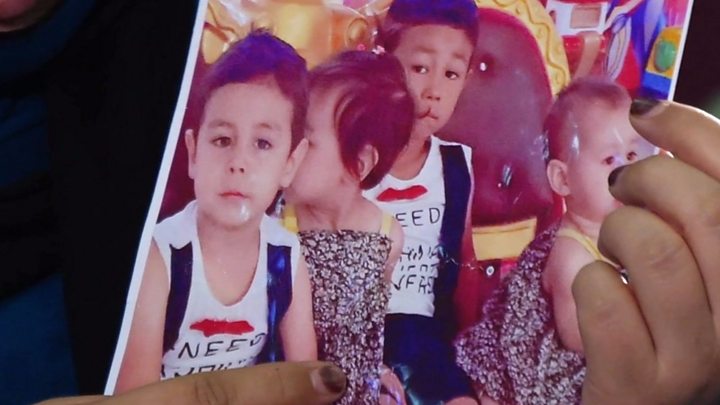
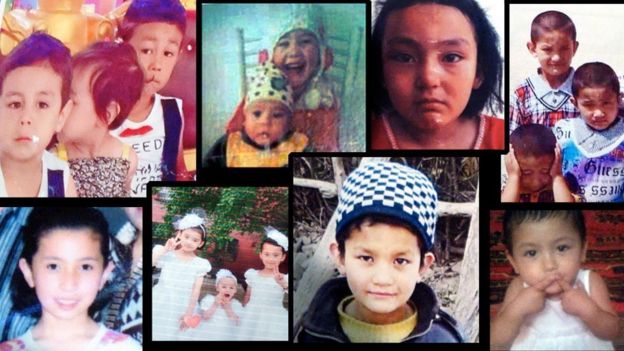
In a large hall in Istanbul, dozens of people queue to tell their stories, many of them clutching photographs of children, all now missing back home in Xinjiang.
“I don’t know who is looking after them,” one mother says, pointing to a picture of her three young daughters, “there is no contact at all.”
Another mother, holding a photo of three sons and a daughter, wipes away her tears. “I heard that they’ve been taken to an orphanage,” she says.
In 60 separate interviews, in wave after wave of anxious, grief-ridden testimony, parents and other relatives give details of the disappearance in Xinjiang of more than 100 children.
They are all Uighurs – members of Xinjiang’s largest, predominantly Muslim ethnic group that has long had ties of language and faith to Turkey. Thousands have come to study or to do business, to visit family, or to escape China’s birth control limits and the increasing religious repression.
But over the past three years, they have found themselves trapped after China began detaining hundreds of thousands of Uighurs and other minorities in giant camps.
The Chinese authorities say the Uighurs are being educated in “vocational training centres” in order to combat violent religious extremism. But evidence shows that many are being detained for simply expressing their faith – praying or wearing a veil – or for having overseas connections to places like Turkey.
For these Uighurs, going back means almost certain detention. Phone contact has been severed – even speaking to relatives overseas is now too dangerous for those in Xinjiang.
With his wife detained back home, one father tells me he fears some of his eight children may now be in the care of the Chinese state.
“I think they’ve been taken to child education camps,” he says.
New research commissioned by the BBC sheds light on what is really happening to these children and many thousands of others.
Dr Adrian Zenz is a German researcher widely credited with exposing the full extent of China’s mass detentions of adult Muslims in Xinjiang. Based on publicly available official documents, his report paints a picture of an unprecedented school expansion drive in Xinjiang.
Campuses have been enlarged, new dormitories built and capacity increased on a massive scale. Significantly, the state has been growing its ability to care full-time for large numbers of children at precisely the same time as it has been building the detention camps.
And it appears to be targeted at precisely the same ethnic groups.
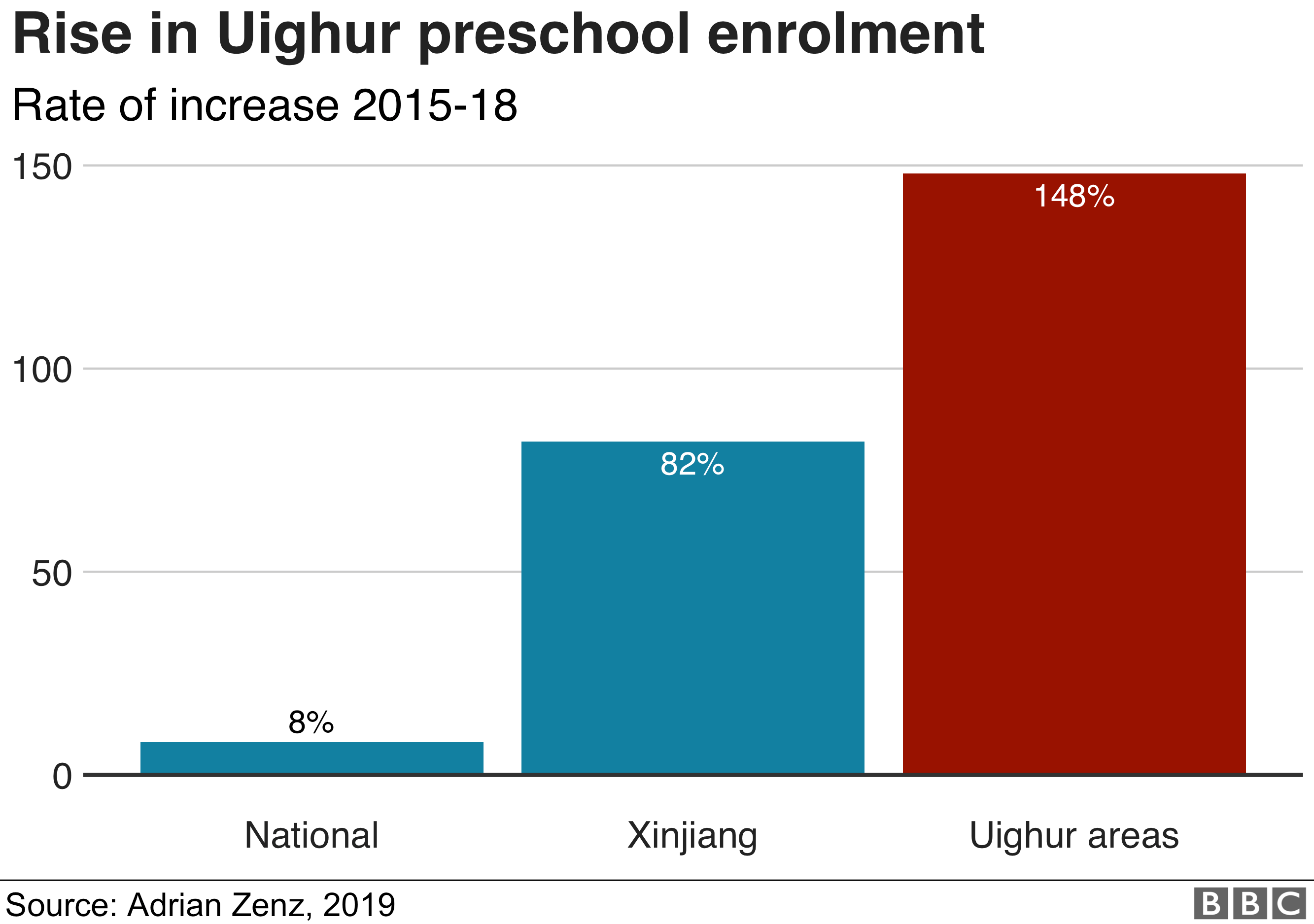
In just one year, 2017, the total number of children enrolled in kindergartens in Xinjiang increased by more than half a million. And Uighur and other Muslim minority children, government figures show, made up more than 90% of that increase.
As a result, Xinjiang’s pre-school enrolment level has gone from below the national average to the highest in China by far.
In the south of Xinjiang alone, an area with the highest concentration of Uighur populations, the authorities have spent an eye watering $1.2bn on the building and upgrading of kindergartens.
Mr Zenz’s analysis suggests that this construction boom has included the addition of large amounts of dormitory space.
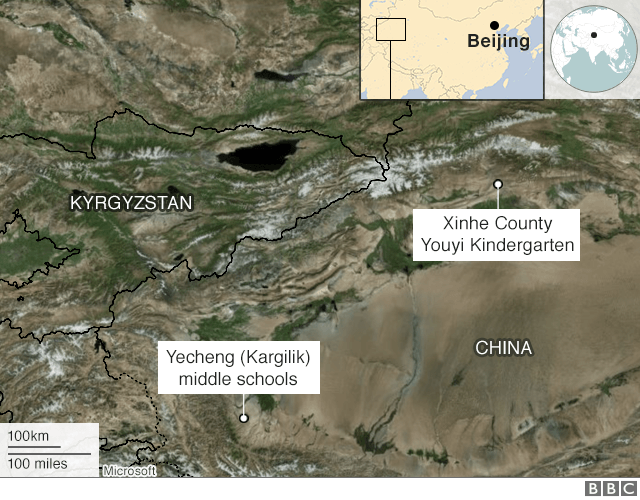
Image caption Xinhe County Youyi Kindergarten has space for 700 children, 80% of whom are from Xinjiang’s minority groups
Xinjiang’s education expansion is driven, it appears, by the same ethos as underlies the mass incarceration of adults. And it is clearly affecting almost all Uighur and other minority children, whether their parents are in the camps or not.
In April last year, the county authorities relocated 2,000 children from the surrounding villages into yet another giant boarding middle school, Yecheng County Number 4.
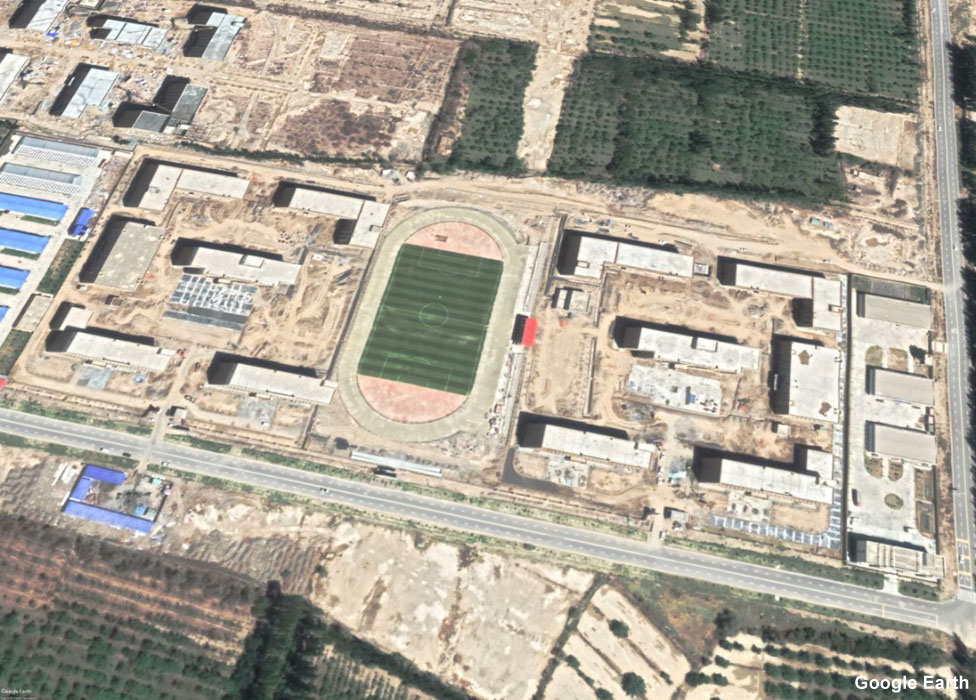
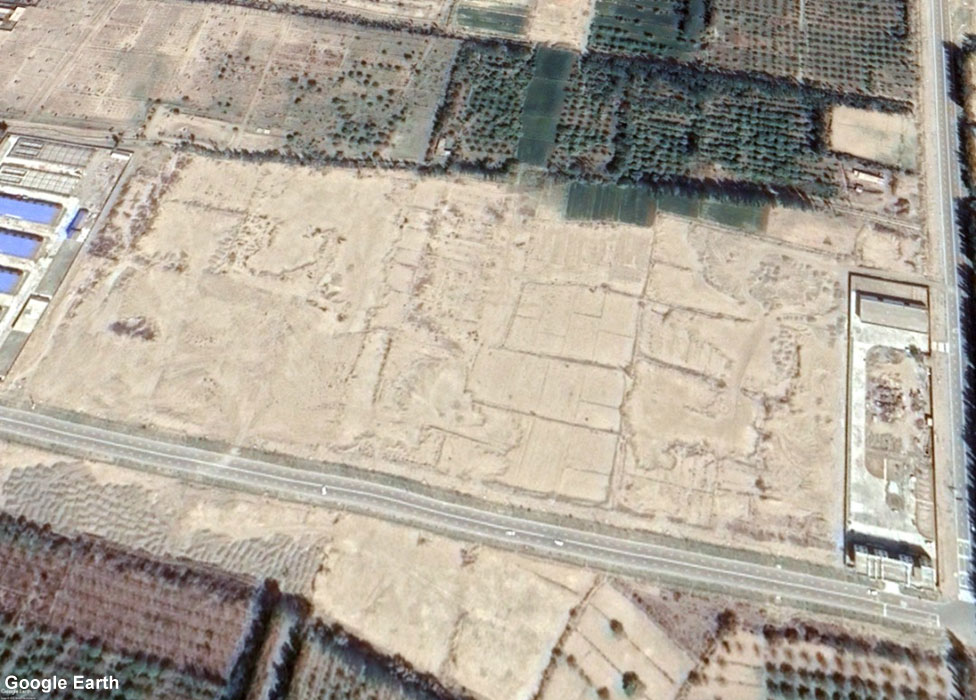
INTERACTIVE Use the slider button to see how the school has developed
May 2019
April 2018
Yecheng County Middle Schools 10 and 11
The image above shows a site being prepared for two new boarding schools in Xinjiang’s southern city of Yecheng (or Kargilik in Uighur).
Dragging the slider reveals the pace of construction – the two middle schools, separated by a shared sports field, are each three times larger than the national average and were built in little more than a year.
Government propaganda extols the virtues of boarding schools as helping to “maintain social stability and peace” with the “school taking the place of the parents.” And Mr Zenz suggests there is a deeper purpose.
“Boarding schools provide the ideal context for a sustained cultural re-engineering of minority societies,” he argues.
Just as with the camps, his research shows that there is now a concerted drive to all but eliminate the use of Uighur and other local languages from school premises. Individual school regulations outline strict, points-based punishments for both students and teachers if they speak anything other than Chinese while in school.
And this aligns with other official statements claiming that Xinjiang has already achieved full Chinese language teaching in all of its schools.
Media caption The BBC visits the camps where China’s Muslims have their “thoughts transformed”
Speaking to the BBC, Xu Guixiang, a senior official with Xinjiang’s Propaganda Department, denies that the state is having to care for large numbers of children left parentless as a result.
“If all family members have been sent to vocational training then that family must have a severe problem,” he says, laughing. “I’ve never seen such a case.”
But perhaps the most significant part of Mr Zenz’s work is his evidence that shows that the children of detainees are indeed being channelled into the boarding school system in large numbers.
There are the detailed forms used by local authorities to log the situations of children with parents in vocational training or in prison, and to determine whether they need centralised care.
Mr Zenz found one government document that details various subsidies available to “needy groups”, including those families where “both a husband and a wife are in vocational training”. And a directive issued to education bureaus by the city of Kashgar that mandates them to look after the needs of students with parents in the camps as a matter of urgency.
Schools should “strengthen psychological counselling”, the directive says, and “strengthen students’ thought education” – a phrase that finds echoes in the camps holding their parents.
It is clear that the effect of the mass internments on children is now viewed as a significant societal issue, and that some effort is going into dealing with it, although it is not something the authorities are keen to publicise.
Media caption The BBC has found new evidence of the increasing control and suppression of Islam in China
Some of the relevant government documents appear to have been deliberately hidden from search engines by using obscure symbols in place of the term “vocational training”. That said, in some instances the adult detention camps have kindergartens built close by, and, when visiting, Chinese state media reporters have extolled their virtues.
These boarding schools, they say, allow minority children to learn “better life habits” and better personal hygiene than they would at home. Some children have begun referring to their teachers as “mummy”.
We telephoned a number of local Education Bureaus in Xinjiang to try to find out about the official policy in such cases. Most refused to speak to us, but some gave brief insights into the system.
We asked one official what happens to the children of those parents who have been taken to the camps.
“They’re in boarding schools,” she replied. “We provide accommodation, food and clothes… and we’ve been told by the senior level that we must look after them well.”
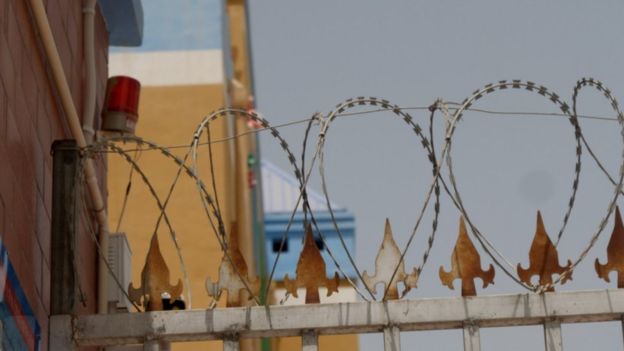
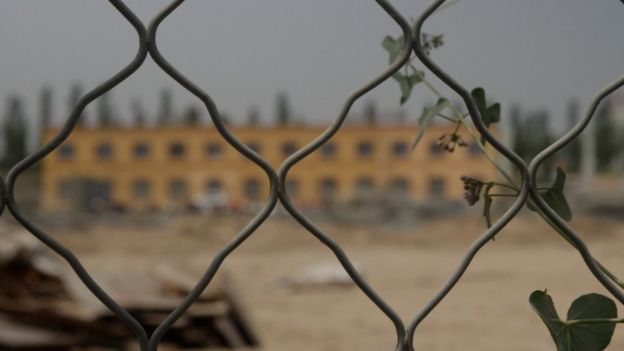
Image caption Hotan Sunshine Kindergarten, seen through a wire fence
In the hall in Istanbul, as the stories of broken families come tumbling out, there is raw despair and deep resentment too.
“Thousands of innocent children are being separated from their parents and we are giving our testimonies constantly,” one mother tells me. “Why does the world keep silent when knowing these facts?”
Back in Xinjiang, the research shows that all children now find themselves in schools that are secured with “hard isolation closed management measures.” Many of the schools bristle with full-coverage surveillance systems, perimeter alarms and 10,000 Volt electric fences, with some school security spending surpassing that of the camps.
The policy was issued in early 2017, at a time when the detentions began to be dramatically stepped up. Was the state, Mr Zenz wonders, seeking to pre-empt any possibility on the part of Uighur parents to forcibly recover their children?
“I think the evidence for systematically keeping parents and children apart is a clear indication that Xinjiang’s government is attempting to raise a new generation cut off from original roots, religious beliefs and their own language,” he tells me.
“I believe the evidence points to what we must call cultural genocide.”
Chinese President Xi Jinping holds a welcome ceremony for Turkish President Recep Tayyip Erdogan before their talks in Beijing, capital of China, July 2, 2019. Xi held talks with Erdogan at the Great Hall of the People in Beijing on Tuesday. (Xinhua/Yin Bogu)
BEIJING, July 2 (Xinhua) — Chinese President Xi Jinping held talks with his Turkish counterpart Recep Tayyip Erdogan at the Great Hall of the People on Tuesday, pledging more efforts to promote strategic cooperation between the two sides and work for sound bilateral ties.
Noting China and Turkey are both major emerging markets and developing countries, Xi said enhancing strategic cooperation is of great significance.
He called on the two sides to deepen political mutual trust, beef up strategic communication, respect each other’s core interests and major concerns on issues pertaining to national sovereignty, independence and territorial integrity, and consolidate the political foundation underlying the development of China-Turkey strategic cooperative relationship to keep bilateral ties on a healthy and stable track.
On anti-terrorism security cooperation, Xi said China appreciates Erdogan’s reiteration on many occasions about not allowing anti-China separatist activities instigated by any force in Turkey, and highly values the repeated emphasis by the Turkish side on supporting China’s anti-terrorism efforts, noting that China is ready to strengthen cooperation with Turkey in the field of international anti-terrorism.
Speaking of synergizing development strategies and expanding pragmatic cooperation, Xi called Turkey an important partner in jointly building the Belt and Road.
“China is willing to move faster in dovetailing the Belt and Road Initiative with the Middle Corridor project, steadily promote cooperation on trade, investment, science and technology, energy, infrastructure and major projects and actively seek cooperation in small and medium-sized programs and those that benefit the people, to deliver concrete benefits to more enterprises and the people,” the Chinese president said.
Xi also called for expanding people-to-people exchanges and tourism cooperation for better mutual understanding between the two peoples, to solidify the popular support for China-Turkey friendship.
In the face of major shifts in the international situation, China and Turkey should firmly uphold the international system with the United Nations at the core and the international law as the basis, safeguard multilateralism and international fairness and justice, as well as the multilateral trading regime with World Trade Organization at the core, Xi said.
He urged the two sides to deepen the strategic cooperative relationship, guard the common interests of China and Turkey as well as developing countries at large and jointly forge a new type of international relations featuring mutual respect, fairness and justice, and win-win cooperation.
“We should keep in contact and coordination in regional affairs and jointly advance political settlements for hotspot issues, to contribute to regional peace, stability and development,” Xi said.
Noting that the time-honored Turkey-China friendship which can be traced back to the time of ancient Silk Road is consolidated today, Erdogan said the close bilateral ties are significant for regional peace and prosperity.
Turkey stays committed to the one-China policy, Erdogan said, stressing that residents of various ethnicities living happily in Xinjiang Uygur Autonomous Region thanks to China’s prosperity is a hard fact, and Turkey will not allow anyone to drive a wedge in its relations with China. He also expressed the readiness to deepen political mutual trust and strengthen security cooperation with China in opposing extremism.
Voicing firm support for the Belt and Road Initiative, the Turkish president said he hopes the two sides can step up cooperation in areas such as trade, investment and 5G networks as well as exchanges in educational, cultural and scientific research sectors.
Prior to the talks, Xi held a welcoming ceremony for Erdogan.
Chinese President Xi Jinping (R) meets with his Turkish counterpart Recep Tayyip Erdogan in Dushanbe, Tajikistan, June 15, 2019. (Xinhua/Wang Ye)
DUSHANBE, June 15 (Xinhua) — Chinese President Xi Jinping met his Turkish counterpart, Recep Tayyip Erdogan, here on Saturday, agreeing to promote bilateral cooperation on the sidelines of the fifth summit of the Conference on Interaction and Confidence Building Measures in Asia.
Xi said that he highly values China-Turkey relations and is willing to work with Erdogan to translate bilateral friendship into mutual trust, and constantly open new chapters in promoting the China-Turkey strategic cooperative relationship.
China and Turkey should give each other firm support on issues that touch their respective core interests and major concerns, and step up the anti-terrorism cooperation, Xi said.
Calling Turkey a traditional Silk Road country, Xi said that China stands ready to enhance their mutually beneficial cooperation within the Belt and Road framework.
The Chinese president also called on the two countries, both important members of the Group of 20 (G20), to strengthen their communication and coordination on multilateral arenas such as the G20.
Agreeing with Xi, Erdogan said that Turkey attaches great importance to relations with China, adding that Turkey is willing to strengthen high-level exchanges between the two countries and expand their cooperation in economy, trade, finance, infrastructure construction and other fields.
The Belt and Road Initiative is very important to Turkey, he said, adding that his country is willing to actively participate in its joint construction and cooperation.
CHANGSHA, April 24 (Xinhua) — China will promote international space cooperation to contribute to sustainable development goals set by the United Nations, a senior official with the China National Space Administration (CNSA) said here Wednesday.
“China is to build a new type of cooperative and win-win relationship with other space agencies and international organizations around the world, to jointly enhance the role of space industries in facilitating sustainable development,” said CNSA deputy director Wu Yanhua at the United Nations/China Forum on Space Solutions: Realizing the Sustainable Development Goals.
Over the years, the use of space has been recognized as one of the key components to successfully achieve the 17 Sustainable Development Goals (SDGs) of the 2030 Agenda for Sustainable Development adopted by the UN, according to Simonetta Di Pippo, director of United Nations Office for Outer Space Affairs.
In order to quantify the impact, a dedicated study was published in early 2018 and shows that around 40 percent of the 169 targets underpinning the 17 SDGs benefit from the use of geo-location and earth observation satellites, said Simonetta at the forum.
Committed to better service for countries along the Belt and Road Initiative, especially developing countries, China is constructing a space information corridor and sharing satellite resources, according to Wu.
“China’s earth observation satellites have actively supported the construction of the Belt and Road spatial information corridor, vigorously developed space international cooperation,” said Wang Cheng, a researcher from the CNSA.
FY-2H, the meteorological satellite located over the Indian Ocean, can fill the observation gap and provide weather monitoring service to countries along the Belt and Road, said Tang Shihao from China Meteorological Administration.
The unique strength of satellites in supporting telemedicine, epidemic prevention and control, and distance education, social security services can be improved, Wu said.
Independently constructed and operated by China, the BeiDou Navigation Satellite System has been widely used in many countries and regions. “The system started to provide RNSS (Radio Navigation Satellite System) services worldwide last December,” said Gao Weiguang from China Satellite Navigation Project Center.
Wu Yanhua said that China was developing a space economy and supporting commercial space development by pushing forward the commercialization of space technologies.
As the provider of Long March launch services, the China Great Wall Industry corporation (CGWIC) has performed 48 dedicated launch services and 17 piggyback launch services for international clients with high successful rate and competitive pricing, according to Zhou Yuanying from CGWIC.
Wu said that China would undertake monitoring and research of global climate change by taking advantage of satellites, to achieve the goals outlined in the Paris Agreement.
By pushing forward international space cooperation, China is also committed to joint efforts to tackle contemporary issues with global impact including poverty, hunger, natural disasters and environmental pollution, Wu added.
Many countries, in particular developing countries, need to make the best possible use of space assets to support the SDGs. At the same time, a lot of space agencies and companies are struggling to find partners/users to which they can offer their particular space solutions, Simonetta said.
“This Forum will build on previous UN workshops and symposiums to provide a unique platform for users and space solution providers to forge partnerships and thus contribute concretely to the achievement of the SDGs.” Simonetta said.
Also on Wednesday, the CNSA inked agreements on space cooperation separately with the UN Office for Outer Space Affairs, Turkey, Ethiopia and Pakistan.
Since 2016, China has set April 24 as the country’s Space Day. Activities on Space Day have become a window for the Chinese public and the world to gain a better understanding of China’s aerospace progress.
The theme this year is to “pursue space dreams for win-win cooperation.”
t was agreed that Saudi Arabia and India should work together for irreversible, verifiable and credible steps against all terrorists without any discrimination.
Statesman News Service | New Delhi | March 12, 2019 2:10 pm
Prime Minister Narendra Modi on Monday held discussions with leaders of three key Islamic nations ~ Saudi Arabia, the United Arab Emirates (UAE) and Turkey ~ and, without directly naming Pakistan, impressed on them the importance of immediate, demonstrable and irreversible action against terrorism by all countries.
Visiting Saudi Minister of State for Foreign AffairsAdel bin Ahmed Al Jubeir had a meeting with Modi in New Delhi on Monday evening while the Indian leader had telephonic conversations with Sheikh Mohammed bin Zayed Al-Nahyan, Crown Prince of Abu Dhabi and Deputy Supreme Commander of the UAE Armed Forces, and Turkish President Recep Tayyip Erdogan.
Saudi Arabia, UAE and Turkey are key allies of Pakistan and are said to have played a significant role in reducing tension between India and Pakistan in the wake of the Pulwama attack.
During his meeting with the Saudi minister, PM Modi thanked the leadership of Saudi Arabia for expressing full solidarity with India in the fight against terrorism in all its forms and manifestations.
It was agreed that Saudi Arabia and India should work together for irreversible, verifiable and credible steps against all terrorists without any discrimination, the External Affairs Ministry said.
During his four-hour visit to the Indian capital, the Saudi minister also met External Affairs Minister Sushma Swaraj. The Indian minister reiterated that an immediate, irreversible and verifiable action to dismantle terror infrastructure was essential to fight the menace of terror.
The Turkish President conveyed to PM Modi his condolences for the victims of the recent terror attacks in India and wished a speedy recovery to those injured in these attacks.
PM Modi told him that terrorism remained one of the gravest threats to global peace and security. He underscored the importance of demonstrable and irreversible action against all terror groups.
ANKARA (Reuters) – Turkey risks jeopardising economic ties with China if it keeps criticising Beijing’s treatment of Uighur Muslims, China’s envoy to Ankara warned, just as Chinese firms are looking to invest in Turkish energy and infrastructure mega-projects.
Last month Turkey broke a long silence over the fate of China’s Uighurs, saying more than one million people faced arbitrary arrest, torture and political brainwashing in Chinese internment camps in the country’s northwestern Xinjiang region.
Turkey’s Foreign Minister Mevlut Cavusoglu repeated Ankara’s concern at a United Nations meeting this week, calling on China to respect human rights and freedom of religion.
China has denied accusations of mistreatment and deems criticism at the United Nations to be interference in its sovereignty. Beijing says the camps are re-education and training facilities that have stopped attacks previously blamed on Islamist militants and separatists.
“There may be disagreements or misunderstandings between friends but we should solve them through dialogue. Criticising your friend publicly everywhere is not a constructive approach,” said Deng Li, Beijing’s top diplomat to Ankara.
“If you choose a non-constructive path, it will negatively affect mutual trust and understanding and will be reflected in commercial and economic relations,” Deng, speaking through a translator, told Reuters in interview.
For now, Deng said that many Chinese companies were looking for investment opportunities in Turkey including the third nuclear power plant Ankara wants to build.
Several Chinese firms including tech giant Alibaba, are actively looking at opportunities in Turkey after the lira’s sell-off has made local assets cheaper.
In addition to Alibaba, which last year purchased Turkish online retailer Trendyol, other companies holding talks included China Life Insurance and conglomerate China Merchants Group, Deng said.
GAPING DEFICIT
Deng said Chinese banks wanted to invest in Turkey, following the lead of Industrial and Commercial Bank of China (ICBC) which bought Tekstilbank in 2015.
Chinese investment in Turkey would help narrow Ankara’s gaping current account deficit, which stood at $27.6 billion last year. Turkey’s trade deficit with China alone stood at $17.8 billion last year, according to Trade Ministry data.
In January, Turkey’s Finance Minister Berat Albayrak said it was “impossible” for Turkey to maintain such a trade deficit with China and other Asian countries, saying the government was considering taking measures.
Deng said he did not expect Turkey to take protectionist steps. “Both countries are strictly against such policies, and both economies need an open world economy,” he said.
He also called on Turkey to adopt Chinese payment platforms such as WeChat and AliPay. “People don’t want to pay in cash and the population here is very young so they wouldn’t have trouble adapting to new technologies,” Deng said.
Good diplomatic and political ties, however, would remain crucial for developing economic ties and attracting more Chinese investment, he said, adding that he had raised the issue with Cavusoglu on Tuesday, a day after the foreign minister’s intervention at the United Nations.
“The most important issue between countries are mutual respect,” he said. “Would you stay friends if your friend criticized you publicly every day?
China is getting two regimental units, which amounts to at least 128 missiles.
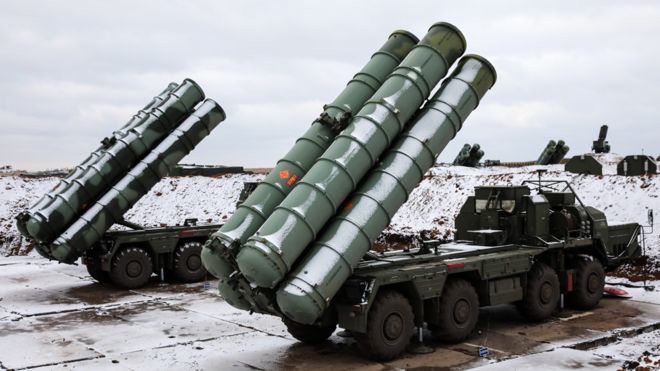
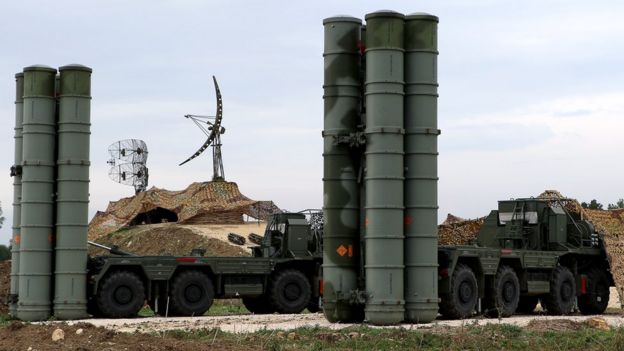
Image copyrightAFPImage captionThe S-400 missile system is deployed at Russia’s Hmeimim airbase in Syria
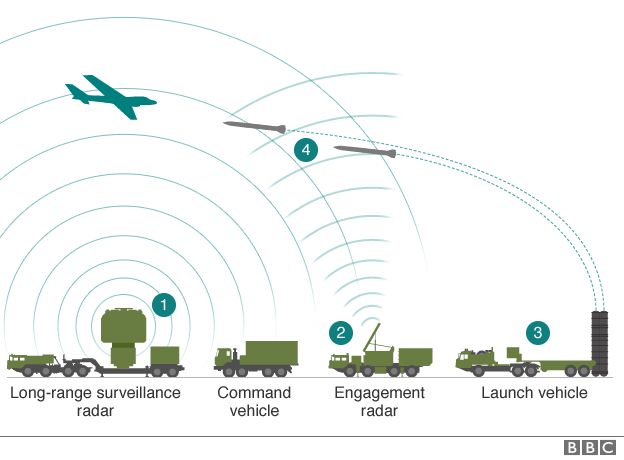
The S-400 “Triumf” is one of the most sophisticated surface-to-air missile systems in the world. It has a range of 400km (248 miles) and one S-400 integrated system can shoot down up to 80 targets simultaneously.
Russia says it can hit aerial targets ranging from low-flying drones to aircraft flying at various altitudes and long-range missiles.
The US sanctions are aimed at putting pressure on the Russian government over its annexation of Crimea and intervention in eastern Ukraine in 2014.
In October, India signed a $5bn (£3.9bn) deal to buy five S-400 regimental units. That amounts to at least 320 missiles. Each S-400 launch vehicle – a heavy lorry – carries four missiles.
Russia has deployed S-400s to protect its military airbase at Hmeimim in Syria.
Turkey, a Nato member, is buying S-400s despite US warnings. The US wants to sell Patriot missiles, made by Raytheon Co, to Turkey instead. The US argues that S-400s are incompatible with Nato systems.
“We made the S-400 deal with Russia, so it’s out of the question for us to turn back. That’s done,” Turkish President Recep Tayyip Erdogan said.
Neither Turkey nor India are yet under US sanctions over the purchases.
How the S-400 system works
Long-range surveillance radar tracks objects and relays information to command vehicle, which assesses potential targets
Target is identified and command vehicle orders missile launch
Launch data are sent to the best placed launch vehicle and it releases surface-to-air missiles
Engagement radar helps guide missiles towards target.


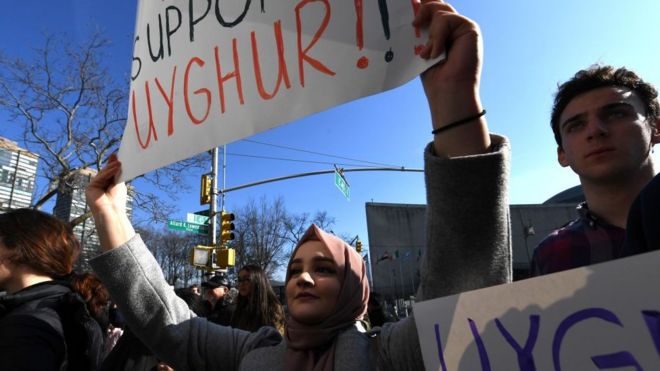 Image copyright GETTY IMAGES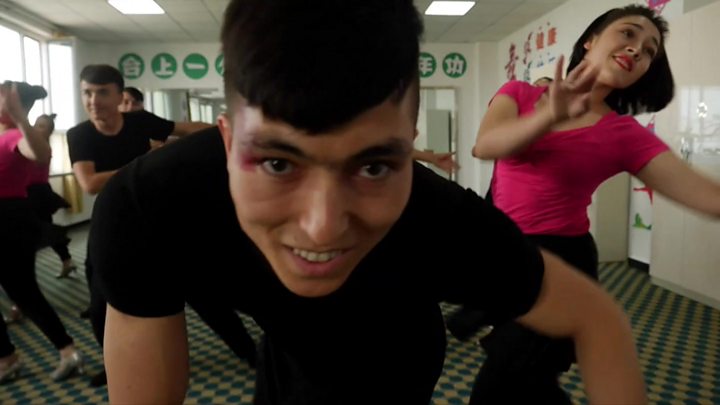



 CHINDIA ALERT: You'll be living in their world, very soon