Chindia Alert: You’ll be Living in their World Very Soon
aims to alert you to the threats and opportunities that China and India present. China and India require serious attention; case of ‘hidden dragon and crouching tiger’.
Without this attention, governments, businesses and, indeed, individuals may find themselves at a great disadvantage sooner rather than later.
The POSTs (front webpages) are mainly 'cuttings' from reliable sources, updated continuously.
The PAGEs (see Tabs, above) attempt to make the information more meaningful by putting some structure to the information we have researched and assembled since 2006.
UNITED NATIONS, Feb. 7 (Xinhua) — A Chinese UN envoy on Friday refuted accusations by the United States over China’s counter-terrorism efforts in its northwestern region of Xinjiang.
At a Security Council meeting on the threat posed by the Islamic State, Wu Haitao, China’s deputy permanent representative to the United Nations, said the remarks by the U.S. representative regarding Xinjiang are “unwarranted.”
Senior Policy Advisor for U.S. UN Mission Michael Barkin, who addressed the council earlier than Wu, claimed that “Uighurs” (Uygurs) and other Muslims have been “detained in internment camps under the guise of counter-terrorism” in Xinjiang.
He labeled China’s counter-terrorism measure as “confinement that is based and imposed on the basis of ethnicity and religion.”
Wu said that Barkin’s “attacks” are “completely baseless, and represent a wanton interference in China’s internal affairs and a brazen attempt to provoke confrontation.”
In nature, he said, the issues Xinjiang faces are not about ethnic group or religion or human rights, but rather they are about counter-terrorism.
Recalling the past, Wu said that for some time, Xinjiang suffered frequent terrorist attacks, which seriously jeopardized the lives and property of all ethnic communities and gravely violated human dignity.
“In response, China has taken resolute, law-based measures to combat terrorism and extremism, eliminating to the extent possible the breeding ground and conditions for terrorism and extremism, effectively curbing the trend of rampant terrorist activities and safeguarding citizens’ basic rights, including the right to life and development,” Wu expounded.
“Those measures have produced good results,” he said. “At present, the situation in Xinjiang is largely stable, and local economy continues to grow. People of all ethnic groups live in harmony. The region has been free of terrorist attacks for over three years.”
He noted relevant policies and measures against terrorism and extremism in Xinjiang constitute a crucial part of the global counter-terrorism efforts.
The Chinese envoy also rejected the remarks of Britain’s representative, who echoed the U.S. stance.
“Regrettably, Britain once again blindly followed the footsteps of the United States and put up unfounded charges against China,” Wu said.
He expressed the hope that Britain has “recorded our positions on this matter,” urging Britain not to use the Security Council “to make trouble, to spread rumor and to interfere with the internal affairs of China.”
BEIJING, Feb. 6 (Xinhua) — China has lodged solemn representations to the United States regarding the recent officials exchanges between the United States and Taiwan, a foreign ministry spokesperson said Thursday.
Spokesperson Hua Chunying made the remarks at an online news briefing when answering a question about Lai Ching-te’s visit to the United States.
China firmly opposes any form of official exchanges between the United States and Taiwan, Hua said, stressing that China’s position is consistent and clear.
China has lodged solemn representations to the U.S. side for allowing Lai’s visit, urging the U.S. side to abide by the one-China principle and the three China-U.S. joint communiques, stop official exchanges with Taiwan, and cut off all forms of contact between Lai and U.S. leaders, government officials and Congress members, said Hua.
She said the United States should handle Taiwan issues prudently and properly and stop sending wrong signals to the “Taiwan independence” forces to avoid serious damage to China-U.S. relations.
BEIJING, Dec. 2 (Xinhua) — The Chinese government has decided to suspend reviewing applications to visit Hong Kong by U.S. military ships and aircraft starting Monday, foreign ministry spokesperson Hua Chunying said.
China will also take sanctions against some U.S. non-governmental organizations (NGOs) for their role in the disturbances in Hong Kong, Hua said at a press conference.
The NGOs include the National Endowment for Democracy, National Democratic Institute for International Affairs, International Republican Institute, Human Rights Watch and Freedom House.
A lot of facts and evidence have shown that the aforementioned NGOs supported anti-China rioters in Hong Kong in various ways, abetted their extreme and violent criminal behavior and incited separatist activities for “Hong Kong independence”, Hua said, adding that these organizations bear major responsibilities for Hong Kong’s chaotic situation and should be sanctioned and pay their price.
The spokesperson said the United States has seriously violated the international law and basic norms governing international relations, and interfered in China’s internal affairs by signing the so-called Hong Kong Human Rights and Democracy Act of 2019 into law despite China’s firm opposition.
“China urges the U.S. to correct its mistake and stop meddling in Hong Kong affairs or interfering in China’s other internal affairs by any word and act,” Hua said.
China will take further necessary actions in accordance with the development of the situation to firmly defend the stability and prosperity of Hong Kong and safeguard national sovereignty, security and development interests, she said.
(Reuters) – Asian companies dominate the market for electric vehicle (EV) batteries and they are expanding their production capacity in Europe, China and the United States in a fight to win lucrative contracts from global automakers.
Some carmakers worry, however, there won’t be enough batteries for all the EVs they plan to launch in the coming years and a bitter row between South Korea’s SK Innovation and LG Chem risks exacerbating the potential shortfall.
Below are details of the world’s leading EV battery makers with details of their customers and expansion plans:
CATL
China’s Contemporary Amperex Technology (CATL), the world’s biggest EV battery maker, counts BMW (BMWG.DE), Volkswagen (VOWG_p.DE), Daimler (DAIGn.DE) – which makes Mercedes cars – Volvo, Toyota Motor Corp (7203.T) and Honda Motor Co (7267.T) among its customers.
The company emerged as a major force partly thanks to Beijing’s policy of only subsidising vehicles equipped with Chinese batteries in the world’s biggest EV market. Beijing is phasing out EV subsidies next year.
CATL, which operates factories in China, is building its first overseas plant in Germany and is considering a U.S. factory.
Japan’s Panasonic, a supplier of U.S. EV pioneer Tesla (TSLA.O), said it has installed equipment to ramp up production at Tesla’s Nevada plant to 35 GWh from its current production of around 30 GWh as of late October. Panasonic has said it is investing about $1.6 billion in the factory.
Panasonic also produces EV batteries in Japan, China and plans to shift some of its plants to a new joint venture with Toyota. Panasonic’s clients also include Honda and Ford Motor Company (F.N).
China’s BYD, which is backed by U.S. investor Warren Buffett, is also one of the world’s biggest EV battery makers. It mainly uses them in-house for its own cars and buses. BYD said last year it is was considering cell production in Europe.
The South Korean firm was an early industry mover, winning a contract to supply General Motor’s (GM.N) Volt in 2008. It also supplies Ford, Renault (RENA.PA), Hyundai Motor (005380.KS), Tesla, Volkswagen and Volvo.
It is investing 3.3 trillion won ($2.8 billion) to build and expand production facilities near Tesla’s plant in Shanghai. It has a joint venture (JV) in China with Geely Automobile Holdings (0175.HK), which makes Volvos, and is in talks with other carmakers about JVs in major markets.
The firm is considering building a second U.S. factory in addition to its facility in Michigan and is expanding its plant in Poland.
SAMSUNG SDI CO LTD (006400.KS) Samsung SDI an affiliate of South Korean tech giant Samsung Electronics (005930.KS), has EV battery plants in South Korea, China and Hungary, which supply customers such as BMW (BMWG.DE), Volvo and Volkswagen. Samsung SDI is investing about 1.2 billion euros ($1.3 billion) to expand its factory in Hungary though the EU is investigating whether Budapest’s financial support complies with the bloc’s state aid rules.
Samsung started production last year on the Hungary plant, which will produce batteries for 50,000 EVs a year.
SK INNOVATION CO LTD (096770.KS) LG Chem’s cross-town rival SK Innovation supplies batteries to Volkswagen, Daimler and Kia Motors (000270.KS), as well as Jaguar Land Rover [TAMOJL.UL] and Ferrari (RACE.MI).
An oil refiner that came to the battery industry late, SKI is investing about $3.9 billion to build three plants in the United States, China and Hungary, with a goal of expanding its annual production capacity to 33 GWh by 2022.
SKI currently operates one battery factory in South Korea, with a capacity of 4.7 GWh annually.
It set up a joint venture with Beijing Automotive Industry Corporation (BAIC) of China in August 2018 and another Chinese partner. It is in talks with Volkswagen about another battery JV and is building a $1.7 billion factory in the U.S. state of Georgia, not far from Volkswagen’s Chattanooga plant.
BEIJING, Nov. 28 (Xinhua) — A spokesperson for China’s Ministry of National Defense on Thursday slammed U.S. warships and military aircraft’s willful and repeated trespassing into the adjacent waters and airspace of China’s islands and reefs in the South China Sea.
The trespassing hurts regional peace and stability, harms China’s sovereignty and security, and endangers the lives of frontline officers and soldiers of both sides, spokesman Ren Guoqiang said at a press conference, calling it “a highly dangerous provocation.”
“We demand that the United States immediately stop such infringement upon China’s interests,” Ren said, adding that the Chinese military is always on high alert and will take all necessary measures to resolutely safeguard national sovereignty, security and development interests.
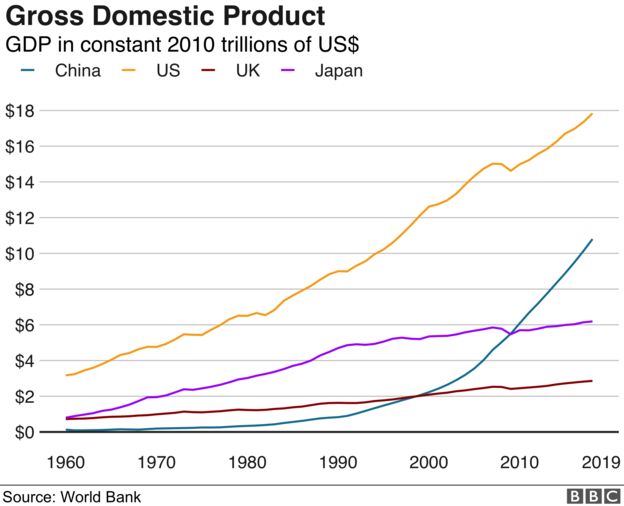
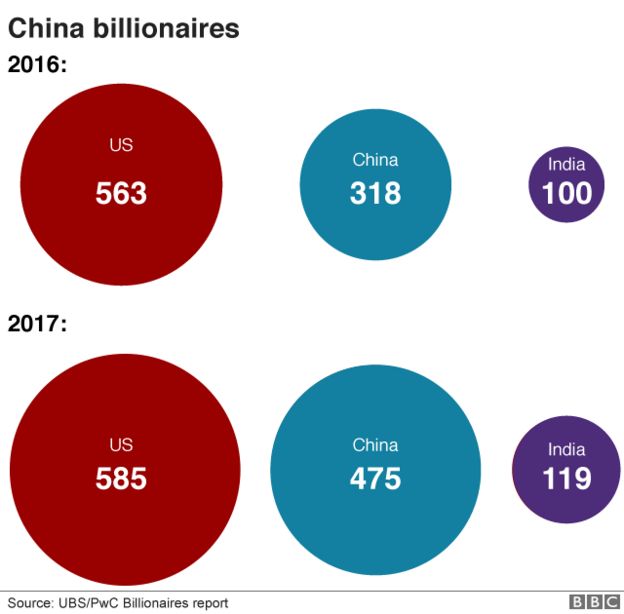
It took China less than 70 years to emerge from isolation and become one of the world’s greatest economic powers.
As the country celebrates the anniversary of the founding of the People’s Republic of China, we look back on how its transformation spread unprecedented wealth – and deepened inequality – across the Asian giant.
“When the Communist Party came into control of China it was very, very poor,” says DBS chief China economist Chris Leung.
“There were no trading partners, no diplomatic relationships, they were relying on self-sufficiency.”
Over the past 40 years, China has introduced a series of landmark market reforms to open up trade routes and investment flows, ultimately pulling hundreds of millions of people out of poverty.
The 1950s had seen one of the biggest human disasters of the 20th Century. The Great Leap Forward was Mao Zedong’s attempt to rapidly industrialise China’s peasant economy, but it failed and 10-40 million people died between 1959-1961 – the most costly famine in human history.
This was followed by the economic disruption of the Cultural Revolution in the 1960s, a campaign which Mao launched to rid the Communist party of his rivals, but which ended up destroying much of the country’s social fabric.
‘Workshop of the world’
Yet after Mao’s death in 1976, reforms spearheaded by Deng Xiaoping began to reshape the economy. Peasants were granted rights to farm their own plots, improving living standards and easing food shortages.
The door was opened to foreign investment as the US and China re-established diplomatic ties in 1979. Eager to take advantage of cheap labour and low rent costs, money poured in.
“From the end of the 1970s onwards we’ve seen what is easily the most impressive economic miracle of any economy in history,” says David Mann, global chief economist at Standard Chartered Bank.
Through the 1990s, China began to clock rapid growth rates and joining the World Trade Organization in 2001 gave it another jolt. Trade barriers and tariffs with other countries were lowered and soon Chinese goods were everywhere.
“It became the workshop of the world,” Mr Mann says.
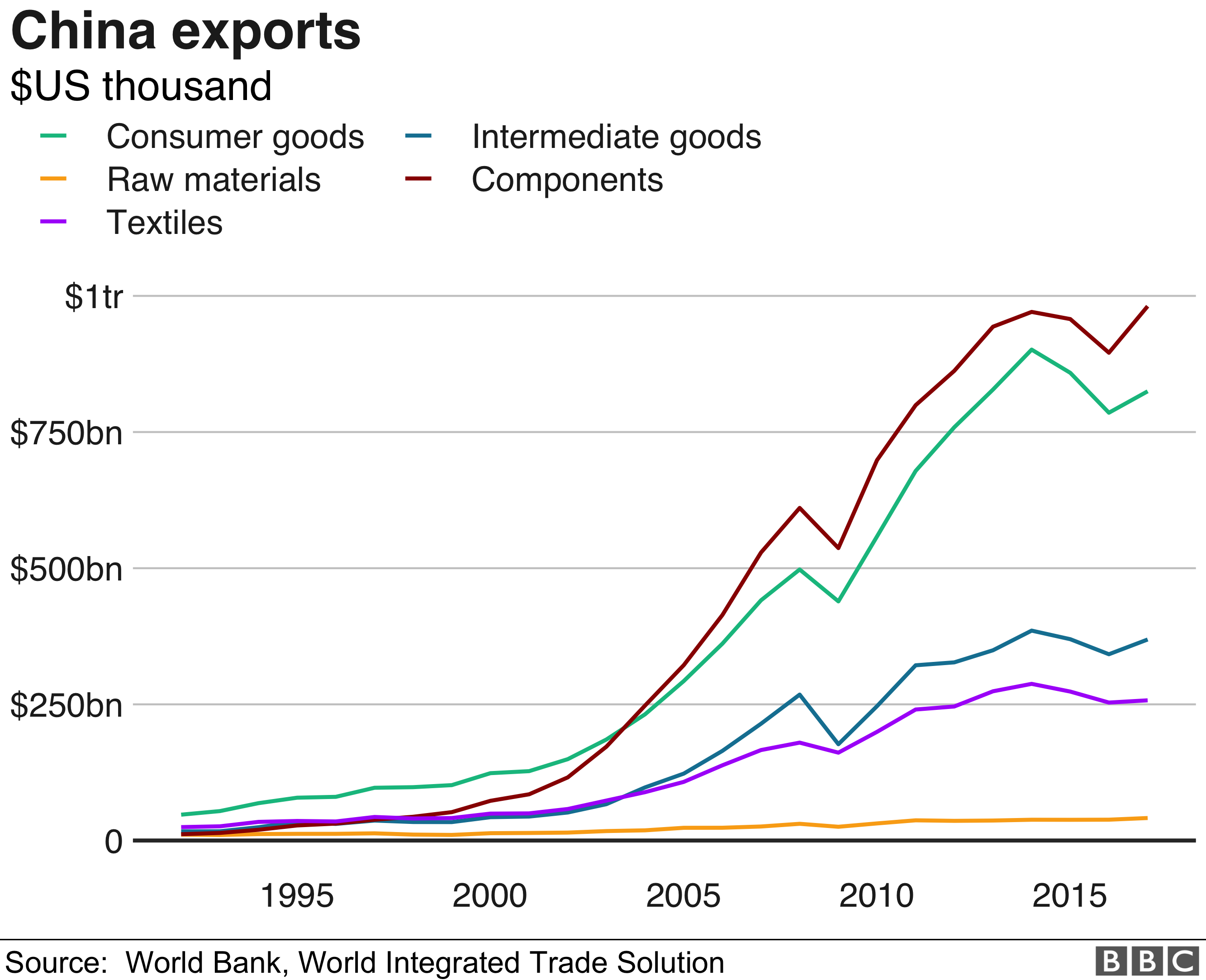
Take these figures from the London School of Economics: in 1978, exports were $10bn (£8.1bn), less than 1% of world trade.
By 1985, they hit $25bn and a little under two decades later exports valued $4.3trn, making China the world’s largest trading nation in goods.
Poverty rates tumble
The economic reforms improved the fortunes of hundreds of millions of Chinese people.
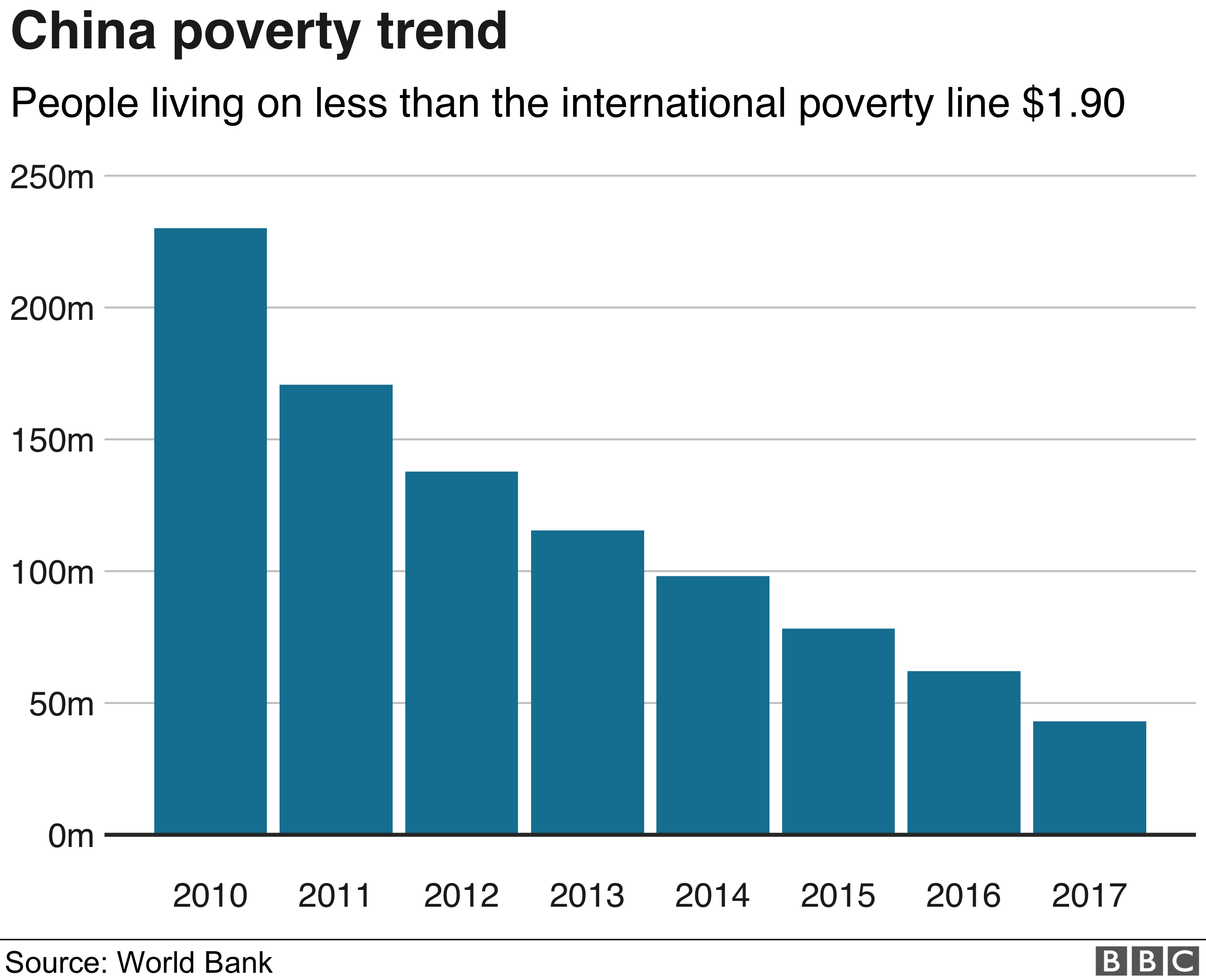
The World Bank says more than 850 million people been lifted out of poverty, and the country is on track to eliminate absolute poverty by 2020.
At the same time, education rates have surged. Standard Chartered projects that by 2030, around 27% of China’s workforce will have a university education – that’s about the same as Germany today.
Rising inequality
Still, the fruits of economic success haven’t spread evenly across China’s population of 1.3 billion people.
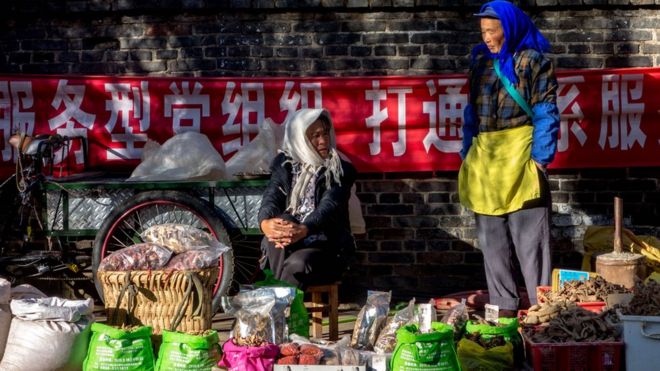
Examples of extreme wealth and a rising middle class exist alongside poor rural communities, and a low skilled, ageing workforce. Inequality has deepened, largely along rural and urban divides.
“The entire economy is not advanced, there’s huge divergences between the different parts,” Mr Mann says.
The World Bank says China’s income per person is still that of a developing country, and less than one quarter of the average of advanced economies.
China’s average annual income is nearly $10,000, according to DBS, compared to around $62,000 in the US.
Slower growth
Now, China is shifting to an era of slower growth.
For years it has pushed to wean its dependence off exports and toward consumption-led growth. New challenges have emerged including softer global demand for its goods and a long-running trade war with the US. The pressures of demographic shifts and an ageing population also cloud the country’s economic outlook.
Still, even if the rate of growth in China eases to between 5% and 6%, the country will still be the most powerful engine of world economic growth.
“At that pace China will still be 35% of global growth, which is the biggest single contributor of any country, three times more important to global growth than the US,” Mr Mann says.
The next economic frontier
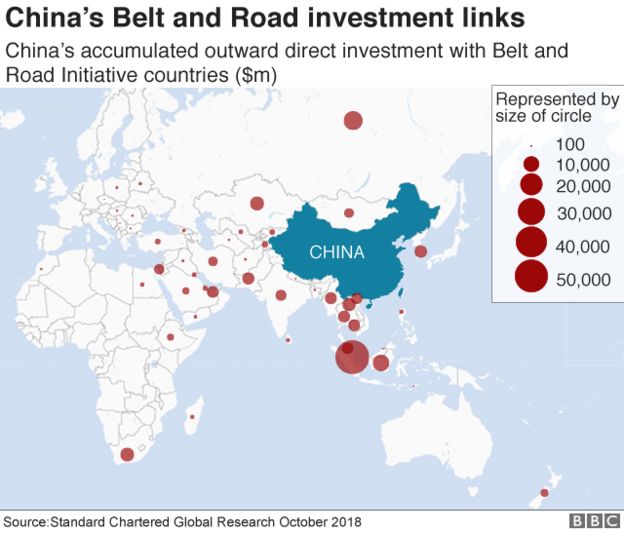
China is also carving out a new front in global economic development. The country’s next chapter in nation-building is unfolding through a wave of funding in the massive global infrastructure project, the Belt and Road Initiative.
The so-called new Silk Road aims to connect almost half the world’s populations and one-fifth of global GDP, setting up trade and investment links that stretch across the world.
Chinese Vice Premier Liu He, also a member of the Political Bureau of the Communist Party of China Central Committee, meets with Chairman of the U.S.-China Business Council (USCBC) Evan Greenberg at the latter’s request in Beijing, capital of China, on Sept. 12, 2019. (Xinhua/Liu Bin)
BEIJING, Sept. 12 (Xinhua) — Chinese Vice Premier Liu He on Thursday met with Chairman of the U.S.-China Business Council (USCBC) Evan Greenberg in Beijing at the latter’s request.
Liu, also a member of the Political Bureau of the Communist Party of China Central Committee, said China welcomes the U.S. side’s latest decision to delay an increase in tariffs, which was previously scheduled for Oct. 1.
The whole world looks forward to seeing progress in trade consultations between China and the United States, Liu said, adding that working groups of both sides will meet next week and have earnest discussions on trade balance, market access, protection of investors and other issues of common concern.
The U.S. business sector does not want to see a hike in tariffs, and hopes that the two countries will solve their differences through consultations and bring bilateral trade back to normal, Greenberg said.
The USCBC is willing to play a positive role in this regard, he added.
BEIJING/HONG KONG (Reuters) – Segway-Ninebot Group, a Beijing-based electric scooter maker, on Friday unveiled a scooter that can return itself to charging stations without a driver, a potential boon for the burgeoning scooter-sharing industry.
Ninebot said Uber and Lyft, the ride-hailing giants that are expanding into scooter-sharing, would be among the customers for the new semi-autonomous vehicles that are expected to hit roads early next year.
Gao Lufeng, Ninebot chairman and chief executive, told Reuters in an interview that AI-driven scooters, controlled remotely from the cloud, could radically improve the economics of scooter-sharing.
“The pain point for scooter operators is to better maintain the scooters at a lower cost,” he said. Currently, operators of scooter sharing fleets have to collect the machines manually for re-charging.
Formed by the 2015 combination of China’s Ninebot and U.S. transportation pioneer Segway, the company has quietly become the largest supplier for scooter-sharing companies such as Bird and Lime.
“I believe scooters will replace bicycles as the prime solution for micro-mobility,” Gao said. “It’s human nature to save energy when commuting.”
The scooter-sharing fad was triggered two years ago with the launch of Bird in California. Venture-capital investors have since poured hundreds of millions of dollars into the sector, and fleets of electric-powered scooters now operate in cities across the U.S. and Europe.
Segway-Ninebot Group has applied to list its shares on the China’s new Nasdaq-style board for homegrown tech firms, the STAR Market. The company sold 1.6 million scooters in 2018, according to a prospectus filed in April.
Lyft and Uber did not immediately respond to emailed requests for comment.
The new scooters will be priced at close to 10,000 yuan ($1,420), more than the company’s traditional scooters, which it sells to scooter companies for $100-$300.
The new machines will start road testing next month and will be largely commercialized in the first quarter of 2020.
The company also launched two self-driving delivery robots — one for outdoor delivery, the other for indoor services.
Ninebot said the unmanned delivery robots will initially serve the food delivery industry in China.
The company is in talks with food delivery operators, including Meituan Dianping and Alibaba Group’s Ele.me, to begin service by the first half of next year.
URUMQI, July 28 (Xinhua) — A group of Chinese experts have criticized the United States for adopting double standards on counterterrorism and deradicalization and using Xinjiang-related issues as a tool to interfere in China’s domestic affairs.
The experts, who specialize in studies in the fields of human rights, international relations and anti-terrorism, made the remarks at a seminar held recently in Urumqi, capital of Xinjiang Uygur Autonomous Region.
Wang Yu, an associate researcher with the Institute of Chinese Borderland Studies, said China’s anti-terror measures implemented in Xinjiang in recent years have provided a new solution to the global fight against terrorism.
For some time China’s Xinjiang has seen frequent incidents of terrorist attacks, but over the past nearly three years, there have been no such incidents in the region, Wang noted.
Gu Liyan, a researcher with the Xinjiang Academy of Social Sciences, accused the United States of using human rights issues to erode public trust in governments of some other countries and create social conflict and unrest there, so as to attain its global hegemony.
“Whatever measures or policies China implements on counterterrorism and deradicalization will never accord with the so-called human rights standards of the U.S.,” she said.
Li Wei, a researcher with the China Institute of Contemporary International Relations, said education and training centers were established in Xinjiang in order to prevent trainees from falling victim to terrorism and extremism.
China’s measures on deradicalization offer a successful case study to the international community and have won widespread recognition and acclaim, said Li.
Shu Hongshui, an anti-terror expert at Northwest University of Political Science and Law, said the U.S. adoption of double standards on counterterrorism and deradicalization is intended to curb China’s development.
The propaganda warfare waged by the United States and some other Western countries against China on Xinjiang-related issues is unable to conceal their strategic anxiety and predicament, Shu said
BEIJING (Reuters) – China has received a briefing from the United States on the latest meeting between U.S. President Donald Trump and North Korean leader Kim Jong Un, China’s Foreign Ministry said on Saturday, in a call between two senior diplomats.
Trump became the first sitting U.S. president to set foot in North Korea on Sunday when he met Kim in the Demilitarized Zone (DMZ) at Panmunjom between the two Koreas and agreed to resume stalled nuclear talks.
Chinese Vice Foreign Minister Luo Zhaohui and U.S. Special Representative for North Korea Stephen Biegun discussed that meeting in a telephone call on Friday, China’s Foreign Ministry said in a short statement.
“Biegun introduced the meeting between the U.S. and North Korean leaders at Panmunjom, and said the U.S. side is willing to strengthen communication and coordination with the Chinese side on the peninsula issue,” the ministry added.
Luo told Biegun the recent “positive interactions” on the North Korean issue by all parties had important meaning for the peace talks process, the ministry said.
“China supports U.S.-North Korea exchanges and dialogue and hopes that the two sides will meet each other halfway and follow the consensus of the leaders of the two countries to resume consultations at the working level as soon as possible,” it added.
Trump’s meeting with Kim came around a week after Chinese President Xi Jinping met Kim himself during a state visit to Pyongyang.
While China has not officially announced it, Luo is likely China’s new special envoy for the North Korea issue, after predecessor Kong Xuanyou became China’s new ambassador in Tokyo in late May.
Luo was also involved in a briefing to Chinese reporters on Xi’s visit to North Korea before Xi went, according to state media.
Luo is an urbane career diplomat who speaks good English, according to diplomats who have met him.
He previously served as China’s ambassador in Canada, Pakistan and India, and also worked in the Chinese embassy in Washington from 1996-2000.




 CHINDIA ALERT: You'll be living in their world, very soon