Archive for ‘UN Secretary General’

22/02/2019

‘Does not represent a judgement’: China on mention of JeM in UNSC statement

China has been repeatedly blocking India and several other countries’ efforts to bring about a global ban on JeM chief Masood Azhar in the UN’s anti-terror 1267 committee.

WORLD Updated: Feb 22, 2019 16:35 IST

Press Trust of India
Beijing
Jaish-e-Muhammad,Pulwama terror attack,UN Security Council
Lethpora: Security agencies inspect the site of suicide bomb attack at Lethpora area, in Pulwama district of south Kashmir, Friday, Feb. 15, 2019. At least 37 CRPF personnel were killed yesterday in one of the deadliest terror attacks in Jammu and Kashmir when a Jaish suicide bomber rammed a vehicle carrying over 100 kg of explosives into their bus in Pulwama district. (PTI Photo/S Irfan)(PTI2_15_2019_000037B)(AP)

China, a permanent member of the UN Security Council, Friday sought to downplay the scathing statement issued by the powerful organ of the world body naming Jaish-e-Muhammad in the Pulwama terror attack, saying the mention of the Pakistan-based outfit was only in “general terms” and “does not represent a judgement”.

Forty Central Reserve Police Force personnel were killed in a suicide attack by Pakistan-based Jaish-e-Mohammed (JeM) in Jammu and Kashmir’s Pulwama district on February 14, sparking outrage in the country.

The powerful UN Security Council (UNSC) on Thursday strongly condemned the “heinous and cowardly” terror attack.

“The members of the Security Council condemned in the strongest terms the heinous and cowardly suicide bombing in Jammu and Kashmir, which left 40 Indian paramilitary forces dead and dozens wounded on February 14, 2019, for which Jaish-e-Mohammed has claimed responsibility,” it said in a statement.

Asked about the statement highlighting the role of JeM claiming the responsibility of the Pulwama attack, China’s foreign ministry spokesman Geng Shuang told reporters that Beijing was closely following the developments related to the terror incident.

“Yesterday, the UN Security Council issued a press statement that mentioned that a particular organisation but only in general terms. It does not represent a judgment on the attack,” Geng said.

His remarks were seen as an attempt by China, without whose endorsement the UNSC statement could not have been released, aimed at placating its close ally Pakistan and play down the indictment of the JeM.

China has been repeatedly blocking India and several other countries’ efforts to bring about a global ban on JeM chief Masood Azhar in the UN’s anti-terror 1267 committee.

While China’s endorsement of the UNSC statement was reflection of wariness on the part of Beijing to repeatedly defend JeM in the UN body, which casts a shadow on its relations with India, observers say it is to be seen what stand Beijing would take when France moves its resolution seeking to list Azhar as a global terrorist in the UN.

France, also member of the permanent five of the UNSC, has officially announced that it would move a resolution soon in the 1267 committee seeking Azhar’s listing.

Since 2016, China has consistently blocked moves first by India and later by the US, the UK and France to designate Azhar as a global terrorist by putting repeated technical holds.

In his response on Friday Geng said that “China also noted that the Pakistani government showed readiness to cooperate with India on the investigation and that it is also ready to resolve differences with India through dialogue”.

“China hopes all parties will work to find the truth about this attack. We hope Pakistan and India will engage in dialogue to jointly safeguard regional peace and stability,” he said.

The UN statement also underlined the need to hold perpetrators, organisers, financiers and sponsors of these “reprehensible acts of terrorism” accountable and bring them to justice”.

The UN condemnation came a day after Pakistan’s Permanent Representative to the UN Maleeha Lodhi met top UN leaders including with Secretary-General Antonio Guterres to brief them about the escalating tensions in the region in the wake of the Pulwama attack.

Source: hindustan Times

19/02/2019

Pakistan PM Imran Khan says ready to talk terror, then packs in warning against strikes

Pakistan PM Imran Khan has denied hand behind Pulwama terror attack stating if there is evidence, his government will act against the culprits.

INDIA Updated: Feb 19, 2019 14:50 IST

HT Correspondent
HT Correspondent
Hindustan Times, Islamabad
Imran Khan,Pulwama attack
Pakistan Prime Minister Imran Khan on Tuesday said if there is any evidence of involvement of any Pakistani national in Pulwama terror attack, his government will act against the culprits. (AP)

Pakistan Prime Minister Imran Khan has denied his country’s role behind the Pulwama terror attack, the worst in Jammu and Kashmir in decades. He claimed that India does not have any evidence to prove Pakistan’s role in terror attacks in Kashmir.

“You (India) have blamed the Pakistan government without any evidence…If you have any evidence, we will act,” Imran Khan said.

He said, “It is in our interest that nobody from our soil spreads violence. I want to tell Indian government that we will take action if evidence is found against anyone from Pakistan.”

“What has Pakistan to gain from this? Why will Pakistan do this at a stage when it is moving towards stability,” said Imran Khan adding that “this is a Naya Pakistan with a new mindset.”

Calling for a dialogue with India, he said, “If you thinks you will attack us and we will not think of retaliating…We will retaliate. We all know starting a war is in the hands of humans, where it will lead us only God knows. This issue should be solved through dialogue.”

Also Read | Eliminated Jaish leadership that planned Pulwama attack within 100 hours, says army

Imran Khan’s reaction comes days after at least 40 CRPF jawans were killed in a terror attack in Jammu and Kashmir. Pakistan-backed terror outfit Jaish-e-Mohammad claimed responsibility for the attack.

Earlier, Pakistan sought an urgent intervention of UN Secretary-General in defusing tensions with India and help facilitate dialogue between the two countries.

Following the terror attack, India launched a diplomatic offensive against Pakistan with the ministry of external affairs reaching out to more than two dozen countries including P5 – the US, the UK, France, Russia and China, which has repeatedly blocked India’s bid to get Jaish-e-Mohammad chief Masood Azhar declared as global terrorist by the United Nations.

Also Read | Army major killed in Pulwama encounter made plans for first anniversary

China has used veto to shield Masood Azhar. Pakistan has also denied its support to the terror group. On Monday, in a joint statement Imran Khan and Saudi Arabia’s prince Mohammed bin Sultan “underlined the need for avoiding politicisation of UN listing regime.” This is being viewed as a snub to India’s renewed efforts to isolate Pakistan over its continued support to terror outfits and corner Masood Azhar’s JeM.

India withdrew the most favoured nation (MFN) status accorded to Pakistan in 1996. The MFN status had not been revoked even during the 1999 Kargil War and in the aftermath of 2008 Mumbai terror attack that killed more than 160 people.

Source: Hindustan Times

15/02/2019

Pulwama attack: India will ‘completely isolate’ Pakistan

India has said it will ensure the “complete isolation” of Pakistan after a suicide bomber killed 46 soldiers in Indian-administered Kashmir.

Federal Minister Arun Jaitley said India would take “all possible diplomatic steps” to cut Pakistan off from the international community.

India accuses Pakistan of failing to act against the militant group which said it carried out the attack.

This is the deadliest attack to hit the disputed region in decades.

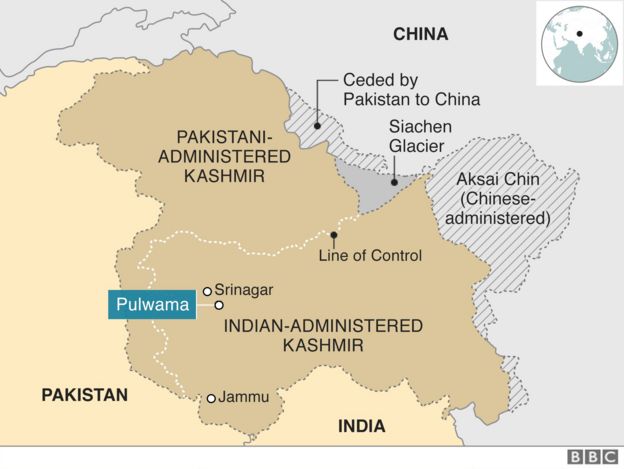
Both India and Pakistan claim all of Muslim-majority Kashmir but only control parts of it.

An insurgency has been ongoing in Indian-administered Kashmir since the late 1980s and there has been an uptick in violence in recent years.

How will India ‘punish’ Pakistan?

India says that Jaish-e-Mohammad, the group behind the attack, has long had sanctuary in Pakistan and accuses its neighbour of failing to crack down on it.

It has called for global sanctions against the group and has said it wants its leader, Masood Azhar, to be listed as a terrorist by the UN security council.

Although India has tried to do this several times in the past, its attempts were repeatedly blocked by China, an ally of Pakistan.

Mr Jaitley set out India’s determination to hold Pakistan to account when speaking to reporters after attending a security meeting early on Friday.

He also confirmed that India would revoke Most Favoured Nation status from Pakistan, a special trading privilege granted in 1996.

Pakistan said it was gravely concerned by the bombing but rejected allegations that it was in any way responsible.

But after Prime Minister Narendra Modi said in a speech that those behind the attack would pay a “heavy price”, many analysts expect more action from Delhi.

After a 2016 attack on an Indian army base that killed 19 soldiers, Delhi said it carried out a campaign of “surgical strikes” in Pakistan-administered Kashmir, across the de facto border. But a BBC investigation found little evidence militants had been hit.

However analysts say that even if the Indian government wants to go further this time, at the moment its options appear limited due to heavy snow across the region.

map

How did the attack unfold?

The bomber used a vehicle packed with explosives to ram into a convoy of 78 buses carrying Indian security forces on the heavily guarded Srinagar-Jammu highway about 20km (12 miles) from the capital, Srinagar.

“A car overtook the convoy and rammed into a bus,” a senior police official told BBC Urdu.

It stands as the deadliest militant attack on Indian forces in Kashmir since the insurgency began in 1989.

The bomber is reported to be Adil Dar, a high school dropout who left home in March 2018. He is believed to be between the ages of 19 and 21.

Soon after the attack Jaish-e-Mohammad released a video, which was then aired on the India Today TV channel. In it, a young man identified as Adil Dar spoke about what he described as atrocities against Kashmiri Muslims. He said he joined the banned group in 2018 and was eventually “assigned” the task of carrying out the attack in Pulwama.

He also said that by the time the video was released he would be in jannat (heaven).

Dar is one of many young Kashmiri men who have been radicalised in recent years. On Thursday, main opposition leader Rahul Gandhi said that the number of Kashmiri men joining militancy had risen from 88 in 2016 to 191 in 2018.

India has been accused of using brutal tactics to put down protests in Kashmir – with thousands of people sustaining eye injuries from pellet guns used by security forces.

What’s the reaction?

“We will give a befitting reply, our neighbour will not be allowed to de-stabilise us,” said Prime Minister Modi.

Mr Gandhi and two former Indian chief ministers of Jammu and Kashmir all condemned the attack and expressed their condolences.

The attack has also been widely condemned around the world, including by the US and the UN Secretary General.

The White House called on Pakistan to “end immediately the support and safe haven provided to all terrorist groups operating on its soil”.

Pakistan said it strongly rejected any attempts “to link the attack to Pakistan without investigations”.

What’s the background?

There have been at least 10 suicide attacks since 1989 but this is only the second suicide attack to use a car.

Prior to Thursday’s bombing, the deadliest attack on Indian security forces in Kashmir this century came in 2002, when militants killed at least 31 people at an army base in Kaluchak near Jammu, most of them civilians and relatives of soldiers.

At least 19 Indian soldiers were killed when militants stormed a base in Uri in 2016. Delhi blamed that attack on the Pakistani state, which denied any involvement.

The latest attack also follows a spike in violence in Kashmir that came about after Indian forces killed a popular militant, 22-year-old Burhan Wani, in 2016.

More than 500 people were killed in 2018 – including civilians, security forces and militants – the highest such toll in a decade.

India and Pakistan have fought three wars and a limited conflict since independence from Britain in 1947 – all but one were over Kashmir.

Who are Jaish-e-Mohammad?

Started by cleric Masood Azhar in 2000, the group has been blamed for attacks on Indian soil in the past, including one in 2001 on the parliament in Delhi which took India and Pakistan to the brink of war.

Most recently, the group was blamed for attacking an Indian air force base in 2016 near the border in Punjab state. Seven Indian security personnel and six militants were killed.

It has been designated a “terrorist” organisation by India, the UK, US and UN and has been banned in Pakistan since 2002.

However Masood Azhar remains at large and is reportedly based in the Bahawalpur area in Pakistan’s Punjab province.

India has demanded his extradition from Pakistan but Islamabad has refused, citing a lack of proof.

Source: The BBC

Law of Unintended Consequences

continuously updated blog about China & India

ChiaHou's Book Reviews

continuously updated blog about China & India

What's wrong with the world; and its economy

continuously updated blog about China & India