Archive for ‘Uncategorized’

09/10/2019

China Focus: Xi’s trip to India, Nepal to inject new impetus into ties

BEIJING, Oct. 9 (Xinhua) — Chinese President Xi Jinping’s upcoming trip to India and Nepal is expected to inject new impetus into China’s relations with the two countries, an official said here Wednesday.

The Chinese Foreign Ministry announced earlier in the day that at the invitation of Indian Prime Minister Narendra Modi and Nepali President Bidhya Devi Bandari, President Xi will attend the second informal meeting with Modi and pay a state visit to Nepal from Oct. 11 to 13.

This will be Xi’s first overseas trip after the grand celebration of the 70th anniversary of the founding of the People’s Republic of China, Vice Foreign Minister Luo Zhaohui told a press briefing.

Xi’s trip will inject new impetus into China-India and China-Nepal relations, even China’s relations with South Asia, Luo said, adding that Xi’s trip will also open up new space for strengthening regional connectivity and economic and trade cooperation, set up new platforms for enhancing mutual trust and friendship among regional people, and make new contributions to world peace and prosperity.

China and India, both as developing countries and emerging economies, are the only two major countries in the world with a population of more than 1 billion, Luo said, stressing that China-India cooperation will not only benefit the development of the two countries, but also help promote world multipolarization and economic globalization, and safeguard the common interests of developing countries.

Since the first informal meeting between Xi and Modi in Wuhan last year, China-India relations have entered a new stage of steady growth, with cooperation and exchanges being carried out in various fields and differences being properly managed, Luo said.

In Chennai, Xi will have an in-depth communication with Modi on issues that have overall, long-term and strategic significance on bilateral relations, set the tune and guide the direction for future development of the ties, and speak to the world in unanimous voice, so as to inject positive energy into the world full of uncertainties.

Regarding Xi’s visit to Nepal, Luo said that Xi will be the first Chinese president to visit the South Asian country after an interval of 23 years.

Nepal, as a friendly neighbor, also serves as an important partner of China in terms of carrying out the Belt and Road cooperation, Luo said.

Since the establishment of diplomatic ties, the two countries have treated each other on an equal footing with mutual respect and support, said Luo, adding that China and Nepal have become a model of mutually beneficial cooperation between countries that are different in social system and size.

“This historic visit will definitely exert historic influence,” Luo said.

He said that Xi will attend the welcome ceremony and banquet hosted by President Bandari, meet with Bandari, hold talks with Prime Minister K.P. Sharma Oli and jointly witness the signing of cooperation documents with him.

Xi will also meet with co-chairman of the Nepal Communist Party Pushpa Kamal Dahal, also known as Prachanda, and leaders of the country’s Federal Parliament and other political party leaders, Luo added.

Leaders of the two countries will make new plans for the development of bilateral relations, ushering in a new era of fast development for China-Nepal relations, Luo said.

This will also consolidate political mutual trust and foundation of public opinions for friendship between the two countries, push forward high quality construction of the Belt and Road, speed up building an interconnectivity network across the Himalayas, and inject new impetus into pragmatic cooperation in various areas between the two countries, Luo said.

Source: Xinhua

09/10/2019

Technology, not China, can be blamed for regional job losses in developed countries, IMF finds

  • Competition from China is not the primary reason for regional job losses in rich countries, new IMF research finds
  • Study finds technological advancement is bigger driver of unemployment, undermining populist argument China is stealing manufacturing jobs
The IMF said automation displaced more jobs in rich countries than China’s growing productivity. Photo: SCMP

Automation rather than market competition from China can be blamed for regional job losses suffered in developed countries, including American rust belt states, according to new research by the International Monetary Fund released on Wednesday.

“Increases in import competition in external markets associated with the rise of China’s productivity do not have marked effects on regional unemployment,” the Washington-based fund said in an academic paper. “Only technology shocks tend to have lasting effects, with even larger unemployment rises for vulnerable lagging regions.”

The paper, which looked at regional disparities within advanced countries, undermines a key argument pushed by US President Donald Trump in the ongoing trade war

 between Washington and Beijing – that China has been stealing American technology and jobs.
Although the research did not mention Trump, the IMF said the argument that market competition displaced jobs was flawed as imports from China could only cause job losses in the near term and such impact “quickly abates”.

The US goods trade deficit with China hit a record of US$419.2 billion in 2018, which the Trump administration has blamed for a decline in US manufacturing jobs.

In the paper, the IMF classified a region as “lagging” if two conditions were met – initial real gross domestic product (GDP) per capita was below the country’s median in 2000, and the region’s average growth between 2000 to 2017 was below average.

Labour productivity tended to be lower and employment in the agriculture sector higher in lagging regions, the IMF said. Within the United States, per capita GDP in the state of New York is 100 per cent higher than in Mississippi, parts of which are considered within the rust belt.

While increases in import competition tended to reduce labour force participation after one year, this impact faded quickly and did not have significant effects on regional unemployment on average, IMF analyst Weicheng Lian said.

The impact of technology was more far-reaching, however, with researchers pinpointing it as the main driver of rising unemployment in lagging regions.

Automation pressures

translate into a decline in the cost of machinery and equipment, leading to more persistent rises in unemployment and declines in labour force participation in lagging regions, compared with less vulnerable regions, the study said.

Lian said that poorer regions tend to specialise in agriculture and manufacturing industries rather than high productivity service sectors such as information technology, communications and finance.
“We find that a negative technology shock … raises unemployment in all regions that are more vulnerable to automation, but lagging regions are particularly hurt,” she said.
China-US trade war may cost US$700 billion by 2020 in synchronised global slowdown, new IMF chief says

US-China trade war could cost world economy US$700 billion by 2020: IMF

Read more

China tones down expectations ahead of US trade war talks as Vice-Premier Liu He leads team to Washington

China tones down expectations ahead of US trade war talks

Read more

Kristalina Georgieva is the new IMF chief, taking over from Christine Lagarde

Kristalina Georgieva is the new IMF chief

Read more

China, US urged to ease trade war tensions that are ‘weighing on’ global commerce, says IMF chief economist

China, US urged to ease tensions that are ‘weighing on global trade’

Read more

US-China trade war caused ‘self-inflicted’ damage to the global economy, says IMF after third 2019 forecast cut

US-China trade war caused ‘self-inflicted’ damage to the global economy

09/10/2019

US imposes China visa restrictions over Uighur issue

Uighur protesters demonstrating in the US in FebruaryImage copyright GETTY IMAGES
Image caption Protests calling for Uighur freedom have been happening all year

The US has said it will impose visa restrictions on Chinese officials accused of involvement in repression of Muslim populations.

It follows the decision on Monday to blacklist 28 Chinese organisations linked by the US to allegations of abuse in the Xinjiang region.

US Secretary of State Mike Pompeo said the Chinese government had instituted “a highly repressive campaign”.

China has dismissed the allegations as groundless.

In a statement, Mr Pompeo accused the Chinese government of a string of abuses against Uighurs, ethnic Kazakhs, Kyrgyz Muslims and other minority Muslim groups.

These included “mass detentions in internment camps; pervasive, high-tech surveillance; draconian controls on expressions of cultural and religious identities; and coercion of individuals to return from abroad to an often perilous fate in China”.

China has rebuffed the US moves.

“There is no such thing as these so-called ‘human rights issues’ as claimed by the United States,” foreign ministry spokesman Geng Shuang said on Monday.

“These accusations are nothing more than an excuse for the United States to deliberately interfere in China’s internal affairs.”

Media caption The BBC visits the camps where China’s Muslims have their “thoughts transformed”

Visa restrictions are to be imposed on Chinese government and Communist Party officials, as well as their family members.

“The United States calls on the People’s Republic of China to immediately end its campaign of repression in Xinjiang, release all those arbitrarily detained, and cease efforts to coerce members of Chinese Muslim minority groups residing abroad to return to China to face an uncertain fate,” the US statement said.

The US and China are currently embroiled in a trade war, and have sent delegations to Washington for a meeting about the tensions later this week.

What is the situation in Xinjiang?

China has been carrying out a massive security operation in Xinjiang, in its far west, in recent years.

Human rights groups and the UN say China has rounded up and detained more than a million Uighurs and other ethnic minorities in vast detention camps, where they are forced to renounce Islam, speak only in Mandarin Chinese and learn obedience to the communist government.

But China says they are attending “vocational training centres” which are giving them jobs and helping them integrate into Chinese society, in the name of preventing terrorism.

Media caption The BBC’s John Sudworth meets Uighur parents in Turkey who say their children are missing in China

There have been increasingly vocal denunciations from the US and other countries about China’s actions in Xinjiang.

Last week, Mr Pompeo alleged that China “demands its citizens worship government, not God” in a press conference in the Vatican.

And in July more than 20 countries at the UN Human Rights Council signed a joint letter criticising China’s treatment of the Uighurs and other Muslims.

Who are the Uighurs?

Uighurs are ethnically Turkic Muslims. They make up about 45% of the Xinjiang region’s population; 40% are Han Chinese.

China re-established control in 1949 after crushing short-lived state of East Turkestan.

Since then, there has been large-scale immigration of Han Chinese and Uighurs fear erosion of their culture.

Xinjiang is officially designated an autonomous region within China, like Tibet to its south.

Source: The BBC

09/10/2019

Kashmir conflict: Woes deepen as lockdown stifles economy

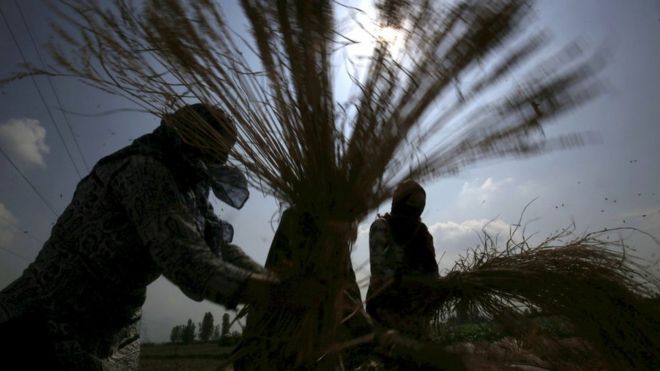
Farmers thresh paddy, separating grain from chaff, during the harvest season on October 2, 2019 on the outskirts of Srinagar, India.Image copyright GETTY IMAGES

The lockdown in Indian-administered Kashmir has cost the region’s economy more than $1bn in two months, according to industry experts. BBC Hindi’s Vineet Khare reports.

Mushtaq Chai recalls the afternoon of 2 August when he received a “security advisory” from the administration. A prominent local businessman, he owns several hotels across the Muslim-majority valley in Indian-administered Kashmir.

The note warned of “terror threats” and advised that tourists and Hindu pilgrims should “curtail their visit… and return as soon as possible”.

Mr Chai, like many others, took the advisory seriously. Two years before, seven Hindu pilgrims were killed in a militant attack while returning from the Amarnath cave, a major Hindu shrine in Kashmir’s Anantnag district.

“This was the first time in Kashmir’s history that tourists and pilgrims were asked to leave,” Mr Chai says.

Indian tourists seen leaving the City during the curfew in Srinagar on 16 August 2019.Image copyright GETTY IMAGES
Image caption Tourists left Kashmir amid a curfew in August

Soon officials arrived to enforce the order, and Mr Chai and his staff made arrangements for all of the guests to leave immediately.

Days later, on 5 August, the federal government stripped the region of its special status and placed it under a communications lockdown.

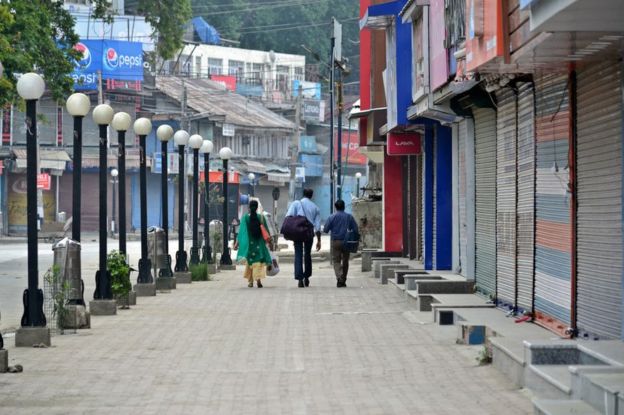
Two months on, the situation is far from normal. Internet and mobile phone connections remain suspended, public transport is not easily available, and most businesses are shut – some in protest against the government, and others for fear of reprisals from militants opposed to Indian rule.

There is also a shortage of skilled labour, as some 400,000 migrants have left since the lockdown began.

What’s more, the streets are deserted and devoid of the tourist business which had supported up to 700,000 people.

Presentational grey line

Read more about Kashmir

Presentational grey line

The lockdown has not come cheap.

A government official, who did not wish to be named, says they are “awaiting a financial package” from the federal government. But the Kashmir Chamber of Commerce and Industry estimates the shutdown has already cost the region more than $1.4bn (£1.13bn), and thousands of jobs have been lost.

“There are around 3,000 hotels in the valley and they are all empty. They have loans to pay off and daily expenses to bear,” says Mr Chai, sitting in his mostly empty hotel in the capital, Srinagar.

Only a handful of his 125 staff are at work. Many haven’t returned because of lack of transport – or fear. Tensions have been high in the region, and there have been a number of protests in the city.

But the situation may improve in the coming days as the government has announced that tourists will allowed in the state from Thursday.

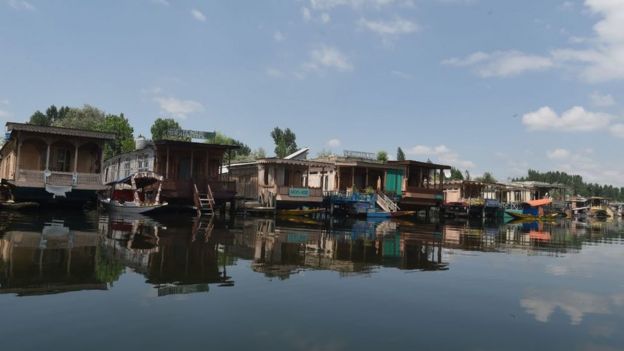
Empty houseboats on Srinagar's Dal lake.Image copyright GETTY IMAGES
Image caption Hundreds of houseboats have been lying vacant

But it isn’t just the hotels which have suffered.

“No internet has meant more than 5,000 travel agents have lost work,” says Javed Ahmed, a travel agent himself. “The government says give jobs to the youth. We are young but jobless. We have nothing to do with politics. We want jobs.”

Srinagar’s almost 1,000 iconic houseboats have also been running empty.

“Every houseboat needs up to $7,000 a year for maintenance,” says Hamid Wangnoo from the Kashmir Houseboats Owners Association. “For many, this is the only source of livelihood.”

And it isn’t just tourism.

“More than 50,000 jobs have been lost in the carpet industry alone,” according to Shiekh Ashiq, president of the chamber of industry.

He says July to September is when carpet makers usually receive orders for export – especially overseas, so they can deliver by Christmas.

But they are unable to contact importers, or even their own employees, because of the communications lockdown.

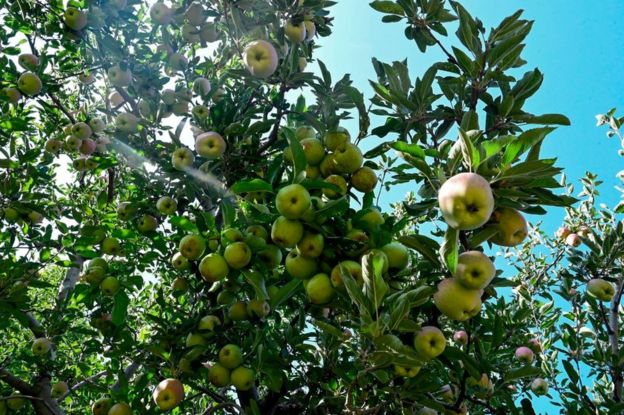
Apples are ready to be harvested in an orchard in Shopian district of southern Kashmir valley.Image copyright GETTY IMAGES
Image caption Kashmir’s famous apple orchards have also been hit hard

In southern Kashmir, the region’s famous apples are still waiting to be plucked from the trees. But shops and cold storage units are shut, and the main apple market is empty. Last year, it did business worth $197m, local farmers say.

“I feel so much pain seeing my apples hanging from the trees that I don’t go to the orchard anymore,” says a worried apple grower, who did not wish to be named.

“Apples account for 12–15% of Kashmir’s economy, but more than half of this year’s produce has not been plucked,” says economic journalist Masood Hussain. “If this continues through October, it will have devastating consequences.”

In Srinagar, some shop owners wait outside their stores and open them for a customer before closing them hurriedly – until the next customer arrives.

One such owner says he is unhappy with the government’s decision, but he is also scared of angry locals who want him to keep his business closed.

“But how do I survive without my daily earnings?” he asked.

Media caption Two wars, a 60-year dispute – a history of the Kashmir conflict

Source: The BBC

09/10/2019

India’s Modi to host China’s Xi at summit with ties strained by Kashmir

NEW DELHI (Reuters) – India’s Prime Minister Narendra Modi will welcome Chinese President Xi Jinping at an informal summit this week, the Indian foreign ministry said on Wednesday, their talks coming at a time of strained ties over the disputed region of Kashmir.

The meeting in the southern Indian city of Chennai on Oct. 11-12 is aimed at enhancing the rapport the leaders built when they met in the Chinese city of Wuhan last year to help stabilise ties after a standoff in another contested section of their long border, far removed from Kashmir.

But India’s decision in August to withdraw special status for Kashmir drew sharp condemnation from Pakistan and its old ally, China, which took the matter to the U.N. Security Council.

During a meeting with Pakistan Prime Minister Imran Khan in Beijing on Wednesday, Xi said that he was watching the situation in Kashmir closely, the official Xinhua News Agency reported.

Xi said that the right and wrong of the situation was clear and India and Pakistan should resolve the dispute via peaceful dialogue, according to Xinhua.

India says its revocation of the special status of Muslim-majority Kashmir, which was accompanied by a crackdown on dissent by the security forces, is an internal matter aimed at developing the Himalayan territory, which is also claimed by Pakistan, more quickly.

India will make clear that any change to its Jammu and Kashmir state is an internal affair if the Chinese side were to raise the matter in the forthcoming talks, a government source said.

China’s close security ties with Pakistan have long been a matter of concern in New Delhi and in recent years India has drawn closer to the United States to help balance China’s rising weight across the region.

“The forthcoming Chennai Informal Summit will provide an opportunity for the two leaders to continue their discussions on overarching issues of bilateral, regional and global importance and to exchange views on deepening India-China Closer Development Partnership,” the Indian ministry said in a statement.

“OMINOUS SIGNALS

China, which has been criticised by the United States for its treatment of members of Muslim ethnic minorities, said it believed India and Pakistan must refrain from taking unilateral action in Kashmir and has expressed concern over human rights violations there. India has dismissed those concerns.

Srikanth Kondapalli, professor of Chinese studies at New Delhi’s Jawaharlal Nehru University, said it was important for the nuclear-armed neighbours to stabilise relations as both dealt with domestic and regional issues.

“The second informal meeting as such is significant given these ominous signals at bilateral, regional and global levels,” he said.

Xi will also make a state visit to Nepal at the end of his India visit, the first by a Chinese president in 22 years, the Nepali foreign ministry said.

China has deepened ties with India’s neighbours, building ports and power stations in an arc stretching from Bangladesh to Sri Lanka and Pakistan as part of its grand Belt and Road energy and infrastructure plan.

Ahead of Xi’s trip to India, China invited Pakistan’s Prime Khan for talks and said it supports Pakistan in safeguarding its independent sovereignty and territorial integrity.

The Himalayan region of Kashmir is divided between India, Pakistan and China. India rules the populous Kashmir Valley and the Hindu-dominated region around Jammu city, while Pakistan controls a wedge of territory in the west, and China holds a thinly populated high-altitude area in the north.
During Xi’s visit, Modi is expected to raise economic issues, including India’s $53 billion trade deficit with China in 2018/19, and the smaller presence of Indian companies in China compared with that of other major economies.
Source: Reuters
08/10/2019

China’s leading robot maker improves lives of the elderly

SHENYANG, Oct. 8 (Xinhua) — China’s leading robot maker, SIASUN Robot & Automation Co., Ltd., said it has been developing robots that can provide better services for the aged.

Based in Shenyang, capital of northeast China’s Liaoning Province, SIASUN’s products have been utilized in nursing institutions, medical institutions and hospitals for the elderly.

So far, the company has created more than 20 kinds of robotic products, including intelligent robots for daily care, intelligent beds, semi-automatic bed chairs and walking aids.

The enterprise said robots could assist the elderly in daily care, which would increase efficiency and reduce the labor intensity of nursing staff.

“With the increasing aging population, there is a huge market and room to grow for rehabilitation robots for the elderly in China,” said Li Xuewei, general manager of SIASUN’s medical and health robot division.

Li said service robots for the elderly and the disabled, such as nursing and rehabilitation robots, would be in high demand in the near future.

As a leading enterprise in China’s robotics industry, SIASUN’s products have been exported to more than 30 countries and regions.

Source: Xinhua

08/10/2019

100-mln-year-old dinosaur footprints found in east China

BEIJING, Oct. 8 (Xinhua) — Paleontologists announced Tuesday in Beijing they had discovered a group of 100-million-year-old fossils of dinosaur footprints in east China’s Zhejiang Province.

Over 20 footprints, ranging from 22.7 cm to 82 cm in length, were discovered in a village in the city of Lanxi, according to Xing Lida, an associate professor with the China University of Geosciences (Beijing). Experts estimate the dinosaurs’ body length ranged from 3.8 to 14 meters.

The footprints are believed to date back 100 million years to the Cretaceous Period, indicating that a large number of sauropods were active in the area, which was believed to be rich in water and grass at that time. Experts infer there would have been carnivorous dinosaurs in symbiosis with these herbivorous dinosaurs, but no evidence has been found so far.

Xing and Martin Lockley, a professor at the University of Colorado, were among the authors of the study, which was published in Historical Biology.

Paleontologists are now working with local authorities to better protect these rare footprints.

Source: Xinhua

08/10/2019

World’s longest double-deck suspension bridge opens to traffic

CHINA-HUBEI-WUHAN-DOUBLE-DECK SUSPENSION BRIDGE-OPENING TO TRAFFIC (CN)

Aerial photo taken on Sept. 25, 2019 shows the Yangsigang Yangtze River bridge in Wuhan, capital of central China’s Hubei Province. The double-deck suspension bridge with the longest span in the world opened to traffic in Wuhan on Oct. 8. The double-deck road bridge over the Yangtze River, with a 1,700-meter-long main span, stretches 4.13 km in total length. The top deck of the 10th Yangtze River bridge has six lanes with a designed speed of 80 kph while the bottom deck also has six lanes but with a designed speed of 60 kph. (Xinhua/Xiong Qi)

WUHAN, Oct. 8 (Xinhua) — A double-deck suspension bridge with the longest span in the world opened to traffic in Wuhan, capital of central China’s Hubei Province, on Tuesday.

The first double-deck road bridge over the Yangtze River, with a 1,700-meter-long main span, stretches 4.13 km in total length.

The top deck of the 10th Yangtze River bridge has six lanes with a designed speed of 80 kph while the bottom deck also has six lanes but with a designed speed of 60 kph.

On the top deck there are also two sightseeing sidewalks and on the bottom deck there are two cycleways together with two sidewalks.

“The Yangsigang Yangtze River bridge is the world’s longest-spanning double-deck suspension bridge,” said Xu Gongyi, chief designer of the structure.

The new bridge will help ease traffic congestion and promote more balanced city development, said Lin Chi, vice president of Wuhan Urban Construction Investment and Development Group Co., Ltd.

Source: Xinhua

08/10/2019

Indian selfie deaths: Four drown in reservoir in Tamil Nadu

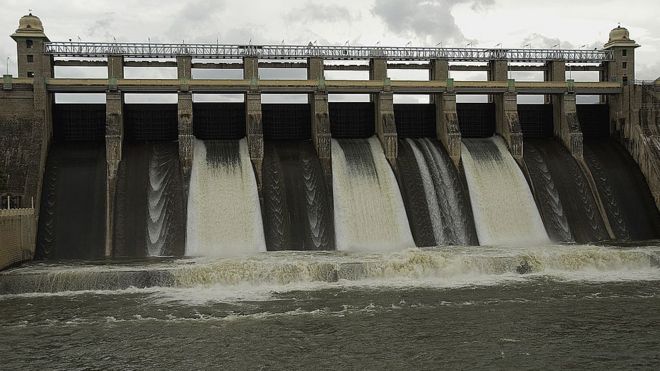
Amaravathi Dam, Coimbatore District, Tamil Nadu, IndiaImage copyright GETTY IMAGES
Image caption Tamil Nadu is home to many dams and reservoirs that are popular with visitors

A newly married woman and three of her family drowned in a reservoir after trying to take a selfie, said police in the southern Indian state of Tamil Nadu.

The dead were among a group of six who held hands and stood in waist deep water near Pambar dam before one of them slipped, pulling the others.

The woman’s husband was able to save his sister but the others drowned.

India has the highest number of recorded selfie deaths in the world.

India accounted for about half of the 259 reported fatalities between 2011 and 2017, according to a study by the US National Library of Medicine. It was followed by Russia, the US and Pakistan.

In Tamil Nadu on Sunday, the young married couple, from Bargur in Krishnagiri, were visiting relatives in Uthangarai along with the bridegroom’s sister, The Hindu newspaper reported.

The three entered the water together with three teenage siblings when one of them, a boy aged 14, slipped and dragged his two sisters aged 18 and 19 with him, along with the newly married woman and the bridegroom’s sister.

The sister was pulled to safety by her brother but the other four disappeared under the water. Police said the bodies were later recovered and that post-mortem examinations would be carried out.

It was the latest in a series of tragedies linked to selfies in India. Experts have warned that people are taking unnecessary risks to impress their family and friends on social media.

In Haryana state in May, three teenagers taking selfies on a railway track jumped out of the way when they saw a train approaching, only to be killed by another train coming in the other direction.

In 2017, the Indian state of Karnataka launched a campaign to warn people that “selfies can kill” after the deaths of four students.

The same year, a man died in Odisha when an elephant he was taking a selfie alongside wrapped its trunk around him and crushed him.

Source: The BBC

07/10/2019

Across China: Bumper harvest on a young farmer’s canvas

NANCHANG, Oct. 6 (Xinhua) — Unlike most of his peers with an unquenchable thirst for urban life, Zhou Jing, a 23-year-old farmer painter, has a special affinity for the golden paddy fields of his hometown.

Zhou, who lives in a small town of Lichuan County, east China’s Jiangxi Province, would drive a tractor on the bumpy country road to the fields every morning, and pack up the paddies in gunny bags with his father.

With a paintbrush in hand and a paintbox on his desk, he was busy coloring a nearly finished oil painting of a bumper autumn harvest in the glow of several groggy light bulbs.

Painting in his small studio fills a pleasant hour after a day’s farm work for the young farmer who has studied painting for seven years. The scratch of paintbrushes is euphonic to his ear.

Although he chose farm work over further study or migrant work after graduating from middle school in 2012, Zhou later signed up to learn to paint at a local industrial park specialized in oil painting.

“I was hesitant, but I knew I should make a living by myself as soon as possible,” he said.

Yet his early paintings were no more than simple compositions of colored blocks, since the young man was not professionally trained. Zhou worked hard and continued to draw long after his classes had ended.

Years of practice did indeed make perfect. Zhou gradually developed his own painting style, as well as the unity of colors. He was finally recognized and started his new career as a registered painter at the industrial park in April.

Life in the countryside is improving as unremitting efforts have been made by the Chinese government to increase support for agriculture, rural areas and farmers. In Lichuan, with a population of less than 300,000, oil wall paintings by the farmers can be found everywhere.

Lichuan was selected as the “Hometown of Chinese Folk Culture and Art” for its oil painting industry in January, with the industrial park’s annual output reaching 300 million yuan (about 41.9 million U.S. dollars). More than 1,000 farmer artists have been trained, increasing their annual income by over 10,000 yuan.

“When I was little I used to envy those who ate chicken drumsticks, food that for me existed only on my drawing paper,” Zhou said. “I had long dreamed of being able to live such a life, and now those dreams have become a reality.”

Source: Xinhua

Law of Unintended Consequences

continuously updated blog about China & India

ChiaHou's Book Reviews

continuously updated blog about China & India

What's wrong with the world; and its economy

continuously updated blog about China & India