04/09/2019
LANZHOU, Sept. 3 (Xinhua) — Bound by lower education levels, traditions and household responsibilities, most ethnic minority women in China’s impoverished regions have never dared to think of ways other than farming to help their families gain a better life.
However, with the government campaign to eradicate poverty gathering steam, small manufacturing workshops are bringing jobs to their doorsteps and empowering the women to take new roles in their families.
Ma Xiuping, living in a village in Linxia Hui Autonomous Prefecture, northwest China’s Gansu Province, could not hide her excitement when recalling the first time she was paid by the factory she started working in.
“I could barely read, and I never imagined I could get a salary like urban workers,” said Ma, who is in her 50s.
The rural cooperative Ma works at makes traditional cloth shoes and employs more than 50 impoverished women workers.
In Gansu Province, such poverty-alleviation factories have created jobs for more than 8,000 women who were once trapped working on farms and taking care of all the family chores, and for them, a different life has started.
“Now I don’t have to ask my husband for money, which makes me more confident,” said the 28-year-old Ma Fatumai who worked at the same workshop with Ma Xiuping. For her first month of work, she earned 1,350 yuan (about 190 U.S. dollars).
For Huang Ayingshe, who works in another poverty-reduction workshop in the prefecture, a job also means more association with the outside world, which she says is “much more fun” than staying at home.
As the deadline to eradicate absolute poverty by 2020 approaches, China is focusing efforts on the nation’s poorest people, and Gansu Province is one of the major battlefields.
Answering the central leadership’s call for “precision poverty alleviation,” which demands tailored policies to suit different local situations, the province seeks to tap the power of women in the battle to wipe out absolute poverty by 2020.
In July, the All-China Women’s Federation held a meeting in the Linxia Hui Autonomous Prefecture, which stressed women’s roles in fighting poverty and called on them to contribute their strength.
Official data showed that China lifted 13.86 million people in rural areas out of poverty in 2018, with the number of impoverished rural residents dropping from 98.99 million in late 2012 to 16.6 million by the end of last year.
Source: Xinhua
Posted in All-China Women's Federation, ethnic minority women, Factory, Gansu Province, Lanzhou, Linxia Hui Autonomous Prefecture, new life, Poverty-reduction workshops, rural cooperative, Salary, traditional cloth shoes, Uncategorized, urban workers |
Leave a Comment »
04/09/2019
Chinese Premier Li Keqiang, also a member of the Standing Committee of the Political Bureau of the Communist Party of China Central Committee, presides over a forum on the work of National Science Fund for Distinguished Young Scholars in Beijing, capital of China, Sept. 2, 2019. (Xinhua/Pang Xinglei)
BEIJING, Sept. 3 (Xinhua) — Chinese Premier Li Keqiang has pledged greater government support to help create a more favorable and freer environment for young scientists to explore and innovate.
He said the National Science Fund for Distinguished Young Scholars will play a bigger role in financially supporting the researchers to be dedicated to basic research and innovation.
Li made the remarks at a forum on the work of the fund, which was held on Monday. He also visited an exhibition of scientific research achievements in the fields of astrophysics, new material, new energy application, medicine and biology, thanks to the support of the fund.
He stressed the need to reinforce basic research in an effort to lay a solid foundation for China’s innovation-driven development.
Governments at all levels should lend long-term and stable support to basic research, and enterprises will also be encouraged to increase investment into basic research, he said.
“We should continue to streamline administrative approvals, delegate power to lower levels and improve regulations and services in the field of science and technology to further reduce constraints,” he said.
The premier also required the further improvement of the management and evaluation of scientific research projects as well as the income distribution system for researchers.
He suggested the fund be used as a national “venture capital fund,” which will not only promote innovation but also be tolerant to failures, so that more scientific and technological personnel, especially young talent, will be encouraged to venture into “no man’s land” to achieve more breakthroughs.
Source: Xinhua
Posted in astrophysics, Biology, Chinese premier Li Keqiang, explore and innovate, favorable and freer environment, government support, medicine, National Science Fund for Distinguished Young Scholars, new energy application, new materials, no man's land, pledged, promote innovation, science and technology, scientific and technological personnel, tolerant to failures, Uncategorized, venture capital fund, young scientists |
Leave a Comment »
04/09/2019
You Quan, a member of the Secretariat of the Communist Party of China (CPC) Central Committee and head of the United Front Work Department of the CPC Central Committee, attends a symposium to commemorate the 74th anniversary of the victory in the Chinese People’s War of Resistance Against Japanese Aggression and the World Anti-Fascist War in Beijing, capital of China, Sept. 3, 2019. (Xinhua/Shen Hong)
BEIJING, Sept. 3 (Xinhua) — China on Tuesday held a symposium to commemorate the 74th anniversary of the victory in the Chinese People’s War of Resistance Against Japanese Aggression and the World Anti-Fascist War.
You Quan, a member of the Secretariat of the Communist Party of China (CPC) Central Committee and head of the United Front Work Department of the CPC Central Committee, joined about 200 representatives from various sectors at the event in Beijing.
Participants including Party officials, military officers, war veterans and student representatives spoke highly of the great achievements made by the Chinese people in safeguarding national independence and liberty and protecting the sovereignty and sanctity of the country at the symposium.
Families of war heroes, representatives of non-Communist parties and foreigners who contributed to China’s war against Japanese aggression also attended the symposium.
Source: Xinhua
Posted in 74th anniversary, anniversary, anti-Fascist victory, Beijing, Chinese People's War of Resistance Against Japanese Aggression, commemorate, Families of war heroes, Foreigners, Japanese aggression, liberty, military officers, national independence, non-Communist parties, party officials, sanctity of the country, Secretariat of the Communist Party of China (CPC) Central Committee, sovereignty, student representatives, symposium, Uncategorized, United Front Work Department of the CPC Central Committee, victory, war veterans, World Anti-Fascist War |
Leave a Comment »
04/09/2019
- Research sheds light on 500-year Chinese weather cycle and suggests a cool change could be on the way
- Findings leave no room for complacency or inaction
A team of Chinese researchers says a period of global cooling could be on the way, but the consequences will be serious. Photo: Xinhua
A new study has found winters in northern China have been warming since 4,000BC – regardless of human activity – but the mainland scientists behind the research warn there is no room for complacency or inaction on climate change, with the prospect of a sudden global cooling also posing a danger.
The study found that winds from Arctic Siberia have been growing weaker, the conifer tree line has been retreating north, and there has been a steady rise in biodiversity in a general warming trend that continues today. It appears to have little to do with the increase in greenhouse gases which began with the industrial revolution, according to the researchers.
Lead scientist Dr Wu Jing, from the Key Laboratory of Cenozoic Geology and Environment at the Institute of Geology and Geophysics, part of the Chinese Academy of Sciences, said the study had found no evidence of human influence on northern China’s warming winters.
“Driving forces include the sun, the atmosphere, and its interaction with the ocean,” Wu said. “We have detected no evidence of human influence. But that doesn’t mean we can just relax and do nothing.”
Moon Lake, a small volcanic lake hidden in the deep forest of China’s Greater Khingan Mountain Range, where a team of scientists spent more than a decade studying the secrets hidden in its sediments. Photo: Baidu
Wu and her colleagues are concerned that, as societies grow more used to the concept of global warming, people will develop a misplaced confidence in our ability to control climate change. Nature, they warned, may trick us and might catch us totally unprepared – causing chaos, panic, famine and even wars as the global climate system is disrupted.
There are already alarming signs, according to their paper, which has been accepted for publication by the online Journal of Geophysical Research: Atmospheres.
Wu and her colleagues spent more than a dozen years studying sediments under Moon Lake, a small volcanic lake hidden in the deep forests of the Greater Khingan Mountain Range in China’s Inner Mongolia autonomous region. They found that winter warming over the past 6,000 years had not been a smooth ride, with ups and downs occurring about every 500 years.
Their findings confirmed an earlier study by a separate team of Chinese scientists, published by online journal Scientific Reports in 2014, which first detected the 500-year cyclical pattern of China’s summer monsoons and linked it to solar activity.
The 2014 research, which drew on 5,000 years’ worth of data, suggested the current warm phase of the cycle could terminate over the next several decades, ushering in a 250-year cool phase, potentially leading to a partial slowdown in man-made global warming.
Wu said the latest study, with 10,000 years’ worth of new data, not only helped to draw a more complete picture of the 500-year cycle, but also revealed a previously unknown mechanism behind the phenomenon, which suggested the impact of the sun on the Earth’s climate may be greater than previously thought.
According to Wu, the variation in solar activity alone was usually not strong enough to induce the rapid changes in vegetation the research team recorded in the sediment cores of Moon Lake. Instead, the scientists found the warming impact was amplified by a massive, random interaction between surface seawater and the atmosphere in the Pacific Ocean known as the El Nino-Southern Oscillation.
As a result of the research findings, Wu said she was now more worried about cooling than warming.
“A sharp drop of temperature will benefit nobody. The biggest problem is, we know it will come, but we don’t know exactly when.”
Source: SCMP
Posted in alarming signs, Arctic Siberia, atmosphere, biodiversity, Chaos, China scientists, China's Inner Mongolia Autonomous Region, Chinese Academy of Sciences, Chinese weather cycle, conifer tree line, deep forests, Driving forces, El Niño–Southern Oscillation, famine, global cooling, Greater Khingan Mountain Range, greenhouse gases, Industrial Revolution, inner mongolia autonomous region, Institute of Geology and Geophysics, Journal of Geophysical Research: Atmospheres, Key Laboratory of Cenozoic Geology and Environment, Moon Lake, nature’s sleeve, Ocean, Pacific Ocean, panic, retreating north, scientists, sediments, solar activity, sun, trick, Uncategorized, unprepared, volcanic lake, warn, wars |
Leave a Comment »
04/09/2019
- Prototype tested last month transports high-voltage power and liquefied natural gas side by side
- It could cut the high cost and waste involved in sending energy from the far west to the east coast
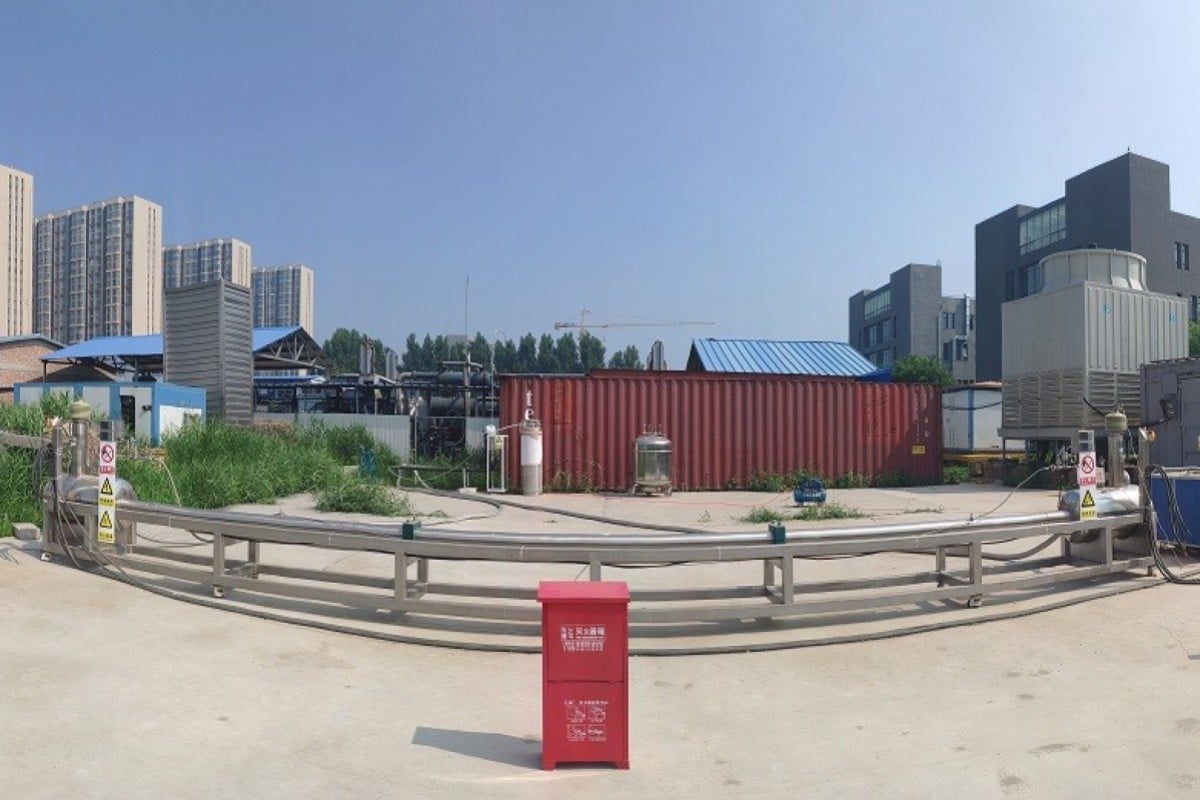
The 10-metre prototype line, combining high-voltage electricity and liquefied natural gas. Photo: Chinese Academy of Sciences
Chinese scientists have developed the world’s first prototype of a superconducting hybrid power line, paving the way for construction of a 2,000km (1,243-mile) line from energy-rich Xinjiang in the country’s far west to its eastern provinces.
The 10-metre, proof-of-concept wire and liquid natural gas hybrid transmission line was up and running at the Chinese Academy of Sciences’ Institute of Electrical Engineering in Beijing last month to show the feasibility of the technology.
The line contains a superconducting wire which can transmit nearly 1,000 amps of electric current at more than 18,000 volts with zero resistance.
In a further difference from a traditional power line, the gap between the superconducting wire and the power line’s outer shell is filled by a flow of slowly moving natural gas liquefied at low temperatures – between minus 183 and minus 173 degrees Celsius (minus 279 to minus 297 Fahrenheit). This allows the line to transfer electricity and fossil fuel at the same time.
Professor Zhang Guomin, the government research project’s lead scientist, told the South China Morning Post that the voltage and current could be much higher in its real-world applications.
“This technology can take the overall efficiency of long-distance energy transport to new heights,” he said.
Existing infrastructure to transfer energy from Xinjiang Uygur autonomous region to the developed eastern areas such as Shanghai has high operational costs because almost 10 per cent of the energy is lost in transmission, according to some studies.
That infrastructure includes the world’s most advanced high-voltage power line and four natural gas pipes, each thousands of kilometres long. One of the natural gas pipelines, from Xinjiang to Shanghai, cost 300 billion yuan (US$42 billion).
The superconductor and natural gas hybrid line offered a possible solution, Zhang said.
Loss of electricity over the superconducting wire would be almost zero because of the elimination of resistance to the movement of electrons, he said.
The transport of liquefied natural gas would also be efficient, because one cubic metre (1,000 litres) of it would be equivalent to 600 cubic metres of the same fuel in gas form.
The temperature needed for liquefaction of natural gas is almost identical to that required for occurrence of superconductivity, at about minus 163 degrees.
Wang Gengchao, professor of physics at East China University of Science and Technology in Shanghai, said the combination was a “smart idea”.
Superconducting materials are not new but their applications have been limited by the difficulty and cost of creating and maintaining the low-temperature environment.
“They are trying to kill two birds with one stone,” Wang, who was not involved in the study, said.
China is preparing to buy US liquefied gas and soybeans again
“But whether the technology can find a use in large-scale infrastructure depends on other things, such as safety. Not everyone will feel comfortable with the idea of putting a high-voltage electric line and flammable natural gas side by side.”
Zhang said another new prototype line, about 30 metres long, was being developed and the 2,000km project was awaiting government approval.
He said the team had solved some major technical obstacles, including reducing the risk of accidents from electrical sparks and gas leakage.
“Many problems remain to be solved, but we are confident this technology will work,” he said. “It will protect the environment. It will save a lot of land from being used for power and gas lines.”
Xinjiang has more energy resources than any other Chinese province or region. It has nearly half of the nation’s coal reserves, a third of its oil and gas, and some of the largest wind and solar farms, according to government statistics.
Source: SCMP
Posted in China alert, Chinese Academy of Sciences, coal reserves, Country, develops, East China University of Science and Technology, east coast, far west, high-voltage power, hybrid power line, Institute of Electrical Engineering, Natural gas, oil and gas, prototype, Shanghai, south china morning post, soybeans, span, superconducting, superconducting wire, transports, two birds with one stone, Uncategorized, US liquefied gas, wind and solar farms, Xinjiang, Xinjiang Uygur Autonomous Region, zero resistance |
Leave a Comment »
04/09/2019
- Two classrooms on Nanjing campus were chosen for pilot project
- Camera automatically captures students’ faces without their cooperation
Students pass through a facial recognition turnstile at China Pharmaceutical University in Nanjing. Photo: Weibo
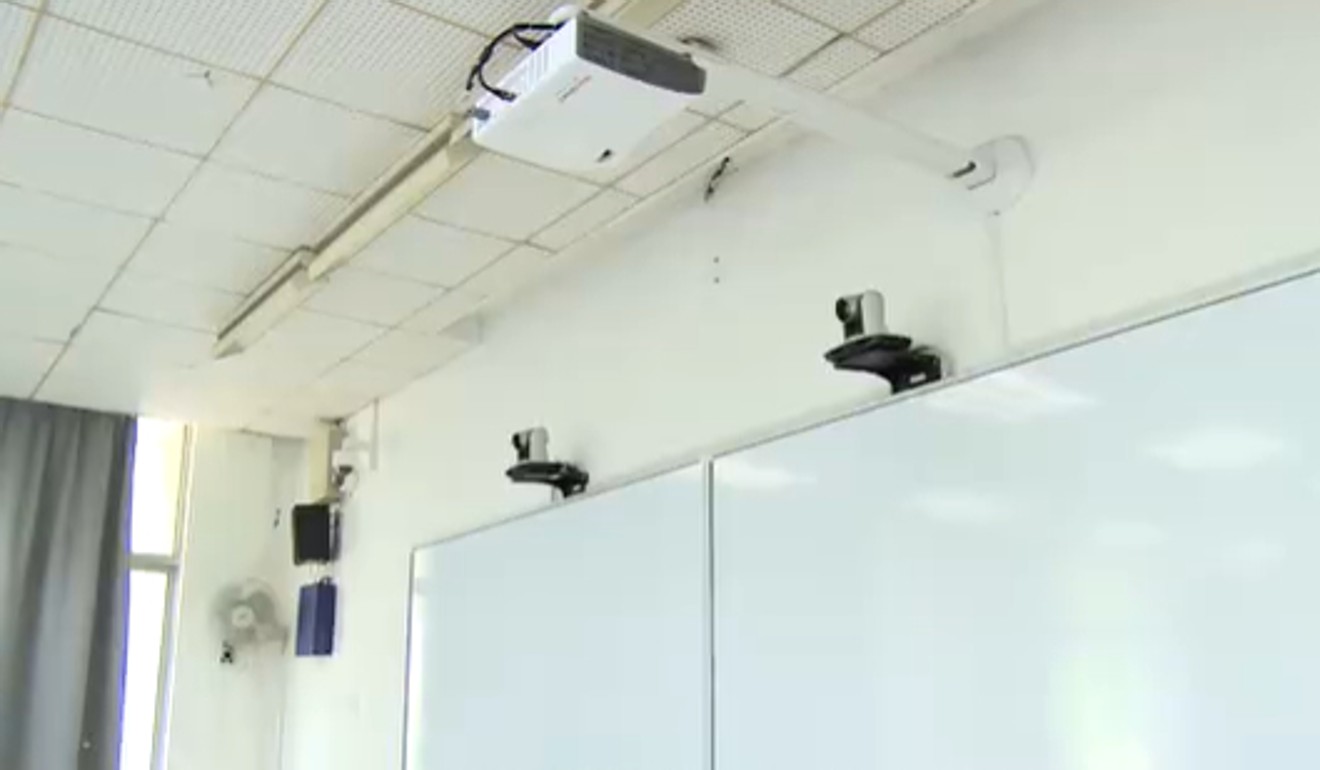
A university in eastern China has installed a facial recognition system at its entrance and in two classrooms to monitor the attendance and behaviour of students.
China Pharmaceutical University in Nanjing, Jiangsu province, announced on its website on Thursday that it was one of the first higher education institutions in the country to put such a system in place.
“It can effectively solve the management difficulties and low efficiencies in a traditional attendance system, and make it easier for managers to track their students,” Xu Jianzhen, director of the university’s library and information centre, told news website Thepaper.cn
In a pilot project, two classrooms were equipped with an attendance system using facial recognition software, with a camera that automatically captured the faces of students in class without their cooperation, the university said.
“Besides attendance, the system installed in the classroom can provide surveillance of the students’ learning, such as whether they are listening to the lectures, how many times they raise their heads, and whether they are playing on their phones or falling asleep,” Xu told the news website.
“The school is taking action to cut down on students skipping class, leaving classes early, paying for a substitute to attend classes for them and not listening in class,” he said.
The plan was not well received online, with some critics raising privacy concerns for staff and students.
Why are Hong Kong protesters targeting lamp posts?
“What kind of talent are they trying to cultivate?” a user of the Twitter-style Weibo network asked. “I’ve never seen such a method.”
Another wrote: “If this system was being installed in Europe or America, they’d be sued and the school would have to close down.”
But Xu said the university had consulted the police and sought legal advice, and was told the system would not be considered an invasion of privacy as classrooms were public spaces.
“You are complaining about [a system] that’s meant to urge you to learn? Are you a student?” he told the news website.
A spokesman said China Pharmaceutical University was using a facial recognition system to improve class attendance. Photo: Weibo
The university would seek feedback from teaching staff before deciding whether to install facial recognition systems in all of its classrooms, according to the report.
In May last year, a school in Hangzhou, Zhejiang province, installed cameras to monitor pupils’ facial expressions and attentiveness in class as part of a “smart classroom behaviour management system” to give teachers real-time information on their students.
Elsewhere, facial recognition has been used to catch unlicensed drivers in the southern technology hub of Shenzhen, jaywalkers in Shanghai, and criminal suspects at public events across China.
Source: SCMP
Posted in America, attendance, attentiveness, automatically captures, Camera, China alert, China Pharmaceutical University, Chinese university, consulted, cooperation, criminal suspects, Europe, facial expressions, Facial recognition system, Hangzhou, invasion of privacy, jaywalkers, jiangsu province, legal advice, library and information centre, Nanjing, pilot project, Police, public events, Shanghai, Shenzhen, students’ faces, sued, Thepaper.cn, Uncategorized, university, unlicensed drivers, website, Weibo, without, zhejiang province |
Leave a Comment »
04/09/2019
- Researchers say they have developed a substance that is 13 times better in tests than widely used alternative
- Experiments could help solve a power source problem that has plagued commercial and military devices
Scientists at the Fujian Institute of Research on the Structure of Matter think they have found a super efficient crystal to make high-energy beams from low-energy lasers. Photo: Alamy
Scientists in southeast China say they have synthesised a crystal with the potential to significantly improve the performance of lasers used in consumer and military equipment.
Crystals of caesium bismuth germanate (CBGO) can turn low-energy beams into high-energy emissions with unparalleled efficiency, according to Professor Mao Jianggao, team leader at the Fujian Institute of Research on the Structure of Matter, part of the Chinese Academy of Sciences, in Fuzhou.
The team looked at several candidate crystals in their experiments. Compared with widely used potassium dihydrogen phosphate crystals, the CBGO crystal was 13 times more efficient at turning infrared lasers into more energised green beams.
“This is a record performance,” Mao said on Tuesday. “This is why we think the crystal may have potential.”
China’s prototype Guanlan anti-submarine warfare satellite uses a high-energy laser to sweep beneath the sea to a depth of 500 metres. Illustration: SCMP
Their findings were published in the German weekly scientific peer-reviewed journal Angewandte Chemie, or Applied Chemistry, last month.
The researchers said CBGO crystals could be a way around a problem that has limited the performance of lasers – the huge amount of electricity needed to power them.
China is building world’s most powerful laser radar to study Earth’s solar shield
The demand on power is great because existing technology is not efficient at converting low-energy beams to high-energy ones – one reason that laser weapons are not yet as common as scientists predicted in the 1960s.
CBGO belongs to a family known as non-linear crystals, which cause abrupt changes to energy that passes through them. The scientists found that CBGO crystals could double the frequency of a laser beam.
As high-energy lasers can be created by merging two low-energy photons, or particles of light, a process known as frequency doubling, CBGO crystals are an ideal medium, and the higher frequency of the laser, the more energy it carries.
Many military and civilian applications required high-energy beams, they said. These included directed energy weapons designed to destroy drones or missiles, or China’s prototype Guanlan anti-submarine warfare satellite, which will use a green laser to penetrate water to a depth of 500 metres (1,640 feet) to detect a target.
Mao said his team’s research was at an early stage and that years of testing would be needed before the CBGO crystals found their way to market.
The CBGO crystal grown in the Fuzhou laboratory was the size of a grain of sand, he said. For industrial use, crystals would need to be at least the size of a dice.
Growing them was a very slow and challenging job, and there was no certainty that CBGO crystals could be grown on an industrial scale, Mao said.
Chinese military could soon disable sensors on enemy missiles using suitcase-sized device after ‘groundbreaking’ study on ultrafast lasers
China is a world leader in crystal research, and some of those most commonly used in laser devices were developed by Chinese scientists thanks to heavy investment from central government.
Professor Li Qiang, deputy director with the Institute of Laser Engineering at Beijing University of Technology, said the discovery of CBGO was encouraging, but its success should be evaluated not only on its efficiency, but also on attributes such as mechanical strength, tolerance to laser damage, and stability in extreme environments such as high humidity.
“Lots of crystals have been proposed over the decades, but only a handful are useful. It’s a high-risk business,” Li said. “China has achieved a leading position in this field not because of luck, but by continuous effort by several generations of researchers through countless failures.”
Source: SCMP
Posted in Angewandte Chemie, Applied Chemistry, Beijing University of Technology, caesium bismuth germanate (CBGO), CBGO, Central government, China’s laser technology, Chinese Academy of Sciences, chinese military, consumer and military equipment, crystal research, crystals, disable sensors, enemy missiles, energised green beams, Fujian Institute of Research on the Structure of Matter, Fuzhou, Guanlan anti-submarine warfare satellite, heavy investment, high-energy beams, infrared lasers, Institute of Laser Engineering, leap forward, low-energy lasers, military and civilian applications, potassium dihydrogen phosphate crystals, suitcase-sized device, super efficient crystal, ultrafast lasers, Uncategorized |
Leave a Comment »
04/09/2019
ISLAMABAD (Reuters) – Pakistan would not use nuclear weapons first, Prime Minister Imran Khan said on Monday, amid tensions with arch-rival India after New Delhi revoked the special status of its part of the disputed Kashmir region.
“We both are nuclear-armed countries. If these tensions increase, the world could be in danger,” Khan said, addressing members of the Sikh religious community in the eastern city of Lahore. “There will be no first from our side ever,” he said.
The foreign ministry’s spokesman subsequently said on Twitter that the comments were being taken out of context and did not represent a change in Pakistan’s nuclear policy.
“PM was simply reiterating Pakistan’s commitment to peace and the need for both nuclear states to demonstrate responsible behaviour,” spokesman Mohammad Faisal said on his official Twitter account.
Tension remains high in Kashmir, where security forces have used tear gas against stone-throwing protesters and the valley remains under lockdown after Indian Prime Minister Narendra Modi’s decision to withdraw special rights for the Muslim-majority state on Aug. 5.
By stripping Indian-controlled Kashmir of its special status, New Delhi blocked the region’s right to frame its own laws and allowed non-residents to buy property there. Delhi said the change would help Kashmir’s development, to the benefit of all, but its move angered many residents of the region and was strongly condemned by Pakistan.
Khan has so far focused on a global diplomatic campaign condemning India’s actions, accusing Modi of committing human rights violations and atrocities in the valley.
He has also said frequently that any misadventure between two nuclear-armed nations could endanger the world.
Muslim-majority Kashmir has long been a flashpoint between India and Pakistan. Both countries rule parts of Kashmir while claiming it in full. Two of the three wars they have fought have been over it.
Also on Monday, Islamabad gave a consular access to an Indian who was given a death sentence for spying by a Pakistani military court, which the International Court of Justice asked Pakistan to review in mid-July.
“Pursuant to the decision of the International Court of Justice, Pakistan provided consular access on 02 September, 2019 to India for Commander Kulbhushan Jadhav, Indian spy, serving Indian Naval officer,” a Pakistani foreign office statement said.
The statement said that at India’s request, there was no restriction on the language of communication and the access was recorded, which continued for two hours.
An Indian external affairs ministry statement said “Jadhav appeared to be under extreme pressure to parrot a false narrative to bolster Pakistan’s untenable claims.” It said Delhi would wait for a detailed report to determine the extent of conformity to the ICJ directives.
Source: Reuters
Posted in Commander Kulbhushan Jadhav, flashpoint, ICJ, India alert, Indian Naval officer, Indian Prime Minister Narendra Modi, Indian spy, International Court of Justice, Islamabad, Kashmir, Lahore, Muslim-majority Kashmir, New Delhi, nuclear weapons, Pakistan, Prime Minister Imran Khan, Prime Minister Narendra Modi, Sikh religious community, tensions, Twitter, Uncategorized |
Leave a Comment »
03/09/2019
ULAN BATOR, Sept. 2 (Xinhua) — A series of cultural events to celebrate the 70th anniversary of the establishment of diplomatic ties between China and Mongolia kicked off at the Mongolian National Modern Art Gallery here on Monday.
Hundreds of people from various fields of both countries, including Mongolian Minister of Education, Culture, Science and Sports Yondonperenlei Baatarbileg and Chinese Ambassador to Mongolia Xing Haiming attended the opening ceremony.
“We will relive the China-Mongolia friendship through more than 20 activities including cultural performances, exhibitions, exchanges of books, watching movies and TV series and free medical exams under a broader theme called ‘Feel China’ for the 70th anniversary of the establishment of diplomatic relations between China and Mongolia,” Xing said at the ceremony.
The ambassador noted that China attaches great importance to China-Mongolia relations and is willing to deepen the alignment of the China-proposed Belt and Road Initiative and Mongolia’s Development Road Program on the basis of equality and mutual benefit.
He expressed hope that the two countries will work together to boost the friendly and mutually beneficial cooperation that brings tangible benefits to the two countries and peoples.
For his part, Baatarbileg said that the culture of any country is a guarantee of independence and the value of its people.
“I have no doubt that the cultural events can give Mongolians a deeper understanding of China’s culture,” he said, noting that the Mongolian government will support any activities aimed at promoting the history and culture of the two countries.
Visitors can partake in martial arts training, craft traditional Chinese embroidery, attend film screenings and taste a variety of Chinese foods.
The events are co-organized by China’s State Council Information Office, China’s Inner Mongolia Autonomous Region, the Mongolian Ministry of Education, Culture, Science and Sports and governor’s office of the Mongolian capital Ulan Bator.
The events run until Friday.
Source: Xinhua
Posted in 70th anniversary, Belt and Road Initiative, Belt and Road Initiative (BRI), China's Inner Mongolia Autonomous Region, China-Mongolia friendship, China-Mongolia ties, Chinese Ambassador to Mongolia, craft traditional Chinese embroidery, cultural events, Culture, film screenings, kick off, martial arts training, Mongolia's Development Road Program, Mongolian Minister of Education, Mongolian Ministry of Education, Culture, Science and Sports, Mongolian National Modern Art Gallery, Science, sports, State Council Information Office, Ulan Bator, Uncategorized, variety of Chinese foods, Xing Haiming, Yondonperenlei Baatarbileg |
Leave a Comment »
03/09/2019
Chinese Vice President Wang Qishan meets with Peruvian Vice President Mercedes Araoz in Beijing, capital of China, Sept. 2, 2019. (Xinhua/Zhang Ling)
BEIJING, Sept. 2 (Xinhua) — Chinese Vice President Wang Qishan met here Monday with Peruvian Vice President Mercedes Araoz, who is in Beijing to attend relevant activities of the Beijing Horticultural Expo.
Wang spoke highly of the current bilateral relationship, saying that China is willing to further advance mutual understanding and trust and deepen cooperation to push the relationship to a higher level.
Araoz congratulated China on the 70th anniversary of the founding of the People’s Republic of China, and said her country is ready to deepen cooperation with China in such areas as trade and economy, investment, agriculture, poverty relief, science, technology and culture.
Source: Xinhua
Posted in agriculture, Beijing, Beijing Horticultural Expo, Chinese Vice President Wang Qishan, Culture, economy, founding of the People's Republic of China (PRC), Investment, Mercedes Araoz, nation’s 70th anniversary, Peruvian Vice President, poverty relief, Science, Technology, Trade, Uncategorized |
Leave a Comment »