Archive for ‘Uncategorized’

07/04/2019

India eco-school: Is this the greenest campus on Earth?

School
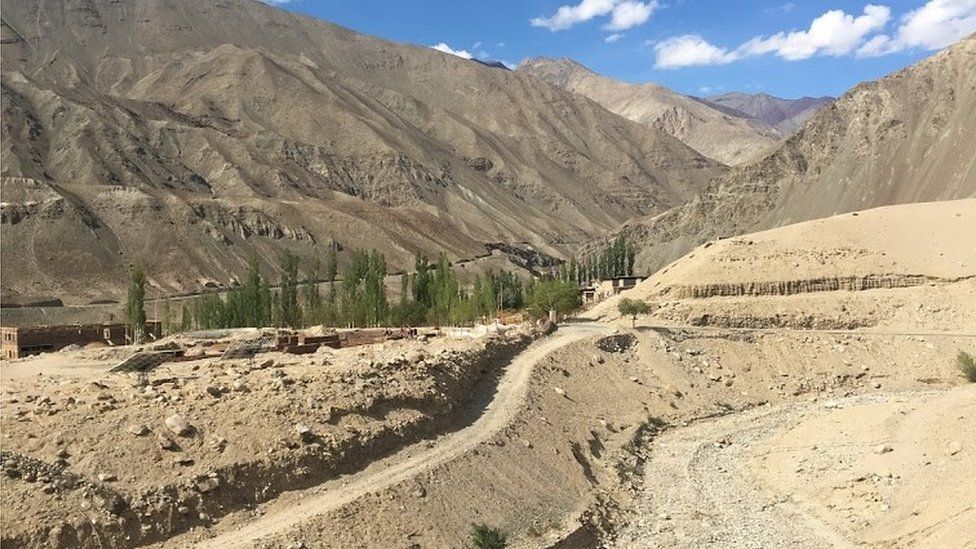
Image captionThe school’s surrounding mountainous landscape is almost devoid of vegetation as it is above the tree line

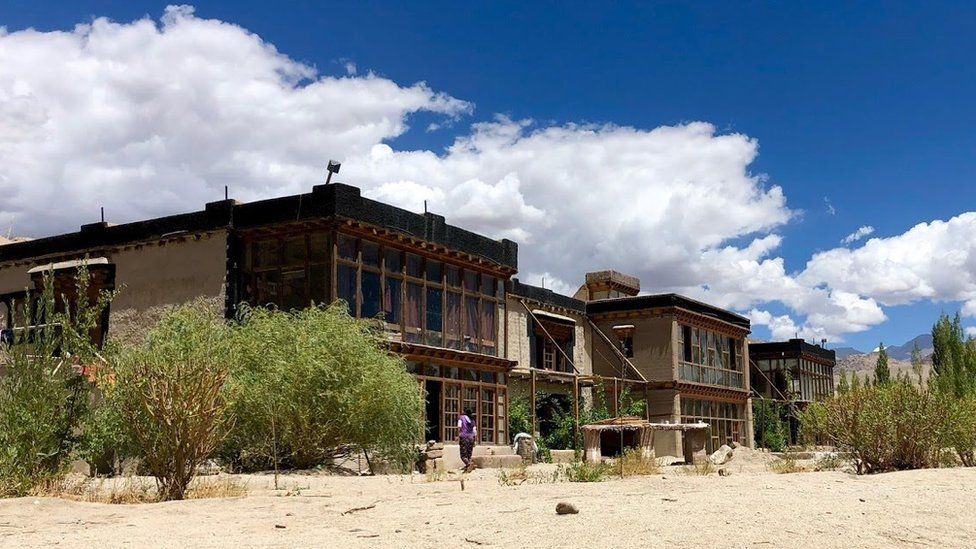
Secmol is a school pioneering practical green education in one of the world’s harshest environments.

Its campus is perched nearly 11,000ft (3,350m) up in the pre-Himalayan mountains along the Indus River in Ladakh, in the Indian state of Jammu and Kashmir.

Road sign

The teenage pupils at Secmol (Students’ Educational and Cultural Movement of Ladakh) lack wi-fi and almost all phone coverage, in an area only accessible by air during the long harsh winter when deep snow renders roads out of the province impassable.

The surrounding mountainous landscape is almost devoid of vegetation as it is above the tree line.
Secmol
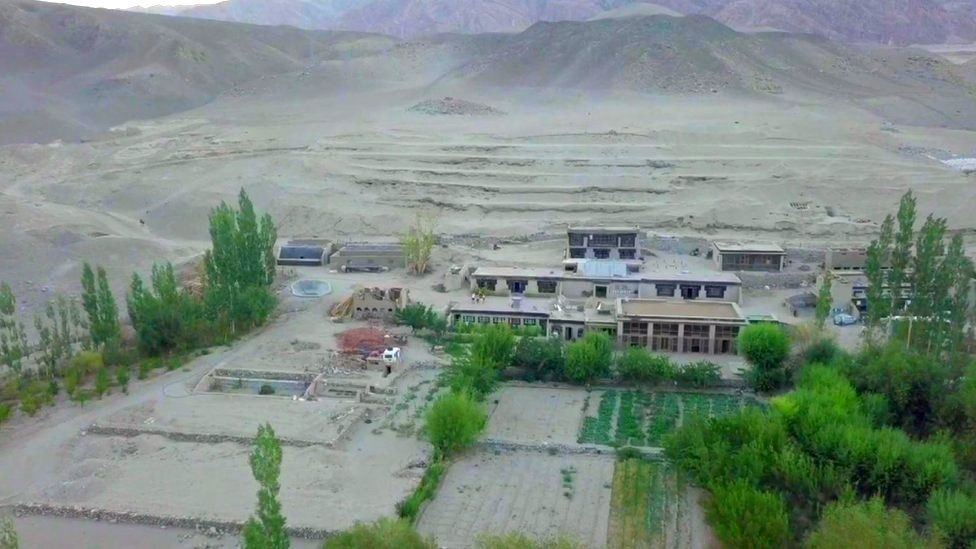
Drone footage of schoolImage copyrightSUMEDH CHAPHEKAR

The school even sets its own time zone to maximise sunlight, which also reminds every student and visitor that when they pass the gates they are entering a different world.

Pupils are all from the regular Ladakhi school system and only those who have failed their year 10 exams are permitted to attend. There are also a number of university students who form a core part of the community along with the teachers.
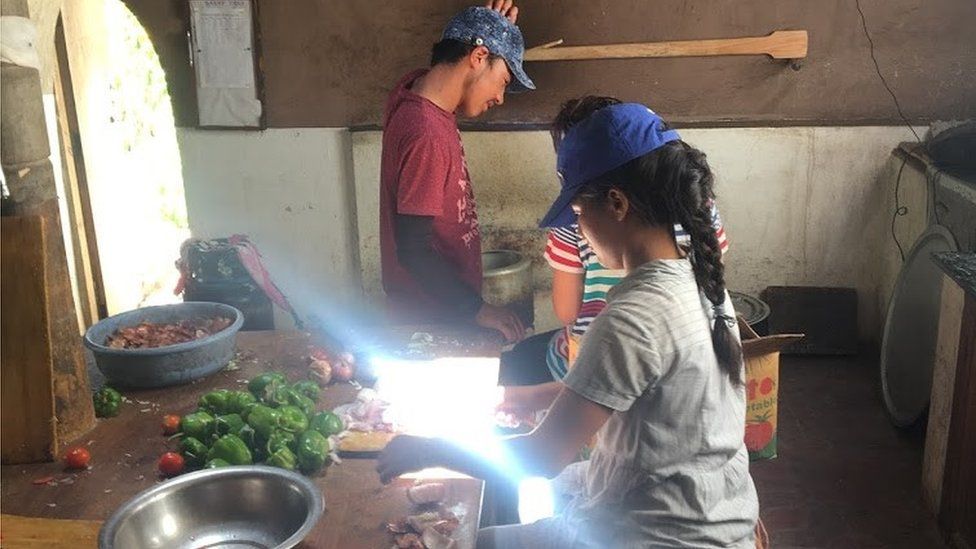
Child helping prepare food in kitchen

School director Konchok Norgay explained to the BBC that the students learn about the environment for an hour or two each day.

In a typical maths lesson, they may calculate if the water from the spring is enough for tree planting, or work out the efficiency of the solar cooker that they use for heating water.

Mirrors used to harness the sun's intense heat

The solar cooker looks impressive, with mirrors crafted to catch the harsh sunlight, focusing their power to create intense heat.

But it is currently only used to boil water for tea.
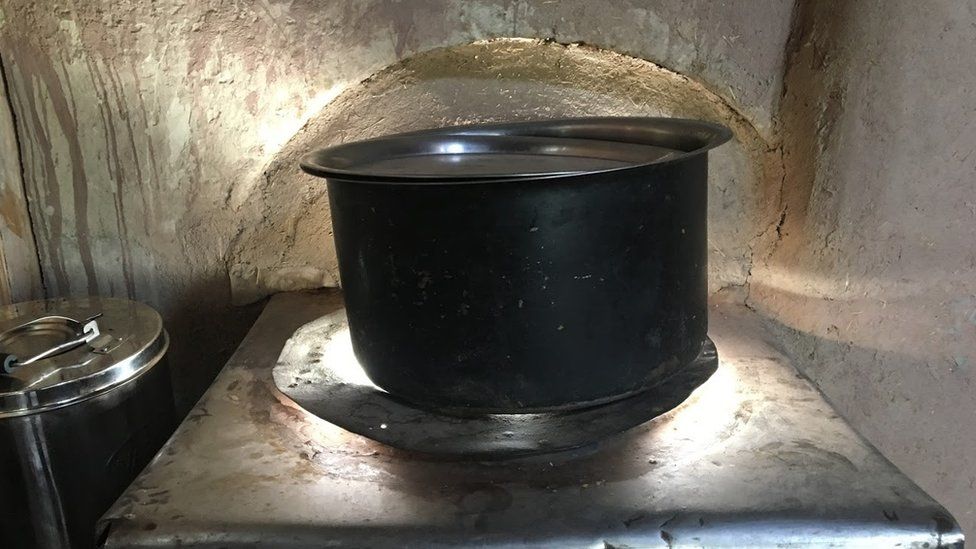
Water is boiled using natural light

Norgay proudly showed off his experimental biogas methane digester, which is powered by slurry.

Dung is mixed with water and then placed in a long tube and left for several days.
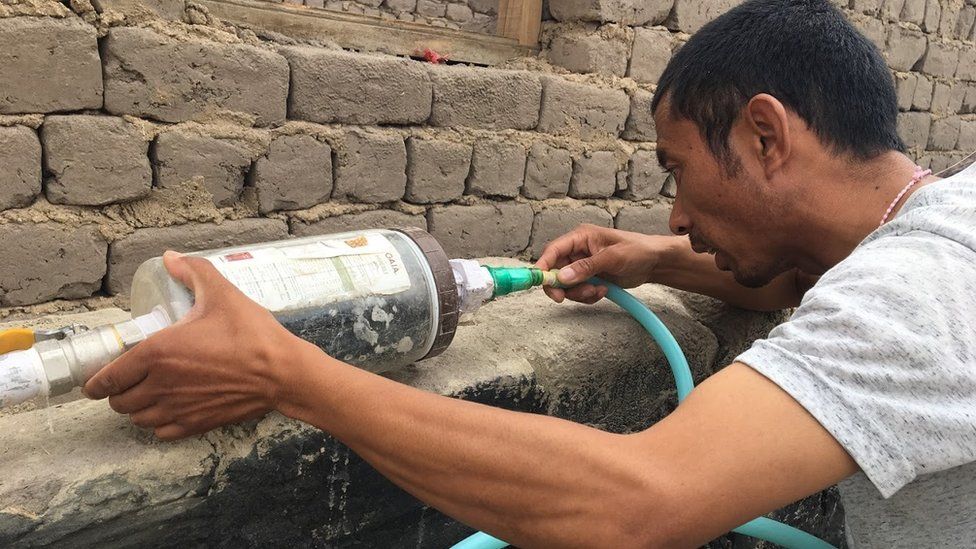
Secmol's director Konchok Norgay

The gas rises to the top, and is filtered through steel wool to ensure the gas does not corrode the oven, before reaching a plastic inflatable reserve tank.

“It’s fantastic as not only do you use less commercial gas, but you use natural materials instead,” student Stanzin Sungrab says. “And we can use the slurry waste as fertiliser in the kitchen garden.”

Each student must perform daily responsibility shifts and develop their confidence with nightly presentations to the rest of the school and visitors.

Stanzin has spent many hours developing relationships with Karjama, Thotkar and Sheyma, the campus cows.
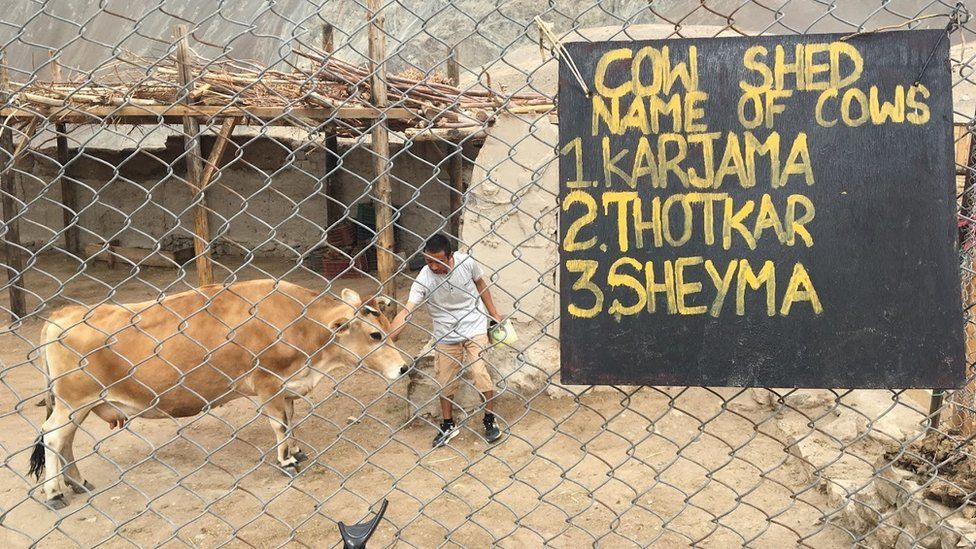
Cow shed

When students are not on the 04:00 breakfast preparation shift, the day starts at 07:00 with a seven-minute group meditation.

Students are encouraged to focus on goals for the day over a meal of cold roti bread and homemade apricot jam.

The apricot stones are sent to a neighbouring monastery, where the kernels are recycled into apricot oil.
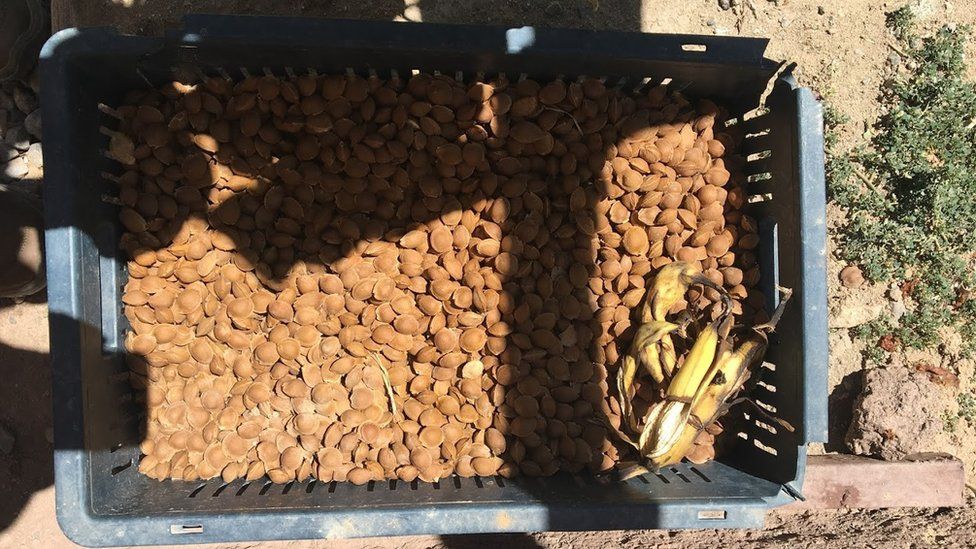
apricot seeds for recycling

Innovation is hard-wired into the architecture of the campus, challenged by an environment where winter temperatures typically reach -15C to -25C, and summer can often peak at 30C.

Ladakh has longstanding environmental credentials – even if the recent sprouting of large concrete hotels and increasing pollution in the capital Leh are challenging its green record.

“We banned plastic bags here 30 years ago,” says Sonam Gatso, who operates a local green organisation.

Sonam also believes local Buddhist culture helps promote environmental awareness. “We try to be compassionate as we believe in Karma – cause-and-effect. If you do wrong to anyone else or the environment, wrong will come to you.”
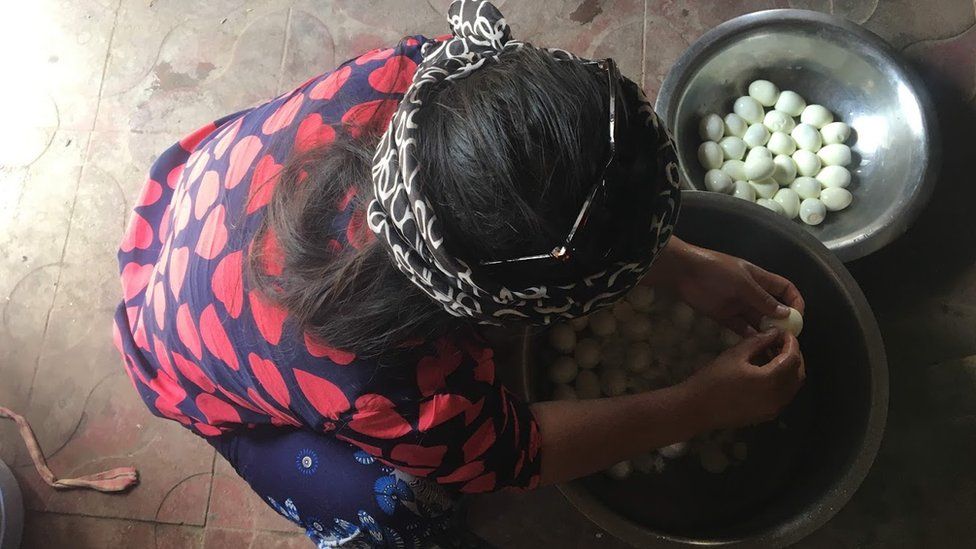
Girl peels eggs

Secmol is an impressive school, but how far can its lessons extend beyond its innovative but isolated campus?

Urgain Nurbu, a former Secmol student who is now living on campus again, has been so inspired by what he learnt that he organised an environmental youth camp in his remote village.
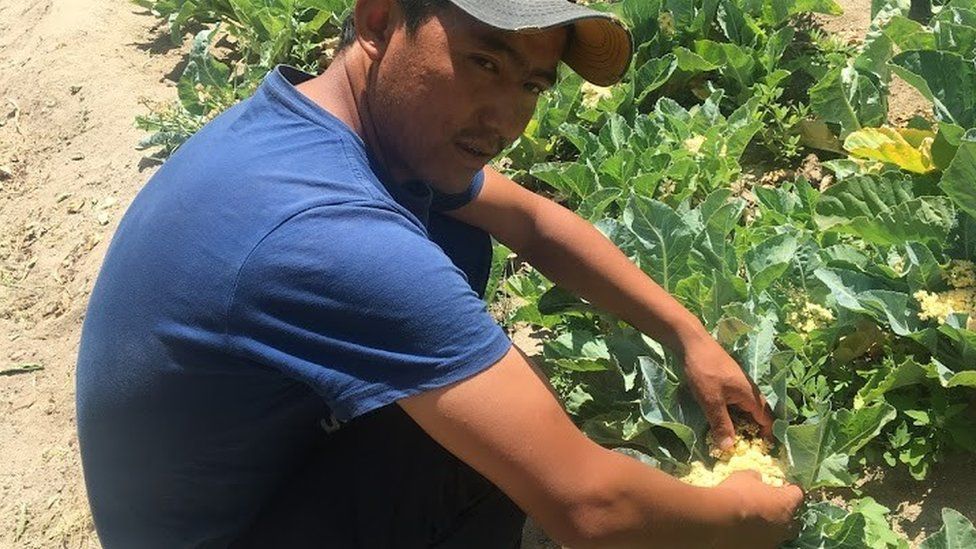
College student Urgain Nurbu

The camp-goers make rain jackets from old plastic, and Urgain invites environmental speakers to inspire the young people.

One graduate has started her own eco-travel company, another makes environmentally-themed films.

Shara, an architectural student, is now experimenting with creating pre-fabricated building blocks from mud, wood shavings and straw.
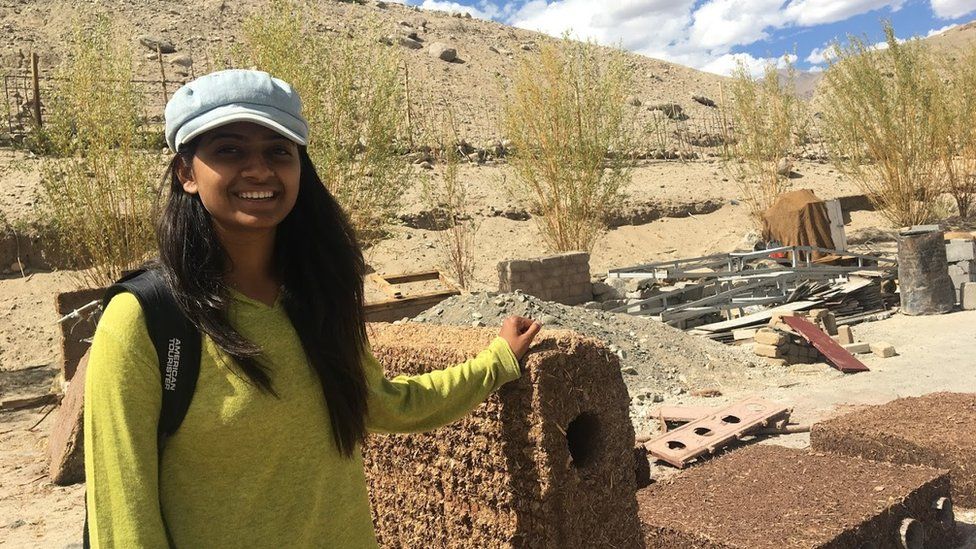
Shara

She is part of a team designing a new university in the area which plans to teach eco-tourism and green architecture, scaling the influence of ideas nurtured in Secmol’s pioneering atmosphere.

For now, the school’s impact is achieved by transforming individual mindsets to create a sense of shared responsibility.

“My grandfather told me how quiet and beautiful our village used to be and there were fish in the river,” student Padma Doma told the BBC.

“That’s why it’s so important to me to protect our precious environment. In the future, maybe it can be like that again.
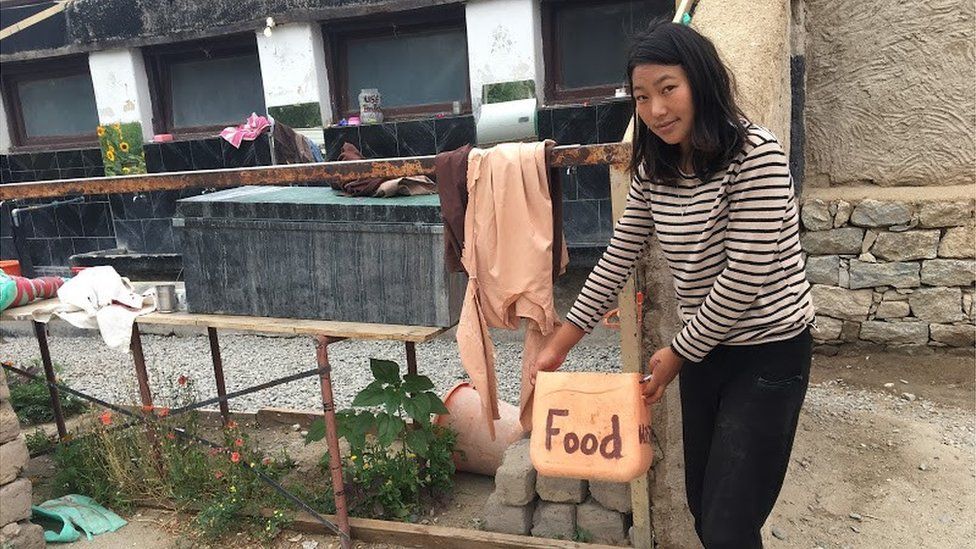
Padma Dolma shows food box

“I want to go home and convince my family to segregate their garbage. Will they listen? Perhaps not, but I will try, and if I see somebody throwing away a packet, I will pick it up.”

Stanzin feels this is “a really critical time for our planet”.

“In our homes we throw away garbage but here we recycle. In our homes we throw away plastic but here we use it for insulation.”

As the environment is so harsh, Ladakhis are very conscious of subtle changes in the weather, and have become increasingly aware of climate change, he says.

“Last year, we didn’t have much snow so there’s not enough snowmelt in the springtime. Because we are so high up and everything must be treasured, you learn to understand the value of the smallest drop of water.”
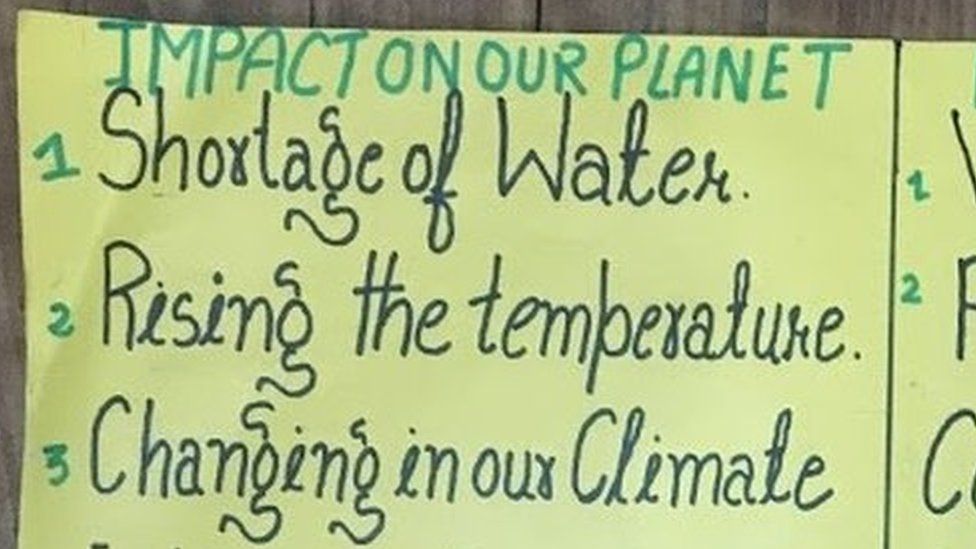
List of things that impact the environment

All photos Emily Kasriel unless indicated. Subject to copyright.

Source: The BBC

07/04/2019

Pakistan says India preparing another attack this month

KARACHI (Reuters) – Pakistan has “reliable intelligence” that India will attack again this month, Foreign Minister Shah Mahmood Qureshi said on Sunday, as tension over a February standoff between the two nuclear-armed neighbours had appeared to ease.

The attack could take place between April 16 and 20, he said, adding that Pakistan had told the five permanent members of the U.N. Security Council of its concerns.

A suicide car bombing by Pakistan-based militants in Indian-controlled Kashmir killed at least 40 Indian paramilitary police on Feb. 14 and the risk of conflict rose dramatically on Feb. 27, when India launched an air strike on what it said was a militant training base.

The following day Pakistan shot down an Indian fighter jet and captured its pilot who was later released.

“We have reliable intelligence that India is planning a new attack on Pakistan. As per our information this could take place between April 16 and 20,” Qureshi told reporters in his hometown of Multan.

He did not elaborate on what evidence Pakistan had or how he could be so specific with the timing, but he said Prime Minister Imran Khan had agreed to share the information with the country.

India’s foreign office didn’t immediately respond to an email seeking comment.

Khan blamed India’s ruling Bharatiya Janata Party (BJP) for “whipping up war hysteria” over claims that India shot down a Pakistani F-16 during the February standoff.

India said it, too, had shot down a Pakistani aircraft and the air force displayed pieces of a missile that it said had been fired by a Pakistani F-16 before it went down.
The success of Indian air strikes on a camp of the Jaish-e-Mohammed militant group in northwestern Pakistan has also been thrown into doubt after satellite images showed little sign of damage.
Pakistan closed its airspace amid the standoff but most commercial air traffic has since resumed and major airports have opened.
Source: reuters
06/04/2019

China’s outbound investment in U.S. expected to rebound, expert says

U.S.-NEW YORK-COMMITTEE 100 CHAIRMAN-CHINESE OUTBOUND INVESTMENT

H. Roger Wang, chairman of Committee of 100, a non-profit U.S. leadership organization of Chinese Americans, speaks during a press conference in New York, the United States, April 5, 2019. Speaking at a press conference on Friday, H. Roger Wang said he is positive that the situation would improve although China’s outbound investment in the United States currently hit the bottom. (Xinhua/Wang Ying)

NEW YORK, April 5 (Xinhua) — China’s outbound investment in the United States is going to recover after posting a deep drop in 2018, according to chairman of Committee of 100, a non-profit U.S. leadership organization of Chinese Americans.

Speaking at a press conference on Friday, H. Roger Wang said he is positive that the situation would improve although China’s outbound investment in the United States currently hit the bottom.

“You will see more Chinese investment into the United States,” said Wang.

Chinese investors only invested 4.8 billion U.S. dollars in the United States in 2018, down from 29 billion U.S. dollars in 2017 and 46 billion U.S. dollars in 2016, according to data from the research institute Rhodium Group.

The slump of Chinese investment in the United States last year resulted from tighter regulatory checks from both the United States and China, according to Wang.

Most companies indicated that they would maintain or accelerate their investment in each other’s markets in 2019, according to a new snap survey with top executives from companies which are committed to doing business in both the United States and China.

“Businesses in both countries plan to stay engaged with most planning to maintain or increase investment,” said a release issued on Friday on the survey jointly conducted by Committee of 100 and the U.S.-China Business Council, which represents American companies that do business with China.

Source: Xinhua

06/04/2019

China, CEEC see steady trade growth

BEIJING, April 6 (Xinhua) — China and Central and Eastern European Countries (CEEC) saw steady trade growth last year as cooperation between the two sides strengthened.

Bilateral trade reached 82.23 billion U.S. dollars last year, up 21 percent year on year, according to the Ministry of Commerce (MOC).

China’s exports to the CEEC totaled 59.19 billion dollars last year, while imports reached 23.04 billion dollars, up 19.6 percent and 24.6 percent respectively, said MOC spokesperson Gao Feng.

Investment between the two sides also expanded. Chinese firms have invested over 10 billion dollars in the CEEC, while receiving more than 1.5 billion dollars from them. Bilateral investment covers sectors including auto parts, chemicals, finance and medicine.

China is willing to deepen economic and trade cooperation with the CEEC and further align the Belt and Road Initiative with CEEC national development strategies to seek win-win partnership, Gao said.

Source: Xinhua

06/04/2019

China to build 15 national logistics hubs in 2019

BEIJING, April 6 (Xinhua) — China will start building about 15 national logistics hubs this year in its bid to build a nation-wide logistics hub network.

In principle, The national logistics hubs will be built on existent logistics hubs which have a sound infrastructure, strong market demand and huge growth potential, according to an implementation plan released by the National Development and Reform Commission and the Ministry of Transport.

The two ministries will determine the locations of the first batch of national logistics hubs based on the demand of the development under national strategies like the Yangtze River economic belt and local government plans.

China aims to build about 30 national logistics hubs by 2020, and 150 by 2025, when the ratio of total logistics expenses to GDP will be reduced to about 12 percent.

The country’s logistics volume totaled 283.1 trillion yuan (42.14 trillion U.S. dollars) in 2018, up 6.4 percent year on year. The ratio of total logistics expenses to GDP stood at 14.8 percent.

Source: Xinhua

06/04/2019

Mobile payment gaining steam in rural China

BEIJING, April 6 (Xinhua) — Mobile payment is gaining steam in China’s rural areas, strengthening its dominant position in online payment in rural areas, according to the country’s central bank.

A total of 274.883 billion mobile payment transactions were made via non-banking payment platforms in 2018, worth 74.42 trillion yuan (11.08 trillion U.S. dollars), up 112.25 percent and 73.48 percent respectively, data from the People’s Bank of China showed.

Mobile payment dominates the online payment market in rural areas, with total transaction deals and volume making up nearly 95 percent and 97 percent of the online payment totals in rural areas.

Rural areas also reported increasing banking transaction accounts and bank cards.

China had 126,600 rural banking outlets by the end of 2018, with about 1.31 bank serving every 10,000 people in rural areas on average.

Source: Xinhua

06/04/2019

China’s leading anti-poverty foundation helps over 30 mln people

BEIJING, April 6 (Xinhua) — The China Foundation for Poverty Alleviation (CFPA) has helped over 30 million people since its establishment 30 years ago.

The foundation has raised over 5.85 billion yuan (871 million U.S. dollars) in cash and in kind as of the end of 2018, according to sources with the foundation.

The CFPA has leveraged the development of local industries to help improve people’s income.

It has spent 11.67 million yuan using e-commerce to help about 16,000 farmers sell their produce since 2015. About 59,000 people have benefited from local tourism development, while over 40.7 billion yuan has been offered as credit to finance farmers.

The “Love Package,” the most popular CFPA program, allows donors to mail care packages to help students in poor areas. The program has received 3.706 million pieces of individual donations and raised 677 million yuan as of the end of the end of 2018.

Source: Xinhua

06/04/2019

People mourn for martyrs who died while fighting forest fire in Sichuan

#CHINA-MARTYRS-FOREST FIRE-HOMETOWN (CN)

A ceremony is held to receive the bone ashes of fireman Zhang Chengpeng, who died while fighting a forest fire in southwest China’s Sichuan Province, at Jinan international airport in Jinan, east China’s Shandong Province, April 5, 2019. The ashes of fireman Zhang Chengpeng returned to his hometown of Zouping in Shandong Province on Friday. (Xinhua/Dong Naide)

Source: Xinhua

06/04/2019

China’s aviation regulator asked to join FAA safety review of Boeing 737 MAX

  • Civil Aviation Administration of China has not decided whether to take up invitation to be part of task force looking into automated flight control system, according to state media
The FAA is putting together an international team of experts to review the safety of the Boeing 737 MAX after two fatal crashes. Photo: EPA-EFE
China’s aviation regulator has been invited to join the US Federal Aviation Administration’s (FAA) task force to review the automated flight control system of Boeing’s 737 MAX jets, state media reported on Saturday.
The Civil Aviation Administration of China has not decided whether to accept the invitation, state broadcaster CCTV reported, citing an administration official.
But the official said the regulator would closely follow the investigation into two fatal crashes involving Boeing 737 MAX planes.
The FAA on Wednesday said it was forming an international team to review the safety of the Boeing 737 MAX following the accidents.
China was the first country to ground all Boeing 737 MAX 8 jets after an Ethiopian Airlines plane crashed outside Addis Ababa on March 10, killing all 157 people on board.

It was the second crash involving Boeing’s newest model, after 189 people were killed when a Lion Air plane crashed into the Java Sea off Indonesia on October 29.

Noting the similarities between the two accidents, China’s civil aviation regulator ordered domestic airlines to ground all 737 MAX 8 aircraft. It stopped taking applications for Boeing’s 737 MAX 8 airworthiness certification on March 21.After China ordered a dozen carriers to ground their 96 planes – about a quarter of all 737 MAX aircraft in operation globally – authorities in Ethiopia, Indonesia, Mongolia, Morocco and Singapore followed suit, along with airlines in Latin America and South Korea, before it was grounded worldwide.

How every Boeing 737 MAX was grounded in five days

China’s civil aviation regulator has said the plane would only be allowed to resume flights after it is satisfied measures to effectively ensure safety have been taken.

On Wednesday, the FAA said it would set up a Joint Authorities Technical Review (JATR) team to evaluate the safety of the Boeing 737 MAX. Experts from the FAA, Nasa and international aviation authorities would “conduct a comprehensive review of the certification of the automated flight control system on the Boeing 737 MAX aircraft”, the FAA said in a statement

“The JATR team will evaluate aspects of the 737 MAX automated flight control system, including its design and pilots’ interaction with the system, to determine its compliance with all applicable regulations and to identify future enhancements that might be needed,” the statement said.

Source: SCMP

06/04/2019

WhatsApp: The ‘black hole’ of fake news in India’s election

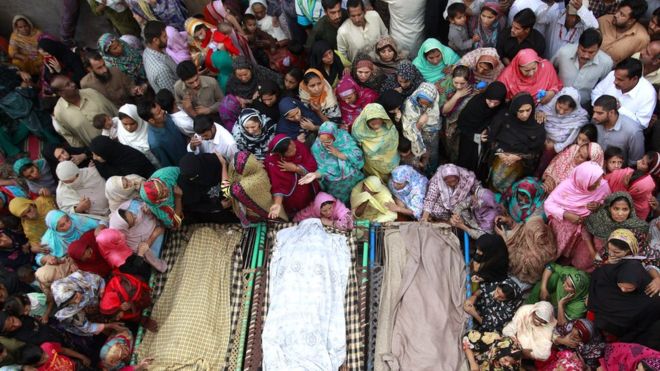
Muslim women and men gathered around three bodies in 2014Image copyrightREUTERS
Image caption The victims of a suicide attack pictured in this 2014 photo were falsely identified as Pakistani militants

WhatsApp, India’s most popular messaging platform, has become a vehicle for misinformation and propaganda ahead of the upcoming election. The Facebook-owned app has announced new measures to fight this but experts say the scale of the problem is overwhelming.

India was in the grip of patriotic fervour in early March when WhatsApp groups were flooded with photographs claiming to show proof that unprecedented Indian air strikes in Pakistani territory had been successful.

While India’s government said the 26 February strikes had killed a “large number of militants”, Islamabad insisted there had been no casualties.

But BBC fact-checkers found that the photos – purportedly of dead militants and a destroyed training camp – were old images that were being shared with false captions.

One photo showed a crowd of Muslim women and men gathered around three bodies but those pictured were actually victims of a suicide attack in Pakistan in 2014. A series of photos – of crumbling buildings, piles of debris and bodies in shrouds lying on the ground – were traced to a devastating earthquake in Pakistan-administered Kashmir in 2005.

A Facebook post misidentifying a photo from an earthquake in KashmirImage copyrightFACEBOOK
Image caption This photo of the aftermath of an earthquake in Kashmir was shared on WhatsApp and Facebook
Presentational white spaceWhatsApp and Facebook have been struggling to curb the impact of “fake news” – messages, photos and videos peddling misleading or outright false information – in elections around the world.

But India’s upcoming election – the world’s largest democratic exercise – is seen as a significant test. Internet usage in rural areas has exploded since the last election in 2014, fuelled by the world’s lowest mobile data prices.

In the lead-up to the vote, Facebook has removed hundreds of accounts and pages for misleading users. WhatsApp, meanwhile, has launched a service to verify reports sent in by users and to study the scale of misinformation on the platform.

What’s the scale of the problem?

India poses a particularly complex problem for Facebook. It is WhatsApp’s largest market – more than 200 million Indians use the app – and a place where users forward more content than anywhere else in the world.

The fact that up to 256 people can be part of a group chat makes it incredibly popular with extended families and large groups of friends. While much of these daily conversations involve people making plans, sharing jokes and catching up – political messages and videos are also shared widely.

BBC research last year found that a rising tide of nationalism was driving Indians to share fake news. Participants tended to assume that WhatsApp messages from family and friends could be trusted and sent on without any checks.

Prasanto K Roy, a tech writer, is in a group of more than 100 classmates from his old high school in Delhi. There are Christians, Hindus and Muslims in the group.

“Since 2014, we have been seeing a great deal of polarisation,” he said. “About 10 people are incessantly sending out fake stuff. Some people like me are doing fact checks and telling them but we are being ignored.”

Many Indians were first introduced to the internet through their smartphones. A recent Reuters Institute survey of English-language Indian internet users found that 52% of respondents got news via WhatsApp. The same proportion said they got their news from Facebook.

But content shared via WhatsApp has led to murder. At least 31 people were killed in 2017 and 2018 as a result of mob attacks fuelled by rumours on WhatsApp and social media, a BBC analysis found.

What’s happening before the election?

Both of the main parties – the governing Bharatiya Janata Party (BJP) of Prime Minister Narendra Modi and the opposition Congress – are exploiting the power of WhatsApp to try to influence India’s 900 million eligible voters.

Before the campaign began, the BJP had plans to assign some 900,000 people with the specific task of localised WhatsApp campaigning, the Hindustan Times newspaper reported.

Congress, the party of the Nehru-Gandhi political dynasty, is focusing on uploading campaign content on Facebook and distributing it via WhatsApp.

Both parties have been accused of spreading false or misleading information, or misrepresentation online. On 1 April, Facebook removed 687 pages or accounts that it said were linked to the Congress party for “co-ordinated inauthentic behaviour”.

Pro-BJP Facebook pages – possibly as many as 200 – were also taken down, according to reports, although Facebook did not confirm this. (The social media company did not respond to a request for an explanation).

Media caption India’s elections are the world’s biggest democratic exercise

The BJP began setting up WhatsApp groups en masse around 2016 as it saw an opportunity to reach vast numbers of people, said Shivam Shankar Singh, a former BJP data analyst who worked on regional elections in 2017 and 2018.

By mapping names on electoral rolls against purchased phone numbers and names, it was able to create groups based on certain demographics – such as caste or religion – and target messaging, he said.

Mr Singh, who now works for anti-BJP opposition parties in the state of Bihar, estimated that there were at least 20,000 pro-BJP WhatsApp groups in northern Uttar Pradesh, India’s most populous state.

National party spokesman Gopal Krishna Agarwal denied that the party had any official policy to set up WhatsApp groups – other than to facilitate communication between party workers.

He said supporters and members at a local level were allowed to set up groups, but that these had no official link to the party.

“We don’t want to control it, it’s an open social media platform,” he said.

Why does WhatsApp pose a unique problem?

Indian fact-checking websites like AltNews and Boom frequently debunk political posts shared on Facebook and Twitter – such as reports that a British analyst of Indian elections had called Congress leader Rahul Gandhi “stupid” or that an air force pilot seen as a national hero had joined Congress.

These posts, while not promoted by official party accounts, are often spread widely by unofficial groups or people supporting the parties. They are then sometimes shared by politicians.

“Facebook and Twitter are platforms that do not allow too much secrecy which allows fact-checkers like us to trace who the bad actors are in many of the cases,” said Jency Jacob, the founder of Indian fact-checking site Boom.

The difference with WhatsApp is that posts there are private and protected by encryption. Mr Roy likened it to “something of a black hole”.

“No-one, including WhatsApp itself, gets to see, read, filter or analyse text messages,” he said.

This is unlikely to change – the company said it “deeply believes in people’s ability to communicate privately online”.

Media caption The digital epidemic killing Indians

What has the company done?

Amid the furore over mob lynchings last year, WhatsApp limited the number of times a user can forward a message to five. It also now labels forwarded messages.

The company has launched a nationwide advertising campaign in 10 languages, which it says has reached hundreds of millions of Indians. It also says that it bans two million accounts globally every month that are sending automated spam messages.

Actors in WhatsApp shirts perform a skit in Jaipur in October 2018Image copyrightREUTERS
Image captionWhatsApp has performed street plays in India to spread awareness about misinformation

New privacy settings also allow users to decide who can add them to groups. Previously any WhatsApp user could be added to a group by any other. Now you can choose to only be added automatically to groups by contacts, or by no-one at all.

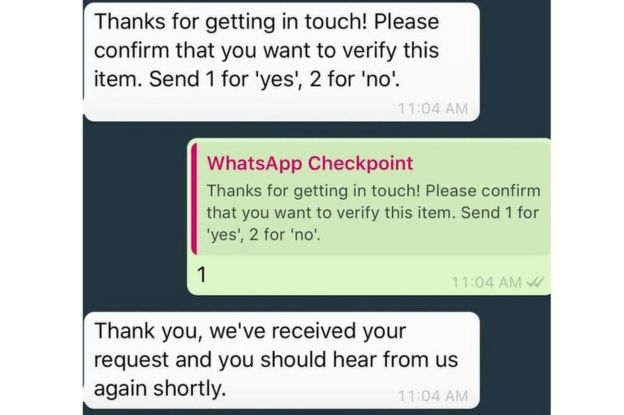
On 2 April the company announced a new project – Checkpoint – that allows users to send in suspicious messages in English and four Indian languages to WhatsApp for verification. Users are told if the message is true, false, misleading or disputed.

It was reported widely as a new fact-checking service but the company has since emphasised that it mostly aims to “study the misinformation phenomenon” and that not all users will receive a response.

Is it working?

While WhatsApp said its moves had decreased forwarded messages by 25%, fact-checkers at other organisations say fake news is still rampant. And they are frustrated that the same rumours and conspiracy theories that they have already debunked – that the Nehru-Gandhi political dynasty have Muslim roots, for example – keep resurfacing.

They say that unless WhatsApp changes its stance on encryption and privacy, the introduction of features similar to those that exist on Facebook – for example, flagging debunked content to users who try to forward it – is impossible.

Screenshots showing WhatsApp checkpoint's service responding to a BBC message asking for confirmation that we want to verify an item
Image captionThe BBC is yet to receive a response from WhatsApp’s new service

Critics also point out that new rules on the platform won’t affect the huge number of group chats that already exist – giving the party of Prime Minister Modi an advantage.

“The BJP is the only party that has WhatsApp groups at this scale,” Mr Singh said. “The other parties can’t do it now because WhatsApp has changed its policies.”

Source: The BBC

Law of Unintended Consequences

continuously updated blog about China & India

ChiaHou's Book Reviews

continuously updated blog about China & India

What's wrong with the world; and its economy

continuously updated blog about China & India