Archive for ‘Uncategorized’

26/03/2019

India to auction fugitive billionaire’s art collection

MUMBAI (Reuters) – Indian tax authorities are hoping for a windfall with the auction on Tuesday of rare oil paintings that were once part of fugitive billionaire jeweller Nirav Modi’s collection and have been seized by the government.

Auctioneers say the sale is the first of its kind in a country where tax authorities have usually auctioned property, gold and luxury items, but not art.

After a court order allowing the auction to take place, tax authorities, who are pursuing Modi over the country’s largest bank fraud, appointed professional auction house Saffronart.

“Until a few years ago, the tax authorities really didn’t know the value of art,” said Farah Siddiqui, an art adviser who is advising clients eyeing Modi’s collection.

The 48-year-old Modi, whose diamonds have sparkled on Hollywood stars, is one of the prime accused in a $2 billion loan fraud at state-run Punjab National Bank. Modi denies the charges and believes they are politically motivated.

The auction comes just weeks before a national election and as Indian Prime Minister Narendra Modi faces pressure to bring back Nirav Modi (no relation), who fled the country last year and has been residing in the United Kingdom.

He was arrested last week by British authorities and remanded in custody after he appeared before a London court. India asked Britain last August to extradite Modi.

The auction includes works by Raja Ravi Varma, a 19th century painter considered among India’s finest, and V.S. Gaitonde, a modern artist known for his abstract and often monochromatic paintings.

“We believe that the collection’s intrinsic value will garner a positive response from collectors,” said Saffronart Chief Executive Dinesh Vazirani.

India Law Alliance, a law firm representing the company controlled by Modi that owns the artwork, said it was challenging the court order that allowed the auction. The case will be heard by the Bombay High Court on Wednesday, a lawyer at the firm told Reuters.

Vijay Aggarwal, a lawyer for Modi, declined to comment.

Source: Reuters

26/03/2019

Surgical strike on poverty, says Rahul Gandhi on minimum income poll promise

Congress president Rahul Gandhi said his promise of minimum income guarantee scheme is his party’s surgical strike on poverty.

LOK SABHA ELECTIONS Updated: Mar 26, 2019 16:48 IST

HT Correspondent
HT Correspondent
Hindustan Times, Ganganagar, Rajasthan
Rahul Gandhi
Rahul Ganghi at a rally in Sriganganagar, Rajastan, on Tuesday. (Congress/Twitter)

Congress president Rahul Gandhi on Tuesday said the promise of minimum income guarantee is his party’s “surgical strike on poverty” that will ensure there is no poor in the country after 2019. Gandhi said the Congress’s promise of minimum income guarantee is “an explosion”.

“It will set off a bomb…This is the Congress’s surgical strike on poverty. They (the BJP) tried to eliminate the poor. We will eliminate poverty,” said Gandhi at a public rally in Rajasthan’s Ganganagar.

‘Surgical strike on poverty’: Rahul Gandhi counters BJP on minimum income promise

A day after the Bharatiya Janata Party tried to discredit the Congress’ promise of a minimum income guarantee scheme in case it comes to power, Congress President Rahul Gandhi countered the BJP’s criticism.

Gandhi hit out at the Narendra Modi government in his speech alleging that the current regime has brought back people who were uplifted from the below poverty line by the Congress-led UPA rule. “The fact that 25 crore people are living in poverty in the 21st century India is a shame,” Gandhi said.

The Congress president said nowhere such a scheme has ever been implemented. “There should not be a single poor person in the country,” he said addressing the Congress’s Jan Sankalp Rally at Suratgarh in Ganganagar district.

On Monday, Gandhi promised that his party would, if it comes to power, guarantee an income of at least Rs 12,000 a month for 20 per cent of India’s poorest families by giving them Rs 6,000 a month. He said the minimum income guarantee scheme, named NYAY (standing for Nyuntam Aay Yojana) meaning justice, would cover 5 crore families or 25 crore people, who constitute the poorest 20 per cent of Indian households.

The scheme, if implemented, is expected to cost Rs 3.6 lakh crore, around 2 per cent of India’s GDP. Gandhi has insisted that it is fiscally prudent.

At his Rajasthan rally, Gandhi said Prime Minister Narendra Modi has tried to “create two Indias” in the last five years giving all the benefits of the government to select few rich people while insisting that if voted to power, the Congress will eradicate poverty completely.

The BJP has rejected the minimum income guarantee promise of Gandhi with Union Finance Minister Arun Jaitley calling it a “bluff announcement” in his blog. Jaitley also said that the total promised by the Congress (Rs 72,000 a year) is just around two-thirds of what the NDA gives the poor.

Source: Hindustan Times

26/03/2019

Will build ten Singapore in Delhi if full statehood granted: Arvind Kejriwal

The ruling Aam Aadmi Party (AAP) in the city is fighting the upcoming Lok Sabha election on the agenda of granting full statehood to Delhi.

PTI | New Delhi | 

Chief Minister and AAP supremo Arvind Kejriwal on Monday promised to build infrastructure equalling “ten Singapore” if full statehood was granted to Delhi.

Addressing a public rally at Patparganj in east Delhi, he called for people’s support in the upcoming elections to ensure that Delhi gets full statehood.

“We will build ten Singapore in Delhi. We will ensure that a flat is given to everyone who is staying in huts in Delhi,” he said.

Taking a dig at Prime Minister Narendra Modi, Kejriwal claimed when the PM was unable to handle Pakistan, how could he be expected to take care of Delhi Police.

“Let us handle Delhi Police and you (PM) take care of Pakistan. You are not able to handle Pakistan, how can you be expected to handle Delhi Police?” he said.

Accusing the Centre of creating hurdles for Delhi’s development, the AAP leader said he faced several obstructions at various stages to get clearances from the central government.

He said the people of Delhi pay Rs 1.5 lakh crore worth Income Tax and receive only Rs 325 crore from the Centre.

“Why should we pay so much and get so less in return? What have Delhiites done to the central government to deserve this? The situation is similar to the time before India got independence.

“First Britishers looted us, now the central government is looting us,” the chief minister said.

“Just for political enmity, PM Modi stopped the development work for the common man of Delhi. Last time you voted for him, but this time do not vote for him, otherwise he would not let me work for development,” he added.

Deputy Chief Minister Manish Sisodia said full statehood for Delhi will ensure that children scoring even 60 per cent marks get admission in colleges in Delhi.

The ruling Aam Aadmi Party (AAP) in the city is fighting the upcoming Lok Sabha election on the agenda of granting full statehood to Delhi.

Raising the slogan of ‘Poorna Rajya Banao Jhadu ka Button Dabao’, the party is busy convincing people to vote for AAP to get full statehood for Delhi.

The election to the seven Lok Sabha seats in the national capital will be held on May 12.

Source: The Statesman
22/03/2019

Chinese president arrives in Italy for state visit

ITALY-ROME-XI JINPING-ARRIVAL

Chinese President Xi Jinping (L) and his wife Peng Liyuan disembark from the airplane upon their arrival in Rome, Italy, on March 21, 2019. Xi arrived in Rome Thursday for a state visit to Italy to map out the future of the bilateral relationship and move it into a new era. (Xinhua/Wang Ye)

ROME, March 21 (Xinhua) — Chinese President Xi Jinping arrived in Rome Thursday for a state visit to Italy to map out the future of the bilateral relationship and move it into a new era.

It is the first visit by a Chinese head of state to the European nation in 10 years.

Two Italian fighter jets escorted Xi’s plane as it entered the country’s airspace.

Xi and his wife, Peng Liyuan, were greeted by senior Italian government officials at the airport.

While delivering a written speech upon arrival, Xi said that the China-Italy relations have withstood the test of time and international vicissitudes since the two countries forged diplomatic ties 49 years ago.

Upholding the principle of mutual respect, trust and benefit, China and Italy have constantly promoted their friendship and cooperation, setting an example of developing bilateral ties between two countries of different social systems, cultural backgrounds and development stages, Xi said.

The practical cooperation between the two countries has yielded fruitful results, bringing tangible benefits to the two peoples, said Xi, adding that the bilateral cultural and people-to-people exchanges are rich and colorful, and have enhanced mutual understanding and friendship.

The Chinese president noted that he is looking forward to meeting the Italian leaders to jointly draw the blueprint for the future development of bilateral relations.

“I believe with the concerted efforts of both sides, the China-Italy comprehensive strategic partnership will enjoy a better tomorrow,” Xi said.

Italy is the first stop of Xi’s three-nation Europe tour, which will also take him to Monaco and France.

Source: Xinhua

22/03/2019

Seven dead after man drives car into crowd in central China

  • Motorist kills six as he ploughs into passers-by, before being shot dead by police
A man drove a car into a crowd on Friday morning, killing six and injuring seven in Hubei province. Photo: Thepaper.cn
Police in central China shot dead a man who drove a car into a crowd on Friday morning, killing six and wounding six others, including children, Chinese media reported.
The police received calls at around 6am about someone driving into pedestrians in the township of Taiping in Hubei province. Officers shot the driver dead, taking the death toll to seven.
The Zaoyang municipal government, which administers Taiping, said the motorist was 44-year-old restaurant owner Cui Lidong.

A police investigation into the incident was under way.

A video published by news portal Thepaper.cn shows several people lying on the ground as an ambulance arrives at the scene.

One witness identified only as Wang said the car ploughed randomly into pedestrians and other vehicles, the Beijing News reported.

Another witness said: “There were bodies everywhere on the street.”

The reports prompted debate online about whether the incident was yet another case of “revenge on society”, where the suspect lashes out at the public to settle personal scores or draw attention to a dispute.

There have been several such revenge cases in recent years, including car crashes, knife attacks and bombings in which the victims were mostly pedestrians or schoolchildren.

In March, police in Tangshan, Hebei province, arrested a man for attacking several pupils outside a primary school. In September 2018, a driver crashed a car into a crowd in central China before attacking pedestrians with a knife and shovel, killing 11 and wounding 44.

Source: SCMP

22/03/2019

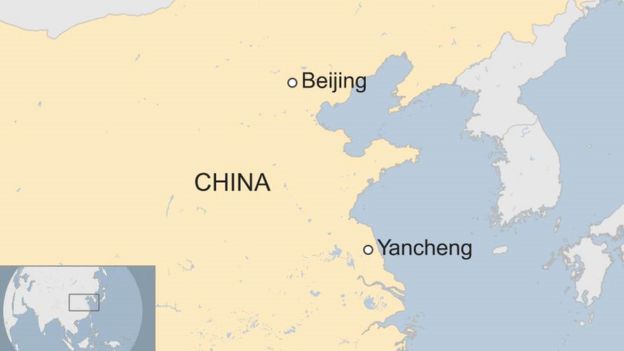
China chemical blast death toll rises to 47

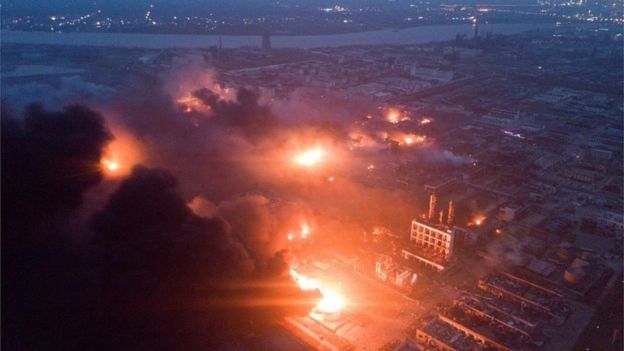
The death toll in a huge blast at a chemical plant in eastern China has jumped to 47, with 90 badly injured, according to state news agency Xinhua.

The powerful explosion followed a fire at the factory which produces fertiliser.

China’s earthquake administration reported a tremor equivalent to 2.2-magnitude at the time of the blast.

The death toll makes it one of the country’s worst industrial accidents in recent years.

The blast happened at about 14:50 local time (06:50 GMT) on Thursday at a plant in Yancheng, run by Tianjiayi Chemical.

According to Xinhua, a total of 640 people were sent to hospital. Many were in critical condition and dozens had severe injuries, the agency reports.

Overhead view of the Tianjiayi Chemical plant on fire with smoke billowingImage copyrightREUTERS
Image captionThe scale of the destruction is clear
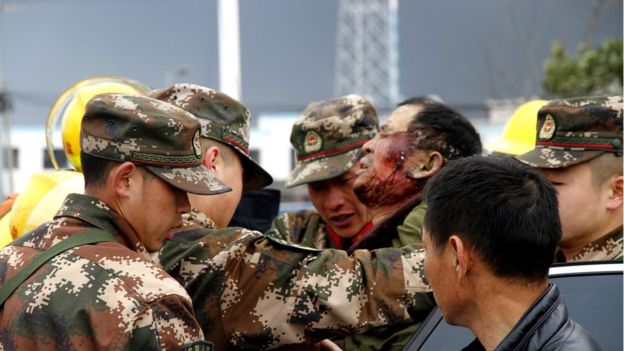
Armed police officers carry an injured man after an explosion at a chemical industrial parkImage copyrightGETTY IMAGES
Image captionHundreds were injured in the explosion, which was reportedly started by a fire at the plant

Images of the site showed a fireball exploding, billowing clouds enveloping the area, injured people, and damage to buildings.

The blast was so powerful that it knocked down factory buildings some distance away, trapping workers, according to local media.

Staff at the Henglida Chemical Factory, 3km (1.8 miles) from the explosion, said its roof collapsed as they fled, and windows and doors were blown out.

Provincial authorities said firefighters had to be brought in from across the province.

The fire was brought under control at around 03:00 local time on Friday, state TV said.

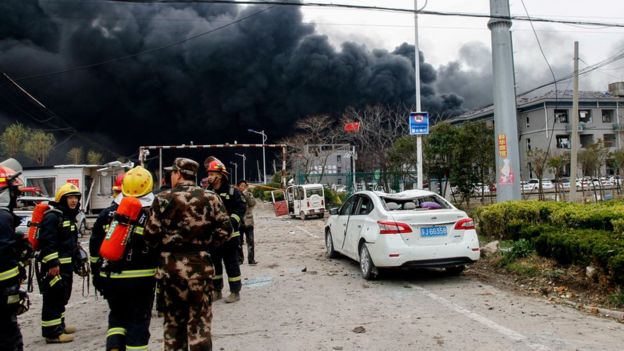
Police at the site of the explosionImage copyrightGETTY IMAGES
Image captionThe cause of the accident is under investigation

One woman, who gave her surname as Xiang, said she had been concerned about safety and pollution levels at the plant for some time.

“We knew we’d be blown up one day,” said told AFP.

Reuters quoted local officials as saying there had been no abnormalities detected at the site before the blast, but that the province would be conducting emergency inspections of other chemical producers and warehouses.

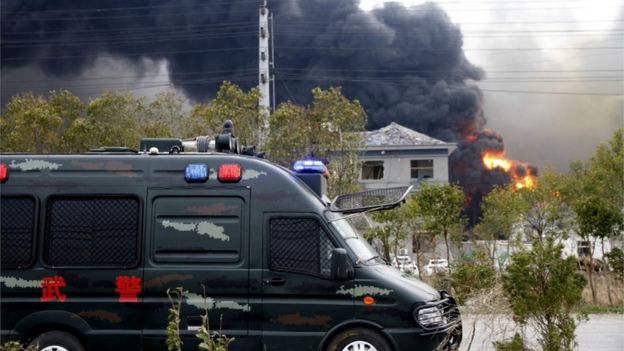
A police van in front of a house with blown out windows, the factory on fire in the background, in Yancheng, ChinaImage copyrightREUTERS
Image captionThe blast blew out windows of buildings across a wide area

Industrial accidents ranging from factory fires to mining disasters are common in China, often due to poorly enforced safety standards.

The biggest accident in recent years was the August 2015 Tianjin explosion, which killed more than 160 people and injured nearly 1,000.

The exact cause of Thursday’s explosion is still under investigation. Tianjiayi Chemical, founded in 2007, has received six government penalties in the past over waste management and air pollution, according to the South China Morning Post.

President Xi Jinping has called for an “all-out effort” to aid the injured and said authorities must learn lessons from the blast prevent future accidents.

Yancheng, China

Source: The BBC

22/03/2019

India election 2019: When will broadband reach all villages?

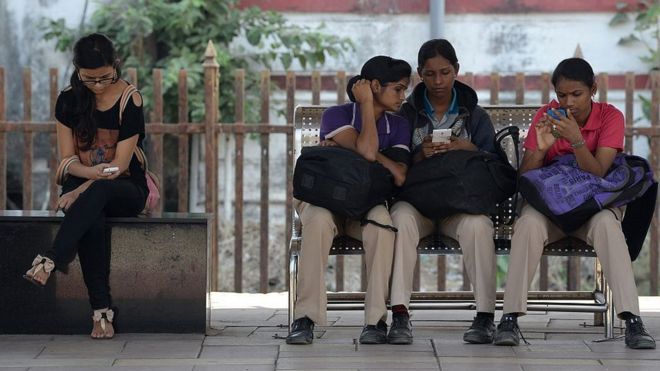
Indian women check their mobile phones at a free Wi-Fi zone in Mumbai in February 2016Image copyrightGETTY IMAGES

India’s Prime Minister Narendra Modi wants more than a billion Indians connected to the internet – and his BJP government is counting on a project taking cheap high-speed broadband to rural areas to achieve this.

The project, to build a nationwide optical fibre network, was launched in 2014 and is the flagship scheme of the government’s Digital India programme.

In the run-up to the Indian election, which gets under way on 11 April, BBC Reality Check is examining claims and pledges made by the main political parties.

So has the project been a success?

Presentational grey line

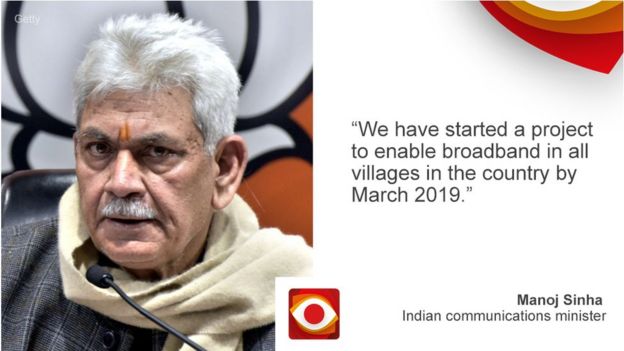
Pledge: Indian Communications Minister Manoj Sinha promised to provide every village in the country with high speed broadband and that this would be achieved by March 2019.

Verdict: The project to set up digital infrastructure in rural India has made substantial headway but has so far achieved less than 50% of its intended target.

Quote card for Indian minister of state (communications) Manoj Sinha
Presentational grey line

An ambitious plan

India has the second highest number of internet users in the world but the penetration is quite low for its size and population.

The BharatNet scheme aims to connect more than 600,000 villages in India with a minimum broadband speed of 100Mbps.

It would enable local service providers to offer internet access to the local population, primarily through mobile phones and other portable devices.

India’s telecom regulator says there were 560 million internet connections in India in September last year.

What’s been achieved so far?

The government’s overall target is to connect 250,000 village councils covering more than 600,000 individual villages across the country.

The work of laying cables and installing equipment to connect 100,000 of them was finally completed in December 2017 after significant delays.

This milestone was hailed a success but there were also critical voices, especially from government opponents about whether the cables were actually operational.

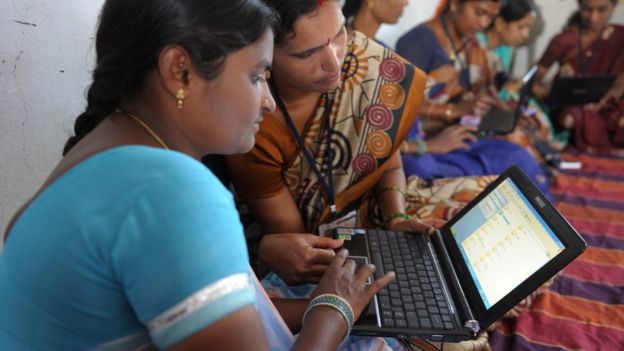
Indian villagers from a self-help group with laptops in Bibinagar village outskirts of Hyderabad on 7 March 2013Image copyrightGETTY IMAGES

The next phase, to connect the remaining councils by March 2019, has been under way for a year now.

In total, as of the end of January this year, official data shows optical fibre cables have been laid in 123,489 village councils – and equipment installed in 116,876 of them.

There is also a plan to install wi-fi hotspots in more than 100,000 council areas – but as of January these were operational in only 12,500 of them.

Old plan, new name

It has been an ambition of successive governments to connect all India to the internet but plans have hit many roadblocks.

BharatNet was first conceived in 2011 by the then Congress government as the National Optical Fibre Network but did not make much headway in its pilot phase.

A parliamentary committee said the project had been affected by “inadequate planning and design” from 2011 to 2014.

When the BJP came to power in 2014, it took over the project and has pushed ahead with national broadband coverage.

And in January last year, the government said it would complete the work ahead of the stipulated deadline of March 2019.

Has the deadline been met?

There was impressive progress made in 2016 and 2017 but since then the pace has slowed.

In January this year, the agency executing BharatNet said 116,411 village councils were “service ready”.

This means that provisions for ready-to-use connectivity have been made.

But not all “service ready” village councils have proper connections, says Osama Manzar, from the non-governmental Digital Empowerment Foundation (DEF).

DEF found that only 50 of 269 “service ready” councils inspected across 13 states in 2018 had the required device and internet connection set-up.

And only 31 of them had “functional”, but slow, internet connections.

Mr Manzar notes that this is problematic considering “the public welfare distribution and the financial sectors rely heavily on digital infrastructure today”.

Another report, citing an internal official memo, said most of the councils had non-functioning networks or faulty equipment.

Next steps

BharatNet has faced also difficulties with electricity supply, theft, low-quality cables and poorly maintained equipment.

And these delays come as India aims to provide broadband in all households and move to 5G networks by 2022.

An official source defended BharatNet as a large-scale infrastructure project tackling difficult sites and not a service scheme, saying it was natural to see delays between set-up and use.

Source: The BBC

22/03/2019

Guns and tourists: Aboard the unlikely India-Pakistan ‘friendship bus’

NEW DELHI (Reuters) – One Friday morning before dawn, a half-empty Volvo coach slipped out of New Delhi’s Ambedkar bus terminal under armed guard, the sirens of a police convoy wailing.

Carrying a mixture of Indian and Pakistani tourists, the bus, emblazoned with the flags of both countries and the phrase ‘Sada-e-Sarhad’ (Call of the Frontier), is one of the few remaining transport links between the nuclear-armed neighbors, who clashed last month over the disputed Kashmir region in a conflict that alarmed world powers.

But as Reuters found on a return trip on what is also known as the ‘dosti (friendship) bus’, that runs daily except Sundays between Delhi and the Pakistani city of Lahore, it is a powerful symbol of hope for better relations between the rivals, who despite their political differences share strong linguistic, cultural and family ties.

After breakfast at a government-run restaurant on the highway where police seal off the grounds, passengers from both countries watch a Bollywood film on board, starring one of India’s many Muslim actors.

“Salman Khan is a Muslim, he is one of us,” said Hilal Ahmad Mir, 36, a Kashmiri apple farmer and father of four.

The journey from his home in the south Kashmir valley to Pakistan’s capital Islamabad to visit his brother Hamid, should be less than 300 km (200 miles) by the most direct route, across the contested border known as the Line of Control.

But with the ongoing conflict making that route effectively impossible, he is forced to take a lengthy detour via Delhi and Lahore, before eventually reaching Islamabad two days later.

Still, he is upbeat.

“Pakistan makes it easy for Kashmiris to get a visa,” he said. “In some ways, Pakistan and India have a very good relationship. We have had a lot of damage. We want friendship, not guns.”

SEPARATED AT BIRTH

India and Pakistan have thousands of years of shared history. Delhi and Lahore’s sandstone forts and grand mosques were all constructed by the Mughal empire, and both countries were later part of British colonial India.

When Britain gave up control of the Indian subcontinent in 1947, it hastily partitioned it into Hindu-majority India and Islamic Pakistan. Hundreds of thousands died in ethnic bloodshed and millions more became refugees.

Relations between the two countries have been strained ever since. They have fought three wars, two of them over the Muslim-majority Kashmir region that both claim in full but rule in part. Last month, they clashed over a suicide attack on an Indian paramilitary convoy in Kashmir by Pakistani militants.

In an attempt to maintain close links to Indian-administered Kashmir, Pakistan often approves visas for the Muslim-majority population on the same day.

For the vast majority of people in both countries, however, arranging a visa to visit to the other side is a bureaucratic process that often takes as long as three months, according to half a dozen of the bus’s passengers.

“My family is divided: my wife’s side is in India, my side in Pakistan,” said Shoaib Mohammed, a banker from Karachi returning after a month in Delhi. “The visa process takes at least 45 days and is often extended.”

Though the bus, inaugurated in 1999 by India’s then-prime minister Atal Bihari Vajpayee, has been briefly suspended over the years, it ran uninterrupted through the last major clash between the two countries that erupted weeks after the launch.

Neither has it been canceled over the tensions of the last month, although passenger numbers dropped into the single digits, officials said, a testimony to the huge police operation to protect it.

Several armed police are always on board – one of whom on this trip snores on the back seat, rifle on his lap. Dozens more block off roads in Delhi and other major towns, while a convoy ahead clears traffic.

But even without policing costs, the bus loses money, according to a senior Pakistani diplomat based in New Delhi familiar with the bus’s operations.

“Commercially, the bus is a failure,” he said. “But relations between the two countries are so bad at the moment neither side can afford to cancel it.”

INTO THE SUNSET

After lunch in another deserted and heavily guarded highway restaurant, the bus passes through Wagah-Attari, one of the few active border crossings between India and Pakistan. It is best known for an elaborate dusk ceremony where high-kicking guards from both countries perform a choreographed routine at a purpose-built stadium that straddles the border.

Most days, just 100 people cross in either direction, Indian and Pakistani border officials said. Both times Reuters crossed the border, the process took close to three hours, and the terminal was deserted with no other travelers in sight apart from those on the bus.

Mir, from Kashmir, is held by Indian border officials for 40 minutes for questioning.

“Kashmiris are dangerous,” he laughed, as he returned to the bus.

Shortly before the dusk ceremony begins, the bus drives across the border through the stadium, where hundreds of spectators from both countries roar their approval.

Passengers then pass through near-identical Pakistani immigration checks.

On board, spirits are high as the bus begins its last lap to the center of Lahore, about 20 km (12 miles) away.

“We have been visiting for the last 40 years and this time there were no problems for me as a normal visitor,” Mohammed said, of his visit to Delhi when tensions were at their peak.

“I didn’t feel any anger against Pakistanis. Nothing.”

Source: Reuters

22/03/2019

Oppn has insulted armed forces, Indians won’t forgive: PM Modi after Pitroda’s IAF remarks

The remarks by Pitroda come on a day when the Pakistan High Commission in Delhi is hosting the reception for the Pakistan National Day, the invite to which has been declined by India.

SNS Web | New Delhi | 

Lashing out heavily at the Congress after Sam Pitroda’s remarks on the IAF strike, Prime Minister Narendra Modi on Friday said the most trusted advisor and guide of Rahul Gandhi has kickstarted the Pakistan National Day celebrations on behalf of the Congress, ironically by demeaning Indian armed forces.

The PM said the Opposition has insulted the country’s armed forces time and again.

Sparking a massive controversy, Gandhi’s close confidant and Chairman of Indian Overseas Congress Sam Pitroda earlier in the day made shocking remarks on the IAF strike questioning the death toll in Balakot after the Indian Air Force dropped bombs on JeM camps in a pre-dawn attack on February 26.

Questioning the strike impact, Pitroda asked, “I would like to know more as I have read in New York Times and other newspapers, what did we really attack, we really killed 300 people?”

“If you say 300 people were killed, we all need to know that; all Indians need to know that. Then comes the global media which says nobody was killed. I look bad as an Indian citizen,” he added.

Referring to the 26/11 Mumbai terror attacks that killed 166 people, Sam Pitroda further said, “Eight people come and do something, you don’t jump on an entire nation. It is naive to assume that just because some people came here and attacked, every citizen of that nation is to be blamed. I don’t believe in that way”.

He also said that “attacks happen all the time, it also happened in Mumbai”, adding that the government could have then reacted and just sent fighter planes, but that is not the right approach”.

The Indian Overseas Congress chief further said that it was not the right approach by the Government to send Indian fighters to deal with issues like terror attacks.

Taking a dig at the Congress, PM Modi reacted saying the “loyal courtier of Congress’ royal dynasty admits what the nation already knew – that the Congress was unwilling to respond to forces of terror”.

“This is a New India – we will answer terrorists in a language they understand and with interest,” PM Modi.

The Prime Minister further appealed to the citizens of the country to question the Opposition leaders on their statements and let them know that the 130 crore Indians will not forgive or forget the Opposition for their antics.Union Minister Smriti Irani too hit back at the Congress saying “now the nation knows why Rahul Gandhi’s UPA chose not to respond with full might post the Mumbai terror attacks”, adding that “Congress sympathies with Pakistan stands exposed”.

The remarks by Pitroda come on a day when the Pakistan High Commission in Delhi is hosting the reception for the Pakistan National Day, the invite to which has been declined by the Government citing the presence of Hurriyat leaders.

Many Congress leaders have demanded proof of the retaliatory assault and casualties in the aftermath of the Pulwama terror attack that left over 44 CRPF men dead on February 14.

Following the Pulwama attack, India carried out “non-military pre-emptive” airstrikes targeting the JeM training camp in Balakot in Pakistan’s restive Khyber Pakhtunkhwa province, about 80-km from the Line of Control (LoC) early on February 26.

Hours after the pre-dawn offensive, Government sources had claimed that over 300 terrorists were killed.

The sparring between the government and the opposition intensified after BJP chief Amit Shah claimed that “more than 250” terrorists were killed in the operation, even when the government was yet to give out an official count of the terrorists killed.

Source: The Statesman
21/03/2019

China calls for more countries to attach importance to Africa

BEIJING, March 20 (Xinhua) — China reiterated its stance on China-Africa cooperation on Wednesday, calling for more countries to think highly of Africa.

Foreign Ministry spokesperson Geng Shuang made the remarks at a press briefing in response to the groundless accusations made against China’s policy towards Africa, such as the Mombasa-Nairobi Standard Gauge Railway (SGR) Project in Kenya will put the country in debt.

Geng cited Kenyan President Uhuru Kenyatta as saying that “in recent years, Kenya-China relations have become closer and closer, and cooperation between the two countries has become tighter in such fields as industry and infrastructure construction.”

The SGR is one of the most ambitious infrastructure projects in Africa and has brought great changes to the lives of the Kenyan people, the president said.

Geng said China appreciates that the leaders of many African countries, including Djibouti and Kenya, and people of insight from all walks of life have a fair evaluation of China-Africa relations and China-Africa cooperation.

China will intensify pragmatic cooperation in various fields with African countries under the Belt and Road Initiative, steadily implement the consensus reached by Chinese and African leaders and promote constant development of the China-Africa comprehensive strategic cooperative partnership.

“We hope more countries will truly pay attention to Africa, attach importance to Africa, and invest in Africa, and work together with China to help Africa’s peace, stability, development and prosperity,” he added.

Source: Xinhua

Law of Unintended Consequences

continuously updated blog about China & India

ChiaHou's Book Reviews

continuously updated blog about China & India

What's wrong with the world; and its economy

continuously updated blog about China & India