Archive for ‘Uncategorized’

24/01/2019

India satellite: Student-made Kalamsat V2 to be put in orbit

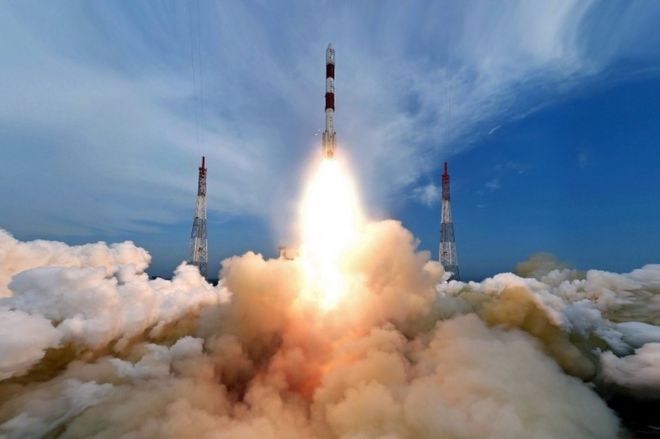
A handout picture provided by the Indian Space Research Organization (ISRO) shows the fully integrated PSLV-C35 taking off from the launch pad at Sriharikota"s Satish Dhawan Space Centre in Andhra Pradesh, India, 26 September 2016Image copyrightEPA
Image captionThe rocket carrying the satellite will be launched from Sriharikota in southern India

India is due to launch what it says is the world’s lightest satellite ever to be put into orbit.

Weighing only 1.26kg (2.6lb), the Kalamsat-V2 has been made by students belonging to a space education firm.

It will help ham radio operators and “inspire schoolchildren to become the scientists and engineers of the future”, India’s space agency says.

The Indian Space Research Organisation (Isro) will launch the satellite from its Sriharikota space centre.

Isro chief K Sivan has claimed that “Kalamsat is the lightest satellite to be ever built and launched into orbit”.

It is equipped to serve as a communications satellite for ham radio transmission, a form of wireless communication used by amateurs for non-commercial activities.

An even lighter satellite, weighing 64 grams and built by the same group of students, was launched on a four-hour mission for a sub-orbital flight from a Nasa facility in the US in June 2017. Sub-orbital spaceflights technically enter space, but don’t get into orbit.

Kalamsat-V2 was made by students belonging to Space Kidz India, a Chennai-based space education firm. So far nine satellites made by Indian students have found a place on space rockets.

In a first, the Indian space agency is also going to reuse a stage of the rocket that will be used to launch the satellite.

Traditionally, rockets are expendable. Their various segments are discarded during an ascent. Fuel is also removed.

They end up as space debris – there are millions of discarded pieces of metal and other materials orbiting the Earth, ranging from defunct satellites to old rocket segments to accidentally dropped astronaut tools. Collisions can cause a great deal of damage, and generate even more pieces of debris.
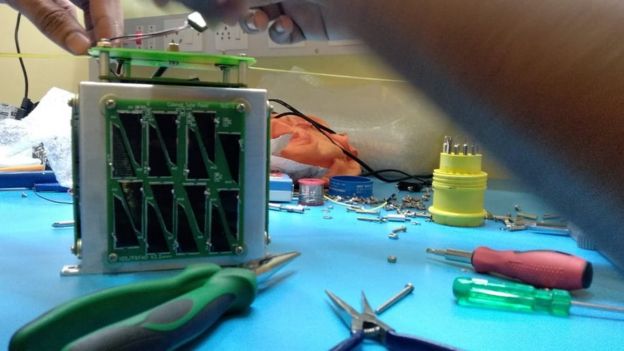
Kalamsat 2
Image captionWeighing only 1.26kg (2.6lb), the Kalamsat-V2 has been made by students belonging to a space education firm

The satellite is being launched by Isro’s reliable Indian Polar Satellite Launch Vehicle (PSLV) – a four-stage rocket that on this launch weighs about 260 tonnes.

Its first three segments usually drop back to Earth; its fourth and final stage uses liquid propellants, and can be stopped and restarted several times to get a spacecraft into just the right orbit.

The fourth stage can take the the satellite in Thursday’s launch to a height of 277km (172 miles) above earth.

But Isro is giving new capability to the last stage so that it can remain active in space for up to a year.

“Why waste such a valuable resource? We decided to convert [the fourth stage] into an experimental orbital platform to conduct small experiments in space,” says Mr Sivan. The PSLV rocket costs upwards of $28m (£21m).

The experimental orbital platform will help researchers carry out experiments in a near zero-gravity environment.

Innovative move

So in this mission, the last stage of the rocket will be “moved to a higher circular orbit” from where the Kalamsat-V2 is expected to beam down its signals.

“This is the first time Isro is conducting such an experiment to reclaim a dead rocket stage and to keep it alive,” Mr Sivan said.

In this new approach, researchers can simply bring in their payloads or experiments which will then be plugged into the equipment bay especially made in the spent rocket.

Isro is the not the first space agency to try this “waste to wealth innovation”.

Jean Yves-LeGall, president of the Centre National d’Etudes Spatiales (CNES), the French space agency, says they have used it “but did not find it a cost effective way to conduct experiments in space”.

Source: The BBC
24/01/2019

India’s ruling party could face electoral wipeout in most populous state, poll shows

NEW DELHI (Reuters) – Prime Minister Narendra Modi’s ruling party could lose a quarter of its seats in India’s parliament with an electoral wipeout in the most populous state, if the Congress Party were to join an opposition alliance there, an opinion poll showed on Wednesday.

Modi’s Bharatiya Janata Party won 282 seats in the 545-seat parliament in the last election, including 73 out of the 80 seats from Uttar Pradesh, a giant northern state of more than 200 million people.

But the India Today-Karvy Insights Mood of the Nation poll forecast that the number of seats held by the BJP in the state could plummet to just five, if Congress were to join an alliance set up by other opposition groups. The next general election is due by May.

The shock poll comes after the BJP lost elections in five state assemblies late last year, including three that it had controlled, largely because of rural anger about low farm incomes tied to weak crop prices.

To achieve such a wipeout in Uttar Pradesh, the opposition parties would have to agree to field a single candidate in each constituency, according to the poll. Congress has so far ruled that out, although even without Congress the other opposition parties would still inflict a sizeable defeat on the BJP.

An alliance of three Uttar Pradesh parties – Samajwadi Party (SP), Bahujan Samaj Party (BSP) and Rashtriya Lok Dal – could win 58 seats without Congress, the poll showed. BJP and its ally in the state, Apna Dal, would win 18 seats in that scenario and Congress would have 4.

“The Congress party will fight in all the seats on its own, but a post-poll alliance with SP-BSP is in the offing,” Congress spokesman Sanjay Jha told Reuters. “We are all ideologically compatible and are committed to defeating the fascist corrupt BJP.”

The BJP dismissed the survey, for which a total of 2,478 people were polled in Uttar Pradesh. Opinion polls have a mixed record in the country of 1.3 billion people, where regional issues often overshadow national concerns.

“It’s a poll even before the election has been announced and before parties are actually involved in electioneering,” BJP spokesman Nalin Kohli said. “In any case, it is painting a rather pessimistic figure for the BJP, which we believe will not be the situation in any circumstance.”

Political analysts, however, say the coming together of the SP and BSP, which have both separately governed Uttar Pradesh and mainly represent Hindus of the lower castes and Muslims, could pose a formidable challenge to the ruling party.

Following the state election losses, Modi is considering a series of vote-catching measures, including directly transferring money to farmers, which may cost more than 1 trillion rupees ($14 billion), according to government sources.

“It won’t be possible for the BJP to fracture this alliance,” said Badri Narayan Tiwari, a political analyst based in the Uttar Pradesh city of Prayagraj.

On Wednesday, the government appointed railways minister Piyush Goyal as interim finance minister while Arun Jaitley, also a top lieutenant of Modi, receives medical treatment in the United States ahead of an interim budget on Feb. 1.

The Uttar Pradesh survey was conducted before Congress appointed its President Rahul Gandhi’s charismatic younger sister, Priyanka Gandhi Vadra, to a senior party position that party officials say will help to energise its campaign.

The poll and Jaitley’s medical condition could impact Indian markets on Thursday.

Source: Reuters

24/01/2019

China detains Australian on suspicion of endangering security

BEIJING/SYDNEY (Reuters) – Chinese authorities are holding an Australian writer, who used to be a Chinese citizen, on suspicion of endangering state security, China said on Thursday, and his lawyer said he was suspected of espionage.

Australian officials said Yang Hengjun was detained shortly after he flew in to the southern city of Guangzhou from New York last week, but it did not believe his detention was the result of rising tension between China and the West.

Chinese foreign ministry spokeswoman Hua Chunying said that Australia was officially notified after Yang was placed under “coercive measures” – a euphemism for detention – in Beijing.

“The Australian citizen Yang Jun, due to being suspected of engaging in criminal acts that endangered China’s national security, was recently placed under coercive measures and is being investigated by the Beijing city State Security Bureau,” Hua told reporters.

Yang’s rights and interests were being protected in accordance with the law, she told a regular news briefing in Beijing, using a slightly different name for him.

Australian Defence Minister Christopher Pyne, arrived on in Beijing on Thursday on for scheduled talks, said Australia would normally expect to be told of such a case within three days under existing diplomatic conventions.

Yang went missing on Friday and Australia was not told until four days later. Pyne said the late notification was disappointing and he would be raising it in his talks with Chinese officials.

“He’s being held in residential surveillance,” Pyne told reporters.

The Australian government was first alerted that Yang had gone missing after friends said he had been out of contact for several days.

Yang’s lawyer, Mo Shaoping, told Reuters that his client was suspected of “espionage”, and was being held under “residential surveillance at a designated location”.

The special detention measure allows authorities to interrogate suspects for six months without necessarily granting access to legal representation. Rights groups say that the lack of oversight raises concern about abuse by interrogators.

Mo said he had been retained by Yang’s wife but because the case involved state security, he would need approval from the authorities before he would be able to meet Yang.

WARNING

Tensions have risen in recent weeks between China and some Western countries after two Canadians, a diplomat on unpaid leave and a consultant, were arrested in China on suspicion of endangering state security.

Those arrests were widely seen in the West as retaliation by China for Canada’s arrest of Meng Wanzhou, a senior Huawei Technologies [HWT.UL] executive, on Dec. 1 at the request of the United States for allegedly violating U.S. sanctions on Iran.

Australia joined international condemnation of the arrest of the two Canadians, but Yang has long been in the sights of Chinese authorities.

He has criticised what he described as Chinese interference in Australia.

Feng Chongyi, an academic at the University of Technology in Sydney, said he asked Yang not to go to China because of the tension.

“I didn’t think it would be safe for him because of the situation with Huawei but he believed that he would be fine as he had been there so many times,” Feng said.

Australian Foreign Minister Marise Payne said staff from Australia’s embassy met Chinese officials on Thursday and, while details were limited, she said there was no evidence Yang’s case was linked to Australia’s criticism of the detention of the Canadians.

“I’d be concerned if there was an indication of that,” Payne told reporters in Sydney.

“We are calling on the Chinese authorities to ensure this matter is dealt with transparently and fairly.”

‘CAN’T HIDE’

Yang was also reported missing for several days while in China in 2011. Two sources familiar with the details said he had been detained but agreed to say he had been unwell.

However, Yang is not seen as a radical dissident.

He became famous in the 2000s for his political essays, which earned him the nickname “democracy peddler”. In recent years, he had published little commentary, instead writing more fiction, including a trilogy of spy novels.

Deng Yuwen, a Beijing-based political analyst who knows Yang, told Reuters that he did not know the reason for Yang’s detention but that his WeChat accounts had been deleted.

“He has basically not publicly released any political essays in recent years,” Deng said.

Chinese President Xi Jinping has presided over a crackdown on dissent since coming to power in 2012, with hundreds of rights lawyers and activists detained. Dozens have been jailed.

Relations between Australia and its largest trading partner have been strained in recent years and Pyne’s trip was arranged in a bid to repair ties damaged by Australian accusations in 2017 that China was meddling in its affairs.

Analysts said Yang’s arrest would add to pressure on Australia to take a stand, and it would prolong tension.

“Australia can’t hide from this. It will need to respectfully protect its citizens,” said Rory Medcalf, head of the National Security College at the Australian National University.

“This detention marks the new normal in the bilateral tension, which will be constant low-level tension.”

Source: Reuters

24/01/2019

Microsoft’s Bing search engine inaccessible in China

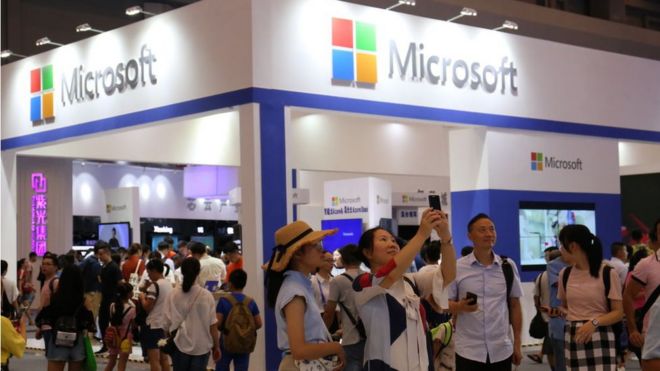
A Microsoft display at a technology show in ChinaImage copyrightGETTY IMAGES

US tech giant Microsoft has confirmed that its search engine Bing is currently inaccessible in China.

Social media users have expressed concern that the search engine might be the latest foreign website to be blocked by censors.

Chinese authorities operate a firewall that blocks many US tech platforms, including Facebook and Twitter.

Microsoft hasn’t said if the outage may be due to censorship, or is merely a technical problem.

“We’ve confirmed that Bing is currently inaccessible in China and are engaged to determine next steps,” Microsoft spokesperson said in a statement.

A BBC correspondent in China attempted to visit the site, and was able to access it through a Chinese internet provider on a desktop, but not on a smartphone.

Many US tech companies are keen to tap into the Chinese market, but have a difficult relationship with the authorities in Beijing.

The government’s internet censorship regime, often known as the “Great Firewall”, uses a series of technical measures to block foreign platforms and controversial content.

Chinese authorities have also cracked down on Virtual Private Networks, which allow users to skirt around the firewall.

China-based messaging services and social media are restricted, with key words and expressions blocked if they express dissent or ridicule senior political leaders.

China ambitions

Bing’s rival Google shut down its search engine in China in 2010, after rows with the authorities over censorship and hacking.

Google has said that it has no immediate plans to re-launch a search engine in China, but has admitted it has looked closely at the idea.

Although Twitter is blocked, it maintains a Greater China office because Chinese customers can use the platform to advertise abroad.

Facebook attempted to set up an office in China last year, but appears to have been blocked.

Microsoft has maintained an office in Beijing since 1992. It has continued to operate Bing and its communication service Skype in China.

Source: The BBC

24/01/2019

Panda teeth are self-regenerating, Chinese and US scientists find – and it could benefit human dentures

  • The animals’ tooth enamel is able to recover its structure after damage, research reveals
  • Potential uses for human dentures and ceramics are being explored
PUBLISHED : Thursday, 24 January, 2019, 6:01pm
UPDATED : Thursday, 24 January, 2019, 6:01pm

Chinese and American scientists have discovered that pandas have self-regenerating teeth and are studying its potential uses for human dentures and ceramics.Giant panda tooth enamel can recover its structure at a microscopic and nanoscopic level to counter wear and tear, the Chinese Academy of Sciences’ Institute of Metal Research has said.

This regeneration helps the animals to munch up to 38kg of tough bamboo stems every day. The fibrous plant makes up 99 per cent of a panda’s typical diet.

However, the study found that the enamel was not resistant to large-scale cracks.

The discovery was made by a research team led by Liu Zengqian, a scientist at the institute’s fracture mechanics laboratory.

The team also included members from the University of California, Berkeley, the University of Science and Technology of China and the Lanzhou University of Technology.

The scientists have been studying the properties of giant panda tooth enamel since 2016.

Panda tooth enamel is made of the mineral hydroxyapatite, whose fibres are arranged in a special structure that reduces the growth of small cracks, Liu was quoted as saying in the Chinese Academy of Sciences press release. Water molecules help the process along, it said.

The research team is using these findings to develop high-performance material for use in bionic human dentures and durable ceramics.

In 2015, researchers at the Chengdu Research Base of Giant Panda Breeding in southwest China found that pandas’ digestive systems had not evolved to adapt to their all-bamboo diet.

Despite spending up to 14 hours a day eating bamboo, giant pandas were able to digest only about 17 per cent of the bamboo they consumed, the researchers found.

Wild giant panda survival rates are threatened by the loss of their bamboo rainforest habitat, but the population has recovered after a high-profile captivity breeding programme backed by the Chinese government.

The animals are no longer classified as endangered. According to the latest census taken in 2014, more than 1,800 pandas are alive in the wild.

Source: SCMP

24/01/2019

China blasts U.S. “technology bullying” with Huawei CFO extradition

BEIJING, Jan. 23 (Xinhua) — China on Wednesday said the U.S. plan to extradite Meng Wanzhou, Huawei chief financial officer, from Canada did not comply with international law or have legitimacy.

The remarks came as Foreign Ministry spokesperson Hua Chunying reiterated China’s position on the Meng Wanzhou case at a press briefing.

Hua said the U.S. request for Meng’s extradition was essentially related to U.S. sanctions against Iran.

“Huawei has stated for many times that it has complied with all laws and regulations of the country in which it operates,” Hua said.

She stressed that China had consistently opposed the U.S. unilateral sanctions against Iran and unilateral sanctions against Iran outside the framework of the UN Security Council, which are not in line with international law and are opposed by the world, including U.S. allies.

“Canada is also opposed to this issue,” Hua said. “The U.S. act is highly political which is essentially technology bullying, and its purpose is to do everything in its power to suppress Chinese high-tech enterprises and contain China’s legitimate development rights.”

She said people of insight and a sense of justice in the international community should resolutely oppose it.

Source: Xinhua

24/01/2019

China clones gene-edited monkeys

CHINA-SHANGHAI-GENE-EDITED MONKEYS (CN)

Photo taken on Nov. 26, 2018 shows the five cloned monkeys with circadian rhythm disorders. China has cloned five monkeys from a gene-edited macaque with circadian rhythm disorders, the first time multiple monkeys have been cloned from a gene-edited monkey for biomedical research. Scientists made the announcement Thursday, with two articles published in National Science Review, a top Chinese journal in English. The cloned monkeys were born in Shanghai at Institute of Neuroscience of Chinese Academy of Sciences. (Xinhua/Institute of Neuroscience of Chinese Academy of Sciences)

SHANGHAI, Jan. 24 (Xinhua) — China has cloned five monkeys from a gene-edited macaque with circadian rhythm disorders, the first time multiple monkeys have been cloned from a gene-edited monkey for biomedical research.

Scientists made the announcement Thursday, with two articles published in National Science Review, a top Chinese journal in English. The cloned monkeys were born in Shanghai at Institute of Neuroscience of Chinese Academy of Sciences.

Researchers said that the advance means that a population of customized gene-edited monkey models with uniform genetic background will be available for biomedical research.

Disorders of circadian rhythm are associated with many human diseases, including sleep disorders, depression, diabetic mellitus, cancer and neurodegenerative diseases, such as Alzheimer’s disease.

Previously, mice and flies were widely used for the research of such diseases, but these animal models differ greatly from human beings in terms of activity routines, brain structure and metabolic rate.

The cloned monkeys, closer to human in physiology, make better models for research on disease pathogenesis and potential therapeutic treatments.

In order to create an ideal donor monkey, researchers knocked out BMAL1, a core circadian regulatory transcription factor, using gene editing at the embryo stage.

They selected one of the gene-edited monkeys with the most severe disease phenotypes as the donor. The fibroblasts of the donor were then used to clone five monkeys by somatic cell nuclear transfer, the same method used to generate Zhong Zhong and Hua Hua, the first cloned monkeys born in China at the end of 2017.

Different from Zhong Zhong and Hua Hua, generated by using fibroblasts from an aborted fetus, the new clones were made using a gene-edited young adult male monkey.

“It shows that besides using fetus, batch cloning of gene-edited male monkeys with diseases is also feasible,” said Qiang Sun of the institute.

Sun said the research program was reviewed and supervised by the institute’s ethic committee in accordance with international ethical standards of animal research.

He said that the research signified the maturing of China’s somatic cell cloning.

Muming Poo, the director of the institute, said that the research team would focus on cloning monkey models with different brain diseases in the future.

Besides being used to study human brain diseases, the models will be used to test medicine effectiveness, which can help reduce the number of animal models used in experiments and lower the cost of medicine development, he said.

Source: Xinhua

24/01/2019

China’s first baby born from transplanted womb

CHINA-SHAANXI-XI'AN-TRANSPLANTED WOMB-BABY-BIRTH (CN)

Doctors perform a cesarean operation on a woman who has successfully received a womb at the Xijing Hospital in Xi’an, northwest China’s Shaanxi Province, Jan. 20, 2019. A woman who successfully received a womb donated by her mother after a uterus transplant in November 2015 gave birth to a healthy baby boy in Shaanxi Province on Sunday. Weighing 2 kg and measuring 48 cm long, the baby is considered to be China’s first and the world’s 14th baby who was born from a transplanted womb, said doctors with the Xijing Hospital. (Xinhua/Zhang Yinan)

XI’AN, Jan. 23 (Xinhua) — A woman who successfully received a womb donated from her mother after a uterus transplant in November 2015 gave birth to a healthy baby boy in northwest China’s Shaanxi Province on Sunday.

Weighing 2 kg and measuring 48 cm long, the baby is China’s first and the world’s 14th baby born from a transplanted womb, doctors with the Xijing Hospital in Xi’an, capital of the province, said Wednesday.

Yang Hua, 26, the new mother, was born without a uterus but has her own ovaries.

When the mother-daughter womb transplant, China’s first human womb transplant, was done in 2015, Yang was 22 and her mother was 43.

Doctors at the Xijing Hospital extracted eggs from Yang. With the help of assisted reproductive technology, they froze 14 embryos in August 2015.

The frozen embryo was successfully implanted in Yang’s womb on June 13, 2018. Yang became pregnant after two weeks.

To ensure the health of Yang and her baby during the pregnancy, the experts from the obstetrics and gynecology department and the urology department of Xijing Hospital made a series of individual immune anti-rejection medication plans and conducted regular ultrasound, plasma concentration and hormone level monitoring.

“The full-term fetus can bring pressure to the transplanted womb, which increases risks during labor,” said Chen Biliang, director of the obstetrics and gynecology department of Xijing Hospital.

Therefore, Chen and his team decided to conduct a cesarean section during the 33th week of Yang’s pregnancy.

Uterus transplants are not new. In the 1960s, Britain and the United States began to experiment with uterus transplants on animals.

In 2000, the world’s first human womb transplant took place on a 26-year-old woman in Saudi Arabia. The transplanted uterus failed after three months and had to be removed.

In 2011, doctors successfully performed a uterus transplant on a woman in Turkey. Two years later, nine women in Sweden successfully received transplanted wombs donated by relatives.

Chen said uterus transplants still remained a medical challenge.

The uterus, with plenty of tenuous blood vessels, grows in the depths of a woman’s pelvic cavity. Therefore, a string of problems including cutting, the structure of the blood vessels during the transplant and strong rejection reactions may occur, according to Chen.

There are about a million women in China suffering from uterine infertility. Due to the limitation of the current assisted reproductive technology and the prohibition of surrogacy in many countries, uterus transplants have provided an effective way for women plagued by uterine infertility to have their own babies, according to Chen.

Source: Xinhua

24/01/2019

Interview: China economy has multiple sources of growth potentials, resilience

NEW YORK, Jan. 23 (Xinhua) — China’s economy enjoys multiple sources of growth potentials and resilience, and its structural change brings about optimism on the country’s ability to tide through difficulties, according to a senior investment advisor with UBS Wealth Management.

Growth potentials and resilience of the Chinese economy stem from a mixed combination of effective fiscal and monetary policies, and the fact that the economy has become more consumption-oriented and less export-dependent, Jorge O. Mariscal, Emerging Markets Chief Investment Officer at UBS Wealth Management, said on Tuesday.

The ongoing transformation of the Chinese economy relies less on traditional exports and more on an increasing number of technological breakthroughs such as 5G and industrial internet, Mariscal said in an email interview with Xinhua.

China’s supply side reform generates the potential momentum of a new model of growth, which fosters innovation and less bureaucracy, Mariscal added.

“The above structural change makes us optimistic about China’s ability to navigate the current difficult juncture,” said Mariscal.

Mariscal said he expected that the Chinese economy would grow 6.1 percent in 2019 amid some mixed trends.

China’s economy, the world’s second largest, grew 6.6 percent year on year to reach 90.0309 trillion yuan (about 13.28 trillion U.S. dollars) in 2018, above the official target of around 6.5 percent, according to data issued by the National Bureau of Statistics (NBS) on Monday.

China also would have higher debt-to-GDP ratio in 2019 due to the slowdown in economic expansion and the easing of fiscal policies, which will likely lead to a rebound of the property sector, liquidity level, and ideally consumption to investment level in 2019, according to Mariscal.

Chinese economy underwent a meaningful slowdown caused by deleveraging in 2018, compounded by negative investment and consumer sentiment due to trade tensions with the United States and a slow and gradual policy response, said Mariscal.

Mariscal also expected more fiscal policies and further expansionary monetary policies from China as China’s central bank has already lowered reserve requirement ratio by 100 basis points so far 2019 with 83 billion U.S. dollars injected to the banking system.

China is still likely to report weak economic indicators in the first quarter of 2019 as the transmission of policies into real economy takes time and the effects of supportive policies are likely to be felt after the first quarter, said Mariscal.

Chinese investment growth has rebounded since October 2018 due to high infrastructure investment from local governments, but it remains to be seen whether it is sufficient to stabilize growth in 2019, according to Mariscal.

A stable economic performance in China will of course promote the stability of global economy as China makes up about 15 percent of global GDP, said Mariscal.

Whether China could manage to mitigate the downside risks by setting forth a series of counter-cyclical policies is crucial to the global economy, especially amid the uncertainties of trade tension between the United States and China.

The impacts from tariffs in 2018 were not as bad as expected based on the most recent statistics of Chinese trade balances, according to Mariscal.

It is estimated that China contributed to nearly 30 percent of the world’s economic growth and remained the largest contributor to global growth in 2018 as China’s economic growth entered a new normal of slower economic growth.

Source: Xinhua

24/01/2019

Chinese VP calls for shaping global architecture for better future of mankind

SWITZERLAND-DAVOS-WANG QISHAN-WEF

Chinese Vice President Wang Qishan addresses the 2019 annual meeting of the World Economic Forum in Davos, Switzerland, on Jan. 23, 2019. (Xinhua/Huang Jingwen)

DAVOS, Switzerland, Jan. 23 (Xinhua) — Chinese Vice President Wang Qishan here on Wednesday called on countries to work together to shape the global architecture in the age of the fourth industrial revolution with the vision to create a better future for all mankind.

While addressing the 2019 annual meeting of the World Economic Forum, Wang said it is imperative to respect national sovereignty and refrain from seeking technological hegemony and interfering in other countries’ domestic affairs.

He called for efforts to uphold multilateralism and jointly build a system of rules for technology and new international cooperation framework featuring peace, security, democracy, transparency, inclusiveness and mutual benefit, so that all people can gain from technological innovation.

Pointing out that new technologies bring opportunities and also create risks and challenges, Wang said that countries need to uphold the security of all mankind and need to improve policy environment and promote social prosperity and stability.

“We need to explore the adoption of relevant rules and standards in a phased way, while leaving broad space for the dissemination and application of scientific discovery and technological innovation,” he said.

Wang also called for accommodating in a balanced manner the interests of all countries, especially those of emerging market and developing countries.

“One should not ask the whole world to address only the security concern and comply only with the standards of developed countries or individual countries,” he said.

This year’s Davos forum gathers global elites to discuss “Globalization 4.0,” a buzzword that means a new wave of globalization in a digital world. More than 60 heads of state or government, 40 international organization heads and 1,700 business leaders attended the event.

Source: Xinhua

Law of Unintended Consequences

continuously updated blog about China & India

ChiaHou's Book Reviews

continuously updated blog about China & India

What's wrong with the world; and its economy

continuously updated blog about China & India