Archive for ‘Uncategorized’

23/01/2019

Priyanka Gandhi Vadra enters active politics, named Congress General Secretary for UP East

Priyanka Gandhi will take charge in the first week of February.

SNS Web | New Delhi | 

Priyanka Gandhi Vadra has officially entered active politics with Congress President Rahul Gandhi appointing his sister as Congress General Secretary for Uttar Pradesh (East) for the upcoming Lok Sabha elections.

The announcement was made by the Indian National Congress on Wednesday. Priyanka will take charge in the first week of February.

“Honourable Congress president has appointed Shrimati Priyanka Gandhi Vadra as AICC General Secretary for Uttar Pradesh East. She will be taking charge with effect on first week of February 2019,” the party said in an official release signed by General Secretary Ashok Gehlot.

Priyanka’s appointment comes as a major challenge for UP CM and BJP’s star campaigner Yogi Adityanath.

“The responsibility given to Priyanka ji is very important. This will not only have an effect on eastern Uttar Pradesh but also other regions,” Senior Congress leader Motilal Vohra said.

Priyanka has always had a say in strategising electoral campaigns and preparing the candidate list for the Congress. Except for 2017 UP elections, Priyanka in years before, had spent days on the campaign trail, meeting people and even directing election strategies. She has campaigned for Rahul Gandhi and Sonia Gandhi in the Lok Sabha constituencies of Amethi and Rae Bareli, respectively.

Businessman Robert Vadra, Priyanka Gandhi Vadra’s husband, took to Facebook to congratulate her “Congratulations P… always by your side in every phase of your life. Give it your best,” he said in the post.

Meanwhile, Member of Parliament Jyotiraditya Scindia was appointed Congress General Secretary for Uttar Pradesh (West).

KC Venugopal was named Congress General Secretary (Organisation), even as he continues in his role as AICC General Secretary in-charge for Karnataka.

Source: The Statesman

23/01/2019

Australia probes reports Chinese-Australian writer is missing in China

SYDNEY (Reuters) – Australia is investigating the whereabouts of a Chinese-Australian man, the Department of Foreign Affairs and Trade (DFAT) said on Wednesday, after a newspaper report raised fears that the dissident former diplomat has been detained in China.

The Sydney Morning Herald newspaper reported on Wednesday that friends feared Yang Hengjun, an author and former Chinese diplomat who is now an Australian citizen, had been detained because he had not been reachable for several days.

His disappearance comes at a time of high tension between China and some parts of the West after two Canadians, a diplomat on unpaid leave and a consultant, were arrested in China on suspicion of endangering state security.

Those arrests were widely seen in the West as retaliation by Beijing for the arrest of Meng Wanzhou, a senior Huawei Technologies [HWT.UL] executive, in Canada on Dec. 1. She is accused of violating U.S. sanctions on Iran.

Two friends contacted by Reuters said they had reported Yang as missing to DFAT. They said he had been missing since he flew from New York to Guangzhou in southern China on Friday.

One of those friends, Feng Chongyi, an academic at the University of Technology in Sydney, said Yang had been scheduled to fly on to Shanghai but never arrived.

“I believe he is in custody of the Ministry of State Security in Beijing,” Feng said.

China’s Foreign Ministry spokeswoman Hua Chunying, asked about Yang’s disappearance, told a regular briefing that she had “no understanding” of the situation.

China’s Ministry of Public Security did not respond immediately to requests for comment.

A DFAT spokeswoman confirmed the department was investigating but did not identify Yang by name.

“The Department of Foreign Affairs and Trade is seeking information about an Australian citizen who has been reported missing in China,” the spokeswoman said.

A source familiar with the investigation said Australia made contact with Chinese officials overnight to ask about Yang’s whereabouts.

Australia joined international condemnation of the arrest of the two Canadians but Yang has long been in the sights of Chinese authorities. He has criticised what he described as Chinese interference in Australia.

Chinese President Xi Jinping has presided over a sweeping crackdown on dissent since coming to power in 2012, with hundreds of rights lawyers and activists detained. Dozens have been jailed.

Source: Reuters

23/01/2019

‘Racist’ D&G ad: Chinese model says campaign almost ruined career

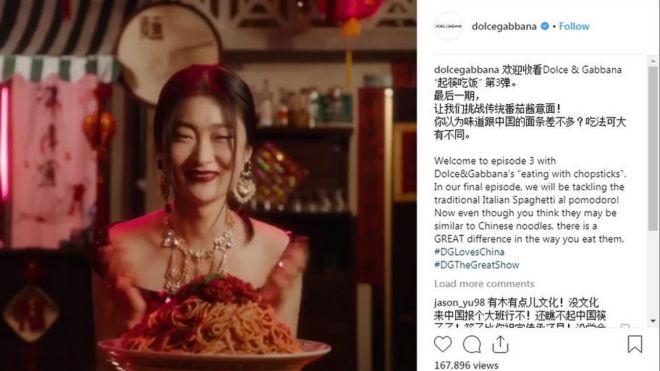
Dolce and Gabbana's #DGLovesChina campaignImage copyrightDOLCE AND GABBANA/INSTAGRAM
Image captionThe ad was supposed to show that ‘#DGLovesChina’

The Chinese model featured in a Dolce & Gabbana ad campaign accused of racism has said the controversy almost ruined her career.

Three videos, released in November, showed Zuo Ye struggling to eat Italian food including cannoli and pizza with chopsticks.

Widely seen as offensive it led to a severe backlash in China with several retailers pulling the brand’s products.

Ms Zuo said she felt “guilty and ashamed” but asked for understanding.

Following her statement on Chinese social media network Weibo, the debate has flared up again with some people saying they hope that she can continue her career as a model and that they understand her hands were tied working with D&G.

‘It nearly killed my career’

In a long post on Monday, Ms Zuo said that usually working for an international brand like D&G would be an exciting career step but that in this case “it nearly killed off my modelling career”.

She explains she understands that “it’s about representing the national image of China and Chinese culture” and that she “therefore feels even more guilty and ashamed”.

She also vowed to “improve my behaviour” in the future.

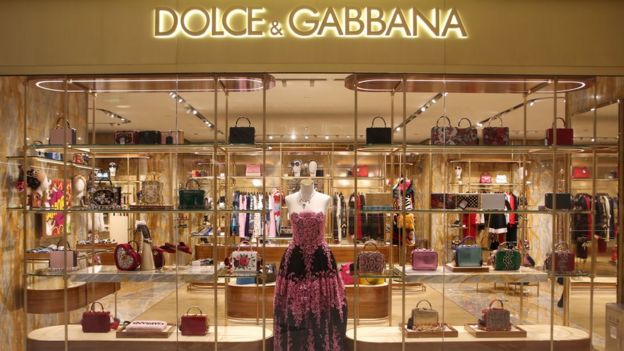
A Dolce & Gabbana store is pictured at Dawanglu on November 22, 2018 in Beijing, ChinaImage copyrightGETTY IMAGES
Image captionConsumers called for a boycott of D&G products in China

According to her statement, she knew the shoot was about trying Italian delicacies but that she felt very awkward when she was asked to eat food like pizza and pasta with chopsticks.

The director told her to show first shock and disbelief, then roll her eyes, and eventually delight and satisfaction at the presumed tastiness of said Italian dishes, she said.

The model explains that she didn’t see the final clip before it was released.

She also writes she didn’t receive any support during the backlash, even when she, her family and agent were all targeted in widespread attacks on social media.

Support and condemnation

Since Ms Zuo’s post, opinion has been divided on Chinese social media.

While some see her as a victim of the Italian brand and sympathise with her experience, others remain critical saying she only had herself to blame.

Others again point out the problem with the powerlessness of models in the industry as a whole where they are often made to do things they might not necessarily want to do.

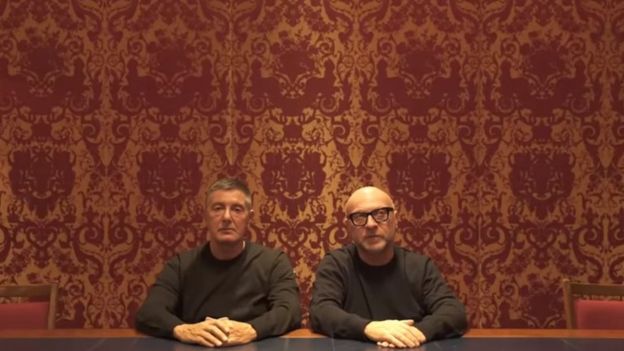
Screengrab of video showing Dolce and Gabbana founders apologising for the campaignImage copyrightDOLCE AND GABBANA
Image captionDomenico Dolce and Stefano Gabbana asked for forgiveness

In November last year, D&G released the videos on social media ahead of a fashion show in Shanghai.

The entire campaign was accused of trivialising Chinese culture and promoting unflattering stereotypes.

“Chinese consumers are not naïve; they will spot insincerity and tokenism a mile off, and respond accordingly,” Dr Julie Bilby of the department of media and communication at RMIT University in Melbourne told the BBC.

The controversy escalated further when screenshots were circulated showing designer Stefano Gabbana allegedly insulting China in an Instagram chat.

D&G insisted the account had been hacked and apologised publicly for the controversial ad campaign.

The Italian luxury company was forced to cancel the fashion show in Shanghai and their products were removed from several Chinese online retailers.

Consumers in China also called for a boycott of the brand.

Source: The BBC

23/01/2019

Israel has enough sense and self interest to avoid efforts to drag it into US-China trade war, analysts say

  • China and Israel mark 27th anniversary of diplomatic ties at a difficult time
  • Relationship could be tested by US efforts to influence Israeli government policy
PUBLISHED : Wednesday, 23 January, 2019, 3:13pm
UPDATED : Wednesday, 23 January, 2019, 4:09pm

Uncertainty over China’s relationship with Israel is growing as the United States puts pressure on its allies to harden their stance on Beijing while trade and geopolitical tensions between the world’s biggest economies get worse.

As China and Israel prepare to mark the 27th anniversary on Thursday of diplomatic ties, analysts from both countries worry that relations, caught in the US-China crossfire, may face more difficult tests.
Like most other countries, Israel wants to maintain good relations with both the US and China and is concerned about an escalating rivalry, Gal Luft, co-director of the Institute for the Analysis of Global Security, a Washington-based think tank, said.

“Sadly, the new atmosphere in US-China relations is putting many countries – Israel included – in an extremely uncomfortable situation in which they are forced to pick sides,” he said.

Luft, a former lieutenant colonel in the Israeli Defence Force, said Israel could become a “sandwich country” like Canada, caught in the middle as Washington continued efforts to build an international coalition against Chinese telecoms giant Huawei

In recent weeks, senior US officials have increased pressure on Israel to reconsider China’s investments in infrastructure and hi-tech sectors there.

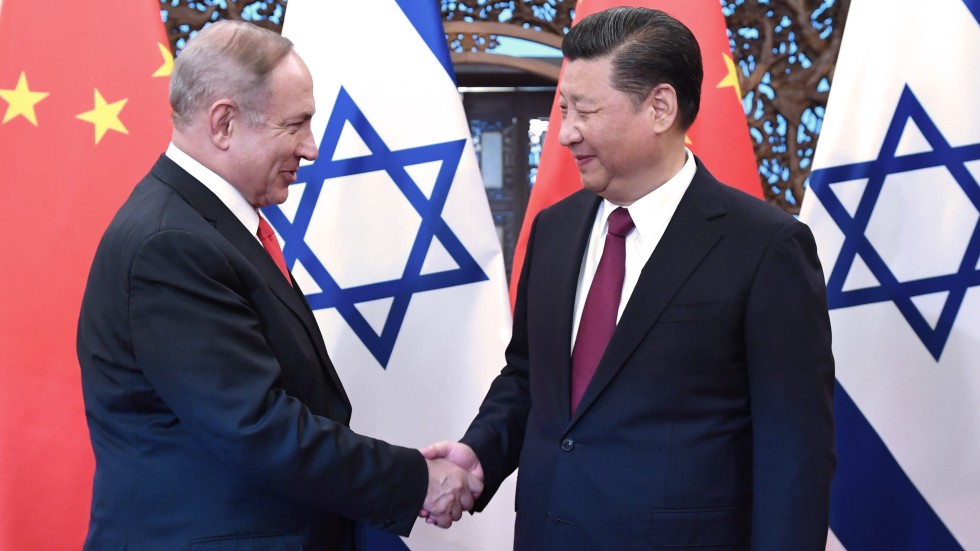
US National Security Adviser John Bolton urged Israeli Prime Minister Benjamin Netanyahu two weeks ago to tread carefully where Chinese telecommunications companies, such as Huawei and ZTE, were concerned because of national security concerns.

Bloomberg reported that US deputy secretary of energy Dan Brouillette issued a warning last week in Tel Aviv that Chinese investment in Israel’s national infrastructure, such as the port of Haifa, could compromise intelligence sharing with the US.

“The US has been abusing the idea of ‘national security,’ slandering and striking down the normal commercial activities of Chinese enterprises,” she said on Monday.

The Sino-Israeli relationship is very different from Beijing’s ties with oil-rich Middle Eastern countries such as Saudi Arabia, Qatar, Iran and Iraq, one analyst said.

Apart from its hi-tech industries, Israel has a significant military and political role in the Middle East. Beijing is seeking to increase its presence in the region as the US plans to withdraw troops from Syria and Afghanistan, Huang Jing, dean of Institute of International and Regional Studies at Beijing Language and Culture University, said.

“Israel may be small in size but is fairly influential in regional geopolitics and its long-standing special ties with Washington in particular make it uniquely important for Beijing”, which sought to steady relations with the US, he said.

Assaf Orion, a retired Israeli brigadier general and a visiting fellow at the Washington Institute for Near East Policy, said China for Israel had great potential as a market, a source of investment, a trade and tourism partner, and an infrastructure powerhouse.

“Israel’s China policy mainly seeks to balance the benefits of their bilateral economic ties on the one hand and its own strategic national security concerns on the other, with the all-but-formal strategic alliance with the US being a paramount national interest for Israel,” he said.

Ties between China and Israel have improved in recent years, especially where trade, investment, education and tourism were concerned.

During a visit to Beijing in 2017, Netanyahu said that China accounted for one-third of the investment in Israel’s hi-tech industries.

Citing a report by the Israel Venture Capital Research Centre, Reuters said Israeli tech start-ups raised US$325 million from Chinese investors in the first three quarters of 2018, up 37 per cent from the same period a year earlier.

During a visit to Jerusalem by China’s Vice President Wang Qishan in October, Netanyahu said that the two countries would complete a free trade agreement this year.

According to a report by Israel’s Institute for National Security Studies in 2017, “China is also involved in building infrastructure in Israel, such as digging the Carmel road tunnels in Haifa, laying a light railway in Tel Aviv, and expanding the Ashdod and Haifa seaports.”

Haifa is Israel’s largest port city and a berth for the US Sixth Fleet. In 2013, the Netanyahu government approved China’s Shanghai International Port Group’s plans to operate the container terminal there for 25 years beginning in 2021.

US has stepped up pressure on Israel to scrap the deal and one of the Sixth Fleet’s warships refused to dock at Haifa in October, citing security concerns that doing so could compromise US and Israeli intelligence assets.

But Luft was critical of Washington’s stance on the Haifa port project as the Chinese company was the only bidder in an open tender.

“The US government is punishing the people of Israel twice” by demanding its ally cancel the deal, Luft said. “First, by denying them competition in the port sector, which would lower their cost of living, and second the government will have to pay a large fine to China if the deal is cancelled. This fine will come at the expense of important public services.”

Despite a boost in diplomatic and trade ties and China’s interest in Israel’s military and security technologies, arms sales and military cooperation between the two countries were limited because of US pressure.

The US moved to block the export of the Phalcon airborne early warning system in 2000 and the Harpy killer drones in 2005 to China.

Orion said that while China’s diplomats often speak about win-win relationships, Israel’s challenge was to seek a win-win-win situation within a triangular relation between the two great powers and a start-up nation state.

“When much of the media discourse is pitching Israel into an exclusive ‘either/or’ choice between the two powers, Israel’s strategic concept should seek ‘precision choice’, promoting its relations with China prudently while minimising risk to itself and avoiding any harm to the US and the strategic relations with it,” he said.

But Luft also voiced concerns that as tension grew between the US and China, Washington tended to expand the definition of “national security” to include broader technology fields like microchips, telecommunication and artificial intelligence.

“This is where I foresee the next set of challenges. Israel will have to determine how far it can stretch the definition of national security and strike the right balance between its commercial needs and its relations with Washington. Israel is a sovereign country. Being a friend and ally of the US does not mean that Israel must be subservient to every whim of Washington,” Luft said.

However, Washington’s pressure campaign seemed to have worked as Israeli officials sought to reassure their American ally over the past week.

Under US pressure, Israel is mulling plans that include legislation to vet foreign investments for the first time, according to Israel’s Haaretz newspaper.

Israeli analysts also expressed dismay over China’s close relations with Iran, Israel’s arch rival in the region, and Beijing’s long-standing pro-Arab and pro-Palestinian policies, saying China often voted against motions that Israel favoured at the United Nations.

“China’s relations with the Arab World are less of a concern in the current regional landscape. However, China’s relations with Iran, which is both obsessed about Israel and committed to its destruction, are more of a worry,” said Orion.

China could do more to dissuade Iran from its aggression against China’s partners in the region: Israel, Saudi Arabia and the United Arab Emirates, he said.

“Keeping the relations good requires constant nurturing, especially at a time the US is trying pull Israel away from China,” Luft added.

Huang also said Beijing must be more careful in dealing with Iran. “The ultimate goal for Beijing should be to avoid advancing Iranian ties at the expense of Sino-Israeli relations,” he said.

He said that despite structural differences between the two countries, Israel had rarely adopted an anti-Chinese stance on issues of importance to Beijing.

“While it remains to be seen how Israel deals with mounting pressure from the US over Huawei and other Chinese telecoms companies and a host of geopolitical issues, I think Israel is shrewd enough to avoid taking sides between the US and China,” Huang said.

Source: SCMP

23/01/2019

Opening of China’s market could serve as future global growth driver: experts

DAVOS, Switzerland, Jan. 22 (Xinhua) — The opening of China’s market is likely to increase the competitiveness of the Chinese economy, which could serve as a future driver of global growth, experts attending the ongoing World Economic Forum (WEF) Annual Meeting said Tuesday.

Attending a penal discussion titled “Rethinking Global Financial Risk,” Fang Xinghai, vice chairman of the China Securities Regulatory Commission, said that the Chinese economy may slow down in 2019 but “it won’t be a collapse.”

“China’s vision for the economy is to make it open, large and competitive. It will be a huge opportunity for all companies,” Fang said, adding that declines in overheated sectors, such as real estate and infrastructure, could provide useful correctives for the market.

Saying that opening up is good for China, Fang emphasized that over the last 40 years China has never had a significant financial crisis.

“How has it managed that? We have a very top-down approach to financial risk management. If risks are accumulating the government will step in. There is a lesson that the rest of the world should look at,” he said.

Jin Keyu, professor of economics of the London School of Economics and Political Science, said only two years ago China was considered as a ticking financial bomb, and the slowdown is the consequence of the government’s successful efforts to deleverage.

“These efforts have made China safer, much of this is the deliberate effort of the government,” she said.

Most of the economic experts predicted economic slowdowns in major global markets, including China and the United States, for 2019, but according to Jin, though growth has become more of an issue, the Chinese government is now shifting its focus to revamping growth.

“China has a lot more scope than most countries in this regard,” she said, adding that China’s main challenge is “how to unleash the real potential of the real economy.”

Ray Dalio, founder of investment management firm Bridgewater Associates, noted that there’s a top-down way of setting a mission, and working those things in a top-down way in China that has produced a 20-fold increase in income.

Chairman of the Swiss bank UBS Axel A. Weber said at the discussion that most of the growth seen globally is “generated by China being included in the world economy.”

“The more we can connect stock markets, the more we can bring international investors into the Chinese economy,” he noted.

Though soft but stable growth characterizes the general outlook for 2019, experts attending the discussion noted that a range of serious risks still exist on the periphery, such as a hard Brexit, climate change, and cybersecurity.

Experts at the discussion also predicted that easing monetary policies and fiscal reforms could offset the slowdown, but with interest rates still at post-financial crisis low points, there are questions about how much room central banks have to manoeuvre.

The 2019 annual meeting of WEF kicked off here Tuesday, bringing together more than 3,000 global leaders from politics, government, civil society, academia, arts and culture as well as the media.

Source: Xinhua

23/01/2019

Xi extends Spring Festival greetings to military veterans

CHINA-BEIJING-XI JINPING-MILITARY VETERANS-SPRING FESTIVAL GREETINGS (CN)

Chinese President Xi Jinping, also general secretary of the Communist Party of China Central Committee and chairman of the Central Military Commission, shakes hands with the retirees during a gala for retired military officials with Beijing-based troops in Beijing, capital of China, on Jan. 22, 2019. Xi extended his Spring Festival greetings to military veterans and retired military officials. (Xinhua/Li Gang)

BEIJING, Jan. 22 (Xinhua) — President Xi Jinping on Tuesday extended his Spring Festival greetings to military veterans and retired military officials.

Xi, also general secretary of the Communist Party of China Central Committee and chairman of the Central Military Commission, watched a gala for retired military officials with Beijing-based troops.

Xi shook hands with the retirees and asked about their health and lives.

Songs and dances about building strong armed forces and the military’s loyalty to the Party were performed.

Senior military officials including Xu Qiliang, Zhang Youxia, Wei Fenghe, Li Zuocheng, Miao Hua and Zhang Shengmin were also present at the show.

Spring Festival, the Chinese Lunar New Year, falls on Feb. 5 this year.

Source: Xinhua

22/01/2019

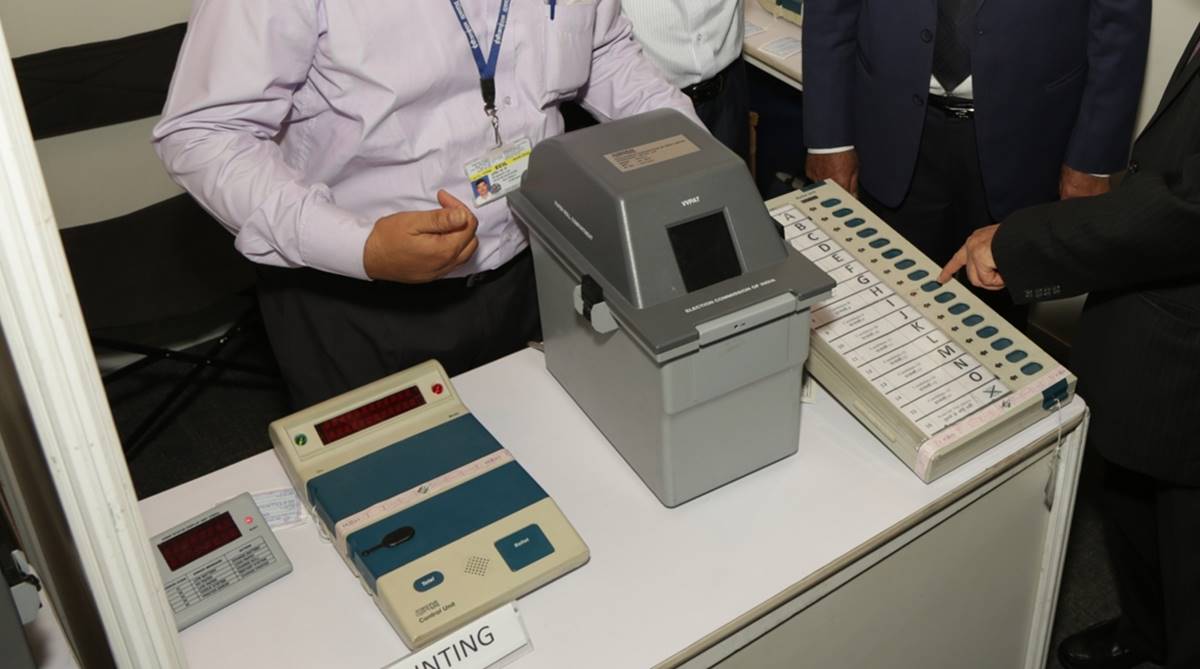
EVM rigging: EC asks Delhi Police to lodge FIR against London hacker Syed Shuja

A senior EC official said on Monday evening, “ECI firmly stands by the empirical facts about foolproof nature of the ECI EVMs deployed in elections in India. Whereas, ECI has been wary of becoming a party to this motivated slugfest, ECI maintains that its EVMs are foolproof.”

SNS Web | New Delhi | 

A day after Syed Shuja, a US-based man arranged an ‘EVM hackathon’ to ‘prove’ that the Electronic Voting Machines (EVMs) can be hacked, the Election Commission of India (ECI) has written to the Delhi Police, requesting it to lodge an FIR and investigate the claims made by Shuja during an event organized in London.

“Through media reports, it has come to the notice of the commission that allegedly one Mr Syed Shuja claimed (at the event in London) that he was part of the EVM design team and he can hack the EVMs used in elections in India,” Election Commission of India wrote to Delhi Police.

Sheyphali Sharan@SpokespersonECI

ECI Firmly Stands by Foolproof Nature of ECI EVMs http://pib.nic.in/PressReleaseIframePage.aspx?PRID=1560825#.XEXRmyz7IrA.twitter 

Sheyphali Sharan@SpokespersonECI

As follow up action, ECI has written to DCP New Delhi District to lodge an FIR & investigate the matter promptly for violation of Dec 505 (1) (b) of PIC@PIB_India @airnewsalerts @DDNewsLive @PIBHindi pic.twitter.com/zEYsRJpguQ

View image on Twitter
See Sheyphali Sharan’s other Tweets

Sheyphali Sharan, the Official Spokesperson, Election Commission of India said in a tweet, “As follow up action, ECI has written to DCP New Delhi District to lodge an FIR & investigate the matter promptly for violation of Dec 505 (1) (b) of PIC.”

Soon after Syed Shuja had made the claims the Election Commission of India (ECI) vehemently denied any possibility of tampering with the EVMs.

Rubbishing his claims, a senior EC official said on Monday evening, “ECI firmly stands by the empirical facts about foolproof nature of the ECI EVMs deployed in elections in India. Whereas, ECI has been wary of becoming a party to this motivated slugfest, ECI maintains that its EVMs are foolproof.”

Addressing a press conference via video conference, Shuja made several explosive allegations regarding EVM tampering during 2014 Lok Sabha Elections.

Source: The Statesman

22/01/2019

U.S. to formally seek extradition of Huawei executive Meng Wanzhou – Globe and Mail

(Reuters) – The United States will proceed with the formal extradition from Canada of Huawei executive Meng Wanzhou, Canada’s ambassador to the United States told the Globe and Mail, as Beijing vowed to respond to Washington’s actions.

The deadline for filing is Jan. 30, or 60 days after Meng was arrested on Dec. 1 in Vancouver.

Meng, the daughter of Huawei Technologies Co Ltd founder Ren Zhengfei, was arrested at the request of the United States over alleged violations of U.S. sanctions on Iran. She was released on bail last month and is due in court in Vancouver on Feb. 6.

Relations between China and Canada turned frosty after the arrest, with China detaining two Canadian citizens and sentencing to death a Canadian man previously found guilty of drug smuggling.

Beijing has not tied any of the three Canadians’ cases to Meng’s arrest, but has warned of severe consequences if she was not immediately released. Western and former Canadian diplomats have said they have no doubt the cases are linked.

Huawei, the world’s biggest maker of telecommunications equipment, said it had no comment on ongoing legal proceedings when contacted by Reuters on Tuesday. A U.S. Justice Department spokesman said: “We will comment through our filings.”

The Canadian Justice Department did not immediately respond to a request for comment outside regular business hours.

China’s Foreign Ministry on Tuesday reiterated calls for Meng’s immediate release and said her case clearly was “not a regular judicial case”.

Anyone with fair judgment would determine that Canada made a “serious mistake” in this matter, ministry spokeswoman Hua Chunying told a regular news briefing.

“Canada and the United States arbitrarily abused their bilateral extradition treaty to seriously infringe upon a Chinese citizen’s security and legal rights,” Hua said.

China “strongly urges” the United States to correct its “mistake”, cancel the arrest order for Meng, and not make a formal extradition request, she added.

Asked if China would retaliate against the United States if Meng is extradited, Hua said, “China will, of course, respond to U.S. actions.” She did not elaborate.

“PAYING THE PRICE”

Canada is one of over 100 countries with which the United States has extradition treaties.

Once a formal request is received, a Canadian court must determine within 30 days if there is sufficient evidence to support extradition, and Canada’s Minister of Justice must give a formal order.

In an article published on Monday, a former Canadian spy chief said Canada should ban Huawei from supplying equipment for next-generation telecoms networks, while Canada’s government is studying any security implications.

Some of Canada’s allies such as the United States and Australia have already imposed restrictions on using Huawei equipment, citing the risk of it being used for espionage.

Huawei has repeatedly said such concerns are unfounded, while China’s ambassador to Canada last week said there would be repercussions if Ottawa blocked Huawei.

In Monday’s interview, MacNaughton said he had complained to the United States that Canada was suffering from Chinese revenge for an arrest made at the U.S.’s request.

“We don’t like that it is our citizens who are being punished,” the Globe and Mail cited MacNaughton as saying. “(The Americans) are the ones seeking to have the full force of American law brought against (Ms. Meng) and yet we are the ones who are paying the price. Our citizens are.”

Canadian Prime Minister Justin Trudeau previously said China was arbitrarily using the death penalty and called on world leaders to raise concerns about the detained Canadians.

Source: Reuters

22/01/2019

Peppa Pig: China falls for an unlikely UK brand ambassador

Undated handout photo supplied by Peppa Pig World of a poster for Peppa Pig celebrating Chinese New YearImage copyrightPA

She’s unlikely to feature on many lists of the all-time top British cultural icons.

But Peppa Pig – the UK-made children’s cartoon character – is right up there with the best of them, at least in China.

With the series racking up 18 billion online views since its launch here seven years ago, the story of Peppa and her unfeasibly English middle class family is, arguably, doing more for Brand Britain than the Beatles, Manchester United and any of the culinary delights – for which the UK is rightly so renowned – put together.

Pork scratching anyone?

It is then no surprise that, when a Peppa-shaped opportunity came knocking, the British powers that be seized the moment.

After watching an episode in which the precocious piglet and her friends visit the Queen in Buckingham Palace – and encourage her to join them jumping in muddy puddles – two Chinese twins posted a video message online, addressed to none other than Her Royal Majesty.

They too, like Peppa, wanted to visit her in her palace, they said.

And it worked.

Well, sort of.

Dame Barbara Woodward, British Ambassador to ChinaImage copyrightBRITISH EMBASSY CHINA
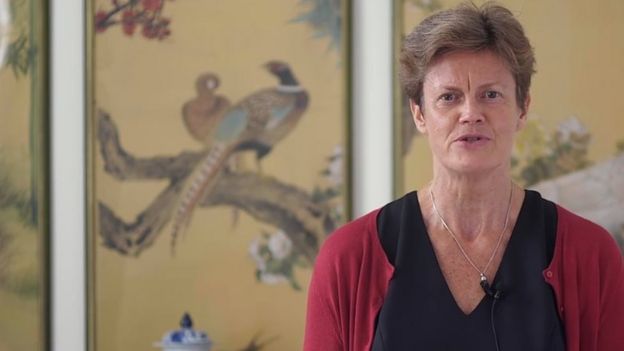
Image captionDame Barbara Woodward, British ambassador to China, invited the twins to her Beijing residence

The British ambassador to China, Dame Barbara Woodward, posted her own video message in reply.

“Hello Mi Ni and Mi Ai,” she said. “I’m the British ambassador, so I’m the Queen’s representative in China.

“I’d like you to come and visit me in my house in Beijing,” she went on, “and we can perhaps have tea and scones in a British style.”

The post has been viewed more than nine million times in China – a multiple of 10 times more views than anything else Dame Barbara has posted in her entire four years as ambassador.

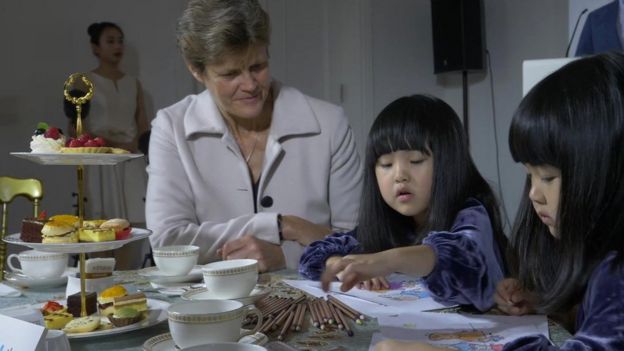
Dame Barbara Woodward, British ambassador to China, with twins Mi Ni and Mi AiImage copyrightHUW EVANS PICTURE AGENCY
Image captionThe twins might travel to the UK next

And so it was that two slightly bewildered five-year-olds found their way to her residence and munched on scones and chocolate cake, and sat colouring in pictures of Peppa Pig, in front of the assembled media.

“Do you think that the Queen really has muddy puddles in her garden?” I asked them.

They nodded. It is a big garden after all.

The whole experience may not have been quite the same as the real deal, but they have also been promised a trip to the UK where they will, at least, get to see Buckingham Palace.

And the British embassy has launched a competition along with Youku – the online channel with the Chinese rights to Peppa Pig – the young winners of which will also join the twins for the trip.

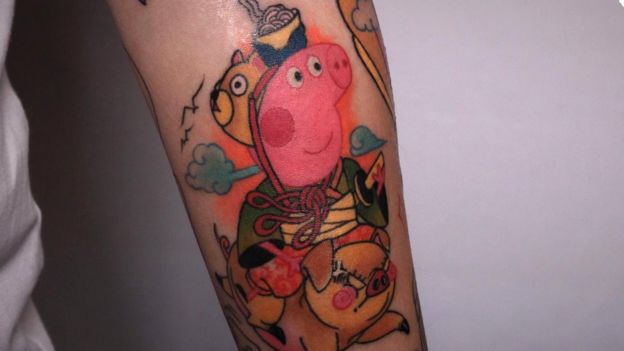
Peppa Pig tattooImage copyrightYUNTIANZHONG TATTOO
Image captionPeppa Pig tattoos have become the symbol of a certain counter-culture in China

The whole Peppa phenomenon, it must be said, has a bit of a dark side in China.

A couple of years ago, pictures began to appear online of people sporting Peppa Pig tattoos.

She appeared to have become the chosen symbol for a counter-culture known as “shehuiren” – literally “society people”.

Early last year, one popular Chinese streaming site, Douyin, began removing Peppa videos en masse.

The nationalist, Communist Party-controlled tabloid Global Times described Shehuiren as people who are “poorly educated with no stable job” and “unruly slackers roaming around and the antithesis of the young generation the party tries to cultivate”.

Soft power

But Peppa has survived this brush with subversion.

A new Peppa Pig movie – made especially for the Chinese market – is due to be launched this coming Chinese New Year.

It is a collaboration between China’s Alibaba Pictures and Canada’s Entertainment One; although still made in the UK, Peppa Pig is now owned by the Canadian company.

The viral trailer for the film – which artfully grafts the story of Peppa onto seasonal themes of Chinese family and belonging – has received more than 300 million hits to date.

With the need for stronger ties with major economies in a post-Brexit world, I asked the UK ambassador whether she thought that a certain pink pig was proving rather more adept at it than British politicians.

“I wouldn’t put it quite as zero sum as that, to be honest,” Dame Barbara laughs in reply.

There are three components to good UK-China ties, she tells me – a strong government-to-government relationship, a strong business-to-business relationship and a strong people-to-people relationship.

“Peppa Pig is as much a part of the latter as the Royal Family, Wimbledon, the Premier League and all the other things we think of when we think of soft power.”

With cute twins, a great British-made product, and massive Chinese media exposure, she must be wishing all UK-China diplomacy could end so happily.

And pigs, as they say, might fly.

22/01/2019

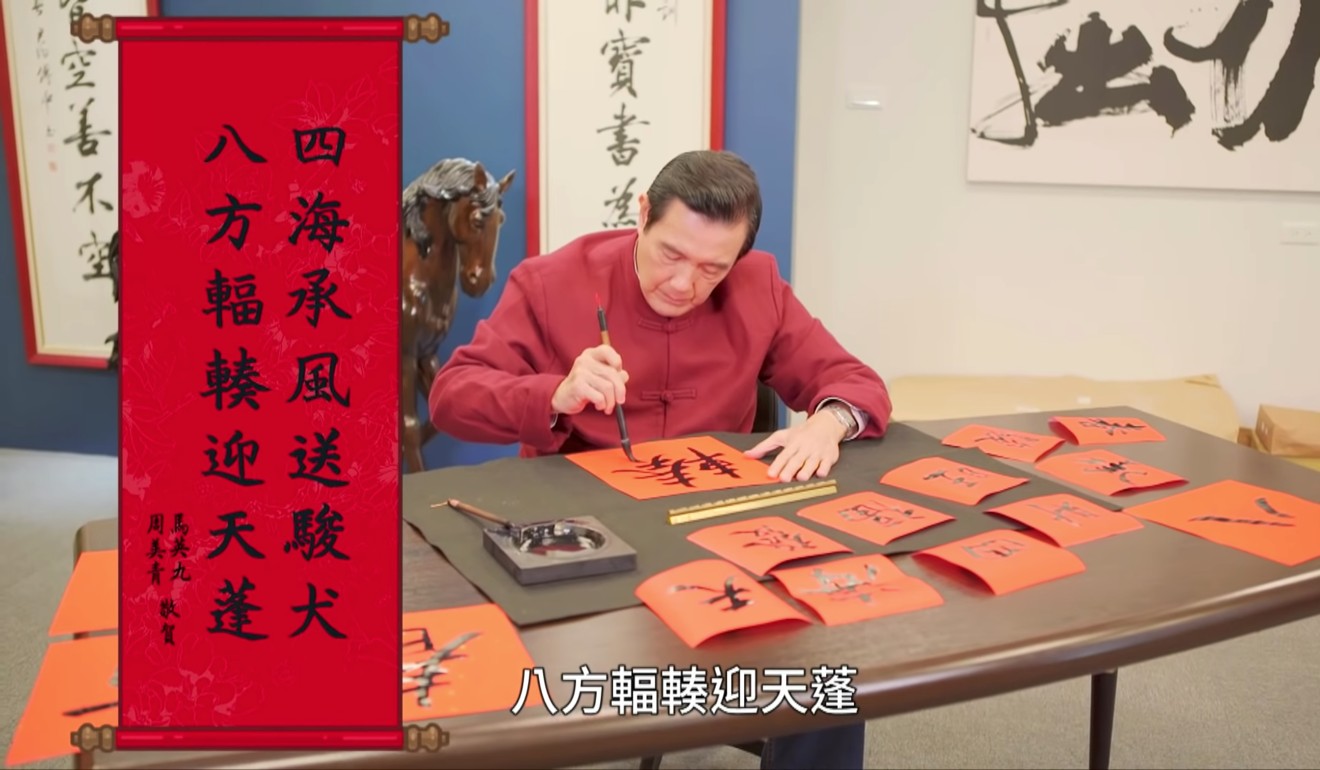
Ma Ying-jeou appears as ‘shopkeeper for a day’ in Taipei bookstore

  • Video clip shows 68-year-old serving customers to ‘earn some money’ for calligraphy brushes and ink to write Lunar New Year couplets for supporters
  • Former Taiwanese president has been trying to rebuild his popularity, but his office says they are unaware of whether he plans to join 2020 election race
PUBLISHED : Tuesday, 22 January, 2019, 7:48pm
UPDATED : Tuesday, 22 January, 2019, 7:58pm

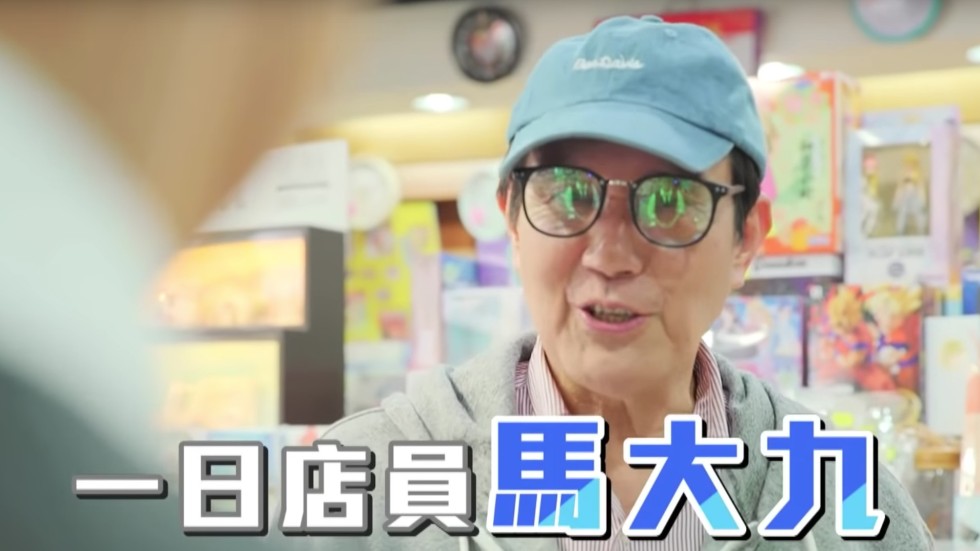
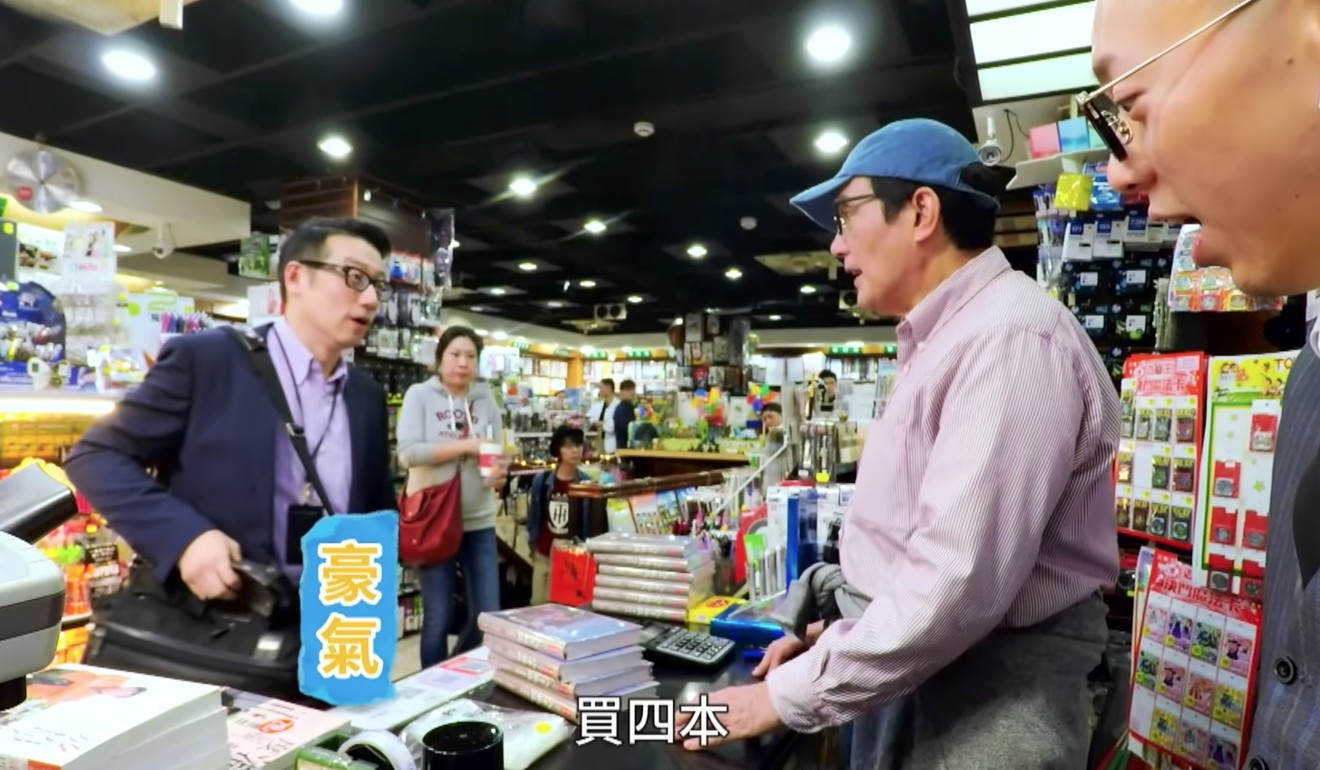
Ma Ying-jeou has been trying to rebuild his popularity, and the latest effort involves a video clip of the former Taiwanese president working as a “shopkeeper for a day” at a bookstore in Taipei.

More than two years after he stepped down from the top job and the helm of the mainland-friendly Kuomintang, the 68-year-old is seen in the video serving customers to “earn some money” so that he can buy calligraphy brushes and ink to write Lunar New Year couplets to give to his supporters.

The video has been viewed more than 110,000 times since Ma’s office posted it on YouTube on Friday.

But the Harvard Law School graduate is not a natural for retail work, judging from the footage. Dressed casually and wearing a face mask to hide his identity, when a customer asks to use JKo Pay – the local version of Apple Pay – Ma appears to have never heard of it.

Still, it is a chance to try to sell some copies of his book. But he fails to drum up any interest in his memoir until he removes the face mask, to the delight of some of the women customers at least.

According to his office, the video aims to show another side to Ma who, in his younger days, was known for his movie star looks and squeaky clean image.

“We want to let the public know that the ex-president is actually an easy-going person, the man next door type,” an official from the office said.

But he would not be drawn on whether the video had anything to do with Ma potentially joining the 2020 presidential election race.

“This kind of question has been around for some time, you’ll have to ask the former president because we have no idea at all,” the official said.

In a recent radio interview, Ma also deflected questions about a possible comeback, saying he had been asked about his intentions numerous times since he launched a political foundation in July and released his memoir in December. “They are much too imaginative,” he said.

Yet efforts on social media such as the “shopkeeper” video are clearly aimed at promoting his image and winning support.

On the self-ruled island, politicians such as Taipei mayor Ko Wen-je, a former doctor with no political affiliation, has had the most success amassing fans on platforms such as YouTube and Facebook.

Kaohsiung mayor Han Kuo-yu, of the KMT, also used social media to help his campaign in the November local government elections.

Lin Ching-hung, an author and commentator, said social media campaigns were a valid way to win public support.

“To improve public understanding of serious topics or to create a laid-back image, there’s nothing wrong with politicians trying to turn around their image or do something lighthearted online – like Ma acting as a shopkeeper for a day, or President Tsai Ing-wen going to Ximending [in Taipei] to eat and shop, or former New Taipei mayor Eric Chu making a pig gesture on Facebook,” Lin said.

But he added that gaining popularity online was not the same as doing a good job in government, and voters knew that.

Ma’s popularity has risen sharply in the past year or so, in contrast with his time as president – especially during the last few years of his second term, which ended in 2016.

When he was first elected in 2008, Ma’s approval rating was at 68 per cent. But his government’s mishandling of the economy and issues such as a devastating typhoon that killed nearly 700 people in 2009, as well as the Sunflower movement – which saw hundreds of students storming the legislature in 2014 – made him highly unpopular.

Law of Unintended Consequences

continuously updated blog about China & India

ChiaHou's Book Reviews

continuously updated blog about China & India

What's wrong with the world; and its economy

continuously updated blog about China & India