Archive for ‘Uncategorized’

02/01/2019

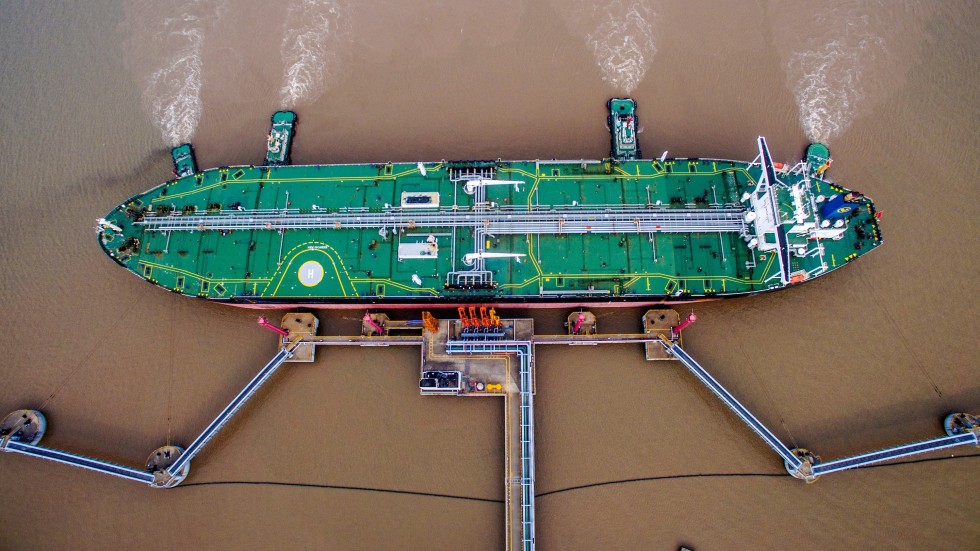
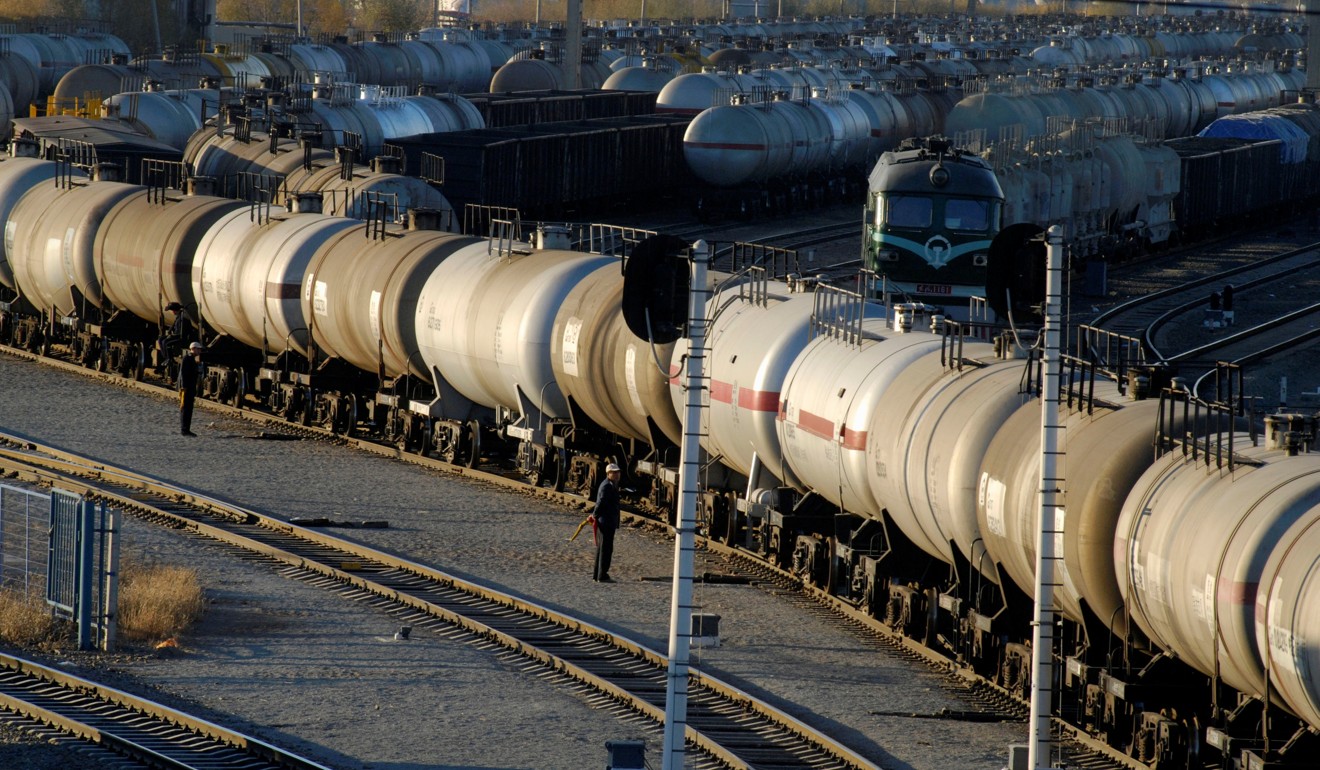
China cuts quotas for crude oil imports in first round of allowances for 2019

  • They total 89.84 million tonnes, down from 121.32 million tonnes a year ago – a move that may signal slowing demand growth in the first half
PUBLISHED : Wednesday, 02 January, 2019, 6:12pm
UPDATED : Wednesday, 02 January, 2019, 6:12pm

China issued its first batch of crude oil import quotas for 2019 on Wednesday at a lower volume than for the same batch a year ago, though expectations are for the volumes to climb later this year.

The Ministry of Commerce granted quotas totalling 89.84 million tonnes to 58 companies in its first allowances for 2019, according to four sources with direct knowledge of the matter and documents reviewed by Reuters on Wednesday.

This is down from the 121.32 million tonnes issued in the first batch of allowances for 2018, although the sources said Beijing may increase the overall volume for 2019 in a second batch of quotas later this year.

It comes as Beijing seeks to end a bruising trade war with Washington and reduce the risk of a sharper economic slowdown in 2019.

The trade frictions are already disrupting global supply chains, fuelling concerns of a bigger blow next year to world trade, investment and financial markets.

Official data released this week showed China’s factory activity contracted in December for the first time in over two years, signalling a continued loss of momentum in the Chinese economy.

The official Purchasing Managers’ Index (PMI) – the first snapshot of China’s economy each month – fell to 49.4 in December, below the 50-point level that separates growth from contraction, according to data from the National Bureau of Statistics on Monday.

It was the first contraction since July 2016 and the weakest reading since February 2016. Analysts had forecast it would dip to 49.9 from 50.0 the previous month.

Lower import quotas may signal slowing crude demand growth for the first half of the year in China, the world’s largest oil importer and second-largest oil consumer.

“The market, in general, does not have an upbeat outlook for imports. I think the drop in quota could likely mean easing growth in China’s crude imports in the first half,” said Zhou Guoxia, a crude oil analyst with consultancy JLC.

Private refiners, also known as teapots, received quotas for 70.65 million tonnes of imports, more than 20 per cent lower than the first batch of quotas issued last year, according to the documents and Reuters data.

This volume should be able to cover 10 months of their requirements, Zhou said.

One of the four sources, who works for a private Chinese refiner, said they received about a third of its annual quota in the first batch and expects to get the remainder in a second batch, which Beijing usually issues around September.

But the start-up of new refineries in China in 2019 is expected to raise crude imports to a record, adding 630,000 barrels per day of new demand, 7 per cent higher than last year, according to Beijing-based consultancy SIA Energy.

Dalian Hengli Petrochemical and Zhejiang Petrochemical, which are starting up new refineries in 2019, have each received quotas of 4 million tonnes, according to the documents reviewed by Reuters.

Dragon Aromatics, a petrochemical producer based in Fujian province, has also received import quota of 600,000 tonnes as it resumes operations at its condensate splitter, the sources said.

02/01/2019

Xi highlights breakthroughs in cross-Strait relations over 70 years

BEIJING, Jan. 2 (Xinhua) — President Xi Jinping highlighted the breakthrough progress made in the cross-Strait relations since 1949, at a gathering on Wednesday to commemorate the 40th anniversary of Chinese mainland’s Message to Compatriots in Taiwan.

Over the 70 years, estrangement between the mainland and Taiwan was ended in line with the common will of compatriots across the Strait, and Taiwan compatriots have made great contributions to the reform and opening-up in the mainland, said Xi, who is also general secretary of the Communist Party of China (CPC) Central Committee and chairman of the Central Military Commission.

During the seven decades, the mainland and Taiwan reached the 1992 Consensus based on the one-China principle, and the political exchanges across the Strait have reached new heights, Xi said.

Over the 70 years, the basic principles of “peaceful reunification” and “one country, two systems” were established, and the basic policy of upholding “one country, two systems” and advancing the national reunification was laid out, according to Xi.

He continued that more and more countries and peoples have understood and supported the cause of the reunification of China over the 70 years.

Furthermore, over the 70 years, a series of major victories in the battles against “Taiwan independence” and separatists have been achieved, Xi said.

01/01/2019

Sabarimala temple: Indian women form ‘620km human chain’ for equality

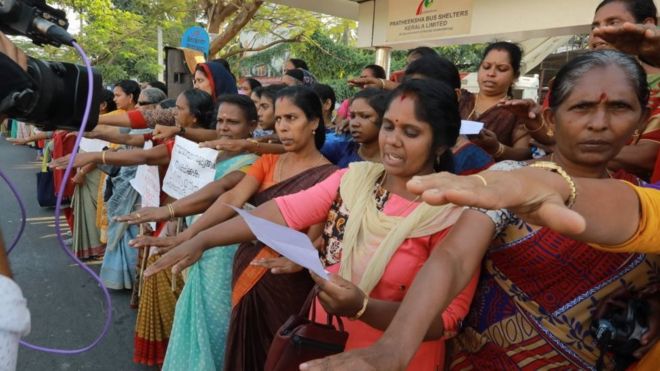
Women's wall in KeralaImage copyrightCV LENIN
Image captionThe demonstration was a response to protests that prevented women from entering a Hindu temple

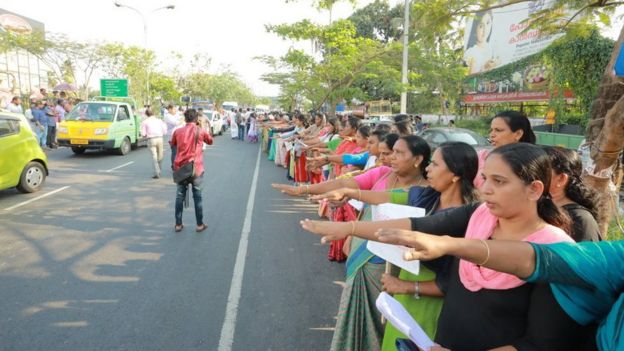
Women in the southern Indian state of Kerala have formed a 620km (385-mile) human chain “in support of gender equality”, amid a row over access to a prominent Hindu temple.

The Sabarimala shrine was historically closed to women of “menstruating age” – defined as between 10 and 50.

India’s top court overturned the ban in September, but protesters have since attacked female visitors.

The “women’s wall” was organised by the state’s left-wing coalition government.

Officials told BBC Hindi’s Imran Qureshi that around five million women from various parts of Kerala had gathered across all national highways to form the chain, which stretched from the northern tip of Kasaragod to the southern end in Thiruvanthapuram.

Organisers had predicted a turnout of around three million.

Officials said the short demonstration was to combat inequality and counter the efforts of right-wing groups that support the ban on women.

One young demonstrator, Kavita Das, told BBC Hindi: “This is a great way of saying how powerful women are, and how we can empower ourselves and help each other. Of course, I support the move to allow women of all ages into the temple. I don’t think tradition or any kind of backwardness should stop women. Those who want to pray must have the right to pray.”

Another woman, Tanuja Bhattadri, observed: “Sabarimala is not the main issue here today. I believe men and women are equal.”

Why is the ban so political?

The Supreme Court decision to let women worship at the Sabarimala shrine came after a petition argued that the custom banning them violated gender equality.

But India’s ruling party, the Hindu nationalist Bharatiya Janata Party (BJP), has argued that the ruling is an attack on Hindu values.

The issue has become increasingly contentious in the run-up to India’s general election, scheduled for April and May. Critics have accused Prime Minister Narendra Modi of pursuing a religiously divisive agenda to court the BJP’s mostly-Hindu support base.

Hinduism regards menstruating women as unclean and bars them from participating in religious rituals – but most temples allow women to enter as long as they are not menstruating, rather than banning women in a broad age group from entering at all.

Women's wall in KeralaImage copyrightCV LENIN
Image captionOfficials said millions of women formed a human chain stretching across the state

‘The temple god is a bachelor’

Protesters have also argued that the court ruling goes against the wishes of the temple’s deity, Lord Ayappa.

They say that the ban on women entering Sabarimala is not about menstruation alone – it is also in keeping with the wish of the deity, who is believed to have laid down clear rules about the pilgrimage to seek his blessings.

According to the temple’s mythology, Lord Ayyappa is an avowed bachelor who has taken an oath of celibacy – and hence the ban.

Very few women have tried to enter the temple amid massive protests in the state, and many who tried have been forced to turn back.

Two women managed to reach the main temple premises in October, with more than 100 police protecting them from stone-throwing protesters as they walked the last 5km stretch to the shrine. They were ultimately forced to turn round after a stand-off with devotees, just metres from Sabarimala’s sanctum.

01/01/2019

India ruling party confident of doing well in general election – Modi

(Reuters) – India’s ruling Bharatiya Janata Party (BJP) is confident of doing well at this year’s general election despite the party’s recent losses in state polls, Prime Minister Narendra Modi said in an interview with Reuters partner ANI on Tuesday.

“No reason for morale down. We are confident and are moving ahead. In 2019, if there is one party which the country trusts and is connected with the people, it is the BJP,” Modi said.

India’s ruling party lost power in three key states in December, handing Modi his biggest defeat since he took office in 2014 and boosting the Congress party opposition and its allies ahead of national polls due by May.

Modi said it was more important to focus on his government’s achievements, including the introduction in September of a new healthcare scheme for the poor.

“In such big numbers people suffering, today they have got treatment, how can I consider this a failure. It is my biggest achievement,” Modi said.

He said party has been discussing what it lacked at the state elections but winning or losing was not the only yardstick. The Hindu nationalist BJP was willing to work with regional parties in the run-up to the general election, he said.

“Our effort is to take everyone along, and listen to everyone. I am committed to give importance to regional aspirations. The country cannot be run by ignoring regional aspirations.”

FARMER RELIEF

Modi said farm loan waivers should be “definitely done” if it helps but that was not a long-term solution to the problem of farmer distress.

“What is lacking in our system, that farmer becomes debt-ridden and the governments have to repeat vicious cycle of elections and loan waivers. So solution is to empower the farmers. From seed to market, give all facilities to the farmers,” he said.

Farmers’ anger about low crop prices and their sense that the government has done far too little to address them contributed to the state election defeats.

The government is now considering three options for a relief package to help farmers suffering because of low crop prices at a cost of as much as 3 trillion rupees ($43.20 billion), three government sources told Reuters last week.

PATEL RESIGNATION

Former Reserve Bank of India governor Urjit Patel had personally written to Prime Minister Narendra Modi about wanting to resign, citing personal reasons, several months before stepping down from the office in December, Modi said.

“The governor himself requested (to resign) because of personal reasons. I am revealing for the first time, he was telling me about this for the past 6-7 months before his resignation. He gave it even in writing. He wrote to me personally”.

Patel resigned after a months-long tussle over policy with the government that raised concerns about the bank’s independence as the next general election nears.

When asked if there was any political pressure on the governor to resign, Modi denied that was the case.

“No such question arises. I acknowledge that Patel did a good job as RBI Governor.”

01/01/2019

China’s military priorities for 2019: boost training and prepare for war

  • PLA’s official newspaper outlines ‘work focus’ in New Year’s Day editorial, saying ‘at no time should we allow any slack in these areas’
PUBLISHED : Tuesday, 01 January, 2019, 10:36pm
UPDATED : Tuesday, 01 January, 2019, 11:40pm

Strengthening training and preparation for war are among the top priorities for China’s military in 2019, its official newspaper said on Tuesday.

“Drilling soldiers and war preparations are the fundamental jobs and work focus of our military, and at no time should we allow any slack in these areas,” the PLA Daily said in its New Year’s Day editorial.

“We should be well prepared for all directions of military struggle and comprehensively improve troops’ combat response in emergencies … to ensure we can meet the challenge and win when there is a situation.”

Other priorities outlined in the editorial included thorough planning and implementation to develop the military, fostering reform and innovation, and party building within the People’s Liberation Army (PLA).

President Xi Jinping, who also heads the military, has been pushing the PLA to boost its combat readiness since he took the top job in late 2012. Observers said stepping up drills could be about flexing the PLA’s military muscle, but spelling it out at the start of the year also suggested it was a more important part of the plan for 2019.

“During the 20 years I spent in the PLA before I left in 2004, military training to boost combat readiness was always one of our top tasks,” said Zeng Zhiping, a retired lieutenant colonel and military analyst based in Nanchang, Jiangxi province.

“But this is something different. When training and preparation for war is highlighted at the beginning of a year it means this is a plan for the whole year, although we don’t know what the real intention behind the rhetoric is at this stage.”

Taiwan’s former deputy defence minister Lin Chong-Pin said it was about showing the PLA’s military strength.

“Prioritising military training and preparation for war is nothing more than a move to boost its diplomatic strength, which the PLA has been emphasising over the past four decades – though it has never gone into battle with any other country during that time,” Lin said.

“This comes at a time when the US has increased pressure on China with a series of military operations. But listen, I’m 100 per cent sure that the PLA will not be waging any war, no matter whether it’s in the South China Sea or the Taiwan Strait. It will only become more cautious when it starts rising more rapidly.”

Meanwhile, at least 38 senior colonels were promoted to the rank of major general in late December, according to local media and Chinese military watchers.

Lin said they were carefully selected by the president himself. “These new major generals were definitely hand-picked by Xi – he intends to build his own army, or the so-called Xi force,” Lin said.

Of those promoted to major general, nine were from the PLA’s ground forces, four were from the air force, three were from the rocket force and 22 from the People’s Armed Police Force.

The military has undergone major upheaval and reform during the past six years, with dozens of generals brought down amid an unprecedented anti-corruption campaign.

They include top generals Guo Boxiong and Xu Caihou, both former Central Military Commission vice-chairmen, Fang Fenghui, who was the PLA chief of staff, and Zhang Yang, former head of the PLA’s General Political Department.

01/01/2019

Japan-China ties to usher in new era in 2019: Japanese PM

TOKYO, Jan. 1 (Xinhua) — Japan will ushering in a new era in its ties with China in the new year among others, Japanese Prime Minister Shinzo Abe said in his New Year speech on Tuesday.

“Japan will draw the global spotlight as we will welcome top world leaders” in the Group of 20 Summit in in June, Abe said.

The prime minister promised to deal with Japan’s low birthrate and aging population, with a free public pre-school education program set to take effect in October for all children aged between three and five.

01/01/2019

Xi congratulates Cuban leaders on 60th anniversary of revolution victory

BEIJING, Jan. 1 (Xinhua) — Chinese President Xi Jinping on Tuesday warmly congratulated Raul Castro, first secretary of the Central Committee of the Communist Party of Cuba, and Miguel Diaz-Canel, president of the Council of State and the Council of Ministers of Cuba, on the 60th anniversary of Cuba’s revolution victory on behalf of the Communist Party of China (CPC) and the Chinese government and people.

In his congratulatory message to Raul Castro, Xi, who is also general secretary of the CPC Central Committee, said under the strong leadership of the Communist Party of Cuba over the past 60 years, the Cuban government and people have made great achievements with hard work in the cause of socialist construction, which are highly appreciated and congratulated by the CPC and the Chinese government and people.

The relations between the two parties and two countries have stood the test of international vicissitudes and achieved fruitful results, making the two sides good friends, good comrades and good brothers, Xi noted.

Xi said he attaches great importance to the development of the China-Cuba friendship and is willing to work together with Raul Castro to lead bilateral relations to keep marching forward.

In his congratulatory message to Diaz-Canel, Xi said that the Communist Party of Cuba and its people are endeavoring to update and improve the nation’s socialist system, which will guarantee new developments in Cuba’s socialist cause.

Xi mentioned Diaz-Canel’s historic visit to China around a month ago, during which the two leaders proposed a blueprint for bilateral ties in the new era, adding that he is willing to join hands with Diaz-Canel for continuous development of China-Cuba relations.

Chinese Premier Li Keqiang also sent a congratulatory message to Diaz-Canel on Tuesday, saying Cuba has enjoyed flourishing national developments and will usher in a brighter future.

The two countries have always understood and supported each other, pushing bilateral relations for an all-round and in-depth development, said the premier.

Li also voiced hope that with the joint efforts from both sides, their traditional friendship will continue to bear fruits.

01/01/2019

Commentary: 40 years on, cooperation still set to define China-U.S. ties

CHINA-U.S.-DIPLOMATIC RELATIONS-40 YEARS

File photo taken on April 15, 1971 shows Chinese table tennis player Yang Ruihua (L) shaking hands with U.S. athlete Dick Miles prior to a friendship match, who had met each other since the 1959 World Table Tennis Championships, in Shanghai, east China. Exactly 40 years ago, Beijing and Washington officially established diplomatic relations, thus ending nearly three decades of isolation, hostility and even confrontation between two big countries with a combined population of over 1 billion, and resetting the course of history and international politics. Just like the “Ping-Pong Diplomacy” that marked a thaw in China-U.S. relations, the establishment of diplomatic ties was another wise and resolute decision made by then Chinese and American leaders with great political courage and far-reaching vision. In the past four decades, their successors have followed their footsteps, guiding the China-U.S. relationship through all complexities and difficulties to maintain a generally steady and smooth development. (Xinhua/Fang Guocai)

by Xinhua writers Zhou Xiaozheng, Xu Feng

BEIJING, Jan. 1 (Xinhua) — Exactly 40 years ago, Beijing and Washington officially established diplomatic relations, thus ending nearly three decades of isolation, hostility and even confrontation between two big countries with a combined population of over 1 billion, and resetting the course of history and international politics.

Just like the “Ping-Pong Diplomacy” that marked a thaw in China-U.S. relations, the establishment of diplomatic ties was another wise and resolute decision made by then Chinese and American leaders with great political courage and far-reaching vision. In the past four decades, their successors have followed their footsteps, guiding the China-U.S. relationship through all complexities and difficulties to maintain a generally steady and smooth development.

“There are a thousand reasons to make the China-U.S. relationship work, and no reason to break it,” Chinese President Xi Jinping said while meeting with his U.S. counterpart, Donald Trump, for the first time, at the Mar-a-Lago estate in the U.S. state of Florida in 2017. Indeed, the China-U.S. relationship is regarded by many as the world’s most important bilateral relationship.

The progress of China-U.S. ties in the past 40 years is nothing but staggering, far exceeding most people’s expectations. Bilateral trade grew from a negligible 2.5 billion U.S. dollars in the late 1970s to over 580 billion dollars in 2017, while the stock of two-way investment rose from practically nil to more than 230 billion dollars.

Even more amazing are the fast-paced changes in people-to-people relations. The Chinese, who once regarded having “overseas relations,” especially families or friends in the United States, as a political and social taboo, are now fervently sending their children — some 200,000 to 300,000 a year — to study in the United States. The Americans have also seen off the so-called “Red Scare” and started to embrace Chinese kung fu, giant pandas and even the learning of the Chinese language as their understanding of the once “mysterious Communist state” deepens.

The Pacific Ocean, which used to serve as a “natural moat” blocking direct transportation between the two countries, is now overflown by more than 300 two-way direct flights each week that carry a total of over 5 million visitors each year.

The 40th anniversary of China-U.S. diplomatic ties comes on the heels of the 40th anniversary of China’s reform and opening-up. The tremendous economic success and social progress China has scored over the past 40 years result primarily from the diligence, creativity and dedication of the Chinese people, but also benefit from the support and assistance from the rest of the world, including the United States.

In return, the rapidly developing China has never stopped merging with the wider world and playing its role as a responsible member of the international community. When the global financial crisis broke out in 2008, China, upholding an all-in-the-same-boat spirit, took swift action and joined the others in a concerted effort to contain the crisis and help bring the hard-hit U.S. and world economy back on track.

Forty years on, cooperation, which might just be one of the many options for China and the United States on Day One of their mended relationship, has turned out to be the best and only correct option. China-U.S. collaboration has not only created immense development opportunities and brought substantial benefits for both countries and both peoples, but also helped reshape the world order, accelerate globalization and improve global governance, thus serving as a major driving force of global peace and prosperity.

Without doubt, the past four decades have not been a smooth ride for China-U.S. relations. Even their economic and trade relations, now reputed as the “ballast stone for bilateral ties,” have experienced twists and turns, from the tough “textile and apparel quota restrictions” and tedious annual reviews of the “Most Favored Nation” status, to the prolonged talks on China’s entry into the World Trade Organization, as well as the ongoing economic and trade frictions. It also seems to be a topic for endless debate in the United States whether China should be seen as a “partner” or a “threat,” and whether the United States should adopt a strategy of “engagement” or “containment.”

As two major countries with different social systems, development paths and historical and cultural backgrounds, it is natural for China and the United States to have disagreements and encounter problems. But such disagreements and problems did not prevent the two countries from normalizing bilateral relations 40 years ago, nor should they be allowed to derail the sound development of bilateral ties today.

Both being great nations with great peoples, China and the United States need not be afraid of any fair, rational and healthy competition, but must be smart enough to avoid a zero-sum game, which harbors a high risk of dragging both nations back into a lose-lose situation of conflicts and confrontation.

At a time when the world is undergoing unprecedentedly profound changes and is fraught with risks and uncertainties, the global community expects even closer collaboration between the two largest economies, so as to help reinforce mankind’s response to numerous common challenges, such as climate change, terrorism, nuclear proliferation, and transnational crimes.

Forty years on, the China-U.S. relationship is once again at a critical point, leaving many on tenterhooks or in a state of speculation. Should the past 40 years be any guide, increasing understanding and win-win cooperation will overcome difficulties and challenges, and cooperation should and will remain at the core of bilateral ties in the long run.

It is all the more comforting and encouraging that both Xi and Trump, in their exchange of congratulatory messages upon the anniversary as well as on multiple other occasions of top-level interaction, vowed to push for more cooperation and further progress of China-U.S. ties.

History has proved that cooperation is the best choice for both sides, Xi said in the message, while Trump said it is his priority to promote cooperative and constructive U.S.-China relations.

From Mar-a-Lago to Beijing and Buenos Aires, meetings and direct communication between the two heads of state, featuring good personal chemistry and rapport at work, have played an irreplaceable role in navigating bilateral ties through uncharted waters. The world has high hopes for them to succeed.

01/01/2019

The Indian woman who makes ‘fake food’ for a living

You can look at it and you can even touch it – but you definitely can’t eat it!

Shilpa Mitha’s creations of classic Indian dishes made with clay went viral on Instagram, prompting her to quit her job and pursue her hobby of making food miniatures.

You can look at it and you can even touch it – but you definitely can’t eat it!

Shilpa Mitha’s creations of classic Indian dishes made with clay went viral on Instagram, prompting her to quit her job and pursue her hobby of making food miniatures.

01/01/2019

As temperatures fall, air quality worsens in Indian capital

NEW DELHI (Reuters) – Pollution levels spiked last week in New Delhi, India’s teeming capital of more than 20 million people, climbing to nearly 12 times the recommended level and exacerbating a public health crisis.

Senior government officials said the main reasons for the surge in the amount of toxic smog trapped over New Delhi were unusually cold air, including fog, and slow wind speeds.

Click here for an interactive Reuters graphic tmsnrt.rs/2GORiU9 on the link between Delhi’s pollution and falling temperatures and wind speeds.

The World Health Organization said this year India was home to the world’s 14 most polluted cities. New Delhi was ranked the sixth most polluted.

In the city on Sunday, levels of PM 2.5, the amount of tiny particulate matter under 2.5 micrograms found in every cubic meter of air, were at 415, well above “hazardous” levels, as defined by the U.S. Environmental Protection Agency. The agency says any level above 35 can be unhealthy.

Pollution levels were exacerbated because of fumes from vehicles, pollutants from coal-fired power plants and industries, as well as smoke from fires being burned to keep people warm.

In October and November, crop residue burning in the neighboring states of Haryana and Punjab also contributed to air pollution.

In India, air pollution claimed 1.24 million lives in 2017, or 12.5 percent of total deaths, according to a study published in Lancet Planetary Health this month.

Law of Unintended Consequences

continuously updated blog about China & India

ChiaHou's Book Reviews

continuously updated blog about China & India

What's wrong with the world; and its economy

continuously updated blog about China & India