20/05/2020
- US chip giant GlobalFoundries confirms it has ceased operations at its only Chinese facility, with industry experts saying the poorly-planned project was doomed to fail
- Closure deals blow to China’s plans to move up semiconductor value chain, amid increasingly hostile tech rivalry with the United States
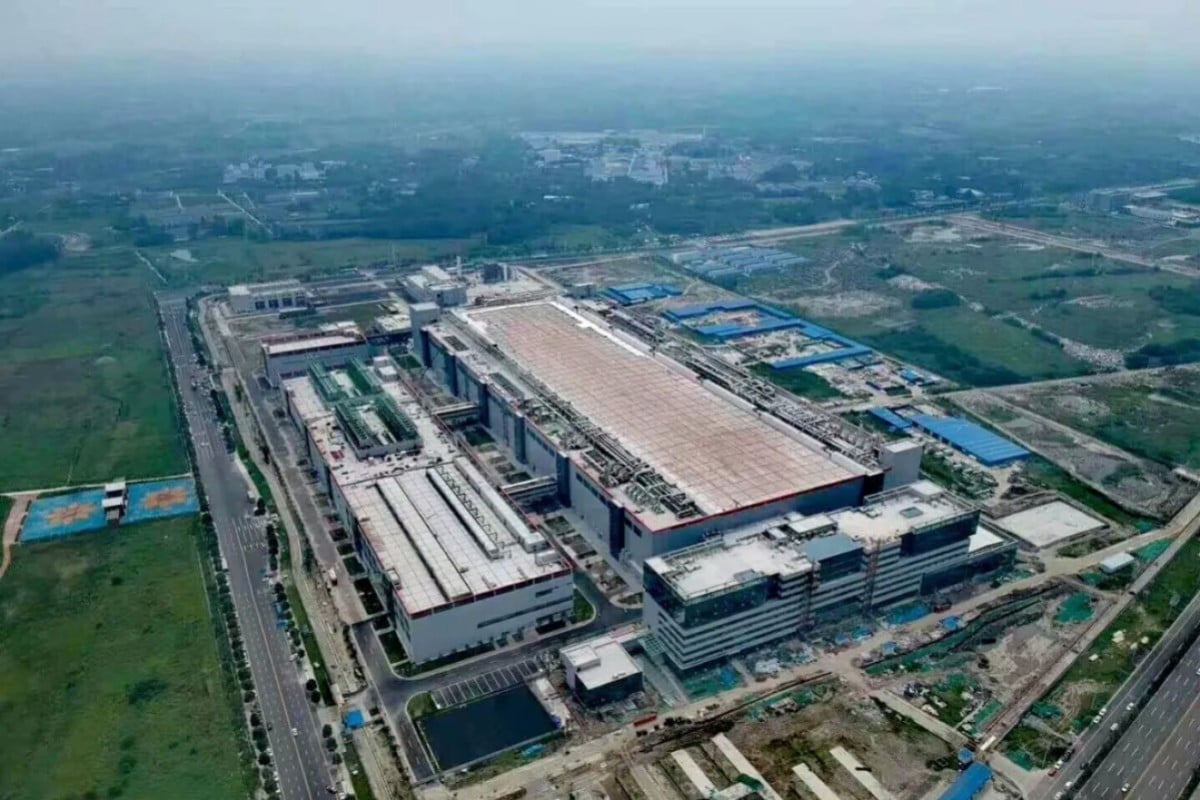
Beijing boasted that the final total investment in the GlobalFoundries plant could be US$10 billion. The plant was intended to produce 300mm wafers, a key material in making chips, but production never started at the 65,000 square metre facility, which was completed mid-2018. Photo: Weibo
US chip giant GlobalFoundries has halted operations at a joint venture factory in China, the company has confirmed, dealing a potential blow to China’s bid to own a bigger slice of the global semiconductor market.
The closure of the firm’s only China facility comes just three years after it announced plans to make chips in the mainland, and comes amid an escalating tech war with the United States.
The winding down, however, has little to do with the fierce superpower rivalry. It comes after two years of speculation as to what was actually happening at the US$100 million facility, which was hailed as “a miracle” by local media when announced to fanfare in 2017, but which never got off the ground.
Nonetheless, the symbolism is rich.
China is struggling in its efforts to boost its domestic chip research and production in a bid to counter US efforts to block it from American technology.
Last week, the US Department of Commerce upped the ante by
banning the sale
of Huawei-designed chips produced outside America if they are made using the US software and technology, adding further pressure to the Chinese telecom giant’s global supply chain.
The GlobalFoundries factory, in a hi-tech park in the southwestern city of Chengdu, was one of China’s major foreign-invested semiconductor projects, for which the local government rolled out the red carpet three years ago.
At the time, Chengdu boasted that the final total investment in the plant could be US$10 billion. The plant was intended to produce 300mm wafers, a key material in making chips, but production never started at the 65,000 square metre facility, which was completed mid-2018.
A spokesperson for California-based GlobalFoundries confirmed that the Chengdu plant had stopped operations and that it had offered staff an “employee optimisation plan”, a commonly-used euphemism for lay-offs.
“The plan is being carried out on the basis of open and transparent communications with the employees and they have been offered various options to choose from based on their personal situations,” a company statement read.
A 2018 annual report from the joint venture, in which GlobalFoundries had a stake of 51 per cent with the rest controlled by an investment vehicle of the Chengdu government, showed that the plant had 320 employees.
A company notice sent to employees dated May 14 and seen by the Post said that after mid-June, the company would only pay 70 per cent of Chengdu’s minimum monthly wage, about 1,246 yuan (US$175.38), while negotiating severance packages with staff.
For some industry analysts who have followed the Chengdu project from its inception, its demise has less to do with the trade war, more to do with poor planning.
There was little detailed research and planning before the project was launched. As far as the Chengdu government is concerned, it lacks a sufficient understanding of GlobalFoundriesGu Wenjun, analyst
“There was little detailed research and planning before the project was launched. As far as the Chengdu government is concerned, it lacks a sufficient understanding of GlobalFoundries, its decision-making mechanism and economic strengths, and it did not get strong support from the central government,” said Gu Wenjun, chief analyst at Shanghai-based semiconductor research firm ICwise.
The idea of establishing a joint venture was first pitched to
Chongqing municipality, a neighbouring city of Chengdu, in 2016. Chongqing signed a memorandum of understanding with GlobalFoundries to set up a plant to manufacture 300mm silicon wafers – components for making integrated circuits – using technology from GlobalFoundries’ Singapore factory.
After the deal to open a Chongqing plant fell through for unclear reasons, Chengdu moved in to cut a deal with GlobalFoundries in late-2016. A 2017 blueprint stated that 3,500 employees could be working at the site, according to Wallace Pai, then GlobalFoundries’ general manager for China.
But production never started. Initially the project was supposed to have two phases: using mainstream technologies to manufacture 300mm wafers from 2018, then transferring to more advanced technologies in late-2019.
However, in October 2018, the two partners decided to “bypass” the phase one manufacturing stage, partly because of China’s increasing demand for more advanced products and GlobalFoundries’ own financial stress. The project has since stalled.
Comparing official announcements from the Chengdu government and GlobalFroundries back in 2017, Gu from ICwise said the two had different focuses, which might explain the plant’s derailment. The government clearly wanted to bring in mainstream, lower-risk technologies to boost the city’s brand, while the company aimed for Chinese capital and government support to invest in more advanced technology, Gu said.
The joint venture will continue after the factory’s demise, with GlobalFoundries still expecting to expand sales in the Chinese market, the company said in its statement. It now has five factories, three in the US and one each in Singapore and Germany.
When The Post contacted the office of the joint venture partner within the Chengdu government, the person answering the phone said they did not know anything about the closure nor future plans, before hanging up without giving their name.
“Our focus in China is on developing and growing our partner ecosystem including creating local technology infrastructure and bringing more intellectual property vendors and electronic design automation partners to better serve the local market,” the company said.
According to the China Semiconductor Industry Association, China’s integrated circuits sales rose 15.8 per cent in 2019 from a year earlier to 756.2 billion yuan (US$106.44 billion), while sales in the global semiconductor market dropped by 12 per cent to US$412 billion.
Last week, Dutch company ASML Holding, a key supplier of chip-making equipment, set up a plant in Wuxi, in Jiangsu province, in a boost to China’s efforts to attract foreign semiconductor investment.
Source: SCMP
Posted in advanced technologies, American, ASML Holding, ‘a miracle’, Beijing’s, blow, Chengdu, China, China Semiconductor Industry Association, chip, Chongqing Municipality, Dutch, euphemism, Factory, foreign, Germany, global, GlobalFoundries, hailed, hostile, Huawei-designed chips, Investment, jiangsu province, lay-offs, mainstream, manufacture, plans, production, semiconductor, semiconductor giant, semiconductor market, shuts, Singapore, symbolism, tech rivalry, technologies, Technology, transferring, Uncategorized, United States, US chip giant, US Department of Commerce, value chain,, Wuxi |
Leave a Comment »
04/06/2019
- IEEE’s ban has ignited a backlash from its Chinese members, resulting in calls to boycott the organisation
Staff at Huawei Technologies have been banned by the Institute of Electrical and Electronics Engineers from taking part in the peer review of research papers, including serving as editors for journals, after the Chinese telecommunications equipment maker was added to a US trade blacklist. Photo: AP
The US government’s efforts to reduce the influence of Huawei Technologies, the world’s largest telecommunications equipment supplier, has extended beyond business to cover scientific research.
That development emerged as the New York-based Institute of Electrical and Electronics Engineers (IEEE) moved to ban Huawei employees from the peer review of research papers, including serving as editors for its journals, after the Chinese hi-tech champion was added to a US trade blacklist.
The decision by IEEE, the world’s biggest technical professional organisation, was leaked online across Chinese social media on Wednesday, igniting a backlash from some of the country’s leading scientists who described the move as “anti-science” and “violating academic freedom”.
Zhang Haixia, a professor with the Institute of Microelectronics at Peking University, announced on her WeChat account on Wednesday that she was quitting IEEE because the decision to comply with the trade blacklist went “far beyond the basic line of science and technology” and challenged her professional integrity.
US is waging a tech war against this district in Shenzhen
“As a professor, I do not accept this,” Zhang wrote online in a public letter addressed to IEEE president-elect Toshio Fukuda.
Her resignation letter was viewed more than 40,000 times since it was posted online. The most popular comments on its thread included calls for Chinese scientists to boycott IEEE.
In a statement on May 30, the IEEE said it must comply with its legal obligations under the laws of the US and other jurisdictions and that compliance with regulations “protects the IEEE, our volunteers, and our members”.
It said Huawei employees are only barred from the peer reviewing process and that they can continue to participate in individual membership, corporate membership, enjoy voting rights and take part in a variety of other activities, including the submission of technical papers for publication.
Huawei said it had no comment about the peer review ban.
The issue between Huawei and IEEE has come amid a raging tech war between the world’s two biggest economies, which recently escalated when the US government placed Huawei and its affiliates under the US Entity List on May 16. That bars the Chinese group from buying hardware, software and services from American hi-tech suppliers without US approval.
A succession of major American technology companies, from Google and Microsoft to Intel and Qualcomm, have suspended their dealings with Huawei to comply with the US trade ban.
Growing disquiet in China as US steps up war on tech champions
US President Donald Trump has also signed an executive order barring US companies from using telecoms equipment made by companies that pose a threat to national security.
The trade blacklist, which is maintained by the Bureau of Industry and Security under the US Department of Commerce, identifies organisations and individuals believed to be involved, or pose a significant risk of becoming involved, in activities contrary to America’s national security or foreign policy interests.
A non-profit organisation founded in January 1963, IEEE had more than 422,000 members in more than 160 countries as of December 31 last year. More than 50 per cent of its members, who are rooted in electrical and computer sciences, engineering and related disciplines, are from outside the US.
Technology is true target of US attack on China, says diplomat
It also publishes around 200 transactions, journals and magazines, and sponsors more than 1,900 conferences in 103 countries.
There is no official data on how many IEEE members are based in mainland China. Public information online, however, showed that at least 80 Huawei employees are members of the organisation.
China’s biggest chip maker to delist from NYSE as US targets tech
In a statement released on May 16, IEEE said that as a corporation organised in New York, it must comply with its legal obligation under US laws. It said the US government’s export restriction covers not only physical goods and software but also technical information.
In the leaked IEEE email, the organisation warned its members of “severe legal implications” if they continue to use Huawei staff as reviewers or editors for the peer review process of its journals.
“IEEE is registered in the US, but we should suggest experts at all levels of IEEE to move its headquarters to places such as Switzerland,” said Zhou Zhihua, a leading computer science professor at Nanjing University and an IEEE fellow, in a post on microblogging site Sina Weibo. “More importantly, let’s show more support to China-produced English-language journals.”
Source: SCMP
Posted in backlash, boycott, Bureau of Industry and Security, Chinese members, Google, Huawei, IEEE, IEEE fellow, ignited, Institute of Electrical and Electronics Engineers (IEEE), Institute of Microelectronics, Intel, largest technical professional society, Microsoft, Nanjing University, organisation, peer review, Peking University, Qualcomm Inc, research, Sina Weibo, Switzerland, Toshio Fukuda, trade blacklist, Uncategorized, US Department of Commerce, US President Donald Trump, WeChat |
Leave a Comment »




 CHINDIA ALERT: You'll be living in their world, very soon